COMMUNICATION

Presented to Dr. Ali Mohammad
Presented by group B

Organizational communication
Contents








Definition of communication
Effective
and
process
of
communication
Theories of communication
Types of communication
Organizational communication
Barriers to communication
Current issues to communication
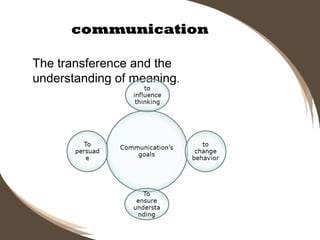
communication
The transference and the
understanding of meaning.
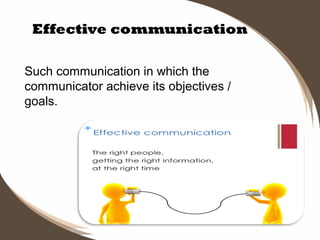
Effective communication
Such communication in which the
communicator achieve its objectives /
goals.
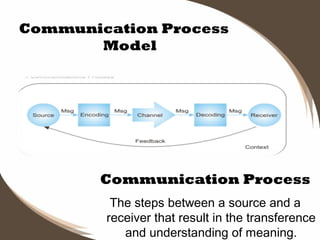
Communication Process
Model

Communication Process
The steps between a source and a
receiver that result in the transference
and understanding of meaning.
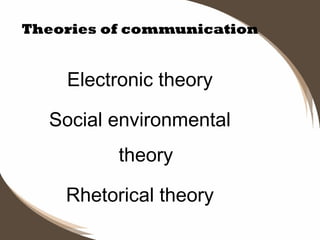
Theories of communication

Electronic theory
Social environmental
theory
Rhetorical theory
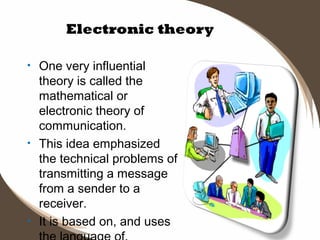
Electronic theory
•

•

•

One very influential
theory is called the
mathematical or
electronic theory of
communication.
This idea emphasized
the technical problems of
transmitting a message
from a sender to a
receiver.
It is based on, and uses
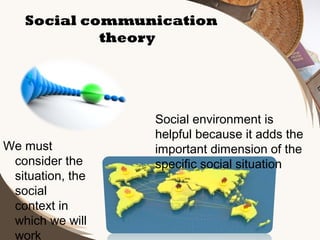
Social communication
theory

We must
consider the
situation, the
social
context in
which we will
work

Social environment is
helpful because it adds the
important dimension of the
specific social situation
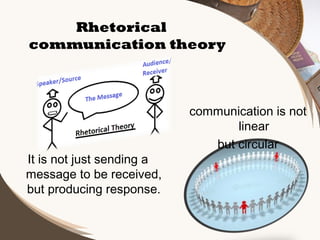
Rhetorical
communication theory

It is not just sending a
message to be received,
but producing response.

communication is not
linear
but circular
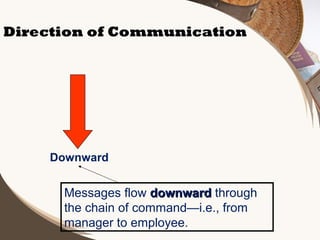
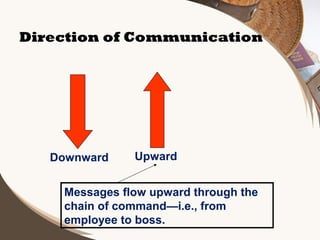
Direction of Communication

Downward

Messages flow downward through
the chain of command—i.e., from
manager to employee.
Direction of Communication

Downward

Upward

Messages flow upward through the
chain of command—i.e., from
employee to boss.
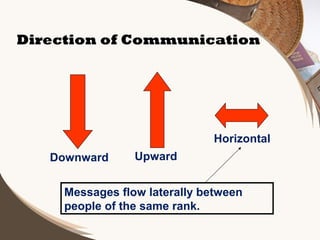
Direction of Communication

Horizontal
Downward

Upward

Messages flow laterally between
people of the same rank.
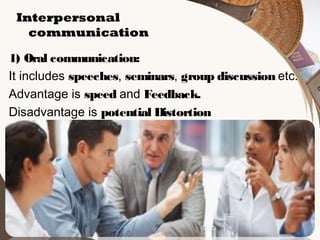
Interpersonal
communication
1) Oral communication:
It includes speeches, seminars, group discussion etc.
Advantage is speed and Feedback.
Disadvantage is potential Distortion
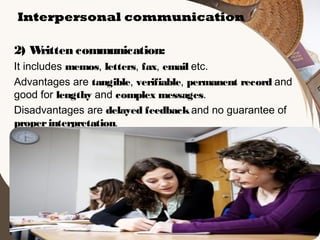
Interpersonal communication
2) W
ritten communication:
It includes memos, letters, fax, email etc.
Advantages are tangible, verifiable, permanent record and
good for lengthy and complex messages.
Disadvantages are delayed feedback and no guarantee of
proper interpretation.
Interpersonal
communication
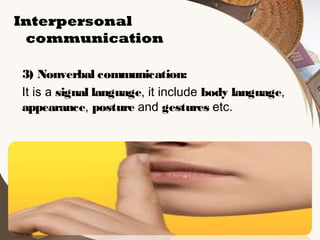
3) Nonverbal communication:
It is a signal language, it include body language,
appearance, posture and gestures etc.
Organizational
Communication
•

Our
1.
2.
3.

The transference and the
understanding of meaning within
and outside the organization is
called organizational
communication.

focus here will be on
Formal small-group networks
The grapevine
Computer-aided communication
Formal Small-Group
Networks
Can be very complicated
•

they can for instance include
hundreds of people or more

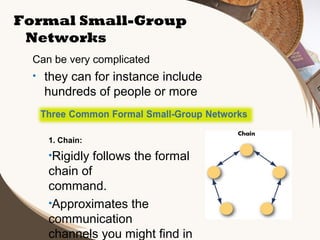
1. Chain:

•Rigidly

follows the formal

chain of
command.
•Approximates the
communication
channels you might find in
Three Common Formal SmallGroup Networks
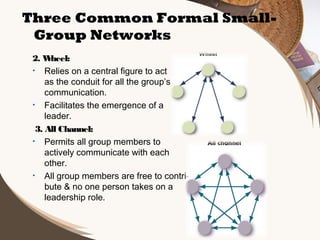
2. W
heel:
• Relies on a central figure to act
as the conduit for all the group’s
communication.
• Facilitates the emergence of a
leader.
3. All Channel:
• Permits all group members to
actively communicate with each
other.
• All group members are free to contribute & no one person takes on a
leadership role.
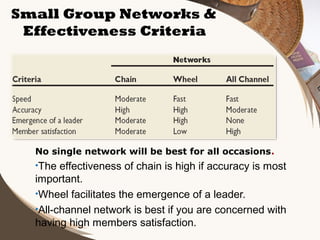
Small Group Networks &
Effectiveness Criteria

No single network will be best for all occasions.
•The

effectiveness of chain is high if accuracy is most
important.
•Wheel facilitates the emergence of a leader.
•All-channel network is best if you are concerned with
having high members satisfaction.
The Grapevine


Grapevine Characteristics

Informal, not controlled by
management.
• Perceived by most employees as being
more believable and reliable than
formal communications.
• Largely used to serve the self-interests
of those who use it.
Results from:
• Desire for information about important
situations
• Ambiguous conditions
•
Computer-Aided
Communication
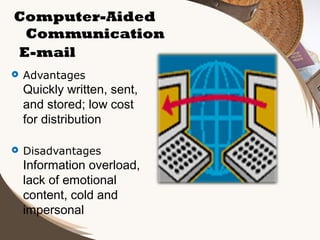
E-mail


Advantages

Quickly written, sent,
and stored; low cost
for distribution


Disadvantages

Information overload,
lack of emotional
content, cold and
impersonal
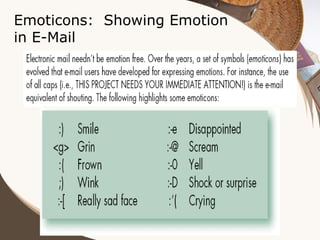
Emoticons: Showing Emotion
in E-Mail
Computer-Aided
Communication (cont’d)


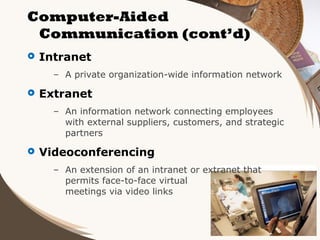
Intranet
– A private organization-wide information network



Extranet
– An information network connecting employees
with external suppliers, customers, and strategic
partners



Videoconferencing
– An extension of an intranet or extranet that
permits face-to-face virtual
meetings via video links
COMMUNICATION BARRIER
• Filtering
• Selective perceptive
• Emotion
• Information Over load
• Semantic barrier
• Cultural barrier
• Socio Psychological Barrier
• Physical Barrier
• Mental Barrier
• Mechanical Barrier
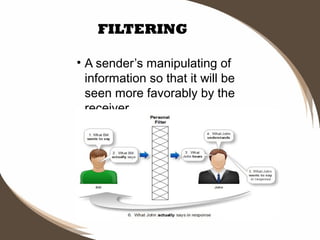
FILTERING
• A sender’s manipulating of
information so that it will be
seen more favorably by the
receiver.
SELECTIVE PERCEPTION
• People selectively interpret
what they see on the basis of
their interest, background,
experience and attitude.
EMOTIONS
• How the receiver feels at the
time of receipt of a
communication will influence
how the message is
interpret.
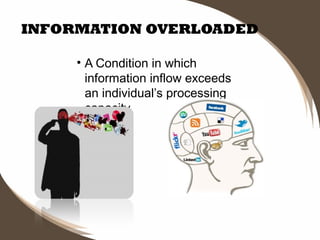
INFORMATION OVERLOADED
• A Condition in which
information inflow exceeds
an individual’s processing
capacity.
SOCIO PSYCHOLOGICAL
BARRIER
• Problem that arise out of an
individual’ understanding,
interpretation and response
to communication due to
socially learnt attributes and
due to personal attributes.
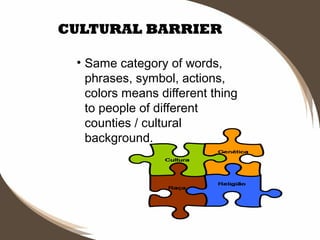
CULTURAL BARRIER
• Same category of words,
phrases, symbol, actions,
colors means different thing
to people of different
counties / cultural
background.
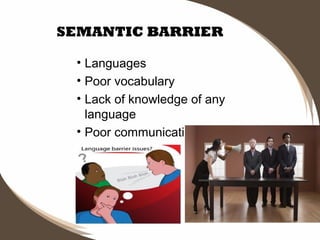
SEMANTIC BARRIER
• Languages
• Poor vocabulary
• Lack of knowledge of any
language
• Poor communication skills
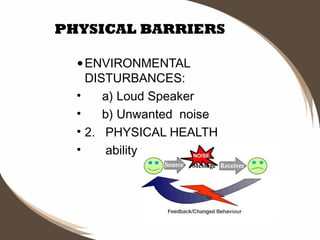
PHYSICAL BARRIERS
•ENVIRONMENTAL
DISTURBANCES:
•
a) Loud Speaker
•
b) Unwanted noise
• 2. PHYSICAL HEALTH
•
ability to receive
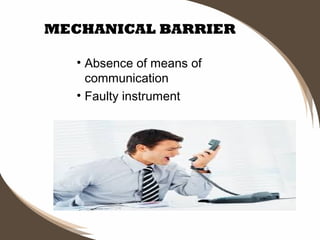
MECHANICAL BARRIER
• Absence of means of
communication
• Faulty instrument
GUIDE LINES FOR
OVERCOMING BARRIERS
• using feedback techniques (e.g.
use questions to clarify
understanding)
• using repetition - repeat the same
message in different ways that
suit the learner. Draw it. Speak it.
Write it
• being positive (i.e. use positive
language/words)
• selecting an appropriate location
(i.e. eliminate distractions and
protect privacy)
• using active listening skills.
Continued ……
• Use of Simple Language: Use of
simple and clear words should be
emphasized. Use of ambiguous
words and jargons should be
avoided.
• Listen attentively and carefully.  
• He/she should not show their
emotions while communication as
the receiver might misinterpret the
message being delivered
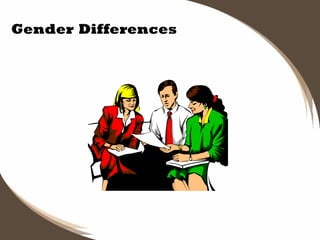
Gender Differences
Communication Barriers
between Men & Women:
•
•
•
•

Difference in style of conversation.
Both have different mind set,
priorities and principles.
Ways of dealing with the same
situation are very different.
A research shows that Men use to
talk to emphasize status whereas
women use it to create connection
Cultural Differences
Cross Cultural
Communication
•
•
•
•
•

Barriers caused by differences
among perception.
Barriers caused by tone difference.
Barriers caused by semantics.
Same word mean different things to
different people.
Barriers caused by word
connotations. Words imply different
things in different languages.
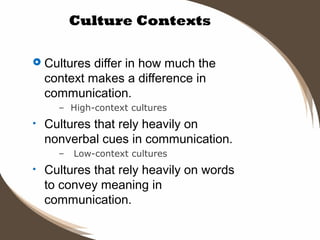
Culture Contexts
 Cultures

differ in how much the
context makes a difference in
communication.
– High-context cultures

•

Cultures that rely heavily on
nonverbal cues in communication.
–

•

Low-context cultures

Cultures that rely heavily on words
to convey meaning in
communication.
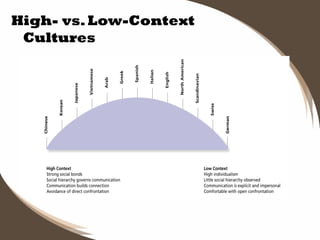
High- vs. Low-Context
Cultures
Politically Correct
Communication
How

do you describe a person who
is ‘wheelchair bound’ (as
handicapped or physically
challenged)
Similarly, a blind or visually impaired,
Elderly or senior,
We must be sensitive of others
feelings.
Should choose politically correct
word.
Words might have the same
Silence as Communication
•
•

Defined as an absence of speech or noise
Not necessarily inaction—can convey:
– Thinking to a question
– Anxiety about speaking
– Agreement or anger
• Individuals should be aware of what silence
might mean in any communication.

Page 45

Atta assignment