COMMUNICATION
COMMUNICATION
the act of transmitting information, ideas from one person to another. Its takes
place among individuals, belonging to various categories and backgrounds &
creates the flow of information between or with in multiple organisation.
CHANNEL OF COMMUNICATION
The path through which information flows from sender to receiver is known as
the channel of communication.
• According to Organizational Structure
Formal & Informal communication
• According to Expression
Oral & written communication
• According to Direction
Downward, Upward & Horizontal communication
TYPES OF COMMUNICATION
• VERBAL & NON VERBAL COMMUNICATION
• WRITTEN COMMUNICATION
• MASS COMMUNICATION
• VISUAL COMMUNICATION
• GROUP COMMUNICATION
• MASS COMMUNICATION
• FEEDBACK COMMUNICATION
According to Organizational
Structure
Formal Communication.
• called formal communications.
• a formal organisation structure and
which are to be sent through the
formal or officially recognised channels
• Like Generally, orders, instructions,
decisions, of the superior officer, etc.
are communicated through this
channel.
Informal Communication.
• known as 'grapevine' communications.
• formal channels of communication are
not used.
• very often, a person can obtain
information which would take a few
days for him to receive through the
officially recognised organisational
channel. Informal communication may
be conveyed by a
• Example: gesture, nod, smile etc.
According to Expression
Oral or Verbal Communication. In the case of oral or
verbal communication, communication is made direct
face to face or through telephone or intercom system.
Oral communication has some merits. They are:
(a) It saves time and money.
(b) On-the-spot clarification of any doubt is possible.
(c) Because of personal touch between the
communicator and listener, communication is more
effective.
(d) While communicating, important points can be
emphasised by the communicator.
Some of the disadvantages of oral communication are:
(a) There is no permanent record of communication
passing through this device.
(b) Oral communication is not suitable for a subject that
has to be kept as a record.
(c) There is greater possibility of communication being
misunderstood or misinterpreted, if the communicator
is poor in vocal expression.
(d) It is suitable only for communications which are not
lengthy.
Written Communication. Written communications include
statements, circulars, letters, reports, memos, manuals
etc. Some of the advantages of written communication
are:
(a) Written communications can be kept as a permanent
record and it can be referred to by the management
whenever it wants.
(b) This method is suitable for communications which are
lengthy.
(c) As communication is in writing, there is a lesser chance
of missing any points in the communication.
(d) This method is suitable for passing of messages to far-
off places.
Written communication, however, suffers from certain
limitations are:
(a) Generally, written communications are more time-
consuming,
(b) If the communication is not clearly worded, it may lead
to confusion and interpretation.
(c) There is no face-to-face discussion between the parties.
Hence, doubts of the receiver of the message may not be
clarified.
(d) Maintaining of secrecy is difficult in this type of
communication.
According to Direction
• Downward Communication. In the case of downward communication, the
communication flows from the superiors to the subordinates. Communications
sent through this channel are generally directives requiring actions to be initiated
by the subordinates. These communications include orders, policy directives,
instructions, etc.
• Upward Communication. In the case of upward communication, communication
flows from the subordinates to the superiors. It includes reports, suggestions,
reactions of workers, proposals, etc. Upward communication enables the
management to evaluate the effectiveness with which its orders have been
carried out and also to know the grievances or suggestions of the subordinates.
• Horizontal or Lateral Communication. It means communication among the
subordinates who are working at the same level of organisation. For example,
communication among foremen or superintendents, or functional managers or
supervisors is horizontal communication.
• Diagonal Communication. It means communication between people who are
neither in the same department nor at the same level of organisational hierarchy.
In this type, communication cuts across departmental lines
BARRIERS TO EFFECTIVE
COMMUNICATION
• The factors which obstruct the effectiveness of communication is known as
Communication Barriers. These barriers cause a mismatch between
understanding of the message by the sender and the receiver. These barriers can
occur at any stage of the communication process.
• Classification of Barriers to Communication
• The barriers to communication can be broadly classified as:
Semantic Barriers
Psychological Barriers
Organizational Barriers
Personal Barriers
Semantic Barriers
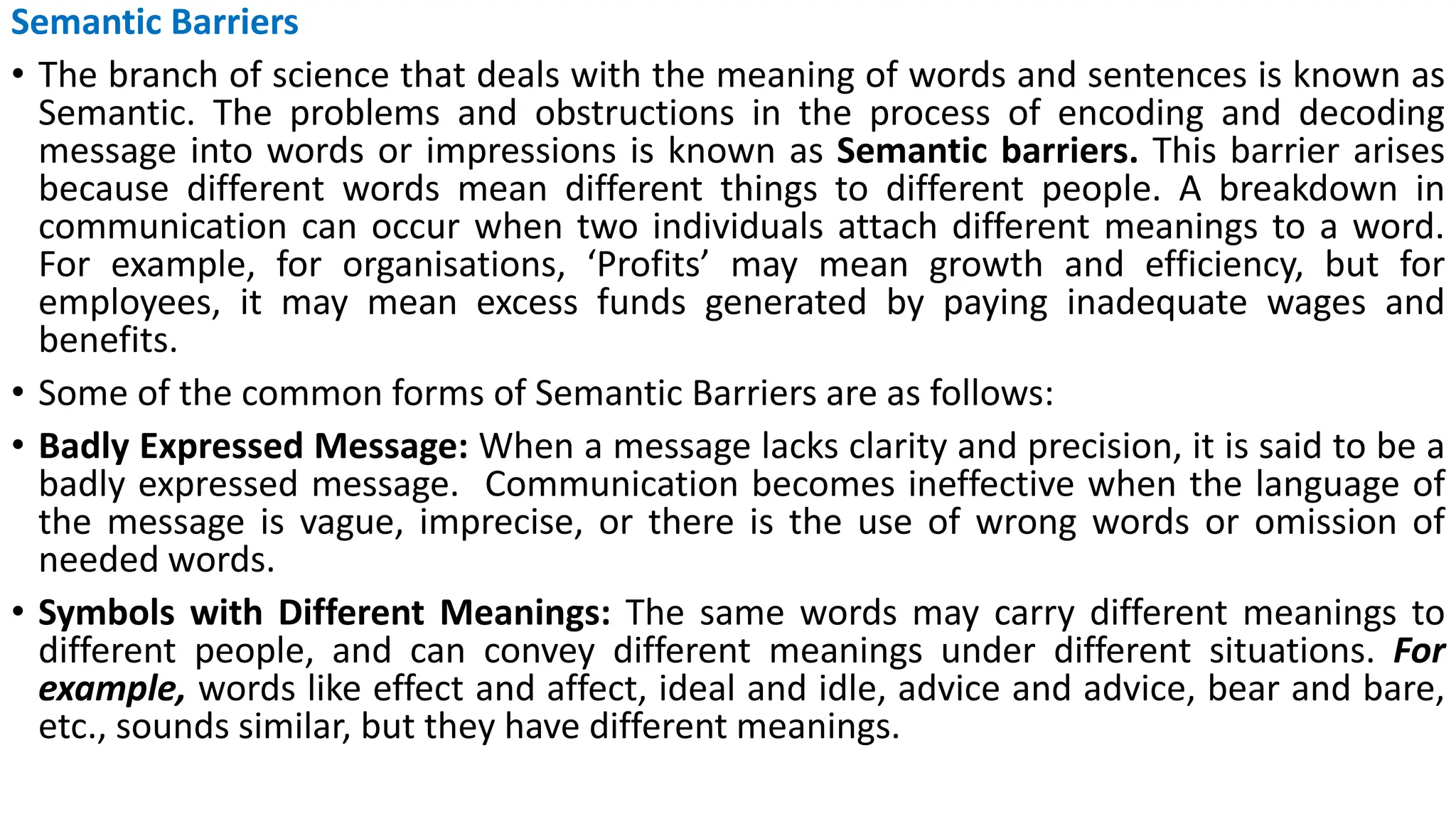
• The branch of science that deals with the meaning of words and sentences is known as
Semantic. The problems and obstructions in the process of encoding and decoding
message into words or impressions is known as Semantic barriers. This barrier arises
because different words mean different things to different people. A breakdown in
communication can occur when two individuals attach different meanings to a word.
For example, for organisations, ‘Profits’ may mean growth and efficiency, but for
employees, it may mean excess funds generated by paying inadequate wages and
benefits.
• Some of the common forms of Semantic Barriers are as follows:
• Badly Expressed Message: When a message lacks clarity and precision, it is said to be a
badly expressed message. Communication becomes ineffective when the language of
the message is vague, imprecise, or there is the use of wrong words or omission of
needed words.
• Symbols with Different Meanings: The same words may carry different meanings to
different people, and can convey different meanings under different situations. For
example, words like effect and affect, ideal and idle, advice and advice, bear and bare,
etc., sounds similar, but they have different meanings.
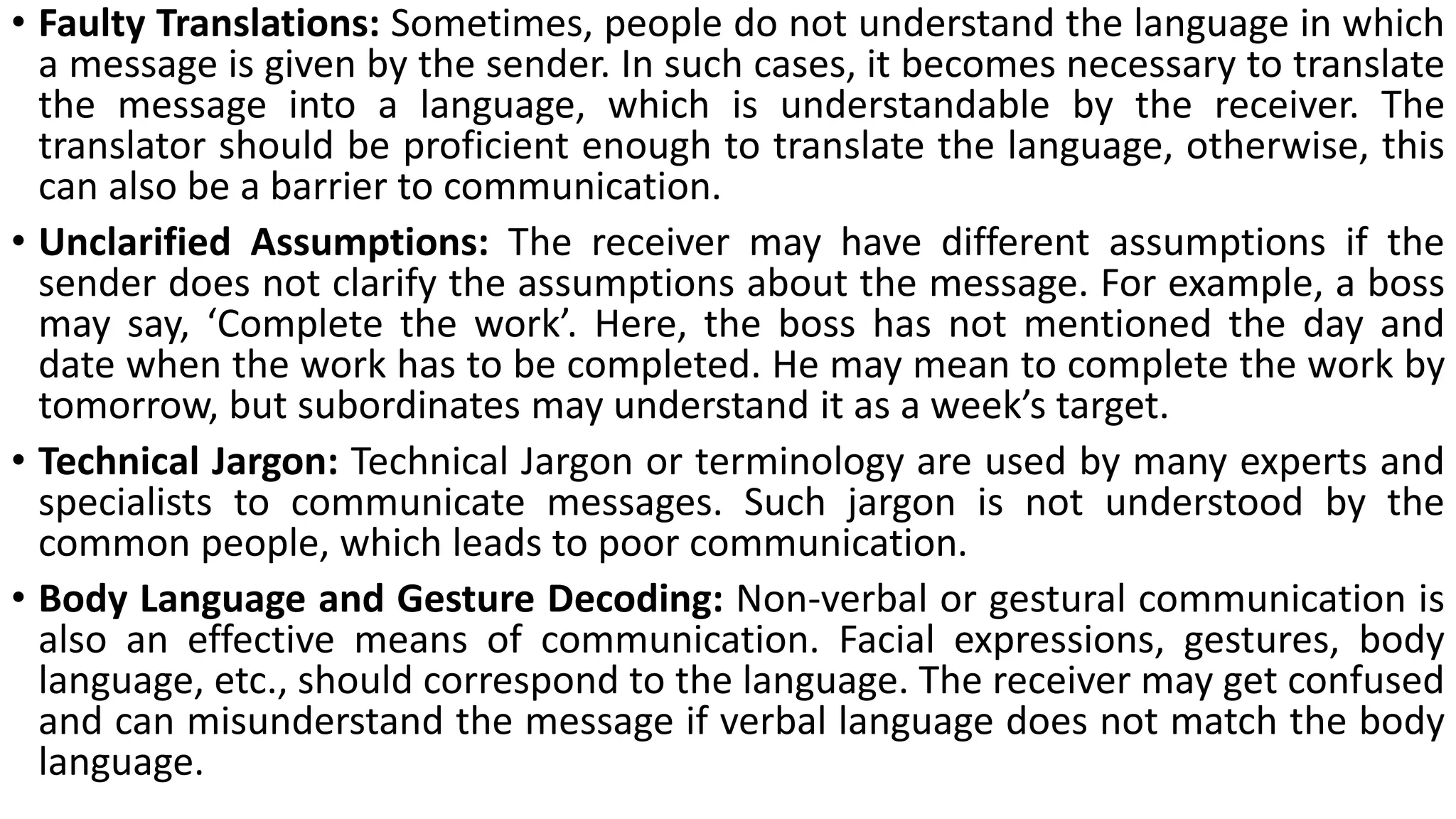
• Faulty Translations: Sometimes, people do not understand the language in which
a message is given by the sender. In such cases, it becomes necessary to translate
the message into a language, which is understandable by the receiver. The
translator should be proficient enough to translate the language, otherwise, this
can also be a barrier to communication.
• Unclarified Assumptions: The receiver may have different assumptions if the
sender does not clarify the assumptions about the message. For example, a boss
may say, ‘Complete the work’. Here, the boss has not mentioned the day and
date when the work has to be completed. He may mean to complete the work by
tomorrow, but subordinates may understand it as a week’s target.
• Technical Jargon: Technical Jargon or terminology are used by many experts and
specialists to communicate messages. Such jargon is not understood by the
common people, which leads to poor communication.
• Body Language and Gesture Decoding: Non-verbal or gestural communication is
also an effective means of communication. Facial expressions, gestures, body
language, etc., should correspond to the language. The receiver may get confused
and can misunderstand the message if verbal language does not match the body
language.
Psychological Barriers
• Barriers which arise on the account of emotional and psychological status of the
sender and receiver of the message are known as Psychological Barriers. For
example, a person who is under stress cannot communicate properly.
• Some of the common forms of Psychological Barriers are as follows:
• Premature Evaluation: The tendency of forming a judgement before listening to
the entire message is known as premature evaluation. This distorts
understanding and acts as a barrier to effective communication. This can also
lead to prejudices against communication.
• Lack of Attention: Communication can be less effective, and the message can be
misunderstood if proper attention is not given to it. This inattention may arise
due to the preoccupied mind of the receiver. For example, a superior gave
instructions to operate a new software, however, the subordinate was
preoccupied with other personal issues. Such lack of attention makes the
communication process one-way and ineffective.
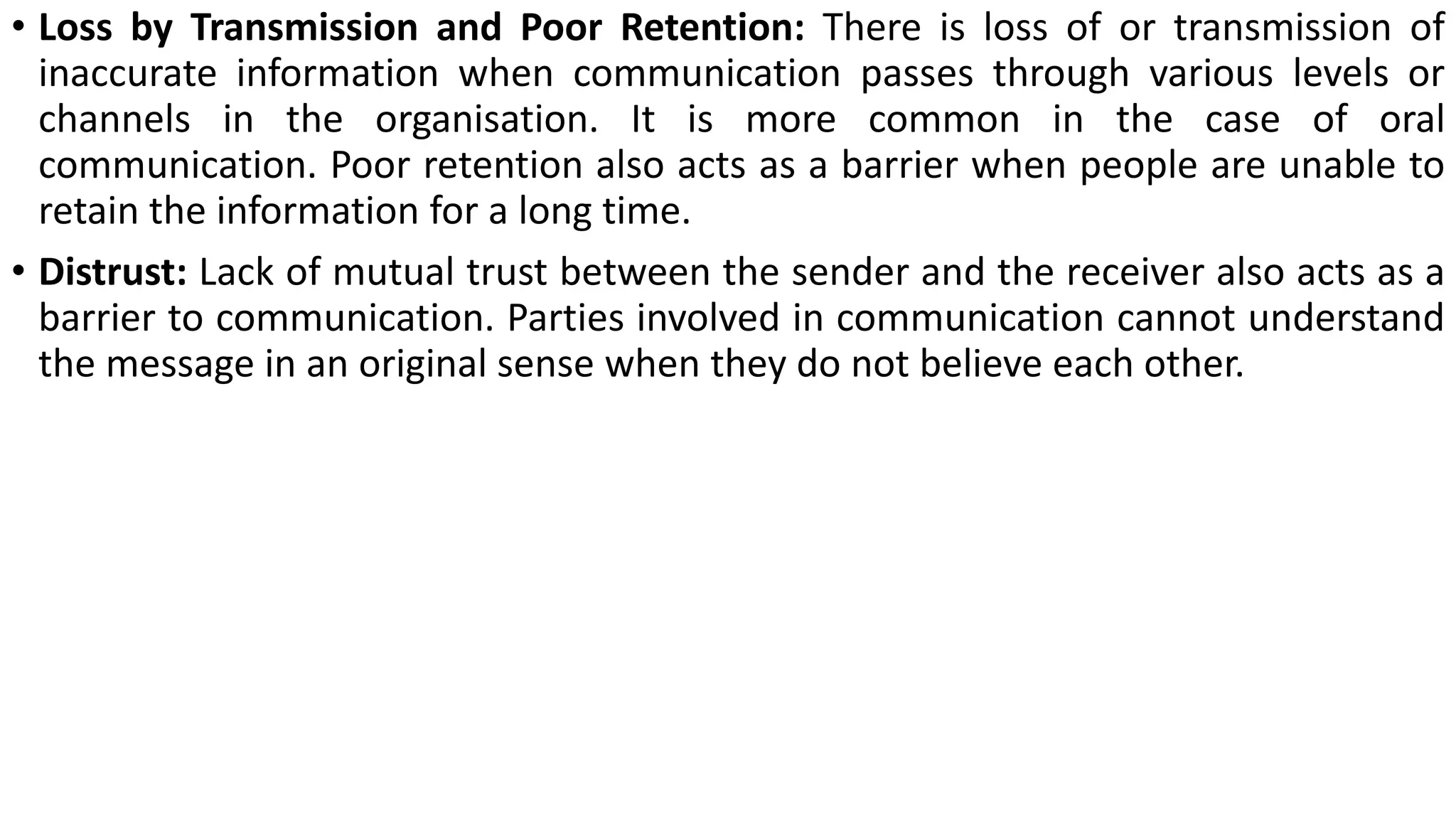
• Loss by Transmission and Poor Retention: There is loss of or transmission of
inaccurate information when communication passes through various levels or
channels in the organisation. It is more common in the case of oral
communication. Poor retention also acts as a barrier when people are unable to
retain the information for a long time.
• Distrust: Lack of mutual trust between the sender and the receiver also acts as a
barrier to communication. Parties involved in communication cannot understand
the message in an original sense when they do not believe each other.
Organisational Barriers
• In an organisation, communication has to pass through various levels and
channels, hence it may not reach the same place as it was sent by the sender.
Organisation structure, rules and regulations, authority relationships, etc., act as
a barrier to effective communication.
• Some of the Organisational Barriers are as follows:
• Organisational Policy: Effectiveness of communication is affected by
organisational policy. The communication process is hampered if the policy is not
supportive of the free flow of communication. For example, in a centralised
organisation, free communication is not encouraged, and communication has to
follow through a proper channel only.
• Rules and Regulations: The process of communication is affected by rigid and
cumbersome rules and regulations. The channels and the subject matter are
already prescribed through, which the messages are to be communicated. These
prescribed rules, regulations, and channels are rigid and can act as barriers.
• Status: Psychological distance is created between superior and subordinate
because of status. Such statuses stand in the way of true and accurate
communication. Subordinates are also not allowed to express their feeling freely
if the manager is status conscious.
• Complexity in Organisation Structure: Organisation structure can also act as a
barrier to communication. If there are many managerial levels in an
organisational structure, then communication gets delayed and distorted.
• Organisational Facilities: If facilities like frequent meetings, conferences,
suggestion boxes, complaint boxes, etc., are absent in an organisation, then
effective communication is hampered.
Personal Barriers
• The effectiveness of communication is influenced by the personal factors of both
sender and the receiver.
• Some of the Personal Barriers are as follows:
• Fear of Challenge to Authority: If a superior fears that a particular
communication can hamper his authority, then he may withhold such
communication, as he always wants to maintain a higher position and prestige in
the organisation.
• Lack of Confidence of Superior on his Subordinates: When superiors do not have
faith or confidence on the competence of their subordinates, then
communication is said to be hampered. When there is a lack of trust and
confidence in subordinates, the superior may not take advice or suggestions from
the subordinates.
•
• Unwillingness to Communicate: Unwillingness to communicate can be another
reason for ineffective communication. Many times, subordinates do not
communicate with their superiors because they believe that if the information is
not correct or appropriate, it will adversely affect them.
• Lack of Proper Incentives: Subordinates also do not take initiative to
communicate, when there is no motivation or incentives for communication. For
example, if there is no reward for the suggestion given by the subordinates, then
they will not take initiative.

COMMUNICATION.pptx

  • 1.
  • 2.
    COMMUNICATION the act oftransmitting information, ideas from one person to another. Its takes place among individuals, belonging to various categories and backgrounds & creates the flow of information between or with in multiple organisation. CHANNEL OF COMMUNICATION The path through which information flows from sender to receiver is known as the channel of communication. • According to Organizational Structure Formal & Informal communication • According to Expression Oral & written communication • According to Direction Downward, Upward & Horizontal communication
  • 3.
    TYPES OF COMMUNICATION •VERBAL & NON VERBAL COMMUNICATION • WRITTEN COMMUNICATION • MASS COMMUNICATION • VISUAL COMMUNICATION • GROUP COMMUNICATION • MASS COMMUNICATION • FEEDBACK COMMUNICATION
  • 4.
  • 5.
    Formal Communication. • calledformal communications. • a formal organisation structure and which are to be sent through the formal or officially recognised channels • Like Generally, orders, instructions, decisions, of the superior officer, etc. are communicated through this channel. Informal Communication. • known as 'grapevine' communications. • formal channels of communication are not used. • very often, a person can obtain information which would take a few days for him to receive through the officially recognised organisational channel. Informal communication may be conveyed by a • Example: gesture, nod, smile etc.
  • 6.
  • 7.
    Oral or VerbalCommunication. In the case of oral or verbal communication, communication is made direct face to face or through telephone or intercom system. Oral communication has some merits. They are: (a) It saves time and money. (b) On-the-spot clarification of any doubt is possible. (c) Because of personal touch between the communicator and listener, communication is more effective. (d) While communicating, important points can be emphasised by the communicator. Some of the disadvantages of oral communication are: (a) There is no permanent record of communication passing through this device. (b) Oral communication is not suitable for a subject that has to be kept as a record. (c) There is greater possibility of communication being misunderstood or misinterpreted, if the communicator is poor in vocal expression. (d) It is suitable only for communications which are not lengthy. Written Communication. Written communications include statements, circulars, letters, reports, memos, manuals etc. Some of the advantages of written communication are: (a) Written communications can be kept as a permanent record and it can be referred to by the management whenever it wants. (b) This method is suitable for communications which are lengthy. (c) As communication is in writing, there is a lesser chance of missing any points in the communication. (d) This method is suitable for passing of messages to far- off places. Written communication, however, suffers from certain limitations are: (a) Generally, written communications are more time- consuming, (b) If the communication is not clearly worded, it may lead to confusion and interpretation. (c) There is no face-to-face discussion between the parties. Hence, doubts of the receiver of the message may not be clarified. (d) Maintaining of secrecy is difficult in this type of communication.
  • 8.
  • 9.
    • Downward Communication.In the case of downward communication, the communication flows from the superiors to the subordinates. Communications sent through this channel are generally directives requiring actions to be initiated by the subordinates. These communications include orders, policy directives, instructions, etc. • Upward Communication. In the case of upward communication, communication flows from the subordinates to the superiors. It includes reports, suggestions, reactions of workers, proposals, etc. Upward communication enables the management to evaluate the effectiveness with which its orders have been carried out and also to know the grievances or suggestions of the subordinates. • Horizontal or Lateral Communication. It means communication among the subordinates who are working at the same level of organisation. For example, communication among foremen or superintendents, or functional managers or supervisors is horizontal communication. • Diagonal Communication. It means communication between people who are neither in the same department nor at the same level of organisational hierarchy. In this type, communication cuts across departmental lines
  • 10.
  • 11.
    • The factorswhich obstruct the effectiveness of communication is known as Communication Barriers. These barriers cause a mismatch between understanding of the message by the sender and the receiver. These barriers can occur at any stage of the communication process. • Classification of Barriers to Communication • The barriers to communication can be broadly classified as: Semantic Barriers Psychological Barriers Organizational Barriers Personal Barriers
  • 12.
    Semantic Barriers • Thebranch of science that deals with the meaning of words and sentences is known as Semantic. The problems and obstructions in the process of encoding and decoding message into words or impressions is known as Semantic barriers. This barrier arises because different words mean different things to different people. A breakdown in communication can occur when two individuals attach different meanings to a word. For example, for organisations, ‘Profits’ may mean growth and efficiency, but for employees, it may mean excess funds generated by paying inadequate wages and benefits. • Some of the common forms of Semantic Barriers are as follows: • Badly Expressed Message: When a message lacks clarity and precision, it is said to be a badly expressed message. Communication becomes ineffective when the language of the message is vague, imprecise, or there is the use of wrong words or omission of needed words. • Symbols with Different Meanings: The same words may carry different meanings to different people, and can convey different meanings under different situations. For example, words like effect and affect, ideal and idle, advice and advice, bear and bare, etc., sounds similar, but they have different meanings.
  • 13.
    • Faulty Translations:Sometimes, people do not understand the language in which a message is given by the sender. In such cases, it becomes necessary to translate the message into a language, which is understandable by the receiver. The translator should be proficient enough to translate the language, otherwise, this can also be a barrier to communication. • Unclarified Assumptions: The receiver may have different assumptions if the sender does not clarify the assumptions about the message. For example, a boss may say, ‘Complete the work’. Here, the boss has not mentioned the day and date when the work has to be completed. He may mean to complete the work by tomorrow, but subordinates may understand it as a week’s target. • Technical Jargon: Technical Jargon or terminology are used by many experts and specialists to communicate messages. Such jargon is not understood by the common people, which leads to poor communication. • Body Language and Gesture Decoding: Non-verbal or gestural communication is also an effective means of communication. Facial expressions, gestures, body language, etc., should correspond to the language. The receiver may get confused and can misunderstand the message if verbal language does not match the body language.
  • 14.
    Psychological Barriers • Barrierswhich arise on the account of emotional and psychological status of the sender and receiver of the message are known as Psychological Barriers. For example, a person who is under stress cannot communicate properly. • Some of the common forms of Psychological Barriers are as follows: • Premature Evaluation: The tendency of forming a judgement before listening to the entire message is known as premature evaluation. This distorts understanding and acts as a barrier to effective communication. This can also lead to prejudices against communication. • Lack of Attention: Communication can be less effective, and the message can be misunderstood if proper attention is not given to it. This inattention may arise due to the preoccupied mind of the receiver. For example, a superior gave instructions to operate a new software, however, the subordinate was preoccupied with other personal issues. Such lack of attention makes the communication process one-way and ineffective.
  • 15.
    • Loss byTransmission and Poor Retention: There is loss of or transmission of inaccurate information when communication passes through various levels or channels in the organisation. It is more common in the case of oral communication. Poor retention also acts as a barrier when people are unable to retain the information for a long time. • Distrust: Lack of mutual trust between the sender and the receiver also acts as a barrier to communication. Parties involved in communication cannot understand the message in an original sense when they do not believe each other.
  • 16.
    Organisational Barriers • Inan organisation, communication has to pass through various levels and channels, hence it may not reach the same place as it was sent by the sender. Organisation structure, rules and regulations, authority relationships, etc., act as a barrier to effective communication. • Some of the Organisational Barriers are as follows: • Organisational Policy: Effectiveness of communication is affected by organisational policy. The communication process is hampered if the policy is not supportive of the free flow of communication. For example, in a centralised organisation, free communication is not encouraged, and communication has to follow through a proper channel only. • Rules and Regulations: The process of communication is affected by rigid and cumbersome rules and regulations. The channels and the subject matter are already prescribed through, which the messages are to be communicated. These prescribed rules, regulations, and channels are rigid and can act as barriers.
  • 17.
    • Status: Psychologicaldistance is created between superior and subordinate because of status. Such statuses stand in the way of true and accurate communication. Subordinates are also not allowed to express their feeling freely if the manager is status conscious. • Complexity in Organisation Structure: Organisation structure can also act as a barrier to communication. If there are many managerial levels in an organisational structure, then communication gets delayed and distorted. • Organisational Facilities: If facilities like frequent meetings, conferences, suggestion boxes, complaint boxes, etc., are absent in an organisation, then effective communication is hampered.
  • 18.
    Personal Barriers • Theeffectiveness of communication is influenced by the personal factors of both sender and the receiver. • Some of the Personal Barriers are as follows: • Fear of Challenge to Authority: If a superior fears that a particular communication can hamper his authority, then he may withhold such communication, as he always wants to maintain a higher position and prestige in the organisation. • Lack of Confidence of Superior on his Subordinates: When superiors do not have faith or confidence on the competence of their subordinates, then communication is said to be hampered. When there is a lack of trust and confidence in subordinates, the superior may not take advice or suggestions from the subordinates. •
  • 19.
    • Unwillingness toCommunicate: Unwillingness to communicate can be another reason for ineffective communication. Many times, subordinates do not communicate with their superiors because they believe that if the information is not correct or appropriate, it will adversely affect them. • Lack of Proper Incentives: Subordinates also do not take initiative to communicate, when there is no motivation or incentives for communication. For example, if there is no reward for the suggestion given by the subordinates, then they will not take initiative.