ORGANIZATIONAL BEHAVIOR

                 ORGANIZATIONAL
                 COMMUNICATION
              NUZUL FARISYA AHMAD FADZIL
               YANG IDURA MOHD YUSOF
                      BM770/2P

11/9/2011                                  1
Communication - Definition
• The sharing of information between two or
  more individuals or groups to reach a
  common understanding


11/9/2011                                     2
Importance of Good
              Communication
• Increased efficiency in new technologies and skills
    Learning, Implementing, Training
    Expands workers skills
• Improved quality of products and services
• Subordinates communicate problems and solutions for
  increasing quality to superiors


11/9/2011                                               3
Importance of Good
              Communication
• Increased responsiveness to customers
    Empowered workers lower response time to satisfy
     customer wants and needs
• More innovation through communication
    Cross-functional teams communicating effectively
     produce higher quality products more efficiently


11/9/2011                                               4
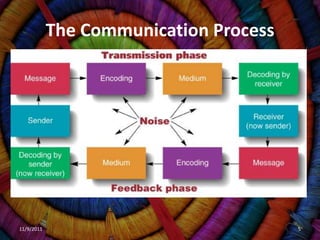
The Communication Process


11/9/2011                               5
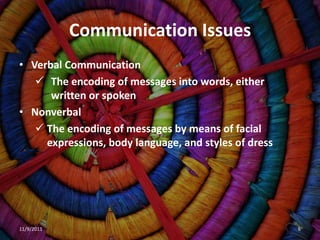
Communication Issues
• Verbal Communication
    The encoding of messages into words, either
      written or spoken
• Nonverbal
    The encoding of messages by means of facial
     expressions, body language, and styles of dress


11/9/2011                                              6
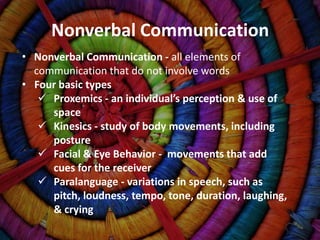
Nonverbal Communication
• Nonverbal Communication - all elements of
  communication that do not involve words
• Four basic types
    Proxemics - an individual’s perception & use of
     space
    Kinesics - study of body movements, including
     posture
    Facial & Eye Behavior - movements that add
     cues for the receiver
    Paralanguage - variations in speech, such as
     pitch, loudness, tempo, tone, duration, laughing,
     & crying
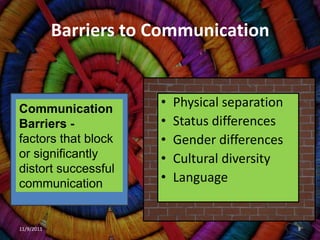
Barriers to Communication


Communication
                        •   Physical separation
Barriers -              •   Status differences
factors that block      •   Gender differences
or significantly        •   Cultural diversity
distort successful
communication           •   Language


11/9/2011                                         8
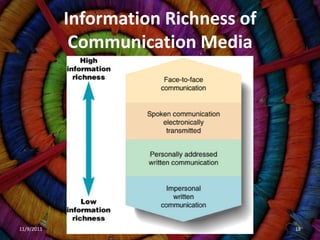
The Dangers of Ineffective
                 Communication
• Managers and their subordinates can become effective
  communicators by:
   – Selecting an appropriate medium for each
     message—there is no one “best” medium.
   – Considering information richness (the amount of
     information a medium can carry).
       • A medium with high richness can carry much
         more information to aid understanding.
   – Is there a need for a paper path or electronic trail to
     provide documentation of the communication?

11/9/2011                                                      9
Communication Networks
• Communication Networks
    The pathways along which information flows in
     groups and teams and throughout the
     organization.
    Choice of communication network depends on:
     • The nature of the group’s tasks
     • The extent to which group members need to
       communicate with each other to achieve group
       goals.


11/9/2011                                             10
Communication Networks
•     Pathways
       Vertical
         • Manager to upper level managers
         • Manager to subordinates (direct reports)
       Lateral
         • Manager to other managers


11/9/2011                                             11
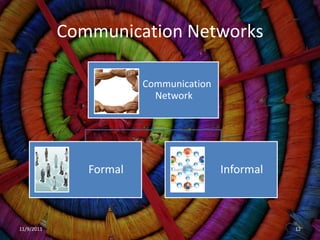
Communication Networks

                        Communication
                          Network


               Formal                   Informal


11/9/2011                                          12
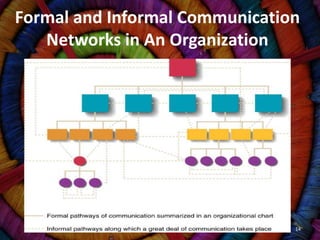
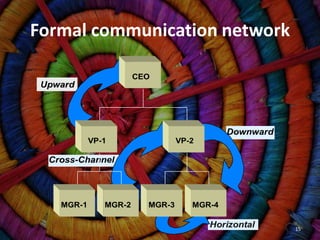
Organization Communication
              Networks
• Organization Chart
   – A pictorial representation of formal reporting channels
     in an organization.
       • Communication in an organization flows through
         formal and informal pathways
       • Vertical communications flow up and down the
         corporate hierarchy.
       • Horizontal communications flow between employees
         of the same level.
       • Informal communications can span levels and
         departments—the grapevine is an informal network
         carrying unofficial information throughout the firm.
                                                          13
Formal and Informal Communication
   Networks in An Organization


                                14
Formal communication network


                               15
Communication
 Networks in
  Groups and
    Teams


                16
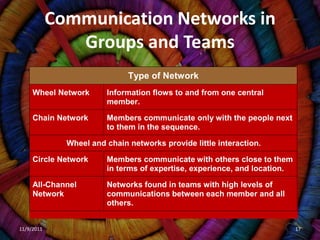
Communication Networks in
               Groups and Teams
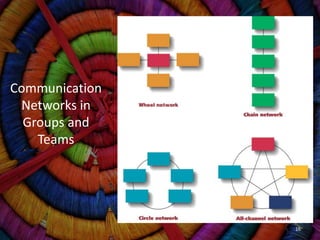
                              Type of Network
     Wheel Network      Information flows to and from one central
                        member.

     Chain Network      Members communicate only with the people next
                        to them in the sequence.

              Wheel and chain networks provide little interaction.

     Circle Network     Members communicate with others close to them
                        in terms of expertise, experience, and location.

     All-Channel        Networks found in teams with high levels of
     Network            communications between each member and all
                        others.


11/9/2011                                                                  17
Information Richness of
             Communication Media


11/9/2011                             18
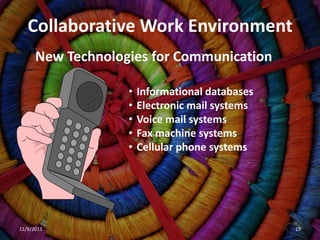
Collaborative Work Environment
      New Technologies for Communication

                   •   Informational databases
                   •   Electronic mail systems
                   •   Voice mail systems
                   •   Fax machine systems
                   •   Cellular phone systems


11/9/2011                                        19
Technological Advances in
                Communication
• Internet
   – Global system of computer networks used by many
     firms use it to communicate with their suppliers.
• World Wide Web (WWW)
   – Provides multimedia access to the Internet.
• Intranets
   – A company-wide system of computer networks for
     information sharing by employees inside the firm.


11/9/2011                                                20
How Do New Technologies
                Affect Behavior?
•   Fast, immediate access to information
•   Immediate access to people in power
•   Instant information exchange across distance
•   Makes schedules & office hours irrelevant
•   May equalize group power
•   May equalize group participation


11/9/2011                                          21
• Communication can become more impersonal -
  interaction with a machine
• Interpersonal skills may diminish -less tact, less
  graciousness
• Non-verbal cues lacking
• Alters social context
• Easy to become overwhelmed with information
• Encourages polyphasic activity


11/9/2011                                              22
Defensive Communication
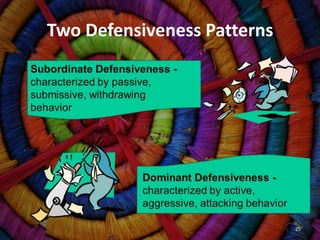
• Defensive Communication - communication that can be
  aggressive, attacking & angry, or passive & withdrawing
• Leads to
   – injured feelings
   – communication breakdowns
   – alienation
   – retaliatory behaviors
   – nonproductive efforts
   – problem solving failures


11/9/2011                                               23
Non-defensive Communication
• Non-defensive Communication - communication that is
  assertive, direct, & powerful
• Provides
   – basis for defense when attacked
   – restores order, balance, and effectiveness


11/9/2011                                           24
Two Defensiveness Patterns


                             25
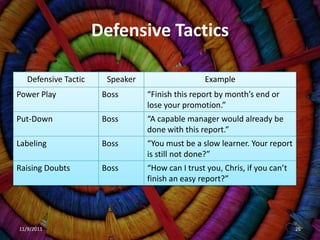
Defensive Tactics

   Defensive Tactic     Speaker                   Example
Power Play             Boss       “Finish this report by month’s end or
                                  lose your promotion.”
Put-Down               Boss       “A capable manager would already be
                                  done with this report.”
Labeling               Boss       “You must be a slow learner. Your report
                                  is still not done?”
Raising Doubts         Boss       “How can I trust you, Chris, if you can’t
                                  finish an easy report?”


11/9/2011                                                                     26
Defensive Tactics

     Defensive Tactic     Speaker                   Example
 Misleading              Employee   “Morgan has not gone over with me
 Information                        the information I need for the report.”
                                    [Morgan left Chris with a copy of the
                                    report.]
 Scapegoating            Employee   “Morgan did not give me input until
                                    just today.”
 Hostile Jokes           Employee   “You can’t be serious! The report isn’t
                                    that important.”
 Deception               Employee   “I gave it to the secretary. Did she lose
                                    it?”


11/9/2011                                                                     27
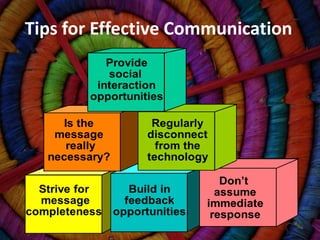
Tips for Effective Communication
Thank You


11/9/2011               29

Organizational Behavior - Communication

  • 1.
    ORGANIZATIONAL BEHAVIOR ORGANIZATIONAL COMMUNICATION NUZUL FARISYA AHMAD FADZIL YANG IDURA MOHD YUSOF BM770/2P 11/9/2011 1
  • 2.
    Communication - Definition •The sharing of information between two or more individuals or groups to reach a common understanding 11/9/2011 2
  • 3.
    Importance of Good Communication • Increased efficiency in new technologies and skills  Learning, Implementing, Training  Expands workers skills • Improved quality of products and services • Subordinates communicate problems and solutions for increasing quality to superiors 11/9/2011 3
  • 4.
    Importance of Good Communication • Increased responsiveness to customers  Empowered workers lower response time to satisfy customer wants and needs • More innovation through communication  Cross-functional teams communicating effectively produce higher quality products more efficiently 11/9/2011 4
  • 5.
  • 6.
    Communication Issues • VerbalCommunication  The encoding of messages into words, either written or spoken • Nonverbal  The encoding of messages by means of facial expressions, body language, and styles of dress 11/9/2011 6
  • 7.
    Nonverbal Communication • NonverbalCommunication - all elements of communication that do not involve words • Four basic types  Proxemics - an individual’s perception & use of space  Kinesics - study of body movements, including posture  Facial & Eye Behavior - movements that add cues for the receiver  Paralanguage - variations in speech, such as pitch, loudness, tempo, tone, duration, laughing, & crying
  • 8.
    Barriers to Communication Communication • Physical separation Barriers - • Status differences factors that block • Gender differences or significantly • Cultural diversity distort successful communication • Language 11/9/2011 8
  • 9.
    The Dangers ofIneffective Communication • Managers and their subordinates can become effective communicators by: – Selecting an appropriate medium for each message—there is no one “best” medium. – Considering information richness (the amount of information a medium can carry). • A medium with high richness can carry much more information to aid understanding. – Is there a need for a paper path or electronic trail to provide documentation of the communication? 11/9/2011 9
  • 10.
    Communication Networks • CommunicationNetworks  The pathways along which information flows in groups and teams and throughout the organization.  Choice of communication network depends on: • The nature of the group’s tasks • The extent to which group members need to communicate with each other to achieve group goals. 11/9/2011 10
  • 11.
    Communication Networks • Pathways  Vertical • Manager to upper level managers • Manager to subordinates (direct reports)  Lateral • Manager to other managers 11/9/2011 11
  • 12.
    Communication Networks Communication Network Formal Informal 11/9/2011 12
  • 13.
    Organization Communication Networks • Organization Chart – A pictorial representation of formal reporting channels in an organization. • Communication in an organization flows through formal and informal pathways • Vertical communications flow up and down the corporate hierarchy. • Horizontal communications flow between employees of the same level. • Informal communications can span levels and departments—the grapevine is an informal network carrying unofficial information throughout the firm. 13
  • 14.
    Formal and InformalCommunication Networks in An Organization 14
  • 15.
  • 16.
    Communication Networks in Groups and Teams 16
  • 17.
    Communication Networks in Groups and Teams Type of Network Wheel Network Information flows to and from one central member. Chain Network Members communicate only with the people next to them in the sequence. Wheel and chain networks provide little interaction. Circle Network Members communicate with others close to them in terms of expertise, experience, and location. All-Channel Networks found in teams with high levels of Network communications between each member and all others. 11/9/2011 17
  • 18.
    Information Richness of Communication Media 11/9/2011 18
  • 19.
    Collaborative Work Environment New Technologies for Communication • Informational databases • Electronic mail systems • Voice mail systems • Fax machine systems • Cellular phone systems 11/9/2011 19
  • 20.
    Technological Advances in Communication • Internet – Global system of computer networks used by many firms use it to communicate with their suppliers. • World Wide Web (WWW) – Provides multimedia access to the Internet. • Intranets – A company-wide system of computer networks for information sharing by employees inside the firm. 11/9/2011 20
  • 21.
    How Do NewTechnologies Affect Behavior? • Fast, immediate access to information • Immediate access to people in power • Instant information exchange across distance • Makes schedules & office hours irrelevant • May equalize group power • May equalize group participation 11/9/2011 21
  • 22.
    • Communication canbecome more impersonal - interaction with a machine • Interpersonal skills may diminish -less tact, less graciousness • Non-verbal cues lacking • Alters social context • Easy to become overwhelmed with information • Encourages polyphasic activity 11/9/2011 22
  • 23.
    Defensive Communication • DefensiveCommunication - communication that can be aggressive, attacking & angry, or passive & withdrawing • Leads to – injured feelings – communication breakdowns – alienation – retaliatory behaviors – nonproductive efforts – problem solving failures 11/9/2011 23
  • 24.
    Non-defensive Communication • Non-defensiveCommunication - communication that is assertive, direct, & powerful • Provides – basis for defense when attacked – restores order, balance, and effectiveness 11/9/2011 24
  • 25.
  • 26.
    Defensive Tactics Defensive Tactic Speaker Example Power Play Boss “Finish this report by month’s end or lose your promotion.” Put-Down Boss “A capable manager would already be done with this report.” Labeling Boss “You must be a slow learner. Your report is still not done?” Raising Doubts Boss “How can I trust you, Chris, if you can’t finish an easy report?” 11/9/2011 26
  • 27.
    Defensive Tactics Defensive Tactic Speaker Example Misleading Employee “Morgan has not gone over with me Information the information I need for the report.” [Morgan left Chris with a copy of the report.] Scapegoating Employee “Morgan did not give me input until just today.” Hostile Jokes Employee “You can’t be serious! The report isn’t that important.” Deception Employee “I gave it to the secretary. Did she lose it?” 11/9/2011 27
  • 28.
    Tips for EffectiveCommunication
  • 29.