
Unit-IV:
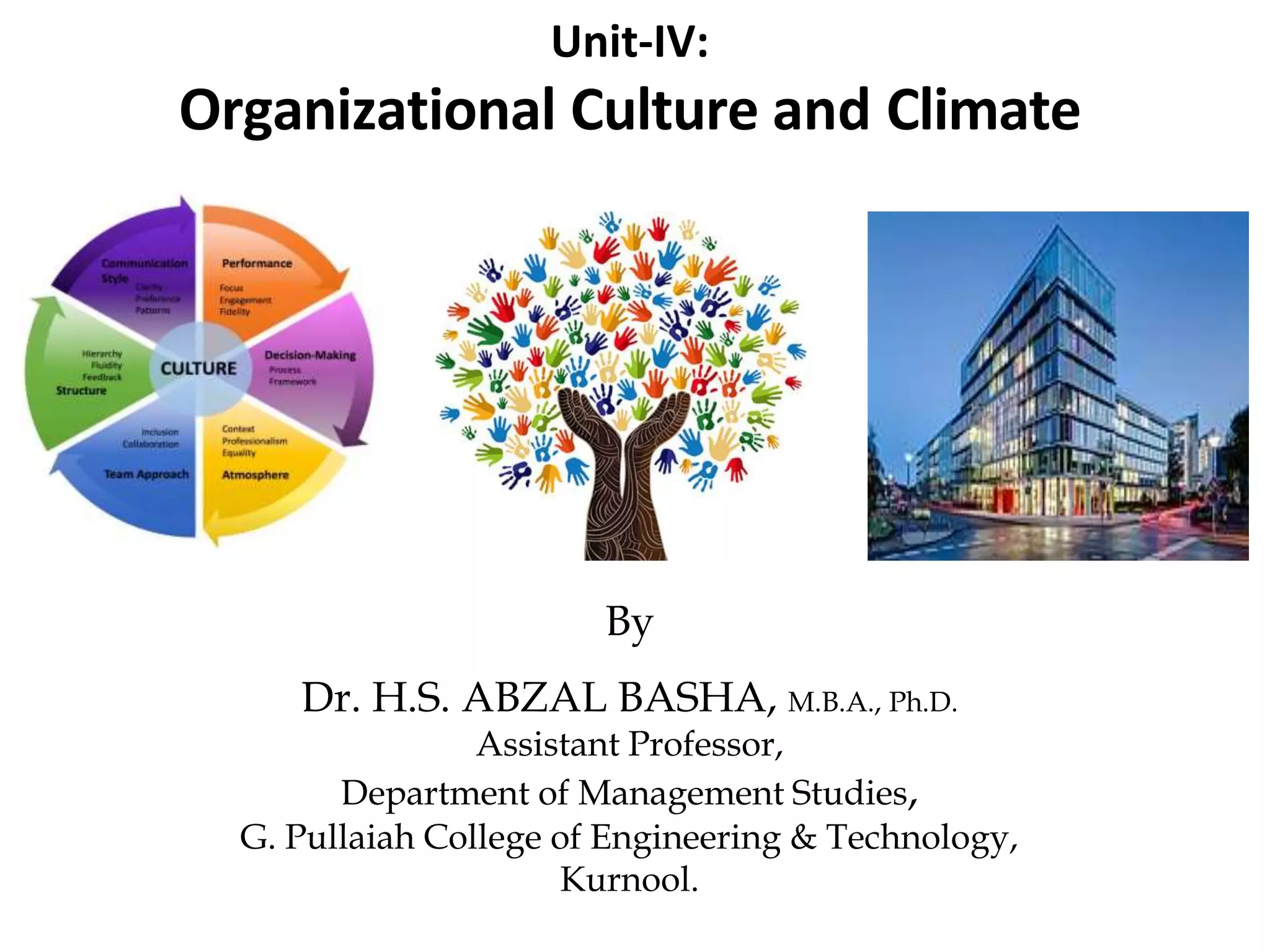
Organizational Culture and Climate
By
Dr. H.S. ABZAL BASHA, M.B.A., Ph.D.
Assistant Professor,
Department of Management Studies,
G. Pullaiah College of Engineering & Technology,
Kurnool.
Introduction
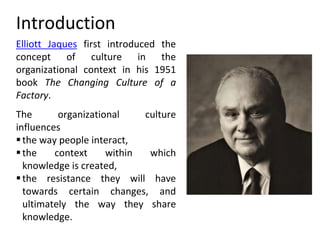
Elliott Jaques first introduced the
concept of culture in the
organizational context in his 1951
book The Changing Culture of a
Factory.
The organizational culture
influences
the way people interact,
the context within which
knowledge is created,
the resistance they will have
towards certain changes, and
ultimately the way they share
knowledge.
What is Organizational Culture?
• A system of meaning shared by the
organization’s members
• Cultural values are collective beliefs,
assumptions, and feelings about what things
are good, normal, rational, valuable, etc.
7 Popular Companies setting Inspiring
Organizational Culture Examples
1. Zappos – Complementing the Right People with the Right
Culture (four-week call center training for all)
2. Walt Disney – The Happiest Place on Earth being the Happiest
Place to Work
3. Twitter – Where Fun meets Inspiration to bring out the Best
4. Nike – The Work Culture that ‘Just did it’
5. Google – A Corporate Culture that Employees Stand by (Google
offers free food, employee trips and parties, financial bonuses, open
presentations by high-level executives, employee recognition, gyms, and has
a pet-friendly environment)
6. Netflix – Where Trust is the Keyword of Culture (Did you know
that Netflix has no set schedule, but offers unlimited vacation days to its
employees)
7. Medium – ‘No people managers. Maximum autonomy’(“Teach
me something.” Routinely asked on Medium hiring interviews)
Organisational culture examples in India
1. Amazon India. (Amit Agarwal, instructed his employees to refrain from
responding to any emails or phone calls between 6 p.m. and 8 a.m.)
2. Tata Consultancy Services. (Maitree, aims to reach out to employees’
families and bring them together for various cultural events.)
3. Godrej Consumer Products. (The company’s LOUD (Live Out Ur Dream) is
a talent search initiative used on the Godrej Campus. This program is for
recognizing some creative and passionate individuals with huge potential.)
4. Bharti Airtel. (Bharti Airtel’s office in Gurgaon provides day-care facilities
for working mothers’ children to balance their role as parent and manage
their professional commitments as well.)
5. Flipkart. (The company has implemented an attractive childcare policy with
a day-care support programme. Expectant mothers can receive a stipend as
a transport allowance for 2 months, before opting for maternity leave.)
6. Hindustan Unilever. (Managers at Hindustan Unilever can take advantage
of the company’s career break policy for up to 5 years so they can pursue
higher education, maternity or paternity leave, or take on other personal
goals.)
Culture’s Overall Function
• Culture is the social glue that
helps hold an organization
by providing
together
appropriate standards for
what employees should say
or do.
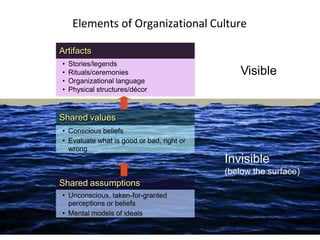
Elements of Organizational Culture
Visible
• Unconscious, taken-for-granted
perceptions or beliefs
• Mental models of ideals
Shared assumptions
• Conscious beliefs
• Evaluate what is good or bad, right or
wrong
Shared values
Artifacts
• Stories/legends
• Rituals/ceremonies
• Organizational language
• Physical structures/décor
Invisible
(below the surface)
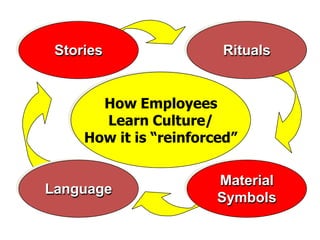
How Employees
Learn Culture/
How it is “reinforced”
Material
Symbols
Language
Stories Rituals
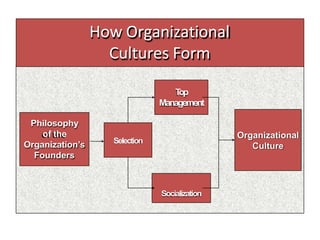
How Organizational
Cultures Form
Philosophy
of the
Organization’s
Founders
Organizational
Culture
Selection
T
op
Management
Socialization
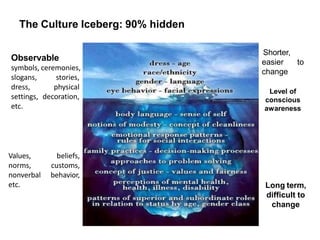
The Culture Iceberg: 90% hidden
Values, beliefs,
norms, customs,
nonverbal behavior,
etc.
Level of
conscious
awareness
Observable
symbols, ceremonies,
slogans, stories,
dress, physical
settings, decoration,
etc.
Shorter,
easier to
change
Long term,
difficult to
change
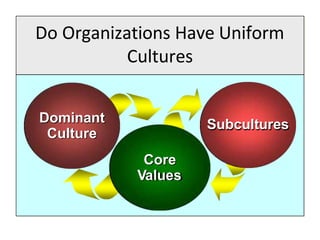
Do Organizations Have Uniform
Cultures
Core
Values
Subcultures
Dominant
Culture
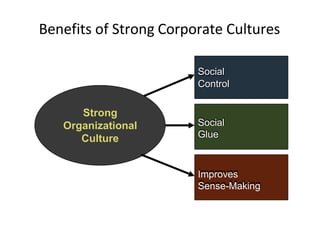
Benefits of Strong Corporate Cultures
Strong
Organizational
Culture
Social
Control
Social
Glue
Improves
Sense-Making
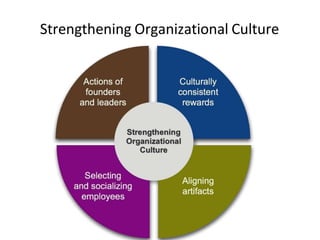
Strengthening Organizational Culture
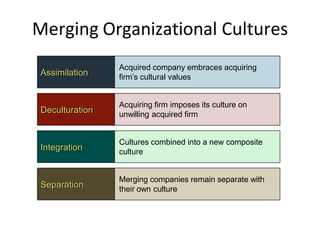
Merging Organizational Cultures
Assimilation
Deculturation
Acquired company embraces acquiring
firm’s cultural values
Acquiring firm imposes its culture on
unwilling acquired firm
Integration
Cultures combined into a new composite
culture
Separation
Merging companies remain separate with
their own culture
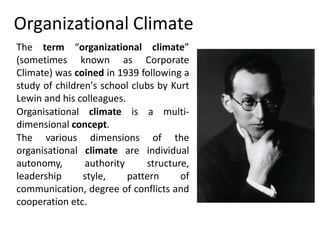
Organizational Climate
The term “organizational climate”
(sometimes known as Corporate
Climate) was coined in 1939 following a
study of children's school clubs by Kurt
Lewin and his colleagues.
Organisational climate is a multi-
dimensional concept.
The various dimensions of the
organisational climate are individual
autonomy, authority structure,
leadership style, pattern of
communication, degree of conflicts and
cooperation etc.
“A set of measurable properties of the perceived work
environment, directly or indirectly, created by individuals who
live and work in this environment and that influences the
motivation and behavior of these people.”
Organizational Climate is a relatively enduring quality of the
internal environment of an organization that
a. is experienced by its members
b. influences their behavior
c. can be described in terms of the values of a particular set
of characteristics of the organization
Elements of Climate
• Quality of Leadership
• Amount of Trust
• Communication, upward and downward
• Feeling of useful work
• Responsibility
• Fair rewards
• Reasonable job pressure
• Opportunity
• Reasonable controls, structure, and bureaucracy
• Employee involvement, participation.
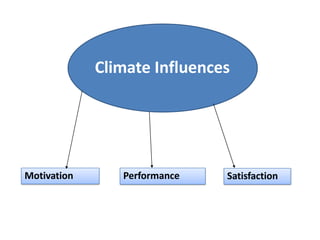
Climate Influences
Motivation Performance Satisfaction
Org. Culture Vs Org. Climate
• Culture refers to ideologies,
values and norms as reflected in
stories and symbols.
• It evolves over a number of years
by good will and reputation.
• It is a broader framework that
determines organisational
climate.
• It cannot easily changed and
manipulated. Changes are
absolutely introduced if
necessary.
• It focus on values and norms of
the organization.
• Climate, on the other hand,
refers to the psychological
environment as reflected in
attitudes and perceptions.
• It evolves according to the
needs of the organisations by
current environmental forces.
• It is short term that defines its
day to day functioning.
• It can be manipulate & changed
according to needs of the
environment.
• It focus on the current work
practices of the organization.
Thank You

Organizational culture vs climate

  • 1.
    Unit-IV: Organizational Culture andClimate By Dr. H.S. ABZAL BASHA, M.B.A., Ph.D. Assistant Professor, Department of Management Studies, G. Pullaiah College of Engineering & Technology, Kurnool.
  • 2.
    Introduction Elliott Jaques firstintroduced the concept of culture in the organizational context in his 1951 book The Changing Culture of a Factory. The organizational culture influences the way people interact, the context within which knowledge is created, the resistance they will have towards certain changes, and ultimately the way they share knowledge.
  • 3.
    What is OrganizationalCulture? • A system of meaning shared by the organization’s members • Cultural values are collective beliefs, assumptions, and feelings about what things are good, normal, rational, valuable, etc.
  • 4.
    7 Popular Companiessetting Inspiring Organizational Culture Examples 1. Zappos – Complementing the Right People with the Right Culture (four-week call center training for all) 2. Walt Disney – The Happiest Place on Earth being the Happiest Place to Work 3. Twitter – Where Fun meets Inspiration to bring out the Best 4. Nike – The Work Culture that ‘Just did it’ 5. Google – A Corporate Culture that Employees Stand by (Google offers free food, employee trips and parties, financial bonuses, open presentations by high-level executives, employee recognition, gyms, and has a pet-friendly environment) 6. Netflix – Where Trust is the Keyword of Culture (Did you know that Netflix has no set schedule, but offers unlimited vacation days to its employees) 7. Medium – ‘No people managers. Maximum autonomy’(“Teach me something.” Routinely asked on Medium hiring interviews)
  • 5.
    Organisational culture examplesin India 1. Amazon India. (Amit Agarwal, instructed his employees to refrain from responding to any emails or phone calls between 6 p.m. and 8 a.m.) 2. Tata Consultancy Services. (Maitree, aims to reach out to employees’ families and bring them together for various cultural events.) 3. Godrej Consumer Products. (The company’s LOUD (Live Out Ur Dream) is a talent search initiative used on the Godrej Campus. This program is for recognizing some creative and passionate individuals with huge potential.) 4. Bharti Airtel. (Bharti Airtel’s office in Gurgaon provides day-care facilities for working mothers’ children to balance their role as parent and manage their professional commitments as well.) 5. Flipkart. (The company has implemented an attractive childcare policy with a day-care support programme. Expectant mothers can receive a stipend as a transport allowance for 2 months, before opting for maternity leave.) 6. Hindustan Unilever. (Managers at Hindustan Unilever can take advantage of the company’s career break policy for up to 5 years so they can pursue higher education, maternity or paternity leave, or take on other personal goals.)
  • 6.
    Culture’s Overall Function •Culture is the social glue that helps hold an organization by providing together appropriate standards for what employees should say or do.
  • 8.
    Elements of OrganizationalCulture Visible • Unconscious, taken-for-granted perceptions or beliefs • Mental models of ideals Shared assumptions • Conscious beliefs • Evaluate what is good or bad, right or wrong Shared values Artifacts • Stories/legends • Rituals/ceremonies • Organizational language • Physical structures/décor Invisible (below the surface)
  • 9.
    How Employees Learn Culture/ Howit is “reinforced” Material Symbols Language Stories Rituals
  • 10.
    How Organizational Cultures Form Philosophy ofthe Organization’s Founders Organizational Culture Selection T op Management Socialization
  • 12.
    The Culture Iceberg:90% hidden Values, beliefs, norms, customs, nonverbal behavior, etc. Level of conscious awareness Observable symbols, ceremonies, slogans, stories, dress, physical settings, decoration, etc. Shorter, easier to change Long term, difficult to change
  • 16.
    Do Organizations HaveUniform Cultures Core Values Subcultures Dominant Culture
  • 17.
    Benefits of StrongCorporate Cultures Strong Organizational Culture Social Control Social Glue Improves Sense-Making
  • 18.
  • 19.
    Merging Organizational Cultures Assimilation Deculturation Acquiredcompany embraces acquiring firm’s cultural values Acquiring firm imposes its culture on unwilling acquired firm Integration Cultures combined into a new composite culture Separation Merging companies remain separate with their own culture
  • 20.
    Organizational Climate The term“organizational climate” (sometimes known as Corporate Climate) was coined in 1939 following a study of children's school clubs by Kurt Lewin and his colleagues. Organisational climate is a multi- dimensional concept. The various dimensions of the organisational climate are individual autonomy, authority structure, leadership style, pattern of communication, degree of conflicts and cooperation etc.
  • 21.
    “A set ofmeasurable properties of the perceived work environment, directly or indirectly, created by individuals who live and work in this environment and that influences the motivation and behavior of these people.” Organizational Climate is a relatively enduring quality of the internal environment of an organization that a. is experienced by its members b. influences their behavior c. can be described in terms of the values of a particular set of characteristics of the organization
  • 22.
    Elements of Climate •Quality of Leadership • Amount of Trust • Communication, upward and downward • Feeling of useful work • Responsibility • Fair rewards • Reasonable job pressure • Opportunity • Reasonable controls, structure, and bureaucracy • Employee involvement, participation.
  • 23.
  • 24.
    Org. Culture VsOrg. Climate • Culture refers to ideologies, values and norms as reflected in stories and symbols. • It evolves over a number of years by good will and reputation. • It is a broader framework that determines organisational climate. • It cannot easily changed and manipulated. Changes are absolutely introduced if necessary. • It focus on values and norms of the organization. • Climate, on the other hand, refers to the psychological environment as reflected in attitudes and perceptions. • It evolves according to the needs of the organisations by current environmental forces. • It is short term that defines its day to day functioning. • It can be manipulate & changed according to needs of the environment. • It focus on the current work practices of the organization.
  • 25.