Organizational Communication
Unit 1
Dr.Reenu Mohan
Department of Commerce
INTRODUCTION
• ORGANIZATION “An organization is a
deliberate arrangement of people to
accomplish some specific purposes.”
• Organization is an open system
communication among people within a
specific context for the purpose of achieving
common goals through cooperative effort
DEFINITION
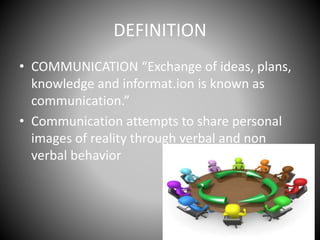
• COMMUNICATION “Exchange of ideas, plans,
knowledge and informat.ion is known as
communication.”
• Communication attempts to share personal
images of reality through verbal and non
verbal behavior
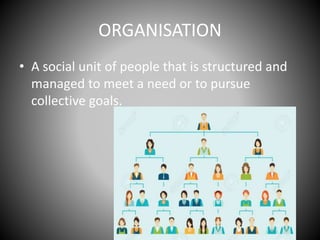
ORGANISATION
• A social unit of people that is structured and
managed to meet a need or to pursue
collective goals.
NATURE OF ORGANISATIONS
• Division of Labor
• Unity of Command
• Authority & Responsibility
• Span of Control
• Scalar principle
• Departmentalization
ORGANIZATION DESIGN
• Organization design is the process of assessing
and selecting the structure and formal system
of communication, division of labor,
coordination, control,authority and
responsibility necessary to achieve an
organization’s goals
Types of Organizational Design
• Functional Design
• Place (or Region-wise) Design
• Product Design
• Multidivisional design
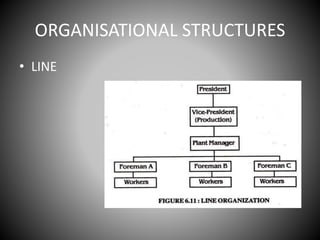
ORGANISATIONAL STRUCTURES
• LINE
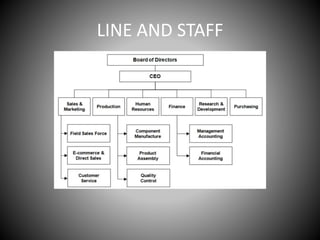
LINE AND STAFF
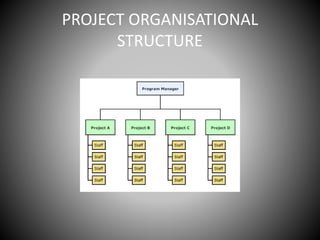
PROJECT ORGANISATIONAL
STRUCTURE
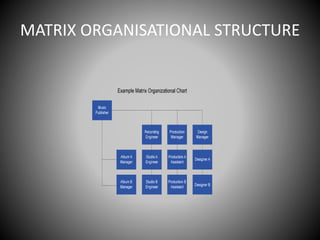
MATRIX ORGANISATIONAL STRUCTURE
• ORGANIZATIONAL COMMUNICATION “All the
pattern, networks and systems of
communication within an organization.”
• Organizational communication is system of
pathways through which messages flow
patterns of interaction among people who
comprise the organization
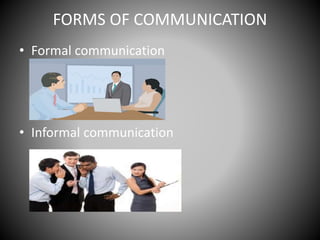
FORMS OF COMMUNICATION
• Formal communication
• Informal communication
FORMS OF COMMUNICATION
• FORMAL COMMUNICATION “Communication that
takes place within prescribed organizational work
arrangements.” For example: Manager asks his/her
employee to do a task.
• INFORMAL COMMUNICATION “Communication that is
not defined by an organization structural hierarchy.”
For example: employees conversation during lunch.
Purpose of informal Communication:
• 1. Social interaction 2. Enhance organizational
performance
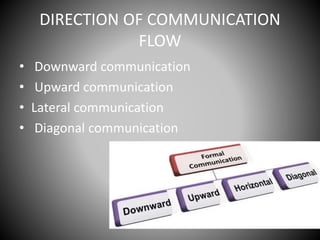
DIRECTION OF COMMUNICATION
FLOW
• Downward communication
• Upward communication
• Lateral communication
• Diagonal communication
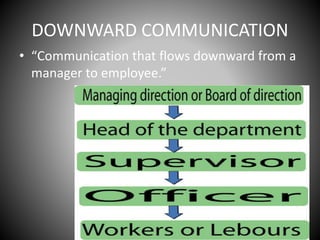
DOWNWARD COMMUNICATION
• “Communication that flows downward from a
manager to employee.”
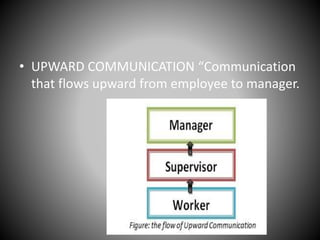
• UPWARD COMMUNICATION “Communication
that flows upward from employee to manager.
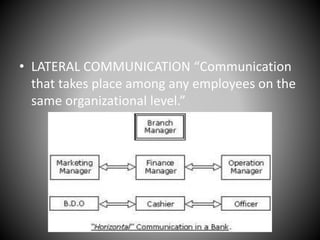
• LATERAL COMMUNICATION “Communication
that takes place among any employees on the
same organizational level.”
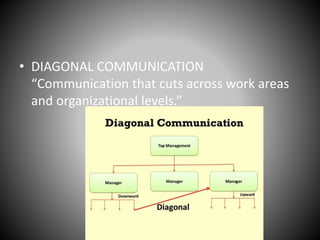
• DIAGONAL COMMUNICATION
“Communication that cuts across work areas
and organizational levels.”
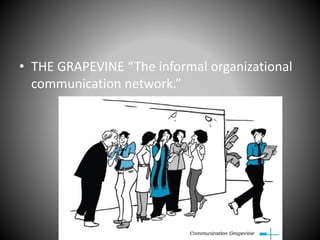
• THE GRAPEVINE “The informal organizational
communication network.”
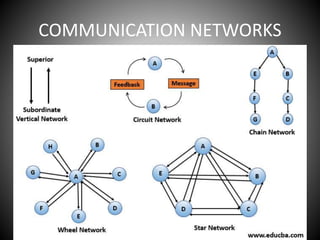
COMMUNICATION NETWORKS
Communication barriers
• Barrier- An obstacle in a place that prevents
us from completing certain tasks.
• Communication barriers can be defined as the
aspects or conditions that interfere with
effective exchange of ideas or thoughts.
TYPES OF BARRIER
• Physical Barrier
• Cultural Barrier
• Language Barrier
• Emotional Barrier
• Organizational Barrier
• Perceptual Barrier
PHYSICAL BARRIER
• Physical barriers relate to disturbance in the
immediate situation, which can interfere in
the course of an effective communication.
• Some of them are easy to Alter whereas,
some may prove to be tough obstacles in the
process of effective communication.
FACTORS CAUSING PHYSICAL BARRIER
• Defects in media
• Distraction in environment
• Distance
• Physical disability
HOW TO OVERCOME?
• To be updated with latest technologies.
• Choosing a suitable environment.
• Removing obstacle.
• Making signs easier to read, example, you
could supplement written signs with pictures
and visual signs
CULTURAL BARRIER
• Cultures provide people ways of thinking--
ways of seeing, hearing, and interpreting the
world.
• Similar words can mean different things to
people from different cultures, even when
they talk the "same" language.
FACTORS CAUSING CULTURAL BARRIER
• Diversified cultural background.
• Language and Accent.
• Religion.
• Behavior and Nature.
HOW TO OVERCOME ?
• Cross culture environment.
• Have a thorough knowledge of your
counterpart’s culture background.
• Conduct effective communication workshop.
• Work in groups and run frequent meeting
LANGUAGE BARRIERS
• Inability to converse in a language that is
known by both the sender and receiver is the
greatest barrier to effective communication. •
When a person uses inappropriate words
while conversing or writing, it could lead to
misunderstanding between the sender and a
receiver.
FACTORS CAUSING LANGUAGE
BARRIERS
• Multi language
• Region
• Inadequate vocabulary
• Interpreting difference
HOW TO OVERCOME ?
• Speak slowly and clearly.
• Ask for clarification.
• Frequently check for understanding.
• Be specific.
• Choose your medium of communication
effectively.
• Be patient.
ORGANIZATIONAL BARRIERS
• Organizational structure greatly affects the
capability of the employees as far as the
communication is concerned .
• All the internal factors which stymie or block the
process of communication are known as
organisational barriers. Some such factors have
already been discussed like restrictive
environments, deceptive tactics, communication
network.
FACTORS CAUSING ORGANIZATIONAL
BARRIERS
• Status relationship
• One way flow
• Organization structure
• Rules and regulations
• Too many levels in organization structure
.
HOW TO OVERCOME?
• Poor structure to the communication.
• A weak delivery.
• The use of the wrong medium to deliver the
communication.
• A mixed message.
• The message is delivered to the wrong
audience.
• A distracting environment
PERCEPTUAL BARRIERS
• The most common problem is that the people
have difference opinion .
• The varied perceptions of every individual
give rise to a need for effective
communication.
• We all have our own preferences, values,
attitudes, origins and life experiences that act
as ‘filters’ on our experiences of people,
events and information
FACTORS CAUSING PERCEPTUAL
BARRIERS
• Difference in Understanding
• Difference in Perception of Reality
• Differences in Values, Attitudes and Opinions
HOW TO OVERCOME?
• Start by listening to others.
• Clarify if there is confusion.
• Stay calm and be positive.
THANK YOU

Organizational Communication

  • 1.
  • 2.
    INTRODUCTION • ORGANIZATION “Anorganization is a deliberate arrangement of people to accomplish some specific purposes.” • Organization is an open system communication among people within a specific context for the purpose of achieving common goals through cooperative effort
  • 3.
    DEFINITION • COMMUNICATION “Exchangeof ideas, plans, knowledge and informat.ion is known as communication.” • Communication attempts to share personal images of reality through verbal and non verbal behavior
  • 4.
    ORGANISATION • A socialunit of people that is structured and managed to meet a need or to pursue collective goals.
  • 5.
    NATURE OF ORGANISATIONS •Division of Labor • Unity of Command • Authority & Responsibility • Span of Control • Scalar principle • Departmentalization
  • 6.
    ORGANIZATION DESIGN • Organizationdesign is the process of assessing and selecting the structure and formal system of communication, division of labor, coordination, control,authority and responsibility necessary to achieve an organization’s goals
  • 7.
    Types of OrganizationalDesign • Functional Design • Place (or Region-wise) Design • Product Design • Multidivisional design
  • 8.
  • 9.
  • 10.
  • 11.
  • 12.
    • ORGANIZATIONAL COMMUNICATION“All the pattern, networks and systems of communication within an organization.” • Organizational communication is system of pathways through which messages flow patterns of interaction among people who comprise the organization
  • 13.
    FORMS OF COMMUNICATION •Formal communication • Informal communication
  • 14.
    FORMS OF COMMUNICATION •FORMAL COMMUNICATION “Communication that takes place within prescribed organizational work arrangements.” For example: Manager asks his/her employee to do a task. • INFORMAL COMMUNICATION “Communication that is not defined by an organization structural hierarchy.” For example: employees conversation during lunch. Purpose of informal Communication: • 1. Social interaction 2. Enhance organizational performance
  • 15.
    DIRECTION OF COMMUNICATION FLOW •Downward communication • Upward communication • Lateral communication • Diagonal communication
  • 16.
    DOWNWARD COMMUNICATION • “Communicationthat flows downward from a manager to employee.”
  • 17.
    • UPWARD COMMUNICATION“Communication that flows upward from employee to manager.
  • 18.
    • LATERAL COMMUNICATION“Communication that takes place among any employees on the same organizational level.”
  • 19.
    • DIAGONAL COMMUNICATION “Communicationthat cuts across work areas and organizational levels.”
  • 20.
    • THE GRAPEVINE“The informal organizational communication network.”
  • 21.
  • 22.
    Communication barriers • Barrier-An obstacle in a place that prevents us from completing certain tasks. • Communication barriers can be defined as the aspects or conditions that interfere with effective exchange of ideas or thoughts.
  • 23.
    TYPES OF BARRIER •Physical Barrier • Cultural Barrier • Language Barrier • Emotional Barrier • Organizational Barrier • Perceptual Barrier
  • 24.
    PHYSICAL BARRIER • Physicalbarriers relate to disturbance in the immediate situation, which can interfere in the course of an effective communication. • Some of them are easy to Alter whereas, some may prove to be tough obstacles in the process of effective communication.
  • 25.
    FACTORS CAUSING PHYSICALBARRIER • Defects in media • Distraction in environment • Distance • Physical disability
  • 26.
    HOW TO OVERCOME? •To be updated with latest technologies. • Choosing a suitable environment. • Removing obstacle. • Making signs easier to read, example, you could supplement written signs with pictures and visual signs
  • 27.
    CULTURAL BARRIER • Culturesprovide people ways of thinking-- ways of seeing, hearing, and interpreting the world. • Similar words can mean different things to people from different cultures, even when they talk the "same" language.
  • 28.
    FACTORS CAUSING CULTURALBARRIER • Diversified cultural background. • Language and Accent. • Religion. • Behavior and Nature.
  • 29.
    HOW TO OVERCOME? • Cross culture environment. • Have a thorough knowledge of your counterpart’s culture background. • Conduct effective communication workshop. • Work in groups and run frequent meeting
  • 30.
    LANGUAGE BARRIERS • Inabilityto converse in a language that is known by both the sender and receiver is the greatest barrier to effective communication. • When a person uses inappropriate words while conversing or writing, it could lead to misunderstanding between the sender and a receiver.
  • 31.
    FACTORS CAUSING LANGUAGE BARRIERS •Multi language • Region • Inadequate vocabulary • Interpreting difference
  • 32.
    HOW TO OVERCOME? • Speak slowly and clearly. • Ask for clarification. • Frequently check for understanding. • Be specific. • Choose your medium of communication effectively. • Be patient.
  • 33.
    ORGANIZATIONAL BARRIERS • Organizationalstructure greatly affects the capability of the employees as far as the communication is concerned . • All the internal factors which stymie or block the process of communication are known as organisational barriers. Some such factors have already been discussed like restrictive environments, deceptive tactics, communication network.
  • 34.
    FACTORS CAUSING ORGANIZATIONAL BARRIERS •Status relationship • One way flow • Organization structure • Rules and regulations • Too many levels in organization structure .
  • 35.
    HOW TO OVERCOME? •Poor structure to the communication. • A weak delivery. • The use of the wrong medium to deliver the communication. • A mixed message. • The message is delivered to the wrong audience. • A distracting environment
  • 36.
    PERCEPTUAL BARRIERS • Themost common problem is that the people have difference opinion . • The varied perceptions of every individual give rise to a need for effective communication. • We all have our own preferences, values, attitudes, origins and life experiences that act as ‘filters’ on our experiences of people, events and information
  • 37.
    FACTORS CAUSING PERCEPTUAL BARRIERS •Difference in Understanding • Difference in Perception of Reality • Differences in Values, Attitudes and Opinions
  • 38.
    HOW TO OVERCOME? •Start by listening to others. • Clarify if there is confusion. • Stay calm and be positive.
  • 39.