MANAGING
COMMUNICATIONS
CHAPTER-3
CONTENT
 COMMUNICATION FUNDAMENTALS
 TYPES OF COMMUNICATION
 ORGANISATIONAL GRAPEVINES AND RUMORS
 Communication is the ever-present activity by which
people relate to one another and combine their efforts.
 Communication is necessary to perpetuate the health of
the organisation.
 Today’s employees have a powerful desire to know what
is going on and how they fit into the larger picture. More
than ever before, managers need to engage in systematic
and extensive communications in upward, downward and
lateral directions.
 Listening skills and humility remain highly important in the
communication process.
COMMUNICATION FUNDAMENTALS
 Communication is the transfer of information and
understanding from one person to another person.
 It is a way of reaching others by transmitting
ideas,facts,thoughts,feelings and values.
 Its goal is to have the receiver understand the message
as it was intended.
 When communication is effective, it provides a bridge of
meaning between two people so that they can share what
they feel and know.
 Communication always involve at least two people, a
sender and a receiver. One person alone cannot
communicate.
 A manager may send a hundred messages, but there is
no communication until each one is received, read, and
understood.
 Communication is what the receiver understands not what
the sender says.
THE IMPORTANCE OF COMMUNICATION
 Organisations cannot exist without communication. If
there is no communication employees do not know what
their co-workers are doing.
 Management cannot receive information inputs, and
supervisors and team leaders cannot give instructions.
 Coordination of work is impossible and the organization
will collapse for lack of it.
 Cooperation also becomes impossible because people
cannot communicate their needs and feelings to others.
 We can say with confidence that every act of
communication influences the organization in some way.
 When communication is effective, it tends to encourage
better performance and job satisfaction. People
understand their jobs better and feel more involved in
them.
OPEN COMMUNICATION
• Open communication is generally better than restricted
communication. In effect, if employees know the problems
an organization is facing and hear what managers are
trying to do, they will usually respond favorably.
• Open communication works best when employees
understand the business, trust that they will receive some
benefit from the organization's success, and are fully
empowered to help run the workplace.
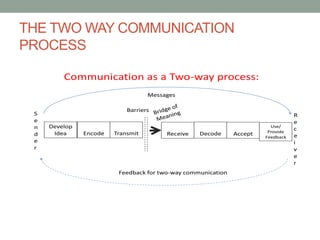
THE TWO WAY COMMUNICATION
PROCESS
Communication as a Two-way process:
Develop
Idea Encode Transmit Receive Decode Accept
Use/
Provide
Feedback
Barriers
R
e
c
e
i
v
e
r
S
e
n
d
e
r
Messages
Feedback for two-way communication
• The two way communication process is the method by
which a sender reaches a receiver with a message. The
process always requires the following eight steps:
Develop an idea: Step-1 is to develop an idea that the
sender wishes to transmit. This is the key step. “Be sure
brain is engaged before putting mouth in gear”
Encode (put it in suitable words): Step-2 is to
encode(convert) the idea into suitable words, charts or
other symbols for transmission.
The key to successful encoding lies in the process of
framing an issue for presentation.
Framing uses rich, colorful, carefully selected language to
shape the perceptions of recipients.
Transmit:When the message is finally developed step-3 is
to transmit it by the method chosen, such as by memo,
phone call or personal visit.
Receive: Transmission allows another person to receive a
message, which is step-4. in this step the initiative transfers
to the receiver, who tunes in to receive the message. If it is
oral, the receiver needs to be a good listener. If the receiver
does not function the message is lost.
Decode: Step 5 is to decode the message so that it can be
understood. The sender wants the receiver to understand
the message exactly as it was sent.
Accept: Once the receiver has obtained and encoded a
message, that person has the opportunity to accept or
reject it. Which is step 6.
Use: Step 7 in the communication process is for the
receiver to use the information. The receiver may discard it,
perform the task as directed, store the information for the
future, or do something else.
Provide Feedback: When the receiver acknowledges the
message and responds to the sender, feedback has
occurred. Feedback completes the communication loop,
because there is a message flow from the sender to the
receiver and back to the sender. This is step-8
COMMUNICATION BARRIERS
Three types of barriers are personal, physical and
semantic.
1) Personal barriers- personal barriers are communication
interferences that arise from human emotions, values
and poor listening habits. They may also stem from
differences in education, race, sex,, socioeconomic
status and other factors.
2) Physical barriers- Physical barriers are communication
interferences that occur in the environment in which the
communication takes place. The physical barriers
include distance between people, walls around a
worker’s cubicle or static that interferes with radio
messages.
3) Semantic barriers: Semantics is the science of meaning.
As contrasted with phonetics, the science of sounds.
Nearly all communication is symbolic; that is it is achieved
using symbols (words,pictures and actions) that suggest
certain meaning.
Semantic barriers arise from limitations in the symbols with
which we communicate.
COMMUNICATION SYMBOLS
 Words are the main communication symbol used on the
job. Many employees spend more than 50 percent of their
time in some form of verbal communication.
 Every common word has several meanings. Multiple
meanings are necessary because we are trying to talk
about an infinitely complex world while using a limited
number of words.
 The complexities of a single language are compounded
when people from diverse backgrounds- such as different
educational level, ethnic heritages or cultures attempt to
communicate.
 Context provide meaning- context is the environment
surrounding the use of a word.
 The effective communicators are idea-centered rather
than just word-centered. They know that words do not
provide meaning, but people do.
 Social cues are positive or negative bits of information
that influence how people react to a communication.
example, job titles, patterns of dress etc.
 Readability is the process of making writing and speech
more understandable.
Guidelines for readable writing
 Use simple and familiar words and phrases
Use personal pronouns
 Use illustrations
 Use short sentences and paragraphs
Use active verbs
 Use only necessary words
 Use a clear structure
 Pictures- A second type of symbol is the picture, which is
used to clarify word communication. Organizations make
extensive use of pictures, such as blueprints, progress
charts, fishbone diagrams, causal maps, visual aids in
training programs.
 A picture is worth a thousand word and actions to tell a
complete story.
Action (Nonverbal Communication). A third type of
communication symbol is action, also know as nonverbal
communication.
 Two significant points about action are sometimes
overlooked. One point is that failure to act is an important
way of communicating. A second point is that actions
speak louder than words.
 An important part of nonverbal communication is body
language, by which people communicate meaning to
others with their bodies in interpersonal interaction.
 Body language is an important supplement to verbal
communication in most parts of the world.
 Facial expressions are especially important sources of
body language in work situations.
Ex: Eye contact, eye movement, smiles and furrowed eyebrow.
DOWNWARD COMMUNICATION
 Downward communication in an organization is the flow of
information from higher to lower levels of authority.
 To communicate downward, some executives rely on
colorful booklets, flashy PowerPoint presentations and
elaborately planned employee meetings. These
approaches while attention getting, often fail to achieve
employee understanding.
 Managers who communicate successfully are sensitive to
human needs and open to true dialogue with their
employees.
UPWARD COMMUNICATION
 Upward communication is the flow of information from
employees to management.
 If the two way flow of information is broken by poor
upward communication, management looses touch with
employee needs and lacks sufficient information to make
sound decisions.
 A starting point for building better upward communication
is to establish a general policy stating what kinds of
upward messages are desired. Additional practices are
questioning, listening, employee meetings, open-door
policies and participation in social groups.
OTHER FORMS OF COMMUNICATION
Not all communication takes place directly down or up the
organizational hierarchy, not all is formally prescribed by
the firm, and not all of it takes place either at work or
through face-to-face interaction.
LATERAL COMMUNICATION
 Managers engage in large amount of lateral communication or
cross communication, which is communication across chains of
command. It is necessary for job coordination with people in
other departments.
 Employees who play a major role in lateral communication are
referred to as boundary spanners.
 Boundary spanning employees have strong communication
links within their department, with people in other units, and
often with external community.
 A network is a group of people who develop and maintain
contact to exchange information informally usually about a
shared interest.
ELECTRONIC COMMUNICATION
 Electronic mail is a computer based communication
system that allows you to send a message to someone or
to a hundred people almost instantaneously.
 It is stored within the computer system until the recipient
turn on their networked personal computers and read the
message at their convenience.
 The primary advantages of electronic mail systems are
their dramatic speed and convenience; the major
disadvantages include the loss of face to face contact.
INFORMAL COMMUNICATION
 The grapevine is an informal communication system. It
coexists with management’s formal communication
system. The term grapevine arose during the civil war.
 Although grapevine information tends to be sent orally, it
may be written. Handwritten or typed notes sometimes
are used. But in the modern electronic office these
messages typically are flashed or computer screens,
creating the new era of the electronic grapevine.
 The major problem with the grapevine- and the one that
gives the grapevine its poor reputation-is rumor.
 The word rumor sometimes is used as a synonym for
grapevine. But technically there is an important difference
between the two terms. Rumor is grapevine information
that is communicated without secure standards of
evidence being present.

PPT- OB -Chapter-3 Managing Communication.pptx

  • 1.
  • 2.
    CONTENT  COMMUNICATION FUNDAMENTALS TYPES OF COMMUNICATION  ORGANISATIONAL GRAPEVINES AND RUMORS
  • 3.
     Communication isthe ever-present activity by which people relate to one another and combine their efforts.  Communication is necessary to perpetuate the health of the organisation.  Today’s employees have a powerful desire to know what is going on and how they fit into the larger picture. More than ever before, managers need to engage in systematic and extensive communications in upward, downward and lateral directions.  Listening skills and humility remain highly important in the communication process.
  • 4.
    COMMUNICATION FUNDAMENTALS  Communicationis the transfer of information and understanding from one person to another person.  It is a way of reaching others by transmitting ideas,facts,thoughts,feelings and values.  Its goal is to have the receiver understand the message as it was intended.  When communication is effective, it provides a bridge of meaning between two people so that they can share what they feel and know.
  • 5.
     Communication alwaysinvolve at least two people, a sender and a receiver. One person alone cannot communicate.  A manager may send a hundred messages, but there is no communication until each one is received, read, and understood.  Communication is what the receiver understands not what the sender says.
  • 6.
    THE IMPORTANCE OFCOMMUNICATION  Organisations cannot exist without communication. If there is no communication employees do not know what their co-workers are doing.  Management cannot receive information inputs, and supervisors and team leaders cannot give instructions.  Coordination of work is impossible and the organization will collapse for lack of it.  Cooperation also becomes impossible because people cannot communicate their needs and feelings to others.  We can say with confidence that every act of communication influences the organization in some way.
  • 7.
     When communicationis effective, it tends to encourage better performance and job satisfaction. People understand their jobs better and feel more involved in them. OPEN COMMUNICATION • Open communication is generally better than restricted communication. In effect, if employees know the problems an organization is facing and hear what managers are trying to do, they will usually respond favorably. • Open communication works best when employees understand the business, trust that they will receive some benefit from the organization's success, and are fully empowered to help run the workplace.
  • 8.
    THE TWO WAYCOMMUNICATION PROCESS Communication as a Two-way process: Develop Idea Encode Transmit Receive Decode Accept Use/ Provide Feedback Barriers R e c e i v e r S e n d e r Messages Feedback for two-way communication
  • 9.
    • The twoway communication process is the method by which a sender reaches a receiver with a message. The process always requires the following eight steps: Develop an idea: Step-1 is to develop an idea that the sender wishes to transmit. This is the key step. “Be sure brain is engaged before putting mouth in gear” Encode (put it in suitable words): Step-2 is to encode(convert) the idea into suitable words, charts or other symbols for transmission. The key to successful encoding lies in the process of framing an issue for presentation.
  • 10.
    Framing uses rich,colorful, carefully selected language to shape the perceptions of recipients. Transmit:When the message is finally developed step-3 is to transmit it by the method chosen, such as by memo, phone call or personal visit. Receive: Transmission allows another person to receive a message, which is step-4. in this step the initiative transfers to the receiver, who tunes in to receive the message. If it is oral, the receiver needs to be a good listener. If the receiver does not function the message is lost. Decode: Step 5 is to decode the message so that it can be understood. The sender wants the receiver to understand the message exactly as it was sent.
  • 11.
    Accept: Once thereceiver has obtained and encoded a message, that person has the opportunity to accept or reject it. Which is step 6. Use: Step 7 in the communication process is for the receiver to use the information. The receiver may discard it, perform the task as directed, store the information for the future, or do something else. Provide Feedback: When the receiver acknowledges the message and responds to the sender, feedback has occurred. Feedback completes the communication loop, because there is a message flow from the sender to the receiver and back to the sender. This is step-8
  • 12.
    COMMUNICATION BARRIERS Three typesof barriers are personal, physical and semantic. 1) Personal barriers- personal barriers are communication interferences that arise from human emotions, values and poor listening habits. They may also stem from differences in education, race, sex,, socioeconomic status and other factors. 2) Physical barriers- Physical barriers are communication interferences that occur in the environment in which the communication takes place. The physical barriers include distance between people, walls around a worker’s cubicle or static that interferes with radio messages.
  • 13.
    3) Semantic barriers:Semantics is the science of meaning. As contrasted with phonetics, the science of sounds. Nearly all communication is symbolic; that is it is achieved using symbols (words,pictures and actions) that suggest certain meaning. Semantic barriers arise from limitations in the symbols with which we communicate. COMMUNICATION SYMBOLS  Words are the main communication symbol used on the job. Many employees spend more than 50 percent of their time in some form of verbal communication.
  • 14.
     Every commonword has several meanings. Multiple meanings are necessary because we are trying to talk about an infinitely complex world while using a limited number of words.  The complexities of a single language are compounded when people from diverse backgrounds- such as different educational level, ethnic heritages or cultures attempt to communicate.  Context provide meaning- context is the environment surrounding the use of a word.
  • 15.
     The effectivecommunicators are idea-centered rather than just word-centered. They know that words do not provide meaning, but people do.  Social cues are positive or negative bits of information that influence how people react to a communication. example, job titles, patterns of dress etc.  Readability is the process of making writing and speech more understandable.
  • 16.
    Guidelines for readablewriting  Use simple and familiar words and phrases Use personal pronouns  Use illustrations  Use short sentences and paragraphs Use active verbs  Use only necessary words  Use a clear structure
  • 17.
     Pictures- Asecond type of symbol is the picture, which is used to clarify word communication. Organizations make extensive use of pictures, such as blueprints, progress charts, fishbone diagrams, causal maps, visual aids in training programs.  A picture is worth a thousand word and actions to tell a complete story. Action (Nonverbal Communication). A third type of communication symbol is action, also know as nonverbal communication.
  • 18.
     Two significantpoints about action are sometimes overlooked. One point is that failure to act is an important way of communicating. A second point is that actions speak louder than words.  An important part of nonverbal communication is body language, by which people communicate meaning to others with their bodies in interpersonal interaction.  Body language is an important supplement to verbal communication in most parts of the world.  Facial expressions are especially important sources of body language in work situations. Ex: Eye contact, eye movement, smiles and furrowed eyebrow.
  • 19.
    DOWNWARD COMMUNICATION  Downwardcommunication in an organization is the flow of information from higher to lower levels of authority.  To communicate downward, some executives rely on colorful booklets, flashy PowerPoint presentations and elaborately planned employee meetings. These approaches while attention getting, often fail to achieve employee understanding.  Managers who communicate successfully are sensitive to human needs and open to true dialogue with their employees.
  • 20.
    UPWARD COMMUNICATION  Upwardcommunication is the flow of information from employees to management.  If the two way flow of information is broken by poor upward communication, management looses touch with employee needs and lacks sufficient information to make sound decisions.  A starting point for building better upward communication is to establish a general policy stating what kinds of upward messages are desired. Additional practices are questioning, listening, employee meetings, open-door policies and participation in social groups.
  • 21.
    OTHER FORMS OFCOMMUNICATION Not all communication takes place directly down or up the organizational hierarchy, not all is formally prescribed by the firm, and not all of it takes place either at work or through face-to-face interaction.
  • 22.
    LATERAL COMMUNICATION  Managersengage in large amount of lateral communication or cross communication, which is communication across chains of command. It is necessary for job coordination with people in other departments.  Employees who play a major role in lateral communication are referred to as boundary spanners.  Boundary spanning employees have strong communication links within their department, with people in other units, and often with external community.  A network is a group of people who develop and maintain contact to exchange information informally usually about a shared interest.
  • 23.
    ELECTRONIC COMMUNICATION  Electronicmail is a computer based communication system that allows you to send a message to someone or to a hundred people almost instantaneously.  It is stored within the computer system until the recipient turn on their networked personal computers and read the message at their convenience.  The primary advantages of electronic mail systems are their dramatic speed and convenience; the major disadvantages include the loss of face to face contact.
  • 24.
    INFORMAL COMMUNICATION  Thegrapevine is an informal communication system. It coexists with management’s formal communication system. The term grapevine arose during the civil war.  Although grapevine information tends to be sent orally, it may be written. Handwritten or typed notes sometimes are used. But in the modern electronic office these messages typically are flashed or computer screens, creating the new era of the electronic grapevine.
  • 25.
     The majorproblem with the grapevine- and the one that gives the grapevine its poor reputation-is rumor.  The word rumor sometimes is used as a synonym for grapevine. But technically there is an important difference between the two terms. Rumor is grapevine information that is communicated without secure standards of evidence being present.