MEM 642 – Organizational Development and Leadership Effectiveness
Polytechnic University of the Philippines (Summer 2014) Briones & Villanueva
Presenters’ Profile
Adrian James A. Briones
Behavior, Safety and Career
Development Trainer
Serbiz Multi-Purpose Cooperative
adrianjamesbriones@yahoo.com
ajplus.wordpress.com
Catherine S. Villanueva
Teacher 1
Andres Bonifacio Elementary School
cathyandykatecurt@gmail.com
Content of Talk
• Why Change?
• Organizational Change
– Need for Organizational Change
– Causes of Organizational Change
– Types of Organizational Change
• Challenges of Change
– Managing Resistance to Change
• Models of Organizational Change
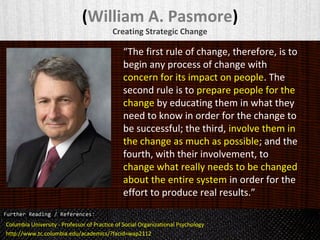
– Lewin’s Change Management Model
– Kotter’s 8 Step Change Model
– Action Research Model
– Positive Model
• Organizational Renewal: Adapting to Change
References
• Cummings, T. and Worley, C. (2005). Organizational Development and Change,
Thomson South Western
• Brown, D.R. & Harvey, D. (2006). An experiential approach to Organizational
development, (7th
Edition). ,Upper Saddle River, NJ: Prentice Hall.
• Crandall, M. (2006). Module 10 - Managing Change, The Information School of the
University of Washington
• Pierce, J. L., Gardner, D. G., with Dunham, R. B. (2002). Managing Organizational
Change and Development, Management and Organizational Behavior: An
Integrated Perspective. Cincinnati, OH: . South-Western College Publishing
• Cummings, T., Worley, C. and Waddell, D. Organizational Change: Development
and Transformation (4th
Edition), Cengage Brain
• Online References:
– http://quickbase.intuit.com/blog/2012/08/28/three-types-of-change-management-models/
• Other References:
– Organizational Change Management Methodology
– Organizational Change, IBUS 681, Dr. Yang
– Organizational Change / Organizational Development, Alexander Settles
Why Change?
• Change is a fact of organizational life, just as it
is in human life. An organization that does not
change cannot survive long – much less thrive
– in an unpredictable world.
• Understanding the triggers that lead people to
think change is needed, and what happens
when managers try to make changes, is
essential given the volatile world we live in.
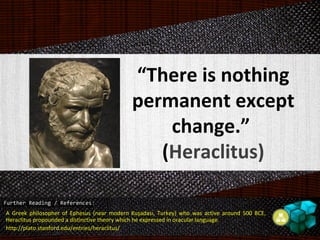
“There is nothing
permanent except
change.”
(Heraclitus)
A Greek philosopher of Ephesus (near modern Kuşadası, Turkey) who was active around 500 BCE,
Heraclitus propounded a distinctive theory which he expressed in oracular language.
http://plato.stanford.edu/entries/heraclitus/
What is Organizational Change?
• “Change is the norm in organizational life.”
(Connor et. Al. 2003: 1)
• It occurs when a company makes a transition from
its current state to some desired future state.
• Organizational change may range from
introducing very micro-scale alterations, such as
the introduction of new software in the office, to
large-scale organizational restructuring, including
the creation of new organizations and the
termination of old ones.
Managing Organisational Change, 2011 – Centre for Financial and Management Studies, SOAS, University of London
What is Organizational Change?
• An alteration of an organization’s
environment, structure, culture,
technology, or people.
– A constant force
– An organizational reality
– An opportunity or a threat
• Reconfigures components of an
organization to increase
efficiency and effectiveness.
The Information School of the University of Washington, 2006
What is Organizational Change?
Is any action or set of actions resulting in a shift in
direction or process that affects the way an
organization works. Change can be deliberate and
planned by leaders within the organization (i.e., shift
from inpatient hospital focus to outpatient primary
care model), or change can originate outside the
organization (i.e., budget cut by Congress) and be
beyond its control.
The Information School of the University of Washington, 2006
Why Do Organizations
Need Organizational
Change?
Why Do Organizations Need
Organizational Change?
• To remain
competitive
• For survival in
globalization and
rapidly evolving
technology
• To respond to a
current crisis
situation
Van de Ven & Poole (1995)
Causes of Organizational Change
1. Teleological Theory – an attempt to achieve an ideal state
through a continuous process of goal-setting, execution,
evaluation & restructuring
2. Life-Cycle Theory – organization is an entity that
depending on the external environments, cycles through
stages of birth, growth, maturation & declination
3. Dialectical Theory – organization is like a multi-cultural
society with opposing values. When one particular force
dominates over others, a new organizational value & goal
is established resulting in organizational change
Types of Organizational Change
1. Evolutionary Change – gradual, intermittent & narrowly-
focused. The purpose is to make continuous
improvement in order to adjust to the environment
changes.
2. Revolutionary Change – rapid, dramatic and broadly
focused. Happens when the current operation method
can no longer fulfill the demand of the external
environment & a significant change has to be made
Challenges of Change
A. Challenges of
Initiating Change
B. Challenges of
Sustaining
Momentum
C. Challenges of System-
Wide Redesign and
Rethinking
A) Challenges of Initiating Change
1. “We don’t have time for this
stuff!” People who are involved
in a group to initiate a change
effort need enough control over
their schedules to give their
work the time that it needs.
2. “We have no help!” Members of
a group need enough support,
coaching and resources to be
able to learn and to do their
work effectively.
A) Challenges of Initiating Change
3. “This stuff isn’t relevant.”
There need to be people who
can make the case for change
– who can connect the
development of new skills to
the real work of the business.
4. “They’re not walking the
talk!” A critical test for any
change effort: the correlation
between espoused values
and actual behavior.
B) Challenges of Sustaining
Momentum
5. “This stuff is…” Personal fear and anxiety –
concerns about vulnerability and inadequacy –
lead members of a group to question a change
effort.
6. “This stuff isn’t working!” Change efforts run into
measurement problems: Early results don’t meet
expectations, or traditional metrics don’t
calibrate to a group’s efforts.
7. “They’re acting like a cult!” A group falls prey to
arrogance, dividing the organization into
“believers” and “nonbelievers”
C) Challenges of System-Wide
Redesign and Rethinking
8. “They… never let us do this stuff.” The group wants
more autonomy; “the powers that be” don’t want
to lose control.
9. “We keep reinventing the wheel.” Instead of
building on previous successes, each group finds
that it has to start from scratch.
10. “Where are we going?” The larger strategy and
purpose of a change effort may be obscured by day-
to-day activity. Big question: Can the organization
achieve a new definition of success?
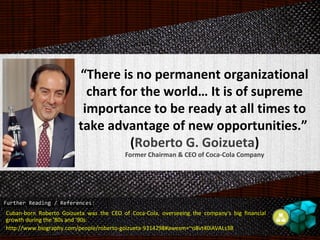
“There is no permanent organizational
chart for the world… It is of supreme
importance to be ready at all times to
take advantage of new opportunities.”
(Roberto G. Goizueta)
Former Chairman & CEO of Coca-Cola Company
Cuban-born Roberto Goizueta was the CEO of Coca-Cola, overseeing the company's big financial
growth during the '80s and '90s.
http://www.biography.com/people/roberto-goizueta-9314298#awesm=~oBvt40iAVALs3B
Managing Resistance to Change
• Education and
Communication
• Participation and
Involvement
• Negotiation and Agreement
• Manipulation and
Cooptation
• Coercion
(William A. Pasmore)
Creating Strategic Change
“The first rule of change, therefore, is to
begin any process of change with
concern for its impact on people. The
second rule is to prepare people for the
change by educating them in what they
need to know in order for the change to
be successful; the third, involve them in
the change as much as possible; and the
fourth, with their involvement, to
change what really needs to be changed
about the entire system in order for the
effort to produce real results.”
Columbia University - Professor of Practice of Social Organizational Psychology
http://www.tc.columbia.edu/academics/?facid=wap2112
Models of
Organizational Change
Models of Organizational Change
A. Lewin’s Change Management Model
B. Kotter’s 8 Step Change Model
C. Action Research Model
D. Positive Model
Other Organizational Change Models: McKinsey 7-S Model, Edgar
Huse’s 7 Stage Model of Change, General Model of Planned
Change
A. Lewin’s Change Management Models
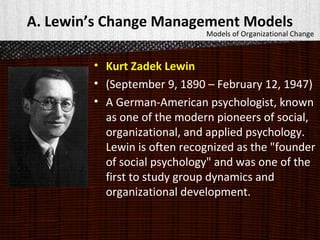
• Kurt Zadek Lewin
• (September 9, 1890 – February 12, 1947)
• A German-American psychologist, known
as one of the modern pioneers of social,
organizational, and applied psychology.
Lewin is often recognized as the "founder
of social psychology" and was one of the
first to study group dynamics and
organizational development.
Models of Organizational Change
A. Lewin’s Change Management Models
Models of Organizational Change
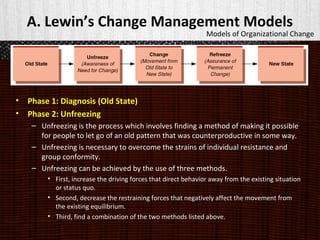
• Phase 1: Diagnosis (Old State)
• Phase 2: Unfreezing
– Unfreezing is the process which involves finding a method of making it possible
for people to let go of an old pattern that was counterproductive in some way.
– Unfreezing is necessary to overcome the strains of individual resistance and
group conformity.
– Unfreezing can be achieved by the use of three methods.
• First, increase the driving forces that direct behavior away from the existing situation
or status quo.
• Second, decrease the restraining forces that negatively affect the movement from
the existing equilibrium.
• Third, find a combination of the two methods listed above.
A. Lewin’s Change Management Models
Models of Organizational Change
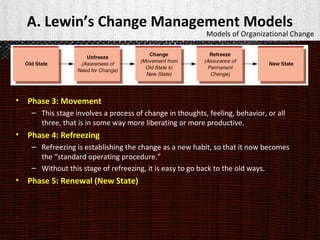
• Phase 3: Movement
– This stage involves a process of change in thoughts, feeling, behavior, or all
three, that is in some way more liberating or more productive.
• Phase 4: Refreezing
– Refreezing is establishing the change as a new habit, so that it now becomes
the “standard operating procedure.”
– Without this stage of refreezing, it is easy to go back to the old ways.
• Phase 5: Renewal (New State)
B. Kotter’s 8 Step Change Model
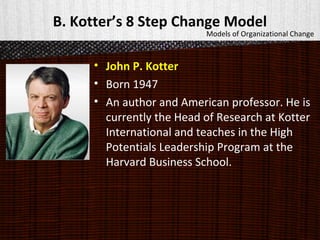
• John P. Kotter
• Born 1947
• An author and American professor. He is
currently the Head of Research at Kotter
International and teaches in the High
Potentials Leadership Program at the
Harvard Business School.
Models of Organizational Change
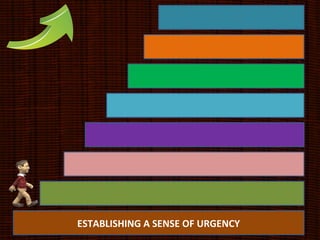
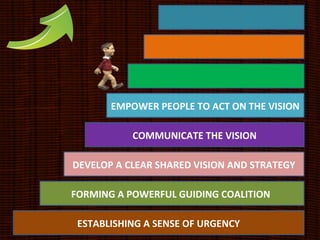
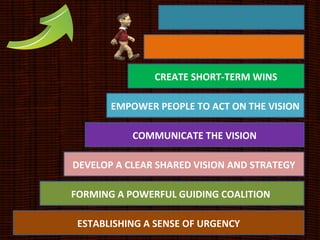
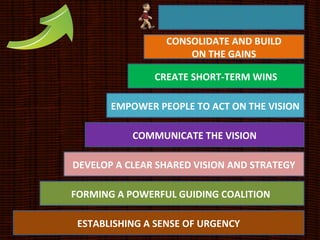
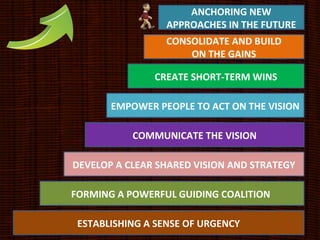
ESTABLISHING A SENSE OF URGENCY
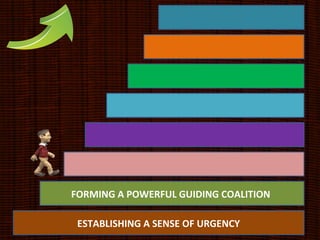
FORMING A POWERFUL GUIDING COALITION
ESTABLISHING A SENSE OF URGENCY
FORMING A POWERFUL GUIDING COALITION
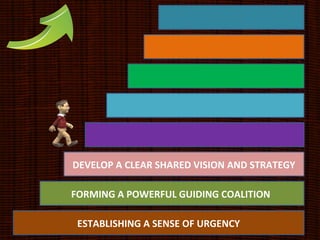
DEVELOP A CLEAR SHARED VISION AND STRATEGY
ESTABLISHING A SENSE OF URGENCY
FORMING A POWERFUL GUIDING COALITION
DEVELOP A CLEAR SHARED VISION AND STRATEGY
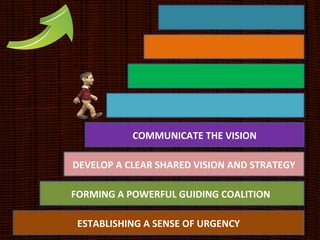
COMMUNICATE THE VISION
ESTABLISHING A SENSE OF URGENCY
FORMING A POWERFUL GUIDING COALITION
DEVELOP A CLEAR SHARED VISION AND STRATEGY
COMMUNICATE THE VISION
EMPOWER PEOPLE TO ACT ON THE VISION
ESTABLISHING A SENSE OF URGENCY
FORMING A POWERFUL GUIDING COALITION
DEVELOP A CLEAR SHARED VISION AND STRATEGY
COMMUNICATE THE VISION
EMPOWER PEOPLE TO ACT ON THE VISION
CREATE SHORT-TERM WINS
ESTABLISHING A SENSE OF URGENCY
FORMING A POWERFUL GUIDING COALITION
DEVELOP A CLEAR SHARED VISION AND STRATEGY
COMMUNICATE THE VISION
EMPOWER PEOPLE TO ACT ON THE VISION
CREATE SHORT-TERM WINS
CONSOLIDATE AND BUILD
ON THE GAINS
ESTABLISHING A SENSE OF URGENCY
FORMING A POWERFUL GUIDING COALITION
DEVELOP A CLEAR SHARED VISION AND STRATEGY
COMMUNICATE THE VISION
EMPOWER PEOPLE TO ACT ON THE VISION
CREATE SHORT-TERM WINS
CONSOLIDATE AND BUILD
ON THE GAINS
ANCHORING NEW
APPROACHES IN THE FUTURE
C. Action Research Model
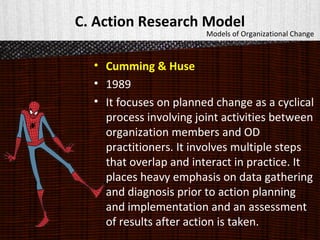
• Cumming & Huse
• 1989
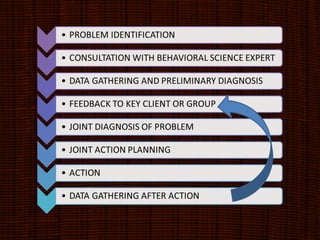
• It focuses on planned change as a cyclical
process involving joint activities between
organization members and OD
practitioners. It involves multiple steps
that overlap and interact in practice. It
places heavy emphasis on data gathering
and diagnosis prior to action planning
and implementation and an assessment
of results after action is taken.
Models of Organizational Change
D. Positive Model
• Focuses on what the organization is doing
right
• Helps members understand their
organization when it is working at its best
• Seeks to build on positive opportunities
that can lead to extraordinary performance
Models of Organizational Change
Organizational
Renewal: Adapting to
Change
Renewal
• Organizational renewal requires that top
managers make adaptive changes to the
environment.
• Manager must analyze the organization, its
departmental system interrelationships, and
the possible effects on the internal
environment.
– This approach, termed the system approach
provides a way of observing, analyzing, and
solving problems in organizations.
Constant Change
• Organizations exist in
constant changing
environment and therefore
must have the capacity to
adopt.
• Managers must do more than
react; they must be able to
anticipate the changing
patterns of people, markets,
product, and technology.
What is Organizational Renewal?
• Organizational renewal may be defined as
an ongoing process of building innovation
and adaptation into the organization.
• Develops a data-driven understanding of
the key exposures your business faces in
these unprecedented times as well as
your specific opportunities for achieving
greater success in the future.
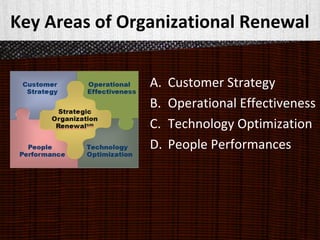
Key Areas of Organizational Renewal
A. Customer Strategy
B. Operational Effectiveness
C. Technology Optimization
D. People Performances
A) Customer Strategy
Analyze market positioning, customer
engagement, demand creation, satisfaction
drivers, changes in purchasing patterns, selling
efficiency, and customer-service efficiency. This
analysis creates a renewed understanding of
your key strategic drivers and the alignment of
your existing business model with current
market requirements.
B) Operational Effectiveness
Focus on the processes in your business that
must provide repeatable, high-quality, cost-
efficient outcomes. This systemic approach
analyzes operational fit, not just identifying but
also assessing the areas of your business’s
extended footprint that must integrate
seamlessly to deliver high levels of customer
satisfaction and operating efficiency.
C) Technology Optimizer
Review each functional area’s utilization of
technology. The review focuses on workload,
cost, complexity, and service levels. It also
covers areas such as knowledge management,
technology proficiency, technology utilization,
and support for new strategies and processes.
D) People Performance
Recognize the critical role your employees play
in the SOR process - they are the glue that
integrates the important facets of your business.
Take a pulse of your staff and review the overall
effectiveness of your people practices, including
performance systems, engagement processes,
HR policies, retention strategies, and
organizational culture.
Executing Your Renewal Strategy
• Recognizing that your ultimate success is
dependent on execution, a Roadmap for
Renewalsm is required to guide your
implementation efforts. This roadmap includes
a prioritization of needs, proper phasing of new
elements, sequencing of activities, milestones,
training, and a compilation of resource and
capital requirements.
The principle of physics
stating that everything
that is organized will
break down unless it is
maintained.
(Entropy)
“Be the change
that you wish to
see in the world.”
(Mahatma Gandhi)
Organizational Change

Organizational Change

  • 1.
    MEM 642 –Organizational Development and Leadership Effectiveness Polytechnic University of the Philippines (Summer 2014) Briones & Villanueva
  • 2.
    Presenters’ Profile Adrian JamesA. Briones Behavior, Safety and Career Development Trainer Serbiz Multi-Purpose Cooperative adrianjamesbriones@yahoo.com ajplus.wordpress.com Catherine S. Villanueva Teacher 1 Andres Bonifacio Elementary School cathyandykatecurt@gmail.com
  • 3.
    Content of Talk •Why Change? • Organizational Change – Need for Organizational Change – Causes of Organizational Change – Types of Organizational Change • Challenges of Change – Managing Resistance to Change • Models of Organizational Change – Lewin’s Change Management Model – Kotter’s 8 Step Change Model – Action Research Model – Positive Model • Organizational Renewal: Adapting to Change
  • 4.
    References • Cummings, T.and Worley, C. (2005). Organizational Development and Change, Thomson South Western • Brown, D.R. & Harvey, D. (2006). An experiential approach to Organizational development, (7th Edition). ,Upper Saddle River, NJ: Prentice Hall. • Crandall, M. (2006). Module 10 - Managing Change, The Information School of the University of Washington • Pierce, J. L., Gardner, D. G., with Dunham, R. B. (2002). Managing Organizational Change and Development, Management and Organizational Behavior: An Integrated Perspective. Cincinnati, OH: . South-Western College Publishing • Cummings, T., Worley, C. and Waddell, D. Organizational Change: Development and Transformation (4th Edition), Cengage Brain • Online References: – http://quickbase.intuit.com/blog/2012/08/28/three-types-of-change-management-models/ • Other References: – Organizational Change Management Methodology – Organizational Change, IBUS 681, Dr. Yang – Organizational Change / Organizational Development, Alexander Settles
  • 5.
    Why Change? • Changeis a fact of organizational life, just as it is in human life. An organization that does not change cannot survive long – much less thrive – in an unpredictable world. • Understanding the triggers that lead people to think change is needed, and what happens when managers try to make changes, is essential given the volatile world we live in.
  • 6.
    “There is nothing permanentexcept change.” (Heraclitus) A Greek philosopher of Ephesus (near modern Kuşadası, Turkey) who was active around 500 BCE, Heraclitus propounded a distinctive theory which he expressed in oracular language. http://plato.stanford.edu/entries/heraclitus/
  • 7.
    What is OrganizationalChange? • “Change is the norm in organizational life.” (Connor et. Al. 2003: 1) • It occurs when a company makes a transition from its current state to some desired future state. • Organizational change may range from introducing very micro-scale alterations, such as the introduction of new software in the office, to large-scale organizational restructuring, including the creation of new organizations and the termination of old ones. Managing Organisational Change, 2011 – Centre for Financial and Management Studies, SOAS, University of London
  • 8.
    What is OrganizationalChange? • An alteration of an organization’s environment, structure, culture, technology, or people. – A constant force – An organizational reality – An opportunity or a threat • Reconfigures components of an organization to increase efficiency and effectiveness. The Information School of the University of Washington, 2006
  • 9.
    What is OrganizationalChange? Is any action or set of actions resulting in a shift in direction or process that affects the way an organization works. Change can be deliberate and planned by leaders within the organization (i.e., shift from inpatient hospital focus to outpatient primary care model), or change can originate outside the organization (i.e., budget cut by Congress) and be beyond its control. The Information School of the University of Washington, 2006
  • 10.
    Why Do Organizations NeedOrganizational Change?
  • 11.
    Why Do OrganizationsNeed Organizational Change? • To remain competitive • For survival in globalization and rapidly evolving technology • To respond to a current crisis situation
  • 12.
    Van de Ven& Poole (1995) Causes of Organizational Change 1. Teleological Theory – an attempt to achieve an ideal state through a continuous process of goal-setting, execution, evaluation & restructuring 2. Life-Cycle Theory – organization is an entity that depending on the external environments, cycles through stages of birth, growth, maturation & declination 3. Dialectical Theory – organization is like a multi-cultural society with opposing values. When one particular force dominates over others, a new organizational value & goal is established resulting in organizational change
  • 13.
    Types of OrganizationalChange 1. Evolutionary Change – gradual, intermittent & narrowly- focused. The purpose is to make continuous improvement in order to adjust to the environment changes. 2. Revolutionary Change – rapid, dramatic and broadly focused. Happens when the current operation method can no longer fulfill the demand of the external environment & a significant change has to be made
  • 14.
  • 15.
    Challenges of Change A.Challenges of Initiating Change B. Challenges of Sustaining Momentum C. Challenges of System- Wide Redesign and Rethinking
  • 16.
    A) Challenges ofInitiating Change 1. “We don’t have time for this stuff!” People who are involved in a group to initiate a change effort need enough control over their schedules to give their work the time that it needs. 2. “We have no help!” Members of a group need enough support, coaching and resources to be able to learn and to do their work effectively.
  • 17.
    A) Challenges ofInitiating Change 3. “This stuff isn’t relevant.” There need to be people who can make the case for change – who can connect the development of new skills to the real work of the business. 4. “They’re not walking the talk!” A critical test for any change effort: the correlation between espoused values and actual behavior.
  • 18.
    B) Challenges ofSustaining Momentum 5. “This stuff is…” Personal fear and anxiety – concerns about vulnerability and inadequacy – lead members of a group to question a change effort. 6. “This stuff isn’t working!” Change efforts run into measurement problems: Early results don’t meet expectations, or traditional metrics don’t calibrate to a group’s efforts. 7. “They’re acting like a cult!” A group falls prey to arrogance, dividing the organization into “believers” and “nonbelievers”
  • 19.
    C) Challenges ofSystem-Wide Redesign and Rethinking 8. “They… never let us do this stuff.” The group wants more autonomy; “the powers that be” don’t want to lose control. 9. “We keep reinventing the wheel.” Instead of building on previous successes, each group finds that it has to start from scratch. 10. “Where are we going?” The larger strategy and purpose of a change effort may be obscured by day- to-day activity. Big question: Can the organization achieve a new definition of success?
  • 20.
    “There is nopermanent organizational chart for the world… It is of supreme importance to be ready at all times to take advantage of new opportunities.” (Roberto G. Goizueta) Former Chairman & CEO of Coca-Cola Company Cuban-born Roberto Goizueta was the CEO of Coca-Cola, overseeing the company's big financial growth during the '80s and '90s. http://www.biography.com/people/roberto-goizueta-9314298#awesm=~oBvt40iAVALs3B
  • 21.
    Managing Resistance toChange • Education and Communication • Participation and Involvement • Negotiation and Agreement • Manipulation and Cooptation • Coercion
  • 22.
    (William A. Pasmore) CreatingStrategic Change “The first rule of change, therefore, is to begin any process of change with concern for its impact on people. The second rule is to prepare people for the change by educating them in what they need to know in order for the change to be successful; the third, involve them in the change as much as possible; and the fourth, with their involvement, to change what really needs to be changed about the entire system in order for the effort to produce real results.” Columbia University - Professor of Practice of Social Organizational Psychology http://www.tc.columbia.edu/academics/?facid=wap2112
  • 23.
  • 24.
    Models of OrganizationalChange A. Lewin’s Change Management Model B. Kotter’s 8 Step Change Model C. Action Research Model D. Positive Model Other Organizational Change Models: McKinsey 7-S Model, Edgar Huse’s 7 Stage Model of Change, General Model of Planned Change
  • 25.
    A. Lewin’s ChangeManagement Models • Kurt Zadek Lewin • (September 9, 1890 – February 12, 1947) • A German-American psychologist, known as one of the modern pioneers of social, organizational, and applied psychology. Lewin is often recognized as the "founder of social psychology" and was one of the first to study group dynamics and organizational development. Models of Organizational Change
  • 26.
    A. Lewin’s ChangeManagement Models Models of Organizational Change • Phase 1: Diagnosis (Old State) • Phase 2: Unfreezing – Unfreezing is the process which involves finding a method of making it possible for people to let go of an old pattern that was counterproductive in some way. – Unfreezing is necessary to overcome the strains of individual resistance and group conformity. – Unfreezing can be achieved by the use of three methods. • First, increase the driving forces that direct behavior away from the existing situation or status quo. • Second, decrease the restraining forces that negatively affect the movement from the existing equilibrium. • Third, find a combination of the two methods listed above.
  • 27.
    A. Lewin’s ChangeManagement Models Models of Organizational Change • Phase 3: Movement – This stage involves a process of change in thoughts, feeling, behavior, or all three, that is in some way more liberating or more productive. • Phase 4: Refreezing – Refreezing is establishing the change as a new habit, so that it now becomes the “standard operating procedure.” – Without this stage of refreezing, it is easy to go back to the old ways. • Phase 5: Renewal (New State)
  • 28.
    B. Kotter’s 8Step Change Model • John P. Kotter • Born 1947 • An author and American professor. He is currently the Head of Research at Kotter International and teaches in the High Potentials Leadership Program at the Harvard Business School. Models of Organizational Change
  • 29.
  • 30.
    ESTABLISHING A SENSEOF URGENCY FORMING A POWERFUL GUIDING COALITION
  • 31.
    ESTABLISHING A SENSEOF URGENCY FORMING A POWERFUL GUIDING COALITION DEVELOP A CLEAR SHARED VISION AND STRATEGY
  • 32.
    ESTABLISHING A SENSEOF URGENCY FORMING A POWERFUL GUIDING COALITION DEVELOP A CLEAR SHARED VISION AND STRATEGY COMMUNICATE THE VISION
  • 33.
    ESTABLISHING A SENSEOF URGENCY FORMING A POWERFUL GUIDING COALITION DEVELOP A CLEAR SHARED VISION AND STRATEGY COMMUNICATE THE VISION EMPOWER PEOPLE TO ACT ON THE VISION
  • 34.
    ESTABLISHING A SENSEOF URGENCY FORMING A POWERFUL GUIDING COALITION DEVELOP A CLEAR SHARED VISION AND STRATEGY COMMUNICATE THE VISION EMPOWER PEOPLE TO ACT ON THE VISION CREATE SHORT-TERM WINS
  • 35.
    ESTABLISHING A SENSEOF URGENCY FORMING A POWERFUL GUIDING COALITION DEVELOP A CLEAR SHARED VISION AND STRATEGY COMMUNICATE THE VISION EMPOWER PEOPLE TO ACT ON THE VISION CREATE SHORT-TERM WINS CONSOLIDATE AND BUILD ON THE GAINS
  • 36.
    ESTABLISHING A SENSEOF URGENCY FORMING A POWERFUL GUIDING COALITION DEVELOP A CLEAR SHARED VISION AND STRATEGY COMMUNICATE THE VISION EMPOWER PEOPLE TO ACT ON THE VISION CREATE SHORT-TERM WINS CONSOLIDATE AND BUILD ON THE GAINS ANCHORING NEW APPROACHES IN THE FUTURE
  • 37.
    C. Action ResearchModel • Cumming & Huse • 1989 • It focuses on planned change as a cyclical process involving joint activities between organization members and OD practitioners. It involves multiple steps that overlap and interact in practice. It places heavy emphasis on data gathering and diagnosis prior to action planning and implementation and an assessment of results after action is taken. Models of Organizational Change
  • 39.
    D. Positive Model •Focuses on what the organization is doing right • Helps members understand their organization when it is working at its best • Seeks to build on positive opportunities that can lead to extraordinary performance Models of Organizational Change
  • 41.
  • 42.
    Renewal • Organizational renewalrequires that top managers make adaptive changes to the environment. • Manager must analyze the organization, its departmental system interrelationships, and the possible effects on the internal environment. – This approach, termed the system approach provides a way of observing, analyzing, and solving problems in organizations.
  • 43.
    Constant Change • Organizationsexist in constant changing environment and therefore must have the capacity to adopt. • Managers must do more than react; they must be able to anticipate the changing patterns of people, markets, product, and technology.
  • 44.
    What is OrganizationalRenewal? • Organizational renewal may be defined as an ongoing process of building innovation and adaptation into the organization. • Develops a data-driven understanding of the key exposures your business faces in these unprecedented times as well as your specific opportunities for achieving greater success in the future.
  • 45.
    Key Areas ofOrganizational Renewal A. Customer Strategy B. Operational Effectiveness C. Technology Optimization D. People Performances
  • 46.
    A) Customer Strategy Analyzemarket positioning, customer engagement, demand creation, satisfaction drivers, changes in purchasing patterns, selling efficiency, and customer-service efficiency. This analysis creates a renewed understanding of your key strategic drivers and the alignment of your existing business model with current market requirements.
  • 47.
    B) Operational Effectiveness Focuson the processes in your business that must provide repeatable, high-quality, cost- efficient outcomes. This systemic approach analyzes operational fit, not just identifying but also assessing the areas of your business’s extended footprint that must integrate seamlessly to deliver high levels of customer satisfaction and operating efficiency.
  • 48.
    C) Technology Optimizer Revieweach functional area’s utilization of technology. The review focuses on workload, cost, complexity, and service levels. It also covers areas such as knowledge management, technology proficiency, technology utilization, and support for new strategies and processes.
  • 49.
    D) People Performance Recognizethe critical role your employees play in the SOR process - they are the glue that integrates the important facets of your business. Take a pulse of your staff and review the overall effectiveness of your people practices, including performance systems, engagement processes, HR policies, retention strategies, and organizational culture.
  • 50.
    Executing Your RenewalStrategy • Recognizing that your ultimate success is dependent on execution, a Roadmap for Renewalsm is required to guide your implementation efforts. This roadmap includes a prioritization of needs, proper phasing of new elements, sequencing of activities, milestones, training, and a compilation of resource and capital requirements.
  • 51.
    The principle ofphysics stating that everything that is organized will break down unless it is maintained. (Entropy)
  • 52.
    “Be the change thatyou wish to see in the world.” (Mahatma Gandhi)

Editor's Notes

  • #6 Chang is a fact of organizational life. It is embedded in the very nature of our exitence.
  • #7 As the Greek Philosopher, Heraticulus mentioned, “There is nothing permannent except change.”
  • #8 For this reason, we can also say that we can never escape the fact that organizations change. SO what is Organizational Change? Accdg. To Connor et Al., Change is the norm. It is vital in every organization may it be in a micro or macro scale. Whether in small issues like the materials used in the office/school setting to the roster of executives within an organization, Organizational change is a must for survival.
  • #9 What is Organizational Change? An alteration of an organization’s environment, structure, culture, technology, or people. A constant force An organizational reality An opportunity or a threat Reconfigures components of an organization to increase efficiency and effectiveness.
  • #10 Organizational Change Is any action or set of actions resulting in a shift in direction or process that affects the way an organization works. Change can be deliberate and planned by leaders within the organization. If change come in an organization and we are not prepared or we lack necessary planning, undesirable consequences may apply. Example: Quezon Institute – Change of Inpatient to outpatient setting Schedule of workers from tri-shift a single day shift (8-4) Workforce reduced (to 25%) Change can originate outside the organization (i.e., budget cut by Congress) and be beyond its control. Example: The Congress reduced budget for Education where the schools in the Philippines suffer, and the outcome is that school resort to cutting down their expenses in manpower and maintenance.
  • #12 Why do we need change? As What Cummings and Worley would mention in their book, change is needed due to 3 facors: To remain competitive. Example would be the change to K12 Curriculum considering the fact that whole of south east asia will adopting a same standard. For survival in globalization and rapidly evolving technology. Example would be in olden days, schools would not include the computer subject and the hands on use of computers within the school until the present time that it has become a vital tool in ordinary schooling. To respond to a current crisis situation. Example would be War in Mindanao (Zamboaga) where schooling was temporarily stopped to avoid having the students and school personnel become Casualties of War.
  • #13 Van de Ven and Poole enumerated 3 theories to explain the causes of Organizational Change: 1) Teleological Theory – an attempt to achieve an ideal state through a continuous process of goal-setting, execution, evaluation & restructuring Organizational change happens with an attempt to be in an ideal state where restructuring happens to the point that goals and execution are evaluated and restructured. Example: HSDC Development Contest (Honda) 2) Life-Cycle Theory – Organizatinal is an entity that depending on the external environments, cycles through stages of birth, growth, maturation & declination. Example would be CDA Rule 10. Capital Build-Up. 3) Dialectical Theory - organization is like a multi-cultural society with opposing values. When one particular force dominates over others, a new organizational value & goal is established resulting in organizational change. Example: CBA where the Workforce Union influences the changes. Example Meralco. Lumpsum instead of Increase.
  • #14 Evolutionary Change – gradual, intermittent & narrowly-focused. The purpose is to make continuous improvement in order to adjust to the environment changes. Example: Incorporation of K12 Curriculum. Revolutionary Change – rapid, dramatic and broadly focused. Happens when the current operation method can no longer fulfill the demand of the external environment & a significant change has to be made Example: Happy Toothpaste.
  • #17 “We don’t have time for this stuff!” People who are involved in a group to initiate a change effort need enough control over their schedules to give their work the time that it needs. “We have no help!” Members of a group need enough support, coaching and resources to be able to learn and to do their work effectively.
  • #18 “This stuff isn’t relevant.” There need to be people who can make the case for change – who can connect the development of new skills to the real work of the business. “They’re not walking the talk!” A critical test for any change effort: the correlation between espoused values and actual behavior. (IMPLEMENTATION)
  • #19 “This stuff is…” Personal fear and anxiety – concerns about vulnerability and inadequacy – lead members of a group to question a change effort. “This stuff isn’t working!” Change efforts run into measurement problems: Early results don’t meet expectations, or traditional metrics don’t calibrate to a group’s efforts. “They’re acting like a cult!” A group falls prey to arrogance, dividing the organization into “believers” and “nonbelievers”
  • #20 “They… never let us do this stuff.” The group wants more autonomy; “the powers that be” don’t want to lose control. “We keep reinventing the wheel.” Instead of building on previous successes, each group finds that it has to start from scratch. “Where are we going?” The larger strategy and purpose of a change effort may be obscured by day-to-day activity. Big question: Can the organization achieve a new definition of success?
  • #21 Being ready includes accepting the fact that there will always be challenges.
  • #22 Managing Resistance to Change: Education and Communication. Example: Ponderosa Leather Goods, Inc. – Conversion to Piece Rate. Training and comparison study presentation to workers. Participation and Involvement. Example: Honda Development Contest Negotiation and Agreement Example: CBA. Meralco Limpsum Manipulation and Cooptation. Example: Union Coercion Example: Quezon Institure Retrenchment
  • #23 “The first rule of change, therefore, is to begin any process of change with concern for its impact on people. The second rule is to prepare people for the change by educating them in what they need to know in order for the change to be successful; the third, involve them in the change as much as possible; and the fourth, with their involvement, to change what really needs to be changed about the entire system in order for the effort to produce real results.”
  • #25 There are various Models used in Organizational Change and we are going to discuss 4 of them. Kotter’s 8 Step Change Model Action Research Model Lewin’s Change Management Model Positive Model General Model of Planned Change Other Organizational Change Models: McKinsey 7-S Model, Edgar Huse’s 7 Stage Model of Change
  • #26 Lewin viewed change as a “Quasi-Stationary Equilibrium” where 2 groups are striving to maintaion status quo or balance. Example would be a supervisor and his worker’s performance. In their balanced state, if you wish to increase the efficiency of both groups, you must raise either one.
  • #27 Phase 1: Is a review of the current standing of an organization. Phase 2: Finding the needs of an organization. What needs to change? Example: School Security (Picking up children)
  • #28 Phase 3: This stage involves a process of change in thoughts, feeling, behavior, or all three, that is in some way more liberating or more productive. Example: Giving “Authority ID Cards” to fetchers. A person without a card cannot fetch a child without due process. Phase 4: Inclusion to Policies / Student or Parent Handbook Phase 5: Renewal (New State). Already existing in “system.”
  • #29 John P. Kotter Born 1947 An author and American professor. He is currently the Head of Research at Kotter International and teaches in the High Potentials Leadership Program at the Harvard Business School. Kotter’s 8 Step Change Model was basked on Kurt Lewin’s Model but is more detailed in laying down the steps.
  • #30 Establishing a Sense of Urgency Examining market and competitive realities Identifying and discussing crises, or major opportunities
  • #31 Forming a Powerful Guiding Coalition Assembling a group with enough power to lead the change effort Encouraging the group to work together as a team
  • #32 Creating a Vision Creating a vision to help direct the change effort Developing strategies for achieving that vision
  • #33 Communicating the Vision Using every vehicle possible to communicate the new vision and strategies Teaching new behaviors by the example of the guiding coalition Key Elements in Effectively Communicating a Vision: Keep it simple. Eliminate all jargon and wasted words. Here is an example of a good statement of vision: "We are going to become faster than anyone else in our industry at satisfying customer needs." Use multiple forums. Try to use every channel possible-big meetings and small, memos and newspapers, formal and informal interaction-to spread the word. Use repetition. Ideas sink in deeply only after they have been heard many times. Lead by example. "Walk your talk" so that your behaviors and decisions are consistent
  • #34 Empowering Others to Act on the Vision Getting rid of obstacles to change Changing systems or structures that seriously undermine the vision Encouraging risk taking and non-traditional ideas, activities, and actions
  • #35 Planning for and Creating Short-Term Wins Planning for visible performance improvements Creating those improvements Recognizing and rewarding employees involved in the improvements
  • #36 Consolidating Improvements and Producing Still More Change Using increased credibility to change systems, structures, and policies that don’t fit the vision Hiring, promoting, and developing employees who can implement the vision Reinvigorating the process with new projects, themes, and change agents
  • #37 Institutionalizing New Approaches Articulating the connections between the new behaviors and corporate success Developing the means to ensure leadership development and succession
  • #39 Example: Problem Identification – Ponderosa Leather Good, Inc. – Piece Rate Consultation w/ behavioral science expert – Internal Industrial Engineer (TMS – Time-Motion Study) Data Gathering and Preliminary Diagnosis - 2-3 Day Trial where results are recorded and evaluated. Feedback to Key Client – Comment from PLGI. Joint Diagnosis – PLGI cites additional problems based on experience and company goals. Joint Action Planning – PLGI and SMPC creates TMS Schedule for Piece Rate Application. Action – Implementation of Piece Rate. Data Gathering – Evaluation of Piece Rate Standing. Feedback to Key Client
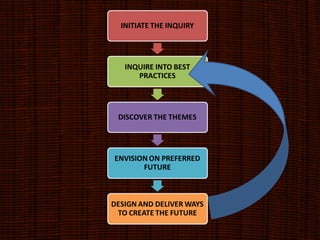
  • #41 Initiate the Inquiry - Cost Reduction Inquire Best Practice - Everyone given the opportunity to suggest a cost reduction program (Contest - Money involved) Discover Themes - Low Cost in Engine Packaging in Storage due expensive bubble bags. Envision a Preferred Future - how much will they save? Design and Deliver Ways - Incorporation to Standard Operating procedures. Inquire – Continues program of looking for cost reduction strategies.
  • #52 As the principle in physics Entropy would say, that everything that is organized will break down unless it is maintained. And that maintenance that is vital is constant change. Either we change as an organization or we break down.