“Change & Development”
What are your reactions when you
hear the word “change?”
•Negative perceptions….
•Positive perceptions….
Your Perceptions of Change
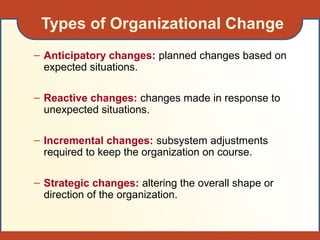
Types of Organizational Change
– Anticipatory changes: planned changes based on
expected situations.
– Reactive changes: changes made in response to
unexpected situations.
– Incremental changes: subsystem adjustments
required to keep the organization on course.
– Strategic changes: altering the overall shape or
direction of the organization.
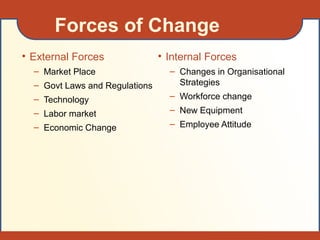
Forces of Change
• External Forces
– Market Place
– Govt Laws and Regulations
– Technology
– Labor market
– Economic Change
• Internal Forces
– Changes in Organisational
Strategies
– Workforce change
– New Equipment
– Employee Attitude
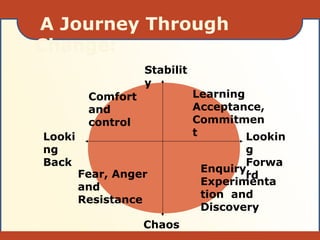
A Journey Through
Change:
Stabilit
y
Learning
Acceptance,
Commitmen
t Lookin
g
Forwa
rd
Looki
ng
Back
Comfort
and
control
Fear, Anger
and
Resistance
Chaos
Enquiry,
Experimenta
tion and
Discovery
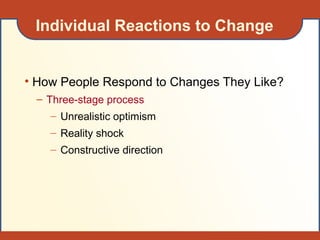
Individual Reactions to Change
• How People Respond to Changes They Like?
– Three-stage process
– Unrealistic optimism
– Reality shock
– Constructive direction
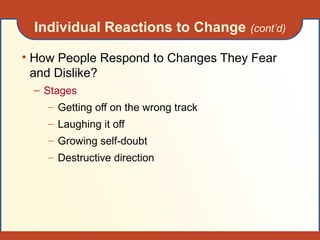
Individual Reactions to Change (cont’d)
• How People Respond to Changes They Fear
and Dislike?
– Stages
– Getting off on the wrong track
– Laughing it off
– Growing self-doubt
– Destructive direction
Change: Organizational and
Individual Perspectives (cont’d)
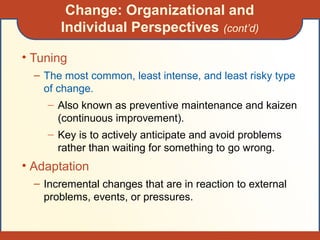
• Tuning
– The most common, least intense, and least risky type
of change.
– Also known as preventive maintenance and kaizen
(continuous improvement).
– Key is to actively anticipate and avoid problems
rather than waiting for something to go wrong.
• Adaptation
– Incremental changes that are in reaction to external
problems, events, or pressures.
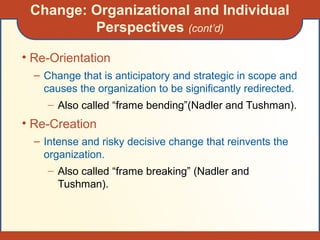
• Re-Orientation
– Change that is anticipatory and strategic in scope and
causes the organization to be significantly redirected.
– Also called “frame bending”(Nadler and Tushman).
• Re-Creation
– Intense and risky decisive change that reinvents the
organization.
– Also called “frame breaking” (Nadler and
Tushman).
Change: Organizational and Individual
Perspectives (cont’d)
Why Do Employees
Resist Change?
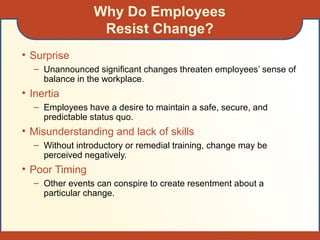
• Surprise
– Unannounced significant changes threaten employees’ sense of
balance in the workplace.
• Inertia
– Employees have a desire to maintain a safe, secure, and
predictable status quo.
• Misunderstanding and lack of skills
– Without introductory or remedial training, change may be
perceived negatively.
• Poor Timing
– Other events can conspire to create resentment about a
particular change.
Why Do Employees Resist Change? (cont’d)
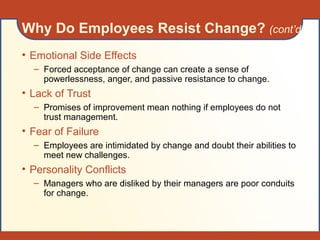
• Emotional Side Effects
– Forced acceptance of change can create a sense of
powerlessness, anger, and passive resistance to change.
• Lack of Trust
– Promises of improvement mean nothing if employees do not
trust management.
• Fear of Failure
– Employees are intimidated by change and doubt their abilities to
meet new challenges.
• Personality Conflicts
– Managers who are disliked by their managers are poor conduits
for change.
• Threat to Job Status/Security
– Employees worry that any change may threaten their
job or security.
• Breakup of Work Group
– Changes can tear apart established on-the-job social
relationships.
• Competing Commitments
– Change can disrupt employees in their pursuit of
other goals.
Why Do Employees Resist Change? (cont’d)
Overcoming Resistance to Change
• Strategies for Overcoming Resistance to
Change
– Education and communication
– Participation and involvement
– Facilitation and support
– Negotiation and agreement
– Manipulation and co-optation
– Explicit and implicit coercion
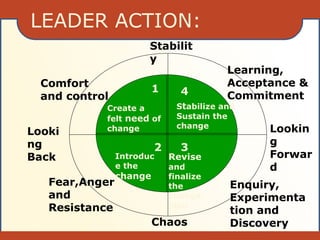
LEADER ACTION:
Stabilit
y
Comfort
and control
Looki
ng
Back
Lookin
g
Forwar
d
Chaos
Fear,Anger
and
Resistance
Enquiry,
Experimenta
tion and
Discovery
Learning,
Acceptance &
Commitment
Create a
felt need of
change
Stabilize and
Sustain the
change
Introduc
e the
change
Revise
and
finalize
the
change
plan
1
2 3
4
Making Change Happen
• Two Approaches to Organization Change
– Organization Development (OD)
– Formal top-down approach
– Grassroots Change
– An unofficial and informal bottom-up approach
Planned Change Through Organization
Development (OD)
• Organization development (OD)
– Planned change programs intended to help people
and organizations function more effectively.
– Applying behavioral science principles, methods,
and theories to create and cope with change.
– OD creates fundamental change in the
organization, as opposed to fixing a problem or
improving a procedure.
– OD programs generally are facilitated by hired
consultants,
Planned Change Through Organization
Development (OD) (cont’d)
• Objectives of OD
– Deepen the sense of organizational purpose.
– Strengthen interpersonal trust.
– Encourage problem solving rather than avoidance.
– Develop a satisfying work experience.
– Supplement formal authority with knowledge and skill-
based authority.
– Increase personal responsibility for planning and
implementing.
– Encourage willingness to change.
Planned Change Through Organization
Development (OD) (cont’d)
• The OD Process (Kurt Lewin)
– Unfreezing, changing, and refreezing social systems
– Unfreezing: neutralizing resistance by preparing
people for change.
– Changing: implementing the planned change
– Refreezing: systematically following a change
program for lasting results.
Unofficial and Informal Grassroots Change
• Grassroots Change
– Change that is spontaneous, informal, experimental,
and driven from within.
• Tempered Radicals
– People who quietly try to change the dominant
organizational culture in line with their convictions.
– Guidelines for tempered radicals
– Think small for big results.
– Be authentic.
– Translate.
– Don’t go it alone.
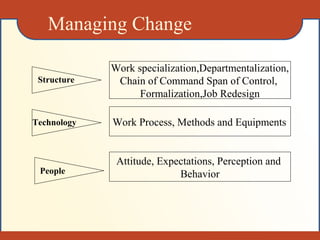
Managing Change
Structure
Technology
People
Work specialization,Departmentalization,
Chain of Command Span of Control,
Formalization,Job Redesign
Attitude, Expectations, Perception and
Behavior
Work Process, Methods and Equipments
Innovation
C
R
E
A
T
I
V
I
T
Y
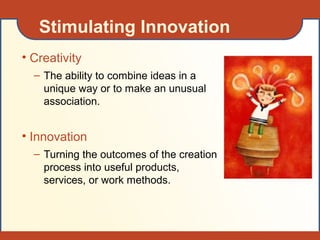
Stimulating Innovation
• Creativity
– The ability to combine ideas in a
unique way or to make an unusual
association.
• Innovation
– Turning the outcomes of the creation
process into useful products,
services, or work methods.
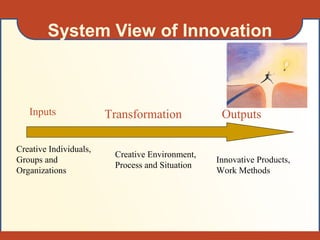
System View of Innovation
Transformation Outputs
Creative Individuals,
Groups and
Organizations
Creative Environment,
Process and Situation
Innovative Products,
Work Methods
Inputs
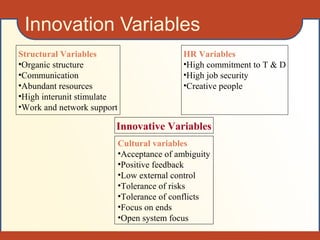
Innovation Variables
Innovative Variables
Structural Variables
•Organic structure
•Communication
•Abundant resources
•High interunit stimulate
•Work and network support
Cultural variables
•Acceptance of ambiguity
•Positive feedback
•Low external control
•Tolerance of risks
•Tolerance of conflicts
•Focus on ends
•Open system focus
HR Variables
•High commitment to T & D
•High job security
•Creative people
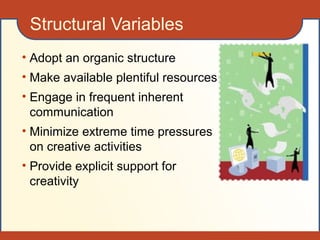
Structural Variables
• Adopt an organic structure
• Make available plentiful resources
• Engage in frequent inherent
communication
• Minimize extreme time pressures
on creative activities
• Provide explicit support for
creativity
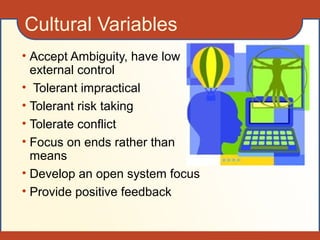
Cultural Variables
• Accept Ambiguity, have low
external control
• Tolerant impractical
• Tolerant risk taking
• Tolerate conflict
• Focus on ends rather than
means
• Develop an open system focus
• Provide positive feedback
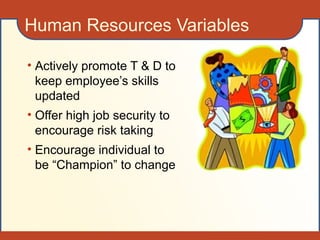
Human Resources Variables
• Actively promote T & D to
keep employee’s skills
updated
• Offer high job security to
encourage risk taking
• Encourage individual to
be “Champion” to change

Change and development

  • 1.
  • 2.
    What are yourreactions when you hear the word “change?” •Negative perceptions…. •Positive perceptions…. Your Perceptions of Change
  • 3.
    Types of OrganizationalChange – Anticipatory changes: planned changes based on expected situations. – Reactive changes: changes made in response to unexpected situations. – Incremental changes: subsystem adjustments required to keep the organization on course. – Strategic changes: altering the overall shape or direction of the organization.
  • 4.
    Forces of Change •External Forces – Market Place – Govt Laws and Regulations – Technology – Labor market – Economic Change • Internal Forces – Changes in Organisational Strategies – Workforce change – New Equipment – Employee Attitude
  • 5.
    A Journey Through Change: Stabilit y Learning Acceptance, Commitmen tLookin g Forwa rd Looki ng Back Comfort and control Fear, Anger and Resistance Chaos Enquiry, Experimenta tion and Discovery
  • 6.
    Individual Reactions toChange • How People Respond to Changes They Like? – Three-stage process – Unrealistic optimism – Reality shock – Constructive direction
  • 7.
    Individual Reactions toChange (cont’d) • How People Respond to Changes They Fear and Dislike? – Stages – Getting off on the wrong track – Laughing it off – Growing self-doubt – Destructive direction
  • 8.
    Change: Organizational and IndividualPerspectives (cont’d) • Tuning – The most common, least intense, and least risky type of change. – Also known as preventive maintenance and kaizen (continuous improvement). – Key is to actively anticipate and avoid problems rather than waiting for something to go wrong. • Adaptation – Incremental changes that are in reaction to external problems, events, or pressures.
  • 9.
    • Re-Orientation – Changethat is anticipatory and strategic in scope and causes the organization to be significantly redirected. – Also called “frame bending”(Nadler and Tushman). • Re-Creation – Intense and risky decisive change that reinvents the organization. – Also called “frame breaking” (Nadler and Tushman). Change: Organizational and Individual Perspectives (cont’d)
  • 10.
    Why Do Employees ResistChange? • Surprise – Unannounced significant changes threaten employees’ sense of balance in the workplace. • Inertia – Employees have a desire to maintain a safe, secure, and predictable status quo. • Misunderstanding and lack of skills – Without introductory or remedial training, change may be perceived negatively. • Poor Timing – Other events can conspire to create resentment about a particular change.
  • 11.
    Why Do EmployeesResist Change? (cont’d) • Emotional Side Effects – Forced acceptance of change can create a sense of powerlessness, anger, and passive resistance to change. • Lack of Trust – Promises of improvement mean nothing if employees do not trust management. • Fear of Failure – Employees are intimidated by change and doubt their abilities to meet new challenges. • Personality Conflicts – Managers who are disliked by their managers are poor conduits for change.
  • 12.
    • Threat toJob Status/Security – Employees worry that any change may threaten their job or security. • Breakup of Work Group – Changes can tear apart established on-the-job social relationships. • Competing Commitments – Change can disrupt employees in their pursuit of other goals. Why Do Employees Resist Change? (cont’d)
  • 13.
    Overcoming Resistance toChange • Strategies for Overcoming Resistance to Change – Education and communication – Participation and involvement – Facilitation and support – Negotiation and agreement – Manipulation and co-optation – Explicit and implicit coercion
  • 14.
    LEADER ACTION: Stabilit y Comfort and control Looki ng Back Lookin g Forwar d Chaos Fear,Anger and Resistance Enquiry, Experimenta tionand Discovery Learning, Acceptance & Commitment Create a felt need of change Stabilize and Sustain the change Introduc e the change Revise and finalize the change plan 1 2 3 4
  • 15.
    Making Change Happen •Two Approaches to Organization Change – Organization Development (OD) – Formal top-down approach – Grassroots Change – An unofficial and informal bottom-up approach
  • 16.
    Planned Change ThroughOrganization Development (OD) • Organization development (OD) – Planned change programs intended to help people and organizations function more effectively. – Applying behavioral science principles, methods, and theories to create and cope with change. – OD creates fundamental change in the organization, as opposed to fixing a problem or improving a procedure. – OD programs generally are facilitated by hired consultants,
  • 17.
    Planned Change ThroughOrganization Development (OD) (cont’d) • Objectives of OD – Deepen the sense of organizational purpose. – Strengthen interpersonal trust. – Encourage problem solving rather than avoidance. – Develop a satisfying work experience. – Supplement formal authority with knowledge and skill- based authority. – Increase personal responsibility for planning and implementing. – Encourage willingness to change.
  • 18.
    Planned Change ThroughOrganization Development (OD) (cont’d) • The OD Process (Kurt Lewin) – Unfreezing, changing, and refreezing social systems – Unfreezing: neutralizing resistance by preparing people for change. – Changing: implementing the planned change – Refreezing: systematically following a change program for lasting results.
  • 19.
    Unofficial and InformalGrassroots Change • Grassroots Change – Change that is spontaneous, informal, experimental, and driven from within. • Tempered Radicals – People who quietly try to change the dominant organizational culture in line with their convictions. – Guidelines for tempered radicals – Think small for big results. – Be authentic. – Translate. – Don’t go it alone.
  • 20.
    Managing Change Structure Technology People Work specialization,Departmentalization, Chainof Command Span of Control, Formalization,Job Redesign Attitude, Expectations, Perception and Behavior Work Process, Methods and Equipments
  • 21.
  • 22.
    Stimulating Innovation • Creativity –The ability to combine ideas in a unique way or to make an unusual association. • Innovation – Turning the outcomes of the creation process into useful products, services, or work methods.
  • 23.
    System View ofInnovation Transformation Outputs Creative Individuals, Groups and Organizations Creative Environment, Process and Situation Innovative Products, Work Methods Inputs
  • 24.
    Innovation Variables Innovative Variables StructuralVariables •Organic structure •Communication •Abundant resources •High interunit stimulate •Work and network support Cultural variables •Acceptance of ambiguity •Positive feedback •Low external control •Tolerance of risks •Tolerance of conflicts •Focus on ends •Open system focus HR Variables •High commitment to T & D •High job security •Creative people
  • 25.
    Structural Variables • Adoptan organic structure • Make available plentiful resources • Engage in frequent inherent communication • Minimize extreme time pressures on creative activities • Provide explicit support for creativity
  • 26.
    Cultural Variables • AcceptAmbiguity, have low external control • Tolerant impractical • Tolerant risk taking • Tolerate conflict • Focus on ends rather than means • Develop an open system focus • Provide positive feedback
  • 27.
    Human Resources Variables •Actively promote T & D to keep employee’s skills updated • Offer high job security to encourage risk taking • Encourage individual to be “Champion” to change