Understanding Changewww.humanikaconsulting.com
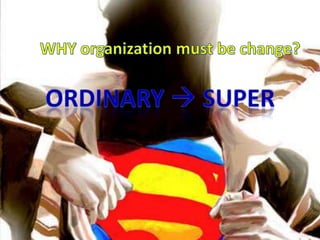
WHY organization must be change?ORDINARY  SUPER
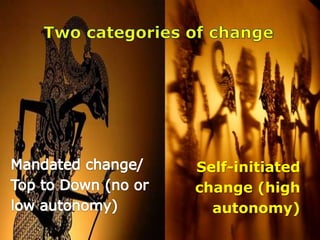
Two categories of changeMandated change/ Top to Down (no or low autonomy)Self-initiated change (high autonomy)
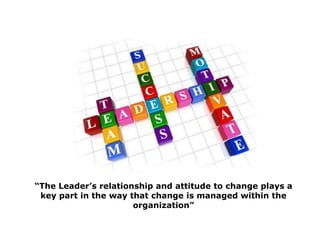
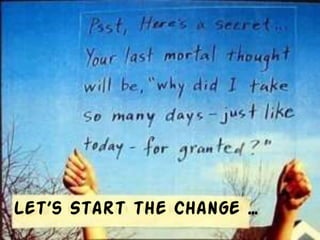
“The Leader’s relationship and attitude to change plays a key part in the way that change is managed within the organization”
“Understanding your organization makes easy to make changes”
CONCEPT 1 : Lewin (1947) : 3 stage model of Attitude ChangeUnfreezing - strategies for gaining support for changeMoving - reducing resistance, motivating, cultural changeRefreezing - evaluating and anchoring change in organization
UnfreezingBreaking down existing ways of doing thingsDiscarding conventional methods & behavioral patternsIntroduce new methods & behaviorTechniques: Education, Communication, Participation in decision-making, etc.
Changing or MovingMove towards proposed change New learningIt is a time of trial & error Careful guidance – problems arise – tackled efficiently
New beliefs, attitudes gained, behavior learnt are implementedManager – Change agent’s roleReinforcement Refreezing
CONCEPT 2 :Kotter (1996) : Change Management ProcessEstablish a sense of urgency
Create a Guiding Coalition (a critical mass to drive change)
Develop a Vision and Strategy
Communicate the Change Vision
Empower Action
Generate Short Term Wins
Consolidate Gains and Produce More Change
Anchor New Approaches in CultureCONCEPT 3 : Morgan (1986) : 8 Core MetaphorsMachines (Efficiency, waste, maintenance, order, clockwork, cogs in a wheel, programs, inputs and outputs, standardization, production, measurement and control, design) Organisms (Living systems, environmental conditions, adaptation, life cycles, recycling, needs, homeostasis, evolution, survival of the fittest, health, illness)Brains (Learning, parallel information processing, distributed control, mindsets, intelligence, feedback, requisite variety, knowledge, networks)Cultures (Society, values, beliefs, laws, ideology, rituals, diversity, traditions, history, service, shared vision and mission, understanding, qualities, families)Political Systems (Interests and rights, power, hidden agendas and back room deals, authority, alliances, party-line, censorship, gatekeepers, leaders, conflict management)Psychic Prisons (Conscious & unconscious processes, repression & regression, ego, denial, projection, coping & defence  mechanisms, pain & pleasure principle, dysfunction, workaholics)Flux and Transformation (Constant change, dynamic equilibrium, flow, self-organization, systemic wisdom, attractors, chaos, complexity, butterfly effect, emergent properties, dialectics, paradox)Instruments of Domination (Alienation, repression, imposing values, compliance, charisma, maintenance of power, force, exploitation, divide and rule, discrimination, corporate interest)
Using CONCEPT to help understand your organizationWhat personal CONCEPT would you use to describe your organization?What does the CONCEPT that you chose to describe your organization say about your relationship with it?Do you have any control or power, or are you ‘powerless’? Do you want to bring about any change? Do you stand a chance?
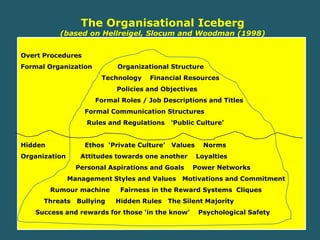
The Organisational Iceberg(based on Hellreigel, Slocum and Woodman (1998)Overt ProceduresFormal Organization            Organizational Structure			        Technology    Financial Resources				Policies and Objectives			     Formal Roles / Job Descriptions and Titles			Formal Communication Structures			 Rules and Regulations   ‘Public Culture’Hidden		Ethos  ‘Private Culture’   Values    NormsOrganization       Attitudes towards one another    Loyalties                          Personal Aspirations and Goals    Power Networks                      Management Styles and Values   Motivations and CommitmentRumour machine     Fairness in the Reward Systems  Cliques           Threats   Bullying     Hidden Rules   The Silent Majority       Success and rewards for those ‘in the know’    Psychological Safety
Reasons for Change Factors may lead to a necessity for changeTo improve performanceTo reduce waste and inefficiencyTo improve management control and satisfaction of the employeesTo improve the quality and productivity of an organizationTo compete in the changing market environment To achieve the desired business results as early as possible
Making Change HappenTwo Approaches to Organizational ChangeOrganization Development (OD)Formal top-down approachGrassroots ChangeAn unofficial and informal bottom-up approach. Change that is spontaneous, informal, experimental, and driven from within.
Barriers to Change - identifying the root causesIts only by analyzing where the problem lies that you can decide what to do, and work out what strategies to put in place -strategies should be context specific
Understanding the barriers to change
Individual ResistanceLack of trust in those leading process of changeConfusion about purpose of changeLack of consultation and involvement in process of changeLoss of personal power or freedomLoss of identity/status - where identity is tied into position or titleFear of the unknown or futureLoss of skills and the need to retrain, so loss of expertiseLifeWhere is the Individual on the ‘ Change Transition’ curve?
Institutional ResistanceChange not locked into strategic development‘Wrong’ timeframeOrganizational culture has an  in-built inflexibility (new titles but same old systems and structures beneath)Inexperienced and inflexible managers who lack charisma, leading changeThreats to existing power holdersLacks a ‘fresh’ view of situationCarries a history of poor change management Poor people management Kinchington (2004)
Overcoming Resistance to ChangeEducation and communicationParticipation and involvementFacilitation and supportNegotiation and agreementLeadership
Change AgentsChange Agents
Persons who act as catalysts and assume the responsibility for managing the change process.
Types of Change Agents
Managers: internal entrepreneurs
Non-managers: change specialists
Outside consultants: change implementation expertsPersonal Responses to Change(Lewis-Parker  7 stage ‘Transition Curve’, 1981)
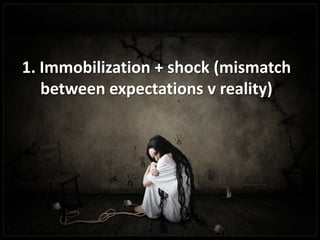
1. Immobilization + shock (mismatch between expectations v reality)
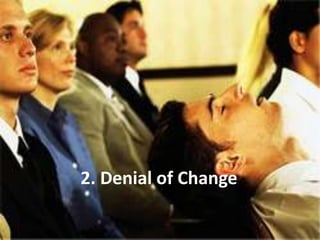
2. Denial of Change
3. Incompetence (resulting in increased awareness and frustration)
4. Acceptance of Reality (willing to let go)
5. Testing (working out ways of dealing with the new reality)
6. Search for Meaning (internalizing the situation and trying to make sense of it)
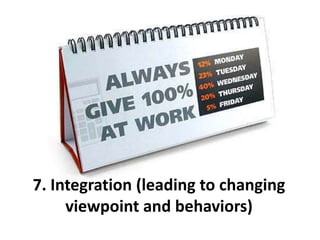
7. Integration (leading to changing viewpoint and behaviors)
Managing Stress on Change
1. Individual ApproachesImplementing time managementIncreasing physical exerciseRelaxation trainingExpanding social support network
2. Organizational ApproachesImproved personnel selection and job placementTrainingUse of realistic goal settingRedesigning of jobsIncreased employee involvementImproved organizational communicationOffering employee sabbaticalsEstablishment of corporate wellness programs
Strategies normally used by managers to Handle Resistance: AvoidanceProviding InformationParticipationManipulationNegotiationPower/ForceBut maybe a more individualized -tailored approach should be considered
What Can a Manager Do?
1. Do not ignore the people side of “change Management”The practice of Change Management is a combination of the methods used by people (usually management teams) within organizations to ensure organizational transition is completed efficiently and effectively.
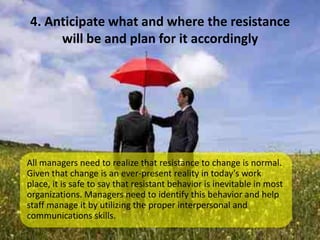
2. Interpersonal and communication skillsTheir interpersonal and communication skills so that they could help their staff overcome the pains associated with change.
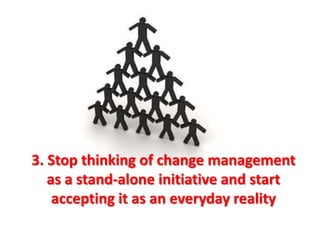
3. Stop thinking of change management as a stand-alone initiative and start accepting it as an everyday reality

understanding change

  • 1.
  • 2.
    WHY organization mustbe change?ORDINARY  SUPER
  • 3.
    Two categories ofchangeMandated change/ Top to Down (no or low autonomy)Self-initiated change (high autonomy)
  • 4.
    “The Leader’s relationshipand attitude to change plays a key part in the way that change is managed within the organization”
  • 5.
    “Understanding your organizationmakes easy to make changes”
  • 6.
    CONCEPT 1 :Lewin (1947) : 3 stage model of Attitude ChangeUnfreezing - strategies for gaining support for changeMoving - reducing resistance, motivating, cultural changeRefreezing - evaluating and anchoring change in organization
  • 7.
    UnfreezingBreaking down existingways of doing thingsDiscarding conventional methods & behavioral patternsIntroduce new methods & behaviorTechniques: Education, Communication, Participation in decision-making, etc.
  • 8.
    Changing or MovingMovetowards proposed change New learningIt is a time of trial & error Careful guidance – problems arise – tackled efficiently
  • 9.
    New beliefs, attitudesgained, behavior learnt are implementedManager – Change agent’s roleReinforcement Refreezing
  • 10.
    CONCEPT 2 :Kotter(1996) : Change Management ProcessEstablish a sense of urgency
  • 11.
    Create a GuidingCoalition (a critical mass to drive change)
  • 12.
    Develop a Visionand Strategy
  • 13.
  • 14.
  • 15.
  • 16.
    Consolidate Gains andProduce More Change
  • 17.
    Anchor New Approachesin CultureCONCEPT 3 : Morgan (1986) : 8 Core MetaphorsMachines (Efficiency, waste, maintenance, order, clockwork, cogs in a wheel, programs, inputs and outputs, standardization, production, measurement and control, design) Organisms (Living systems, environmental conditions, adaptation, life cycles, recycling, needs, homeostasis, evolution, survival of the fittest, health, illness)Brains (Learning, parallel information processing, distributed control, mindsets, intelligence, feedback, requisite variety, knowledge, networks)Cultures (Society, values, beliefs, laws, ideology, rituals, diversity, traditions, history, service, shared vision and mission, understanding, qualities, families)Political Systems (Interests and rights, power, hidden agendas and back room deals, authority, alliances, party-line, censorship, gatekeepers, leaders, conflict management)Psychic Prisons (Conscious & unconscious processes, repression & regression, ego, denial, projection, coping & defence mechanisms, pain & pleasure principle, dysfunction, workaholics)Flux and Transformation (Constant change, dynamic equilibrium, flow, self-organization, systemic wisdom, attractors, chaos, complexity, butterfly effect, emergent properties, dialectics, paradox)Instruments of Domination (Alienation, repression, imposing values, compliance, charisma, maintenance of power, force, exploitation, divide and rule, discrimination, corporate interest)
  • 18.
    Using CONCEPT tohelp understand your organizationWhat personal CONCEPT would you use to describe your organization?What does the CONCEPT that you chose to describe your organization say about your relationship with it?Do you have any control or power, or are you ‘powerless’? Do you want to bring about any change? Do you stand a chance?
  • 19.
    The Organisational Iceberg(basedon Hellreigel, Slocum and Woodman (1998)Overt ProceduresFormal Organization Organizational Structure Technology Financial Resources Policies and Objectives Formal Roles / Job Descriptions and Titles Formal Communication Structures Rules and Regulations ‘Public Culture’Hidden Ethos ‘Private Culture’ Values NormsOrganization Attitudes towards one another Loyalties Personal Aspirations and Goals Power Networks Management Styles and Values Motivations and CommitmentRumour machine Fairness in the Reward Systems Cliques Threats Bullying Hidden Rules The Silent Majority Success and rewards for those ‘in the know’ Psychological Safety
  • 20.
    Reasons for ChangeFactors may lead to a necessity for changeTo improve performanceTo reduce waste and inefficiencyTo improve management control and satisfaction of the employeesTo improve the quality and productivity of an organizationTo compete in the changing market environment To achieve the desired business results as early as possible
  • 21.
    Making Change HappenTwoApproaches to Organizational ChangeOrganization Development (OD)Formal top-down approachGrassroots ChangeAn unofficial and informal bottom-up approach. Change that is spontaneous, informal, experimental, and driven from within.
  • 22.
    Barriers to Change- identifying the root causesIts only by analyzing where the problem lies that you can decide what to do, and work out what strategies to put in place -strategies should be context specific
  • 23.
  • 24.
    Individual ResistanceLack oftrust in those leading process of changeConfusion about purpose of changeLack of consultation and involvement in process of changeLoss of personal power or freedomLoss of identity/status - where identity is tied into position or titleFear of the unknown or futureLoss of skills and the need to retrain, so loss of expertiseLifeWhere is the Individual on the ‘ Change Transition’ curve?
  • 25.
    Institutional ResistanceChange notlocked into strategic development‘Wrong’ timeframeOrganizational culture has an in-built inflexibility (new titles but same old systems and structures beneath)Inexperienced and inflexible managers who lack charisma, leading changeThreats to existing power holdersLacks a ‘fresh’ view of situationCarries a history of poor change management Poor people management Kinchington (2004)
  • 26.
    Overcoming Resistance toChangeEducation and communicationParticipation and involvementFacilitation and supportNegotiation and agreementLeadership
  • 27.
  • 28.
    Persons who actas catalysts and assume the responsibility for managing the change process.
  • 29.
  • 30.
  • 31.
  • 32.
    Outside consultants: changeimplementation expertsPersonal Responses to Change(Lewis-Parker 7 stage ‘Transition Curve’, 1981)
  • 33.
    1. Immobilization +shock (mismatch between expectations v reality)
  • 34.
  • 35.
    3. Incompetence (resultingin increased awareness and frustration)
  • 36.
    4. Acceptance ofReality (willing to let go)
  • 37.
    5. Testing (workingout ways of dealing with the new reality)
  • 38.
    6. Search forMeaning (internalizing the situation and trying to make sense of it)
  • 39.
    7. Integration (leadingto changing viewpoint and behaviors)
  • 40.
  • 41.
    1. Individual ApproachesImplementingtime managementIncreasing physical exerciseRelaxation trainingExpanding social support network
  • 42.
    2. Organizational ApproachesImprovedpersonnel selection and job placementTrainingUse of realistic goal settingRedesigning of jobsIncreased employee involvementImproved organizational communicationOffering employee sabbaticalsEstablishment of corporate wellness programs
  • 43.
    Strategies normally usedby managers to Handle Resistance: AvoidanceProviding InformationParticipationManipulationNegotiationPower/ForceBut maybe a more individualized -tailored approach should be considered
  • 44.
    What Can aManager Do?
  • 45.
    1. Do notignore the people side of “change Management”The practice of Change Management is a combination of the methods used by people (usually management teams) within organizations to ensure organizational transition is completed efficiently and effectively.
  • 46.
    2. Interpersonal andcommunication skillsTheir interpersonal and communication skills so that they could help their staff overcome the pains associated with change.
  • 47.
    3. Stop thinkingof change management as a stand-alone initiative and start accepting it as an everyday reality