

ORGANISATION
TRANSFORMATION
Ranjeet Kumar Singh
CHANGE - Introduction








Developmental change – First Order ;Change that enhances or corrects existing
aspects of an organisation, often focusing on the improvement of a skill or
process.
Transitional change seeks to achieve a known desired state that is different
from the existing one. Episodic, planned and second order, or radical.
Transformational change is radical or second order in nature. Requires a shift
in assumptions made by the organisation and its members.
Nature of Changes: Changes to the organizational culture, business processes,
physical environment, job design / responsibilities, staff skills / knowledge and
policies / procedures.

 Difficult to introduce change to an organization. Failure to do so can cause many
projects fail.
 Organizations go through four stages on the way to achieving their strategic
objective:

Denial  Resistance  Exploration  Renewal
 Productivity Dip- Negative impact on the productivity during the stages.
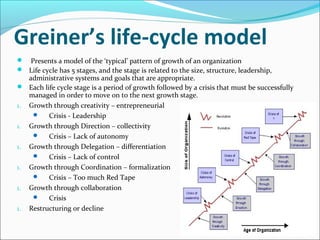
Greiner’s life-cycle model
  Presents a model of the ‘typical’ pattern of growth of an organization
 Life cycle has 5 stages, and the stage is related to the size, structure, leadership, 

administrative systems and goals that are appropriate.
 Each life cycle stage is a period of growth followed by a crisis that must be successfully 
managed in order to move on to the next growth stage.
1. Growth through creativity – entrepreneurial

Crisis - Leadership
1. Growth through Direction – collectivity

Crisis – Lack of autonomy
1. Growth through Delegation – differentiation

Crisis – Lack of control
1. Growth through Coordination – formalization

Crisis – Too much Red Tape
1. Growth through collaboration

Crisis 
1. Restructuring or decline
COMMUNICATE
 Know the objective of the CHANGE !
 Communicate-- the need for change, what was done & how it 







worked, current steps taken.
Goals and its accomplishment . How do you plan to reach the goals, 
what will you need to reach the goals, how long might it take and 
how will you know when you've reached your goals or not? Focus on 
the coordination of the departments/programs in your organization, 
not on each part by itself. 
Envoy the decisions to employees providing them the authority and 
responsibility to get the job done. 
Get feedbacks from employees regarding the problems and measure 
to solve them. Teams including the employee can be formed to solve 
the problem.
Viewpoint- towards the needs of customers/client and employees
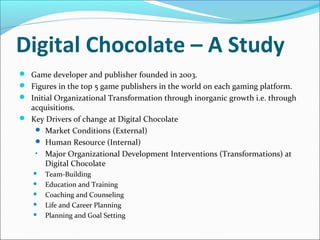
Digital Chocolate – A Study
 Game developer and publisher founded in 2003.
 Figures in the top 5 game publishers in the world on each gaming platform.
 Initial Organizational Transformation through inorganic growth i.e. through

acquisitions.
 Key Drivers of change at Digital Chocolate
 Market Conditions (External)
 Human Resource (Internal)
• Major Organizational Development Interventions (Transformations) at
Digital Chocolate






Team-Building
Education and Training
Coaching and Counseling
Life and Career Planning
Planning and Goal Setting
Organisational transformation

Organisational transformation