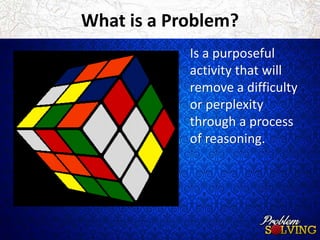
What is a Problem? 
Is a purposeful 
activity that will 
remove a difficulty 
or perplexity 
through a process 
of reasoning.
Reflective Thinking 
Is utilized in problem solving; it 
consists of two (2) phases: 
1) Statement of the perplexity 
or difficulty which gives rise 
to thinking. 
2) The act of searching, or 
inquiring, to find the 
material, process that will 
solve or dispose of the 
perplexity. 
Problem solving is both a learning 
and teaching procedure.
Classifications of Problems 
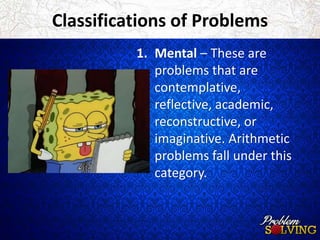
1. Mental – These are 
problems that are 
contemplative, 
reflective, academic, 
reconstructive, or 
imaginative. Arithmetic 
problems fall under this 
category.
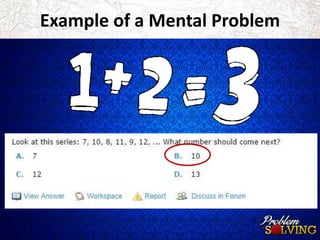
Example of a Mental Problem
Classifications of Problems 
2. Symbolic – These are 
problems that require 
written language, 
drawing, modeling, or 
construction for solution.
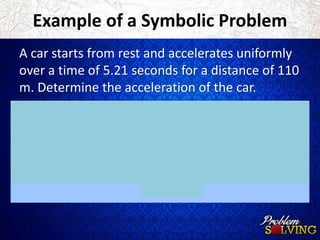
Example of a Symbolic Problem 
A car starts from rest and accelerates uniformly 
over a time of 5.21 seconds for a distance of 110 
m. Determine the acceleration of the car.
Classifications of Problems 
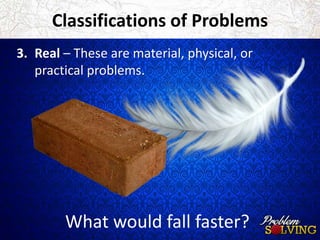
3. Real – These are material, physical, or 
practical problems. 
What would fall faster?
Functions of the Problem Method 
1. To give training in reasoning. 
2. To give practical knowledge 
and skills. 
3. To develop proper thought 
habits that will enable the 
child to meet whatever 
exigencies in life there are. 
4. To escape the consequences 
of some acts. 
5. To learn how to act in a new 
situation.
Functions of the Problem Method 
6. To learn how to make 
something. 
7. To solve a puzzling mental 
problem. 
8. To get out of a difficult 
situation. 
9. To learn to suspend judgment. 
10.To satisfy curiosity.
Functions of the Problem Method 
11.To learn to define and limit 
problems. 
12.To learn how to find solutions. 
13.To improve judgment. 
14.To verify opinion. 
15.To discover a new process. 
16.To invent a new device. 
17.To create a new idea. 
18.To improve knowledge.
Functions of the Problem Method 
19.To entertain others. 
20.To help another solve a 
problem.
Values 
Because the problem method is based on 
psychological drives, like curiosity, the child’s 
attitude toward school work is improved. The 
problem become sits stimulus and its solution; 
the goal. The child is encouraged to work on his 
own ability and the teacher ceases to be a 
taskmaster. It builds proper attitudes, among 
which the scientific attitude of considering all 
data accurately and objectively and testing the 
conclusion carefully.
Values 
Not only does the pupil improve his ability to 
solve his own problems, but he also learns to 
evaluate the thoughts and solutions of others. 
Too often, students can recite facts but cannot 
apply them to situations. Experience is problem 
solving will provide opportunities to utilize these 
facts, to acquire new meanings, and to gain new 
insights.
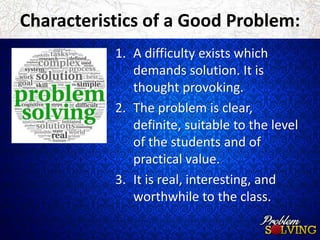
Characteristics of a Good Problem: 
1. A difficulty exists which 
demands solution. It is 
thought provoking. 
2. The problem is clear, 
definite, suitable to the level 
of the students and of 
practical value. 
3. It is real, interesting, and 
worthwhile to the class.
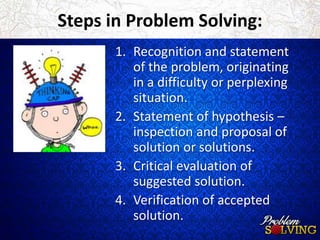
Steps in Problem Solving: 
1. Recognition and statement 
of the problem, originating 
in a difficulty or perplexing 
situation. 
2. Statement of hypothesis – 
inspection and proposal of 
solution or solutions. 
3. Critical evaluation of 
suggested solution. 
4. Verification of accepted 
solution.
Problem solving

Problem solving

  • 2.
    What is aProblem? Is a purposeful activity that will remove a difficulty or perplexity through a process of reasoning.
  • 3.
    Reflective Thinking Isutilized in problem solving; it consists of two (2) phases: 1) Statement of the perplexity or difficulty which gives rise to thinking. 2) The act of searching, or inquiring, to find the material, process that will solve or dispose of the perplexity. Problem solving is both a learning and teaching procedure.
  • 4.
    Classifications of Problems 1. Mental – These are problems that are contemplative, reflective, academic, reconstructive, or imaginative. Arithmetic problems fall under this category.
  • 5.
    Example of aMental Problem
  • 6.
    Classifications of Problems 2. Symbolic – These are problems that require written language, drawing, modeling, or construction for solution.
  • 7.
    Example of aSymbolic Problem A car starts from rest and accelerates uniformly over a time of 5.21 seconds for a distance of 110 m. Determine the acceleration of the car.
  • 8.
    Classifications of Problems 3. Real – These are material, physical, or practical problems. What would fall faster?
  • 9.
    Functions of theProblem Method 1. To give training in reasoning. 2. To give practical knowledge and skills. 3. To develop proper thought habits that will enable the child to meet whatever exigencies in life there are. 4. To escape the consequences of some acts. 5. To learn how to act in a new situation.
  • 10.
    Functions of theProblem Method 6. To learn how to make something. 7. To solve a puzzling mental problem. 8. To get out of a difficult situation. 9. To learn to suspend judgment. 10.To satisfy curiosity.
  • 11.
    Functions of theProblem Method 11.To learn to define and limit problems. 12.To learn how to find solutions. 13.To improve judgment. 14.To verify opinion. 15.To discover a new process. 16.To invent a new device. 17.To create a new idea. 18.To improve knowledge.
  • 12.
    Functions of theProblem Method 19.To entertain others. 20.To help another solve a problem.
  • 13.
    Values Because theproblem method is based on psychological drives, like curiosity, the child’s attitude toward school work is improved. The problem become sits stimulus and its solution; the goal. The child is encouraged to work on his own ability and the teacher ceases to be a taskmaster. It builds proper attitudes, among which the scientific attitude of considering all data accurately and objectively and testing the conclusion carefully.
  • 14.
    Values Not onlydoes the pupil improve his ability to solve his own problems, but he also learns to evaluate the thoughts and solutions of others. Too often, students can recite facts but cannot apply them to situations. Experience is problem solving will provide opportunities to utilize these facts, to acquire new meanings, and to gain new insights.
  • 15.
    Characteristics of aGood Problem: 1. A difficulty exists which demands solution. It is thought provoking. 2. The problem is clear, definite, suitable to the level of the students and of practical value. 3. It is real, interesting, and worthwhile to the class.
  • 16.
    Steps in ProblemSolving: 1. Recognition and statement of the problem, originating in a difficulty or perplexing situation. 2. Statement of hypothesis – inspection and proposal of solution or solutions. 3. Critical evaluation of suggested solution. 4. Verification of accepted solution.