Organizational Change
                               An Introduction


   © Ramakrishna Kongalla,
        Asstt. Professor


            R'tist @ Tourism
Lesson Plan

•   Objectives
•   Introduction
•   Concept of organizational change
•   forces for change
•   levels of change
•   Types of change
•   Steps in managed change
•   Resistance to change
•   Implementing change successfully
•   Methods of introducing @ Tourism
                         R'tist
                                change
OBJECTIVES
• Discuss the nature and process of change;
• Make aware about the nature and process of
  change;
• Understand different types of changes;
• Know the reasons and causes of resistance to
  change; and
• Understand how change can be introduced in an
  organisation.

                    R'tist @ Tourism
Organisation
• Organization is a social system.
• All parts of organization affect all other parts
• Anything happening at one end is transmitted to
  the other end
• Interrelationship between the elements &
  environment
• Orderly behaviour – equilibrium
• Becomes an established way of life
• Disturbance to this naturally exercises pressure
• Evokes a reaction – acceptance/rejection
                      R'tist @ Tourism
Change
• Alternation which occurs in the overall work
  environment of an organization
• ‘Change is the law of nature’
• Nothing is permanent except change
     • Change often results from the pressure of forces which
       are both outside and inside the organisation;
     • The whole organisation tends to be affected by the
       change in any part of it; and
     • Change takes place in all parts of the organisation, but at
       varying rates of speed and degrees of significance.

                            R'tist @ Tourism
External & Internal forces
• External Forces
    • Macro environment (PEST factors)
    • Micro Environment (Consumers, Suppliers, Stake
      Holders)
    • Opportunities & Threats (SWOT)
• Internal Forces
    • Internal Environment (Men, Money, Machinery,
      Materials, Minutes)
    • Strengths & Weaknesses (SWOT)
                      R'tist @ Tourism
Change In an Organization
• It is in a constant interactional and
  interdependent relationship with its
  environment
     • Change in its external environment, such as changes in
       consumer tastes and preferences, competition, economic
       policies of the Government, etc., make it imperative for
       an organisation to make changes in its internal system
• Composed of a number of subsystems which are
  also in a dynamic relationship of interaction and
  interdependence with one another
     • Any change in a subsystem creates a chain of changes
       throughout the entire system
                           R'tist @ Tourism
CONCEPT OF ORGANISATIONAL CHANGE
• ‘Organisational change’ implies the creation of
  imbalances in the existing pattern of situation
• Operations & Functions for a long time establishes
  structural set-up
• Members evolve a tentative set of relations with
  the environment, adjustment with job, working
  conditions, friends and colleagues etc.
• Change requires individuals to make new
  adjustments. Hence the fear of adjustment gives
  rise to the problem of change and resistance to
  change
                       R'tist @ Tourism
Management of Change is Defined as…
• A conscious and concerted initiative by those who are in-charge
  of the destiny of the business undertaking or firm to keep a
  constant and intelligent watch over the behaviour of
  uncontrollable forces, to assess their impact and influence of
  the controllable forces, and to evolve appropriate strategies
  and action programmes to maintain a dynamic equilibrium
  between the controllable and uncontrollable forces.

• Controllable forces are those forces about which sufficient
  information is available. Such forces can be managed easily
• Uncontrollable forces are those about which not much is
  known. These forces exert a powerful influence on the
  behaviour of controllable forces and limit the scope of
  managerial action.

                             R'tist @ Tourism
FORCES FOR CHANGE
(a) External Forces                   .
  – Demographic characteristics,
  – Technological advances,
  – Market changes, and
  – Social and political pressures
(b) Internal Forces
  – Human resource problems and Prospects
  – Managerial behavior/decisions


                       R'tist @ Tourism
LEVELS OF CHANGE
• (a) Individual Level Change
   – Job assignment, physical Move, Change in maturity of a
     person
   – Not significant on organisation, but significant on group
• b) Group Level Changes
   – Major effect because organizational activities are done in
     groups like departments or informal groups
   – affect workflows, job design, social organisation, influence
     and status systems, and communication patterns.
   – Managers must consider group factors
• (c) Organization Level Changes
   – involves major programs that affect both individuals and
     groups
   – Decisions regarding these changes are generally made by
     senior management and are seldom implemented by only a
     single manager         R'tist @ Tourism
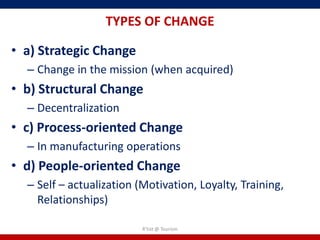
TYPES OF CHANGE

• a) Strategic Change
  – Change in the mission (when acquired)
• b) Structural Change
  – Decentralization
• c) Process-oriented Change
  – In manufacturing operations
• d) People-oriented Change
  – Self – actualization (Motivation, Loyalty, Training,
    Relationships)

                          R'tist @ Tourism
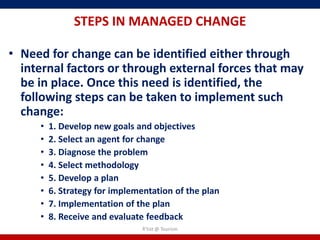
STEPS IN MANAGED CHANGE

• Need for change can be identified either through
  internal factors or through external forces that may
  be in place. Once this need is identified, the
  following steps can be taken to implement such
  change:
     •   1. Develop new goals and objectives
     •   2. Select an agent for change
     •   3. Diagnose the problem
     •   4. Select methodology
     •   5. Develop a plan
     •   6. Strategy for implementation of the plan
     •   7. Implementation of the plan
     •   8. Receive and evaluate feedback
                                R'tist @ Tourism
RESISTANCE TO CHANGE
• Resistance to change - a natural phenomenon
• Not all change is resisted
• In organisation changes are accepted than
  resisted
• Acceptance to change is Adaption
• Resistance to change is Unnatural behavior
• Failure to understand this characteristic of
  resistance can cause many managers to attempt
  to run through changes rather than try to
  understand the sources of the resistance.
                    R'tist @ Tourism
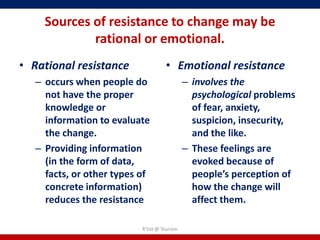
Sources of resistance to change may be
             rational or emotional.
• Rational resistance                • Emotional resistance
   – occurs when people do                    – involves the
     not have the proper                        psychological problems
     knowledge or                               of fear, anxiety,
     information to evaluate                    suspicion, insecurity,
     the change.                                and the like.
   – Providing information                    – These feelings are
     (in the form of data,                      evoked because of
     facts, or other types of                   people’s perception of
     concrete information)                      how the change will
     reduces the resistance                     affect them.

                           R'tist @ Tourism
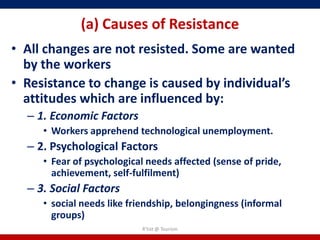
(a) Causes of Resistance
• All changes are not resisted. Some are wanted
  by the workers
• Resistance to change is caused by individual’s
  attitudes which are influenced by:
  – 1. Economic Factors
     • Workers apprehend technological unemployment.
  – 2. Psychological Factors
     • Fear of psychological needs affected (sense of pride,
       achievement, self-fulfilment)
  – 3. Social Factors
     • social needs like friendship, belongingness (informal
       groups)
                           R'tist @ Tourism
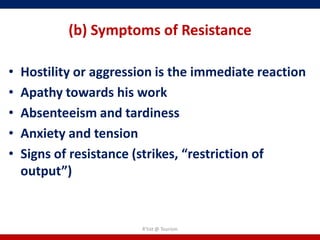
(b) Symptoms of Resistance

•   Hostility or aggression is the immediate reaction
•   Apathy towards his work
•   Absenteeism and tardiness
•   Anxiety and tension
•   Signs of resistance (strikes, “restriction of
    output”)


                        R'tist @ Tourism
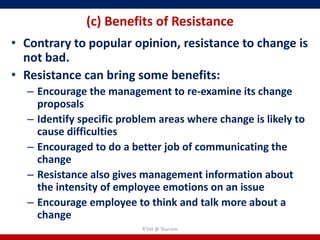
(c) Benefits of Resistance
• Contrary to popular opinion, resistance to change is
  not bad.
• Resistance can bring some benefits:
  – Encourage the management to re-examine its change
    proposals
  – Identify specific problem areas where change is likely to
    cause difficulties
  – Encouraged to do a better job of communicating the
    change
  – Resistance also gives management information about
    the intensity of employee emotions on an issue
  – Encourage employee to think and talk more about a
    change
                          R'tist @ Tourism
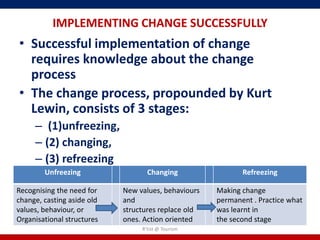
IMPLEMENTING CHANGE SUCCESSFULLY
• Successful implementation of change
  requires knowledge about the change
  process
• The change process, propounded by Kurt
  Lewin, consists of 3 stages:
     – (1)unfreezing,
     – (2) changing,
     – (3) refreezing
        Unfreezing                 Changing                 Refreezing

Recognising the need for    New values, behaviours   Making change
change, casting aside old   and                      permanent . Practice what
values, behaviour, or       structures replace old   was learnt in
Organisational structures   ones. Action oriented    the second stage
                                 R'tist @ Tourism
METHODS OF INTRODUCING CHANGE


• Kotter and Schlisinger have suggested six
  methods of introducing change
  – 1. Education + Communication
  – 2. Participation + involvement
  – 3. Facilitation+ Support
  – 4. Negotiation + Agreement
  – 5. Manipulation + cooptation
  – 6. Explicit + implicit coercion


                       R'tist @ Tourism
How to make the change the permanent

•   Use of group forces,
•   Use of leadership,
•   Shared rewards,
•   Working with unions, and
•   Concern for employees.


                   R'tist @ Tourism
Thank You…!!!
©Ramakrishna Kongalla
e-mail: artist.ramakrishna@gmail.com


              R'tist @ Tourism

01 organisational change

  • 1.
    Organizational Change An Introduction © Ramakrishna Kongalla, Asstt. Professor R'tist @ Tourism
  • 2.
    Lesson Plan • Objectives • Introduction • Concept of organizational change • forces for change • levels of change • Types of change • Steps in managed change • Resistance to change • Implementing change successfully • Methods of introducing @ Tourism R'tist change
  • 3.
    OBJECTIVES • Discuss thenature and process of change; • Make aware about the nature and process of change; • Understand different types of changes; • Know the reasons and causes of resistance to change; and • Understand how change can be introduced in an organisation. R'tist @ Tourism
  • 4.
    Organisation • Organization isa social system. • All parts of organization affect all other parts • Anything happening at one end is transmitted to the other end • Interrelationship between the elements & environment • Orderly behaviour – equilibrium • Becomes an established way of life • Disturbance to this naturally exercises pressure • Evokes a reaction – acceptance/rejection R'tist @ Tourism
  • 5.
    Change • Alternation whichoccurs in the overall work environment of an organization • ‘Change is the law of nature’ • Nothing is permanent except change • Change often results from the pressure of forces which are both outside and inside the organisation; • The whole organisation tends to be affected by the change in any part of it; and • Change takes place in all parts of the organisation, but at varying rates of speed and degrees of significance. R'tist @ Tourism
  • 6.
    External & Internalforces • External Forces • Macro environment (PEST factors) • Micro Environment (Consumers, Suppliers, Stake Holders) • Opportunities & Threats (SWOT) • Internal Forces • Internal Environment (Men, Money, Machinery, Materials, Minutes) • Strengths & Weaknesses (SWOT) R'tist @ Tourism
  • 7.
    Change In anOrganization • It is in a constant interactional and interdependent relationship with its environment • Change in its external environment, such as changes in consumer tastes and preferences, competition, economic policies of the Government, etc., make it imperative for an organisation to make changes in its internal system • Composed of a number of subsystems which are also in a dynamic relationship of interaction and interdependence with one another • Any change in a subsystem creates a chain of changes throughout the entire system R'tist @ Tourism
  • 8.
    CONCEPT OF ORGANISATIONALCHANGE • ‘Organisational change’ implies the creation of imbalances in the existing pattern of situation • Operations & Functions for a long time establishes structural set-up • Members evolve a tentative set of relations with the environment, adjustment with job, working conditions, friends and colleagues etc. • Change requires individuals to make new adjustments. Hence the fear of adjustment gives rise to the problem of change and resistance to change R'tist @ Tourism
  • 9.
    Management of Changeis Defined as… • A conscious and concerted initiative by those who are in-charge of the destiny of the business undertaking or firm to keep a constant and intelligent watch over the behaviour of uncontrollable forces, to assess their impact and influence of the controllable forces, and to evolve appropriate strategies and action programmes to maintain a dynamic equilibrium between the controllable and uncontrollable forces. • Controllable forces are those forces about which sufficient information is available. Such forces can be managed easily • Uncontrollable forces are those about which not much is known. These forces exert a powerful influence on the behaviour of controllable forces and limit the scope of managerial action. R'tist @ Tourism
  • 10.
    FORCES FOR CHANGE (a)External Forces . – Demographic characteristics, – Technological advances, – Market changes, and – Social and political pressures (b) Internal Forces – Human resource problems and Prospects – Managerial behavior/decisions R'tist @ Tourism
  • 11.
    LEVELS OF CHANGE •(a) Individual Level Change – Job assignment, physical Move, Change in maturity of a person – Not significant on organisation, but significant on group • b) Group Level Changes – Major effect because organizational activities are done in groups like departments or informal groups – affect workflows, job design, social organisation, influence and status systems, and communication patterns. – Managers must consider group factors • (c) Organization Level Changes – involves major programs that affect both individuals and groups – Decisions regarding these changes are generally made by senior management and are seldom implemented by only a single manager R'tist @ Tourism
  • 12.
    TYPES OF CHANGE •a) Strategic Change – Change in the mission (when acquired) • b) Structural Change – Decentralization • c) Process-oriented Change – In manufacturing operations • d) People-oriented Change – Self – actualization (Motivation, Loyalty, Training, Relationships) R'tist @ Tourism
  • 13.
    STEPS IN MANAGEDCHANGE • Need for change can be identified either through internal factors or through external forces that may be in place. Once this need is identified, the following steps can be taken to implement such change: • 1. Develop new goals and objectives • 2. Select an agent for change • 3. Diagnose the problem • 4. Select methodology • 5. Develop a plan • 6. Strategy for implementation of the plan • 7. Implementation of the plan • 8. Receive and evaluate feedback R'tist @ Tourism
  • 14.
    RESISTANCE TO CHANGE •Resistance to change - a natural phenomenon • Not all change is resisted • In organisation changes are accepted than resisted • Acceptance to change is Adaption • Resistance to change is Unnatural behavior • Failure to understand this characteristic of resistance can cause many managers to attempt to run through changes rather than try to understand the sources of the resistance. R'tist @ Tourism
  • 15.
    Sources of resistanceto change may be rational or emotional. • Rational resistance • Emotional resistance – occurs when people do – involves the not have the proper psychological problems knowledge or of fear, anxiety, information to evaluate suspicion, insecurity, the change. and the like. – Providing information – These feelings are (in the form of data, evoked because of facts, or other types of people’s perception of concrete information) how the change will reduces the resistance affect them. R'tist @ Tourism
  • 16.
    (a) Causes ofResistance • All changes are not resisted. Some are wanted by the workers • Resistance to change is caused by individual’s attitudes which are influenced by: – 1. Economic Factors • Workers apprehend technological unemployment. – 2. Psychological Factors • Fear of psychological needs affected (sense of pride, achievement, self-fulfilment) – 3. Social Factors • social needs like friendship, belongingness (informal groups) R'tist @ Tourism
  • 17.
    (b) Symptoms ofResistance • Hostility or aggression is the immediate reaction • Apathy towards his work • Absenteeism and tardiness • Anxiety and tension • Signs of resistance (strikes, “restriction of output”) R'tist @ Tourism
  • 18.
    (c) Benefits ofResistance • Contrary to popular opinion, resistance to change is not bad. • Resistance can bring some benefits: – Encourage the management to re-examine its change proposals – Identify specific problem areas where change is likely to cause difficulties – Encouraged to do a better job of communicating the change – Resistance also gives management information about the intensity of employee emotions on an issue – Encourage employee to think and talk more about a change R'tist @ Tourism
  • 19.
    IMPLEMENTING CHANGE SUCCESSFULLY •Successful implementation of change requires knowledge about the change process • The change process, propounded by Kurt Lewin, consists of 3 stages: – (1)unfreezing, – (2) changing, – (3) refreezing Unfreezing Changing Refreezing Recognising the need for New values, behaviours Making change change, casting aside old and permanent . Practice what values, behaviour, or structures replace old was learnt in Organisational structures ones. Action oriented the second stage R'tist @ Tourism
  • 20.
    METHODS OF INTRODUCINGCHANGE • Kotter and Schlisinger have suggested six methods of introducing change – 1. Education + Communication – 2. Participation + involvement – 3. Facilitation+ Support – 4. Negotiation + Agreement – 5. Manipulation + cooptation – 6. Explicit + implicit coercion R'tist @ Tourism
  • 21.
    How to makethe change the permanent • Use of group forces, • Use of leadership, • Shared rewards, • Working with unions, and • Concern for employees. R'tist @ Tourism
  • 22.
    Thank You…!!! ©Ramakrishna Kongalla e-mail:artist.ramakrishna@gmail.com R'tist @ Tourism