Cooperative
Development
Authority (CDA)
827 Aurora Blvd., Service Road, Brgy. Immaculate
Conception Cubao, 1111 Quezon City, Philippines
What is a Cooperative?
An autonomous and duly registered association
of persons, with a common bond of interest,
who have voluntarily joined together to achieve
their social, economic and cultural needs and
aspirations by making equitable contributions
to the capital required, patronizing their
products and services and accepting a fair share
of risks and benefits of the undertaking in
accordance with the universally accepted
cooperative principles.
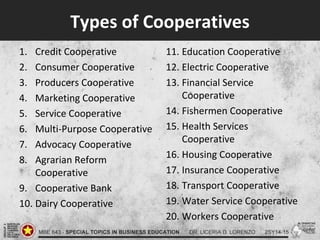
Types of Cooperatives
1. Credit Cooperative
2. Consumer Cooperative
3. Producers Cooperative
4. Marketing Cooperative
5. Service Cooperative
6. Multi-Purpose Cooperative
7. Advocacy Cooperative
8. Agrarian Reform
Cooperative
9. Cooperative Bank
10. Dairy Cooperative
11. Education Cooperative
12. Electric Cooperative
13. Financial Service
Cooperative
14. Fishermen Cooperative
15. Health Services
Cooperative
16. Housing Cooperative
17. Insurance Cooperative
18. Transport Cooperative
19. Water Service Cooperative
20. Workers Cooperative
Objectives of a Cooperative
1. Provide goods and services to its members to
enable them to attain increased income, savings,
investments, productivity, and purchasing power,
and promote among themselves equitable
distribution of net surplus through maximum
utilization of economies of scale, cost-sharing and
risk-sharing;
2. Provide optimum social and economic benefits to
its members;
3. Teach them efficient ways of doing things in a
cooperative manner;
Objectives of a Cooperative
4. Propagate cooperative practices and new ideas in
business and management;
5. Allow the lower income and less privileged groups
to increase their ownership in the wealth of the
nation; and
6. Cooperate with the government, other
cooperatives and people- oriented organizations to
further the attainment of any of the foregoing
objectives.
Cooperative Development Authority
The lead government
agency mandated by virtue
of Republic Act No. 9520
(Philippine Cooperative
Code of 2008) to promote
the viability and growth of
Philippine cooperatives. It is
the only government
agency that registers
cooperatives.
Constitutional Mandate
“The Congress shall create an agency
to promote the viability and growth of
cooperatives as instruments for
equity, social justice and economic
development.”
(Section 15, Article 12 of the 1987 Philippine Constitution)
Enabling Laws
• REPUBLIC ACT 6939 (March 10, 1990)
• EXECUTIVE ORDER NO. 95, Series of 1993
• EXECUTIVE ORDER NO. 332, Series of 2004
CDA’s Reasons for Being
• Chief implementer of the Cooperative Code
(Lead Government agency on cooperatives
development) and the sole registering
government agency of all types of co-ops
• Facilitates coordination of various cooperative
programs and activities of government
agencies, non-government organizations and
cooperatives.
CDA’s Mission & Vision
Vision
An effective and efficient regulatory agency
working towards the development of viable,
sustainable, socially responsive and globally
competitive cooperatives.
Mission
To ensure the safe and sound operations of
cooperatives.
Requirements for Registration
• Cooperative Name Reservation Notice
• Economic Survey
• Articles of Cooperation & By-Laws
• Treasurer’s Affidavit
• Surety Bonds of Accountable Officers
• Certificate of Pre-Membership Education Seminar (PMES)
• Undertaking to comply w/ the auditing and accounting
standards prescribed by the Authority.
• Proof of Land Ownership
• Well Drilling Data (in case of existing groundwater source)
including Physical and Chemical Analysis of water.
• Registration Fee
Privilege of Cooperatives
Tax Exemptions
•All national, city, provincial, municipal or
barangay taxes.
•Income Tax, Value-Added Tax, Percentage Tax,
Donor’s Tax, Excise Tax, Documentary Stamp
Tax, Annual Registration Fee, all taxes on
transactions with insurance companies and
banks
Cooperative Development Authority

Cooperative Development Authority

  • 2.
    Cooperative Development Authority (CDA) 827 AuroraBlvd., Service Road, Brgy. Immaculate Conception Cubao, 1111 Quezon City, Philippines
  • 4.
    What is aCooperative? An autonomous and duly registered association of persons, with a common bond of interest, who have voluntarily joined together to achieve their social, economic and cultural needs and aspirations by making equitable contributions to the capital required, patronizing their products and services and accepting a fair share of risks and benefits of the undertaking in accordance with the universally accepted cooperative principles.
  • 5.
    Types of Cooperatives 1.Credit Cooperative 2. Consumer Cooperative 3. Producers Cooperative 4. Marketing Cooperative 5. Service Cooperative 6. Multi-Purpose Cooperative 7. Advocacy Cooperative 8. Agrarian Reform Cooperative 9. Cooperative Bank 10. Dairy Cooperative 11. Education Cooperative 12. Electric Cooperative 13. Financial Service Cooperative 14. Fishermen Cooperative 15. Health Services Cooperative 16. Housing Cooperative 17. Insurance Cooperative 18. Transport Cooperative 19. Water Service Cooperative 20. Workers Cooperative
  • 6.
    Objectives of aCooperative 1. Provide goods and services to its members to enable them to attain increased income, savings, investments, productivity, and purchasing power, and promote among themselves equitable distribution of net surplus through maximum utilization of economies of scale, cost-sharing and risk-sharing; 2. Provide optimum social and economic benefits to its members; 3. Teach them efficient ways of doing things in a cooperative manner;
  • 7.
    Objectives of aCooperative 4. Propagate cooperative practices and new ideas in business and management; 5. Allow the lower income and less privileged groups to increase their ownership in the wealth of the nation; and 6. Cooperate with the government, other cooperatives and people- oriented organizations to further the attainment of any of the foregoing objectives.
  • 8.
    Cooperative Development Authority Thelead government agency mandated by virtue of Republic Act No. 9520 (Philippine Cooperative Code of 2008) to promote the viability and growth of Philippine cooperatives. It is the only government agency that registers cooperatives.
  • 9.
    Constitutional Mandate “The Congressshall create an agency to promote the viability and growth of cooperatives as instruments for equity, social justice and economic development.” (Section 15, Article 12 of the 1987 Philippine Constitution)
  • 10.
    Enabling Laws • REPUBLICACT 6939 (March 10, 1990) • EXECUTIVE ORDER NO. 95, Series of 1993 • EXECUTIVE ORDER NO. 332, Series of 2004
  • 11.
    CDA’s Reasons forBeing • Chief implementer of the Cooperative Code (Lead Government agency on cooperatives development) and the sole registering government agency of all types of co-ops • Facilitates coordination of various cooperative programs and activities of government agencies, non-government organizations and cooperatives.
  • 12.
    CDA’s Mission &Vision Vision An effective and efficient regulatory agency working towards the development of viable, sustainable, socially responsive and globally competitive cooperatives. Mission To ensure the safe and sound operations of cooperatives.
  • 13.
    Requirements for Registration •Cooperative Name Reservation Notice • Economic Survey • Articles of Cooperation & By-Laws • Treasurer’s Affidavit • Surety Bonds of Accountable Officers • Certificate of Pre-Membership Education Seminar (PMES) • Undertaking to comply w/ the auditing and accounting standards prescribed by the Authority. • Proof of Land Ownership • Well Drilling Data (in case of existing groundwater source) including Physical and Chemical Analysis of water. • Registration Fee
  • 14.
    Privilege of Cooperatives TaxExemptions •All national, city, provincial, municipal or barangay taxes. •Income Tax, Value-Added Tax, Percentage Tax, Donor’s Tax, Excise Tax, Documentary Stamp Tax, Annual Registration Fee, all taxes on transactions with insurance companies and banks

Editor's Notes

  • #6 Types of Cooperatives 1. Credit Cooperative is one that promotes and undertakes savings and lending services among its members. It generates a common pool of funds in order to provide financial assistance and other related financial services to its members for productive and provident purposes; 2. Consumer Cooperative is one the primary purpose of which is to procure and distribute commodities to members and non- members; 3. Producers Cooperative is one that undertakes joint production whether agricultural or industrial. It is formed and operated by its members to undertake the production and processing of raw materials or goods produced by its members into finished or processed products for sale by the cooperative to its members and non-members. Any end product or its derivative arising from the raw materials produced by its members, sold in the name of and for the account of the cooperative, shall be deemed a product of the cooperative and its members; 4. Marketing Cooperative is one which engages in the supply of production inputs to members and markets their products; 5. Service Cooperative is one which engages in medical and dental care, hospitalization, transportation, insurance, housing, labor, electric light and power, communication, professional and other services; 6. Multi-Purpose Cooperative combines two (2) or more of the business activities of these different types of cooperatives; 7. Advocacy Cooperative is a primary cooperative which promotes and advocates cooperativism among its members and the public through socially-oriented projects, education and training, research and communication, and other similar activities to reach out to its intended beneficiaries; 8. Agrarian Reform Cooperative is one organized by marginal farmers majority of which are agrarian reform beneficiaries for the purpose of developing an appropriate system of land tenure, land development, land consolidation or land management in areas covered by agrarian reform; 9. Cooperative Bank is one organized for the primary purpose of providing a wide range of financial services to cooperatives and their members; 10. Dairy Cooperative is one whose members are engaged in the production of fresh milk which may be processed and/or marketed as dairy products; 11. Education Cooperative is one organized for the primary purpose of owning and operating licensed educational institutions, notwithstanding the provisions of Republic Act No. 9155, otherwise known as the Governance of Basic Education Act of 2001; 12. Electric Cooperative is one organized for the primary purpose of undertaking power generation, utilizing renewable sources, including hybrid systems, acquisition and operation of sub transmission or distribution to its household members; 13. Financial Service Cooperative is one organized for the primary purpose of engaging in savings and credit services and other financial services; 14. Fishermen Cooperative is one organized by marginalized fishermen in localities whose products are marketed either as fresh or processed products; 15. Health Services Cooperative is one organized for the primary purpose of providing medical, dental, and other health services; 16. Housing Cooperative is one organized to assist or provide access to housing for the benefit of its regular members who actively participate in the savings program for housing. It is co-owned and controlled by its members; 17. Insurance Cooperative is one engaged in the business of insuring life and property of cooperatives and their members; 18. Transport Cooperative is one which includes land and sea transportation, limited to small vessels, as defined or classified under the Philippine maritime laws, organized under the provisions of RA 9520; 19. Water Service Cooperative is one organized to own, operate and manage waters systems for the provision and distribution of potable water for its members and their households; 20. Workers Cooperative is one organized by workers, including the self-employed, who are at the same time the members and owners of the enterprise. Its principal purpose is to provide employment and business opportunities to its members and manage it in accordance with cooperative principles; and 21. Other types of Cooperatives as may be determined by the Authority.
  • #11 REPUBLIC ACT 6939 (March 10, 1990) “An act creating the cooperative development authority to promote the viability and growth of cooperatives as instruments of equity, social justice and economic development, defining its powers, functions and responsibilities, rationalizing government policies and agencies with cooperative functions, supporting cooperative development, transferring the registration and regulation functions of existing government agencies on cooperatives as such and consolidating the same with the authority, appropriating funds therefor, and for other purposes” EXECUTIVE ORDER NO. 95, Series of 1993 Designating the CDA as the lead government agency on cooperative promotion, development and regulation and calling on all government agencies with cooperative programs to coordinate these to CDA. It also provides for the creation of the National Coordinating Committee and Cooperative Development Councils EXECUTIVE ORDER NO. 332, Series of 2004 Transferring the Cooperative Development Authority from the Office of the President to the Department of Finance (DoF)
  • #15 Privileges Enjoyed by Cooperatives Cooperatives shall enjoy the privilege of depositing their sealed cash boxes or containers, documents or any valuable papers in the safes of the municipal or city treasurers and other government offices free of charge, and the custodian of such articles shall issue a receipt acknowledging the articles received duly witnessed by another person; Cooperatives organized among government employees, notwithstanding any law or regulation to the contrary, shall enjoy the free use of any available space in their agency, whether owned or rented by the Government; Cooperatives rendering special types of services and facilities such as cold storage, ice plant, electricity, transportation, and similar services and facilities shall secure a franchise therefore, and such cooperatives shall open their membership to all persons qualified in their areas of operation; In areas where appropriate cooperatives exist the preferential right to supply government institutions and agencies rice, corn and other grains, fish and othervmarine products meat, eggs, milk, vegetables, tobacco and other agricultural commodities produced by their members shall be granted to the cooperatives concerned; Preferential treatment in the allocation of fertilizers and in rice distribution shall be granted to cooperatives by the appropriate government agencies; Preferential and equitable treatment in the allocation or control of bottomries of commercial shipping vessels in connection with the shipment of goods and products of cooperatives; Cooperatives and their federations, such as market vendor cooperatives, shall have preferential rights in management of public markets and/or lease of public market facilities, stall or spaces; Credit cooperatives and/or federations shall be entitled to loans, credit lines, rediscounting of their loan notes, and other eligible papers with the Development Bank of the Philippines, the Philippine National Bank, the Land Bank of the Philippines and other financial institutions except the Central Bank of the Philippines; Cooperatives transacting business with the Government of the Philippines or any of its political subdivisions or any of its agencies or instrumentalities, including government-owned and controlled corporations shall be exempt from prequalification bidding requirements; and Cooperatives shall enjoy the privilege of being represented by the provincial or city fiscal or the Office of the Solicitor General, free of charge, except when the adverse party is the Republic of the Philippines.