Why Do OrganizationsChange?
Organizational change:is the movement
of an organization from one state of
affairs to another.
03/30/25
2
3.
Organizational Change…
It mayinvolve a change in a company’s structure,
strategy, policies, procedures, technology, or culture.
The change may be planned years in advance or may be
forced upon an organization because of a shift in the
environment.
Organizational change can be radical and alter the way
an organization operates, or it may be incremental and
slowly change the way things are done. 03/30/25
3
4.
In any case,regardless of the type,
change involves letting go of the old
ways in which work is done and
adjusting to the new ways.
Therefore, fundamentally, it is a
process that involves effective people
management. 03/30/25
4
5.
Organizational change isoften a
response to changes in the environment.
1.Workforce Demographics
2.Technology
3.Globalization
4.Market Conditions
5.Organizational Growth
6.Poor Performance 03/30/25
5
6.
Resistance to Change
(Organizationalinertia)
•Changing an organization is often essential for a
company to remain competitive.
•Failure to change may influence the ability of a
company to survive.
•Yet, employees do not always welcome changes
03/30/25
6
7.
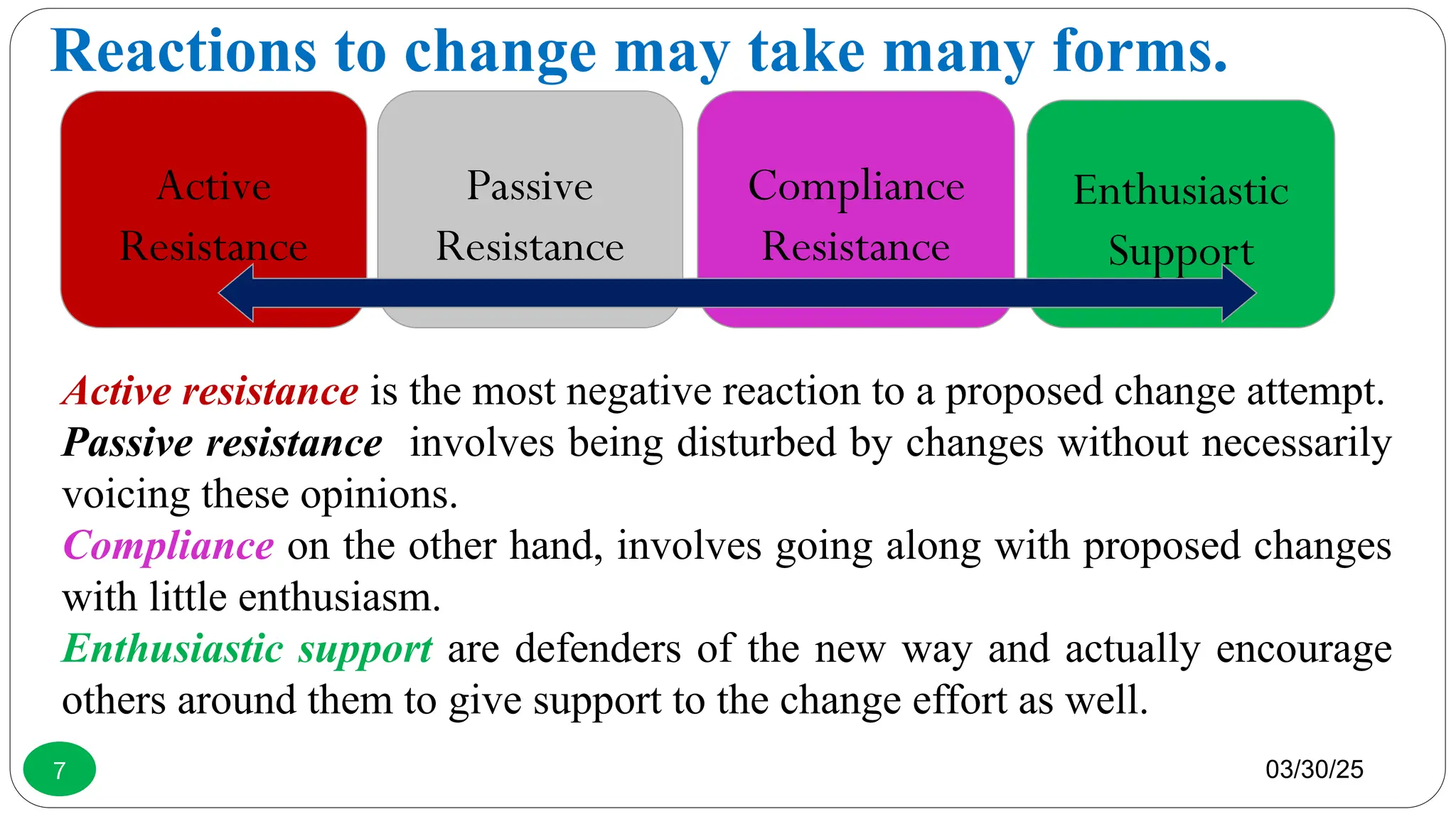
Reactions to changemay take many forms.
03/30/25
7
Active
Resistance
Passive
Resistance
Compliance
Resistance
Enthusiastic
Support
Active resistance is the most negative reaction to a proposed change attempt.
Passive resistance involves being disturbed by changes without necessarily
voicing these opinions.
Compliance on the other hand, involves going along with proposed changes
with little enthusiasm.
Enthusiastic support are defenders of the new way and actually encourage
others around them to give support to the change effort as well.
8.
03/30/25
8
Any change attemptwill have to overcome the resistance on the
part of people to be successful.
Otherwise, the result will be loss of time and energy as well as an
inability on the part of the organization to adapt to the changes in
the environment and make its operations more efficient.
Resistance to change also has negative consequences for the
people in question.
Research shows that when people negatively react to
organizational change, they experience negative emotions, use
sick time more often, and are more likely to
9.
03/30/25
9
Why Do PeopleResist Change?
1. Disrupted Habits
People often resist change for the simple reason
that change disrupts our habits.
2. Personality
Research shows that people who have a positive self-
concept are better at coping with change, probably
because those who have high self-esteem may feel that
whatever the changes are, they are likely to adjust to it
well and be successful in the new system.
10.
03/30/25
10
3. Feelings ofUncertainty
Change inevitably brings feelings of uncertainty. E.g You have just heard
that your company is merging with another. What would be your
reaction? Such change is often turbulent, and it is often unclear what is
going to happen to each individual.
4. Fear of Failure
People also resist change when they feel that their performance may be
affected under the new system.
5. Personal Impact of Change
In fact, people tend to be more welcoming of change that is favorable to
them on a personal level (such as giving them more power over others, or
change that improves quality of life such as bigger and nicer offices).
11.
03/30/25
11
6. Prevalence ofChange
The lack of a history of successful changes may cause people to
feel skeptical toward the newly planned changes. Therefore,
considering the history of changes in the company is important to
understanding why people resist.
7. Perceived Loss of Power
One other reason why people may resist change is that change
may affect their power and influence in the organization. Imagine
that your company moved to a more team-based structure,
turning supervisors into team leaders. In the old structure,
supervisors were in charge of hiring and firing all those reporting
to them. Under the new system, this power is given to the team
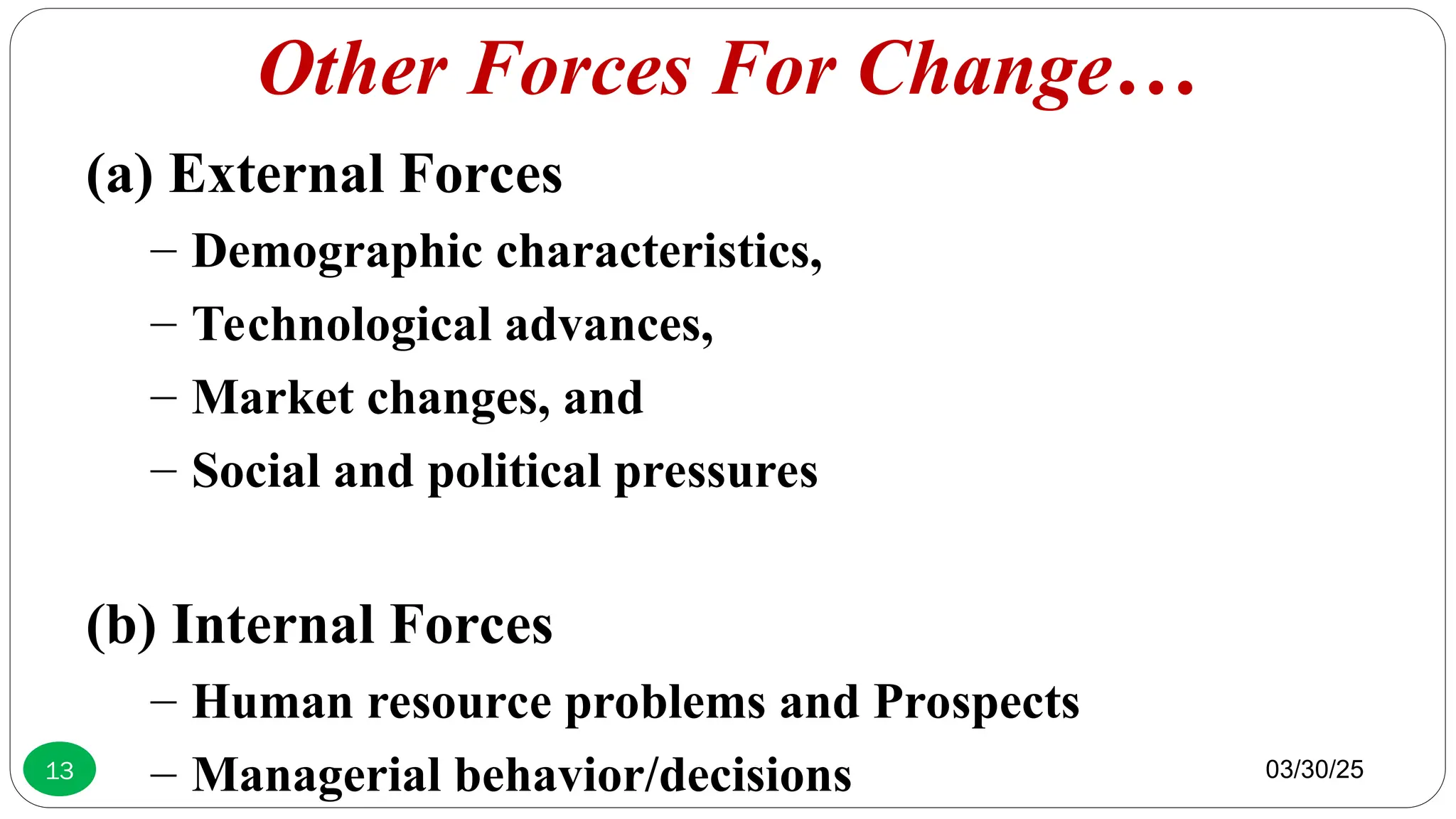
Other Forces ForChange…
(a) External Forces
– Demographic characteristics,
– Technological advances,
– Market changes, and
– Social and political pressures
(b) Internal Forces
– Human resource problems and Prospects
– Managerial behavior/decisions 03/30/25
13
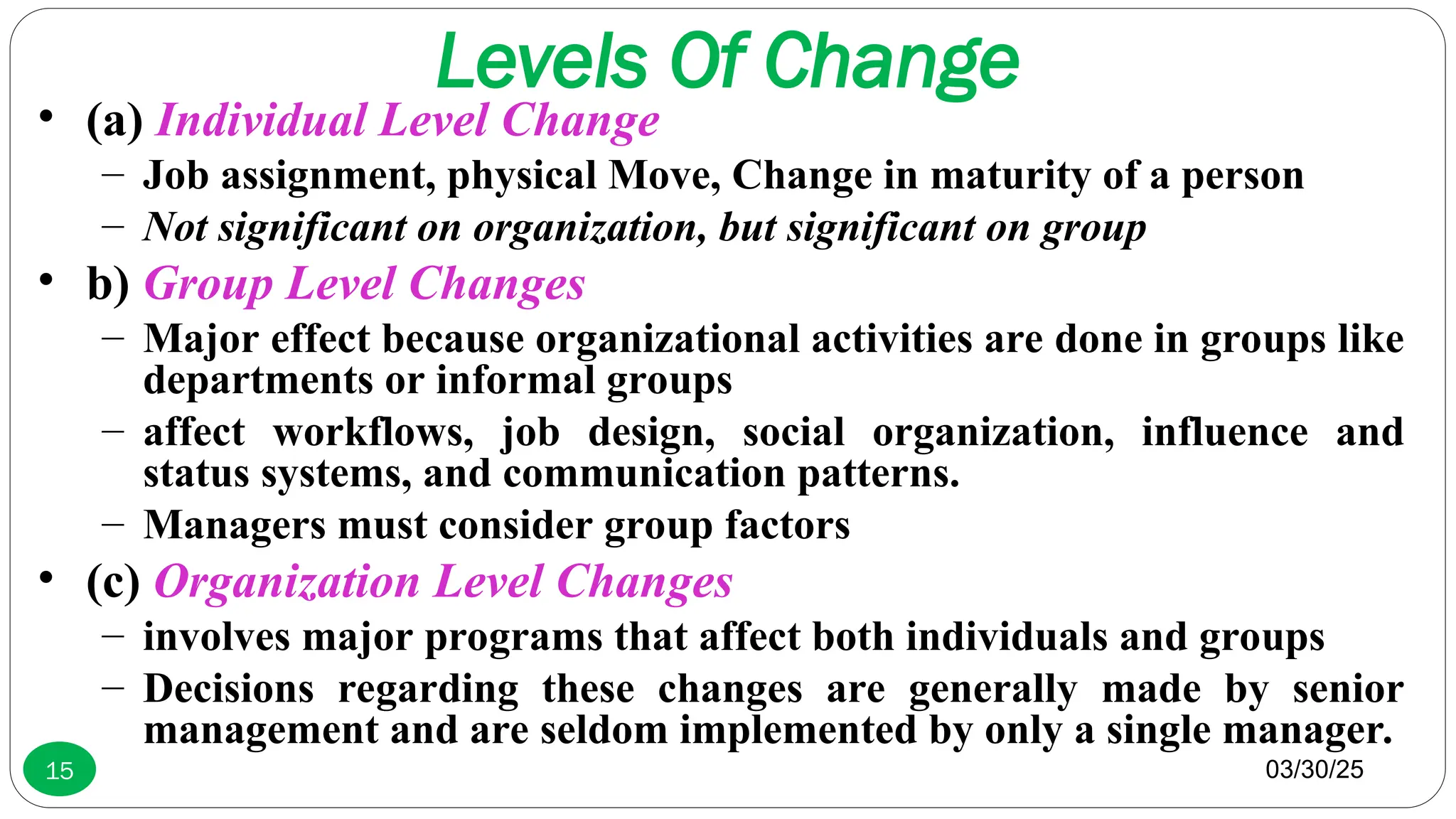
Levels Of Change
•(a) Individual Level Change
– Job assignment, physical Move, Change in maturity of a person
– Not significant on organization, but significant on group
• b) Group Level Changes
– Major effect because organizational activities are done in groups like
departments or informal groups
– affect workflows, job design, social organization, influence and
status systems, and communication patterns.
– Managers must consider group factors
• (c) Organization Level Changes
– involves major programs that affect both individuals and groups
– Decisions regarding these changes are generally made by senior
management and are seldom implemented by only a single manager.
03/30/25
15
16.
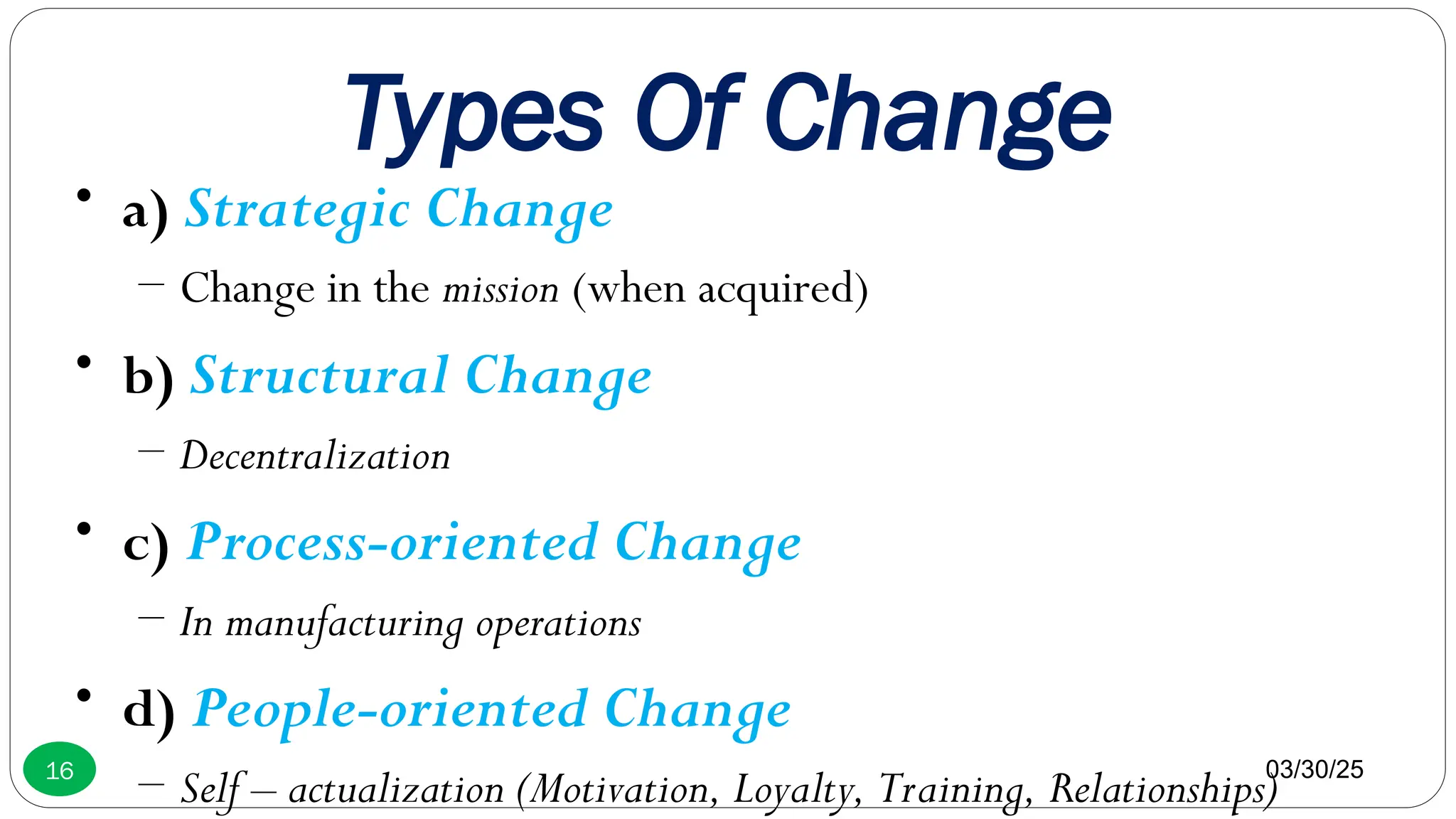
Types Of Change
•a) Strategic Change
– Change in the mission (when acquired)
• b) Structural Change
– Decentralization
• c) Process-oriented Change
– In manufacturing operations
• d) People-oriented Change
– Self – actualization (Motivation, Loyalty, Training, Relationships)
03/30/25
16
17.
03/30/25
17
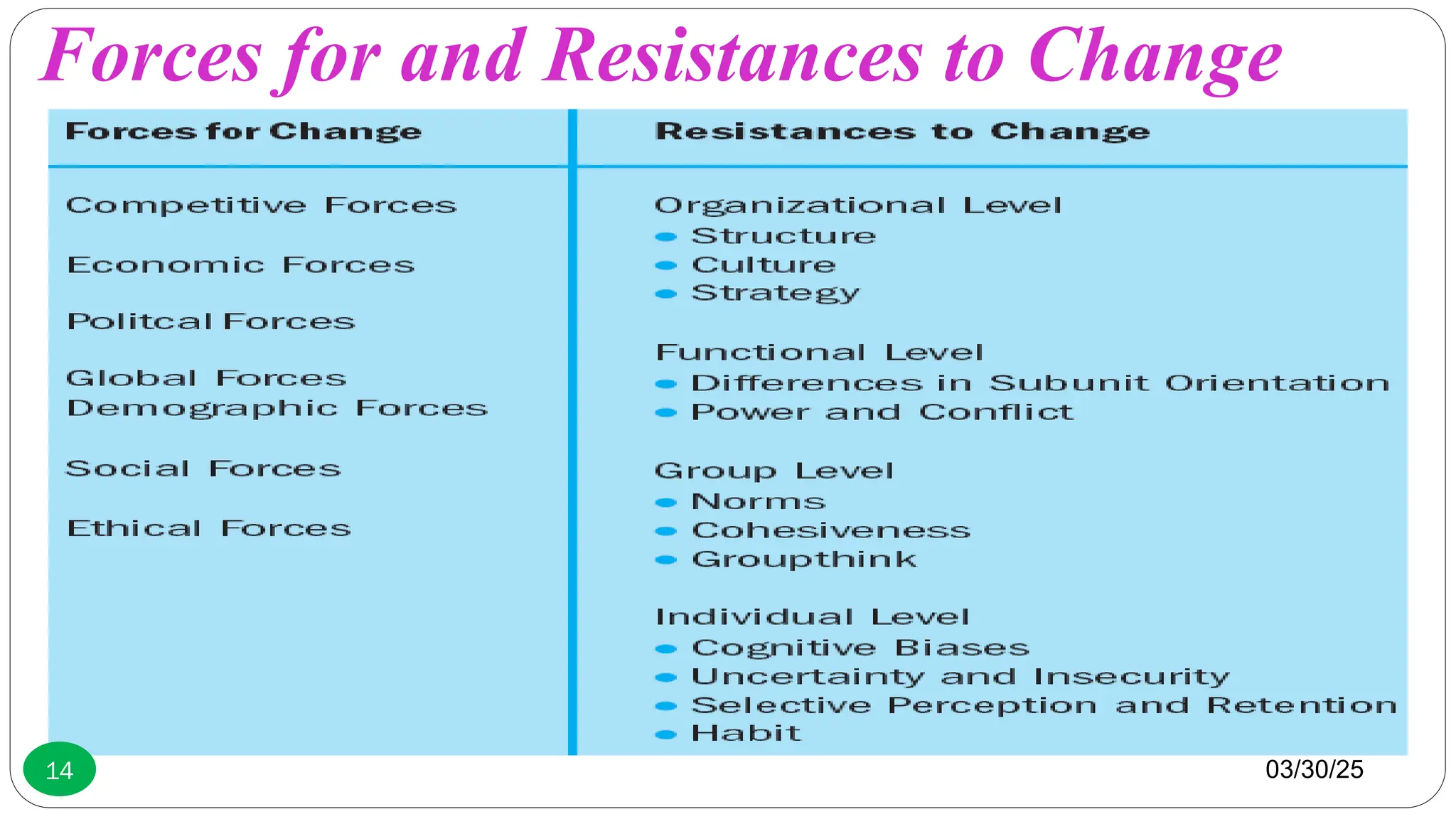
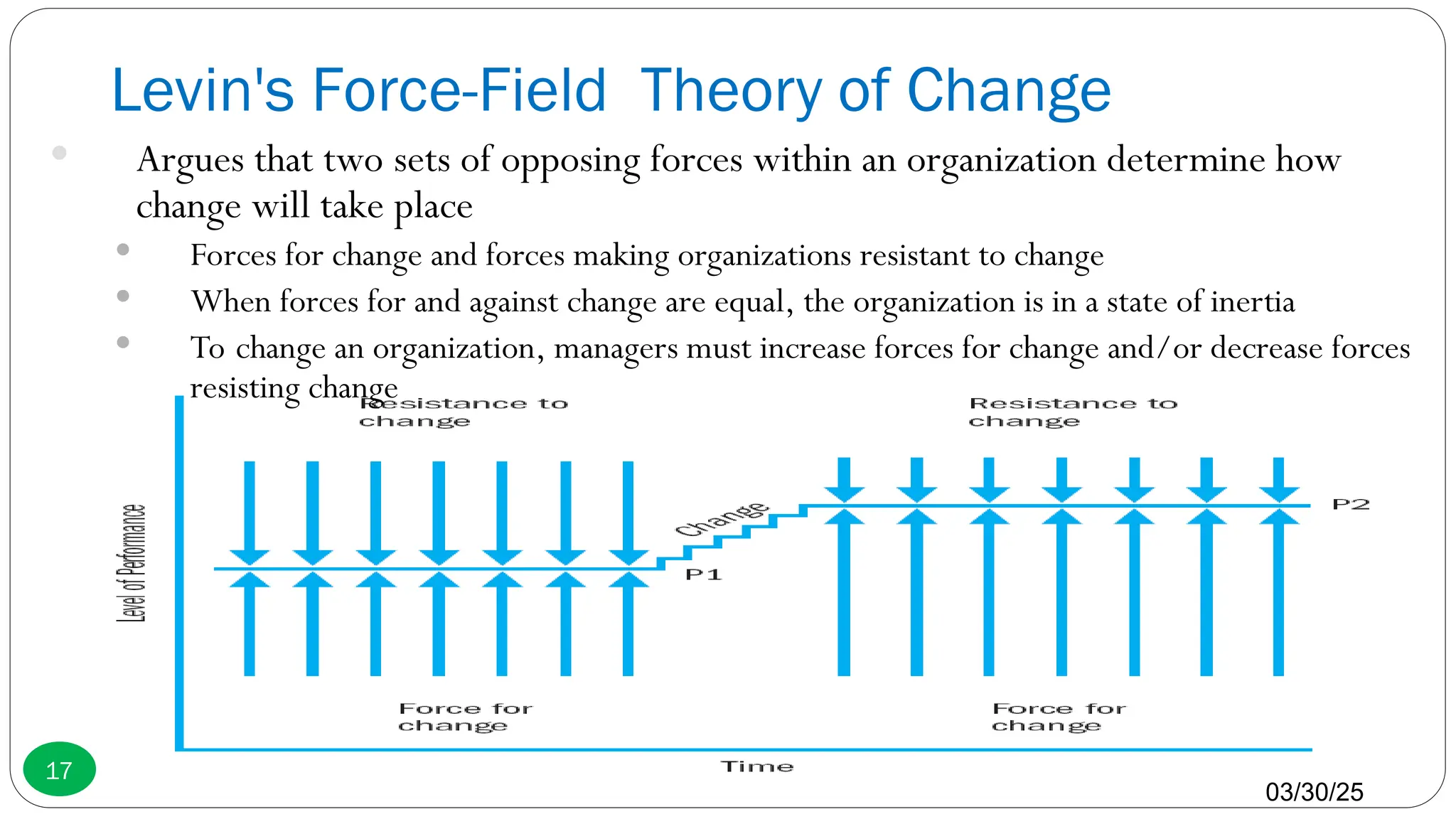
Argues thattwo sets of opposing forces within an organization determine how
change will take place
Forces for change and forces making organizations resistant to change
When forces for and against change are equal, the organization is in a state of inertia
To change an organization, managers must increase forces for change and/or decrease forces
resisting change
Levin's Force-Field Theory of Change
18.
03/30/25
18
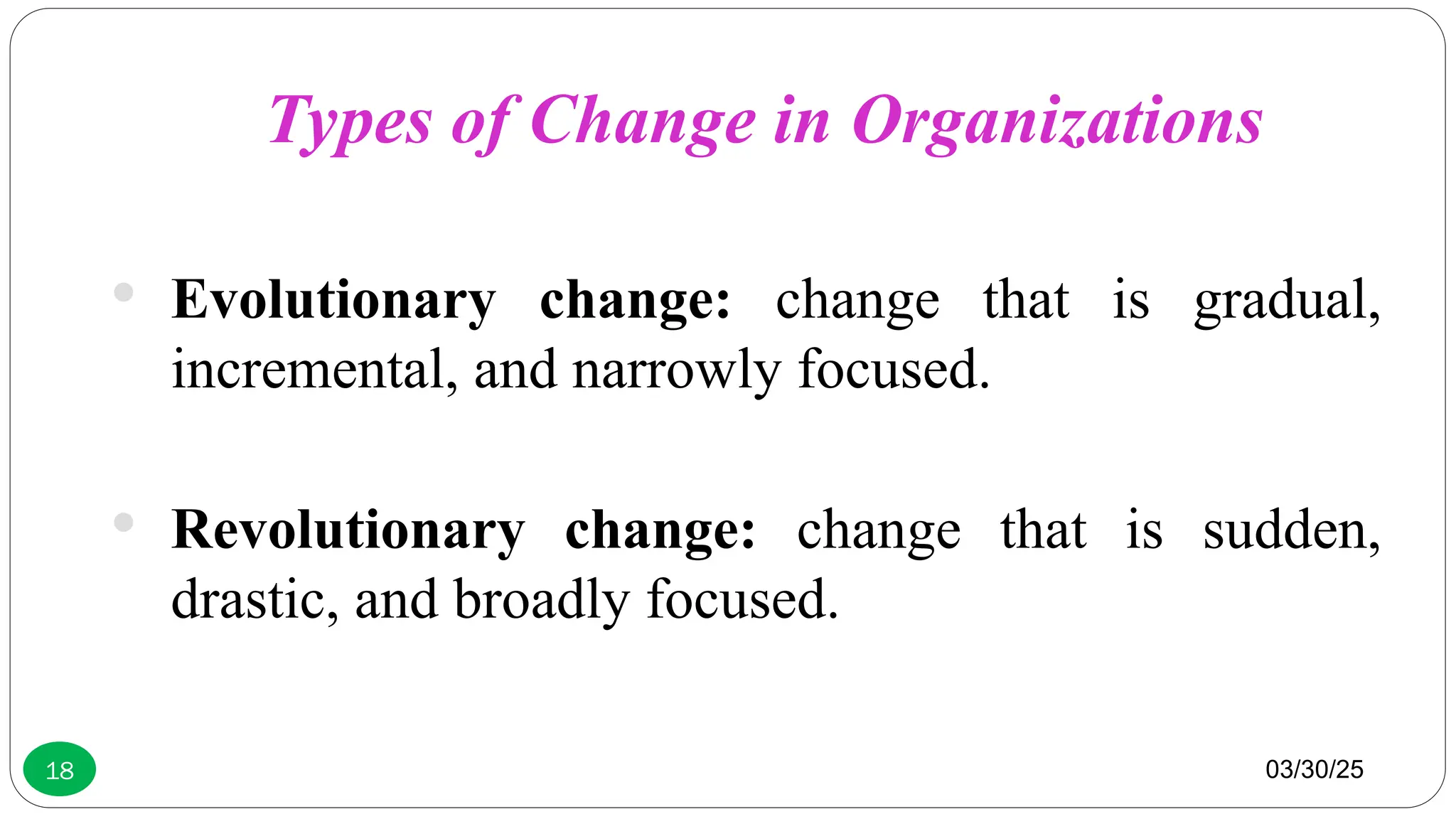
Evolutionary change:change that is gradual,
incremental, and narrowly focused.
Revolutionary change: change that is sudden,
drastic, and broadly focused.
Types of Change in Organizations
19.
03/30/25
19
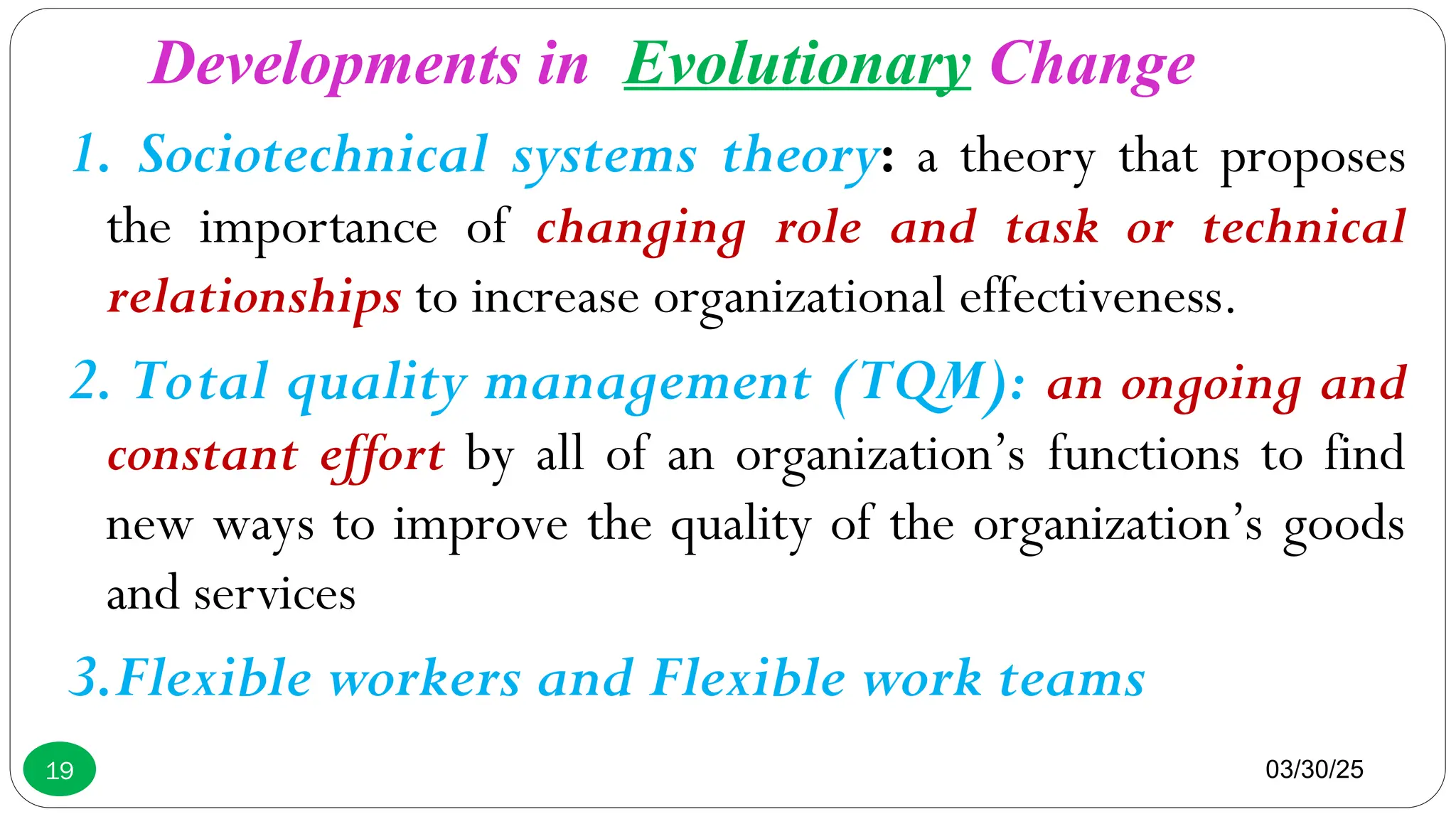
1. Sociotechnical systemstheory: a theory that proposes
the importance of changing role and task or technical
relationships to increase organizational effectiveness.
2. Total quality management (TQM): an ongoing and
constant effort by all of an organization’s functions to find
new ways to improve the quality of the organization’s goods
and services
3.Flexible workers and Flexible work teams
Developments in Evolutionary Change
20.
03/30/25
20
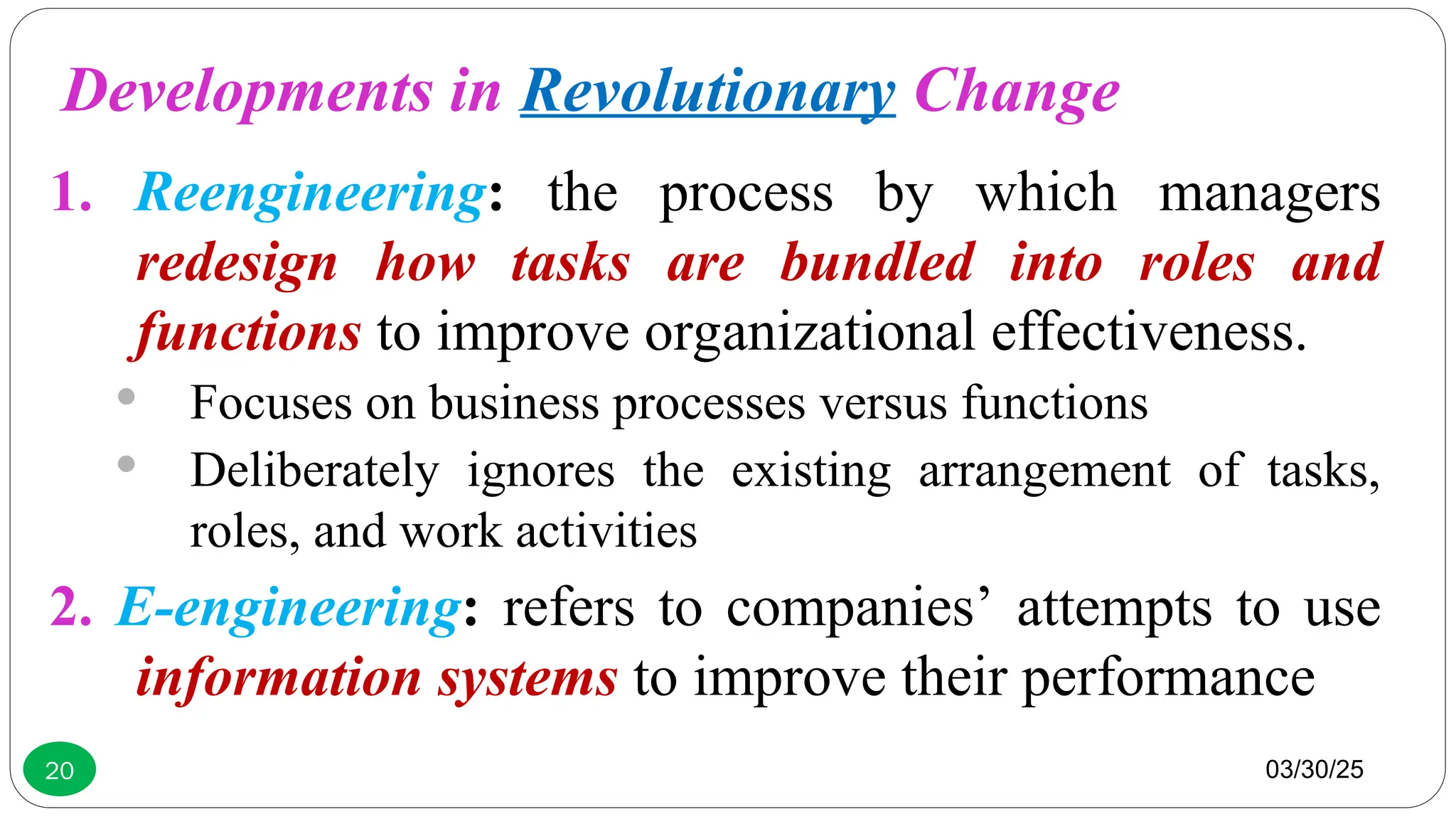
1. Reengineering: theprocess by which managers
redesign how tasks are bundled into roles and
functions to improve organizational effectiveness.
Focuses on business processes versus functions
Deliberately ignores the existing arrangement of tasks,
roles, and work activities
2. E-engineering: refers to companies’ attempts to use
information systems to improve their performance
Developments in Revolutionary Change
21.
03/30/25
21
3. Restructuring: changingtask and authority relationships and
redesigning organizational structure and culture to improve
organizational effectiveness
4. Downsizing: the process of streamlining the
organizational hierarchy and laying off managers and
workers to reduce bureaucratic costs
5. Innovation: the process by which organizations use their skills and
resources to:
Create new technologies
Develop new goods and services
Better respond to the needs of their customers
One of the most difficult instruments of change to manage.
Developments in Revolutionary Change (cont.)
22.
03/30/25
22
Is All ResistanceBad?
Resistance to change may be a positive force in
some instances. In fact, resistance to change is a
valuable feedback tool that should not be ignored.
Why are people resisting the proposed changes? Do
they feel that the new system will not work? If so,
why not? By listening to people and incorporating
their suggestions into the change effort, it is
possible to make a more effective change.
03/30/25
24
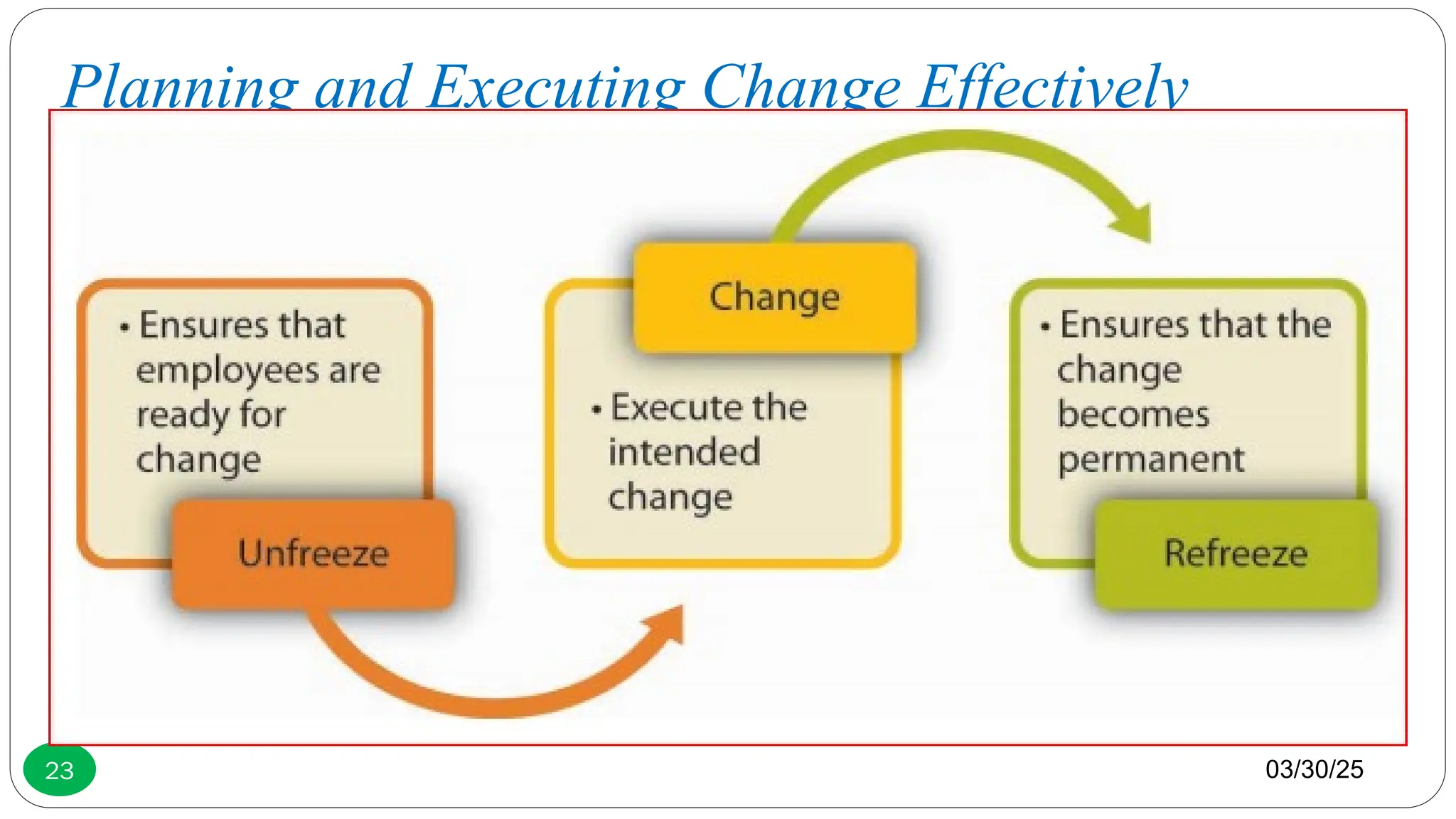
Executing change withoutprior preparation is likely to
lead to failure. Instead, organizations should start with
Unfreezing or making sure that organizational members
are ready for and receptive to change. This is followed
by change or executing the planned changes.
Finally, refreezing involves ensuring that change
becomes permanent and the new habits, rules, or
procedures become the norm.
25.
03/30/25
25
Many change effortsfail because people are
insufficiently prepared for change.
1.Create a Vision for Change
2.Communicating a Plan for Change
3.Develop a Sense of Urgency
4.Building a Coalition
5.Provide Support
6.Allow Employees to Participate
7.Executing Change
8.Continue to Provide Support
9.Create Small Wins
26.
Management of Changeis Defined as…
• A conscious and concerted initiative by those 1who are in-charge of the
destiny of the business undertaking or firm to 2keep a constant and
intelligent watch over the behavior of uncontrollable forces, to 3assess their
impact and influence of the controllable forces, and to evolve
appropriate strategies and action programs to 4maintain a dynamic
equilibrium between the controllable and uncontrollable forces.
• Controllable forces are those forces about which sufficient
information is available. Such forces can be managed easily
• Uncontrollable forces are those about which not much is known.
These forces exert a powerful influence on the behaviour of
controllable forces and limit the scope of managerial action.
03/30/25
26