Organization Design & StructureOrganization Design & Structure
Organizational structureOrganizational structure
 The formal configuration between individuals and
groups with respect to the allocation of tasks,
responsibilities, and authorities within organizations.
 The pattern of jobs and groups of jobs in an
organization.
 A diagram representing the connections between the
various departments within an organization: a graphic
representation of organizational design –
 Organizational Chart
Organizational DesignOrganizational Design
 The process of coordinating the structural
elements of an organization in the most
appropriate manner.
 The process by which managers create a specific
type of organizational structure and culture so
that a company can operate in the most efficient
and effective way.
Factors affecting OrganizationalFactors affecting Organizational
StructureStructure
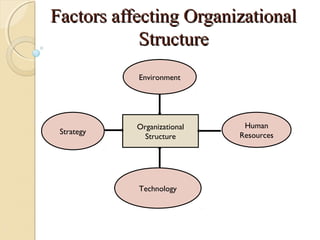
Organizational
Structure
Environment
Technology
Strategy
Human
Resources
Key Design DecisionsKey Design Decisions
Division of Labor - Low
- High
Departmentalization - Homogeneous
- Heterogeneous
Span of Control - Less
- More
Authority - High
-Low
DIFFERENTIATIONDIFFERENTIATION
 Process of deciding how to divide the work in an organization.
Ensures that essential tasks are assigned to one or more jobs.
 Four Dimensions of Differentiation by Lawrence and Lorsch
1.Manager’s goal orientation
2.Time orientation
3.Interpersonal orientation
4.Formality of struscture
FORMS OF DIFFERENTIATION:
Horizontal Differentiation
 Vertical Differentiation
 Spatial Differentiation
HORIZONTAL DIFFERENTIATIONHORIZONTAL DIFFERENTIATION
 Differentiation between organizational subunits
 Based on employees’ specialization
 Increases with specialization and departmentalization
DEPARTMENTALIZATION
The process of breaking up organizations into coherent units.
 Functional OrganizationFunctional Organization: The type of departmentalization based
on the activities or functions performed (e.g., sales, finance).
 Product OrganizationProduct Organization: The type of departmentalization based on
the products (or product lines) produced.
 Matrix OrganizationMatrix Organization: The type of departmentalization in which a
product or project form is superimposed on a functional form.
VERTICAL DIFFERENTIATIONVERTICAL DIFFERENTIATION
 Difference in authority and responsibility in
organizational hierarchy
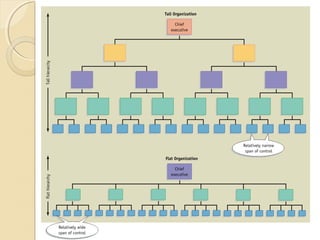
 Tall, narrow organizations-greater vertical
differentiation
 Flat, wide organizations-less vertical
differentiation
Tall structures have many levels of authority
relative to the organization’s size.
Flat structures have few levels but wide
spans of control.
SPATIALSPATIAL
DIFFERENTIATIONDIFFERENTIATION
 Geographic dispersion of offices, plants and
personnel
 Increase in no. of locations-increases complexity
but necessary
 May give organization political and legal
advantages in a country
 Horizontal, vertical and spatial differentiation
indicate the width, height and breadth of an
organizational structural needs
INTEGRATIONINTEGRATION
Definition- The process of coordinating the
different parts of an organization.
Designed to achieve unity among individuals and
groups .
Supports a state of dynamic equilibrium - elements
of organization are integrated, balanced.
VERTICAL INTEGRATIONVERTICAL INTEGRATION
Hierarchical referral
Rules and procedures
Plans and schedules
Positions add to the organization structure
Management information system
HORIZONTAL INTEGRATIONHORIZONTAL INTEGRATION
Liaison roles
Task forces
Integrator positions
Teams
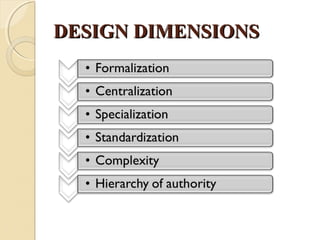
DESIGN DIMENSIONSDESIGN DIMENSIONS
Guide to designing structuresGuide to designing structures
 How many tasks should a position contain?
 How specialized should each task be?
 Skills, ability, knowledge and training needed
for work?
 Basis for grouping positions?
 What should be the span of control?
 How centralized or de-centralized should the
decision making power be?
 How standardized should the work content be?
 How large should each unit be?
ORGANIZATION IMPLICATIONSORGANIZATION IMPLICATIONS
 External environment
Dynamic vs Stable environments
Complex vs Simple environments
Diverse vs Integrated environments
Hostile vs Munificent environments
 Organizational size
 Technology
 Organizational Strategy
MINTZBERG’S MODEL – ORGANISATIONALMINTZBERG’S MODEL – ORGANISATIONAL
STRUCTURESTRUCTURE
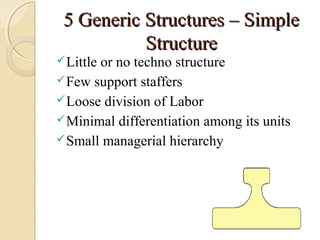
5 Generic Structures – Simple5 Generic Structures – Simple
StructureStructure
Little or no techno structure
Few support staffers
Loose division of Labor
Minimal differentiation among its units
Small managerial hierarchy
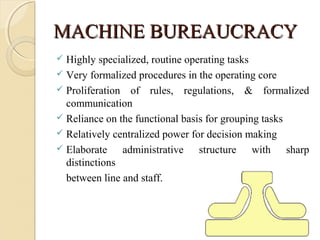
MACHINE BUREAUCRACYMACHINE BUREAUCRACY
 Highly specialized, routine operating tasks
 Very formalized procedures in the operating core
 Proliferation of rules, regulations, & formalized
communication
 Reliance on the functional basis for grouping tasks
 Relatively centralized power for decision making
 Elaborate administrative structure with sharp
distinctions
between line and staff.
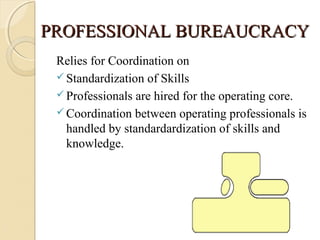
PROFESSIONAL BUREAUCRACYPROFESSIONAL BUREAUCRACY
Relies for Coordination on
 Standardization of Skills
 Professionals are hired for the operating core.
 Coordination between operating professionals is
handled by standardardization of skills and
knowledge.
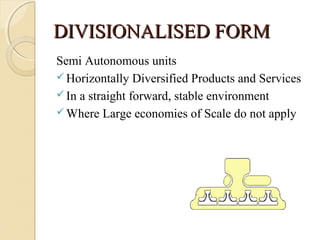
DIVISIONALISED FORMDIVISIONALISED FORM
Semi Autonomous units
 Horizontally Diversified Products and Services
 In a straight forward, stable environment
 Where Large economies of Scale do not apply
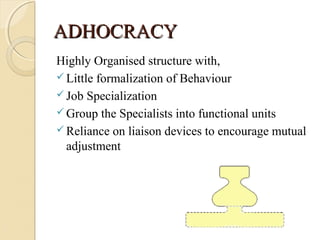
ADHOCRACYADHOCRACY
Highly Organised structure with,
 Little formalization of Behaviour
 Job Specialization
 Group the Specialists into functional units
 Reliance on liaison devices to encourage mutual
adjustment
THANK YOU.THANK YOU.

Organizational design and structure

  • 1.
    Organization Design &StructureOrganization Design & Structure
  • 2.
    Organizational structureOrganizational structure The formal configuration between individuals and groups with respect to the allocation of tasks, responsibilities, and authorities within organizations.  The pattern of jobs and groups of jobs in an organization.  A diagram representing the connections between the various departments within an organization: a graphic representation of organizational design –  Organizational Chart
  • 3.
    Organizational DesignOrganizational Design The process of coordinating the structural elements of an organization in the most appropriate manner.  The process by which managers create a specific type of organizational structure and culture so that a company can operate in the most efficient and effective way.
  • 4.
    Factors affecting OrganizationalFactorsaffecting Organizational StructureStructure Organizational Structure Environment Technology Strategy Human Resources
  • 5.
    Key Design DecisionsKeyDesign Decisions Division of Labor - Low - High Departmentalization - Homogeneous - Heterogeneous Span of Control - Less - More Authority - High -Low
  • 6.
    DIFFERENTIATIONDIFFERENTIATION  Process ofdeciding how to divide the work in an organization. Ensures that essential tasks are assigned to one or more jobs.  Four Dimensions of Differentiation by Lawrence and Lorsch 1.Manager’s goal orientation 2.Time orientation 3.Interpersonal orientation 4.Formality of struscture FORMS OF DIFFERENTIATION: Horizontal Differentiation  Vertical Differentiation  Spatial Differentiation
  • 7.
    HORIZONTAL DIFFERENTIATIONHORIZONTAL DIFFERENTIATION Differentiation between organizational subunits  Based on employees’ specialization  Increases with specialization and departmentalization DEPARTMENTALIZATION The process of breaking up organizations into coherent units.  Functional OrganizationFunctional Organization: The type of departmentalization based on the activities or functions performed (e.g., sales, finance).  Product OrganizationProduct Organization: The type of departmentalization based on the products (or product lines) produced.  Matrix OrganizationMatrix Organization: The type of departmentalization in which a product or project form is superimposed on a functional form.
  • 8.
    VERTICAL DIFFERENTIATIONVERTICAL DIFFERENTIATION Difference in authority and responsibility in organizational hierarchy  Tall, narrow organizations-greater vertical differentiation  Flat, wide organizations-less vertical differentiation Tall structures have many levels of authority relative to the organization’s size. Flat structures have few levels but wide spans of control.
  • 10.
    SPATIALSPATIAL DIFFERENTIATIONDIFFERENTIATION  Geographic dispersionof offices, plants and personnel  Increase in no. of locations-increases complexity but necessary  May give organization political and legal advantages in a country  Horizontal, vertical and spatial differentiation indicate the width, height and breadth of an organizational structural needs
  • 11.
    INTEGRATIONINTEGRATION Definition- The processof coordinating the different parts of an organization. Designed to achieve unity among individuals and groups . Supports a state of dynamic equilibrium - elements of organization are integrated, balanced.
  • 12.
    VERTICAL INTEGRATIONVERTICAL INTEGRATION Hierarchicalreferral Rules and procedures Plans and schedules Positions add to the organization structure Management information system HORIZONTAL INTEGRATIONHORIZONTAL INTEGRATION Liaison roles Task forces Integrator positions Teams
  • 13.
  • 14.
    Guide to designingstructuresGuide to designing structures  How many tasks should a position contain?  How specialized should each task be?  Skills, ability, knowledge and training needed for work?  Basis for grouping positions?  What should be the span of control?  How centralized or de-centralized should the decision making power be?  How standardized should the work content be?  How large should each unit be?
  • 15.
    ORGANIZATION IMPLICATIONSORGANIZATION IMPLICATIONS External environment Dynamic vs Stable environments Complex vs Simple environments Diverse vs Integrated environments Hostile vs Munificent environments  Organizational size  Technology  Organizational Strategy
  • 16.
    MINTZBERG’S MODEL –ORGANISATIONALMINTZBERG’S MODEL – ORGANISATIONAL STRUCTURESTRUCTURE
  • 17.
    5 Generic Structures– Simple5 Generic Structures – Simple StructureStructure Little or no techno structure Few support staffers Loose division of Labor Minimal differentiation among its units Small managerial hierarchy
  • 18.
    MACHINE BUREAUCRACYMACHINE BUREAUCRACY Highly specialized, routine operating tasks  Very formalized procedures in the operating core  Proliferation of rules, regulations, & formalized communication  Reliance on the functional basis for grouping tasks  Relatively centralized power for decision making  Elaborate administrative structure with sharp distinctions between line and staff.
  • 19.
    PROFESSIONAL BUREAUCRACYPROFESSIONAL BUREAUCRACY Reliesfor Coordination on  Standardization of Skills  Professionals are hired for the operating core.  Coordination between operating professionals is handled by standardardization of skills and knowledge.
  • 20.
    DIVISIONALISED FORMDIVISIONALISED FORM SemiAutonomous units  Horizontally Diversified Products and Services  In a straight forward, stable environment  Where Large economies of Scale do not apply
  • 21.
    ADHOCRACYADHOCRACY Highly Organised structurewith,  Little formalization of Behaviour  Job Specialization  Group the Specialists into functional units  Reliance on liaison devices to encourage mutual adjustment
  • 22.