Why is change management a topic in organizational behavior? Organizations need to be
able to adapt to different market conditions and customer needs—and it seems as though
those kinds of changes are happening every day. When an organization isn’t flexible,
another business will swoop in and take those customers—and those profits—away.
But change management is definitely a behavior. Organizations don’t have to change—
people have to change. And that’s what change management is all about.
Managers at an organization need to recognize problems as they occur and adjust their
processes accordingly to solve for them. Good change management skills make this an
easier process.
Forces of Change
The art of progress is to preserve order amid change and to preserve
change amid order.
—Alfred North Whitehead
Alfred North Whitehead was a philosopher and mathematician, but, with
that kind of insight on the subject of change, he could have been a CEO.
Today’s business leaders have to worry about addressing customer needs in
a fast-paced environment impacted by social, economic, political and
cultural shifts. In today’s business environment, the ever-looming presence
of change is pretty much the only thing that stays the same.
The problem is, no one likes change.
Change, like the passing of time, is unavoidable
Organizations and their managers have to learn how to anticipate and implement change
effectively. Managers need to find ways to overcome their employees’ natural aversion to change,
because managing change effectively can mean the difference between staying in business and
becoming irrelevant to their customers. The first step in managing change effectively is to
understand what change is and where it comes from.
Organizational change is the transformation or adjustment to the way an organization functions.
Organizations adjust to small changes all the time, possibly looking to improve productivity,
responding to a new regulation, hiring a new employee, or something similar. But on top of these
little adjustments we make at work all the time, there are larger pressures that loom over us, like
competition, technology, or customer demands. Those larger pressures sometimes require larger
responses.
What forces create these changes?
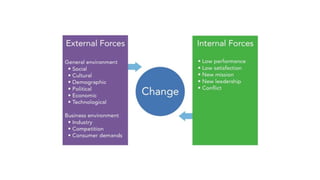
External forces are those changes that are part of an organization’s general and business
environment. There are several kinds of external forces an organization might face:
Demographic. A changing work demographic might require an organizational change in culture.
Social. Changing social trends can pressure organizations into making changes. are becoming
more environmentally conscious, a trend which has pushed fast food restaurants to replace
Styrofoam containers with paper.
Political. Government restrictions often force change onto organizations. This can be something
as simple as a change in minimum wage for employees, or as complex as rules and restrictions
governing fair competition in business.
Technology.
Economic.
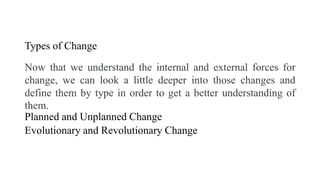
Types of Change
Now that we understand the internal and external forces for
change, we can look a little deeper into those changes and
define them by type in order to get a better understanding of
them.
Planned and Unplanned Change
Evolutionary and Revolutionary Change
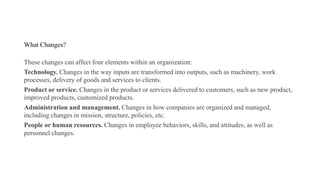
What Changes?
These changes can affect four elements within an organization:
Technology. Changes in the way inputs are transformed into outputs, such as machinery, work
processes, delivery of goods and services to clients.
Product or service. Changes in the product or services delivered to customers, such as new product,
improved products, customized products.
Administration and management. Changes in how companies are organized and managed,
including changes in mission, structure, policies, etc.
People or human resources. Changes in employee behaviors, skills, and attitudes, as well as
personnel changes.
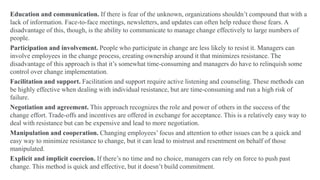
Education and communication. If there is fear of the unknown, organizations shouldn’t compound that with a
lack of information. Face-to-face meetings, newsletters, and updates can often help reduce those fears. A
disadvantage of this, though, is the ability to communicate to manage change effectively to large numbers of
people.
Participation and involvement. People who participate in change are less likely to resist it. Managers can
involve employees in the change process, creating ownership around it that minimizes resistance. The
disadvantage of this approach is that it’s somewhat time-consuming and managers do have to relinquish some
control over change implementation.
Facilitation and support. Facilitation and support require active listening and counseling. These methods can
be highly effective when dealing with individual resistance, but are time-consuming and run a high risk of
failure.
Negotiation and agreement. This approach recognizes the role and power of others in the success of the
change effort. Trade-offs and incentives are offered in exchange for acceptance. This is a relatively easy way to
deal with resistance but can be expensive and lead to more negotiation.
Manipulation and cooperation. Changing employees’ focus and attention to other issues can be a quick and
easy way to minimize resistance to change, but it can lead to mistrust and resentment on behalf of those
manipulated.
Explicit and implicit coercion. If there’s no time and no choice, managers can rely on force to push past
change. This method is quick and effective, but it doesn’t build commitment.
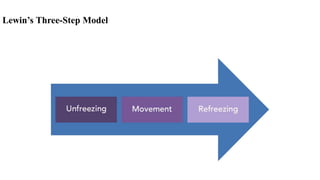
Lewin’s Three-Step Model
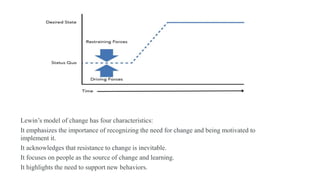
Lewin’s model of change has four characteristics:
It emphasizes the importance of recognizing the need for change and being motivated to
implement it.
It acknowledges that resistance to change is inevitable.
It focuses on people as the source of change and learning.
It highlights the need to support new behaviors.
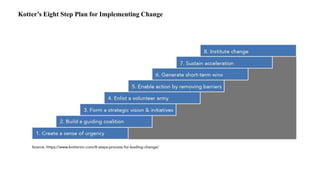
Kotter’s Eight Step Plan for Implementing Change
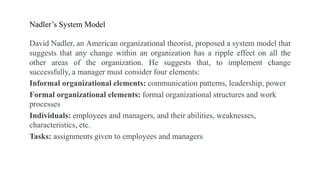
Nadler’s System Model
David Nadler, an American organizational theorist, proposed a system model that
suggests that any change within an organization has a ripple effect on all the
other areas of the organization. He suggests that, to implement change
successfully, a manager must consider four elements:
Informal organizational elements: communication patterns, leadership, power
Formal organizational elements: formal organizational structures and work
processes
Individuals: employees and managers, and their abilities, weaknesses,
characteristics, etc.
Tasks: assignments given to employees and managers
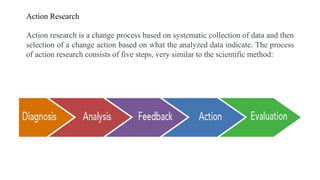
Action Research
Action research is a change process based on systematic collection of data and then
selection of a change action based on what the analyzed data indicate. The process
of action research consists of five steps, very similar to the scientific method:
Organizational Development
Remember earlier when we said that these models for change don’t usually
solve for organizational inertia? To a certain extent, organizational
development addresses that. Organizational development is a collection of
planned-change interventions, built on humanistic-democratic values, that
seeks to improve organizational effectiveness and employee well-being.
The guiding principles of organizational development are:
Commitment to long-lasting change
Humanistic approach
Action research tools
Focus on process
Organizational development requires the organization to invest a good deal of time and research and it
isn’t as much a fix for organizational inertia as it is a prevention of it. Some of the techniques and
interventions employed by organizational development departments include the following:
Sensitivity training. This is training that seeks to change behavior through unstructured group interaction.
The objective is to provide subjects with increased awareness of their own behavior and how others
perceive them, to facilitate better integration between individuals and organization.
Survey feedback. The use of questionnaires to identify discrepancies among member perceptions, with
discussion and remedies following.
Team building. High interaction among team members to increase trust and openness.
Intergroup development. These are efforts to change the attitudes, stereotypes and perceptions that
groups have of each other.
Appreciative inquiry. This process seeks to identify the qualities and strengths of an organization, on
which performance improvement can be built. The inquiry usually involves strategizing with employees
on performance improvement and “future state” ideals.
Crisis Management
Crisis management is really just the management of unplanned
change. When managers unsuccessfully anticipate their competitor’s
next move or don’t accurately read the environment, a crisis can
occur. It can also occur as the result of organizational inertia.
Crisis management can be avoided by keeping the organization
healthy. That is, not allowing it to become inflexible, infusing a
certain amount of conflict in order to stave off complacency, and
keeping innovation fresh by encouraging experimentation and
bringing in new people with new ideas.
THE END

BBA404 U-2 PPT.pptx

  • 1.
    Why is changemanagement a topic in organizational behavior? Organizations need to be able to adapt to different market conditions and customer needs—and it seems as though those kinds of changes are happening every day. When an organization isn’t flexible, another business will swoop in and take those customers—and those profits—away. But change management is definitely a behavior. Organizations don’t have to change— people have to change. And that’s what change management is all about. Managers at an organization need to recognize problems as they occur and adjust their processes accordingly to solve for them. Good change management skills make this an easier process.
  • 2.
    Forces of Change Theart of progress is to preserve order amid change and to preserve change amid order. —Alfred North Whitehead Alfred North Whitehead was a philosopher and mathematician, but, with that kind of insight on the subject of change, he could have been a CEO. Today’s business leaders have to worry about addressing customer needs in a fast-paced environment impacted by social, economic, political and cultural shifts. In today’s business environment, the ever-looming presence of change is pretty much the only thing that stays the same. The problem is, no one likes change.
  • 3.
    Change, like thepassing of time, is unavoidable Organizations and their managers have to learn how to anticipate and implement change effectively. Managers need to find ways to overcome their employees’ natural aversion to change, because managing change effectively can mean the difference between staying in business and becoming irrelevant to their customers. The first step in managing change effectively is to understand what change is and where it comes from. Organizational change is the transformation or adjustment to the way an organization functions. Organizations adjust to small changes all the time, possibly looking to improve productivity, responding to a new regulation, hiring a new employee, or something similar. But on top of these little adjustments we make at work all the time, there are larger pressures that loom over us, like competition, technology, or customer demands. Those larger pressures sometimes require larger responses.
  • 4.
    What forces createthese changes? External forces are those changes that are part of an organization’s general and business environment. There are several kinds of external forces an organization might face: Demographic. A changing work demographic might require an organizational change in culture. Social. Changing social trends can pressure organizations into making changes. are becoming more environmentally conscious, a trend which has pushed fast food restaurants to replace Styrofoam containers with paper. Political. Government restrictions often force change onto organizations. This can be something as simple as a change in minimum wage for employees, or as complex as rules and restrictions governing fair competition in business. Technology. Economic.
  • 6.
    Types of Change Nowthat we understand the internal and external forces for change, we can look a little deeper into those changes and define them by type in order to get a better understanding of them. Planned and Unplanned Change Evolutionary and Revolutionary Change
  • 7.
    What Changes? These changescan affect four elements within an organization: Technology. Changes in the way inputs are transformed into outputs, such as machinery, work processes, delivery of goods and services to clients. Product or service. Changes in the product or services delivered to customers, such as new product, improved products, customized products. Administration and management. Changes in how companies are organized and managed, including changes in mission, structure, policies, etc. People or human resources. Changes in employee behaviors, skills, and attitudes, as well as personnel changes.
  • 8.
    Education and communication.If there is fear of the unknown, organizations shouldn’t compound that with a lack of information. Face-to-face meetings, newsletters, and updates can often help reduce those fears. A disadvantage of this, though, is the ability to communicate to manage change effectively to large numbers of people. Participation and involvement. People who participate in change are less likely to resist it. Managers can involve employees in the change process, creating ownership around it that minimizes resistance. The disadvantage of this approach is that it’s somewhat time-consuming and managers do have to relinquish some control over change implementation. Facilitation and support. Facilitation and support require active listening and counseling. These methods can be highly effective when dealing with individual resistance, but are time-consuming and run a high risk of failure. Negotiation and agreement. This approach recognizes the role and power of others in the success of the change effort. Trade-offs and incentives are offered in exchange for acceptance. This is a relatively easy way to deal with resistance but can be expensive and lead to more negotiation. Manipulation and cooperation. Changing employees’ focus and attention to other issues can be a quick and easy way to minimize resistance to change, but it can lead to mistrust and resentment on behalf of those manipulated. Explicit and implicit coercion. If there’s no time and no choice, managers can rely on force to push past change. This method is quick and effective, but it doesn’t build commitment.
  • 9.
  • 10.
    Lewin’s model ofchange has four characteristics: It emphasizes the importance of recognizing the need for change and being motivated to implement it. It acknowledges that resistance to change is inevitable. It focuses on people as the source of change and learning. It highlights the need to support new behaviors.
  • 11.
    Kotter’s Eight StepPlan for Implementing Change
  • 12.
    Nadler’s System Model DavidNadler, an American organizational theorist, proposed a system model that suggests that any change within an organization has a ripple effect on all the other areas of the organization. He suggests that, to implement change successfully, a manager must consider four elements: Informal organizational elements: communication patterns, leadership, power Formal organizational elements: formal organizational structures and work processes Individuals: employees and managers, and their abilities, weaknesses, characteristics, etc. Tasks: assignments given to employees and managers
  • 13.
    Action Research Action researchis a change process based on systematic collection of data and then selection of a change action based on what the analyzed data indicate. The process of action research consists of five steps, very similar to the scientific method:
  • 14.
    Organizational Development Remember earlierwhen we said that these models for change don’t usually solve for organizational inertia? To a certain extent, organizational development addresses that. Organizational development is a collection of planned-change interventions, built on humanistic-democratic values, that seeks to improve organizational effectiveness and employee well-being. The guiding principles of organizational development are: Commitment to long-lasting change Humanistic approach Action research tools Focus on process
  • 15.
    Organizational development requiresthe organization to invest a good deal of time and research and it isn’t as much a fix for organizational inertia as it is a prevention of it. Some of the techniques and interventions employed by organizational development departments include the following: Sensitivity training. This is training that seeks to change behavior through unstructured group interaction. The objective is to provide subjects with increased awareness of their own behavior and how others perceive them, to facilitate better integration between individuals and organization. Survey feedback. The use of questionnaires to identify discrepancies among member perceptions, with discussion and remedies following. Team building. High interaction among team members to increase trust and openness. Intergroup development. These are efforts to change the attitudes, stereotypes and perceptions that groups have of each other. Appreciative inquiry. This process seeks to identify the qualities and strengths of an organization, on which performance improvement can be built. The inquiry usually involves strategizing with employees on performance improvement and “future state” ideals.
  • 16.
    Crisis Management Crisis managementis really just the management of unplanned change. When managers unsuccessfully anticipate their competitor’s next move or don’t accurately read the environment, a crisis can occur. It can also occur as the result of organizational inertia. Crisis management can be avoided by keeping the organization healthy. That is, not allowing it to become inflexible, infusing a certain amount of conflict in order to stave off complacency, and keeping innovation fresh by encouraging experimentation and bringing in new people with new ideas.
  • 17.