Organizational Behavior
Eighteenth Edition
Chapter 3
Attitudes and Job
Satisfaction
Copyright © 2019, 2017, 2015, 2013 Pearson Education, Inc. All Rights Reserved.
Compare the Major Job Attitudes (1 of 5)
• Job Satisfaction
– A positive feeling about the job resulting from an
evaluation of its characteristics.
• Job Involvement
– Degree to which a person identifies with a job, actively
participates in it, and considers performance important
to self-worth.
– Psychological Empowerment
 Belief in the degree of influence over one’s job,
competence, job meaningfulness, and autonomy.
Copyright © 2019, 2017, 2015, 2013 Pearson Education, Inc. All Rights Reserved.
Compare the Major Job Attitudes (2 of 5)
• Organizational Commitment
– Identifying with a particular organization and its goals
and wishing to maintain membership in the
organization.
– Employees who are committed will be less likely to
engage in work withdrawal even if they are dissatisfied,
because they have a sense of organizational loyalty.
Clic
d
Copyright © 2019, 2017, 2015, 2013 Pearson Education, Inc. All Rights Reserved.
Define Job Satisfaction (2 of 5)
• Job Satisfaction
– A positive feeling about a job resulting from
an evaluation of its characteristics.
Copyright © 2019, 2017, 2015, 2013 Pearson Education, Inc. All Rights Reserved.
Define Job Satisfaction (3 of 5)
• How satisfied are people in their jobs?
– Over the last 30 years, employees in the U.S. and most
developed countries have generally been satisfied with
their jobs.
 With the recent economic downturn, more workers
are less satisfied.
 Satisfaction levels differ depending on the facet
involved.
 There are cultural differences in job satisfaction.
Copyright © 2019, 2017, 2015, 2013 Pearson Education, Inc. All Rights Reserved.
Define Job Satisfaction (4 of 5)
Exhibit 3-3 Average Job Satisfaction Levels by Facet
Copyright © 2019, 2017, 2015, 2013 Pearson Education, Inc. All Rights Reserved.
Contrast the Three Components of an
Attitude (1 of 2)
• Attitudes are evaluative statements—either favorable or
unfavorable—about objects, people, or events.
– They reflect how we feel about something.
Click to add text
Copyright © 2019, 2017, 2015, 2013 Pearson Education, Inc. All Rights Reserved.
Summarize the Main Causes of Job
Satisfaction (1 of 3)
• What causes job satisfaction?
– Job conditions
 The intrinsic nature of the work itself, social
interactions, and supervision are important
predictors of satisfaction and employee well-being.
– Personality
 People who have positive core self-evaluations,
who believe in their inner worth and basic
competence, are more satisfied with their jobs than
those with negative core self-evaluations.
Copyright © 2019, 2017, 2015, 2013 Pearson Education, Inc. All Rights Reserved.
Summarize the Main Causes of Job
Satisfaction (3 of 3)
• Corporate Social Responsibility (CSR)
– Corporate social responsibility (CSR): self-regulated
actions to benefit society or the environment beyond
what is required by law.
 Includes environmental sustainability initiatives,
nonprofit work, and charitable giving.
 Increasingly affects employee job satisfaction.
– CSR is particularly important for Millennials.
 But, not everyone finds value in CSR.
Copyright © 2019, 2017, 2015, 2013 Pearson Education, Inc. All Rights Reserved.
Contrast the Three Components of an
Attitude (2 of 2)
Exhibit 3-1 The Components of an Attitude
Click to add text
Copyright © 2019, 2017, 2015, 2013 Pearson Education, Inc. All Rights Reserved.
Learning Objectives
3.1 Contrast the three components of an attitude.
3.2 Summarize the relationship between attitudes and
behavior.
3.3 Compare the major job attitudes.
3.4 Define job satisfaction.
3.5 Summarize the main causes of job satisfaction.
3.6 Identify three outcomes of job satisfaction.
3.7 Identify four employee responses to dissatisfaction.
Copyright © 2019, 2017, 2015, 2013 Pearson Education, Inc. All Rights Reserved.
Summarize the Relationship Between
Attitudes and Behavior (2 of 2)
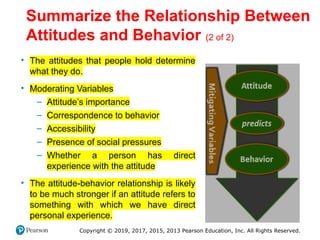
• The attitudes that people hold determine
what they do.
• Moderating Variables
– Attitude’s importance
– Correspondence to behavior
– Accessibility
– Presence of social pressures
– Whether a person has direct
experience with the attitude
• The attitude-behavior relationship is likely
to be much stronger if an attitude refers to
something with which we have direct
personal experience.
Copyright © 2019, 2017, 2015, 2013 Pearson Education, Inc. All Rights Reserved.
Outcomes of Job Satisfaction
• Job Performance
– Happy workers are more likely to be productive workers.
• OCB organizational citizenship behavior
– People who are more satisfied with their jobs are more likely
to engage in OCB.
• Customer Satisfaction
– Satisfied employees increase customer satisfaction and
loyalty.
• Life Satisfaction
– Research shows that job satisfaction is positively correlated
with life satisfaction.
Click to add tex
[
Copyright © 2019, 2017, 2015, 2013 Pearson Education, Inc. All Rights Reserved.
Four Employee Responses to
Dissatisfaction (2 of 2)
• Counterproductive Work Behavior (CWB)
– Counterproductive work behavior: actions that
actively damage the organization, including stealing,
behaving aggressively toward coworkers, or being late
or absent.
– Absenteeism: the more satisfied you are, the less likely
you are to miss work.
– Turnover: a pattern of lowered job satisfaction is the
best predictor of intent to leave.
• Managers Often “Don’t Get It”
Copyright © 2019, 2017, 2015, 2013 Pearson Education, Inc. All Rights Reserved.
Implications for Managers (1 of 2)
• Of the major job attitudes – job satisfaction, job
involvement, organizational commitment, perceived
organizational support (POS), and employee engagement
– remember that an employee’s job satisfaction level is the
best single predictor of behavior.
• Pay attention to your employees’ job satisfaction levels as
determinants of their performance, turnover, absenteeism,
and withdrawal behaviors.
Copyright © 2019, 2017, 2015, 2013 Pearson Education, Inc. All Rights Reserved.
Implications for Managers (2 of 2)
• Measure employee job attitudes objectively and at
regular intervals to determine how employees are
reacting to their work.
• To raise employee satisfaction, evaluate the fit between
the employee’s work interests and the intrinsic parts of
his/her job to create work that is challenging and
interesting to the individual.
• Consider the fact that high pay alone is unlikely to create
a satisfying work environment.

Organizational Behavior Chapter 3--.pptx

  • 1.
    Organizational Behavior Eighteenth Edition Chapter3 Attitudes and Job Satisfaction Copyright © 2019, 2017, 2015, 2013 Pearson Education, Inc. All Rights Reserved.
  • 2.
    Copyright © 2019,2017, 2015, 2013 Pearson Education, Inc. All Rights Reserved. Compare the Major Job Attitudes (1 of 5) • Job Satisfaction – A positive feeling about the job resulting from an evaluation of its characteristics. • Job Involvement – Degree to which a person identifies with a job, actively participates in it, and considers performance important to self-worth. – Psychological Empowerment  Belief in the degree of influence over one’s job, competence, job meaningfulness, and autonomy.
  • 3.
    Copyright © 2019,2017, 2015, 2013 Pearson Education, Inc. All Rights Reserved. Compare the Major Job Attitudes (2 of 5) • Organizational Commitment – Identifying with a particular organization and its goals and wishing to maintain membership in the organization. – Employees who are committed will be less likely to engage in work withdrawal even if they are dissatisfied, because they have a sense of organizational loyalty. Clic d
  • 4.
    Copyright © 2019,2017, 2015, 2013 Pearson Education, Inc. All Rights Reserved. Define Job Satisfaction (2 of 5) • Job Satisfaction – A positive feeling about a job resulting from an evaluation of its characteristics.
  • 5.
    Copyright © 2019,2017, 2015, 2013 Pearson Education, Inc. All Rights Reserved. Define Job Satisfaction (3 of 5) • How satisfied are people in their jobs? – Over the last 30 years, employees in the U.S. and most developed countries have generally been satisfied with their jobs.  With the recent economic downturn, more workers are less satisfied.  Satisfaction levels differ depending on the facet involved.  There are cultural differences in job satisfaction.
  • 6.
    Copyright © 2019,2017, 2015, 2013 Pearson Education, Inc. All Rights Reserved. Define Job Satisfaction (4 of 5) Exhibit 3-3 Average Job Satisfaction Levels by Facet
  • 7.
    Copyright © 2019,2017, 2015, 2013 Pearson Education, Inc. All Rights Reserved. Contrast the Three Components of an Attitude (1 of 2) • Attitudes are evaluative statements—either favorable or unfavorable—about objects, people, or events. – They reflect how we feel about something. Click to add text
  • 8.
    Copyright © 2019,2017, 2015, 2013 Pearson Education, Inc. All Rights Reserved. Summarize the Main Causes of Job Satisfaction (1 of 3) • What causes job satisfaction? – Job conditions  The intrinsic nature of the work itself, social interactions, and supervision are important predictors of satisfaction and employee well-being. – Personality  People who have positive core self-evaluations, who believe in their inner worth and basic competence, are more satisfied with their jobs than those with negative core self-evaluations.
  • 9.
    Copyright © 2019,2017, 2015, 2013 Pearson Education, Inc. All Rights Reserved. Summarize the Main Causes of Job Satisfaction (3 of 3) • Corporate Social Responsibility (CSR) – Corporate social responsibility (CSR): self-regulated actions to benefit society or the environment beyond what is required by law.  Includes environmental sustainability initiatives, nonprofit work, and charitable giving.  Increasingly affects employee job satisfaction. – CSR is particularly important for Millennials.  But, not everyone finds value in CSR.
  • 10.
    Copyright © 2019,2017, 2015, 2013 Pearson Education, Inc. All Rights Reserved. Contrast the Three Components of an Attitude (2 of 2) Exhibit 3-1 The Components of an Attitude Click to add text
  • 11.
    Copyright © 2019,2017, 2015, 2013 Pearson Education, Inc. All Rights Reserved. Learning Objectives 3.1 Contrast the three components of an attitude. 3.2 Summarize the relationship between attitudes and behavior. 3.3 Compare the major job attitudes. 3.4 Define job satisfaction. 3.5 Summarize the main causes of job satisfaction. 3.6 Identify three outcomes of job satisfaction. 3.7 Identify four employee responses to dissatisfaction.
  • 12.
    Copyright © 2019,2017, 2015, 2013 Pearson Education, Inc. All Rights Reserved. Summarize the Relationship Between Attitudes and Behavior (2 of 2) • The attitudes that people hold determine what they do. • Moderating Variables – Attitude’s importance – Correspondence to behavior – Accessibility – Presence of social pressures – Whether a person has direct experience with the attitude • The attitude-behavior relationship is likely to be much stronger if an attitude refers to something with which we have direct personal experience.
  • 13.
    Copyright © 2019,2017, 2015, 2013 Pearson Education, Inc. All Rights Reserved. Outcomes of Job Satisfaction • Job Performance – Happy workers are more likely to be productive workers. • OCB organizational citizenship behavior – People who are more satisfied with their jobs are more likely to engage in OCB. • Customer Satisfaction – Satisfied employees increase customer satisfaction and loyalty. • Life Satisfaction – Research shows that job satisfaction is positively correlated with life satisfaction. Click to add tex [
  • 14.
    Copyright © 2019,2017, 2015, 2013 Pearson Education, Inc. All Rights Reserved. Four Employee Responses to Dissatisfaction (2 of 2) • Counterproductive Work Behavior (CWB) – Counterproductive work behavior: actions that actively damage the organization, including stealing, behaving aggressively toward coworkers, or being late or absent. – Absenteeism: the more satisfied you are, the less likely you are to miss work. – Turnover: a pattern of lowered job satisfaction is the best predictor of intent to leave. • Managers Often “Don’t Get It”
  • 15.
    Copyright © 2019,2017, 2015, 2013 Pearson Education, Inc. All Rights Reserved. Implications for Managers (1 of 2) • Of the major job attitudes – job satisfaction, job involvement, organizational commitment, perceived organizational support (POS), and employee engagement – remember that an employee’s job satisfaction level is the best single predictor of behavior. • Pay attention to your employees’ job satisfaction levels as determinants of their performance, turnover, absenteeism, and withdrawal behaviors.
  • 16.
    Copyright © 2019,2017, 2015, 2013 Pearson Education, Inc. All Rights Reserved. Implications for Managers (2 of 2) • Measure employee job attitudes objectively and at regular intervals to determine how employees are reacting to their work. • To raise employee satisfaction, evaluate the fit between the employee’s work interests and the intrinsic parts of his/her job to create work that is challenging and interesting to the individual. • Consider the fact that high pay alone is unlikely to create a satisfying work environment.

Editor's Notes

  • #1 If this PowerPoint presentation contains mathematical equations, you may need to check that your computer has the following installed: 1) MathType Plugin 2) Math Player (free versions available) 3) NVDA Reader (free versions available) Welcome to this Organizational Behavior course that uses the 18th edition of the textbook, Organizational Behavior by Robbins and Judge. This is considered among the most widely used OB textbooks in the world. Robbins and Judge are recognized as definitive aggregators of OB concepts, applications, and practices. The course and this book will provide you with a resource that will benefit you throughout your degree program and your professional life. Chapter 3: Attitudes and Job Satisfaction
  • #2 Most of the research in OB has been concerned with three major job attitudes: job satisfaction, job involvement, and organizational commitment. In addition, perceived organizational support and employee engagement are important. Job satisfaction is the positive feeling about the job resulting from an evaluation of its characteristics. Job involvement looks at the degree of psychological identification with the job. Related to this is psychological empowerment, which is defined as employees’ beliefs in the degree to which they influence their work environment, their competencies, the meaningfulness of their job, and their perceived autonomy.
  • #3 Another important job attitude is organizational commitment, which is defined as the act of identifying with a particular organization and its goals, and wishing to remain a member of the organization.
  • #4 As we have discussed, job satisfaction is defined as a positive feeling about a job resulting from an evaluation of its characteristics. There are multiple ways to measure job satisfaction, but two approaches are popular. The single global rating approach is a response to one question, such as, “All things considered, how satisfied are you with your job?” Respondents circle a number between 1 and 5 on a scale from “highly satisfied” to “highly dissatisfied.” The second approach, the summation of job facets, is more sophisticated. It identifies key elements in a job, such as the nature of the work, supervision, present pay, promotion opportunities, and relations with coworkers.
  • #5 Research shows that over the past 30 years, the majority of U.S. workers have been satisfied with their jobs. However, the recent economic downturn has generated a dramatic drop-off in satisfaction levels, with just half of workers reporting feeling satisfied now. The exhibits on the following two slides illustrate additional details regarding differences among job satisfaction, including the affect of particular facets and cultural context.
  • #6 As shown here in Exhibit 3-3, people have typically been more satisfied with their jobs overall, with the work itself, and with their supervisors and coworkers, than they have been with their pay and promotion opportunities.
  • #7 Attitudes are evaluative statements or judgments concerning objects, people, or events. They reflect how we feel about something. In other words, saying “I like my job”, reflects your attitude toward work.
  • #8 Interesting jobs that provide training, variety, independence, and control satisfy most employees. There is also a strong correspondence between how well people enjoy the social context of their workplace and how satisfied they are overall. Interdependence, feedback, social support, and interaction with coworkers outside the workplace are strongly related to job satisfaction even after accounting for characteristics of the work itself. Personality also plays a role in job satisfaction. Research has shown that people who have positive core self-evaluations, who believe in their inner worth and basic competence, are more satisfied with their jobs than those with negative core self-evaluations. Pay also has an influence on job satisfaction but not as much as one might think. We’ll look at it in the next slide.
  • #9 An organization’s commitment to corporate social responsibility (CSR), or its self-regulated actions to benefit society or the environment beyond what is required by law, increasingly affects employee job satisfaction. Organizations practice CSR in a number of ways, including environmental sustainability initiatives, nonprofit work, and charitable giving. The relationship between CSR and job satisfaction is particularly strong for Millennials. Although the link between CSR and job satisfaction is strengthening, not all employees find value in CSR. Therefore, organizations need to address a few issues in order to be most effective: First, not all projects are equally meaningful for every person’s job satisfaction, yet participation for all employees is sometimes expected. Second, some organizations require employees to contribute in a prescribed manner. Third, CSR measures can seem disconnected from the employee’s actual work, providing no increase to job satisfaction.
  • #10 Attitudes are made up of three components. The cognitive component is the belief in the way things are. The affective component is the more critical part of the attitude, as it is calls upon emotions or feelings. The behavioral component describes the intention to behave in a certain way toward someone or something. These three components work together to aid in our understanding of the complexity of an attitude.
  • #11 After studying this chapter, you should be able to: Contrast the three components of an attitude. Summarize the relationship between attitudes and behavior. Compare the major job attitudes. Define job satisfaction. Summarize the main causes of job satisfaction. Identify three outcomes of job satisfaction. Identify four employee responses to dissatisfaction.
  • #12 Some variables moderate the relationship between attitude and behavior. These variables include the importance of the attitude to the person, the correspondence of the attitude to the behavior, the accessibility of the attitude, the presence of social pressures on behavior, and the direct experience a person has with the attitude. These mitigating variables will affect whether or not and to what degree a certain attitude will predict behavior. Finally, the attitude–behavior relationship is likely to be much stronger if an attitude refers to something with which we have direct personal experience.
  • #13 Now, let’s look at specific outcomes of job satisfaction related to job performance, OCB, customer satisfaction, and life satisfaction. Job Performance: Happy workers are more likely to be productive workers—the evidence suggests that productivity is likely to lead to satisfaction. Organizational Citizenship Behavior (OCB): It seems logical to assume job satisfaction should be a major determinant of an employee’s organizational citizenship behavior (OCB). Finally, research shows that when people are more satisfied with their jobs, they are more likely to engage in OCBs. Customer Satisfaction: Evidence indicates that satisfied employees increase customer satisfaction and loyalty. Life Satisfaction: Research in Europe indicated that job satisfaction is positively correlated with life satisfaction, and your attitudes and experiences in life spill over in to your job approaches and experiences. Furthermore, life satisfaction decreases when people become unemployed.
  • #14 In addition, we can look at job dissatisfaction by exploring counterproductive work behavior. Substance abuse, stealing at work, undue socializing, gossiping, absenteeism, and tardiness are examples of behaviors that are destructive to organizations. They are indicators of a broader syndrome called counterproductive work behavior (CWB), also termed deviant behavior in the workplace, or simply employee withdrawal. CWB doesn’t just happen—the behaviors often follow negative and sometimes longstanding attitudes. Generally, job dissatisfaction predicts CWB. People who are not satisfied with their work become frustrated, which lowers their performance and makes them more likely to commit CWB. Other research suggests that, in addition to vocational misfit (being in the wrong line of work), lack of fit with the organization (working in the wrong kind of organizational culture) also predicts CWBs. As a manager, you can take steps to mitigate CWB. You can poll employee attitudes, for instance, and identify areas for workplace improvement. If there is no vocational fit, the employee will not be fulfilled, so you can screen for that. Tailoring tasks so a person’s abilities and values can be exercised should increase job satisfaction and reduce CWB. Furthermore, creating strong teams, integrating supervisors with them, providing formalized team policies, and introducing team-based incentives may help lower the CWB “contagion” that lowers the standards of the group. Absenteeism: We find a consistent negative relationship between satisfaction and absenteeism. The more satisfied you are, the less likely you are to miss work. Turnover: Satisfaction is also negatively related to turnover, but the correlation is stronger than what we found for absenteeism. Workplace Deviance: Job dissatisfaction predicts unionization, stealing, undue socializing, and tardiness. If employees don’t like their work environment, they will respond somehow. Managers Often “Don’t Get It” It should come as no surprise that job satisfaction can affect the bottom line. Regular surveys can reduce gaps between what managers think employees feel and what they really feel.
  • #15 Creating a satisfied workforce is not a guarantee of successful performance, but managers should make it a priority as much as possible. In particular, managers should: Of the major job attitudes—job satisfaction, job involvement, organizational commitment, perceived organizational support (POS), and employee engagement—remember that an employee’s job satisfaction level is the best single predictor of behavior. Pay attention to employees’ job satisfaction levels as determinants of their performance, turnover, absenteeism, and withdrawal behaviors.
  • #16 Measure employee job attitudes objectively and at regular intervals to determine how employees are reacting to their work. Evaluate the fit between the employee’s work interests and the intrinsic parts of his/her job to create work that is challenging and interesting to the individual. Consider the fact that high pay alone is unlikely to create a satisfying work environment.