


EMERGING TRENDS  in ORGANIZATIONAL DEVELOPMENT By Jonathan Mozenter 7/29/99 A Massachusetts Bay OD Learning Group Event
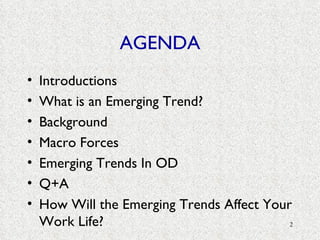
AGENDA Introductions What is an Emerging Trend? Background Macro Forces Emerging Trends In OD Q+A How Will the Emerging Trends Affect Your Work Life?
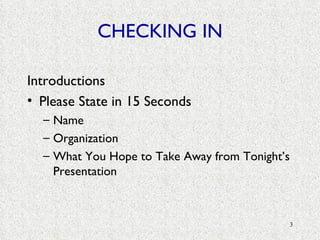
CHECKING IN Introductions Please State in 15 Seconds Name Organization What You Hope to Take Away from Tonight’s Presentation
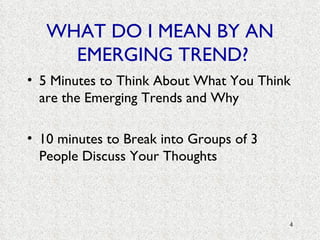
WHAT DO I MEAN BY AN  EMERGING TREND? 5 Minutes to Think About What You Think are the Emerging Trends and Why 10 minutes to Break into Groups of 3 People Discuss Your Thoughts
BACKGROUND
HYPOTHESIS Systemic Approach OD Trends are Driven by Organization Challenges which are Driven by Macro Forces Expected Results Constant Change Learning and Flexibility  OD trends:  Learning Organizations, Knowledge Management, Change Management, and Org. Design
METHODOLOGY Library and Internet Research Qualitative and Quantitative Research 4 Groups of People Interviewed External OD Consultants Internal OD Consultants Line Managers Other Business Minds
MACRO FORCES
DISCUSSION OF THE  MACRO FORCES Changes in Technology Constant Change Partnerships and Alliances Changes in the Structure of Work Increasing Diversity in the Work Force Shifting Age Demographics
CHANGES IN TECHNOLOGY Largest Effecting Macro Force Possible Cause Other Macro Forces Ramifications Speed of Change New Strategies New Distribution Channels New Relationships Increased Competition
CONSTANT CHANGE 2nd Biggest Impact A Derivative of Other Macro Forces Ramifications Dealing w/ Uncertainty Need More Flexible Process Employee Burn Out
PARTNERSHIPS & ALLIANCES 3rd Biggest Impact “ Companies Can’t Do It By Themselves Anymore” Key is to Actively Manage the Relationships Challenges in Making P&A Work Dealing with Ambiguity Culture Differences Boundary Issues Finding “Right” Partner
CHANGES IN WORK STRUCTURE   By Product of Other Macro Forces Types of Changes Information Technology Driven (ERP) More Global Virtual Organizations Focus on Core/Outsourcing Project Work and Cross Functional Teams Customer Focus
DIVERSITY Effects will Grow by 15% over Next 3 Years (Highest of all Forces) Possibly be Driven by Increased Globalization Today Many People Still View Diversity as an Affirmative Action Issue Not a Strategic One
CHANGES IN DEMOGRAPHICS Caused by  Declining Birth Rates Baby Boomers Aging Value Conflicts Between Generations Rise of Ethnic Minorities into Leadership Examples Finance Industry Healthcare Industry  Grocery Industry
OTHER MACRO FORCES Mergers and Acquisitions Defensive Move to Take Advantage of Economies of Scale Will Continue to Happen Often Fail:  Culture Problems and/or Poor Integration Program Globalization Enabled by Technology Free Trade Laws Growing Interdependencies
ORGANIZATIONAL CHALLENGES RESULTING FROM MACRO FORCES Dealing with Inc. Competition and Customization Need to be Flexible and Cope with Uncertainty Create an Environment of Constant Learning Adapting to New Technology and Globalization Developing New Management Competencies
EMERGING TRENDS IN ORGANIZATIONAL DEVELOPMENT
OD INTERVENTIONS MOST FREQUENTLY USED TODAY Mission and Vision Statement Analysis Strategic Planning Reward and Recognition Change Management Leadership Team Building  Facilitation
TREND#1:  EXPANDING THE USE OF OD More Accepted Because it is Needed to Enhance Productivity & Profitability Companies Need to Change to Survive Employee Performance is a Key Competitive Advantage More Research:  55% of HBR Articles are OD Related Over Last Year
TREND#1:  EXPANDING THE USE OF OD IDC Forecasts Change Management Consulting Fastest Growing at 18.6% Research Indicates High Use of OD Interventions Lead to High Returns More Exposure to OD Quantitative Data
TREND#1:  EXPANDING THE USE OF OD OD in Education OD in Management Consulting OD in Human Resources
TREND #2:  COMBINGING  “HARD” BUSINESS COMPETENCIES AND OD Managers Need OD Skills to Successfully Do Their Jobs OD Practitioners Need: Measure Results Using Bottom Line Metrics Align Interventions with Strategy
TREND #2:  COMBINGING  “HARD” BUSINESS COMPETENCIES AND OD Line Managers Need: Lead with Mission, Vision, and Values Create and Maintain the Appropriate Culture Manage Change Create and Maintain Continuos Learning Build Employee Self-Esteem Empower Employees
TREND #2:  COMBINGING  “HARD” BUSINESS COMPETENCIES AND OD MBA Programs Teach OD Competencies in Core Classes OD in Project Management OD in Management Consulting
TREND #2:  COMBINGING  “HARD” BUSINESS COMPETENCIES AND OD OD is Perceived as Too Soft and has a Bad Reputation Historically has Not Always Been Aligned with Business Goals and Metrics OD Practitioner Needs to Enhance Business Knowledge  Understand Strategic Needs of Client Better Sell Services Better by Speaking Client’s Language Measure OD Interventions in Bottom Line Metrics
TREND #2:  COMBINGING  “HARD” BUSINESS COMPETENCIES AND OD Research on Ideal OD Grad Programs Need Knowledge of the Following Business Areas Finance Business Management Operations Program Evaluation Information Systems
TREND #2:  COMBINGING  “HARD” BUSINESS COMPETENCIES AND OD Measurement Needed to Advance the Field of OD Measurement Improves Quality of Interventions Research Indicates:  Org. Who Strategically Use People Metrics have Higher Rates of Return Using Balance Scorecard and ROI
TREND#3:  CREATING WHOLE SYSTEM CHANGE - ORGANIZATIONAL DESIGN AND CULTURE CHANGE Move from Isolated Interventions to Whole System Interventions Aligning Strategy with Org. Design, Culture, and Compensation More Effective, Longer Lasting, and More Expensive
TREND#3:  CREATING WHOLE SYSTEM CHANGE - ORGANIZATIONAL DESIGN AND CULTURE CHANGE Maximizing Flexibility Focus on Core Competencies (Shamrock Org)  Work In Teams Constantly Develop Core Staff Retention Proper Reputation Screen for Emotional Intelligence Actively Manage Culture
TREND#3:  CREATING WHOLE SYSTEM CHANGE - ORGANIZATIONAL DESIGN AND CULTURE CHANGE Globalization Be Big and Act Small at Same Time (ABB) Business Units have 2 Managers and Freedom Develop Global Mangers Empowerment Producers, Integrators, and Shapers AES, Flat, Units Run by a Team of Generalists 50% Performance and 50% Modeling Values
TREND#3:  CREATING WHOLE SYSTEM CHANGE - ORGANIZATIONAL DESIGN AND CULTURE CHANGE Implementation Restructure Entire Vertical Organization Coordinating Mechanisms Explicitly Map Out Decision Making Process Mergers Acquisitions New Culture and Org Design before M&A Transformation Process and Communication Programs
TREND#4:  USING OD TO FACILITATE PARTNERSHIPS AND ALLIANCES Success Factors:  Relationships, Culture, Communication, and Design Nicholson McBride Alliance Advantage
TREND#4:  USING OD TO FACILITATE PARTNERSHIPS AND ALLIANCES Helping Companies Prepare Appreciative Inquiry Culture Assessment Organizational Assessment Vision Development Deal with Ambiguity
TREND#4:  USING OD TO FACILITATE PARTNERSHIPS AND ALLIANCES Help Mange Relationship by Facilitating Process Initial Design Environment of Trust and Openness Type of Alliance Scope of Project Success Factors How will it be Measured
TREND#4:  USING OD TO FACILITATE PARTNERSHIPS AND ALLIANCES Define Communication Patters at All Levels Alliance Governance and Alliance Interfaces Conflict Management & Quick Decision Making Coach Executives Constantly Reevaluate Renegotiate Learning Match Learning Objectives w\ Learning System
TREND#5:  ENHANCING CONTINUAL LEARNING Necessary to Stay Competitive Creates Awareness of Evolving Customer Needs and Market Dynamics Fastest Growing Interventions Knowledge Management Learning Organizations System Thinking Improving Employees Ability to Learn
TREND#5:  ENHANCING CONTINUAL LEARNING Knowledge Management Many Different Types Use OD in Implementation Learning Organizations Fifth Discipline Vs. “Learning Mission” Executive/Leadership  Development 360 Feedback, Coaching, Mentors, Job Rotations Corporate University with Real Time Learning
TREND#5:  ENHANCING CONTINUAL LEARNING Community of Practices Match Purpose with Type Knowledge Communities Social Networking Analysis Improving Employees Ability to Learn Defensive Routines Emotional Intelligence Personal and Social Competence
TREND#5:  ENHANCING CONTINUAL LEARNING Diversity Culture that Appreciates Difference Dialogue and Conflict Management Skills Group Reflection Promote Individual and Group Reflection both During and After Projects Scenario Planning
Q & A
APPLYING EMERGING OD TRENDS TO YOUR ORGANIZATION Break Into Small Groups of 3 Answer Following Questions How Do You Seeing The Trends Play Out in Your Organization and/or Your Clients? What is Inhibiting Them? How Can You Deal with this Resistance
FEEDBACK ON PRESENTATION

Trendsppt

  • 1.
    EMERGING TRENDS in ORGANIZATIONAL DEVELOPMENT By Jonathan Mozenter 7/29/99 A Massachusetts Bay OD Learning Group Event
  • 2.
    AGENDA Introductions Whatis an Emerging Trend? Background Macro Forces Emerging Trends In OD Q+A How Will the Emerging Trends Affect Your Work Life?
  • 3.
    CHECKING IN IntroductionsPlease State in 15 Seconds Name Organization What You Hope to Take Away from Tonight’s Presentation
  • 4.
    WHAT DO IMEAN BY AN EMERGING TREND? 5 Minutes to Think About What You Think are the Emerging Trends and Why 10 minutes to Break into Groups of 3 People Discuss Your Thoughts
  • 5.
  • 6.
    HYPOTHESIS Systemic ApproachOD Trends are Driven by Organization Challenges which are Driven by Macro Forces Expected Results Constant Change Learning and Flexibility OD trends: Learning Organizations, Knowledge Management, Change Management, and Org. Design
  • 7.
    METHODOLOGY Library andInternet Research Qualitative and Quantitative Research 4 Groups of People Interviewed External OD Consultants Internal OD Consultants Line Managers Other Business Minds
  • 8.
  • 9.
    DISCUSSION OF THE MACRO FORCES Changes in Technology Constant Change Partnerships and Alliances Changes in the Structure of Work Increasing Diversity in the Work Force Shifting Age Demographics
  • 10.
    CHANGES IN TECHNOLOGYLargest Effecting Macro Force Possible Cause Other Macro Forces Ramifications Speed of Change New Strategies New Distribution Channels New Relationships Increased Competition
  • 11.
    CONSTANT CHANGE 2ndBiggest Impact A Derivative of Other Macro Forces Ramifications Dealing w/ Uncertainty Need More Flexible Process Employee Burn Out
  • 12.
    PARTNERSHIPS & ALLIANCES3rd Biggest Impact “ Companies Can’t Do It By Themselves Anymore” Key is to Actively Manage the Relationships Challenges in Making P&A Work Dealing with Ambiguity Culture Differences Boundary Issues Finding “Right” Partner
  • 13.
    CHANGES IN WORKSTRUCTURE By Product of Other Macro Forces Types of Changes Information Technology Driven (ERP) More Global Virtual Organizations Focus on Core/Outsourcing Project Work and Cross Functional Teams Customer Focus
  • 14.
    DIVERSITY Effects willGrow by 15% over Next 3 Years (Highest of all Forces) Possibly be Driven by Increased Globalization Today Many People Still View Diversity as an Affirmative Action Issue Not a Strategic One
  • 15.
    CHANGES IN DEMOGRAPHICSCaused by Declining Birth Rates Baby Boomers Aging Value Conflicts Between Generations Rise of Ethnic Minorities into Leadership Examples Finance Industry Healthcare Industry Grocery Industry
  • 16.
    OTHER MACRO FORCESMergers and Acquisitions Defensive Move to Take Advantage of Economies of Scale Will Continue to Happen Often Fail: Culture Problems and/or Poor Integration Program Globalization Enabled by Technology Free Trade Laws Growing Interdependencies
  • 17.
    ORGANIZATIONAL CHALLENGES RESULTINGFROM MACRO FORCES Dealing with Inc. Competition and Customization Need to be Flexible and Cope with Uncertainty Create an Environment of Constant Learning Adapting to New Technology and Globalization Developing New Management Competencies
  • 18.
    EMERGING TRENDS INORGANIZATIONAL DEVELOPMENT
  • 19.
    OD INTERVENTIONS MOSTFREQUENTLY USED TODAY Mission and Vision Statement Analysis Strategic Planning Reward and Recognition Change Management Leadership Team Building Facilitation
  • 20.
    TREND#1: EXPANDINGTHE USE OF OD More Accepted Because it is Needed to Enhance Productivity & Profitability Companies Need to Change to Survive Employee Performance is a Key Competitive Advantage More Research: 55% of HBR Articles are OD Related Over Last Year
  • 21.
    TREND#1: EXPANDINGTHE USE OF OD IDC Forecasts Change Management Consulting Fastest Growing at 18.6% Research Indicates High Use of OD Interventions Lead to High Returns More Exposure to OD Quantitative Data
  • 22.
    TREND#1: EXPANDINGTHE USE OF OD OD in Education OD in Management Consulting OD in Human Resources
  • 23.
    TREND #2: COMBINGING “HARD” BUSINESS COMPETENCIES AND OD Managers Need OD Skills to Successfully Do Their Jobs OD Practitioners Need: Measure Results Using Bottom Line Metrics Align Interventions with Strategy
  • 24.
    TREND #2: COMBINGING “HARD” BUSINESS COMPETENCIES AND OD Line Managers Need: Lead with Mission, Vision, and Values Create and Maintain the Appropriate Culture Manage Change Create and Maintain Continuos Learning Build Employee Self-Esteem Empower Employees
  • 25.
    TREND #2: COMBINGING “HARD” BUSINESS COMPETENCIES AND OD MBA Programs Teach OD Competencies in Core Classes OD in Project Management OD in Management Consulting
  • 26.
    TREND #2: COMBINGING “HARD” BUSINESS COMPETENCIES AND OD OD is Perceived as Too Soft and has a Bad Reputation Historically has Not Always Been Aligned with Business Goals and Metrics OD Practitioner Needs to Enhance Business Knowledge Understand Strategic Needs of Client Better Sell Services Better by Speaking Client’s Language Measure OD Interventions in Bottom Line Metrics
  • 27.
    TREND #2: COMBINGING “HARD” BUSINESS COMPETENCIES AND OD Research on Ideal OD Grad Programs Need Knowledge of the Following Business Areas Finance Business Management Operations Program Evaluation Information Systems
  • 28.
    TREND #2: COMBINGING “HARD” BUSINESS COMPETENCIES AND OD Measurement Needed to Advance the Field of OD Measurement Improves Quality of Interventions Research Indicates: Org. Who Strategically Use People Metrics have Higher Rates of Return Using Balance Scorecard and ROI
  • 29.
    TREND#3: CREATINGWHOLE SYSTEM CHANGE - ORGANIZATIONAL DESIGN AND CULTURE CHANGE Move from Isolated Interventions to Whole System Interventions Aligning Strategy with Org. Design, Culture, and Compensation More Effective, Longer Lasting, and More Expensive
  • 30.
    TREND#3: CREATINGWHOLE SYSTEM CHANGE - ORGANIZATIONAL DESIGN AND CULTURE CHANGE Maximizing Flexibility Focus on Core Competencies (Shamrock Org) Work In Teams Constantly Develop Core Staff Retention Proper Reputation Screen for Emotional Intelligence Actively Manage Culture
  • 31.
    TREND#3: CREATINGWHOLE SYSTEM CHANGE - ORGANIZATIONAL DESIGN AND CULTURE CHANGE Globalization Be Big and Act Small at Same Time (ABB) Business Units have 2 Managers and Freedom Develop Global Mangers Empowerment Producers, Integrators, and Shapers AES, Flat, Units Run by a Team of Generalists 50% Performance and 50% Modeling Values
  • 32.
    TREND#3: CREATINGWHOLE SYSTEM CHANGE - ORGANIZATIONAL DESIGN AND CULTURE CHANGE Implementation Restructure Entire Vertical Organization Coordinating Mechanisms Explicitly Map Out Decision Making Process Mergers Acquisitions New Culture and Org Design before M&A Transformation Process and Communication Programs
  • 33.
    TREND#4: USINGOD TO FACILITATE PARTNERSHIPS AND ALLIANCES Success Factors: Relationships, Culture, Communication, and Design Nicholson McBride Alliance Advantage
  • 34.
    TREND#4: USINGOD TO FACILITATE PARTNERSHIPS AND ALLIANCES Helping Companies Prepare Appreciative Inquiry Culture Assessment Organizational Assessment Vision Development Deal with Ambiguity
  • 35.
    TREND#4: USINGOD TO FACILITATE PARTNERSHIPS AND ALLIANCES Help Mange Relationship by Facilitating Process Initial Design Environment of Trust and Openness Type of Alliance Scope of Project Success Factors How will it be Measured
  • 36.
    TREND#4: USINGOD TO FACILITATE PARTNERSHIPS AND ALLIANCES Define Communication Patters at All Levels Alliance Governance and Alliance Interfaces Conflict Management & Quick Decision Making Coach Executives Constantly Reevaluate Renegotiate Learning Match Learning Objectives w\ Learning System
  • 37.
    TREND#5: ENHANCINGCONTINUAL LEARNING Necessary to Stay Competitive Creates Awareness of Evolving Customer Needs and Market Dynamics Fastest Growing Interventions Knowledge Management Learning Organizations System Thinking Improving Employees Ability to Learn
  • 38.
    TREND#5: ENHANCINGCONTINUAL LEARNING Knowledge Management Many Different Types Use OD in Implementation Learning Organizations Fifth Discipline Vs. “Learning Mission” Executive/Leadership Development 360 Feedback, Coaching, Mentors, Job Rotations Corporate University with Real Time Learning
  • 39.
    TREND#5: ENHANCINGCONTINUAL LEARNING Community of Practices Match Purpose with Type Knowledge Communities Social Networking Analysis Improving Employees Ability to Learn Defensive Routines Emotional Intelligence Personal and Social Competence
  • 40.
    TREND#5: ENHANCINGCONTINUAL LEARNING Diversity Culture that Appreciates Difference Dialogue and Conflict Management Skills Group Reflection Promote Individual and Group Reflection both During and After Projects Scenario Planning
  • 41.
  • 42.
    APPLYING EMERGING ODTRENDS TO YOUR ORGANIZATION Break Into Small Groups of 3 Answer Following Questions How Do You Seeing The Trends Play Out in Your Organization and/or Your Clients? What is Inhibiting Them? How Can You Deal with this Resistance
  • 43.