© Korn Ferry 2015. ALL RIGHTS RESERVED.
Korn Ferry
Assessment of Leadership Potential
Assessment Description
SPARK POTENTIAL
IGNITE GREATNESS
© Korn Ferry 2015. ALL RIGHTS RESERVED.
2
Your
capacity and
interest to
develop the
qualities required
for effective
performance in a
significantly
more
challenging
leadership role.
Leadership
potential
© Korn Ferry 2014. ALL RIGHTS RESERVED.
Overview
1. Intro to assessment
2. Detail review of assessment structure
3. Goal setting
© Korn Ferry 2014. ALL RIGHTS RESERVED.
Preparing for and Utilising Feedback
1. Being ready
2. Being open
3. Making concrete plans to take action
© Korn Ferry 2015. ALL RIGHTS RESERVED.
5
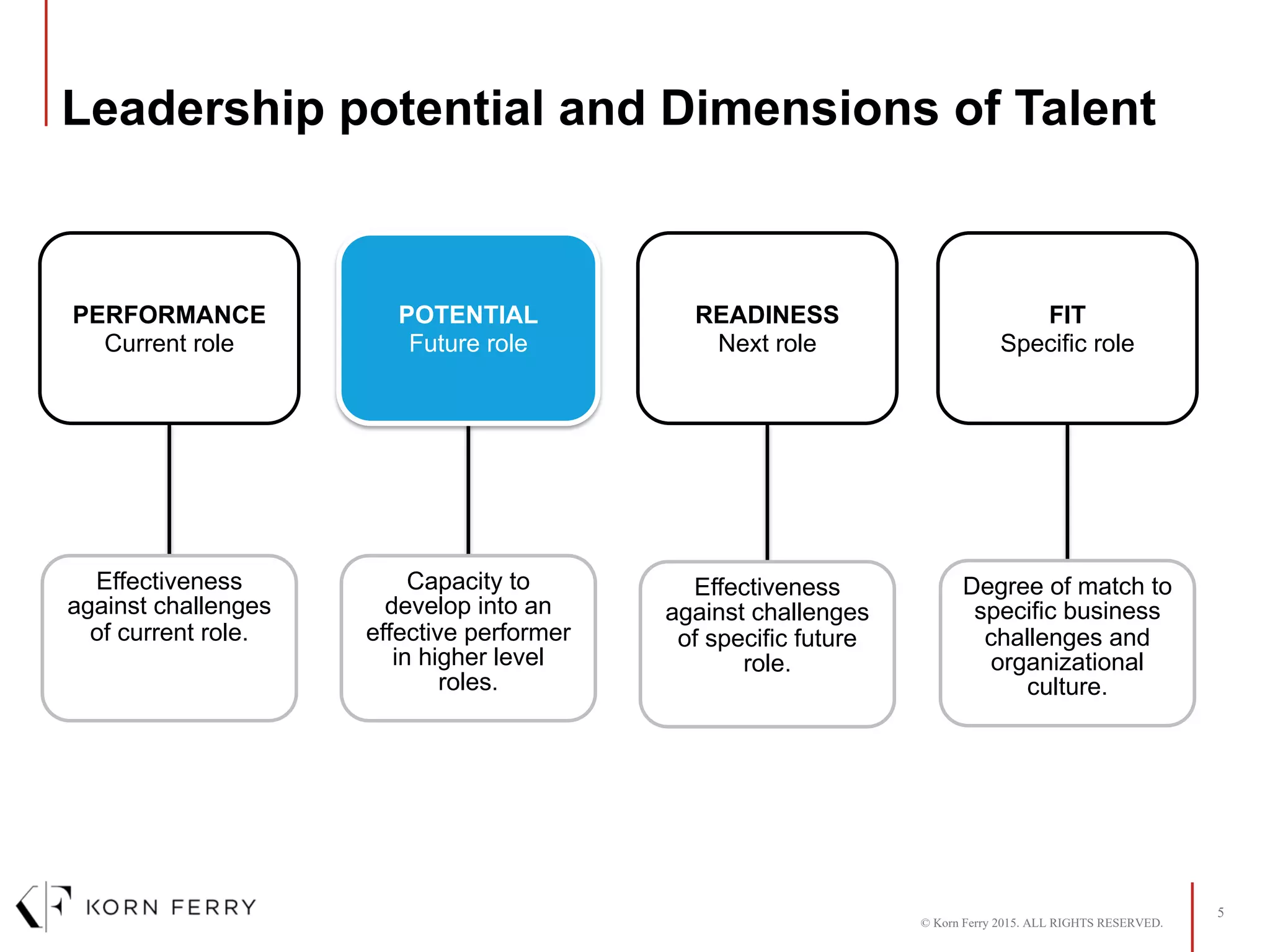
Leadership potential and Dimensions of Talent
Degree of match to
specific business
challenges and
organizational
culture.
Effectiveness
against challenges
of specific future
role.
Capacity to
develop into an
effective performer
in higher level
roles.
Effectiveness
against challenges
of current role.
PERFORMANCE
Current role
POTENTIAL
Future role
READINESS
Next role
FIT
Specific role
At each career or
role transition
Freedman (1998, 2005)
Potential is defined in reference
to a specific (target) leadership
role or level.
Current
Level
Target
Aspiration
You
indicated
this
And this
We picked this as a comparison
© Korn Ferry 2015. ALL RIGHTS RESERVED. 8
Leadership means to be ready to change
Learn to manage projects and
day-to-day business operations.
Let go of doing the work.
Relate well to people with
different goals/objectives.
Deal with inherited challenges.
Learn to manage through
others.
Develop rather than implement
vision/strategy.
Perform in the spotlight.
Coordinate / Integrate across
diverse business functions.
Chief Executive Officer/Top
Organizational Executive
Top Business or Organizational
Group Executive
Senior / Top Functional Leader
Business or Organizational Unit/
Division Leader
Functional Leader
Mid-level Leader
First Level Leader
Team Lead
Individual Contributor /
Professional
© Korn Ferry 2015. ALL RIGHTS RESERVED.
9
Six Signposts of Leadership Potential
Drivers
The drive and
motivation to
serve as a
leader.
Awareness
Self-
awareness of
strengths and
developmental
needs.
Leadership
Traits
Leadership
traits
associated
with
advancement.
Derailment
risks
Managed
derailment risks.
Experience
A track record
of formative
experiences.
Learning
agility
The ability to
learn from
experience.
Aptitude for logic
and reasoning.
© Korn Ferry 2015. ALL RIGHTS RESERVED.
10
Advancement
drive
Refers to a leader’s drive to advance
through collaboration, ambition, challenge.
Career
planning
Reflects how narrowly or broadly focused
are the participant’s career goals and how
specific is his/her career plan.
Role
preferences
Indicates the preference for the work of roles
requiring versatility and achievement
through others vs. professional mastery and
expertise.
Drivers
How interested and driven you are in
pursuing the challenges and work of
leaders.
Research shows that high potential leaders
value the nature of leadership work, the
opportunity to make a difference,
having a positive impact on their coworkers and
organization, and having greater responsibility.
Advancement drive and
Role preferences are
normed against the
Target Level. Career
planning is not normed.
2 of 3 need to be green
in order to be ‘strong’ in
the overview.
© Korn Ferry 2015. ALL RIGHTS RESERVED.
11
Core
experience
Reflects what the leader has learned in
the course of his/her day-to-day
leadership career.
Perspective Reflects the diversity of a leader’s
experience across organizations,
industries, functional areas, and
countries.
Key
challenges
Indicates the leader’s experience with
a number of seminal developmental
challenges.
Experience
Experience explores where you have
been and how you have prepared to
transition to more significantly
challenging roles.
All experience
subscales are normed
against someone’s
Current level.
2 of 3 need to be green
in order to be ‘strong’
in the overview.
Research has found that challenging experiences
contribute to the development of a broad variety of
leadership competencies including business
knowledge, visioning, strategic thinking, problem
solving, decision making, change management,
and interpersonal skill.
© Korn Ferry 2015. ALL RIGHTS RESERVED.
12
Awareness
Self-awareness The extent to which the leader is
aware of his/her strengths and
development needs.
Situational
self-awareness
The extent to which the leader
monitors, and is aware of how
events impact his/her performance.
The extent to which you are aware of
your strengths and development needs
in the context of your work.
All awareness subscales
are normed against the
Target Level
2 of 2 need to be green in
order to be ‘strong’ in the
overview.
Research shows that highly self-aware leaders
have a positive impact on company
performance. A prevalence of high self-
awareness amongst leaders correlates with a
high rate of return.
© Korn Ferry 2015. ALL RIGHTS RESERVED.
13
The extent to which leaders extract
lessons from experience and leverage
them in novel situations.
Learning agility
Mental
agility
Reflects a leader’s tendency to be
inquisitive and approach problems in novel
ways.
People
agility
Reflects a leader’s skill in reading others
and applying the insights gained in people-
related matters.
Change
agility
Reflects a leader’s tendency to promote
new possibilities and to take ideas from
vision to reality.
Results
agility
Reflects the propensity to deliver
outstanding results in new and tough
situations.
All Learning agility
subscales are normed
against the Target Level
3 of 4 subscales need to
be green in order to be
‘strong’ in the overview.
Research shows that learning agile leaders are
rated more competent, recognized as having the
most potential for advancement, get promoted
faster and more often than their peers, and
outperform their peers after a promotion.
© Korn Ferry 2015. ALL RIGHTS RESERVED.
14
Dispositions leaders possess that
make them naturally inclined to lead.
Focus
Reflects the balance between attending
to details and keeping an eye on the big
picture.
Persistence
Reflects the passionate pursuit of
personally valued long-term goals.
Tolerance of
ambiguity
Reflects a leader’s capacity to deal
effectively with uncertainty or confusing
situations.
Assertiveness
Reflects the willingness to assume a
leader role and comfort with leadership.
Optimism
Reflects a leader’s tendency to have a
positive outlook.
Leadership traits
All Leadership traits
subscales are normed
against the Target Level
4 of 5 subscales need to
be green in order to be
‘strong’ in the overview.
Research shows that the traits matter to
success and that some matter more than
others for leadership success.
© Korn Ferry 2015. ALL RIGHTS RESERVED.
15
Leaders manage those configurations
of traits which might lead them to
derail.
Derailment risks
Volatile Indicates a risk toward being
mercurial, erratic, or unpredictable.
Micro-
managing
Indicates a risk toward over
controlling the work of direct reports.
Closed Indicates a risk toward being closed
to alternative perspectives and
opportunities.
Derailment risks are
normed against the
Target Level
3 of 3 must be green in
order for it to be ‘strong’
in the overview page.
Research shows the risks related to derailment
go up at higher job levels: expectations are
higher and consequences of failure are higher.
Reading your
report
© Korn Ferry 2015. ALL RIGHTS RESERVED.
17
Individual Report
The target level
against which you
are assessed.
© Korn Ferry 2015. ALL RIGHTS RESERVED.
18
9 org levels and 6 norm groups
First Level
Leader
Mid-level
Leader
Business
Unit Leader
Sr.
Executive
Norm
groupings
Functional
Leader
Sr. Functional
Leader
1 2 3 4 5 6 7 8 9
Org
levels
1 2 3 4 5 6
© Korn Ferry 2015. ALL RIGHTS RESERVED.
19
Signposts are presented in the development
language
There is NO
total score
in KFALP
© Korn Ferry 2015. ALL RIGHTS RESERVED.
20
Individual Report: Overview page
Signposts that need
development
Signposts that do not
need development
© Korn Ferry 2015. ALL RIGHTS RESERVED.
21
Individual Report: Assessment details
Status, Icon, Signpost
1. Overview of what the
signpost measures.
2. Summary of your
results.
© Korn Ferry 2015. ALL RIGHTS RESERVED.
22
Learner’s score (percentile)
§ Normed against the target level.
§ Except for Experience – normed against the current level.
Individual Report: Reading the results
Well below average
Below average
At or above average
Well above average
(sometimes)
Your results place you
at the 16th percentile
compared to
successful target
level leaders.
© Korn Ferry 2015. ALL RIGHTS RESERVED.
23
Generic, boilerplate definition of
lower scores.
Generic, boilerplate definition of
higher scores.
Individual Report: Scale
Computer generated,
narrative interpretation
of your results.
© Korn Ferry 2015. ALL RIGHTS RESERVED.
24
Learner’s score (percentile)
Individual Report: Derailment risks
High risk 91+
Risk 85-90
Minimal to low risk for <85
Your results place you
at the 28th percentile
compared to target
level leaders.
© Korn Ferry 2015. ALL RIGHTS RESERVED.
25
Individual Report: Development priorities
Top three development
priorities based on the
scores.
© Korn Ferry 2015. ALL RIGHTS RESERVED.
26
Individual Report: Summary
© Korn Ferry 2015. ALL RIGHTS RESERVED.
27
Individual Report: Levels
Current level (as
reported by you).
Target level (set by
your organization).
Career
aspiration (as
reported by
you).
© Korn Ferry 2015. ALL RIGHTS RESERVED.
28
Individual Report: Summative overview
Highlights of your
career to-date.
Summary of your (self-
reported) career goals
and career plan.
Attributes you chose to
describe your ideal
role.
© Korn Ferry 2015. ALL RIGHTS RESERVED.
29
Individual Report: Aspirations
Your report having
two or more years
experience at
each.
You would
consider roles in
these areas.
Your (self-
reported) current
level.
Number of rows to appear in the report will depend on what was chosen by you.
Getting the most
from your results
© Korn Ferry 2015. ALL RIGHTS RESERVED.
31
What: What do your
results say about you?
So What: What
implications do your results
have for your goals and
objectives?
Now What: What are
you going to do about it?
© Korn Ferry 2015. ALL RIGHTS RESERVED.
32
What: What do your
results say about you?
§ Be sure you can
accurately describe your
assessment results.
§ This sounds simple (and it
can be) but it’s very
important.
© Korn Ferry 2015. ALL RIGHTS RESERVED.
33
So What: What
implications do your
results have for your
goals and objectives?
…My results suggest
that I am less
comfortable with
ambiguity than is
typical for successful
target level leaders.
…I aspire to be a
target level leader.
…I need to find a
way to keep my
relative intolerance
for ambiguity from
impacting my
success as a leader.
© Korn Ferry 2015. ALL RIGHTS RESERVED.
34
Now What: What
are you going to do
about it?
…I need to find a
way to keep my
relative intolerance
for ambiguity from
impacting my
success as a leader.
…Maybe there is a
way I can decrease
the amount if
ambiguity I face.
…Maybe I can learn
to be more tolerant
of ambiguity.
…Perhaps I can
delegate the most
ambiguous tasks to
my team to pre-
process for me.
© Korn Ferry 2015. ALL RIGHTS RESERVED.
35
Other considerations
§ How important is it?
§ What other priorities
are there?
§ How much effort is
required?
§ Where will I get the
best return on my
developmental effort?
© Korn Ferry 2015. ALL RIGHTS RESERVED.
36
When developing goals, ensure that they are:
§ Focused (no more than 3).
§ Challenging and realistic.
§ Relevant to the organization.
§ Action-oriented.
§ Measurable.
§ Time-phased.
Goal setting
© Korn Ferry 2015. ALL RIGHTS RESERVED.
37
Complete Doodle
Poll to set
appointment with
Susan to receive
report by email
and review results.
Address
questions.
Set up time with
manager to
discuss themes
and focus areas.
Complete your
Development Plan.
Next steps

Kfalp individual feedback_slides2018

  • 1.
    © Korn Ferry2015. ALL RIGHTS RESERVED. Korn Ferry Assessment of Leadership Potential Assessment Description SPARK POTENTIAL IGNITE GREATNESS
  • 2.
    © Korn Ferry2015. ALL RIGHTS RESERVED. 2 Your capacity and interest to develop the qualities required for effective performance in a significantly more challenging leadership role. Leadership potential
  • 3.
    © Korn Ferry2014. ALL RIGHTS RESERVED. Overview 1. Intro to assessment 2. Detail review of assessment structure 3. Goal setting
  • 4.
    © Korn Ferry2014. ALL RIGHTS RESERVED. Preparing for and Utilising Feedback 1. Being ready 2. Being open 3. Making concrete plans to take action
  • 5.
    © Korn Ferry2015. ALL RIGHTS RESERVED. 5 Leadership potential and Dimensions of Talent Degree of match to specific business challenges and organizational culture. Effectiveness against challenges of specific future role. Capacity to develop into an effective performer in higher level roles. Effectiveness against challenges of current role. PERFORMANCE Current role POTENTIAL Future role READINESS Next role FIT Specific role
  • 6.
    At each careeror role transition Freedman (1998, 2005)
  • 7.
    Potential is definedin reference to a specific (target) leadership role or level. Current Level Target Aspiration You indicated this And this We picked this as a comparison
  • 8.
    © Korn Ferry2015. ALL RIGHTS RESERVED. 8 Leadership means to be ready to change Learn to manage projects and day-to-day business operations. Let go of doing the work. Relate well to people with different goals/objectives. Deal with inherited challenges. Learn to manage through others. Develop rather than implement vision/strategy. Perform in the spotlight. Coordinate / Integrate across diverse business functions. Chief Executive Officer/Top Organizational Executive Top Business or Organizational Group Executive Senior / Top Functional Leader Business or Organizational Unit/ Division Leader Functional Leader Mid-level Leader First Level Leader Team Lead Individual Contributor / Professional
  • 9.
    © Korn Ferry2015. ALL RIGHTS RESERVED. 9 Six Signposts of Leadership Potential Drivers The drive and motivation to serve as a leader. Awareness Self- awareness of strengths and developmental needs. Leadership Traits Leadership traits associated with advancement. Derailment risks Managed derailment risks. Experience A track record of formative experiences. Learning agility The ability to learn from experience. Aptitude for logic and reasoning.
  • 10.
    © Korn Ferry2015. ALL RIGHTS RESERVED. 10 Advancement drive Refers to a leader’s drive to advance through collaboration, ambition, challenge. Career planning Reflects how narrowly or broadly focused are the participant’s career goals and how specific is his/her career plan. Role preferences Indicates the preference for the work of roles requiring versatility and achievement through others vs. professional mastery and expertise. Drivers How interested and driven you are in pursuing the challenges and work of leaders. Research shows that high potential leaders value the nature of leadership work, the opportunity to make a difference, having a positive impact on their coworkers and organization, and having greater responsibility. Advancement drive and Role preferences are normed against the Target Level. Career planning is not normed. 2 of 3 need to be green in order to be ‘strong’ in the overview.
  • 11.
    © Korn Ferry2015. ALL RIGHTS RESERVED. 11 Core experience Reflects what the leader has learned in the course of his/her day-to-day leadership career. Perspective Reflects the diversity of a leader’s experience across organizations, industries, functional areas, and countries. Key challenges Indicates the leader’s experience with a number of seminal developmental challenges. Experience Experience explores where you have been and how you have prepared to transition to more significantly challenging roles. All experience subscales are normed against someone’s Current level. 2 of 3 need to be green in order to be ‘strong’ in the overview. Research has found that challenging experiences contribute to the development of a broad variety of leadership competencies including business knowledge, visioning, strategic thinking, problem solving, decision making, change management, and interpersonal skill.
  • 12.
    © Korn Ferry2015. ALL RIGHTS RESERVED. 12 Awareness Self-awareness The extent to which the leader is aware of his/her strengths and development needs. Situational self-awareness The extent to which the leader monitors, and is aware of how events impact his/her performance. The extent to which you are aware of your strengths and development needs in the context of your work. All awareness subscales are normed against the Target Level 2 of 2 need to be green in order to be ‘strong’ in the overview. Research shows that highly self-aware leaders have a positive impact on company performance. A prevalence of high self- awareness amongst leaders correlates with a high rate of return.
  • 13.
    © Korn Ferry2015. ALL RIGHTS RESERVED. 13 The extent to which leaders extract lessons from experience and leverage them in novel situations. Learning agility Mental agility Reflects a leader’s tendency to be inquisitive and approach problems in novel ways. People agility Reflects a leader’s skill in reading others and applying the insights gained in people- related matters. Change agility Reflects a leader’s tendency to promote new possibilities and to take ideas from vision to reality. Results agility Reflects the propensity to deliver outstanding results in new and tough situations. All Learning agility subscales are normed against the Target Level 3 of 4 subscales need to be green in order to be ‘strong’ in the overview. Research shows that learning agile leaders are rated more competent, recognized as having the most potential for advancement, get promoted faster and more often than their peers, and outperform their peers after a promotion.
  • 14.
    © Korn Ferry2015. ALL RIGHTS RESERVED. 14 Dispositions leaders possess that make them naturally inclined to lead. Focus Reflects the balance between attending to details and keeping an eye on the big picture. Persistence Reflects the passionate pursuit of personally valued long-term goals. Tolerance of ambiguity Reflects a leader’s capacity to deal effectively with uncertainty or confusing situations. Assertiveness Reflects the willingness to assume a leader role and comfort with leadership. Optimism Reflects a leader’s tendency to have a positive outlook. Leadership traits All Leadership traits subscales are normed against the Target Level 4 of 5 subscales need to be green in order to be ‘strong’ in the overview. Research shows that the traits matter to success and that some matter more than others for leadership success.
  • 15.
    © Korn Ferry2015. ALL RIGHTS RESERVED. 15 Leaders manage those configurations of traits which might lead them to derail. Derailment risks Volatile Indicates a risk toward being mercurial, erratic, or unpredictable. Micro- managing Indicates a risk toward over controlling the work of direct reports. Closed Indicates a risk toward being closed to alternative perspectives and opportunities. Derailment risks are normed against the Target Level 3 of 3 must be green in order for it to be ‘strong’ in the overview page. Research shows the risks related to derailment go up at higher job levels: expectations are higher and consequences of failure are higher.
  • 16.
  • 17.
    © Korn Ferry2015. ALL RIGHTS RESERVED. 17 Individual Report The target level against which you are assessed.
  • 18.
    © Korn Ferry2015. ALL RIGHTS RESERVED. 18 9 org levels and 6 norm groups First Level Leader Mid-level Leader Business Unit Leader Sr. Executive Norm groupings Functional Leader Sr. Functional Leader 1 2 3 4 5 6 7 8 9 Org levels 1 2 3 4 5 6
  • 19.
    © Korn Ferry2015. ALL RIGHTS RESERVED. 19 Signposts are presented in the development language There is NO total score in KFALP
  • 20.
    © Korn Ferry2015. ALL RIGHTS RESERVED. 20 Individual Report: Overview page Signposts that need development Signposts that do not need development
  • 21.
    © Korn Ferry2015. ALL RIGHTS RESERVED. 21 Individual Report: Assessment details Status, Icon, Signpost 1. Overview of what the signpost measures. 2. Summary of your results.
  • 22.
    © Korn Ferry2015. ALL RIGHTS RESERVED. 22 Learner’s score (percentile) § Normed against the target level. § Except for Experience – normed against the current level. Individual Report: Reading the results Well below average Below average At or above average Well above average (sometimes) Your results place you at the 16th percentile compared to successful target level leaders.
  • 23.
    © Korn Ferry2015. ALL RIGHTS RESERVED. 23 Generic, boilerplate definition of lower scores. Generic, boilerplate definition of higher scores. Individual Report: Scale Computer generated, narrative interpretation of your results.
  • 24.
    © Korn Ferry2015. ALL RIGHTS RESERVED. 24 Learner’s score (percentile) Individual Report: Derailment risks High risk 91+ Risk 85-90 Minimal to low risk for <85 Your results place you at the 28th percentile compared to target level leaders.
  • 25.
    © Korn Ferry2015. ALL RIGHTS RESERVED. 25 Individual Report: Development priorities Top three development priorities based on the scores.
  • 26.
    © Korn Ferry2015. ALL RIGHTS RESERVED. 26 Individual Report: Summary
  • 27.
    © Korn Ferry2015. ALL RIGHTS RESERVED. 27 Individual Report: Levels Current level (as reported by you). Target level (set by your organization). Career aspiration (as reported by you).
  • 28.
    © Korn Ferry2015. ALL RIGHTS RESERVED. 28 Individual Report: Summative overview Highlights of your career to-date. Summary of your (self- reported) career goals and career plan. Attributes you chose to describe your ideal role.
  • 29.
    © Korn Ferry2015. ALL RIGHTS RESERVED. 29 Individual Report: Aspirations Your report having two or more years experience at each. You would consider roles in these areas. Your (self- reported) current level. Number of rows to appear in the report will depend on what was chosen by you.
  • 30.
  • 31.
    © Korn Ferry2015. ALL RIGHTS RESERVED. 31 What: What do your results say about you? So What: What implications do your results have for your goals and objectives? Now What: What are you going to do about it?
  • 32.
    © Korn Ferry2015. ALL RIGHTS RESERVED. 32 What: What do your results say about you? § Be sure you can accurately describe your assessment results. § This sounds simple (and it can be) but it’s very important.
  • 33.
    © Korn Ferry2015. ALL RIGHTS RESERVED. 33 So What: What implications do your results have for your goals and objectives? …My results suggest that I am less comfortable with ambiguity than is typical for successful target level leaders. …I aspire to be a target level leader. …I need to find a way to keep my relative intolerance for ambiguity from impacting my success as a leader.
  • 34.
    © Korn Ferry2015. ALL RIGHTS RESERVED. 34 Now What: What are you going to do about it? …I need to find a way to keep my relative intolerance for ambiguity from impacting my success as a leader. …Maybe there is a way I can decrease the amount if ambiguity I face. …Maybe I can learn to be more tolerant of ambiguity. …Perhaps I can delegate the most ambiguous tasks to my team to pre- process for me.
  • 35.
    © Korn Ferry2015. ALL RIGHTS RESERVED. 35 Other considerations § How important is it? § What other priorities are there? § How much effort is required? § Where will I get the best return on my developmental effort?
  • 36.
    © Korn Ferry2015. ALL RIGHTS RESERVED. 36 When developing goals, ensure that they are: § Focused (no more than 3). § Challenging and realistic. § Relevant to the organization. § Action-oriented. § Measurable. § Time-phased. Goal setting
  • 37.
    © Korn Ferry2015. ALL RIGHTS RESERVED. 37 Complete Doodle Poll to set appointment with Susan to receive report by email and review results. Address questions. Set up time with manager to discuss themes and focus areas. Complete your Development Plan. Next steps