Download the fullversion and explore a variety of test banks
or solution manuals at https://testbankdeal.com
Organizational Behavior 18th Edition Robbins
Solutions Manual
_____ Follow the link below to get your download now _____
https://testbankdeal.com/product/organizational-
behavior-18th-edition-robbins-solutions-manual/
Access testbankdeal.com now to download high-quality
test banks or solution manuals
2.
We have selectedsome products that you may be interested in
Click the link to download now or visit testbankdeal.com
for more options!.
Organizational Behavior 18th Edition Robbins Test Bank
https://testbankdeal.com/product/organizational-behavior-18th-edition-
robbins-test-bank/
Organizational Behavior 14th Edition Robbins Solutions
Manual
https://testbankdeal.com/product/organizational-behavior-14th-edition-
robbins-solutions-manual/
Organizational Behavior 16th Edition Robbins Solutions
Manual
https://testbankdeal.com/product/organizational-behavior-16th-edition-
robbins-solutions-manual/
Basic Business Statistics 11th Edition Berenson Solutions
Manual
https://testbankdeal.com/product/basic-business-statistics-11th-
edition-berenson-solutions-manual/
3.
Introduction to EducationalResearch 1st Edition Mertler
Test Bank
https://testbankdeal.com/product/introduction-to-educational-
research-1st-edition-mertler-test-bank/
Business Communication Process and Product Canadian 5th
Edition Guffey Test Bank
https://testbankdeal.com/product/business-communication-process-and-
product-canadian-5th-edition-guffey-test-bank/
Intimate Relationships 2nd Edition Bradbury Test Bank
https://testbankdeal.com/product/intimate-relationships-2nd-edition-
bradbury-test-bank/
Practical Financial Management 7th Edition Lasher Test
Bank
https://testbankdeal.com/product/practical-financial-management-7th-
edition-lasher-test-bank/
Marriages and Families in the 21st Century A Bioecological
Approach 2nd Edition Howe Test Bank
https://testbankdeal.com/product/marriages-and-families-in-the-21st-
century-a-bioecological-approach-2nd-edition-howe-test-bank/
4.
Strategic Management CreatingCompetitive Advantages
Canadian 4th Edition Dess Solutions Manual
https://testbankdeal.com/product/strategic-management-creating-
competitive-advantages-canadian-4th-edition-dess-solutions-manual/
This ebook isfor the use of anyone anywhere in the United
States and most other parts of the world at no cost and with
almost no restrictions whatsoever. You may copy it, give it away
or re-use it under the terms of the Project Gutenberg License
included with this ebook or online at www.gutenberg.org. If you
are not located in the United States, you will have to check the
laws of the country where you are located before using this
eBook.
Title: The Enchanted Burro
Author: Charles Fletcher Lummis
Release date: February 24, 2019 [eBook #58954]
Language: English
Credits: E-text prepared by the Online Distributed Proofreading
Team (http://www.pgdp.net) from page images
generously made available by Internet Archive
(https://archive.org)
*** START OF THE PROJECT GUTENBERG EBOOK THE ENCHANTED
BURRO ***
41.
E-text prepared by
theOnline Distributed Proofreading Team
(http://www.pgdp.net)
from page images generously made available by
Internet Archive
(https://archive.org)
Note: Images of the original pages are available through Internet
Archive. See
https://archive.org/details/enchantedburro00lummrich
The Enchanted Burro
BURRO
And Other Storiesas I Have Known Them
From Maine to Chile and California
BY
CHARLES F. LUMMIS
AUTHOR OF
Strange Corners of Our Country, A Tramp Across the Continent,
Mexico Today, The Spanish Pioneers of America, My
Friend Will, The Gold Fish of Gran Chimú,
The Land of Poco Tiempo, Pueblo
Indian Folkstories,
etc., etc.
NEW EDITION
WITH MANY NEW STORIES AND ILLUSTRATIONS
CHICAGO
A. C. McCLURG & CO.
1912
44.
Copyright, 1897, byWay & Williams
Copyright
A. C. McCLURG & CO.
1912
Published September, 1912
M. F. Hall Printing Company
Chicago
To
AMADO
and
AMADO
The name that stood for such a friend is tall enough for two—
My oldest on the old frontier, my newest on the new.
Nor is it on my heart to pray my baby’s feet be spared
So rugged paths (companioned so) as once his father fared.
45.
Contents
Page
The Enchanted Burro(New Mexico) 1
The Mummy-Miner (Peru) 25
A Boy of the Andes (Peru) 43
A Daughter of the Misti (Peru) 65
The Witch Deer (New Mexico) 85
Felipe’s Sugaring-Off (Peru) 99
Andrés, the Arriero (Bolivia) 111
Our Yellow Slave 141
The Peak of Gold (New Mexico) 161
Pablo’s Deer Hunt (New Mexico) 179
Candelária’s Curse (New Mexico) 203
The Habit of the Fraile (Peru) 219
The Great Magician 241
The Silver Omelet (Mexico) 257
A Duel in the Desert (California) 275
A ’Rastle with a Wildcat (New England) 285
A Tame Deer (California) 299
The Rebel Double Runner (New England) 315
The Balsa Boy of Lake Titi-Caca (Bolivia) 333
46.
Illustrations
Page
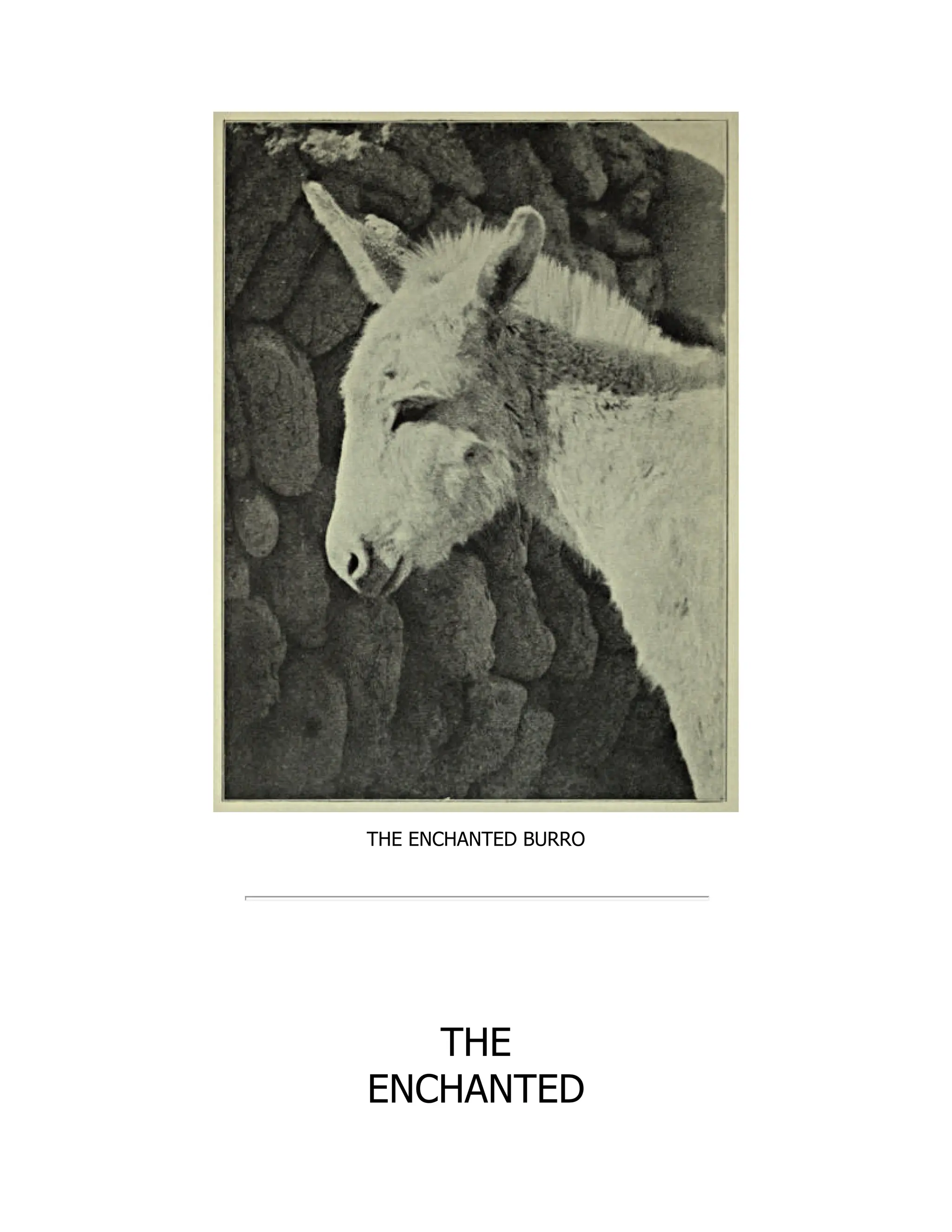
The enchanted burroFrontispiece
Lelo 17
The home of the Soroche 55
In Ta-bi-rá 179
“The bones of Ta-bi-rá” 186
The patio process at Guanajuato 257
Wildcat and owl in death-struggle 280
47.
Foreword
The Truly Cleverknow enough to make books of a country by a
few days of Pullman and hotel—or even by skimming the public
library at home, without the bother and expense of travel at all.
But the few Dullards now left can arrive in Knowledge only by
plodding; not “as on wings of eagles” and Inspiration, but by the
drudgery of learning.
It has taken more than twenty-five arduous years to beat into me
what little I hope I know about the Frontiers of the Three Americas.
To learn several new languages and digest innumerable old
chronicles was but one side of the task: everywhere, and among
many peoples, I had to win slow adoption from Stranger to Friend;
to travel footsore or saddleweary; to share their beds, their feasts,
their famine, their speech, their ideas, their pleasures and their
hardships—in fact, to live their life. And it was Life—Human and
warm, even at its rudest.
Part of these stories, under this same title, were published in 1897
by an amateur firm which very presently succumbed—post hoc,
indeed, but I trust not propter. So the book has been out of print for
a dozen years. It was very gently entreated by critics and public
while its young godfathers lasted.
I now add five stories and 4,000 miles of geography—clear back to
my venerable boyhood. Born and bred a Yankee, I Escaped In Time
(at 23), and have become a much better Indian, New Mexican,
Mexican, Peruvian, Californian and composite Paisano of the Frontier.
It may be that other graduate New Englanders will find here some
echo to memory of what they and I used to think we knew of the
48.
Stern and Rockbound,so long ago; and that the Unremoved will
pardon my lapses, in view of my enduring Alibi.
As to anything this side of New England, I won’t “either apologize
or fight.” This part is not remote and precarious memory of the only
true Golden Age—the Age when we Haven’t Any—but the indelible
autograph of thirty older years, scarred and wrinkled upon me inside
and out. It can take care of itself.
Most of these stories, in both instances, are of episodes in which I
had some part. Not all are “True Stories,” but all are truthful. I hope
that makes them no duller than if they had been guessed out of
whole cloth and innocence.
C. F. L.
Los Angeles, Cal.
49.
The Enchanted Burro.
TheEnchanted Burro.
Lelo dropped the point of his heavy irrigating hoe and stood with
chin dented upon the rude handle, looking intently to the east.
Around his bare ankles the rill from the acéquia[1] eddied a moment
and then sucked through the gap in the little ridge of earth which
bounded the irrigating bed. The early sun was yellow as gold upon
the crags of the mesa[2]—that league-long front of ragged cliffs
whose sandstones, black-capped by the lava of the immemorial Year
of Fire, here wall the valley of the Rio Grande on the west. Where a
spur of the frowning Kú-mai runs out is a little bay in the cliffs; and
here the outermost fields of Isleta were turning green with spring.
The young wheat swayed and whispered to the water, whose scouts
stole about amid the stalks, and came back and called their fellows
forward, and spread hither and yon, till every green blade was
drinking and the tide began to creep up the low boundaries at either
side. Up at the sluice gate a small but eager stream was tumbling
from the big, placid ditch, and on it came till it struck the tiny dam
which closed the furrow just beyond Lelo, and, turning, stole past
him again to join the rest amid the wheat. The irrigating bed, twenty
feet square, filled and filled, and suddenly the gathered puddle
broke down a barrier and came romping into the next bed without
so much as saying “By your leave.” And here it was not so friendly;
for, forgetting that it had come only to bring a drink, it went
50.
stampeding about, knockingdown the tender blades and half
covering them with mud. At sound of this, Lelo seemed suddenly to
waken, and lifting with his hoe the few clods which dammed the
furrow, he dropped them into the first gap, and jumping into the
second bed repaired its barrier also with a few strokes. Then he let
in a gentler stream from the furrow.
“Poco, and I should have lost a bed,” he said to himself,
goodnaturedly. Blas always took things easy, and I presume that is
the reason no one ever called him anything but Lelo[3]—“Slow-
poke”—for Indian boys are as given to nicknames as are any others,
and the mote had stuck to him ever since its invention. He was
rather slow—this big, powerful boy, with a round, heavy chin and a
face less clear-cut than was common in the pueblo. Old ’Lipe had
taken to wife a Navajo captive, and all could see that the boy carried
upon his father’s strong frame the flatter, more stolid features of his
mother’s nomad people.
But now the face seemed not quite so heavy; for again he was
looking toward the pueblo and bending his head as one who listens
for a far whisper. There it came again—a faint, faint air which not
one of us could have heard, but to this Indian boy it told of shouts
and mingled wails.
“What will be?” cried Lelo, stamping his hoe upon the barrier, and
with unwonted fire in his eyes. “For surely I hear the voice of women
lamenting, and there are men’s shouts as in anger. Something heavy
it will be—and perhaps I am needed.” Splashing up to the ditch, he
shut the gate and threw down his hoe, and a moment later was
running toward Isleta with the long, heavy, tireless stride that was
the jest of the other boys in the rabbit hunt, but left Lelo not so very
far behind them after all.
In the pueblo was, indeed, excitement enough. Little knots of the
swart people stood here and there, talking earnestly but low; in the
broad, flat plaza were many hurrying to and fro; and in the street
beyond was a great crowd about a house whence arose the long,
wild wails of mourners.
51.
“What is, tioDiego?” asked Lelo, stopping where a number of men
stood in gloomy silence. “What has befallen? For even in the milpa[4]
I heard the cries, and came running to see.”
“It is ill,” answered the old man he had addressed as uncle. “It
seems that Those Above are angry with us! For this morning the
captain of war finds himself dead in bed—and scalped! And no tracks
of man were about his door.”
“Ay, all is ill!” groaned a short, heavy-set man, in a frayed blanket.
“For yesterday, coming from the llano[5] with my burro,[6] I met a
stranger—a bárbaro. And, blowing upon Paloma, he bewitched the
poor beast so that it sprang off the trail and was killed at the bottom
of the cliff. It lacked only that! Last month it was the raid of the
Cumanche; and, though we followed and slew many of the robbers
and got back many animals, yet mine were not found, and this was
the very last that remained to me.”
“Pero, Don ’Colás!” cried Lelo, “your burro I saw this very morning
as I went to the field before the sun. Paloma it was, with the white
face and the white hind foot—for do I not know him well? He was
passing through the bushes under the cliffs at the point, and turned
to look at me as I crossed the fields below.”
“Vaya!” cried Nicolás, angrily. “Did I not see him, with these my
eyes, jump the cliff of two hundred feet yesterday, and with these
my hands feel him at the foot that he was dead? Go, with your
stories of a stupid, for——”
But here the alguazil, who was one of the group, interrupted:
“Lelo has no fool’s eyes, and this thing I shall look into. Since this
morning, many things look suspicious. Come, show me where fell
thy burro—for to me all these doings are cousins one to another.”
Nicolás, with angry confidence, accompanied the broad-
shouldered Indian sheriff, and their companions followed silently.
Across the adobe-walled gardens they trudged, and into the sandy
“draw,” whose trail led along the cliff and up among the jumble of
fallen crags at one side.
52.
“Yonder he jumpedoff,” said ’Colás, “and fell——” But even then
he rubbed his eyes and turned pale. For where he had left the limp,
bleeding carcass of poor Paloma only twenty-four hours before,
there was now nothing to be seen. Only, upon a rock, were a few
red blotches.
“What is this!” demanded the alguazil, sternly. “Hast thou hidden
him away? Claro that something fell here—for there is blood and a
tuft of hair upon yon stone. But where is the burro?”
“How should I hide him, since he was dead as the rocks? It is
witchcraft, I tell you—for see! There are no tracks of him going
away, even where the earth is soft. And for the coyotes and wildcats
—they would have left his bones. The Gentile I met—he is the witch.
First he gave the evil eye to my poor beast, that it killed itself; and
now he has flown away in its shape to do other ills.”
“It can be so,” mused the sheriff, gravely; “but in the meantime
there is no remedy—I have to answer to the Fathers of Medicine for
you who bring such stories of dead burros, but cannot show them.
For, I tell you, this has something to say for the deed that was done
in the pueblo this morning. Al calaboz!”
Half an hour later, poor Nicolás was squatted disconsolately upon
the bare floor of the adobe jail—that simple prison from which no
one of the simple prisoners ever thinks to dig out. It is not so much
the clay wall that holds them, as the authority of law, which no
Pueblo ever yet questioned.
“’Colás’s burro” was soon in every mouth. The strange story of its
death and its reappearance to Lelo were not to be mocked at. So it
used to be, that the animals were as people; and every one knew
that there were witches still who took the forms of brutes and flew
by night to work mischief. Perhaps it was some wizard of the
Cumanche who thus, by the aid of the evil ones, was avenging the
long-haired horse-thieves who had fallen at Tajique.[7] And now
Pascual, returning from a ranch across the river, made known that,
sitting upon his roof all night to think of the year, he had been aware
53.
of a burrothat passed down the street even to the house of the war
captain; after which he had noticed it no more. Clearly, then!
Some even thought that Lelo should be imprisoned, since he had
seen the burro in the morning. And when, searching anew, they
found in a splinter of the captain’s door a long, coarse, gray hair,
every man looked about him suspiciously. But there was no other
clew—save that Francisco, the cleverest of hunters, called the
officials to a little corner of the street, where the people had not
crowded, and pointed to some dim marks in the sand.
“Que importa?” said the gray haired governor, shrugging his
shoulders, as he leaned on his staff of office and looked closely. “In
Isleta there are two thousand burros, and their paths are
everywhere.”
“But see!” persisted the trailer. “Are they like this? For this brute
was lame in all the legs, so that his feet fell over to the inside a little,
instead of coming flatly down. It will be the Enchanted Burro!”
“Ahu!” cried Lelo, who stood by. “And this morning when I passed
the burro of Don ’Colás in the bushes, I saw that it was laming along
as if its legs were stiff.”
By now no one doubted that there was witchcraft afoot, and the
officials whose place it is were taking active measures to preserve
the pueblo. The cacique sat in his closed house fasting and praying,
with ashes upon his head. The Cum-pa-huit-la-wen were running
here and there with their sacred bows and arrows, prying into every
corner, if haply they might find a witch. In the house of mourning
the Shamans were blinding the eyes of the ghosts, that none might
follow the trail of the dead captain and do him harm before he
should reach the safe other world. And in the medicine house the
Father of All Medicine was blowing the slow smoke across the sacred
bowl, to read in that magic mirror the secrets of the whole world.
But in spite of everything, a curse seemed to have fallen upon the
peaceful town. Lucero, the third assistant war captain, did not return
with his flock, and when searchers went to the llano, they found him
54.
lying by achapparo bush dead, and his sheep gone. But worst of all,
he was scalped, and all the wisdom of that cunning head had been
carried away to enrich the mysterious foe—for the soul and talents
of an Indian go with his hair, according to Indian belief. And in a day
or two came running Antonio Peralta to the pueblo, gray as the dead
and without his blanket. Herding his father’s horses back of the
Accursed Hill, he sat upon a block of lava to watch them. As they
grazed, a lame burro came around the hill grazing toward them. And
when it was among them, they suddenly raised their heads in fear
and snorted and turned to run; but the burro, rising like a mountain
lion, sprang upon one of them and fastened on its neck, and all the
herd stampeded to the west, the accursed burro still perched upon
its victim and tearing it. Ay! a gray burro, jovero,[8] and with a white
foot behind. Antonio had his musket, but he dared not fire after this
witch beast. And here were twelve more good horses gone of what
the Cumanche robbers had left.
By now the whole pueblo was wrought to the highest tension.
That frightful doubt which seizes a people oppressed by supernatural
fears brooded everywhere. No man but was sure that the man he
hated was mixed up in the witchcraft; no man who was disliked by
any one but felt the finger of suspicion pointing at him. People grew
dumb and moody, and looked at each other from the corner of the
eye as they passed without even a kindly “Hina-kú-p’wiu, neighbor.”
As for work, that was almost forgotten, though the fields cried out
for care. No one dared take a flock to the llano, and few went even
to their gardens. There were medicine makings every night to
exorcise the evil spirits, and the Shamans worked wonders, and the
medicine guards prowled high and low for witches. The cacique sat
always in his house, seeing no one, nor eating, but torturing his
flesh for the safety of his people.
And still there was no salvation. Not a night went by but some
new outrage befell. Now it was a swooping away of herds, now
some man of the wisest and bravest was slain and scalped in his
bed. And always there were no more tracks than those of a burro,
55.
stiff-kneed, whose hoofsdid not strike squarely upon the ground.
Many, also, caught glimpses of the Enchanted Burro as they peered
at midnight from their dark windows. Sometimes he plodded
mournfully along the uncertain streets, as burros do; but some
vowed that he came down suddenly from the sky, as alighting from
a long flight. Without a doubt, old Melo had seen the brute walk up
the ladder of Ambrósio’s house the very night Ambrósio was found
dead in the little lookout room upon his own roof. And a burro which
could climb a ladder could certainly fly.
On the fourth day Lelo could stand it no longer. “I am going to the
field,” he said, “before the wheat dies. For it is as well to be eaten by
the witches now as that we should starve to death next winter, when
there will be nothing to eat.”
“What folly is this?” cried the neighbors. “Does Lelo think he is
stronger than the ghosts? Let him stay behind those who are more
men.”
But Lelo had another trait, quite as marked as his slowness and
good nature. When his deliberate mind was made up there was no
turning him; and, though he was as terrified as anyone by the awful
happenings of the week, he had decided to attend to his field. So he
only answered the taunts with a stolid, respectful: “No, I do not put
myself against the ghosts. But perhaps they will let me alone,
knowing that my mother has now no one else to feed her.”
The flat-faced mother brought him two tortillas[9] for lunch; and
putting her hands upon his shoulders, looked at him a moment from
wet eyes, saying not a word. And slinging over his shoulder the bow-
case and quiver, Lelo trudged away.
He plodded along the crooked meadow road, white-patched here
and there with crystals of alkali; jumped the main irrigating ditch
with a great bound, and took “across lots” over the adobe fences
and through the vineyards and the orchards of apple, peach and
apricot.
56.
In the fartheredge of the last orchard stood a tiny adobe house,
where old Reyes had lived in the summer-time to guard her ripening
fruits. Since her death it had been abandoned, with the garden, and
next summer the Indian congress could allot it to any one who
asked, since it would have been left untilled for five years. The
house was half hidden from sight—overshadowed on one side by
ancient pear trees and on the other by the black cliffs of an advance
guard of the lava flow.
As he passed the ruined hut Lelo suddenly stooped and began
looking anxiously at a footprint in the soft earth. “That was from no
moccasin of the Tee-wahn,” he muttered to himself, “for the sole is
flatter than ours. And it comes out of the house, where no one ever
goes, now that Grandmother Reyes is dead. But this! For in three
steps it is no more the foot of a man, but of a beast—going even to
the bushes where I saw the Enchanted Burro that morning”—and all
of a tremble, Lelo leaned up against the wall of the house. It was all
he could do to keep from turning and bolting for home—and you
need not laugh at him. The bow-case at his side was from the tawny
mountain lion Lelo had slain with his own hands in the cañons of the
Tetilla; and when Refúgio, the youngest medicine-man, fell wounded
in the fore-front of the fight at Tajique, it was Lelo who had
lumbered forward and brought him away in his arms, saving his life
and hair from the Cumanche knife. But it takes a braver man to
stand against his own superstitions than to face wild beast or wilder
savage; and now, though Lelo did not flee, his knees smote together
and the blood seemed to have left his head dry and over-light. He
sat down, so weak was he; and, with back against the wall, he tried
to gather his scattered thoughts.
At that very moment, if Lelo had turned his head a very little more
to the left and looked at one particular rift in the thorny
greasewoods that choked the foot of the cliff, he might have seen
two dark, hungry eyes fixed upon him; but Lelo was not looking that
way so much as to the corner of the cliff. There he would have to
pass to the field; and it was just around that corner that he had
seen the Enchanted Burro. “And there also I have seen the mouth of
57.
a cave, wherethey say the ogres used to live and where no one
dares to enter”—and he shivered again, like one half frozen. Then he
did look back to the left, but saw nothing, for the eyes were no
longer there. Only, a few rods farther to the left, and where Lelo
could not see for the wall at his back, the tall, white ears of a burro
were moving quietly along in the bushes, which hid the rest of its
body. Now and then the animal stopped and cocked up its ears, as if
to listen; and its eyes rose over the bush, shining with a deep,
strange light. Just beyond was the low adobe wall which separated
Reyes’s garden from the next—running from the foot of the cliff
down past the old house.
To go on to the field needed even more courage than to keep
from fleeing for home; and stubborn as he was, Lelo was trying to
muster up legs and heart to proceed. He even rose to his feet and
drew back his elbows fiercely, straining the muscles of his chest,
where there seemed to be such a weight. Just around the corner of
the house, at that same moment, a burro’s head, with white ears
and a blazed face, rose noiselessly above the adobe fence, and
seeing nothing, a pair of black hoofs came up, and in a swift bound
the animal was over the wall—so lightly that even the sharp Indian
ears not fifteen feet away heard nothing of it.
But if Lelo did not notice, a sharper watcher did. “Kay-eé-w’yoo!”
cried a complaining voice, and a brown bird with broad wings and a
big, round head went fluttering from its perch on the roof. Lelo
started violently, and then smiled at himself. “It is only tecolóte,” he
muttered, “the little owl that lives with the túsas,[10] and they say he
is very wise. To see where he went.”
The boy stole around the corner of the house, but the owl was
nowhere to be seen, and he started back.
As he turned the angle again, he caught sight of a burro’s head
just peeping from around the other corner; and Lelo felt the blood
sinking from his face. The beast gave a little start and then dropped
its head to a bunch of alfalfa that was green at the corner. But this
did not relieve Lelo’s terror. It was Paloma—dead Paloma—now the
58.
Witch Burro. Therewas no mistaking that jovero face. And plain it
was, too, that this was no longer burro-true, but one of the accursed
spirits in burro shape. Those eyes! They seemed, in that swift flash
in which they had met Lelo’s, to be sunk far, far into the skull; and
he was sure that deep in them he saw a dull gleam of red. And the
ears and head—they were touched with death, too! Their skin
seemed hard and ridgy as a rawhide, instead of fitting as the skin
does in life. So, also, was the neck; but no more was to be seen for
the angle of the wall.
LELO
59.
There are menwho die at seventy without having lived so long or
suffered so much as Lelo lived and suffered in those few seconds.
His breath refused to come, and his muscles seemed paralyzed.
This, then, was the Enchanted Burro—the witch that had slain the
captain of war, and his lieutenants, and many more. And now he was
come for Lelo—for though he nosed the alfalfa, one grim eye was
always on the boy. So, no doubt, he had watched his other victims—
but from behind, for not one of them had ever moved. And with that
thought a sudden rush of blood came pricking like needles in Lelo’s
head.
“No one of them saw him, else they had surely fought! And shall I
give myself to him like a sheep? Not if he were ten witches!” And
with the one swift motion of all his life, the lad dropped on one
knee, even as hand and hand clapped notch to bowstring, and, in a
mighty tug, drew the arrow to the head.
Lightning-like as was his move, the burro understood, and hastily
reared back—but a hair too late. The agate-tipped shaft struck
midway of its neck with a loud tap as upon a drum, and bored
through and through till the feathers touched the skin. The animal
sprang high in air, with so wild and hideous a scream as never came
from burro’s throat before, and fell back amid the alfalfa, floundering
and pawing at its neck.
But Lelo had waited for no more. Already he was over the wall and
running like a scared mustang, the bow gripped in his left hand, his
right clutching the bow-case, whose tawny tail leaped and fluttered
behind him. One-Eyed Quico could have made it to the pueblo no
faster than the town slow-poke, who burst into the plaza and the
porch of the governor’s house, gasping:
“The Enchanted Burro! I have—killed—him!”
Fifteen minutes later the new war captain, the medicine men, the
governor, and half the rest of the men of the pueblo were entering
Reyes’s garden, and Lelo was allowed to walk with the principales.
All were very grave, and some a little pale—for it was no laughing
60.
matter to meddlewith the fiend, even after he was dead. There lay
the burro, motionless. No pool of blood was around; but the white
feathers of the arrow had turned red. Cautiously they approached till
suddenly Francisco, the sharpest eyed of trailers, dashed forward
and caught up the two hind legs from amid the alfalfa, crying:
“Said I not that he tipped the hoofs? With reason!”
For from each ankle five dark, naked toes projected through a slit
in the hide.
“Ay, well bewitched!” exclaimed the war captain. “Pull me the
other side!” And at their tug the belly of the burro parted lengthwise,
showing only a stiff, dried skin, and inside the cavity a swart body
stripped to the breech-clout. Alongside lay arrows and a strong bow
of buffalo horn, with a light copper hatchet and a keen scalping
knife.
“Sácalo!” ordered the war captain; but it was easier said than
done. They bent the stubborn rawhide well apart; but not until one
had run his knife up the neck of the skin and cut both ends of Lelo’s
arrow could they haul out the masquerader. The shaft had passed
through his throat from side to side, pinning it to the rawhide, and
there he had died.
When the slippery form was at last dragged forth, and they saw
its face, there was a startled murmur through the crowd; for even
without the long scalp lock and the vermilion face-paint, there were
many there who would have known the Cumanche medicine man,
whose brother was the chief that fell at Tajique. He, too, had been
taken prisoner, and had taunted his captors and promised to pay
them, and in the night had escaped, leaving one sentinel dead and
another wounded.
The Enchanted Burro was all very plain now. The plains conjurer,
knowing well by habit how to play on superstitious fears, had used
poor Paloma as the instrument of his revenge—hiding the carcass
and drying the skin quickly on a frame with hot ashes, so that it
stood perfectly in shape by itself. The bones of the fore legs he had
61.
left in, tobe managed with his hands; and in the dark or amid grass,
no one would have noticed the peculiarity of the hind legs. He had
only to pry open the slit in the belly and crawl in, and the stiff hide
closed after him. Thus he had wreaked the vengeance for which,
uncompanioned, he had followed the Pueblos back to their village.
In the cave behind the greasewoods were the scalps of his victims,
drying on little willow hoops; but instead of going to deck a
Cumanche lodge in the great plains, they were tenderly buried in the
old church-yard, restored to their proper owners.
After all these years there still are in the pueblo many tales of the
Enchanted Burro, nothing lost by the re-telling. As for the skin itself,
it lies moth-eaten in the dark storeroom of the man who has been
first assistant war captain for twenty years, beginning his novitiate
the very day he finished a witch and a Cumanche with a single
arrow.
62.
The Mummy Miner.
TheMummy Miner.
There was certainly nothing suggestive of antiquity about Faquito’s
appearance. His droll, brown face, his thickset boyish figure and the
alarming tatters of his scant apparel were all undignified as his name
—which had got to the most disrespectful distance possible from the
stately Francisco of the baptismal font. There could be no worthier
name for a boy of Peru than that worn by the great conquistador
Pizarro. But it is hard to live up to the dignity of the christening, and
Francisco degenerates into Francisquito, which is fond; and then to
Franco, which is familiar; and finally to Faquito, which is positively
rude. Probably it never occurred to the lad to be comforted with
thinking that the greatest conqueror of the Americas was called
Faquito, too, when he was herding his pigs in Truxillo; and that if
one Faquo could grow up to be Don Francisco, so might another.
These consolations of philosophy never do come to us until we are
too old to need them so much.
But perhaps you are thinking: “Well, why should a twelve-year-old
cholo boy look antiquated? Are lads of that age in Peru expected to
be ancient, any more than in New York or Boston?”
N-no, not exactly that—though in the quick tropics a boy is older
at twelve than is one of the same years in the temperate zone;
bigger and more mature. But it was Faquito’s occupation rather than
his age which made me think of him as rather paradoxical. You will
63.
admit that tofind this irresponsible, twinkling face set in one of the
most century-worn frames on earth might well seem incongruous,
not to say startling. The sight of this half Spanish, half Indian[11] boy
of to-day, playing with lives and thoughts that were forgotten five
hundred years ago—aye, and some of them, perhaps, that long
before the Old World dreamed there was a New—was enough to
make any explorer rub his eyes.
Doubtless we shall understand each other better by a little
translation. Huaco is a word not found in the Spanish dictionaries,
for it belongs only to Peru. It is from the Quichua, or speech of the
Incas, of whom you have heard so many remarkable (and not very
accurate) stories; and as adopted into the Spanish of Peru means
specifically a relic of the ancient Indian “civilizations” which occupied
this strange land before the coming of Europeans. Huaquero is the
Spanish derivative to mean a digger of these antiquities—in other
words, a mummy miner. This is a regular profession in Peru, just as
much as gold mining. A competent huaquero commands as good
wages as a skilled laborer in the marvelous silver mountain of Cerro
de Pasco; and, if he works “on his own hook,” may earn much more.
Peru is dotted everywhere with the ruins of large towns of the Incas
and other tribes—some of them that we have so long been taught to
regard as “kings” and the like, while in fact they were tribes very
much like the Pueblo Indians of New Mexico; remarkably advanced
in some things, but still entirely Indians socially, politically and
mentally. Some of these ruins have been deserted for uncounted
centuries, and no man can say who built them nor when they were
abandoned. In fact, Peru is the American Egypt in antiquity; and a
more than Egypt in richness. It was in its time the richest country in
the world. Even before Europeans came to tap its peaks of silver and
valleys of gold, the ancient Peruvians had discovered a way to treat
the precious metals, and used them to adorn themselves and their
temples. Like the Indians they were, they had the invariable Indian
idea of the next world; and always buried with their dead the best
clothing and other property, to give the wanderer a handsome start
beyond the grave—precisely as our aborigines do still. And as the
64.
dryness of thePeruvian desert preserves mummies indefinitely
through the ages, you will begin to see how mummy mining has
become one of the important industries of Peru. There are mummies
everywhere; and each mummy has still what was its wealth in life.
The gold and silver trinkets, the exquisite cloths and potteries of
these strange folk of old, and all the other relics of their handiwork,
fetch high prices from museums and collectors.
So that was Faquo’s business—and a very hard and unpleasant
business it is. Taita[12] Pedro should have provided for his family;
but taita Pedro much preferred to lie around the great sugar
plantation in the next valley beyond the arm of desert, and keep his
swarthy hide full of the cheap rum which is the last and worst gift of
the sugar cane. He never came home to the little cabin at Lurin—a
hut of quincha, or wattled bamboos plastered with adobe—except to
get money. Poor, fat Maria would have had a very rough time caring
for her fat brood, if it had not been for Faquito. She worked in the
cane fields of the nearer hacienda, and washed for the priest; but
the few reales she could earn would not have been enough to put a
cotton shirt on half the backs she was responsible for, after feeding
all the mouths. Mariquita was a perfect little woman for ten years
old; but she could only attend to the babies—which was indeed
contract enough for a much older nurse. So it had been a great relief
when Faquo got big enough to be a producer—with the equal good
fortune that the sandy headland only two miles away was crowned
by the mighty ruins of Pachacámac.
Every day, except Sundays and fiestas, Faquito was early trudging
the dusty road to the ruins, his spade over his shoulder, his fat face
screwed up sometimes to whistle a doleful yaraví (the only air he
knew), or as often equally twisted with munching sugar cane. It was
very convenient to have one’s candy growing by the roadside—
particularly as there were no stores. All a boy had to do was to
clamber over the adobe wall, cut a stalk of the caña dulce from amid
its dense bristle of sword leaves, and clamber back to chew upon
this pithy molasses candy at leisure. There was generally a culm in
65.
Faquito’s hand ashe trudged across; and when he got tired of
chewing the obstinate fiber, he would rest his jaws with whistling.
When he had crossed the flat, and waded the shallow brook of
Lurin, there was a great scramble up the precipitous bluff which is
the jumping-off place of the desert; and even Faquo was always
puffing hard by the time he came to the top. An ancient wall was
there; and under the long, morning shadow of this he used to sit
down a moment—partly for a bit of a rest, and partly because he
liked to gaze upon that strange vista in the hot, level light. Behind
was the lovely valley, dense green with tropic cane-fields and
bananas and palms; but in front was the great, gray desert,
unspotted by one living blade. On the rolling sand hills close before
him was a wild, mysterious huddle of mighty walls, tall and broken
and gray in the sunlight, with black shadows lurking in their angles—
walls and walls in a bewildering labyrinth. At his left was the huge
castle on its tall headland, boxed about with tier after tier of walls
thirty feet high; and in front of him the central hill, crowned with an
enormous building. In a hollow at the foot of the castle, fifty acres
were thick-dotted with dark, irregular holes, around which thousands
of white specks gleamed in the sun. Momently, too, little puffs of
dust flew up here and there. Castro and Juan and Pancho, the
grown-up huaqueros from Lima, were already at work down there
amid the bleaching skulls, each at the bottom of his dusty shaft,
hoping at any moment to find a rich tomb—perhaps even the “Big
Fish” of Peruvian folk lore. That is what Faquito was dreaming about,
too. How many times he had heard of the hundreds of man-loads of
gold that the Yuncas buried in Pachacámac when Hernando Pizarro
came pricking down from the mountains, every horse of his
cavalcade shod with silver!
If he could only find the Pez Grande! Or even the tail of it! He got
up from under the wall with a sigh and started down the dusty trail
toward where the men were at work. His “mine” was there too—
where he had dug a week without finding any but the poorest
graves.
66.
Just then anowl—the little brown owl of the desert—flew up
almost at his very feet and alighted upon a wall a few rods away.
How Mariquita would like it for a pet! Faquo crept up behind the
wall; but just as he was about to clap his hat over the bird it
fluttered off a few rods farther.
It was so stupid with the sun that Faquo felt sure he would get it
this time, and again he crept up. But stupid as the owl was, it was
just too smart for Faquo. A dozen times it was almost in his hands;
but a dozen times, too, it fluttered away again—until it had led him
up the central hill, through the great ruined building there, and
down the other side.
At the foot of an adobe wall sixty feet high it settled upon the
edge of some deep-sunken rooms. Faquo scrambled down a gap and
stole out along the parapet; and suddenly reaching up from this
shelter caught the astonished bird by the wing. But he had forgotten
the beak and claws, which the very field-mice know. As they hooked
savagely into his brown fist he drew back sharply—and just too far.
The ledge was very narrow; and overbalanced by his recoil, he fell
sprawling twenty feet into the great cell below.
Luckily there was at the bottom nothing harder than the universal
in-blown sand; and though sadly shaken up by the fall Faquo was
not seriously hurt. For a few moments he lay there half stunned;
then slowly gathered himself up and looked about in a dazed way.
The owl was still in his hand—less by his grasp than by the
obstinate clenching of its own curved claws, which now began to
hurt again. He unhooked them painfully, one by one, tore a tatter
from his shirt and tied it about those mischievous feet. A rather
stubborn boy, Faquo. It was very hard to turn his attention from
anything upon which he had once started, until it was finished.
At last, when his prize was safely anchored to a clod of adobe, he
was free to think of more important matters. Pues! He had walked
into a bad trap. There were no doors nor windows down here—
clearly the ancients had descended into these cellar-like rooms by
67.
ladders, which hadlong ago disappeared. And how was he to get up
that twenty feet? In this adobe he could cut steps to the top; or
even, in time, burrow through the base of that eight-foot wall—but
his spade stood away up there on the ledge, leaning against the
parapet where he had left it.
“Castro! Cas-tro-o!” he screamed at the top of his lungs—but it
seemed that his voice did not rise at all out of the sunken chamber.
How buried and pent it was! He shouted until he was hoarse; but
knew as well that the huaqueros did not hear him, as if he could
have seen them still digging stolidly away, far down the other side of
the hill.
The place grew terrible to him. In such a maze of ruins they might
not find him until too late. Maria would come to look, surely, if he
were not home by dark; but how could she expect to find him so far
from where he always worked?
He knew well, this boy of the edge of the desert, that one does
not last long on such a gridiron of the tropics. Without food one may
do for several days; but without water, under that sun——! Already
his mouth was parched.
And that maldito owl—that was to blame for it all! He started up
angrily with a clod of adobe to throw at it. But his arm dropped
suddenly. “No! Nana says always that the birds, too, are children of
Taita Diós, and that He loves best those who are good to them. So
perhaps I am punished for catching it. Pobrecito! For now we both
are caught.”
The owl did not seem to mind so much. It sat bunched upon its
tethered feet, blinking back at Faquo. It looked so very grave, so
very wise! Quiza it knew very much about the ruins; for here it had
lived, and its people, very long now. Perhaps it even knew where
was the Big Fish!
Even as Faquo looked at it with these thoughts, the owl turned its
head down on one side, and looked at him soberly along its
shoulder. Some might have laughed at this proceeding, but not so
68.
Faquito. He wastoo good an Indian to despise the wisdom of them
that talk not; and suddenly he asked with great earnestness: “In
truth that thou dost know, friend owl! No?”
At this direct question the owl turned its head down upon the
other shoulder, and looked wiser than ever. Surely, he knew!
“But where?” cried the boy. “Tell me, owl friend!”
But the bird said not a word. Only it gazed at Faquo very
seriously; and then, turning its head as upon a pivot, began to
spruce up the feathers upon its back, as much as to say: “Oh, that
you must find out for yourself, as I did.”
Such a wise bird, but so unspoken! Really, how convenient it must
be to be able to turn one’s head square around that way, and look
straight back! It must be that he can even see that spot on the wall
just behind him and above his head—that round place where the
adobe is yellower than the rest. Probably the plaster was broken
there, and they patched it.
Faquo got up idly, and set the owl carefully to one side, and
passed his hand over the spot. It was somewhat larger than his
head—just a round patch of adobe plaster, centuries old, yet
evidently newer than the rest of the wall.
He picked aimlessly at its edge. A pebble came out under his
fingers, and showed, behind, a small crevice—as if a deep hole had
been filled up, instead of a little break in the wall plaster. Instantly
the boy’s eyes waked up, and a queer, professional look settled upon
his face.
“It will be a wall niche,” he said gravely. “And sometimes they
filled them up to change the wall; but why did the owl sit by this
one, if that was all?”
He pried and pulled until his fingers were sore, and pounded with
his fist upon the yellow patch; but the adobe was very stubborn.
How aggravating to have the spade perched away up there, when
he wanted to open this niche! For by now he had quite forgotten
69.
about getting outof his prison. The strange fascination that all
miners know was upon him.
Plague take the spade! He picked up again the strong lump of
adobe which had fallen with him from the upper wall, and flung it at
the offending spade. It struck the sandy shelf, and a little stream of
sand fell down with the missile. That gave him a thought; and he
picked up his clod and threw it again and again and again.
Each time it fell back a little smaller, but each time a little more
sand sifted down. Then the sand, thus started, began frittering down
of its own accord, and the undermined shovel began to creep,
stopped, slid a little, and at last pitched down and fell at Faquo’s
feet.
He jabbed at the adobe with the corner of his spade, and the hard
lumps showered down upon his bare toes. In a few moments a
smooth-rimmed opening was revealed, and he thrust in his arm.
It was not like any of the niches he knew—the ones that have
never been closed, but remain as they were 500 years ago, when
the people of Pachacámac kept on these odd shelves their
ornaments and trinkets. This one was like a nest of the “God-give-
you” bird—with a small opening, but large inside. In the big hollow
was something soft; and Faquo drew out his hand full of beautiful
yellow floss.
“The wool of the vicuña, only,” he mumbled, disappointedly, but
with the expert’s air. “But why should they ceil that up? Perhaps
there is also cloth.”
In went the brown fist again; and rummaging down through the
silken fleece, his fingers met something firmer. In a moment he had
it out—a long bundle of that matchless weaving of old Peru; of cloth
as soft and strong as silk, woven with strange figures of men and
gods and beasts; such fabrics as never unthinking loom has woven,
nor any machine less wondrous than the fingers of a man.
“Ay! It will be worth twenty soles!” cried Faquo softly. “But it is so
heavy! Perhaps they have wound it on a stone.”
70.
Very tenderly heunrolled it, that none of those bright threads—
stronger than all the centuries, but brittle to a careless touch—might
be broken. But when the last fold came off, this very stupid Indian
boy fell down on his knees in the sand, and cried and cried. For it
was not a stone at all.
If you will go to the Exposicion in Lima, among the bewildering
collections of Peruvian antiquities, you can see two priceless idols,
each big as a large doll. They are like human figures, excellently
sculptured; and the strangest thing about them is that they are
made of alternate zones of gold and silver from feet to head, so that
they remind one of that great image we read of in Revelations.
That is the nearest Faquito ever came to finding the Pez Grande—
and quite near enough for one poor boy. And that is what took my
breath away when I had wakened and hauled up with my reata the
little, ragged cholo I accidentally spied in the trap where he had
cried himself to sleep over something hugged in his arms.
When he had laid the precious images and the spade on the broad
top of the wall, and told me all about it, he insisted on being lowered
again on the rope to get the owl, which he loosed and let go, saying,
in the tone of an old man:
“Taita Diós—God our Father—sends us friends we know not. For
the owl brought me here and showed me the place, so that now we
are very rich. And even so, I could have died there without the help
of you. So I think your grace may be even as wise as the owl, which
knows where is the Pez Grande.”
71.
Welcome to ourwebsite – the perfect destination for book lovers and
knowledge seekers. We believe that every book holds a new world,
offering opportunities for learning, discovery, and personal growth.
That’s why we are dedicated to bringing you a diverse collection of
books, ranging from classic literature and specialized publications to
self-development guides and children's books.
More than just a book-buying platform, we strive to be a bridge
connecting you with timeless cultural and intellectual values. With an
elegant, user-friendly interface and a smart search system, you can
quickly find the books that best suit your interests. Additionally,
our special promotions and home delivery services help you save time
and fully enjoy the joy of reading.
Join us on a journey of knowledge exploration, passion nurturing, and
personal growth every day!
testbankdeal.com






![Chapter 8 Motivation: From Concepts to Applications Page
Copyright © 2019 Pearson Education, Inc.
276
inspections regularly and to make their findings public. However, many other companies
have not signed, and none of the 15 companies whose clothing was manufactured at the
Rana Plaza plant donated to the International Labour Organization fund for survivors.
With the rise of CSR initiatives, what is the responsibility of organizations toward the
working conditions of their subcontractors, at home or abroad? Professor Cindi Fukami
asks, “Should [companies] outsource the production of these items made under
conditions that wouldn’t be approved of in the United States, but . . . are perfectly legal in
the situation where they are [produced]?” There is clearly not an easy solution.
Sources: B. Kennedy, “The Bangladesh Factory Collapse One Year Later,” CBS, April 23, 2014,
http://www.cbsnews.com/news/thebangladesh-factory-collapse-one-year-later/; J. Kenny and A. Matthews, “Bangladesh Cuts Power
to Leather District After Years of Environmental Violations,” PBS Newhour: The Rundown, April 11, 2017,
http://www.pbsnewshour/rundown/bangladesh-cuts-power-leather-district-years-health-violations; J. O’Donnell and C. Macleod,
“Latest Bangladesh Fire Puts New Pressure on Retailers,” USA Today, May 9, 2013, www.usatoday.com; and T. Hayden, “Tom
Hayden: Sweatshops Attract Western Investors,” USA Today, May 17, 2013, www.usatoday.com.
Class Exercise
1. Divide the class into groups of three to five students each.
2. Assign each group to act as a stakeholder in a debate on sweatshop labor. Teams
should include sweatshop workers, management, stockholders, consumers, and
workers in the home country.
3. Ask students to research the perspective of their stakeholder.
4. Finally, ask teams to debate the existence of a garment factory with sweatshop
conditions in India. The factory provides garments to several large multinational
companies.
Teaching Notes
This exercise is applicable to face-to-face classes or synchronous online classes such as
BlackBoard 9.1, Breeze, WIMBA, and Second Life Virtual Classrooms. See
(http://www.wimba.com/solutions/higher-education/wimba_classroom_for_higher_education) and
(http://docplayer.net/19442732-Effective-use-of-collaboration-tools-for-online-learning-jennifer-pontano-
ke-anna-skipwith-drexel-university-e-learning-2-0-conference-march-2011.html) for more
information.
Point/Counterpoint
“Face-Time” Matters
This exercise contributes to:
Learning Objective: Demonstrate how the different types of variable-pay programs can increase employee
motivation
Learning Outcome: Describe the major theories of motivation and relate them to organizational
performance
AASCB: Reflective thinking](https://image.slidesharecdn.com/4360-250323122444-73a97fc7/75/Organizational-Behavior-18th-Edition-Robbins-Solutions-Manual-26-2048.jpg)




![This ebook is for the use of anyone anywhere in the United
States and most other parts of the world at no cost and with
almost no restrictions whatsoever. You may copy it, give it away
or re-use it under the terms of the Project Gutenberg License
included with this ebook or online at www.gutenberg.org. If you
are not located in the United States, you will have to check the
laws of the country where you are located before using this
eBook.
Title: The Enchanted Burro
Author: Charles Fletcher Lummis
Release date: February 24, 2019 [eBook #58954]
Language: English
Credits: E-text prepared by the Online Distributed Proofreading
Team (http://www.pgdp.net) from page images
generously made available by Internet Archive
(https://archive.org)
*** START OF THE PROJECT GUTENBERG EBOOK THE ENCHANTED
BURRO ***](https://image.slidesharecdn.com/4360-250323122444-73a97fc7/75/Organizational-Behavior-18th-Edition-Robbins-Solutions-Manual-40-2048.jpg)

![The Enchanted Burro.
The Enchanted Burro.
Lelo dropped the point of his heavy irrigating hoe and stood with
chin dented upon the rude handle, looking intently to the east.
Around his bare ankles the rill from the acéquia[1] eddied a moment
and then sucked through the gap in the little ridge of earth which
bounded the irrigating bed. The early sun was yellow as gold upon
the crags of the mesa[2]—that league-long front of ragged cliffs
whose sandstones, black-capped by the lava of the immemorial Year
of Fire, here wall the valley of the Rio Grande on the west. Where a
spur of the frowning Kú-mai runs out is a little bay in the cliffs; and
here the outermost fields of Isleta were turning green with spring.
The young wheat swayed and whispered to the water, whose scouts
stole about amid the stalks, and came back and called their fellows
forward, and spread hither and yon, till every green blade was
drinking and the tide began to creep up the low boundaries at either
side. Up at the sluice gate a small but eager stream was tumbling
from the big, placid ditch, and on it came till it struck the tiny dam
which closed the furrow just beyond Lelo, and, turning, stole past
him again to join the rest amid the wheat. The irrigating bed, twenty
feet square, filled and filled, and suddenly the gathered puddle
broke down a barrier and came romping into the next bed without
so much as saying “By your leave.” And here it was not so friendly;
for, forgetting that it had come only to bring a drink, it went](https://image.slidesharecdn.com/4360-250323122444-73a97fc7/75/Organizational-Behavior-18th-Edition-Robbins-Solutions-Manual-49-2048.jpg)
![stampeding about, knocking down the tender blades and half
covering them with mud. At sound of this, Lelo seemed suddenly to
waken, and lifting with his hoe the few clods which dammed the
furrow, he dropped them into the first gap, and jumping into the
second bed repaired its barrier also with a few strokes. Then he let
in a gentler stream from the furrow.
“Poco, and I should have lost a bed,” he said to himself,
goodnaturedly. Blas always took things easy, and I presume that is
the reason no one ever called him anything but Lelo[3]—“Slow-
poke”—for Indian boys are as given to nicknames as are any others,
and the mote had stuck to him ever since its invention. He was
rather slow—this big, powerful boy, with a round, heavy chin and a
face less clear-cut than was common in the pueblo. Old ’Lipe had
taken to wife a Navajo captive, and all could see that the boy carried
upon his father’s strong frame the flatter, more stolid features of his
mother’s nomad people.
But now the face seemed not quite so heavy; for again he was
looking toward the pueblo and bending his head as one who listens
for a far whisper. There it came again—a faint, faint air which not
one of us could have heard, but to this Indian boy it told of shouts
and mingled wails.
“What will be?” cried Lelo, stamping his hoe upon the barrier, and
with unwonted fire in his eyes. “For surely I hear the voice of women
lamenting, and there are men’s shouts as in anger. Something heavy
it will be—and perhaps I am needed.” Splashing up to the ditch, he
shut the gate and threw down his hoe, and a moment later was
running toward Isleta with the long, heavy, tireless stride that was
the jest of the other boys in the rabbit hunt, but left Lelo not so very
far behind them after all.
In the pueblo was, indeed, excitement enough. Little knots of the
swart people stood here and there, talking earnestly but low; in the
broad, flat plaza were many hurrying to and fro; and in the street
beyond was a great crowd about a house whence arose the long,
wild wails of mourners.](https://image.slidesharecdn.com/4360-250323122444-73a97fc7/75/Organizational-Behavior-18th-Edition-Robbins-Solutions-Manual-50-2048.jpg)
![“What is, tio Diego?” asked Lelo, stopping where a number of men
stood in gloomy silence. “What has befallen? For even in the milpa[4]
I heard the cries, and came running to see.”
“It is ill,” answered the old man he had addressed as uncle. “It
seems that Those Above are angry with us! For this morning the
captain of war finds himself dead in bed—and scalped! And no tracks
of man were about his door.”
“Ay, all is ill!” groaned a short, heavy-set man, in a frayed blanket.
“For yesterday, coming from the llano[5] with my burro,[6] I met a
stranger—a bárbaro. And, blowing upon Paloma, he bewitched the
poor beast so that it sprang off the trail and was killed at the bottom
of the cliff. It lacked only that! Last month it was the raid of the
Cumanche; and, though we followed and slew many of the robbers
and got back many animals, yet mine were not found, and this was
the very last that remained to me.”
“Pero, Don ’Colás!” cried Lelo, “your burro I saw this very morning
as I went to the field before the sun. Paloma it was, with the white
face and the white hind foot—for do I not know him well? He was
passing through the bushes under the cliffs at the point, and turned
to look at me as I crossed the fields below.”
“Vaya!” cried Nicolás, angrily. “Did I not see him, with these my
eyes, jump the cliff of two hundred feet yesterday, and with these
my hands feel him at the foot that he was dead? Go, with your
stories of a stupid, for——”
But here the alguazil, who was one of the group, interrupted:
“Lelo has no fool’s eyes, and this thing I shall look into. Since this
morning, many things look suspicious. Come, show me where fell
thy burro—for to me all these doings are cousins one to another.”
Nicolás, with angry confidence, accompanied the broad-
shouldered Indian sheriff, and their companions followed silently.
Across the adobe-walled gardens they trudged, and into the sandy
“draw,” whose trail led along the cliff and up among the jumble of
fallen crags at one side.](https://image.slidesharecdn.com/4360-250323122444-73a97fc7/75/Organizational-Behavior-18th-Edition-Robbins-Solutions-Manual-51-2048.jpg)
![“Yonder he jumped off,” said ’Colás, “and fell——” But even then
he rubbed his eyes and turned pale. For where he had left the limp,
bleeding carcass of poor Paloma only twenty-four hours before,
there was now nothing to be seen. Only, upon a rock, were a few
red blotches.
“What is this!” demanded the alguazil, sternly. “Hast thou hidden
him away? Claro that something fell here—for there is blood and a
tuft of hair upon yon stone. But where is the burro?”
“How should I hide him, since he was dead as the rocks? It is
witchcraft, I tell you—for see! There are no tracks of him going
away, even where the earth is soft. And for the coyotes and wildcats
—they would have left his bones. The Gentile I met—he is the witch.
First he gave the evil eye to my poor beast, that it killed itself; and
now he has flown away in its shape to do other ills.”
“It can be so,” mused the sheriff, gravely; “but in the meantime
there is no remedy—I have to answer to the Fathers of Medicine for
you who bring such stories of dead burros, but cannot show them.
For, I tell you, this has something to say for the deed that was done
in the pueblo this morning. Al calaboz!”
Half an hour later, poor Nicolás was squatted disconsolately upon
the bare floor of the adobe jail—that simple prison from which no
one of the simple prisoners ever thinks to dig out. It is not so much
the clay wall that holds them, as the authority of law, which no
Pueblo ever yet questioned.
“’Colás’s burro” was soon in every mouth. The strange story of its
death and its reappearance to Lelo were not to be mocked at. So it
used to be, that the animals were as people; and every one knew
that there were witches still who took the forms of brutes and flew
by night to work mischief. Perhaps it was some wizard of the
Cumanche who thus, by the aid of the evil ones, was avenging the
long-haired horse-thieves who had fallen at Tajique.[7] And now
Pascual, returning from a ranch across the river, made known that,
sitting upon his roof all night to think of the year, he had been aware](https://image.slidesharecdn.com/4360-250323122444-73a97fc7/75/Organizational-Behavior-18th-Edition-Robbins-Solutions-Manual-52-2048.jpg)
![lying by a chapparo bush dead, and his sheep gone. But worst of all,
he was scalped, and all the wisdom of that cunning head had been
carried away to enrich the mysterious foe—for the soul and talents
of an Indian go with his hair, according to Indian belief. And in a day
or two came running Antonio Peralta to the pueblo, gray as the dead
and without his blanket. Herding his father’s horses back of the
Accursed Hill, he sat upon a block of lava to watch them. As they
grazed, a lame burro came around the hill grazing toward them. And
when it was among them, they suddenly raised their heads in fear
and snorted and turned to run; but the burro, rising like a mountain
lion, sprang upon one of them and fastened on its neck, and all the
herd stampeded to the west, the accursed burro still perched upon
its victim and tearing it. Ay! a gray burro, jovero,[8] and with a white
foot behind. Antonio had his musket, but he dared not fire after this
witch beast. And here were twelve more good horses gone of what
the Cumanche robbers had left.
By now the whole pueblo was wrought to the highest tension.
That frightful doubt which seizes a people oppressed by supernatural
fears brooded everywhere. No man but was sure that the man he
hated was mixed up in the witchcraft; no man who was disliked by
any one but felt the finger of suspicion pointing at him. People grew
dumb and moody, and looked at each other from the corner of the
eye as they passed without even a kindly “Hina-kú-p’wiu, neighbor.”
As for work, that was almost forgotten, though the fields cried out
for care. No one dared take a flock to the llano, and few went even
to their gardens. There were medicine makings every night to
exorcise the evil spirits, and the Shamans worked wonders, and the
medicine guards prowled high and low for witches. The cacique sat
always in his house, seeing no one, nor eating, but torturing his
flesh for the safety of his people.
And still there was no salvation. Not a night went by but some
new outrage befell. Now it was a swooping away of herds, now
some man of the wisest and bravest was slain and scalped in his
bed. And always there were no more tracks than those of a burro,](https://image.slidesharecdn.com/4360-250323122444-73a97fc7/75/Organizational-Behavior-18th-Edition-Robbins-Solutions-Manual-54-2048.jpg)
![stiff-kneed, whose hoofs did not strike squarely upon the ground.
Many, also, caught glimpses of the Enchanted Burro as they peered
at midnight from their dark windows. Sometimes he plodded
mournfully along the uncertain streets, as burros do; but some
vowed that he came down suddenly from the sky, as alighting from
a long flight. Without a doubt, old Melo had seen the brute walk up
the ladder of Ambrósio’s house the very night Ambrósio was found
dead in the little lookout room upon his own roof. And a burro which
could climb a ladder could certainly fly.
On the fourth day Lelo could stand it no longer. “I am going to the
field,” he said, “before the wheat dies. For it is as well to be eaten by
the witches now as that we should starve to death next winter, when
there will be nothing to eat.”
“What folly is this?” cried the neighbors. “Does Lelo think he is
stronger than the ghosts? Let him stay behind those who are more
men.”
But Lelo had another trait, quite as marked as his slowness and
good nature. When his deliberate mind was made up there was no
turning him; and, though he was as terrified as anyone by the awful
happenings of the week, he had decided to attend to his field. So he
only answered the taunts with a stolid, respectful: “No, I do not put
myself against the ghosts. But perhaps they will let me alone,
knowing that my mother has now no one else to feed her.”
The flat-faced mother brought him two tortillas[9] for lunch; and
putting her hands upon his shoulders, looked at him a moment from
wet eyes, saying not a word. And slinging over his shoulder the bow-
case and quiver, Lelo trudged away.
He plodded along the crooked meadow road, white-patched here
and there with crystals of alkali; jumped the main irrigating ditch
with a great bound, and took “across lots” over the adobe fences
and through the vineyards and the orchards of apple, peach and
apricot.](https://image.slidesharecdn.com/4360-250323122444-73a97fc7/75/Organizational-Behavior-18th-Edition-Robbins-Solutions-Manual-55-2048.jpg)
![a cave, where they say the ogres used to live and where no one
dares to enter”—and he shivered again, like one half frozen. Then he
did look back to the left, but saw nothing, for the eyes were no
longer there. Only, a few rods farther to the left, and where Lelo
could not see for the wall at his back, the tall, white ears of a burro
were moving quietly along in the bushes, which hid the rest of its
body. Now and then the animal stopped and cocked up its ears, as if
to listen; and its eyes rose over the bush, shining with a deep,
strange light. Just beyond was the low adobe wall which separated
Reyes’s garden from the next—running from the foot of the cliff
down past the old house.
To go on to the field needed even more courage than to keep
from fleeing for home; and stubborn as he was, Lelo was trying to
muster up legs and heart to proceed. He even rose to his feet and
drew back his elbows fiercely, straining the muscles of his chest,
where there seemed to be such a weight. Just around the corner of
the house, at that same moment, a burro’s head, with white ears
and a blazed face, rose noiselessly above the adobe fence, and
seeing nothing, a pair of black hoofs came up, and in a swift bound
the animal was over the wall—so lightly that even the sharp Indian
ears not fifteen feet away heard nothing of it.
But if Lelo did not notice, a sharper watcher did. “Kay-eé-w’yoo!”
cried a complaining voice, and a brown bird with broad wings and a
big, round head went fluttering from its perch on the roof. Lelo
started violently, and then smiled at himself. “It is only tecolóte,” he
muttered, “the little owl that lives with the túsas,[10] and they say he
is very wise. To see where he went.”
The boy stole around the corner of the house, but the owl was
nowhere to be seen, and he started back.
As he turned the angle again, he caught sight of a burro’s head
just peeping from around the other corner; and Lelo felt the blood
sinking from his face. The beast gave a little start and then dropped
its head to a bunch of alfalfa that was green at the corner. But this
did not relieve Lelo’s terror. It was Paloma—dead Paloma—now the](https://image.slidesharecdn.com/4360-250323122444-73a97fc7/75/Organizational-Behavior-18th-Edition-Robbins-Solutions-Manual-57-2048.jpg)

![admit that to find this irresponsible, twinkling face set in one of the
most century-worn frames on earth might well seem incongruous,
not to say startling. The sight of this half Spanish, half Indian[11] boy
of to-day, playing with lives and thoughts that were forgotten five
hundred years ago—aye, and some of them, perhaps, that long
before the Old World dreamed there was a New—was enough to
make any explorer rub his eyes.
Doubtless we shall understand each other better by a little
translation. Huaco is a word not found in the Spanish dictionaries,
for it belongs only to Peru. It is from the Quichua, or speech of the
Incas, of whom you have heard so many remarkable (and not very
accurate) stories; and as adopted into the Spanish of Peru means
specifically a relic of the ancient Indian “civilizations” which occupied
this strange land before the coming of Europeans. Huaquero is the
Spanish derivative to mean a digger of these antiquities—in other
words, a mummy miner. This is a regular profession in Peru, just as
much as gold mining. A competent huaquero commands as good
wages as a skilled laborer in the marvelous silver mountain of Cerro
de Pasco; and, if he works “on his own hook,” may earn much more.
Peru is dotted everywhere with the ruins of large towns of the Incas
and other tribes—some of them that we have so long been taught to
regard as “kings” and the like, while in fact they were tribes very
much like the Pueblo Indians of New Mexico; remarkably advanced
in some things, but still entirely Indians socially, politically and
mentally. Some of these ruins have been deserted for uncounted
centuries, and no man can say who built them nor when they were
abandoned. In fact, Peru is the American Egypt in antiquity; and a
more than Egypt in richness. It was in its time the richest country in
the world. Even before Europeans came to tap its peaks of silver and
valleys of gold, the ancient Peruvians had discovered a way to treat
the precious metals, and used them to adorn themselves and their
temples. Like the Indians they were, they had the invariable Indian
idea of the next world; and always buried with their dead the best
clothing and other property, to give the wanderer a handsome start
beyond the grave—precisely as our aborigines do still. And as the](https://image.slidesharecdn.com/4360-250323122444-73a97fc7/75/Organizational-Behavior-18th-Edition-Robbins-Solutions-Manual-63-2048.jpg)
![dryness of the Peruvian desert preserves mummies indefinitely
through the ages, you will begin to see how mummy mining has
become one of the important industries of Peru. There are mummies
everywhere; and each mummy has still what was its wealth in life.
The gold and silver trinkets, the exquisite cloths and potteries of
these strange folk of old, and all the other relics of their handiwork,
fetch high prices from museums and collectors.
So that was Faquo’s business—and a very hard and unpleasant
business it is. Taita[12] Pedro should have provided for his family;
but taita Pedro much preferred to lie around the great sugar
plantation in the next valley beyond the arm of desert, and keep his
swarthy hide full of the cheap rum which is the last and worst gift of
the sugar cane. He never came home to the little cabin at Lurin—a
hut of quincha, or wattled bamboos plastered with adobe—except to
get money. Poor, fat Maria would have had a very rough time caring
for her fat brood, if it had not been for Faquito. She worked in the
cane fields of the nearer hacienda, and washed for the priest; but
the few reales she could earn would not have been enough to put a
cotton shirt on half the backs she was responsible for, after feeding
all the mouths. Mariquita was a perfect little woman for ten years
old; but she could only attend to the babies—which was indeed
contract enough for a much older nurse. So it had been a great relief
when Faquo got big enough to be a producer—with the equal good
fortune that the sandy headland only two miles away was crowned
by the mighty ruins of Pachacámac.
Every day, except Sundays and fiestas, Faquito was early trudging
the dusty road to the ruins, his spade over his shoulder, his fat face
screwed up sometimes to whistle a doleful yaraví (the only air he
knew), or as often equally twisted with munching sugar cane. It was
very convenient to have one’s candy growing by the roadside—
particularly as there were no stores. All a boy had to do was to
clamber over the adobe wall, cut a stalk of the caña dulce from amid
its dense bristle of sword leaves, and clamber back to chew upon
this pithy molasses candy at leisure. There was generally a culm in](https://image.slidesharecdn.com/4360-250323122444-73a97fc7/75/Organizational-Behavior-18th-Edition-Robbins-Solutions-Manual-64-2048.jpg)