GENERAL ELECTRIC, NEW YORK
Case Study : Succession Planning at GE


      M.S.Ramaiah Management Institute, Bangalore | MBA (PRIST-A) | HRM Case Study
Presented By : Team Members

 Christ Biswasi Minz
 Debarati Sen Gupta

 Denny Singh

 Kumar Shubham

 Krishna Kumar

 Kartikey Yamdagni

 Kamal Nayan

 Maneet Kumar

 Manishankar Sonkushre

 Man Mohan Anand

           M.S.Ramaiah Management Institute, Bangalore | MBA PRIST(A) 2009-11
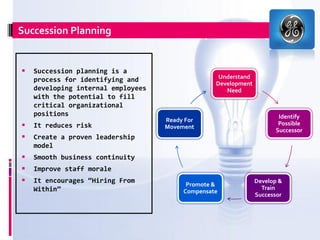
Succession Planning


   Succession planning is a
    process for identifying and                    Understand
                                                  Development
    developing internal employees                    Need
    with the potential to fill
    critical organizational
    positions                                                          Identify
                                    Ready For
   It reduces risk                 Movement
                                                                       Possible
                                                                      Successor
   Create a proven leadership
    model
   Smooth business continuity
   Improve staff morale
   It encourages “Hiring From
                                          Promote &
                                                                Develop &
    Within”                                                       Train
                                         Compensate
                                                                Successor
Introduction : General Electric

  Established in 1892, Thomas Alva Edison merged his EELC with
    Thomson-Houston Electric Company to form General Electric.


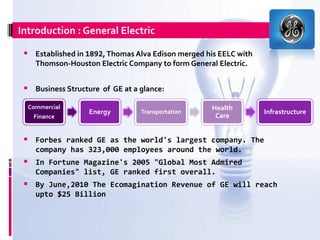
  Business Structure of GE at a glance:
  Commercial                                        Health
                   Energy        Transportation                   Infrastructure
   Finance                                           Care


  Forbes ranked GE as the world's largest company. The
    company has 323,000 employees around the world.
  In Fortune Magazine's 2005 "Global Most Admired
    Companies" list, GE ranked first overall.
  By June,2010 The Ecomagination Revenue of GE will reach
    upto $25 Billion
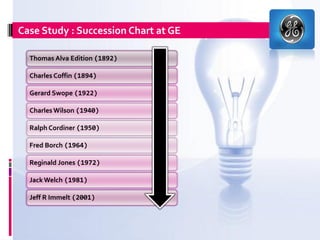
Case Study : Succession Chart at GE

  Thomas Alva Edition (1892)

  Charles Coffin (1894)

  Gerard Swope (1922)

  Charles Wilson (1940)

  Ralph Cordiner (1950)

  Fred Borch (1964)

  Reginald Jones (1972)

  Jack Welch (1981)

  Jeff R Immelt (2001)
Case Study : Summary


  Succession Planning Process at GE – The leading
   diversified business in the world
  Growth of GE from inception and GE’s commitment to
   succession planning
  It explains succession planning and leadership
   development at GE
  It examine CEO’s succession planning under Jack
   Welch (GE’s CEO 1981-2001)
  It shows differences between management style and
   ideologies of Immelt and Welch
  Finally, the future of GE under the leadership of
   Immelt
Case Study : Discussion Session

 Q:1(a)
   Critically examine the importance of leadership development
   and succession planning at GE and explain how it is
   undertaken at the company?
 A:1(a)
     Adopted Succession Planning from Mid-1900.
     Movement of candidates across all its business
     Focus on “Talent Differentiation”
     Major Tools Used at GE for Differentiating Talent
       Vitality Curves
       9 Blocks
       Accomplishment Analysis
Case Study : Discussion Session

 Q:1(b)
   Why do you think that involvement of the top leadership
   in the succession planning process is important?
 A:1(b)
   Advantages of involving the top management in the
   succession Planning:
       Better Assessment Ability
       Employees will be trained under experts
       Personal attention to key candidates
       Build a health relationship between top management and
        employees
Case Study : Discussion Session

 Q:2(a)
   Study and comment on the CEO succession planning process
   Welch followed.
 A:2(a)
     In 1994, Welch created a list of essential qualities,
        skills and characteristics an “Ideal CEO” should posses.
       Submitted a list of 23 candidates to GE Board
       Organized informal events to look at potential CEO
        candidates
       By 1998, The original list narrowed down to 8 serious
        candidates.
       Developed “Eight Basic Objective for Selecting CEO
        Successor”.
Case Study : Discussion Session

 Q:2(a)
   Do you think Welch was right in deciding against
   retaining final CEO candidate, who failed to make it to
   the job? Justify your answer.
 A:2(a)
   Yes, Welch was right.
    Each candidate are equally enough to run GE
    They could easily become CEOs of any leading company
    Retaining candidates may results into personal as well
      as business conflicts
    Work efficiency may reduce after retaining
Case Study : Discussion Session

 Q:3(a)
 Comment on the performance of GE under Immelt’s leadership.
 A:3(a)
 Immelt’s Performance at GE
     Due to 9/11, GE failed to report double digit earning
      growth in the fiscal 2002
     Measures opted by Immelt:
        Cut costs through layoffs
        Restructured GE business
        Introduced a Customer Service program – ACFC
        He focused on “Customer Centric” strategy.
        Invested $100 million in R&D to form “Global Research
         Center”
Case Study : Discussion Session

 Q:3(b)
 Compare Welch’s and Immelt’s leadership styles and ideologies.


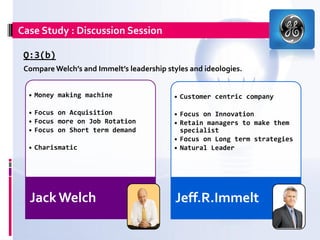
  • Money making machine                   • Customer centric company

  • Focus on Acquisition                   • Focus on Innovation
  • Focus more on Job Rotation             • Retain managers to make them
  • Focus on Short term demand               specialist
                                           • Focus on Long term strategies
  • Charismatic                            • Natural Leader


  Jack Welch                                Jeff.R.Immelt
Case Study : Discussion Session

 Q:3(c)
   Do you think Immelt is right in investing more in R&D and
   innovation, rather than on acquisition? Give reason to
   support your answer.
 A:3(c)
     Yes, He was right because in case of economic slowdown
        the company need to make their own growth.
       Growth opportunity through innovation helps in economy
        slowdown, rather than acquisitions
       He spent $100 Millions to “Revamp House of Magic”
        (Global Research Lab)
       New products/technology always attract customers more
        than existing one thus generates more revenue
Case Study : Discussion Session

 Q:4(a)
   Examine the need for Succession Planning in Companies and
   identify various problems a company might have to face due
   to lack of succession planning system.

 A:4(a)
 Need for succession planning
     To have a ready pool of deserving candidates to fill the
      leadership positions when need arises.
     Opportunities for internal employees increases
     Build a healthy relationship between Top Management &
      employees
 Problems due to lack of succession planning
     Affect business performance and reputation
     Moral of the company’s staff is affected
     Severance pay, In case external employee is hired
Case Study : Discussion Session

 Q:4(b)
   Many companies appoint CEOs from outside, rather than from
   within the company. Do you support this practice? Justify
   your answer, citing reasons.


 A:4(b)
   No, Reasons are explained below:
    Non-Familiarity with OC
    They don’t understand norms and rules of the company
    Increases cost
    Demotivate employees
Case Study : Conclusion


  Preparing future leader

  Building-up the performer

  Creating healthy working environment

  Overall cost saving.
Case Study : Bibliography

  Websites:

     http://www.google.co.in
     http://www.icmrindia.org/
     http://www.ge.com/in/

  Books

     Human Resource Management – V.S.P Rao
Case Study : Succession Planning At GE


                      Thank You

GE Succession Planning - A Case Study

  • 1.
    GENERAL ELECTRIC, NEWYORK Case Study : Succession Planning at GE M.S.Ramaiah Management Institute, Bangalore | MBA (PRIST-A) | HRM Case Study
  • 2.
    Presented By :Team Members Christ Biswasi Minz Debarati Sen Gupta Denny Singh Kumar Shubham Krishna Kumar Kartikey Yamdagni Kamal Nayan Maneet Kumar Manishankar Sonkushre Man Mohan Anand M.S.Ramaiah Management Institute, Bangalore | MBA PRIST(A) 2009-11
  • 3.
    Succession Planning  Succession planning is a process for identifying and Understand Development developing internal employees Need with the potential to fill critical organizational positions Identify Ready For  It reduces risk Movement Possible Successor  Create a proven leadership model  Smooth business continuity  Improve staff morale  It encourages “Hiring From Promote & Develop & Within” Train Compensate Successor
  • 4.
    Introduction : GeneralElectric  Established in 1892, Thomas Alva Edison merged his EELC with Thomson-Houston Electric Company to form General Electric.  Business Structure of GE at a glance: Commercial Health Energy Transportation Infrastructure Finance Care  Forbes ranked GE as the world's largest company. The company has 323,000 employees around the world.  In Fortune Magazine's 2005 "Global Most Admired Companies" list, GE ranked first overall.  By June,2010 The Ecomagination Revenue of GE will reach upto $25 Billion
  • 5.
    Case Study :Succession Chart at GE Thomas Alva Edition (1892) Charles Coffin (1894) Gerard Swope (1922) Charles Wilson (1940) Ralph Cordiner (1950) Fred Borch (1964) Reginald Jones (1972) Jack Welch (1981) Jeff R Immelt (2001)
  • 6.
    Case Study :Summary  Succession Planning Process at GE – The leading diversified business in the world  Growth of GE from inception and GE’s commitment to succession planning  It explains succession planning and leadership development at GE  It examine CEO’s succession planning under Jack Welch (GE’s CEO 1981-2001)  It shows differences between management style and ideologies of Immelt and Welch  Finally, the future of GE under the leadership of Immelt
  • 7.
    Case Study :Discussion Session Q:1(a) Critically examine the importance of leadership development and succession planning at GE and explain how it is undertaken at the company? A:1(a)  Adopted Succession Planning from Mid-1900.  Movement of candidates across all its business  Focus on “Talent Differentiation”  Major Tools Used at GE for Differentiating Talent  Vitality Curves  9 Blocks  Accomplishment Analysis
  • 8.
    Case Study :Discussion Session Q:1(b) Why do you think that involvement of the top leadership in the succession planning process is important? A:1(b) Advantages of involving the top management in the succession Planning:  Better Assessment Ability  Employees will be trained under experts  Personal attention to key candidates  Build a health relationship between top management and employees
  • 9.
    Case Study :Discussion Session Q:2(a) Study and comment on the CEO succession planning process Welch followed. A:2(a)  In 1994, Welch created a list of essential qualities, skills and characteristics an “Ideal CEO” should posses.  Submitted a list of 23 candidates to GE Board  Organized informal events to look at potential CEO candidates  By 1998, The original list narrowed down to 8 serious candidates.  Developed “Eight Basic Objective for Selecting CEO Successor”.
  • 10.
    Case Study :Discussion Session Q:2(a) Do you think Welch was right in deciding against retaining final CEO candidate, who failed to make it to the job? Justify your answer. A:2(a) Yes, Welch was right.  Each candidate are equally enough to run GE  They could easily become CEOs of any leading company  Retaining candidates may results into personal as well as business conflicts  Work efficiency may reduce after retaining
  • 11.
    Case Study :Discussion Session Q:3(a) Comment on the performance of GE under Immelt’s leadership. A:3(a) Immelt’s Performance at GE  Due to 9/11, GE failed to report double digit earning growth in the fiscal 2002  Measures opted by Immelt:  Cut costs through layoffs  Restructured GE business  Introduced a Customer Service program – ACFC  He focused on “Customer Centric” strategy.  Invested $100 million in R&D to form “Global Research Center”
  • 12.
    Case Study :Discussion Session Q:3(b) Compare Welch’s and Immelt’s leadership styles and ideologies. • Money making machine • Customer centric company • Focus on Acquisition • Focus on Innovation • Focus more on Job Rotation • Retain managers to make them • Focus on Short term demand specialist • Focus on Long term strategies • Charismatic • Natural Leader Jack Welch Jeff.R.Immelt
  • 13.
    Case Study :Discussion Session Q:3(c) Do you think Immelt is right in investing more in R&D and innovation, rather than on acquisition? Give reason to support your answer. A:3(c)  Yes, He was right because in case of economic slowdown the company need to make their own growth.  Growth opportunity through innovation helps in economy slowdown, rather than acquisitions  He spent $100 Millions to “Revamp House of Magic” (Global Research Lab)  New products/technology always attract customers more than existing one thus generates more revenue
  • 14.
    Case Study :Discussion Session Q:4(a) Examine the need for Succession Planning in Companies and identify various problems a company might have to face due to lack of succession planning system. A:4(a) Need for succession planning  To have a ready pool of deserving candidates to fill the leadership positions when need arises.  Opportunities for internal employees increases  Build a healthy relationship between Top Management & employees Problems due to lack of succession planning  Affect business performance and reputation  Moral of the company’s staff is affected  Severance pay, In case external employee is hired
  • 15.
    Case Study :Discussion Session Q:4(b) Many companies appoint CEOs from outside, rather than from within the company. Do you support this practice? Justify your answer, citing reasons. A:4(b) No, Reasons are explained below:  Non-Familiarity with OC  They don’t understand norms and rules of the company  Increases cost  Demotivate employees
  • 16.
    Case Study :Conclusion  Preparing future leader  Building-up the performer  Creating healthy working environment  Overall cost saving.
  • 17.
    Case Study :Bibliography  Websites:  http://www.google.co.in  http://www.icmrindia.org/  http://www.ge.com/in/  Books  Human Resource Management – V.S.P Rao
  • 18.
    Case Study :Succession Planning At GE Thank You