M R Jhalawad
Motivating Employees 2
 Management is a practice of consciously & continually
shaping an organization
 Organization utilizes four resources:
 For effective & efficient utilization of resources
five managerial functions are performed:
 Managers perform these activities to achieve
organizational goals
Human Monetary Physical Information
Planning & Decision Making Organizing
Staffing
Leading /
Motivating
Controlling
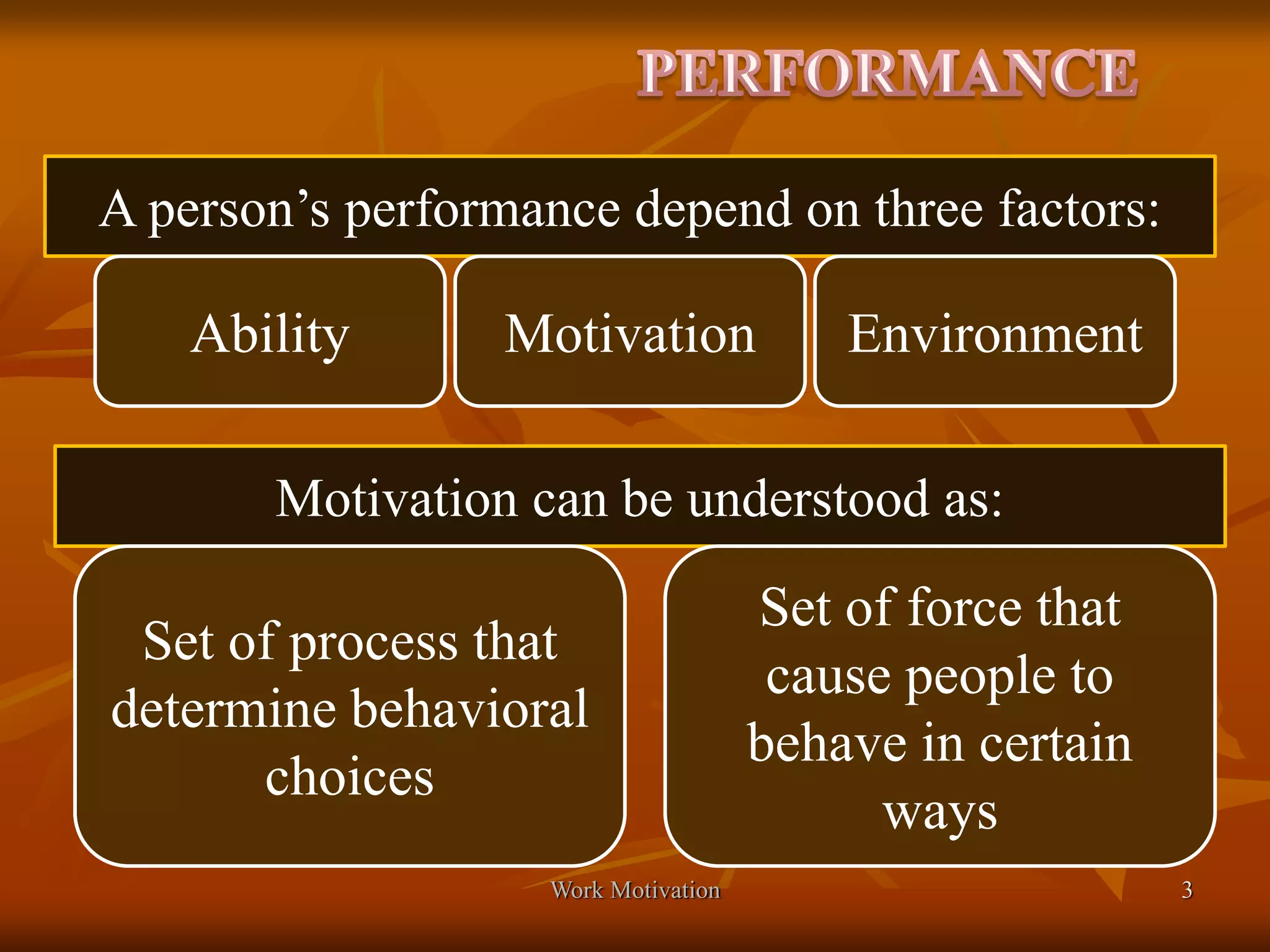
Work Motivation 3
A person’s performance depend on three factors:
Ability Motivation Environment
Motivation can be understood as:
Set of process that
determine behavioral
choices
Set of force that
cause people to
behave in certain
ways
Work Motivation 4
“Willingness to exert high level of efforts
towards org goals, conditioned by efforts ability
to satisfy some individual needs.”
Stephen R Robbins
Key elements of definition:
NeedsOrg GoalsEfforts
Work Motivation 5
MOTIVATION PROCESS
Inner Drive, Needs, or Motives cause
Behavioral Action
Fulfill Goal
Bring Satisfaction
Provide Reinforcement
Motivating People 6
Physical
Security
Social
Esteem
Self-actualizationMaslow’s Need Hierarchy
Maslow has given a
framework that explains
Strength of certain needs
There seems to be a
hierarch into which
human needs are
arranged as shown in
the figure
Motivating People 7
Identified two different sets of factors:
Satisfaction or no
satisfaction
Dissatisfaction or no
dissatisfaction
Factors influencing satisfaction:
• Called MOTIVATION factors
• Relate specifically to work content
Factors causing dissatisfaction:
• Called HYGIENE factors
• Relate to work environment
Motivating People 8
Achievement
Recognition
The work itself
Responsibility
Advancement
Supervisor
Working conditions
Interpersonal
relations
Pay & security
Company policy
Motivation Factors Hygiene Factors
External Drivers of Motivation
Motivating Employees 9
Money
Teamwork
Security of
job
Bonus
Recognition
Promotion
Workplace
conditions
Friendly
working
Environment
Reward /
Punishment
Internal Drivers of Motivation
Motivating Employees 10
Growth The need to improve knowledge,
skill & attitude
Security
Value
Ego
Social
The need to feel secure & provide
security
The need to provide money or worth
The need to be seen to be a leader
The need to create time for doing
what you really want to do
Present Level of Motivation
Motivating Employees 11
Before We Proceed
Further Let Us Assess
Motivation Level Of
The Organization
How to Examining Motivation Level of Dept
 People generate fresh solutions to the company's most
pressing problems.
 Teams collaborate to create innovative products & services
that revolutionise marketplace
 Employees enthusiastically give their energy, time &
dedication to the company
 People remain loyal to the organization even during tough
times
 Everyone feels stimulated by the challenges of his role
 Employees take pride in their work & feel accountable for
company's future.
A workforce with these sterling qualities can vault a company
far ahead of its rivals
0
Motivation More Important Than Ever
 Honest answers to such questions will reveal present
motivation level
 In present business conditions, motivating people has
become crucial
 Through motivation managers help their employees
generate excellent performance.
 True motivation is complex & require artful blend of
managerial skills
1
Comprehensive Approach to Motivation
 This can be discussed in five parts:
1. Helping employees find meaning
2. Strengthening personal qualities
3. Fostering commitment beyond just the
job
4. Retaining your top performers
5. Selecting right rewards, recognition,
and incentives
1
Helping Employees Finding Meaning
 People believe that their work & efforts matter
 Must have continual activities
 View employees as customer
 Foster a sense of mutual partnership
 Managers must tailor their communication style &
recognition systems based on what drive them to
workplace.
 Eight Career anchors have been identified in this
respect
1
Career Anchors
1. Technical / functional competence
2. Managerial competence
3. Autonomy
4. Security
5. Entrepreneurial creativity
6. Pure challenge
7. Sense of service
8. Ability to balance work life & private life
1
Strengthening Personal Qualities
 Motivated people demonstrate a set of distinctive
personal qualities
 They are optimistic also while being realistic
 They take pride in their work
 Build relationship of trust
 Take steps to avoid burnout
 Manager may help in strengthening these qualities
1
Trust
 Build it, earn it & re - establish when it is
broken
 Trust allow people to work more effectively
 Elements that may help in creating trust:
1. Develop your own capacity for trust first
2. Build trust behaviourally &
incrementally
3. Tackle betrayal head-on
1
Fostering Commitment Beyond Just the Job
 You can foster commitment beyond job by
clarifying company's objectives & goals
 Ways of measuring progress towards goals
 Challenging employees to identify opportunities
to leverage existing knowledge
 Ensuring that people know how all parts of
organisation work together
19
Fostering commitment beyond just the job
 When you motivate people to excel, their energy &
creativity ripple across entire organisation
 Motivated employees make others to focus on
possibilities rather than problems
 They feel responsible for entire business processes, not
just on their own tasks
 They work to "unstick" knowledge - to transfer
practices across units & functions
 As a result company as a whole can benefit.
20
How to Energise
Power & influence in today' companies have less to
do with employees' position and more to do with
their ability to energise others.
A research study by Baker & Andrew Parker was
able to measure the long noted influence that
energising relationship have on performance.
21
What Distinguishes Energisers?
Energisers do five things very well:
1. They create a compelling vision by focusing on
possibilities rather than current or past problems
2. They help others feel fully engaged
3. Energisers are also learning from their colleagues
4. Energisers are goal oriented but flexible about how to
get there
5. Energisers speak their mind, maintaining integrity
between their words & actions
22
Retaining Top Performers
 It is crucial to secure top performers loyalty to the company
by retaining them
 Techniques for talent management are:
1. Aim for retention of top people & attrition of low performers
2. Enhance collaboration & cooperation among talented direct
reports
3. Identify people for whom loyalty, community building and
being part of something bigger matter a great deal
4. Match star performers to work that challenges them to
develop their skills
23
Retention Strategy
 Hire for retention - look beyond skills & experience to
individual values and attitude
 Research what particular group of employees want -
identify the "root cause" of turnover among specific
group of employees.
 Structure the company to allow choices - choices may
be of two types - 1. Career path, 2. Facilities
 Single out people for special programs - companies
must find ways to know what employees want & need
24
Nine Steps Toward Creating a Great Workplace
 Help people see the purpose of what they do
 Expect a lot
 But do not dictate the "How"
 Be really available
 Break the golden rule
 Get the world out in 24 hours or less
 Make sure people have what they need to do
their job
 Say: ‘I appreciate’ / ‘thank you’
 Have fun 25
How Good is Your Workplace
 Job satisfaction is notoriously hard to measure.
 A Gallup study of one million persons found
that satisfaction depend on how employees
answer just 12 questions, listed below in order
of importance.
 To assess your workplace, ask people for their
responses:
26
How good is your workplace
1. Do I know what is expected of me at work?
2. Do I have materials & equipment I need to do my work
right?
3. At work, do I have opportunity to do what I do best every
day?
4. In the last seven days, have I received recognition or praise
for good work?
5. Does my supervisor or someone else at work seem to care
about me as a person?
6. Is there someone at work who encourages my development ?
27
How good is your workplace?
7. At work, do my opinions seem to count?
8. Does the mission of my company make me feel like my
work is important?
9. Are my coworkers committed to doing quality work?
10. Do I have a best friend at work?
11. In the last six months, have I talked with someone
about my progress?
12. At work, have I had opportunities to learn & grow?
28
Selecting Right Rewards, Recognition, &
Incentives
 None can honestly say that financial incentives do not
matter in professional lives.
 But money alone is not enough to motivate people to
excel on the job
 Most effective incentive systems blend monetary
with non-monetary forms of rewards.
 Often it is non monetary types that prove most
motivating
29
Monetary Reward
 In the compensation half of your incentives
equation, consider letting employees select from
a manure including cash, variable compensation
to achievement of performance targets
 You shall give your people a direct line of sight
between their on the job accomplishments &
rewards they receive.
30
How to Choose Right Mix of Rewards?
Understand what employees most values:
‡ Praise
‡ Authority to do their work & make decisions
‡ Involving them in decisions
‡ Managerial support & involvement
‡ Asking employees their opinions
‡ Support from managers when they have made a mistake
‡ Learning & development opportunities
‡ Manager availability & time
31
Motivating Employees 32
Where Managers Go Wrong in Managing?
 Fail to get know employees as people
 Fail to provide clear directions
 Fail to trust
 Fail to listen to & help employees to feel that their
opinions are valued
 Make decision & then ask people for their input
 Fail to react to problems & issues that will soon foster
 Trying to be friend with employees who report to you
 Fail to communicate effectively
 Not treating all people equal
33Motivating Employees
How to Destroy Motivation at Work
 Treat employees like children
 Make rules for many because of behavior of few
 Focus on mistakes & errors, no matter how
trivial they are in comparison with success
 Apply policies unfairly & inequitably
 Stomp on employee initiative & ideas
 Tell employees that they are empowered & then
review & retain veto power over small decisions
Motivating Employees 34
How to Destroy Motivation at Work
 In meetings, coaching sessions & performance
reviews in which manager does majority of talk
 Violate employees confidentiality by sharing
information inappropriately
 Measure aspects of work for employee review
that the employee cannot control
 Set unattainable goals & panelize employee for
not meeting them
Motivating Employees 35
Conclusion
 While what employees want from work is
situational, depending on the person, his needs &
rewards that are meaningful to him, giving
people what they want from work is really quite
straight forward. People want:
 Control of their work inspires motivation
 To belong to the in-crowed creates motivation
 The opportunity for growth & development is
motivational
 Leadership is key in motivation
Motivating Employees 36
**Story of Appreciation**
One young academically excellent person went to apply for a
managerial position in a big company.
He passed the first interview, the director did the last interview,
made the last decision.
The director discovered from the CV that the youth's academic
achievements were excellent all the way, from the secondary
school until the postgraduate research, never had a year when he
did not score.
The director asked,
"Did you obtain any scholarships in school?"
the youth answered "none“.
The director asked,
" Was it your father who paid for your school fees?"
The youth answered,
"My father passed away when I was one year old, it
was my mother who paid for my school fees.
The director asked,
" Where did your mother work?"
The youth answered,
"My mother worked as clothes cleaner.
The director requested the youth to show his hands.
The youth showed a pair of hands that were smooth and
perfect.
The director asked,
" Have you ever helped your mother wash the clothes
before?"
The youth answered,
"Never, my mother always wanted me to study and read
more books.
Furthermore, my mother can wash clothes faster than me.
The director said,
"I have a request. When you go back today, go and clean
your mother's hands, and then see me tomorrow morning.
The youth felt that his chance of landing the job was high.
When he went back, he happily requested his mother to
let him clean her hands.
His mother felt strange, happy but with mixed feelings,
she showed her hands to the kid.
The youth cleaned his mother's hands slowly. His tear fell
as he did that.
It was the first time he noticed that his mother's hands
were so wrinkled, and there were so many bruises in her
hands. Some bruises were so painful that his mother
shivered when they were cleaned with water.
This was the first time the youth realized that it was this pair
of hands that washed the clothes everyday to enable him
to pay the school fee.
The bruises in the mother's hands were the price that the
mother had to pay for his graduation, academic
excellence and his future.
After finishing the cleaning of his mother's hands,
the youth quietly washed all the remaining clothes for
his mother.
That night, mother and son talked for a very long time.
Next morning, the youth went to the director's office.
The Director noticed the tears in the youth's eyes,
asked:
" Can you tell me what have you done and learned
yesterday in your house?"
The youth answered,
" I cleaned my mother's hand, and also finished
cleaning all the remaining clothes'
The Director asked,
Please tell me your feelings
The youth said,
Number 1,
I know now what is appreciation. Without my mother,
there would not the successful me today.
Number 2,
by working together and helping my mother, only I now
realize how difficult and tough it is to get something done.
Number 3,
I have come to appreciate the importance and value
of family relationship.
The director said,
" This is what I am looking for to be my manager.
I want to recruit a person who can appreciate
the help of others, a person who knows the
sufferings of others to get things done,
and a person who would not put money as his only
goal in life.
You are hired.
Later on, this young person worked very hard,
and received the respect of his subordinates.
Every employee worked diligently and as a team.
The company's performance improved tremendously.
Motivating Employees 45
This presentation was prepared taking help
from text books, general books & articles.
I am sorry, I have not taken note of
authors’ names.
So, I am unable to quote them.
This presentation is purely for
academic purpose.

Motivating Employees

  • 1.
  • 2.
    Motivating Employees 2 Management is a practice of consciously & continually shaping an organization  Organization utilizes four resources:  For effective & efficient utilization of resources five managerial functions are performed:  Managers perform these activities to achieve organizational goals Human Monetary Physical Information Planning & Decision Making Organizing Staffing Leading / Motivating Controlling
  • 3.
    Work Motivation 3 Aperson’s performance depend on three factors: Ability Motivation Environment Motivation can be understood as: Set of process that determine behavioral choices Set of force that cause people to behave in certain ways
  • 4.
    Work Motivation 4 “Willingnessto exert high level of efforts towards org goals, conditioned by efforts ability to satisfy some individual needs.” Stephen R Robbins Key elements of definition: NeedsOrg GoalsEfforts
  • 5.
    Work Motivation 5 MOTIVATIONPROCESS Inner Drive, Needs, or Motives cause Behavioral Action Fulfill Goal Bring Satisfaction Provide Reinforcement
  • 6.
    Motivating People 6 Physical Security Social Esteem Self-actualizationMaslow’sNeed Hierarchy Maslow has given a framework that explains Strength of certain needs There seems to be a hierarch into which human needs are arranged as shown in the figure
  • 7.
    Motivating People 7 Identifiedtwo different sets of factors: Satisfaction or no satisfaction Dissatisfaction or no dissatisfaction Factors influencing satisfaction: • Called MOTIVATION factors • Relate specifically to work content Factors causing dissatisfaction: • Called HYGIENE factors • Relate to work environment
  • 8.
    Motivating People 8 Achievement Recognition Thework itself Responsibility Advancement Supervisor Working conditions Interpersonal relations Pay & security Company policy Motivation Factors Hygiene Factors
  • 9.
    External Drivers ofMotivation Motivating Employees 9 Money Teamwork Security of job Bonus Recognition Promotion Workplace conditions Friendly working Environment Reward / Punishment
  • 10.
    Internal Drivers ofMotivation Motivating Employees 10 Growth The need to improve knowledge, skill & attitude Security Value Ego Social The need to feel secure & provide security The need to provide money or worth The need to be seen to be a leader The need to create time for doing what you really want to do
  • 11.
    Present Level ofMotivation Motivating Employees 11 Before We Proceed Further Let Us Assess Motivation Level Of The Organization
  • 12.
    How to ExaminingMotivation Level of Dept  People generate fresh solutions to the company's most pressing problems.  Teams collaborate to create innovative products & services that revolutionise marketplace  Employees enthusiastically give their energy, time & dedication to the company  People remain loyal to the organization even during tough times  Everyone feels stimulated by the challenges of his role  Employees take pride in their work & feel accountable for company's future. A workforce with these sterling qualities can vault a company far ahead of its rivals 0
  • 13.
    Motivation More ImportantThan Ever  Honest answers to such questions will reveal present motivation level  In present business conditions, motivating people has become crucial  Through motivation managers help their employees generate excellent performance.  True motivation is complex & require artful blend of managerial skills 1
  • 14.
    Comprehensive Approach toMotivation  This can be discussed in five parts: 1. Helping employees find meaning 2. Strengthening personal qualities 3. Fostering commitment beyond just the job 4. Retaining your top performers 5. Selecting right rewards, recognition, and incentives 1
  • 15.
    Helping Employees FindingMeaning  People believe that their work & efforts matter  Must have continual activities  View employees as customer  Foster a sense of mutual partnership  Managers must tailor their communication style & recognition systems based on what drive them to workplace.  Eight Career anchors have been identified in this respect 1
  • 16.
    Career Anchors 1. Technical/ functional competence 2. Managerial competence 3. Autonomy 4. Security 5. Entrepreneurial creativity 6. Pure challenge 7. Sense of service 8. Ability to balance work life & private life 1
  • 17.
    Strengthening Personal Qualities Motivated people demonstrate a set of distinctive personal qualities  They are optimistic also while being realistic  They take pride in their work  Build relationship of trust  Take steps to avoid burnout  Manager may help in strengthening these qualities 1
  • 18.
    Trust  Build it,earn it & re - establish when it is broken  Trust allow people to work more effectively  Elements that may help in creating trust: 1. Develop your own capacity for trust first 2. Build trust behaviourally & incrementally 3. Tackle betrayal head-on 1
  • 19.
    Fostering Commitment BeyondJust the Job  You can foster commitment beyond job by clarifying company's objectives & goals  Ways of measuring progress towards goals  Challenging employees to identify opportunities to leverage existing knowledge  Ensuring that people know how all parts of organisation work together 19
  • 20.
    Fostering commitment beyondjust the job  When you motivate people to excel, their energy & creativity ripple across entire organisation  Motivated employees make others to focus on possibilities rather than problems  They feel responsible for entire business processes, not just on their own tasks  They work to "unstick" knowledge - to transfer practices across units & functions  As a result company as a whole can benefit. 20
  • 21.
    How to Energise Power& influence in today' companies have less to do with employees' position and more to do with their ability to energise others. A research study by Baker & Andrew Parker was able to measure the long noted influence that energising relationship have on performance. 21
  • 22.
    What Distinguishes Energisers? Energisersdo five things very well: 1. They create a compelling vision by focusing on possibilities rather than current or past problems 2. They help others feel fully engaged 3. Energisers are also learning from their colleagues 4. Energisers are goal oriented but flexible about how to get there 5. Energisers speak their mind, maintaining integrity between their words & actions 22
  • 23.
    Retaining Top Performers It is crucial to secure top performers loyalty to the company by retaining them  Techniques for talent management are: 1. Aim for retention of top people & attrition of low performers 2. Enhance collaboration & cooperation among talented direct reports 3. Identify people for whom loyalty, community building and being part of something bigger matter a great deal 4. Match star performers to work that challenges them to develop their skills 23
  • 24.
    Retention Strategy  Hirefor retention - look beyond skills & experience to individual values and attitude  Research what particular group of employees want - identify the "root cause" of turnover among specific group of employees.  Structure the company to allow choices - choices may be of two types - 1. Career path, 2. Facilities  Single out people for special programs - companies must find ways to know what employees want & need 24
  • 25.
    Nine Steps TowardCreating a Great Workplace  Help people see the purpose of what they do  Expect a lot  But do not dictate the "How"  Be really available  Break the golden rule  Get the world out in 24 hours or less  Make sure people have what they need to do their job  Say: ‘I appreciate’ / ‘thank you’  Have fun 25
  • 26.
    How Good isYour Workplace  Job satisfaction is notoriously hard to measure.  A Gallup study of one million persons found that satisfaction depend on how employees answer just 12 questions, listed below in order of importance.  To assess your workplace, ask people for their responses: 26
  • 27.
    How good isyour workplace 1. Do I know what is expected of me at work? 2. Do I have materials & equipment I need to do my work right? 3. At work, do I have opportunity to do what I do best every day? 4. In the last seven days, have I received recognition or praise for good work? 5. Does my supervisor or someone else at work seem to care about me as a person? 6. Is there someone at work who encourages my development ? 27
  • 28.
    How good isyour workplace? 7. At work, do my opinions seem to count? 8. Does the mission of my company make me feel like my work is important? 9. Are my coworkers committed to doing quality work? 10. Do I have a best friend at work? 11. In the last six months, have I talked with someone about my progress? 12. At work, have I had opportunities to learn & grow? 28
  • 29.
    Selecting Right Rewards,Recognition, & Incentives  None can honestly say that financial incentives do not matter in professional lives.  But money alone is not enough to motivate people to excel on the job  Most effective incentive systems blend monetary with non-monetary forms of rewards.  Often it is non monetary types that prove most motivating 29
  • 30.
    Monetary Reward  Inthe compensation half of your incentives equation, consider letting employees select from a manure including cash, variable compensation to achievement of performance targets  You shall give your people a direct line of sight between their on the job accomplishments & rewards they receive. 30
  • 31.
    How to ChooseRight Mix of Rewards? Understand what employees most values: ‡ Praise ‡ Authority to do their work & make decisions ‡ Involving them in decisions ‡ Managerial support & involvement ‡ Asking employees their opinions ‡ Support from managers when they have made a mistake ‡ Learning & development opportunities ‡ Manager availability & time 31
  • 32.
  • 33.
    Where Managers GoWrong in Managing?  Fail to get know employees as people  Fail to provide clear directions  Fail to trust  Fail to listen to & help employees to feel that their opinions are valued  Make decision & then ask people for their input  Fail to react to problems & issues that will soon foster  Trying to be friend with employees who report to you  Fail to communicate effectively  Not treating all people equal 33Motivating Employees
  • 34.
    How to DestroyMotivation at Work  Treat employees like children  Make rules for many because of behavior of few  Focus on mistakes & errors, no matter how trivial they are in comparison with success  Apply policies unfairly & inequitably  Stomp on employee initiative & ideas  Tell employees that they are empowered & then review & retain veto power over small decisions Motivating Employees 34
  • 35.
    How to DestroyMotivation at Work  In meetings, coaching sessions & performance reviews in which manager does majority of talk  Violate employees confidentiality by sharing information inappropriately  Measure aspects of work for employee review that the employee cannot control  Set unattainable goals & panelize employee for not meeting them Motivating Employees 35
  • 36.
    Conclusion  While whatemployees want from work is situational, depending on the person, his needs & rewards that are meaningful to him, giving people what they want from work is really quite straight forward. People want:  Control of their work inspires motivation  To belong to the in-crowed creates motivation  The opportunity for growth & development is motivational  Leadership is key in motivation Motivating Employees 36
  • 37.
    **Story of Appreciation** Oneyoung academically excellent person went to apply for a managerial position in a big company. He passed the first interview, the director did the last interview, made the last decision. The director discovered from the CV that the youth's academic achievements were excellent all the way, from the secondary school until the postgraduate research, never had a year when he did not score. The director asked, "Did you obtain any scholarships in school?" the youth answered "none“.
  • 38.
    The director asked, "Was it your father who paid for your school fees?" The youth answered, "My father passed away when I was one year old, it was my mother who paid for my school fees. The director asked, " Where did your mother work?" The youth answered, "My mother worked as clothes cleaner. The director requested the youth to show his hands. The youth showed a pair of hands that were smooth and perfect.
  • 39.
    The director asked, "Have you ever helped your mother wash the clothes before?" The youth answered, "Never, my mother always wanted me to study and read more books. Furthermore, my mother can wash clothes faster than me. The director said, "I have a request. When you go back today, go and clean your mother's hands, and then see me tomorrow morning. The youth felt that his chance of landing the job was high.
  • 40.
    When he wentback, he happily requested his mother to let him clean her hands. His mother felt strange, happy but with mixed feelings, she showed her hands to the kid. The youth cleaned his mother's hands slowly. His tear fell as he did that. It was the first time he noticed that his mother's hands were so wrinkled, and there were so many bruises in her hands. Some bruises were so painful that his mother shivered when they were cleaned with water.
  • 41.
    This was thefirst time the youth realized that it was this pair of hands that washed the clothes everyday to enable him to pay the school fee. The bruises in the mother's hands were the price that the mother had to pay for his graduation, academic excellence and his future. After finishing the cleaning of his mother's hands, the youth quietly washed all the remaining clothes for his mother. That night, mother and son talked for a very long time. Next morning, the youth went to the director's office.
  • 42.
    The Director noticedthe tears in the youth's eyes, asked: " Can you tell me what have you done and learned yesterday in your house?" The youth answered, " I cleaned my mother's hand, and also finished cleaning all the remaining clothes' The Director asked, Please tell me your feelings
  • 43.
    The youth said, Number1, I know now what is appreciation. Without my mother, there would not the successful me today. Number 2, by working together and helping my mother, only I now realize how difficult and tough it is to get something done. Number 3, I have come to appreciate the importance and value of family relationship.
  • 44.
    The director said, "This is what I am looking for to be my manager. I want to recruit a person who can appreciate the help of others, a person who knows the sufferings of others to get things done, and a person who would not put money as his only goal in life. You are hired. Later on, this young person worked very hard, and received the respect of his subordinates. Every employee worked diligently and as a team. The company's performance improved tremendously.
  • 45.
    Motivating Employees 45 Thispresentation was prepared taking help from text books, general books & articles. I am sorry, I have not taken note of authors’ names. So, I am unable to quote them. This presentation is purely for academic purpose.

Editor's Notes

  • #9 Exercise – What Do People Want from Their jobs?