2-1
Chapter 12Chapter 12
Capital BudgetingCapital Budgeting
and Estimatingand Estimating
Cash FlowsCash Flows
Instructor: Ajab Khan Burki
2-2
Capital Budgeting andCapital Budgeting and
Estimating Cash FlowsEstimating Cash Flows
The Capital Budgeting Process
Generating Investment Project
Proposals
Estimating Project “After-Tax
Incremental Operating Cash
Flows”
2-3
What isWhat is
Capital Budgeting?Capital Budgeting?
The process of identifying,
analyzing, and selecting
investment projects whose
returns (cash flows) are
expected to extend beyond
one year.
The process of identifying,
analyzing, and selecting
investment projects whose
returns (cash flows) are
expected to extend beyond
one year.
2-4
The CapitalThe Capital
Budgeting ProcessBudgeting Process
Generate investment proposals
consistent with the firm’s strategic
objectives.
Estimate after-tax incremental
operating cash flows for the
investment projects.
Evaluate project incremental cash
flows.
2-5
The CapitalThe Capital
Budgeting ProcessBudgeting Process
Select projects based on a value-
maximizing acceptance criterion.
Reevaluate implemented
investment projects continually
and perform postaudits for
completed projects.
2-6
Classification of InvestmentClassification of Investment
Project ProposalsProject Proposals
1. New products or expansion of
existing products
2. Replacement of existing equipment or
buildings
3. Research and development
4. Exploration
5. Other (e.g., safety or pollution related)
2-7
Screening ProposalsScreening Proposals
and Decision Makingand Decision Making
1. Section Chiefs
2. Plant Managers
3. VP for Operations
4. Capital Expenditures
Committee
5. President
6. Board of Directors
AdvancementAdvancement
to the nextto the next
level dependslevel depends
on coston cost
and strategicand strategic
importance.importance.
2-8
Estimating After-TaxEstimating After-Tax
Incremental Cash FlowsIncremental Cash Flows
 CashCash (not accounting income) flowsflows
 OperatingOperating (not financing) flowsflows
 After-tax flowsAfter-tax flows
 Incremental flowsIncremental flows
Basic characteristics ofBasic characteristics of
relevant project flowsrelevant project flows
2-9
Estimating After-TaxEstimating After-Tax
Incremental Cash FlowsIncremental Cash Flows
 Ignore sunk costssunk costs
 Include opportunity costsopportunity costs
 Include project-driven changes inchanges in
working capitalworking capital net of spontaneous
changes in current liabilities
 Include effects of inflationeffects of inflation
Principles that must be adheredPrinciples that must be adhered
to in the estimationto in the estimation
2-10
Tax ConsiderationsTax Considerations
and Depreciationand Depreciation
Generally, profitable firms prefer to use
an accelerated method for tax
reporting purposes (MACRS).
DepreciationDepreciation represents the systematic
allocation of the cost of a capital asset
over a period of time for financial
reporting purposes, tax purposes, or
both.
2-11
Depreciation and theDepreciation and the
MACRS MethodMACRS Method
Everything else equal, the greater the
depreciation charges, the lower the
taxes paid by the firm.
Depreciation is a noncash expense.
Assets are depreciated (MACRS) on one
of eight different property classes.
Generally, the half-year convention is
used for MACRS.
2-12
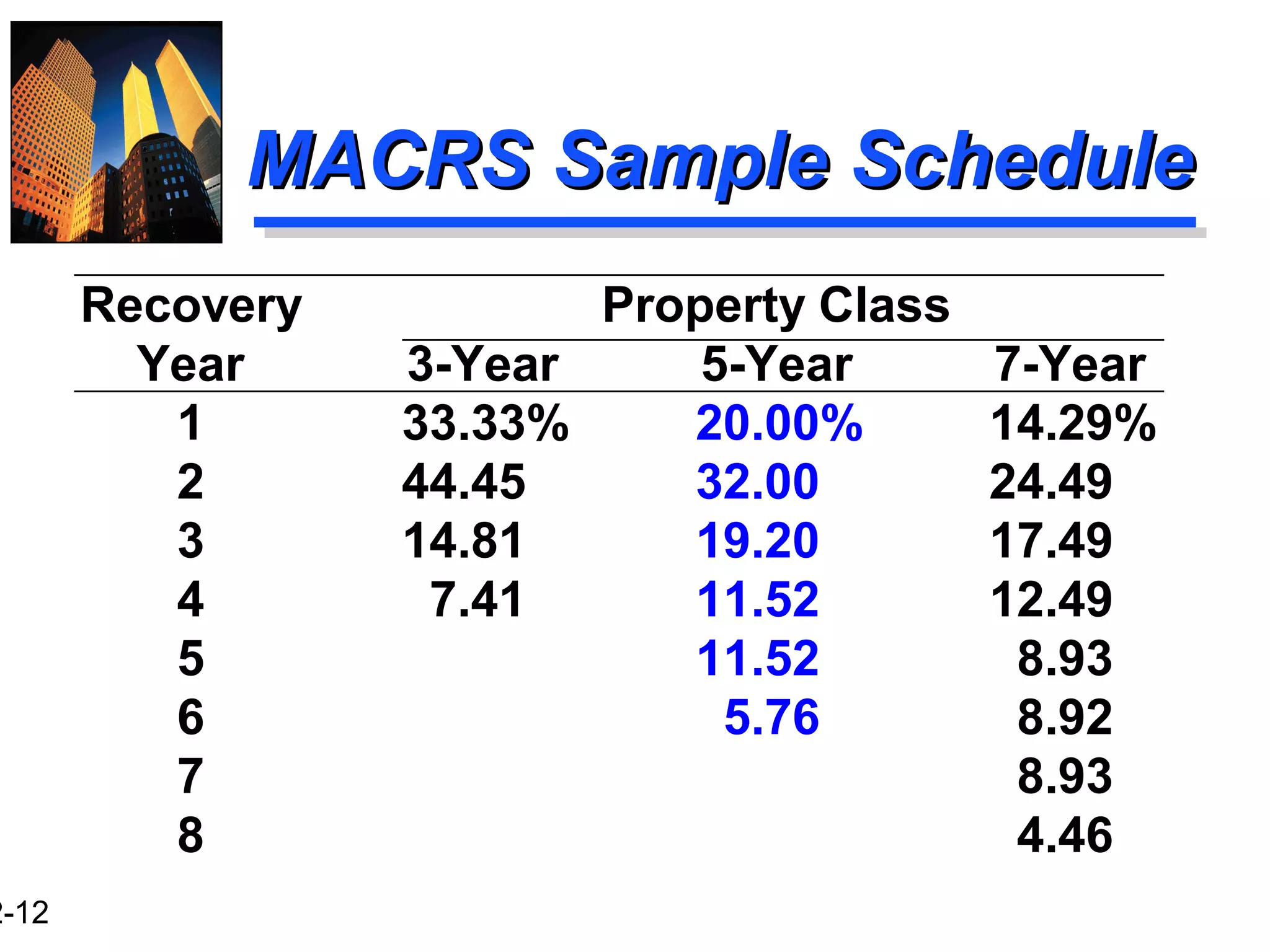
MACRS Sample ScheduleMACRS Sample Schedule
Recovery Property Class
Year 3-Year 5-Year 7-Year
1 33.33% 20.00% 14.29%
2 44.45 32.00 24.49
3 14.81 19.20 17.49
4 7.41 11.52 12.49
5 11.52 8.93
6 5.76 8.92
7 8.93
8 4.46
2-13
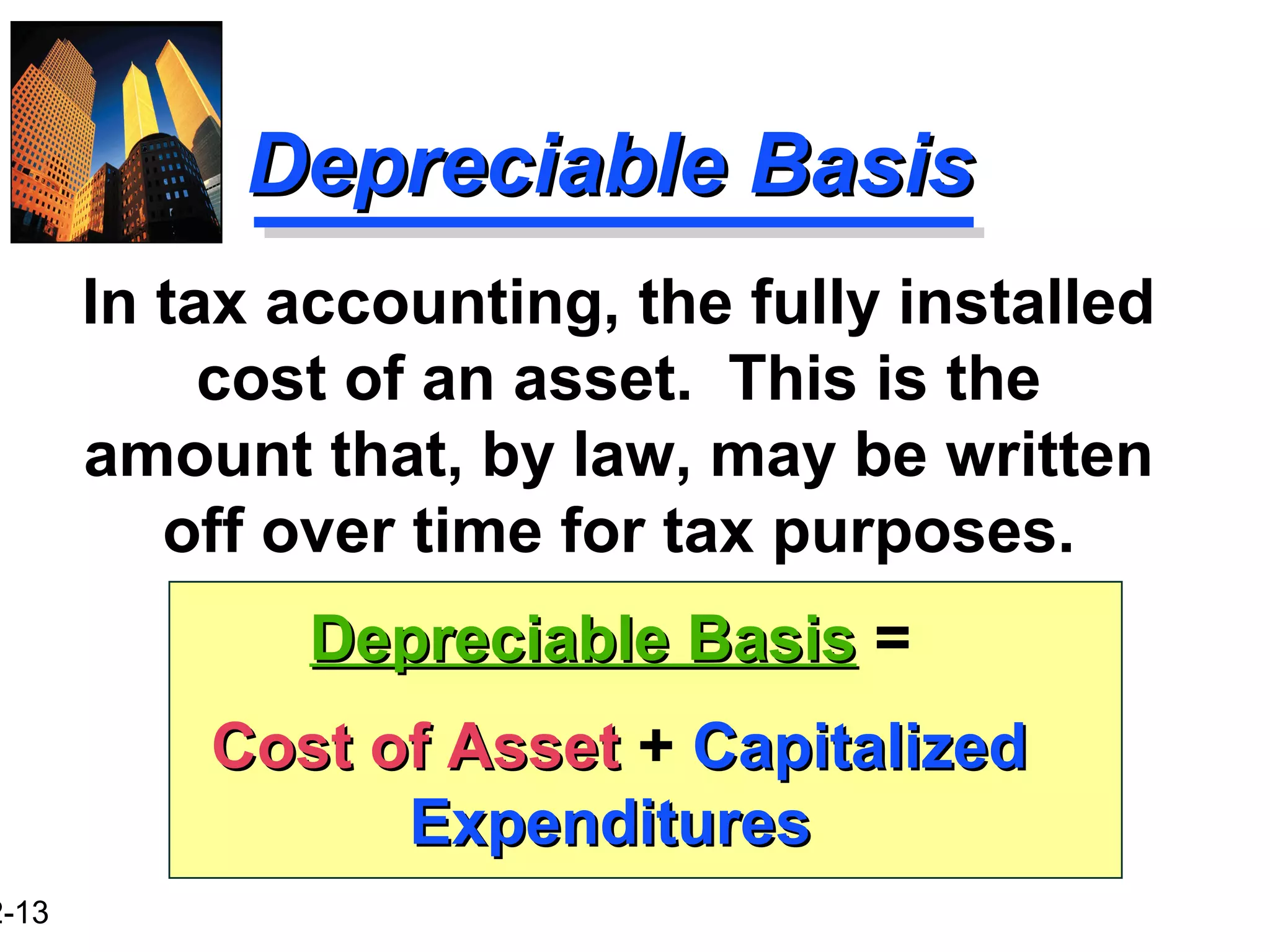
Depreciable BasisDepreciable Basis
In tax accounting, the fully installed
cost of an asset. This is the
amount that, by law, may be written
off over time for tax purposes.
Depreciable BasisDepreciable Basis =
Cost of AssetCost of Asset + CapitalizedCapitalized
ExpendituresExpenditures
2-14
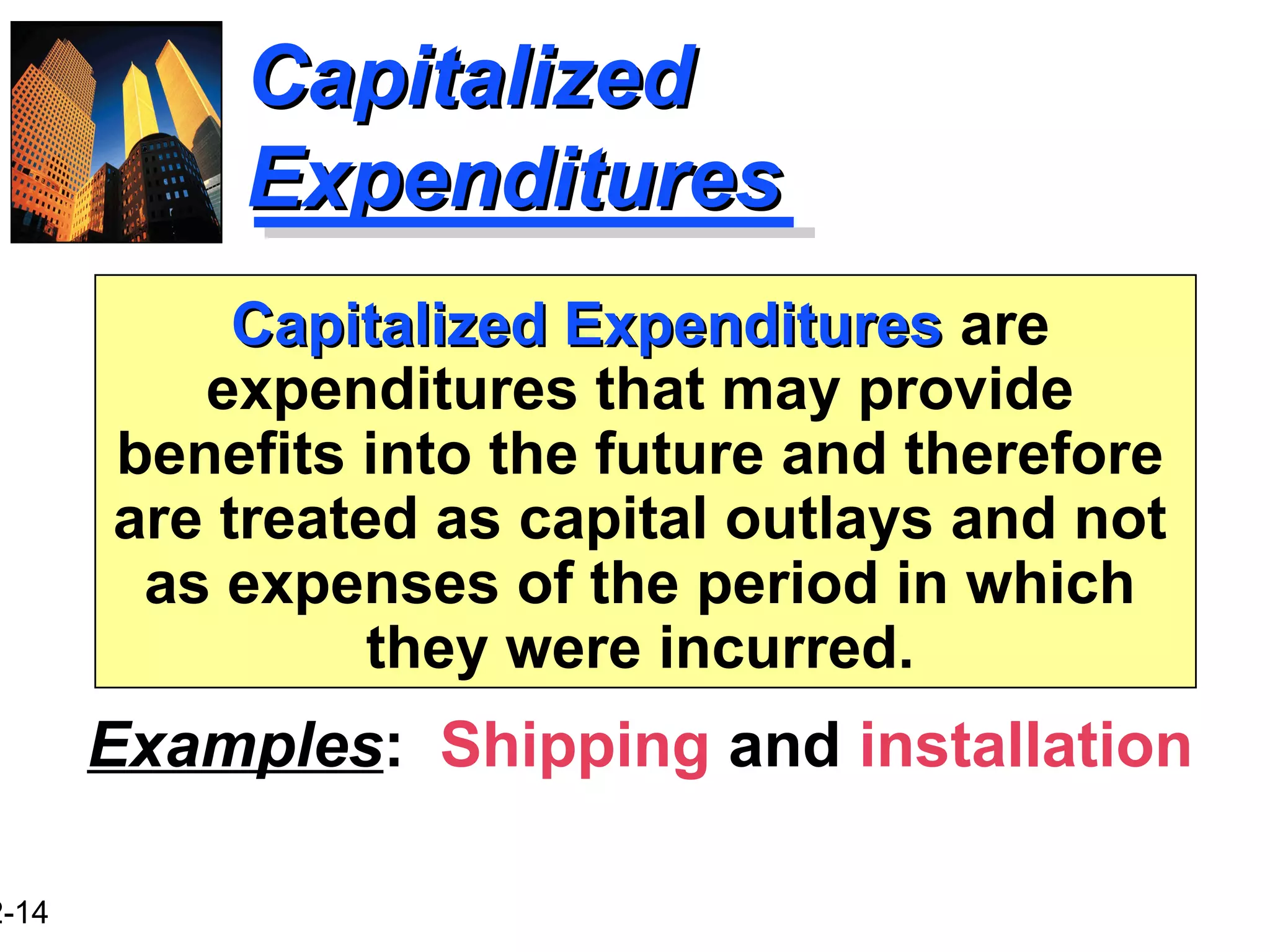
CapitalizedCapitalized
ExpendituresExpenditures
Capitalized ExpendituresCapitalized Expenditures are
expenditures that may provide
benefits into the future and therefore
are treated as capital outlays and not
as expenses of the period in which
they were incurred.
Examples: Shipping and installation
2-15
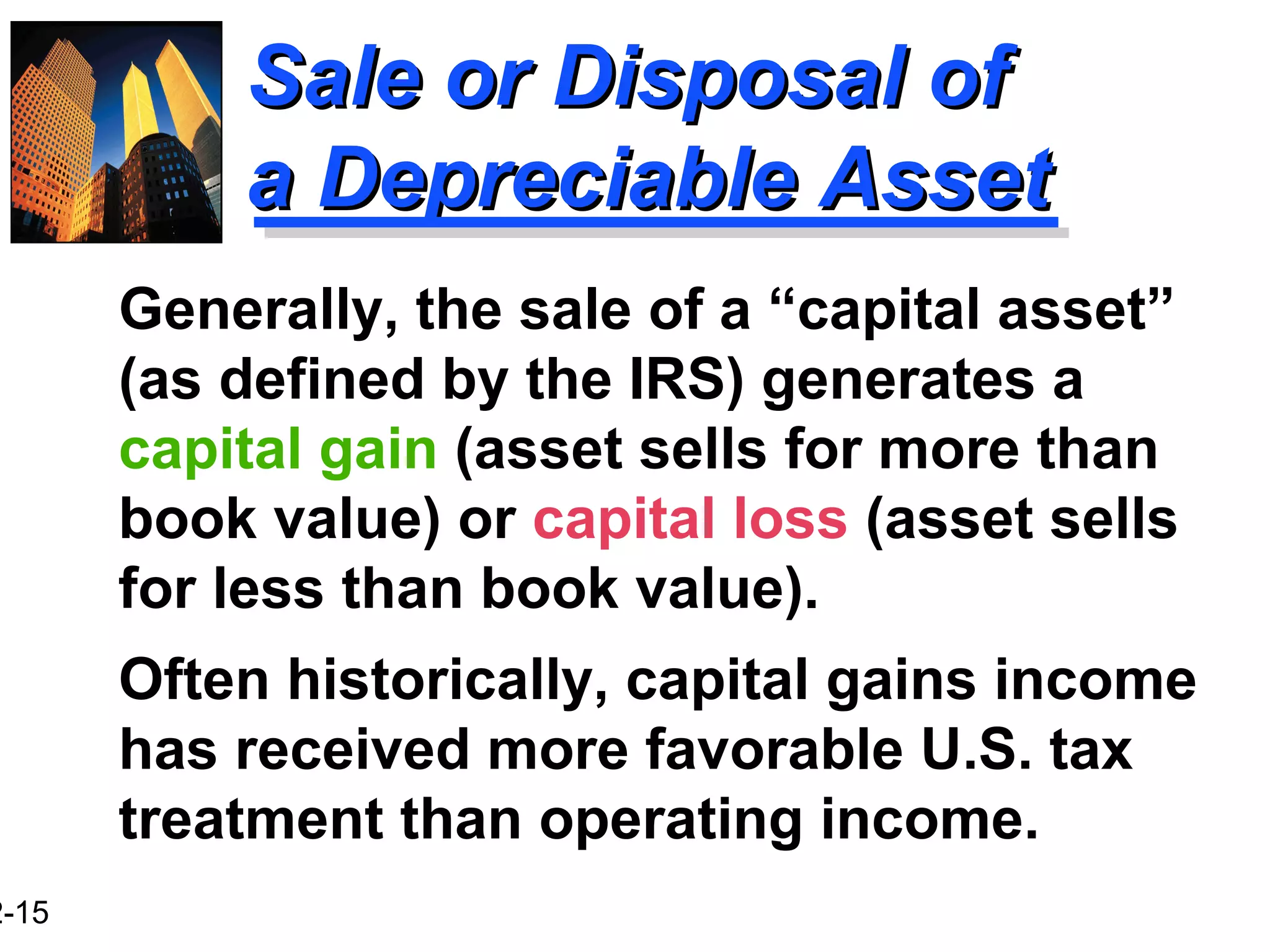
Sale or Disposal ofSale or Disposal of
a Depreciable Asseta Depreciable Asset
Often historically, capital gains income
has received more favorable U.S. tax
treatment than operating income.
Generally, the sale of a “capital asset”
(as defined by the IRS) generates a
capital gain (asset sells for more than
book value) or capital loss (asset sells
for less than book value).
2-16
Corporate CapitalCorporate Capital
Gains / LossesGains / Losses
Capital losses are deductible only
against capital gains.
Currently, capital gains are taxed
at ordinary income tax rates for
corporations, or a maximum 35%.
2-17
Calculating theCalculating the
Incremental Cash FlowsIncremental Cash Flows
Initial cash outflowInitial cash outflow -- the initial net cash
investment.
Interim incremental net cash flowsInterim incremental net cash flows --
those net cash flows occurring after the
initial cash investment but not including
the final period’s cash flow.
Terminal-year incremental net cashTerminal-year incremental net cash
flowsflows -- the final period’s net cash flow.
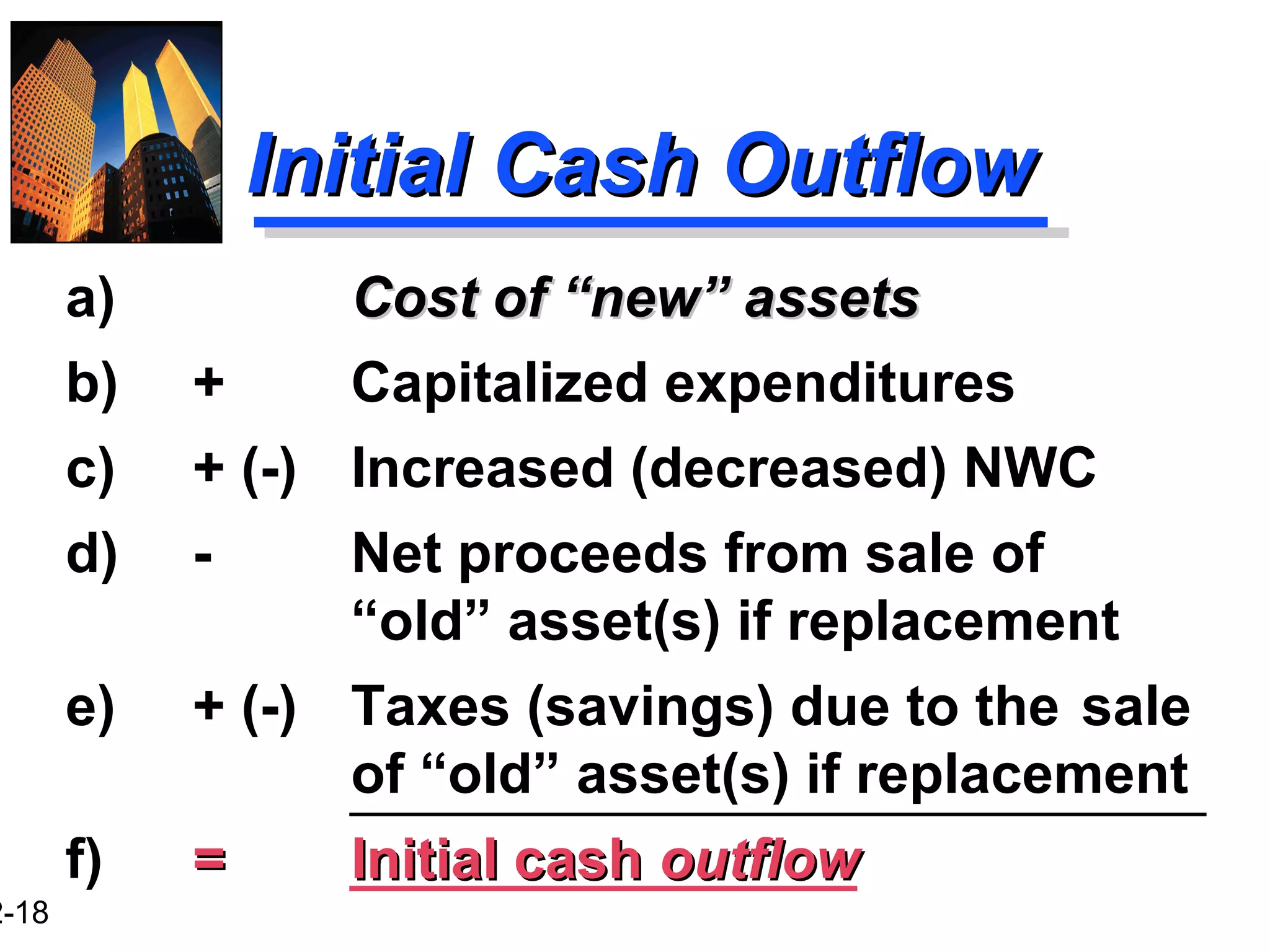
2-18
Initial Cash OutflowInitial Cash Outflow
a) Cost of “new” assetsCost of “new” assets
b) + Capitalized expenditures
c) + (-) Increased (decreased) NWC
d) - Net proceeds from sale of
“old” asset(s) if replacement
e) + (-) Taxes (savings) due to the sale
of “old” asset(s) if replacement
f) == Initial cashInitial cash outflowoutflow
2-19
Incremental Cash FlowsIncremental Cash Flows
a) Net incr. (decr.) in operating revenue
less (plus) any net incr. (decr.) in
operating expenses, excluding depr.
b) - (+) Net incr. (decr.) in tax depreciation
c) = Net change in income before taxes
d) - (+) Net incr. (decr.) in taxes
e) = Net change in income after taxes
f) + (-) Net incr. (decr.) in tax depr. charges
g) == Incremental net cash flow for periodIncremental net cash flow for period
2-20
Terminal-YearTerminal-Year
Incremental Cash FlowsIncremental Cash Flows
a) Calculate the incremental net cashincremental net cash
flowflow for the terminal periodterminal period
b) + (-) Salvage value (disposal/reclamation
costs) of any sold or disposed assets
c) - (+) Taxes (tax savings) due to asset sale
or disposal of “new” assets
d) + (-) Decreased (increased) level of “net”
working capital
e) == Terminal year incremental net cash flowTerminal year incremental net cash flow
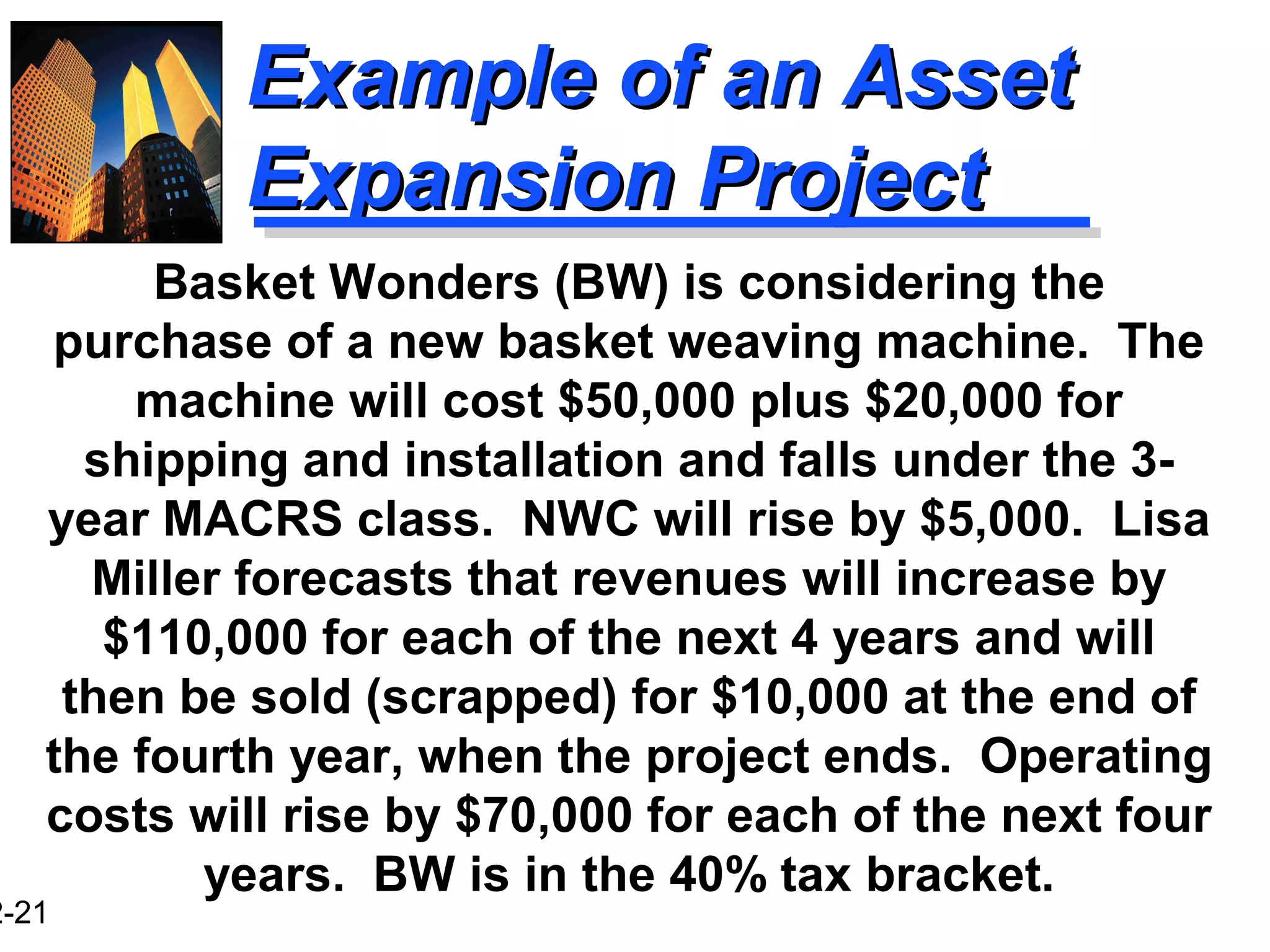
2-21
Example of an AssetExample of an Asset
Expansion ProjectExpansion Project
Basket Wonders (BW) is considering the
purchase of a new basket weaving machine. The
machine will cost $50,000 plus $20,000 for
shipping and installation and falls under the 3-
year MACRS class. NWC will rise by $5,000. Lisa
Miller forecasts that revenues will increase by
$110,000 for each of the next 4 years and will
then be sold (scrapped) for $10,000 at the end of
the fourth year, when the project ends. Operating
costs will rise by $70,000 for each of the next four
years. BW is in the 40% tax bracket.
2-22
Initial Cash OutflowInitial Cash Outflow
a) $50,000
b) + 20,000
c) + 5,000
d) - 0 (not a replacement)
e) + (-) 0 (not a replacement)
f) == $75,000*$75,000*
* Note that we have calculated this value as a
“positive” because it is a cash OUTFLOW (negative).
2-23
Incremental Cash FlowsIncremental Cash Flows
Year 1 Year 2 Year 3 Year 4
a) $40,000 $40,000 $40,000 $40,000
b) - 23,331 31,115 10,367 5,187
c) = $16,669 $ 8,885 $29,633 $34,813
d) - 6,668 3,554 11,853 13,925
e) = $10,001 $ 5,331 $17,780 $20,888
f) + 23,331 31,115 10,367 5,187
g) == $33,332 $36,446 $28,147 $26,075$33,332 $36,446 $28,147 $26,075
2-24
Terminal-YearTerminal-Year
Incremental Cash FlowsIncremental Cash Flows
a) $26,075$26,075 The incremental cash flowincremental cash flow
from the previous slide in
Year 4.
b) + 10,000 Salvage Value.
c) - 4,000 .40*($10,000 - 0) Note, the
asset is fully depreciated at
the end of Year 4.
d) + 5,000 NWC - Project ends.
e) == $37,075$37,075 Terminal-year incrementalTerminal-year incremental
cash flow.cash flow.
2-25
Summary of ProjectSummary of Project
Net Cash FlowsNet Cash Flows
Asset Expansion
Year 0 Year 1 Year 2 Year 3 Year 4
-$75,000*-$75,000* $33,332$33,332 $36,446 $28,147$36,446 $28,147 $37,075$37,075
* Notice again that this value is a negativenegative
cash flow as we calculated it as the initial
cash OUTFLOW in slide 12-18.
2-26
Example of an AssetExample of an Asset
Replacement ProjectReplacement Project
Let us assume that previous asset expansion
project is actually an asset replacement project.
The original basis of the machine was $30,000 and
depreciated using straight-line over five years
($6,000 per year). The machine has two years of
depreciation and four years of useful life remain-
ing. BW can sell the current machine for $6,000.
The new machine will not increase revenues
(remain at $110,000) but it decreases operating
expenses by $10,000 per year (old = $80,000). NWC
will rise to $10,000 from $5,000 (old).
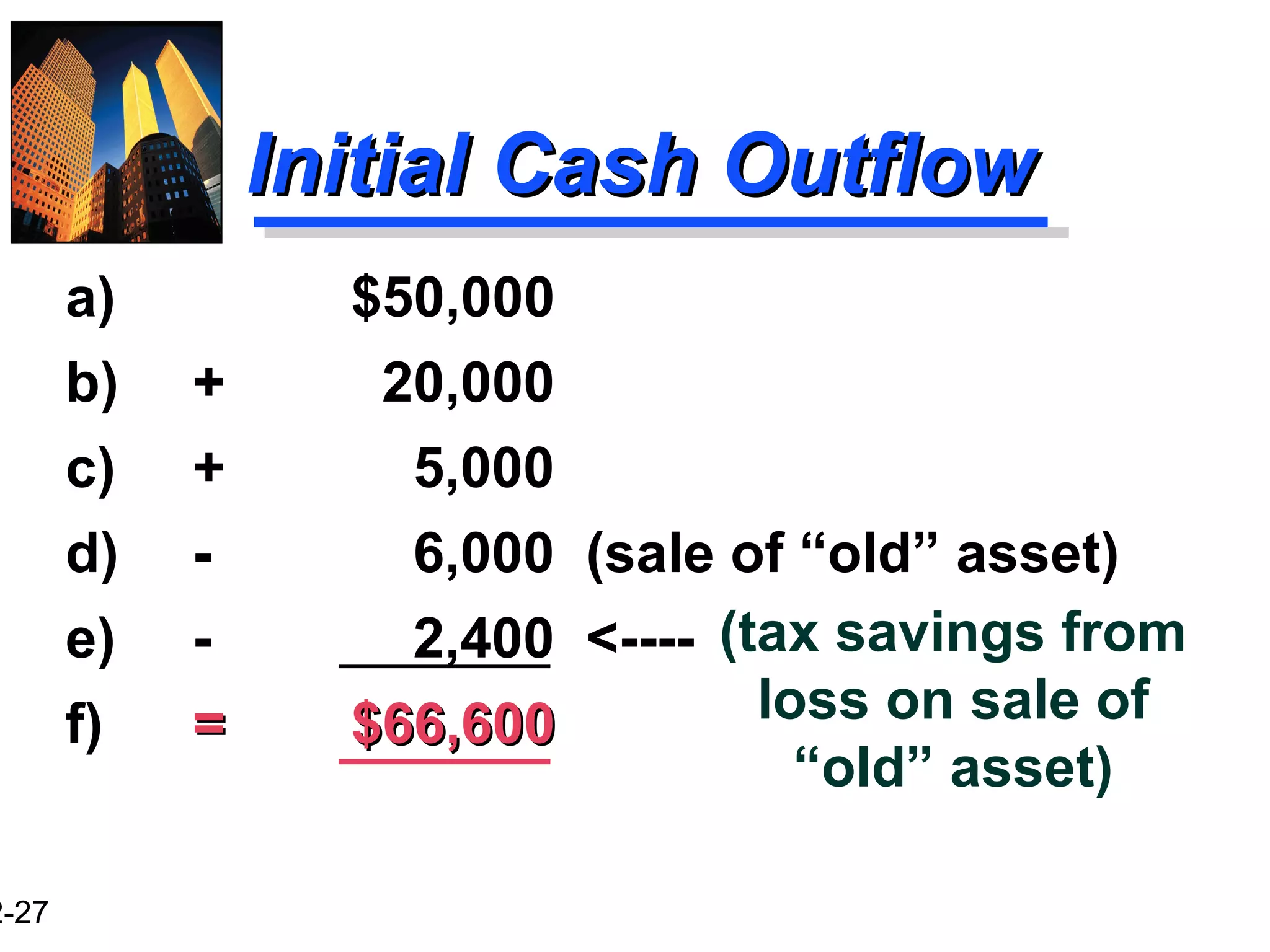
2-27
Initial Cash OutflowInitial Cash Outflow
a) $50,000
b) + 20,000
c) + 5,000
d) - 6,000 (sale of “old” asset)
e) - 2,400 <----
f) == $66,600$66,600
(tax savings from
loss on sale of
“old” asset)
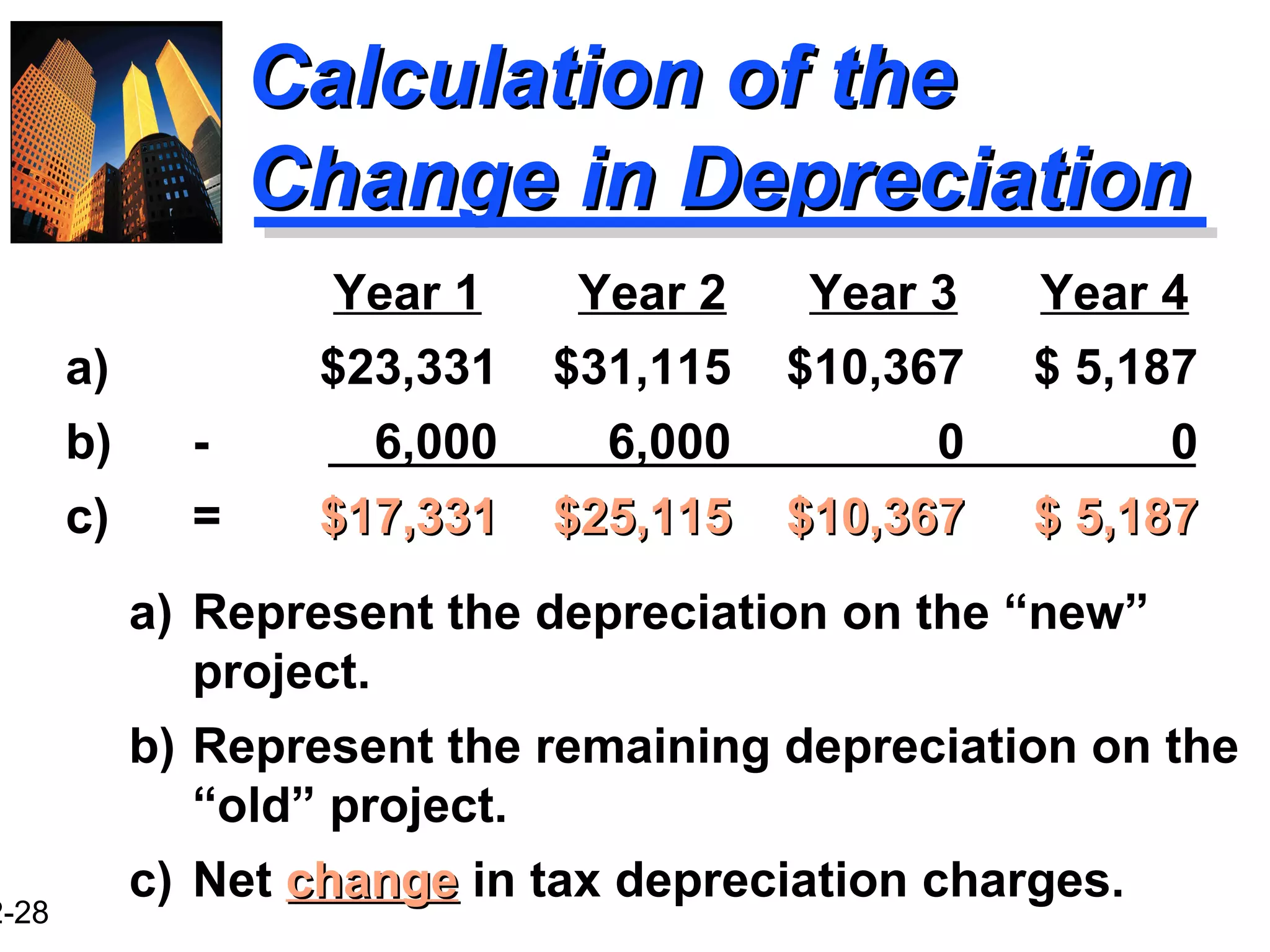
2-28
Calculation of theCalculation of the
Change in DepreciationChange in Depreciation
Year 1 Year 2 Year 3 Year 4
a) $23,331 $31,115 $10,367 $ 5,187
b) - 6,000 6,000 0 0
c) = $17,331 $25,115 $10,367 $ 5,187$17,331 $25,115 $10,367 $ 5,187
a) Represent the depreciation on the “new”
project.
b) Represent the remaining depreciation on the
“old” project.
c) Net changechange in tax depreciation charges.
2-29
Incremental Cash FlowsIncremental Cash Flows
Year 1 Year 2 Year 3 Year 4
a) $10,000 $10,000 $10,000 $10,000
b) - 17,331 25,115 10,367 5,18717,331 25,115 10,367 5,187
c) = $ -7,331 -$15,115 $ -367 $ 4,813
d) - -2,932 -6,046 -147 1,925
e) = $ -4,399 $ -9,069 $ -220 $ 2,888
f) + 17,33117,331 25,11525,115 10,367 5,18710,367 5,187
g) == $12,932 $16,046 $10,147 $ 8,075$12,932 $16,046 $10,147 $ 8,075
2-30
Terminal-YearTerminal-Year
Incremental Cash FlowsIncremental Cash Flows
a) $ 8,075$ 8,075 The incremental cash flowincremental cash flow
from the previous slide in
Year 4.
b) + 10,000 Salvage Value.
c) - 4,000 (.40)*($10,000 - 0). Note, the
asset is fully depreciated at
the end of Year 4.
d) + 5,000 Return of “added” NWC.
e) == $19,075$19,075 Terminal-year incrementalTerminal-year incremental
cash flow.cash flow.
2-31
Summary of ProjectSummary of Project
Net Cash FlowsNet Cash Flows
Asset Expansion
Year 0 Year 1 Year 2 Year 3 Year 4
-$75,000-$75,000 $33,332$33,332 $36,446 $28,147$36,446 $28,147 $37,075$37,075
Asset Replacement
Year 0 Year 1 Year 2 Year 3 Year 4
-$66,600-$66,600 $12,933$12,933 $16,046 $10,147$16,046 $10,147 $19,075$19,075

Financial Management Slides Ch 12

  • 1.
    2-1 Chapter 12Chapter 12 CapitalBudgetingCapital Budgeting and Estimatingand Estimating Cash FlowsCash Flows Instructor: Ajab Khan Burki
  • 2.
    2-2 Capital Budgeting andCapitalBudgeting and Estimating Cash FlowsEstimating Cash Flows The Capital Budgeting Process Generating Investment Project Proposals Estimating Project “After-Tax Incremental Operating Cash Flows”
  • 3.
    2-3 What isWhat is CapitalBudgeting?Capital Budgeting? The process of identifying, analyzing, and selecting investment projects whose returns (cash flows) are expected to extend beyond one year. The process of identifying, analyzing, and selecting investment projects whose returns (cash flows) are expected to extend beyond one year.
  • 4.
    2-4 The CapitalThe Capital BudgetingProcessBudgeting Process Generate investment proposals consistent with the firm’s strategic objectives. Estimate after-tax incremental operating cash flows for the investment projects. Evaluate project incremental cash flows.
  • 5.
    2-5 The CapitalThe Capital BudgetingProcessBudgeting Process Select projects based on a value- maximizing acceptance criterion. Reevaluate implemented investment projects continually and perform postaudits for completed projects.
  • 6.
    2-6 Classification of InvestmentClassificationof Investment Project ProposalsProject Proposals 1. New products or expansion of existing products 2. Replacement of existing equipment or buildings 3. Research and development 4. Exploration 5. Other (e.g., safety or pollution related)
  • 7.
    2-7 Screening ProposalsScreening Proposals andDecision Makingand Decision Making 1. Section Chiefs 2. Plant Managers 3. VP for Operations 4. Capital Expenditures Committee 5. President 6. Board of Directors AdvancementAdvancement to the nextto the next level dependslevel depends on coston cost and strategicand strategic importance.importance.
  • 8.
    2-8 Estimating After-TaxEstimating After-Tax IncrementalCash FlowsIncremental Cash Flows  CashCash (not accounting income) flowsflows  OperatingOperating (not financing) flowsflows  After-tax flowsAfter-tax flows  Incremental flowsIncremental flows Basic characteristics ofBasic characteristics of relevant project flowsrelevant project flows
  • 9.
    2-9 Estimating After-TaxEstimating After-Tax IncrementalCash FlowsIncremental Cash Flows  Ignore sunk costssunk costs  Include opportunity costsopportunity costs  Include project-driven changes inchanges in working capitalworking capital net of spontaneous changes in current liabilities  Include effects of inflationeffects of inflation Principles that must be adheredPrinciples that must be adhered to in the estimationto in the estimation
  • 10.
    2-10 Tax ConsiderationsTax Considerations andDepreciationand Depreciation Generally, profitable firms prefer to use an accelerated method for tax reporting purposes (MACRS). DepreciationDepreciation represents the systematic allocation of the cost of a capital asset over a period of time for financial reporting purposes, tax purposes, or both.
  • 11.
    2-11 Depreciation and theDepreciationand the MACRS MethodMACRS Method Everything else equal, the greater the depreciation charges, the lower the taxes paid by the firm. Depreciation is a noncash expense. Assets are depreciated (MACRS) on one of eight different property classes. Generally, the half-year convention is used for MACRS.
  • 12.
    2-12 MACRS Sample ScheduleMACRSSample Schedule Recovery Property Class Year 3-Year 5-Year 7-Year 1 33.33% 20.00% 14.29% 2 44.45 32.00 24.49 3 14.81 19.20 17.49 4 7.41 11.52 12.49 5 11.52 8.93 6 5.76 8.92 7 8.93 8 4.46
  • 13.
    2-13 Depreciable BasisDepreciable Basis Intax accounting, the fully installed cost of an asset. This is the amount that, by law, may be written off over time for tax purposes. Depreciable BasisDepreciable Basis = Cost of AssetCost of Asset + CapitalizedCapitalized ExpendituresExpenditures
  • 14.
    2-14 CapitalizedCapitalized ExpendituresExpenditures Capitalized ExpendituresCapitalized Expendituresare expenditures that may provide benefits into the future and therefore are treated as capital outlays and not as expenses of the period in which they were incurred. Examples: Shipping and installation
  • 15.
    2-15 Sale or DisposalofSale or Disposal of a Depreciable Asseta Depreciable Asset Often historically, capital gains income has received more favorable U.S. tax treatment than operating income. Generally, the sale of a “capital asset” (as defined by the IRS) generates a capital gain (asset sells for more than book value) or capital loss (asset sells for less than book value).
  • 16.
    2-16 Corporate CapitalCorporate Capital Gains/ LossesGains / Losses Capital losses are deductible only against capital gains. Currently, capital gains are taxed at ordinary income tax rates for corporations, or a maximum 35%.
  • 17.
    2-17 Calculating theCalculating the IncrementalCash FlowsIncremental Cash Flows Initial cash outflowInitial cash outflow -- the initial net cash investment. Interim incremental net cash flowsInterim incremental net cash flows -- those net cash flows occurring after the initial cash investment but not including the final period’s cash flow. Terminal-year incremental net cashTerminal-year incremental net cash flowsflows -- the final period’s net cash flow.
  • 18.
    2-18 Initial Cash OutflowInitialCash Outflow a) Cost of “new” assetsCost of “new” assets b) + Capitalized expenditures c) + (-) Increased (decreased) NWC d) - Net proceeds from sale of “old” asset(s) if replacement e) + (-) Taxes (savings) due to the sale of “old” asset(s) if replacement f) == Initial cashInitial cash outflowoutflow
  • 19.
    2-19 Incremental Cash FlowsIncrementalCash Flows a) Net incr. (decr.) in operating revenue less (plus) any net incr. (decr.) in operating expenses, excluding depr. b) - (+) Net incr. (decr.) in tax depreciation c) = Net change in income before taxes d) - (+) Net incr. (decr.) in taxes e) = Net change in income after taxes f) + (-) Net incr. (decr.) in tax depr. charges g) == Incremental net cash flow for periodIncremental net cash flow for period
  • 20.
    2-20 Terminal-YearTerminal-Year Incremental Cash FlowsIncrementalCash Flows a) Calculate the incremental net cashincremental net cash flowflow for the terminal periodterminal period b) + (-) Salvage value (disposal/reclamation costs) of any sold or disposed assets c) - (+) Taxes (tax savings) due to asset sale or disposal of “new” assets d) + (-) Decreased (increased) level of “net” working capital e) == Terminal year incremental net cash flowTerminal year incremental net cash flow
  • 21.
    2-21 Example of anAssetExample of an Asset Expansion ProjectExpansion Project Basket Wonders (BW) is considering the purchase of a new basket weaving machine. The machine will cost $50,000 plus $20,000 for shipping and installation and falls under the 3- year MACRS class. NWC will rise by $5,000. Lisa Miller forecasts that revenues will increase by $110,000 for each of the next 4 years and will then be sold (scrapped) for $10,000 at the end of the fourth year, when the project ends. Operating costs will rise by $70,000 for each of the next four years. BW is in the 40% tax bracket.
  • 22.
    2-22 Initial Cash OutflowInitialCash Outflow a) $50,000 b) + 20,000 c) + 5,000 d) - 0 (not a replacement) e) + (-) 0 (not a replacement) f) == $75,000*$75,000* * Note that we have calculated this value as a “positive” because it is a cash OUTFLOW (negative).
  • 23.
    2-23 Incremental Cash FlowsIncrementalCash Flows Year 1 Year 2 Year 3 Year 4 a) $40,000 $40,000 $40,000 $40,000 b) - 23,331 31,115 10,367 5,187 c) = $16,669 $ 8,885 $29,633 $34,813 d) - 6,668 3,554 11,853 13,925 e) = $10,001 $ 5,331 $17,780 $20,888 f) + 23,331 31,115 10,367 5,187 g) == $33,332 $36,446 $28,147 $26,075$33,332 $36,446 $28,147 $26,075
  • 24.
    2-24 Terminal-YearTerminal-Year Incremental Cash FlowsIncrementalCash Flows a) $26,075$26,075 The incremental cash flowincremental cash flow from the previous slide in Year 4. b) + 10,000 Salvage Value. c) - 4,000 .40*($10,000 - 0) Note, the asset is fully depreciated at the end of Year 4. d) + 5,000 NWC - Project ends. e) == $37,075$37,075 Terminal-year incrementalTerminal-year incremental cash flow.cash flow.
  • 25.
    2-25 Summary of ProjectSummaryof Project Net Cash FlowsNet Cash Flows Asset Expansion Year 0 Year 1 Year 2 Year 3 Year 4 -$75,000*-$75,000* $33,332$33,332 $36,446 $28,147$36,446 $28,147 $37,075$37,075 * Notice again that this value is a negativenegative cash flow as we calculated it as the initial cash OUTFLOW in slide 12-18.
  • 26.
    2-26 Example of anAssetExample of an Asset Replacement ProjectReplacement Project Let us assume that previous asset expansion project is actually an asset replacement project. The original basis of the machine was $30,000 and depreciated using straight-line over five years ($6,000 per year). The machine has two years of depreciation and four years of useful life remain- ing. BW can sell the current machine for $6,000. The new machine will not increase revenues (remain at $110,000) but it decreases operating expenses by $10,000 per year (old = $80,000). NWC will rise to $10,000 from $5,000 (old).
  • 27.
    2-27 Initial Cash OutflowInitialCash Outflow a) $50,000 b) + 20,000 c) + 5,000 d) - 6,000 (sale of “old” asset) e) - 2,400 <---- f) == $66,600$66,600 (tax savings from loss on sale of “old” asset)
  • 28.
    2-28 Calculation of theCalculationof the Change in DepreciationChange in Depreciation Year 1 Year 2 Year 3 Year 4 a) $23,331 $31,115 $10,367 $ 5,187 b) - 6,000 6,000 0 0 c) = $17,331 $25,115 $10,367 $ 5,187$17,331 $25,115 $10,367 $ 5,187 a) Represent the depreciation on the “new” project. b) Represent the remaining depreciation on the “old” project. c) Net changechange in tax depreciation charges.
  • 29.
    2-29 Incremental Cash FlowsIncrementalCash Flows Year 1 Year 2 Year 3 Year 4 a) $10,000 $10,000 $10,000 $10,000 b) - 17,331 25,115 10,367 5,18717,331 25,115 10,367 5,187 c) = $ -7,331 -$15,115 $ -367 $ 4,813 d) - -2,932 -6,046 -147 1,925 e) = $ -4,399 $ -9,069 $ -220 $ 2,888 f) + 17,33117,331 25,11525,115 10,367 5,18710,367 5,187 g) == $12,932 $16,046 $10,147 $ 8,075$12,932 $16,046 $10,147 $ 8,075
  • 30.
    2-30 Terminal-YearTerminal-Year Incremental Cash FlowsIncrementalCash Flows a) $ 8,075$ 8,075 The incremental cash flowincremental cash flow from the previous slide in Year 4. b) + 10,000 Salvage Value. c) - 4,000 (.40)*($10,000 - 0). Note, the asset is fully depreciated at the end of Year 4. d) + 5,000 Return of “added” NWC. e) == $19,075$19,075 Terminal-year incrementalTerminal-year incremental cash flow.cash flow.
  • 31.
    2-31 Summary of ProjectSummaryof Project Net Cash FlowsNet Cash Flows Asset Expansion Year 0 Year 1 Year 2 Year 3 Year 4 -$75,000-$75,000 $33,332$33,332 $36,446 $28,147$36,446 $28,147 $37,075$37,075 Asset Replacement Year 0 Year 1 Year 2 Year 3 Year 4 -$66,600-$66,600 $12,933$12,933 $16,046 $10,147$16,046 $10,147 $19,075$19,075