Organizational Behavior 16th Edition Robbins
Solutions Manual download
https://testbankfan.com/product/organizational-behavior-16th-
edition-robbins-solutions-manual/
Find test banks or solution manuals at testbankfan.com today!
We believe these products will be a great fit for you. Click
the link to download now, or visit testbankfan.com
to discover even more!
Organizational Behavior 16th Edition Robbins Test Bank
https://testbankfan.com/product/organizational-behavior-16th-edition-
robbins-test-bank/
Organizational Behavior 18th Edition Robbins Solutions
Manual
https://testbankfan.com/product/organizational-behavior-18th-edition-
robbins-solutions-manual/
Organizational Behavior 14th Edition Robbins Solutions
Manual
https://testbankfan.com/product/organizational-behavior-14th-edition-
robbins-solutions-manual/
Auditing and Assurance Services 7th Edition Louwers Test
Bank
https://testbankfan.com/product/auditing-and-assurance-services-7th-
edition-louwers-test-bank/
Advertising and Promotion An Integrated Marketing
Communications Perspective 10th Edition Belch Test Bank
https://testbankfan.com/product/advertising-and-promotion-an-
integrated-marketing-communications-perspective-10th-edition-belch-
test-bank/
Changing Earth Exploring Geology and Evolution 7th Edition
Monroe Solutions Manual
https://testbankfan.com/product/changing-earth-exploring-geology-and-
evolution-7th-edition-monroe-solutions-manual/
Integrated Marketing Communications Strategic Planning
Perspectives Canadian 5th Edition Tuckwell Solutions
Manual
https://testbankfan.com/product/integrated-marketing-communications-
strategic-planning-perspectives-canadian-5th-edition-tuckwell-
solutions-manual/
Systems Analysis and Design 6th Edition Dennis Solutions
Manual
https://testbankfan.com/product/systems-analysis-and-design-6th-
edition-dennis-solutions-manual/
Aerodynamics for Engineering Students 6th Edition Houghton
Solutions Manual
https://testbankfan.com/product/aerodynamics-for-engineering-
students-6th-edition-houghton-solutions-manual/
Intermediate Accounting 9th Edition Spiceland Solutions
Manual
https://testbankfan.com/product/intermediate-accounting-9th-edition-
spiceland-solutions-manual/
Chapter 8 Motivation: From Concepts to Applications Page
Copyright © 2015 Pearson Education, Inc.
270
Chapter8
Motivation:
From Concepts to Applications
LEARNING OBJECTIVES
After studying this chapter, students should be able to:
1. Describe the job characteristics model and the way it motivates by changing the
work environment.
2. Compare the main ways jobs can be redesigned.
3. Explain how specific alternative work arrangements can motivate employees.
4. Describe how employee involvement measures can motivate employees.
5. Demonstrate how the different types of variable-pay programs can increase
employee motivation.
6. Show how flexible benefits turn benefits into motivators.
7. Identify the motivational benefits of intrinsic rewards.
INSTRUCTOR RESOURCES
Instructors may wish to use the following resources when presenting this chapter.
Learning Catalytics Questions: Instructor Directions and Follow-Up
Organizational
Behavior Concept
LC Question Instructor Directions and Follow-Up
Job enrichment Select a past job that you
have held and describe how
you would approach
enriching this job.
Introduce this question before students arrive in class
or right after you discuss job enrichment. Next, show
some of the examples to the class in order to apply
the concept.
Variable pay
programs
How would you like to be
paid? (Pick one best choice.)
a. Merit-based pay
b. Piece-rate pay
c. Skill-based pay
d. Bonus
Introduce this question after you have covered the
topic of variable pay. Debrief student responses by
pointing out pros and cons of each approach.
Chapter 8 Motivation: From Concepts to Applications Page
Copyright © 2015 Pearson Education, Inc.
271
Text Exercises
• Myth or Science?: “Money Can’t Buy Happiness”
• An Ethical Choice: Sweatshops and Worker Safety
• glOBalization!: Outcry Over Executive Pay Is Heard Everywhere
• Point/Counterpoint: “Face-Time” Matters
• Questions for Review
• Experiential Exercise: Applying the Job Characteristics Model
• Ethical Dilemma: Inmates for Hire
Text Cases
• Case Incident 1: Motivation for Leisure
• Case Incident 2: Attaching the Carrot to the Stick
Instructor’s Choice
This section presents an exercise that is NOT found in the student's textbook. Instructor's
Choice reinforces the text's emphasis through various activities. Some Instructor's Choice
activities are centered on debates, group exercises, Internet research, and student
experiences. Some can be used in class in their entirety, while others require some
additional work on the student's part. The course instructor may choose to use these at
any time throughout the class—some may be more effective as icebreakers, while some
may be used to pull together various concepts covered in the chapter.
Web Exercises
At the end of each chapter of this Instructor’s Manual, you will find suggested exercises
and ideas for researching OB topics on the Internet. The exercises “Exploring OB Topics
on the Web” are set up so that you can simply photocopy the pages, distribute them to
your class, and make assignments accordingly. You may want to assign the exercises as
an out-of-class activity or as lab activities with your class.
Summary and Implications for Managers
A. The study of what motivates individuals is ultimately key to organizational
performance.
B. Employees whose differences are recognized, who feel valued, and who have the
opportunity to work in jobs that are tailored to their strengths and interests will be
motivated to perform at the highest levels.
C. Employee participation also can increase employee productivity, commitment to
work goals, motivation, and job satisfaction. Specific implications for managers
are below:
1. Recognize individual differences. Spend the time necessary to understand
what’s important to each employee. Design jobs to align with individual
needs and maximize their motivation potential.
Chapter 8 Motivation: From Concepts to Applications Page
Copyright © 2015 Pearson Education, Inc.
272
2. Use goals and feedback. You should give employees firm, specific goals,
and they should get feedback on how well they are faring in pursuit of
those goals.
3. Allow employees to participate in decisions that affect them. Employees
can contribute to setting work goals, choosing their own benefits
packages, and solving productivity and quality problems.
4. Link rewards to performance. Rewards should be contingent on
performance, and employees must perceive the link between the two.
5. Check the system for equity. Employees should perceive that experience,
skills, abilities, effort, and other obvious inputs explain differences in
performance and hence in pay, job assignments, and other obvious
rewards.
This chapter begins with a vignette describing the reaction to Yahoo! CEO Marissa Mayer’s decision to
recall all telecommuters. While Mayer believes the decision is important to productivity, she has been
widely criticized by those who believe the decision will make it difficult for some employees to maintain a
work-life balance.
BRIEF CHAPTER OUTLINE
I. Motivating by Job Design: The Job Characteristics Model (Exhibit 8.1)
A. The job characteristics model (JCM) proposed that any job may be described by
five core job dimensions:
1. Skill variety: The degree to which the job requires a variety of different
activities, so the worker can use a number of different skills and talent.
2. Task identity: The degree to which the job requires completion of a whole
and identifiable piece of work.
3. Task significance: The degree to which the job has a substantial impact on
the lives or work of other people.
4. Autonomy: The degree to which the job provides the worker freedom,
independence, and discretion in scheduling the work and determining the
procedures to be used in carrying it out.
5. Feedback: The degree to which carrying out the work activities generates
direct and clear information about your own performance.
B. Much evidence supports the JCM concept that the presence of a set of job
characteristics—variety, identity, significance, autonomy, and feedback—does
generate higher and more satisfying job performance.
C. But we can better calculate motivating potential by simply adding the
characteristics rather than using the formula.
D. A few studies have tested the job characteristics model in different cultures, but
the results aren’t consistent.
E. How Can Jobs Be Redesigned?
1. Introduction
a. Repetitive jobs provide little variety, autonomy, or motivation. People
generally seek out jobs that are challenging and stimulating.
Chapter 8 Motivation: From Concepts to Applications Page
Copyright © 2015 Pearson Education, Inc.
273
2. Job rotation
a. Often referred to as cross-training.
b. Periodic shifting of an employee from one task to another.
c. Strengths of job rotation are that it reduces boredom, increases motivation,
and helps employees better understand their work contributions.
d. Drawbacks include creates disruptions, extra time for supervisors
addressing questions, training time and efficiencies.
3. Job enrichment
a. Expands jobs by increasing the degree to which the worker controls the
planning, execution, and evaluation of the work.
b. Guidelines for job enrichment (Exhibit 8–2)
i. Combining tasks puts fractionalized tasks back together to form a new
and larger module of work.
ii. Forming natural work units makes an employee’s tasks create an
identifiable and meaningful whole.
iii. Establishing client relationships increases the direct relationships
between workers and their clients (clients can be internal as well as
outside the organization).
iv. Expanding jobs vertically gives employees responsibilities and control
formerly reserved for management.
v. Opening feedback channels lets employees know how well they are
doing and whether their performance is improving, deteriorating, or
remaining constant.
c. The evidence on job enrichment shows it reduces absenteeism and
turnover costs and increases satisfaction, but not all programs are equally
effective.
F. Relational Job Design
1. While redesigning jobs on the basis of job characteristics theory is likely to
make work more intrinsically motivating to people, more contemporary
research is focusing on how to make jobs more prosocially motivating to
people.
2. In other words, how can managers design work so employees are motivated
to promote the well-being of the organization’s beneficiaries?
a. Beneficiaries of organizations might include customers, clients, patients,
and users of products or services.
b. This view of job design shifts the spotlight from the employee to those
whose lives are affected by the job that employee performs.
3. One way to make jobs more prosocially motivating is to better connect
employees with the beneficiaries of their work, for example, by relating
stories from customers who have found the company’s products or services to
be helpful.
4. Meeting beneficiaries firsthand allows employees to see that their actions
affect a real, live person, and that their jobs have tangible consequences.
5. In addition, connections with beneficiaries make customers or clients more
accessible in memory and more emotionally vivid, which leads employees to
consider the effects of their actions more.
Chapter 8 Motivation: From Concepts to Applications Page
Copyright © 2015 Pearson Education, Inc.
274
6. Finally, connections allow employees to easily take the perspective of
beneficiaries, which fosters higher levels of commitment.
G. Alternative Work Arrangements
1. Flextime or flexible work hours. Allows employees some discretion over
when they arrive at and leave work. (Exhibit 8–3)
a. Benefits include reduced absenteeism, increased productivity, reduced
overtime expense, and reduced hostility toward management, and
increased autonomy and responsibility for employees.
b. Major drawback is that it’s not applicable to all jobs.
2. Job sharing. Allows two or more individuals to split a traditional 40-hour-a-
week job.
a. Only 12 percent of large organizations now offer job sharing, a decline
from 18 percent in 2008.
b. Job sharing allows an organization to draw on the talents of more than one
individual in any given job.
c. It also opens the opportunity to acquire skilled workers—for instance,
women with young children and retirees—who might not be available on a
full-time basis.
d. From the employee’s perspective, job sharing increases flexibility and can
increase motivation and satisfaction when a 40-hour-a-week job is just not
practical.
e. From the employee’s perspective, job sharing increases flexibility and can
increase motivation and satisfaction when a 40-hour-a-week job is just not
practical.
f. The major drawback is finding compatible pairs of employees who can
successfully coordinate the intricacies of one job.
i. In the United States, the national Affordable Care Act may create an
incentive for companies to increase job sharing arrangements in order
to avoid the fees employees must pay the government for full-time
employees.
3. Telecommuting. Employees who do their work at home at least two days a
week on a computer that is linked to their office.
a. There are three categories: routine information-handling tasks, mobile
activities, and professional and other knowledge-related tasks.
b. Potential benefits of telecommuting:
i. Larger labor pool
ii. Higher productivity
iii. Less turnover
iv. Improved morale
v. Reduced office-space costs
c. Downsides of telecommuting:
i. Employer
(a) Less direct supervision of employees
(b) Difficulty coordinating teamwork
(c) Reduced knowledge transfer
Chapter 8 Motivation: From Concepts to Applications Page
Copyright © 2015 Pearson Education, Inc.
275
ii. Employee
(a) Increased feelings of isolation
(b) Reduced job satisfaction
(c) Less “face-time”
H. The Social and Physical Context of Work
1. The job characteristics model shows most employees are more motivated and
satisfied when their intrinsic work tasks are engaging.
2. Research demonstrates that social aspects and work context are as important
as other job design features.
3. Some social characteristics that improve job performance include
interdependence, social support, and interactions with other people outside
work.
4. The work context is also likely to affect employee satisfaction.
II. Employee Involvement
A. Introduction
1. Employee involvement is a participative process that uses employees’ input to
increase their commitment to the organization’s success.
2. Employee involvement programs differ among countries.
a. A study of four countries, including the United States and India,
confirmed the importance of modifying practices to reflect national
culture.
B. Examples of Employee Involvement Programs
1. Participative management
a. Common to all participative management programs is joint decision
making, in which subordinates share a significant degree of decision
making power with their immediate superiors.
b. Participative management has, at times, been promoted as a panacea for
poor morale and low productivity.
c. But for it to work, employees must have trust and confidence in their
leaders.
d. Leaders should refrain from coercive techniques and instead stress the
organizational consequences of decision making to employees.
e. Studies of the participation–performance relationship have yielded mixed
findings.
2. Representative participation
a. Almost every country in Western Europe requires companies to practice
representative participation.
b. The goal is to redistribute power within an organization, putting labor on a
more equal footing with the interests of management and stockholders by
letting workers be represented by a small group of employees who
actually participate.
C. Linking Employee Involvement Programs and Motivation Theories
a. Theory Y is consistent with participative management.
b. Theory X aligns with autocratic style.
c. Two-factor theory aligns with employee involvement programs in
providing intrinsic motivation.
Chapter 8 Motivation: From Concepts to Applications Page
Copyright © 2015 Pearson Education, Inc.
276
d. Extensive employee involvement programs clearly have the potential to
increase employee intrinsic motivation in work tasks.
III. Using Rewards to Motivate Employees
A. Introduction
1. As we saw in Chapter 3, pay is not a primary factor driving job satisfaction.
However, it does motivate people, and companies often underestimate its
importance in keeping top talent.
B. What to Pay: Establishing the Pay Structure
1. Complex process that entails balancing internal equity and external equity.
2. Some organizations prefer to pay leaders by paying above market.
3. Paying more may net better-qualified and more highly motivated employees
who may stay with the firm longer.
C. How to Pay: Rewarding Individual Employees Through Variable-Pay Programs
1. Introduction
a. A number of organizations are moving away from paying solely on
credentials or length of service.
b. Piece-rate plans, merit-based pay, bonuses, profit sharing, gain sharing,
and employee stock ownership plans are all forms of a variable-pay
program, which bases a portion of an employee’s pay on some individual
and/or organizational measure of performance.
c. Earnings therefore fluctuate up and down.
2. Variable-pay plans have long been used to compensate salespeople and
executives.
a. Globally, around 80 percent of companies offer some form of variable-pay
plan.
b. Moreover, recent research shows that 26% of U.S. companies have either
increased or plan to increase the proportion of variable pay in employee
pay programs, and another 40% have already recently increased the
proportion of variable pay.
c. Unfortunately, most employees still don’t see a strong connection between
pay and performance.
d. The fluctuation in variable pay is what makes these programs attractive to
management.
3. Piece-rate pay plans—workers are paid a fixed sum for each unit of
production completed.
a. A pure piece-rate plan provides no base salary and pays the employee only
for what he or she produces.
b. Although incentives are motivating and relevant for some jobs, it is
unrealistic to think they can constitute the only piece of some employees’
pay.
4. Merit-based pay plans—based on performance appraisal ratings.
a. Main advantage is that it allows employers to differentiate pay based on
performance.
b. Create perceptions of relationships between performance and rewards.
c. Despite their intuitive appeal, merit pay plans have several limitations.
Chapter 8 Motivation: From Concepts to Applications Page
Copyright © 2015 Pearson Education, Inc.
277
i. One is that they are typically based on an annual performance
appraisal and thus are only as valid as the performance ratings.
ii. Another limitation is that the pay-raise pool fluctuates on economic or
other conditions that have little to do with individual performance.
iii. Finally, unions typically resist merit pay plans.
5. Bonuses
a. An annual bonus is a significant component of total compensation for
many jobs.
b. Among Fortune 100 CEOs, the bonus (mean of $1.01 million) generally
exceeds the base salary (mean of $863,000).
c. Bonus plans increasingly include lower-ranking employees; many
companies now routinely reward productive employees with bonuses in
the thousands of dollars when profits improve.
d. Downsides of bonuses: employees’ pay is more vulnerable to cuts.
6. Skill-based pay
a. Skill-based pay (also called competency-based or knowledge-based pay)
is an alternative to job-based pay that bases pay levels on how many skills
employees have or how many jobs they can do.
b. For employers, the lure of skill-based pay plans is that they increase the
flexibility of the workforce: filling staffing needs is easier when employee
skills are interchangeable.
c. Disadvantages
i. People can “top out”—that is, they can learn all the skills the program
calls for them to learn.
ii. Finally, skill-based plans don’t address level of performance. They
deal only with whether someone can perform the skill.
7. Profit-sharing plans
a. Profit-sharing plans are organization-wide programs that distribute
compensation based on some established formula centered around a
company’s profitability.
8. Gainsharing
a. Gainsharing is a formula-based group incentive plan.
b. It differs from profit sharing in tying rewards to productivity gains rather
than profits, so employees can receive incentive awards even when the
organization isn’t profitable.
9. Employee stock ownership plans
a. An employee stock ownership plan (ESOP) is a company-established
benefit plan in which employees acquire stock, often at below-market
prices, as part of their benefits.
b. Most of the 10,000 or so ESOPs in the United States are in small, privately
held companies.
c. Research on ESOPs indicates they increase employee satisfaction and
innovation.
10. Evaluation of variable pay
a. Do variable-pay programs increase motivation and productivity?
b. Studies generally support the idea that organizations with profit-sharing
Chapter 8 Motivation: From Concepts to Applications Page
Copyright © 2015 Pearson Education, Inc.
278
plans have higher levels of profitability than those without them.
c. Profit sharing plans have also been linked to higher levels of employee
affective commitment, especially in small organizations.
d. Another study found that whereas piece-rate pay-for performance plans
stimulated higher levels of productivity, this positive affect was not
observed for risk-averse employees.
e. You’d probably think individual pay systems such as merit pay or pay-for-
performance work better in individualistic cultures such as the United
States or that group-based rewards such as gain sharing or profit sharing
work better in collectivistic cultures.
i. Unfortunately, there isn’t much research on the issue.
11. Flexible benefits: developing a benefits package
a. Flexible benefits individualize rewards by allowing each employee to
choose the compensation package that best satisfies his or her current
needs and situation.
b. These plans replace the “one-benefit-plan-fits-all” programs designed for a
male with a wife and two children at home that dominated organizations
for more than 50 years.
i. Fewer than 10 percent of employees now fit this image.
ii. About 25 percent are single, and one-third are part of two-income
families with no children.
c. Flexible benefits can accommodate differences in employee needs based
on age, marital status, spouses’ benefit status, and number and age of
dependents.
d. There are three basic types of programs:
i. Modular plans: pre-designed with each module put together to meet
the needs of a specific group of employees.
ii. Core-plus plans: a core of essential benefits and a menu like selection
of other benefit options.
iii. Flexible spending plans: employees set aside pretax dollars up to the
amount offered in the plan to pay for particular benefits, such as health
care and dental premiums.
e. Today, almost all major corporations in the United States offer flexible
benefits.
D. Intrinsic Rewards: Employee Recognition Programs
1. Organizations are increasingly recognizing that important work rewards can
be both intrinsic and extrinsic.
a. Rewards are intrinsic in the form of employee recognition programs and
extrinsic in the form of compensation systems.
i. Employee recognition programs range from a spontaneous and private
thank-you to widely publicized formal programs in which specific
types of behavior are encouraged and the procedures for attaining
recognition are clearly identified.
ii. Some research suggests financial incentives may be more motivating
in the short term, but in the long run, it’s nonfinancial incentives.
Chapter 8 Motivation: From Concepts to Applications Page
Copyright © 2015 Pearson Education, Inc.
279
iii. A few years ago, research found that recognition, recognition, and
more recognition was key to employee motivation.
(a) As illustrated in Exhibit 8-4, Phoenix Inn, a West Coast chain of
small hotels, encourages employees to smile by letting customers
identify this desirable behavior and then recognizing winning
employees with rewards and publicity.
iv. Despite the increased popularity of employee recognition programs,
critics argue they are highly susceptible to political manipulation by
management.
IV. Summary and Implications for Managers
A. The study of what motivates individuals is ultimately key to organizational
performance.
B. Employees whose differences are recognized, who feel valued, and who have the
opportunity to work in jobs that are tailored to their strengths and interests will be
motivated to perform at the highest levels.
C. Employee participation also can increase employee productivity, commitment to
work goals, motivation, and job satisfaction. Specific implications for managers
are below:
1. Recognize individual differences. Spend the time necessary to understand
what’s important to each employee. Design jobs to align with individual needs
and maximize their motivation potential.
2. Use goals and feedback. You should give employees firm, specific goals, and
they should get feedback on how well they are faring in pursuit of those goals.
3. Allow employees to participate in decisions that affect them. Employees can
contribute to setting work goals, choosing their own benefits packages, and
solving productivity and quality problems.
4. Link rewards to performance. Rewards should be contingent on performance,
and employees must perceive the link between the two.
5. Check the system for equity. Employees should perceive that experience,
skills, abilities, effort, and other obvious inputs explain differences in
performance and hence in pay, job assignments, and other obvious rewards.
EXPANDED CHAPTER OUTLINE
I. Motivating by Job Design: The Job Characteristics Model (Exhibit 8.1)
A. The Job Characteristics Model (JCM) proposed that any job may be described
by five core job dimensions:
1. Skill variety: The degree to which the job requires a variety of different
activities, so the worker can use a number of different skills and talent.
2. Task identity: The degree to which the job requires completion of a whole and
identifiable piece of work.
3. Task significance: The degree to which the job has a substantial impact on the
lives or work of other people.
Chapter 8 Motivation: From Concepts to Applications Page
Copyright © 2015 Pearson Education, Inc.
280
4. Autonomy: The degree to which the job provides the worker freedom,
independence, and discretion in scheduling the work and determining the
procedures to be used in carrying it out.
5. Feedback: The degree to which carrying out the work activities generates
direct and clear information about the effectiveness of your own performance.
6. The first three dimensions—skill variety, task identity, and task
significance—combine to create meaningful work the incumbent will view as
important, valuable, and worthwhile.
7. From a motivational standpoint, the JCM proposes that individuals obtain
internal rewards when they learn (knowledge of results) that they personally
(experienced responsibility) have performed well on a task they care about
(experienced meaningfulness).
8. Individuals with a high growth need are more likely to experience the critical
psychological states when their jobs are enriched—and respond to them more
positively—than are their counterparts with low growth need.
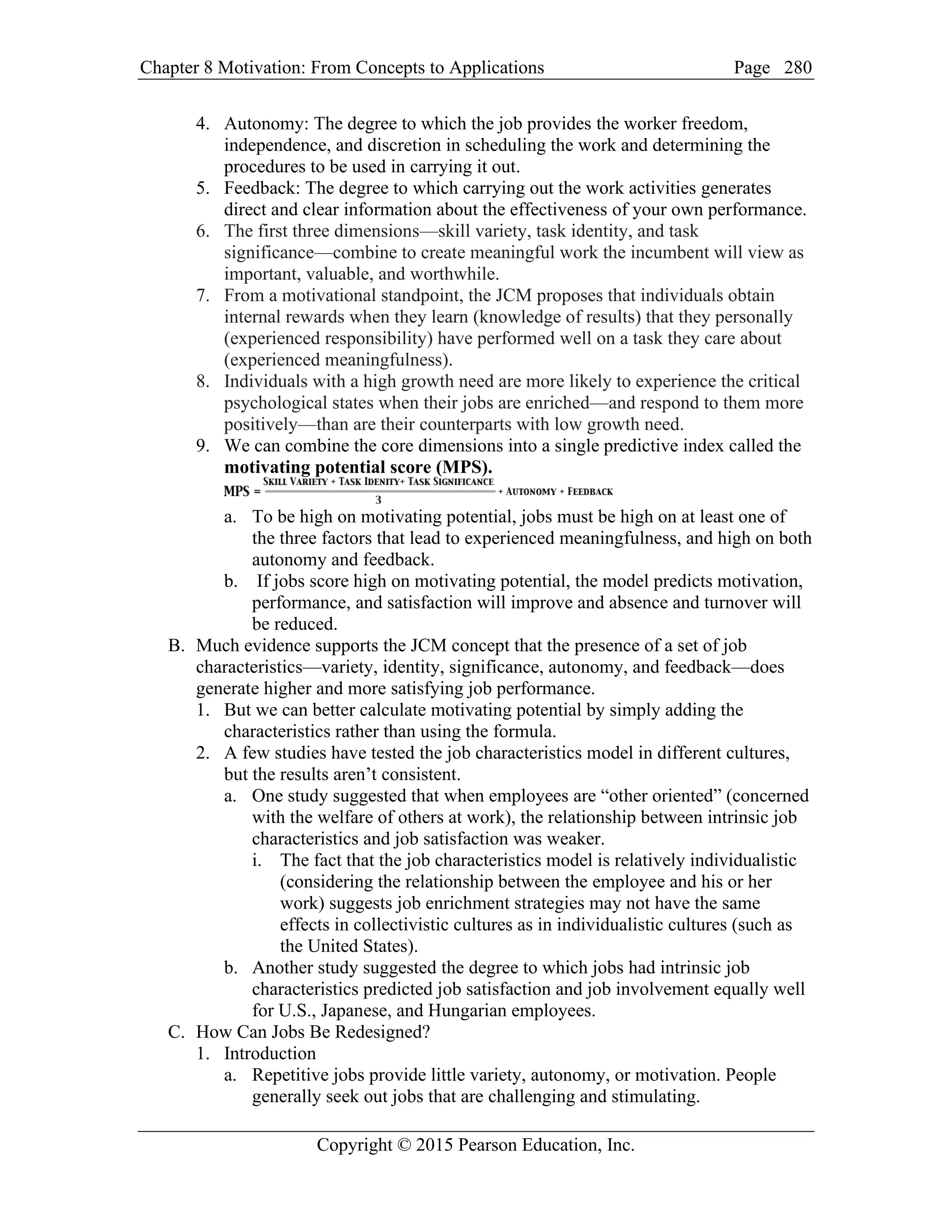
9. We can combine the core dimensions into a single predictive index called the
motivating potential score (MPS).
a. To be high on motivating potential, jobs must be high on at least one of
the three factors that lead to experienced meaningfulness, and high on both
autonomy and feedback.
b. If jobs score high on motivating potential, the model predicts motivation,
performance, and satisfaction will improve and absence and turnover will
be reduced.
B. Much evidence supports the JCM concept that the presence of a set of job
characteristics—variety, identity, significance, autonomy, and feedback—does
generate higher and more satisfying job performance.
1. But we can better calculate motivating potential by simply adding the
characteristics rather than using the formula.
2. A few studies have tested the job characteristics model in different cultures,
but the results aren’t consistent.
a. One study suggested that when employees are “other oriented” (concerned
with the welfare of others at work), the relationship between intrinsic job
characteristics and job satisfaction was weaker.
i. The fact that the job characteristics model is relatively individualistic
(considering the relationship between the employee and his or her
work) suggests job enrichment strategies may not have the same
effects in collectivistic cultures as in individualistic cultures (such as
the United States).
b. Another study suggested the degree to which jobs had intrinsic job
characteristics predicted job satisfaction and job involvement equally well
for U.S., Japanese, and Hungarian employees.
C. How Can Jobs Be Redesigned?
1. Introduction
a. Repetitive jobs provide little variety, autonomy, or motivation. People
generally seek out jobs that are challenging and stimulating.
Chapter 8 Motivation: From Concepts to Applications Page
Copyright © 2015 Pearson Education, Inc.
281
2. Job rotation
a. Often referred to as cross-training.
b. Periodic shifting of an employee from one task to another.
c. When activity is no longer challenging, the employee is shifted to a
different task.
d. Strengths of job rotation are that it reduces boredom, increases motivation,
and helps employees better understand their work contributions.
e. Weaknesses include: disruptions, extra time for supervisors addressing
questions, training time and efficiencies.
3. Job enrichment
a. Expands jobs by increasing the degree to which the worker controls the
planning, execution, and evaluation of the work.
b. Guidelines for job enrichment (Exhibit 8–2)
i. Combining tasks puts fractionalized tasks back together to form a new
and larger module of work.
ii. Forming natural work units makes an employee’s tasks create an
identifiable and meaningful whole.
iii. Establishing client relationships increases the direct relationships
between workers and their clients (clients can be internal as well as
outside the organization).
iv. Expanding jobs vertically gives employees responsibilities and control
formerly reserved for management.
v. Opening feedback channels lets employees know how well they are
doing and whether their performance is improving, deteriorating, or
remaining constant.
c. Another method for improving the meaningfulness of work is providing
employees with mutual assistance programs.
i. Employees who can help each other directly through their work come
to see themselves, and the organizations for which they work, in more
positive, prosocial terms.
ii. This, in turn, can increase employee affective commitment.
d. The evidence on job enrichment shows it reduces absenteeism and
turnover costs and increases satisfaction, but not all programs are equally
effective.
i. Some recent evidence suggests job enrichment works best when it
compensates for poor feedback and reward systems.
ii. Work design may also not affect everyone in the same way.
iii. One recent study showed employees with a higher preference for
challenging work experienced larger reductions in stress following job
redesign than individuals who did not prefer challenging work.
D. Relational Job Design
1. While redesigning jobs on the basis of job characteristics theory is likely to
make work more intrinsically motivating to people, more contemporary
research is focusing on how to make jobs more prosocially motivating to
people.
Chapter 8 Motivation: From Concepts to Applications Page
Copyright © 2015 Pearson Education, Inc.
282
2. In other words, how can managers design work so employees are motivated
to promote the well-being of the organization’s beneficiaries?
a. Beneficiaries of organizations might include customers, clients, patients,
and users of products or services.
b. This view of job design shifts the spotlight from the employee to those
whose lives are affected by the job that employee performs.
3. One way to make jobs more prosocially motivating is to better connect
employees with the beneficiaries of their work, for example, by relating
stories from customers who have found the company’s products or services to
be helpful.
4. Meeting beneficiaries firsthand allows employees to see that their actions
affect a real, live person, and that their jobs have tangible consequences.
5. In addition, connections with beneficiaries make customers or clients more
accessible in memory and more emotionally vivid, which leads employees to
consider the effects of their actions more.
6. Finally, connections allow employees to easily take the perspective of
beneficiaries, which fosters higher levels of commitment.
E. Alternative Work Arrangements
1. Flextime or flexible work hours. Allows employees some discretion over
when they arrive at and leave work. (Exhibit 8–3)
a. Benefits include reduced absenteeism, increased productivity, reduced
overtime expense, and reduced hostility toward management, and
increased autonomy and responsibility for employees.
b. Major drawback is that it’s not applicable to all jobs or every worker.
2. Job sharing. Allows two or more individuals to split a traditional 40-hour-a-
week job.
a. Only 12 percent of larger organizations now offer job sharing, a decline
from 18 percent in 2008.
i. Reasons it is not more widely adopted are likely the difficulty of
finding compatible partners to share a job and the historically negative
perceptions of individuals not completely committed to their job and
employer.
ii. Job sharing allows an organization to draw on the talents of more than
one individual in a given job.
b. The major drawback is finding compatible pairs of employees who can
successfully coordinate the intricacies of one job.
3. Telecommuting. Employees who do their work at home at least two days a
week on a computer that is linked to their office.
a. The spread of telecommuting
i. The U.S. Department of the Census estimated there had been a 25%
increase in self-employed home-based workers from 1999 to 2005, and
a 20% increase in employed workers who work exclusively from
home.
ii. One recent survey of nearly 500 organizations found that 57% of
organizations offered telecommuting, with 36% allowing employees to
telecommute at least part of the time and 20% allowing employees to
Chapter 8 Motivation: From Concepts to Applications Page
Copyright © 2015 Pearson Education, Inc.
283
telecommute full time, and those percentages have remained relatively
stable since 2008.
iii. Well-known organizations that actively encourage telecommuting
include AT&T, IBM, American Express, Sun Microsystems, and a
number of U.S. government agencies.
b. What kinds of jobs lend themselves to telecommuting?
i. There are three categories: routine information-handling tasks, mobile
activities, and professional and other knowledge-related tasks.
ii. Writers, attorneys, analysts, and employees who spend the majority of
their time on computers or the telephone—such as telemarketers,
customer service representatives, reservation agents, and product
support specialists—are natural candidates.
iii. As telecommuters, they can access information on their computers at
home as easily as in the company’s office.
c. Potential benefits of telecommuting
i. Larger labor pool
ii. Higher productivity
iii. Less turnover
iv. Improved morale
v. Reduced office-space costs
d. Downsides of Telecommuting
i. Employer
(a) Less direct supervision of employees
(b) Difficult coordinating teamwork
(c) Reduced knowledge transfer
ii. Employee
(a) Increased feeling of isolation
(b) Reduced job satisfaction
(c) Less ‘face-time’
F. The Social and Physical Context of Work
1. The job characteristics model shows most employees are more motivated and
satisfied when their intrinsic work tasks are engaging.
2. Having the most interesting workplace characteristics in the world may not
always lead to satisfaction if you feel isolated from your co-workers, and
having good social relationships can make even the most boring and onerous
tasks more fulfilling.
3. Research demonstrates that social aspects and work context are as important
as other job design features.
4. Some social characteristics that improve job performance include
interdependence, social support, and interactions with other people outside
work.
5. The work context is also likely to affect employee satisfaction.
6. To assess why an employee is not performing to her best level, look at the
work environment to see whether it’s supportive.
Chapter 8 Motivation: From Concepts to Applications Page
Copyright © 2015 Pearson Education, Inc.
284
II. Employee Involvement
A. Introduction
1. Employee involvement is a participative process that uses employees’ input to
increase their commitment to the organization’s success.
a. The logic is that if we engage workers in decisions that affect them and
increase their autonomy and control over their work lives, they will
become more motivated, more committed to the organization, more
productive, and more satisfied with their jobs.
2. Employee involvement programs differ among countries.
a. A study of four countries, including the United States and India,
confirmed the importance of modifying practices to reflect national
culture.
i. While U.S. employees readily accepted employee involvement
programs, managers in India who tried to empower their employees
were rated low by those employees.
ii. These reactions are consistent with India’s high power–distance
culture, which accepts and expects differences in authority.
iii. Similarly, Chinese workers who were very accepting of traditional
Chinese values showed few benefits from participative decision
making, but workers who were less traditional were more satisfied and
had higher performance ratings under participative management.
B. Examples of Employee Involvement Programs
1. Participative management
a. Common to all participative management programs is joint decision
making, in which subordinates share a significant degree of decision
making power with their immediate superiors.
b. Participative management has, at times, been promoted as a panacea for
poor morale and low productivity.
c. But for it to work, employees must have trust and confidence in their
leaders.
d. Leaders should refrain from coercive techniques and instead stress the
organizational consequences of decision making to employees.
e. Studies of the participation–performance relationship have yielded mixed
findings.
i. Organizations that institute participative management do have higher
stock returns, lower turnover rates, and higher estimated labor
productivity, although these effects are typically not large.
ii. A careful review of research at the individual level shows participation
typically has only a modest influence on employee productivity,
motivation, and job satisfaction.
iii. Of course, this doesn’t mean participative management can’t be
beneficial under the right conditions. But it is not a sure means for
improving performance.
2. Representative participation
a. Every country in Western Europe requires companies to practice
participative management.
Random documents with unrelated
content Scribd suggests to you:
What could be said to the last argument? Just fancy having to
consider, otherwise than pleasurably, the increased appetite of one
of our young ones fresh from a day by the sea or in the country?
But, apart from the money question, the desire to go into the
country after a time wears off, even among those who have before
lived in pure air and among country sights and scenes; people get
used to their dull, sordid surroundings; the memory of fairer sights
grows dim, and the imagination is not strong enough to conjure
them up again.
‘Shure, I ain’t been in the country this fifteen year,’ an old woman
once startled me by saying at a country party; ‘and if it hadn’t been
for your note ’ere it would ha’ been another fifteen year afore I’d ha’
seen it.’
And she was not so poor, this old lady; 7s. a week, perhaps, and
2s. 6d. to pay for rent. It was not her poverty which prevented her
seeing the fifteen fair springs which had passed since she came from
the Green Isle. No! it was just the want of power to make the effort
—a loss to her far more serious than the loss of the sight of the
country. As the late James Hinton used to say, ‘The worst thing is to
be in hell and not know it is hell’; perhaps the best thing one can do
for another is to give him the glimpse of heaven, which, letting in
the light, shows the blackness of hell.
‘Don’t you think green is God’s favourite colour?’ asked an old
lady, the thought being suggested as we stood together in a forest
of soft green. ‘Well, I can’t say,’ was the answer; ‘look at the sky;
how blue that is.’ ‘Yes, but that isn’t always blue, and the earth is
’most always green.’
Does it not seem a pity that this old poet soul, so fit to teach
God’s lessons, should live all through the summer days in one room,
shared by four other people, seeing only the mud colours of London,
which certainly are not God’s favourite colours. It was this same old
lady who said on receiving her first invitation, ‘All the years I’ve lived
in London I was never asked to go into the country before you asked
me.’
But the want of pleasure and change is no newly discovered
need of the poor. School-treats and excursions and bean-feasts have
been organised and carried out almost since Sunday-schools have
existed and congregations had a corporate life. Every summer sees
the columns of the newspapers used to ask for money to give 900,
1,000, 2,000 children ‘one day in the country,’ and when the money
is obtained and the day arrives, the children are packed into vans or
a special train and turned into the woods or fields to enjoy
themselves (and tease the frogs) until tea, buns, and hymns bring
the ‘’appy day’ to an end. Good days these, full of pleasure and
health-giving exercise, but perhaps mixed with too large an element
of excitement to teach the children to enjoy the country for its own
sake, to enable them to learn in Dame Nature’s lap ‘that we can feed
this mind of ours in a wise passiveness.’
Neither have the clergy overlooked this need as existing among
their grown people, and most of those working in poor
neighbourhoods organise an annual ‘Treat,’ each person paying, say,
1s., to be met by the 6d. from the Pastor’s Fund. These treats
sometimes assume the enormous proportions of 2,000 or 3,000
persons. All carry their mid-day meal to be eaten when and how
they like. The assembling for tea and a few speeches by the rector
and those in authority are the only means taken to bring the people
together and to introduce the sense of host and guest. And with the
memory of the 1s. paid, this sense is very difficult either to arouse or
maintain. But, good as in many ways these treats are, they do not
do all they might. They do not introduce fresh experiences, an
acquaintance with other lives, the interest of new knowledge.
We receive but what we give,
And in our life alone does nature live,
as Coleridge puts it; and such sadly empty minds want the
interpretation of the friendly eye to make them see what they went
out ‘for to see.’
Struck with these ideas, we determined to try another method of
entertaining our neighbours; and believing that they had the same
need of social intercourse as that felt by the rich, and taking for
granted that the kind of country entertainment most prevalent
among the rich was that most enjoyed, we based our parties on the
same foundation, remembering always that the minds of the poor
being emptier, more active entertainment was needed, and that the
party to which we invited them was perhaps the one day’s outing in
the whole year, the one glimpse that they had (apart from divorce
suits) into the lives and habits of the richer classes.
On talking over our plan with friends who, living in the suburbs of
London, had the necessary garden, it was not long before we
received kindly invitations to take thirty, forty, fifty, of our neighbours
to spend the afternoon in the country. The day and hour fixed, it
was left with us to decide which guests should be invited, and to
pass on the invitation. Sometimes our hosts particularly wish to
entertain children as well as grown people; and if so, we include the
children in the invitation; but on the whole, experience has taught
that those parties are most thoroughly enjoyed from which the
children are omitted. This will not be misunderstood when it is
remembered that these mothers and fathers have their children,
perhaps seven, all small together, constantly with them for 365 days
in the year, both day and night; that the children become noisy and
excited in the country, and that each child’s noise, though it may be
music in the ear of its mother, can hardly be anything but what it is,
disagreeable sounds, in the ears of its mother’s neighbour. Another
objection to the presence of the children is the extreme difficulty of
entertaining them and the grown people together. To the social
gatherings of other classes it is not the rule to invite children with
their parents, and the taste or feeling which forbids such a rule is
common to the poor.
It is not difficult, knowing many people who would be glad of a
day’s outing, to pass on such invitations; but it is pleasanter, if it can
be so arranged, that the guests should beforehand be acquainted
with each other. For that reason it is better to invite together the
members of a mothers’ meeting and their husbands, the habitués of
a club, the inhabitants of one block of buildings, the denizens of a
particular court, the singing-class, the members of any society who
worship, work, or learn together—in short, those who unite for any
purpose.
There are other advantages in this plan besides the obvious one
of the guests being already acquainted. Those who have hitherto
seen each other’s character from the work point of view only now
get another standpoint, and the day’s pleasure, together with the
hearty laugh and the many-voiced songs, does more than many a
pastoral address can do to teach forgiveness and break down
barriers raised by quarrels—quarrels which more often owe their
origin to close neighbourhoods than to bad tempers. ‘Now she ain’t
such a bad ’un as one would think, considering the way she behaved
to my Billy—is she now?’ is a true remark illustrating what I would
say.
The guests chosen, the invitations go out in the usual form: ‘Mrs.
So-and-So,’ mentioning our hostess’s name, ‘hopes to have the
pleasure of seeing Mr. and Mrs. So-and-So on Monday, 14th, to
spend the afternoon in the country,’ and then follow the time of the
train and the name of the station where the rendezvous is to be
held. Added to these the friends connected in any way with the
expected guests, the district visitor, the superintendent of the
mothers’ meeting, the lady rent-collector are also invited; as well as
those who have gifts of entertaining or those to whom we wish to
introduce our neighbours. A train is generally chosen between one
and two o’clock, so as to enable the man to get a half-day’s work
and the woman to see to necessary household duties and give the
children their dinner before she starts.
On reaching the country station the party rambles through the
lanes, picking grasses and flowers, taking, if possible, a détour
before arriving at the host’s house. ‘Why, the trees smell,’ exclaimed
one town-bred woman in almost awe-struck astonishment, standing
under a lilac-tree. ‘Don’t it make one feel gentle-like!’ was another
remark made more to himself than to anyone else, which came from
a rough one-legged board-man, as he stood overlooking a quiet, far-
stretching scene near Wimbledon.
Unless one has lived in close streets and amid noise and grinding
hurry, it is difficult to understand the pleasures of these walks. The
sweetness of the air, the quiet which can be felt, the very fact of
strolling in the road without looking out to avoid being run over, are
a relief, and the absence of the ever-present anxiety of the care of
the children is a great addition to the irresponsible enjoyment of the
day.
The destination reached, it is a great help if the host and hostess
will come out to meet and welcome the party, as is customary
towards guests of other classes. By this simple courtesy the tone is
at once given, and the people feel themselves not brought out to a
‘treat’ but invited and welcomed as guests. I have seen men, among
whom we were told when we first went to Whitechapel it was not
‘safe’ to go alone, entirely changed by the bearing of their hosts to
them, and the determination with which they set out, to have a
‘lark,’ at whatever inconvenience to others, gradually melt away
under the influence of being treated as gentlemen. ‘Why, she said
she was glad to see me,’ said a low, coarse fellow, taking as a
personal compliment to himself the conventional form of expression.
The duty of introducing and welcoming over, we are glad if we
find tables on a shady lawn or under a tent ready spread and
waiting for us. In the excitement of getting off, the midday meal
taken hurriedly has probably been a slight one, and the walk and
unwonted fresh air have given good appetites. Sometimes our
hostess has made arrangements that all the party should take their
food together, and this is the better plan if it can be managed. ‘Why,
the gentry is sitting down with us. Now I do call that comfortable
like,’ was overheard on one occasion when this arrangement had
been followed. If the one class waits on the other it but emphasises
the painful class distinctions so sadly prominent in the ordinary
affairs of life, and the feeling aroused in the minds of the people as
they see the richer members of the party taken by the hostess to the
house to have ‘something to eat’ is not always amiable, the
‘something’ being interpreted as better, anyhow other than that
provided for them, or why should it not have been taken together?
The repast given by our many kindly hosts during these eight
summers of parties has been various. Some add eggs and bacon to
the tea and cakes; others give a large joint, which is even more
enjoyed, a cut off a good 14 lb. sirloin of beef being a rare luxury in
the ordinary dietary of the working classes, while others again offer
tea, differing only in quantity from the ordinary afternoon meal
which is commonly taken between lunch and dinner. Some of our
hosts give every variety of cake, such as Scotch housewives delight
in making, though I remember one lady who, while most kind and
anxious to give pleasure, told me, as if it were an additional
advantage, that she had ‘had all the cakes made very plain, and that
they were all baked the day before yesterday.’
The meal over, the real pleasure of the day begins, and this must
entirely depend on the capabilities of the hostess for entertaining
and on the possibilities of the garden. If it is large, there is nothing
townpeople like better than to saunter about, to wander in the
shrubberies, to see the hothouses, conservatories, ferneries,
especially if some one will be the guide and point out what is
interesting, this spot where the best view is to be obtained, that
curious flower, and tell the story hanging on this queerly shaped
tree. ‘Aye, aye, ma’am, it’s all very beautiful, but to my mind you’re
the beautifullest flower of the lot,’ was the spontaneous compliment
elicited from a weather-beaten costermonger to the stately old lady
who had taken pains to show him her garden, and though the
remark was greeted with shouts of laughter from the surrounding
group, the ‘Well, he ain’t far wrong, I’m sure,’ showed that the words
had only spoken out the thoughts of many.
Sometimes the men go off to play cricket or bowls, to see the
puppies or horses, or some other beasts particularly interesting to
the masculine mind; or perhaps the interminable game of rounders
occupies all the time. Sometimes swings, see-saws, or a row on the
pond are great amusements. ‘Oh dear, I think I’ve only just learnt to
enjoy myself,’ gasped one buxom woman of fifty, breathless with
swinging her neighbour, whose face told that her life’s holidays could
without difficulty be counted; while, to a few, the fact of sitting still
and looking out and feeling the quiet is pleasure enough. ‘I seem to
see further than ever I saw before,’ murmured a pale young mother,
sitting on the Upper Terrace at Hampstead, and as she said it she
looked as if the sight of the country just then, when her eyes were
reopened by her new motherhood, might, in another sense, make
her see farther than she had ever seen before.
If the garden is small and its resources soon ended, games must
be resorted to, and such games as ‘tersa,’ where running and motion
are enjoyed; the ‘ring and the string,’ when eyes and ears must be
on the alert; or ‘blow the candle blindfold’; all cause hearty fun,
especially when the unconscious blindfold, having walked crookedly,
energetically blows, as he thinks, at the candle, which is still burning
steadily a yard or two from him. On some of these occasions the
hostess has had her carriage out, and by taking four or five of the
guests at a time all have been able to have a short drive, and see
from a higher elevation something more of the country, ‘Well, I don’t
know that I was ever in a carriage before,’ said one woman, who
could hardly be said to have been in one then, as she dismounted
from the box. ‘Except at funerals,’ corrected her neighbour. Might not
some of the extraordinary liking, which is so common among the
poor, for attending funerals be partly for the sake of the rare event
of a drive? Occasionally it is possible to get up a dance, with the
help of a fiddle or piano, and many a pale, worn face has lost, for
the time at least, its stamp of weariness as it grew interested in the
ups and downs of ‘Sir Roger de Coverley.’ ‘Bless me, if I ever thought
to do any dancing, except the dancing of babbies,’ was an
unexpected comment from my partner on one occasion; and many
times have I since been referred to to confirm the fact that ‘You did
see me dancing, didn’t you, ma’am?’
Besides these active pleasures, there is the enjoyment of music,
the love and appreciation of which is so deep and warm in these
uncultured minds; music which more than anything else helps to
smooth away class as well as other inequalities. I have seen rough
low-class men and women leave their active games or the swing for
which they had been waiting and cluster round the singer or
musician begging for another and yet ‘another bit.’ What they like
best is a song with a chorus, or historical songs where they can hear
the words, and next to these solemn music on a harmonium or
organ; but any music charms them, and the hostess who is either
musical herself or who invites her musical friends to help her finds
the task of entertaining much easier. An oft-repeated mistake is that
the poor like comic songs about themselves, and ‘Betsy Waring’ has
been suggested and sung at our parties more often than I like to
remember. A moment’s sympathetic thought will show, however, that
the poor want other and wider interests, and it can hardly be the
kindliest method of amusing them to sing them a song, the joke of
which lies in imitations and ‘take-offs’ of their mispronunciation. It is,
too, generally thought that the uneducated cannot appreciate what
is commonly understood as ‘good music,’ but this, too, is a mistake.
Long years ago I remember Mrs. Nassau Senior coming to a night-
school of rough girls, held in a rough court. That evening some
street row was more attractive than A B C, and our scholars were
clustered around the heroine of the fight. I can still see the picture
made by Mrs. Senior as she stood and sang in the doorway of the
schoolroom, which opened directly on to the court, and among such
surroundings it was a deep-sighted sympathy which led her to
choose ‘Angels ever bright and fair.’ For long afterwards she was
remembered as ‘the lady who came and sang about the angels, and
looked like one herself.’
It is well if the hostess can bring her instrument to the window,
so that the people can hear as they sit on the lawn outside and
enjoy the air; perhaps she may find it possible to ask two or three of
her guests who can sing, with strong, sweet, though untrained
voices, to join her in a duet or glee, and helping, they enjoy the
pleasure with the helper’s joy. Occasionally one of the party may
have brought an accordion with which to aid the impromptu concert,
or some one will recall the piece of poetry committed to memory
long years ago, and then we have a recitation, which pleases none
the less because it is ‘Jim Straw’s one bit,’ and has been heard a few
times before. If it be wet or windy the hostess may ask her guests
into the drawing-room. ‘You did not see the drawing-room, did you,
mum?’ asked one of the guests after a party which I had been
obliged to leave early; ‘it was lovely, and we all sat there quite
friendly-like and listened to the music. I did like the look of that
room.’ Very pregnant of influence are these introductions into a
house scrupulously clean and tastily furnished—a house kept as the
dwelling of every human being should be kept. Do we not know
ourselves, if we go to visit a friend with a higher standard of art,
morals, or culture, how subtle is the influence; how from such visits
(albeit unconsciously, or at least hardly with deliberate resolve) is
dated the turning towards the new light, the intention to be more
perfect?
One lady, with the real feeling of hostess-ship, took her
Whitechapel guests, as she would any others, into a bedroom to
take their outdoor things off. Touching, if amusing, was the remark
of a girl of fifteen or thereabouts who, turning to her mother, said,
‘Look, mother, here’s a bed with a room all to itself!’ ‘Has any one
really slept in this white bed?’ was asked by another of that same
party. While to others of a rather higher class, who have been
servants before marriage, the reintroduction to such a house is a
great pleasure, though to them not such a revelation as it is to those
who have passed all their lives in factories or workshops. It is a
welcome reminder of their past, and often suggests little
improvements in the arrangement of their homes. It is a means also
of diffusing a love of beauty, a sense of harmony, and an artistic
taste, not to be despised among those who feel that the ‘Beauty of
Holiness’ constitutes its attraction to the right living which leads to
Righteousness.
In various ways, too many to describe, but which every hostess
can devise, the hours between half-past four and eight can be
pleasantly filled, until the drawing in of the long summer evening
brings the party to a close. The announcement of supper is generally
greeted with, ‘What, go home already?’ or, ‘The time don’t go so fast
working days,’ but garden parties must necessarily end with daylight,
and for folk up at six in the morning ten or eleven o’clock is a late
enough bed hour. Supper is generally a small meal—cake, buns, or
pastry, with lemonade, fruit, or cold coffee—simply a light
refreshment taken standing; but some of the friends who entertain
us like better to give the light meal on the arrival of the guests, and
the more substantial one later. The first plan, though, is perhaps
better, as the people leave their homes early, and many of them
miss their dinner altogether, amid the necessary preparation for the
long absence.
‘Good-night, sir, and God bless you for this day!’ was the farewell
of one of his guests to his silver-haired host, words which struck him
deeply. ‘Dear me, dear me! why did I never think of it before?’ he
exclaimed; and really this means of doing good seems so simple and
self-evident that it is to be wondered at that those working among
the poor should often not know where to take their people for a
day’s outing. London suburbs abound with families hardly one of
whom does not give a garden party in the course of the summer,
and yet how few of these parties are to guests ‘who cannot bid
again!’ The expense of such a party is certainly not the reason of its
rarity. An entertainment such as I have told about, even when meat
is given, does not cost more than a shilling or eighteenpence a head.
The trouble cannot be the deterrent motive, for that is nothing to be
compared to the trouble of a dinner-party, nor even of any ordinary
‘at home.’ ‘The servants would not like it’ is sometimes urged as a
reason, but it is certainly not the experience of those who, having
overcome the objections of their servants, have tried it, and found
that they entered thoroughly into the spirit of a party at which they
had the pleasant duty of entertaining joined to their usual one of
serving, and on more than one occasion the hearty welcome given
by the servants has added much to the success of our day.
Perhaps, amid the many difficulties to which modern civilisation
has brought us, one of the saddest is the mutual ignorance of the
lives and minds of members of the same household—an ignorance
often leading to division. It may not, I think, be the least important
good of these parties that they afford a subject regarding which
master and servants can be, anyhow for one day, of one mind and
purpose.
Neither does it require the possession of a mansion or park
before such an invitation can be sent; in fact, some of the
pleasantest parties have been given in the smallest gardens, where
kindliness and genial welcome have made up for want of space. One
lady, indeed, who was staying for the summer in lodgings in the
country gave happy afternoons and pleasant memories to more than
eighty people. She asked them in little groups of twelve or fourteen,
took them long country rambles, or obtained permission to saunter
in a neighbour’s garden, and when the evenings drew in (it was in
August) brought them back to her rooms, where a good tea-supper
and a few songs brought the entertainment to a close.
The guests need not always be grown people. It is, perhaps,
even more important to give the growing girl or the boy just
entering into manhood a taste for simple pleasures. Very delightful is
the interest and enjoyment of these young things in the country life
and wonders. The evening sewing-class, consisting of big girls at
work every day in factories; the Bible class of young men; the
discussion club; the children-servants (so numerous and so joyless in
our great cities)—such little groups can be found around every place
of worship, or are known to every one living among or busying
himself for the good of the poor. All are open to invitations, and
these can be entertained even more easily than their elders. ‘Don’t
you remember this or that?’ my young friends often ask about some
trivial incident long since vanished from my memory, and when,
demurring, I ask ‘When?’ the unfailing answer, varying in form but
monotonous in substance, is ‘Why, that day when you took us into
the country. You can’t forget. It was grand.’
Strangely ignorant are some of these town-bred folk of things
which seem to us always to have been known and never to have
been taught. They call every flower a rose, and express wonder at
the commonest object. ‘Law! here’s straw a-growing!’ I once heard
in a corn-field, and emerging into a fir-wood soon after, we all joined
in a laugh at the remark, ‘Why, here’s hundreds of Christmas trees
all together.’ Anything, provided it is joined to active movement,
without which young things never seem quite happy, serves to
amuse and to pass the time. A competition to see which girls shall
gather the best nosegays, the proposal to the boys to search for
some animal, queer plant, or odd stone, have helped to carry the
guests over many miles and through long afternoons. Perhaps one
of the nicest things which any young lady can do, even if she is not
able or allowed to attempt the larger undertaking of a party, is to
take some ten or twelve school boys and girls for a walk on their
Saturday afternoon holiday. She need keep them, perhaps, only
three or four hours, when milk or lemonade and buns, got at any
milk-shop, will serve as a substitute for the usual tea.
But, besides these country parties which town-dwellers are quite
unable to give, there is still left to us Londoners the possibility (not
to say duty) of inviting the poor to our own houses. Our poor
neighbours have not been asked to many such parties, but the few
to which they have been bidden have been very pleasant. At one our
hostess, but lately returned from the East, had arranged tableaux-
vivants introducing Oriental costumes in her drawing-room, and the
guests were delighted at seeing the people of the one foreign nation
of which they knew anything—the Bible having been the literature
which made them conversant with that—as large as life, and all ‘real
men and solid women.’ Another time a little charade was got up, and
proud was the mother whose baby was pressed into early service as
a play-actor. Other friends have entertained us after a visit to the
Kensington Museum or Zoological Gardens, while some evenings
have been passed in much the same way as by other people who
meet for social pleasure; with talk, music, strange foreign things,
portfolios, and puzzles, though games may, perhaps, have occupied
a somewhat longer time than is usual among guests with more
conversational interests. To all of us have these parties given much
pleasure—pleasure which is, in truth, healthful and refreshing amid
the sorrow and pain so liberally mingled in the life’s cup of the poor.
‘This evening I’ve forgot all the winter’s troubles,’ followed the
‘Good-night’ from the lips of a pain-broken woman; and considering
the ‘winter’s troubles’ included the death of a child and the semi-
starvation resulting from the almost constant out-of-work condition
of the husband, the party seemed a strangely inadequate means of
producing even temporarily so large a result.
The efforts made to attend are one of the signs of how much
these and the country parties are enjoyed. One woman came, with
her puling, pink ten-days-old baby, and both men and women
constantly get up from a sick-bed to return to it again as soon as the
pleasure is over. ‘We can’t afford to lose it, yer see; they don’t come
too often,’ is the sort of answer one usually receives in reply to
remonstrance.
But this paper will accomplish its object if ‘they do come oftener,’
and if not only the poor of our big London, to whom we owe special
duties, but if the poor of all great cities are more thought of in the
light of guests.
The duty once recognised, the method becomes plain. Every one,
even those whose work does not take them among the poor, can
manage to be introduced to some who are leading pleasure-barren
lives, and to employers of labour in factories or trades it is especially
easy. The introduction made, the rest follows naturally, and though
pleasure is in itself so great a good that I would hold the thing worth
doing if this alone were obtained, yet I think a prophet’s eye is not
needed to see the other possible good resulting from such
gatherings. The wider interests, the seeds of culture, the
introduction to simple recreations, the suggestion of ideal beauty,
the possession of happy memories, the class relationships, are the
advantages one can rapidly count off as accruing to the entertained,
and as important are the gains of the entertainers. The rich, coming
face to face with the poor, have seen patience which puts their
restlessness to shame; endurance about which poems have yet to be
written; hope which is deep and springing from the roots of their
being; charity which never faileth, including, as it often does, the
adoption of the orphan child or the sharing of the room with a lone
woman, compared to which the biggest subscription is as nothing;
kindliness which, though unthinking, spareth not itself. Each class
has its virtues, but, as yet, they are unknown to each other. It is for
the rich to take the first step towards knowing and being known; it is
for them to say if the class hatreds, which like other ‘warfare comes
from misunderstanding,’ shall exist in our midst. It is for them to
make the way of friendship through the wall of gold now dividing the
rich from the poor. It is for them to give fellowship which, crushing
envy, takes the sting out of poverty. And all this can be done, by
spending some thought, a little money, and some afternoons in
being ‘At Home’ to the poor.
Great ends these to follow the small trouble and expense of a
garden party. It will not, though, be the first time in history that
good has been done by means which seemed contemptible, and it
will not seem strange to those who have learnt that it is a Life and
not a law, friendships and not organisations, which have taught the
world its greatest lessons.
Henrietta O. Barnett.
VI.
UNIVERSITY SETTLEMENTS.[1]
1 Reprinted, by permission, from the Nineteenth Century of February
1884.
Once more, as happens in crises of history, rich and poor have met.
‘Scientific charity,’ or the system which aims at creating respectability
by methods of relief, has come to the judgment, and has been found
wanting. Societies which helped the poor by gifts made paupers,
churches which would have saved them by preaching made
hypocrites, and the outcome of scientific charity is the working man
too thrifty to pet his children and too respectable to be happy.
Those who have tried hardest at planning relief and at bringing
to a focus the forces of charity, those who have sacrificed
themselves to stop the demoralising out-relief and restore to the
people the spirit of self-reliance, will be the first to confess
dissatisfaction if they are told that the earthly paradise of the
majority of the people must be to belong to a club, to pay for a
doctor through a provident dispensary, and to keep themselves
unspotted from charity or pauperism. There is not enough in such
hope to call out efforts of sacrifice, and a steady look into such an
earthly paradise discloses that the life of the thrifty is a sad life,
limited both by the pressure of continuous toil and by the fear lest
this pressure should cease and starvation ensue.
The poor need more than food: they need also the knowledge,
the character, the happiness which are the gift of God to this age.
The age has received His best gifts, but hitherto they have fallen
mostly to the rich.
It is a moment of Peace. To-day there are no battles, but the
returns of the dead and wounded from accidents with machinery
and from diseases resulting from injurious trades show that there
are countless homes in which there must still be daily uncertainty as
to the father’s return, and many children and wives who become
orphans and widows for their country’s good.
It is an age of Knowledge. But if returns were made either of the
increased health due to the skill of doctors and sanitarians, or of the
increased pleasures due to the greater knowledge of the thoughts
and acts of other men in other times and countries, it would be
shown that neither length of days nor pleasure falls to the lot of the
poor. Few are the poor families where the mother will not say, ‘I
have buried many of mine.’ Few are the homes where the talk has
any subject beyond the day’s doings and the morrow’s fears.
It is an age of Travel, but the mass of the poor know little
beyond the radius of their own homes. It is no unusual thing to find
people within ten miles of a famous sight which they have never
seen, and it is the usual thing to find complete ignorance of other
modes of life, a thorough contempt for the foreigner and all his
ways. The improved means of communication which is the boast of
the age, and which has done so much to widen thought, tends to
the enjoyment of the rich more than of the poor.
It is an age of the Higher Life. Higher conceptions of virtue, a
higher ideal of what is possible for man, are the best gift to our day,
but it is received only by those who have time and power to study.
‘They who want the necessaries of life want also a virtuous and an
equal mind,’ says the Chinese sage; and so the poor, being without
those things necessary to the growth of mind and feeling, jeopardise
Salvation—the possession, that is, of a life at one with the Good and
the True, at one with God.
Those who care for the poor see that the best things are missed,
and they are not content with the hope offered by ‘scientific charity.’
They see that the best things might be shared by all, and they
cannot stand aside and do nothing. ‘The cruellest man living,’ it has
been said, ‘could not sit at his feast unless he sat blindfold,’ and
those who see must do something. They may be weary of
revolutionary schemes, which turn the world upside down to
produce after anarchy another unequal division; they may be weary,
too, of philanthropic schemes which touch but the edge of the
question. They may hear of dynamite, and they may watch the
failure of an Education Act, as the prophets watched the failure of
teachers without knowledge. They may criticise all that
philanthropists and Governments do, but still they themselves would
do something. No theory of progress, no proof that many individuals
among the poor have become rich, will make them satisfied with the
doctrine of laissez faire; they simply face the fact that in the richest
country of the world the great mass of their countrymen live without
the knowledge, the character, and the fulness of life which are the
best gift to this age, and that some thousands either beg for their
daily bread or live in anxious misery about a wretched existence.
What can they do which revolutions, which missions, and which
money have not done?
It is in answer to such a question that I make the suggestion of
this paper. I make it especially as a development of the idea which
underlies a College Mission. These Missions are generally
inaugurated by a visit to a college from some well-known clergyman
working in the East End of London or in some such working-class
quarter. He speaks to the undergraduates of the condition of the
poor, and he rouses their sympathy. A committee is appointed,
subscriptions are promised, and after some negotiations a young
clergyman, a former member of the college, is appointed as a
Mission curate of a district. He at once sets in motion the usual
parochial machinery of district visiting, mothers’ meetings, clubs, &c.
He invites the assistance of those of his old mates who will help; at
regular intervals he makes a report of his progress, and if all goes
well he is at last able to tell how the district has become a parish.
The Mission, good as its influence may be, is not, it seems to me,
an adequate expression of the idea which moved the promoters. The
hope in the College when the first sympathy was roused was that all
should join in good work, and the Mission is necessarily a
Churchman’s effort. The desire was that as University men they
should themselves bear the burdens of the poor—and the Mission
requires of them little more than an annual guinea subscription. The
grand idea which moved the College, the idea which, like a new
creative spirit, is brooding over the face of Society, and is making
men conscious of their brotherhood, finds no adequate expression in
the district church machinery with which, in East London, I am
familiar. There is little in that machinery which helps the people to
conceive of religion apart from sectarianism, or of a Church which is
‘the nation bent on righteousness.’ There is little, too, in the ordinary
parochial mechanism which will carry to the homes of the poor a
share of the best gifts now enjoyed in the University.
Imagine a man’s visit to the Mission District of his college. He has
thought of the needs of the poor, and of the way in which those
needs are being met. He has formed in his mind a picture of a
district where loving supervision has made impossible the
wretchedness of ‘horrible London’; he expects to find well-ordered
houses, people interested in the thoughts of the day, gathering
round their pastor to learn of men and of God. He finds instead an
Ireland in England, people paying 3s. or 4s. a week for rooms
smaller than Irish cabins, without the pure air of the Irish hill-side,
and with vice which makes squalor hopeless. He finds a population
dwarfed in stature, smugly content with their own existence,
ignorant of their high vocation to be partners of the highest, where
even the children are not joyful. He measures the force which the
Mission curate is bringing to bear against all this evil. He finds a
church which is used only for a few hours in the week, and which is
kept up at a cost of 150l. a year. He finds the clergyman absorbed in
holding together his congregation by means of meetings and treats,
and almost broken down by the strain put upon him to keep his
parochial organisation going. The clergyman is alone, his church
work absorbs his power and attracts little outside help. What can he
do to improve the dwellings and widen the lives of 4,000 persons?
What can he do to spread knowledge and culture? What can he do
to teach the religion which is more than church-going? What wonder
if, when he is asked what help he needs, he answers, ‘Money for my
church,’ ‘Teachers for my Sunday school,’ ‘Managers for my clothing
club’? What wonder, too, if the visitor, seeing such things and
hearing such demands, goes away somewhat discontented,
somewhat inclined to give up faith in the Mission, and, what is
worse, ready to believe that there is no way by which the best can
be given to the poor?
It is to members of the Universities anxious to unite in a common
purpose of improving the lives of the people that I make the
suggestion that University Settlements will better express their idea.
College Missions have done some of the work on which they have
been sent, but in their very nature their field is limited. It is in no
opposition to these Missions, but rather with a view to more fully
cover their idea, that I propose the new scheme. The details of the
plan may be shortly stated.
The place of settlement must of course first be fixed. It will be in
some such poor quarter as that of East London, where a house can
be taken in which there shall be both habitable chambers and large
reception-rooms. A man must be chosen to be the chief of the
Settlement; he must receive a salary which, like that of the Mission
curate, will be guaranteed by the College, and he must make his
home in the house. He must have taken a good degree, be qualified
to teach, and be endowed with the enthusiasm of humanity. Such
men are not hard to find; under a wiser Church government they
would be clergymen, and serve the people as the nation’s ministers;
but, under a Church government which in an age of reform has
remained unreformed, they are kept outside, and often fret in other
service. One of these, qualified by training to teach, qualified by
character to organise and command, qualified by disposition to make
friends with all sorts of men, would gladly accept a position in which
he could both earn a livelihood and fulfil his calling. He would be the
centre of the University Settlement. Men fresh from college or old
University men would come to occupy the chambers as residents.
Lecturers in connection with the University Extension Society would
be his fellow-lecturers in the reception-rooms, and as the head of
such a Settlement he would extend a welcome to all classes in his
new neighbourhood.
The old Universities exercise a strange charm: the Oxford or
Cambridge man is still held to possess some peculiar knowledge,
and the fact that three of the most democratic boroughs are
represented by University professors has its explanation. ‘He speaks
beautiful German, but of course those University gentlemen ought
to,’ was a man’s reflection to me after a talk with a Cambridge
professor. Those, too, who may be supposed to know what draws in
an advertising poster, are always glad to print after the name of a
speaker his degree and college.
Thus it would be that the head of the Settlement would find
himself as closely related to his new surroundings as to his old. The
same reputation, which would draw to him fellow-scholars or old
pupils, would put him in a position to discover the work and thought
going on around him. He would become familiar with the teachers in
the elementary and middle-class schools, he would measure the
work done by clergy and missionaries, he would be in touch with the
details of local politics; and, what is most important of all, he would
come into sympathy with the hope, the unnamed hope, which is
moving in the masses.
The Settlement would be common ground for all classes. In the
lecture-room the knowledge gathered at the highest sources would,
night after night, be freely given. In the conversation rooms the
students would exchange ideas and form friendships. At the weekly
receptions of ‘all sorts and conditions of men’ the residents would
mingle freely in the crowd.
The internal arrangements would be simple enough. The Head
would undertake the domestic details and fix the price which
residents would pay for board and lodging. He would admit new
members and judge if the intentions of those who offered were
honest. Some would come for their vacations; others occupied
during the daytime would come to make the place their home.
University men, barristers, Government clerks, curates, medical
students, or business men each would have opportunity both for
solitary and for associated life, and the expense would be various to
suit their various means. The one uniting bond would be the
common purpose, ‘not without action to die fruitless,’ but to do
something to improve the condition of the people. It would be the
duty of the Head to keep alive among his fellows the freshness of
their purpose, ‘to recall the stragglers, refresh the outworn, praise
and reinspire the brave.’ He would have, therefore, to judge of the
powers of each to fill the places to which he could introduce them.
To some he would recommend official positions, to some teaching,
to some the organisation of relief, to some the visiting of the sick,
and thus new life would be infused into existing churches, chapels,
and institutions. Others he would introduce as members of Co-
operative Societies, Friendly Societies, or Political and Social Clubs.
He would so arrange that all should occupy positions in which they
would become friends of his neighbours, and discover, perhaps as
none have yet discovered, how to meet their needs.
In such an institution it is easy to see that development might be
immeasurable. A born leader of men surrounded by a group of
intelligent and earnest friends, pledged not ‘to go round in an eddy
of purposeless dust,’ and placed face to face with the misery and
apathy they know to be wrong, would of necessity discover means
beyond our present vision. They would bind themselves by sympathy
and service to the lives of the people; they would bring the light and
strength of intelligence to bear on their government, and they would
give a voice both to their needs and their wrongs. It is easy to
imagine what such settlers in a great town might do, but it will be
more to the point to consider how they may express the idea which
underlies the College Mission—the interest, that is, of centres of
education in the centres of industry, and the will of University men to
acknowledge their brotherhood with the people.
If it be that the Missionary’s account of his Mission district fails at
last to rouse the interest of his hearers, and if his work seems to be
absorbed in the effort to keep going his parochial machinery amid a
host of like machines, the same cannot be the fate of the
Settlement.
Some of the settlers will settle themselves for longer periods, and
those who are occupied during the daytime will find it as possible to
live among the poor as among the rich; but there must also be room
for those who can spend only a few weeks or months in the
Settlement, so that men may come, as some already have come, to
East London to spend part of a vacation in serving the people. This
interchange of life between the University and the Settlement will
keep up between the two a living tie. Each term will bring, not a set
speech about the work of the Mission, but the many chats on the
wonders of human life. The condition of the English people will come
to be a fact more familiar than that of the Grecian or Roman, and
the history of the College Settlement will be better known than that
of the boat or the eleven. On the other side, thoughts and feelings
which are now often spent in vain talks at debating societies will go
up to town to refresh those who are spent by labour, or to find an
outlet in action.
There is no fear that the College Settlement will fail to rouse
interest. Its life will be the life of the College. As long as both draw
their strength from the common source, from the same body of
members, the sympathy of the College will be with the people. Nor
is there any fear lest the work of the settlers become stereotyped, as
is often the case with the work of Missions and Societies. Each year,
each term, would alter the constitution of the Settlement as other
settlers brought in other characters and the results of other
knowledge, or as their ideas became modified by common work with
the various religious and secular organisations of the neighbourhood.
The danger, indeed, would not be from uniformity of method or
narrowness of aim; rather would it be the endeavour of the Head to
limit the diversity which many minds would introduce, and restrain a
liberality willing to see good in every form of earnestness. The
variety of work which would embrace the most varied effort, and
enlist its members in every movement for the common good, would
keep about the Settlement the beauty of a perpetual promise.
If we go further, and ask how this plan reaches deeper than
others which have gone before, the question is not so easily
answered, because it is impossible to prophesy that a University
Settlement will make the poor rich or give them the necessaries of
true life. Inasmuch, though, as poverty—poverty in its true sense,
including poverty of the knowledge of God and man—is largely due
to the division of classes, a University Settlement does provide a
remedy which goes deeper than that provided by popular
philanthropy.
The poor man of modern days has to live in a quarter of the
town where he cannot even try to live with those superior to himself.
Around him are thousands educated as he has been educated, with
taste and with knowledge on a level with his own. The demand for
low things has created a supply of low satisfactions. Thus it is that
the amusements are unrecreative, the lectures uninstructive, and the
religion uninspiring. It is not possible for the inhabitant of the poor
quarter to come into casual intercourse with the higher manners of
life and thought except at a cost which would constitute a large
percentage of his income.
I am afraid that it is long before we can expect the rich and poor
again to live as neighbours: for good or evil they have been divided,
and other means must, for the present, be found for making
common the property of knowledge. One such means is the
University Settlement. Men who have knowledge may become
friends of the poor and share that knowledge and its fruits as, day
by day, they meet in their common rooms for talk or for instruction,
for music or for play.
The settlers will be able to join in that which is done by other
societies, while they share all their best with the poor, and in the
highest sense make their property common. They may be some of
the best charity agents, for they will have an experience out of the
reach of others, which they will have accumulated through their
different agencies. As members of various secular and religious
organisations, they may be able to compare notes after the day’s
work, and offer evidence as to how the poor live which, in days to
come, might be invaluable. They may be some of the best
educators, for, bringing ever-fresh stores of thought, they will see
the weak spots in a routine which daily tires a child because it does
so little to teach him, and they will have an opinion on national
education better worth considering than the grumbles of those
wearied with most things, or the congratulations of officials who
judge by examinations. They may be the best Church reformers, for
they will make more and more manifest how it is not institutions but
righteousness which exalts a nation; how, one after another, all
reforms fail because men tell lies and love themselves; and how,
therefore, the first of all reforms is the reform of the Church, whose
mission for the nation is that it create righteousness.
There is, then, for the settler of a University Settlement an ideal
worthy of his sacrifice. He looks not to a Church buttressed by party
spirit, nor to a community founded on self-helped respectability. He
looks rather to a community where the best is most common, where
there is no more hunger and misery, because there is no more
ignorance and sin—a community in which the poor have all that
gives value to wealth, in which beauty, knowledge, and
righteousness are nationalised.
Samuel A. Barnett.
[This paper was read at a meeting at St. John’s College, Oxford, in November
1883, and resulted in the foundation of Toynbee Hall, Whitechapel, and other
University Settlements in poor districts of large towns.]
VII.
PICTURES FOR THE PEOPLE.[1]
1 Reprinted, by permission, from the Cornhill Magazine, March 1883.
‘It is folly, if nothing worse, to attempt it. What do the people want
with fine art? They will neither understand nor appreciate it. Show
them an oleograph of “Little Red Riding Hood,” or a coloured
illustration of “Daniel in the Lions’ Den,” and they will like it just as
much as Mr. Millais’s “Chill October” or Mr. Watts’s “Love and Death.”’
Such opinions met us at every turn when we first began to think
of having an Art Exhibition in Whitechapel. But we knew that it is not
only indifference which keeps the people living in the far East away
from the West End Art Treasures. The expense of transit; the
ignorance of ways of getting about; the shortness of daylight beyond
working hours during the greater part of the year; the impression
that the day when they could go is sure to be the day when the
Museum is ‘closed to the public’—all these little discouragements
become difficulties, especially to the large number who have not yet
had enough opportunities of knowing the joy which Art gives.
‘Well, I should not have believed I could have enjoyed myself so
much, and yet been so quiet,’ describes a lesson learnt from an hour
spent in Mr. Watts’s Gallery at Little Holland House; and once, after
showing a party of mechanics a large photograph of the Dresden
Madonna, I was asked, ‘Where now can we see such things often?’
while further talk on the picture elicited from another of the same
group, ‘But that’s more the philosophy of pictures; one wants to see
a great many to learn how to see them so.’
Such remarks, by no means isolated, and the proposal that we
should ‘get up a Loan Exhibition’ from one of our active working-
men friends, turned inclination into determination.
The resources at command were hardly enough to promise
success in the undertaking. They were but three schoolrooms, thirty
feet by sixty, behind the church, not on a central thoroughfare, and
approached by a passage yard; the light was much obscured by
surrounding buildings; the doorways were narrow and the staircase
crooked. But friends came forward to help, and there was soon
formed a large committee, which, after meeting two or three times
to discuss general principles and plans, divided itself into sub-
committees to carry out special branches of a work which, though to
a large extent one of detail, was by no means slight.
The hanging committee undertook to measure space, obtain the
sizes of pictures, and see to the strength of rods and thickness of
walls, but to the general committee was left the duty of refusing
undesirable-sized or inappropriate pictures. This last was by no
means the least difficult labour, so extraordinary were some of the
loans offered to us; a dreadful portrait of an uncomely old lady was
sent because ‘she was the maternal grandmother of a man who
used to keep a shop in the High Street,’ this recommendation being
considered sufficient to obtain for the picture a place in an Art
Collection; a pencil drawing ‘done by John when he was only fifteen,
and now he’s doing well in the pawnbroking line,’ was held worthy
by a proud mother.
But if, on the one side, we were somewhat overwhelmed with
offers of loans of doubtful description, on the other we were not
unfrequently surprised at the unwillingness of art owners to lend
their treasures. Vain were promises of safety and insurance. ‘I don’t
fear for the pictures, but I don’t like to have my walls bare,’ was the
too common answer; and the argument, ‘Not for a fortnight, to
enable thousands of people to see them?’ rarely penetrated the coat
of selfishness which incases such owners.
By no means had the hanging committee a monopoly of work.
The decorative committee made it its duty to provide hangings,
flags, bunting; to hide the usual schoolroom suggestions, and to
make the place attractive to the passing crowd. The advertising
committee undertook the difficult and expensive work of making the
undertaking known, always difficult, but especially so when many of
the people among whom the information has to be spread can
neither read nor write. The finance committee did the dull but
necessary work connected with money.
At the first Exhibition 3d. was charged for admission during seven
days, and free admittance granted for two days. On the threepenny
days 4,000 people paid or were paid for; on the free days, including
Sunday, 5,000 came to see the show. The box for donations
contained on the seven paying days 4l. 16s. 1d.; on the two free
days 6l. 2s. 3d. The second Exhibition was opened free. In the
thirteen days 26,492 people came to see it. The boxes contained
21l. 8s. 9d., and 4,600 catalogues were sold at 1d.,[2]
realising
20l. 17s. 1d., the cost of printing of which was 17l. 16s.
2 First edition was sold at 3d.; and some on the first day at 6d., while a
few were given away.
Not the least weighted with responsibility was the watch
committee, whose work was the safeguarding of the loans, both by
night and day. Policemen, firemen, and caretakers had to be
engaged, not to mention the organisation required to arrange for the
eighteen or twenty gentlemen who came down daily to ‘take a
watch’ of four hours in the rooms; where their presence not only
served to prevent unseemly conduct, but their descriptions of
pictures and homely chats with the people made often all the
difference between an intelligent visit and a listless ten minutes’
stare. The work of borrowing was everybody’s work; and, on the
whole, the response met with has been generous, particularly from
the artists and those owners whose possessions were few.
The first Exhibition included—besides pictures—pottery,
needlework, and curiosities; but, interesting as these were, the
expense of getting them together, providing cases for them, and
showing them thoroughly under glass, was so great that in the
second Exhibition it was determined to exhibit only pictures and such
Welcome to our website – the perfect destination for book lovers and
knowledge seekers. We believe that every book holds a new world,
offering opportunities for learning, discovery, and personal growth.
That’s why we are dedicated to bringing you a diverse collection of
books, ranging from classic literature and specialized publications to
self-development guides and children's books.
More than just a book-buying platform, we strive to be a bridge
connecting you with timeless cultural and intellectual values. With an
elegant, user-friendly interface and a smart search system, you can
quickly find the books that best suit your interests. Additionally,
our special promotions and home delivery services help you save time
and fully enjoy the joy of reading.
Join us on a journey of knowledge exploration, passion nurturing, and
personal growth every day!
testbankfan.com

Organizational Behavior 16th Edition Robbins Solutions Manual

  • 1.
    Organizational Behavior 16thEdition Robbins Solutions Manual download https://testbankfan.com/product/organizational-behavior-16th- edition-robbins-solutions-manual/ Find test banks or solution manuals at testbankfan.com today!
  • 2.
    We believe theseproducts will be a great fit for you. Click the link to download now, or visit testbankfan.com to discover even more! Organizational Behavior 16th Edition Robbins Test Bank https://testbankfan.com/product/organizational-behavior-16th-edition- robbins-test-bank/ Organizational Behavior 18th Edition Robbins Solutions Manual https://testbankfan.com/product/organizational-behavior-18th-edition- robbins-solutions-manual/ Organizational Behavior 14th Edition Robbins Solutions Manual https://testbankfan.com/product/organizational-behavior-14th-edition- robbins-solutions-manual/ Auditing and Assurance Services 7th Edition Louwers Test Bank https://testbankfan.com/product/auditing-and-assurance-services-7th- edition-louwers-test-bank/
  • 3.
    Advertising and PromotionAn Integrated Marketing Communications Perspective 10th Edition Belch Test Bank https://testbankfan.com/product/advertising-and-promotion-an- integrated-marketing-communications-perspective-10th-edition-belch- test-bank/ Changing Earth Exploring Geology and Evolution 7th Edition Monroe Solutions Manual https://testbankfan.com/product/changing-earth-exploring-geology-and- evolution-7th-edition-monroe-solutions-manual/ Integrated Marketing Communications Strategic Planning Perspectives Canadian 5th Edition Tuckwell Solutions Manual https://testbankfan.com/product/integrated-marketing-communications- strategic-planning-perspectives-canadian-5th-edition-tuckwell- solutions-manual/ Systems Analysis and Design 6th Edition Dennis Solutions Manual https://testbankfan.com/product/systems-analysis-and-design-6th- edition-dennis-solutions-manual/ Aerodynamics for Engineering Students 6th Edition Houghton Solutions Manual https://testbankfan.com/product/aerodynamics-for-engineering- students-6th-edition-houghton-solutions-manual/
  • 4.
    Intermediate Accounting 9thEdition Spiceland Solutions Manual https://testbankfan.com/product/intermediate-accounting-9th-edition- spiceland-solutions-manual/
  • 5.
    Chapter 8 Motivation:From Concepts to Applications Page Copyright © 2015 Pearson Education, Inc. 270 Chapter8 Motivation: From Concepts to Applications LEARNING OBJECTIVES After studying this chapter, students should be able to: 1. Describe the job characteristics model and the way it motivates by changing the work environment. 2. Compare the main ways jobs can be redesigned. 3. Explain how specific alternative work arrangements can motivate employees. 4. Describe how employee involvement measures can motivate employees. 5. Demonstrate how the different types of variable-pay programs can increase employee motivation. 6. Show how flexible benefits turn benefits into motivators. 7. Identify the motivational benefits of intrinsic rewards. INSTRUCTOR RESOURCES Instructors may wish to use the following resources when presenting this chapter. Learning Catalytics Questions: Instructor Directions and Follow-Up Organizational Behavior Concept LC Question Instructor Directions and Follow-Up Job enrichment Select a past job that you have held and describe how you would approach enriching this job. Introduce this question before students arrive in class or right after you discuss job enrichment. Next, show some of the examples to the class in order to apply the concept. Variable pay programs How would you like to be paid? (Pick one best choice.) a. Merit-based pay b. Piece-rate pay c. Skill-based pay d. Bonus Introduce this question after you have covered the topic of variable pay. Debrief student responses by pointing out pros and cons of each approach.
  • 6.
    Chapter 8 Motivation:From Concepts to Applications Page Copyright © 2015 Pearson Education, Inc. 271 Text Exercises • Myth or Science?: “Money Can’t Buy Happiness” • An Ethical Choice: Sweatshops and Worker Safety • glOBalization!: Outcry Over Executive Pay Is Heard Everywhere • Point/Counterpoint: “Face-Time” Matters • Questions for Review • Experiential Exercise: Applying the Job Characteristics Model • Ethical Dilemma: Inmates for Hire Text Cases • Case Incident 1: Motivation for Leisure • Case Incident 2: Attaching the Carrot to the Stick Instructor’s Choice This section presents an exercise that is NOT found in the student's textbook. Instructor's Choice reinforces the text's emphasis through various activities. Some Instructor's Choice activities are centered on debates, group exercises, Internet research, and student experiences. Some can be used in class in their entirety, while others require some additional work on the student's part. The course instructor may choose to use these at any time throughout the class—some may be more effective as icebreakers, while some may be used to pull together various concepts covered in the chapter. Web Exercises At the end of each chapter of this Instructor’s Manual, you will find suggested exercises and ideas for researching OB topics on the Internet. The exercises “Exploring OB Topics on the Web” are set up so that you can simply photocopy the pages, distribute them to your class, and make assignments accordingly. You may want to assign the exercises as an out-of-class activity or as lab activities with your class. Summary and Implications for Managers A. The study of what motivates individuals is ultimately key to organizational performance. B. Employees whose differences are recognized, who feel valued, and who have the opportunity to work in jobs that are tailored to their strengths and interests will be motivated to perform at the highest levels. C. Employee participation also can increase employee productivity, commitment to work goals, motivation, and job satisfaction. Specific implications for managers are below: 1. Recognize individual differences. Spend the time necessary to understand what’s important to each employee. Design jobs to align with individual needs and maximize their motivation potential.
  • 7.
    Chapter 8 Motivation:From Concepts to Applications Page Copyright © 2015 Pearson Education, Inc. 272 2. Use goals and feedback. You should give employees firm, specific goals, and they should get feedback on how well they are faring in pursuit of those goals. 3. Allow employees to participate in decisions that affect them. Employees can contribute to setting work goals, choosing their own benefits packages, and solving productivity and quality problems. 4. Link rewards to performance. Rewards should be contingent on performance, and employees must perceive the link between the two. 5. Check the system for equity. Employees should perceive that experience, skills, abilities, effort, and other obvious inputs explain differences in performance and hence in pay, job assignments, and other obvious rewards. This chapter begins with a vignette describing the reaction to Yahoo! CEO Marissa Mayer’s decision to recall all telecommuters. While Mayer believes the decision is important to productivity, she has been widely criticized by those who believe the decision will make it difficult for some employees to maintain a work-life balance. BRIEF CHAPTER OUTLINE I. Motivating by Job Design: The Job Characteristics Model (Exhibit 8.1) A. The job characteristics model (JCM) proposed that any job may be described by five core job dimensions: 1. Skill variety: The degree to which the job requires a variety of different activities, so the worker can use a number of different skills and talent. 2. Task identity: The degree to which the job requires completion of a whole and identifiable piece of work. 3. Task significance: The degree to which the job has a substantial impact on the lives or work of other people. 4. Autonomy: The degree to which the job provides the worker freedom, independence, and discretion in scheduling the work and determining the procedures to be used in carrying it out. 5. Feedback: The degree to which carrying out the work activities generates direct and clear information about your own performance. B. Much evidence supports the JCM concept that the presence of a set of job characteristics—variety, identity, significance, autonomy, and feedback—does generate higher and more satisfying job performance. C. But we can better calculate motivating potential by simply adding the characteristics rather than using the formula. D. A few studies have tested the job characteristics model in different cultures, but the results aren’t consistent. E. How Can Jobs Be Redesigned? 1. Introduction a. Repetitive jobs provide little variety, autonomy, or motivation. People generally seek out jobs that are challenging and stimulating.
  • 8.
    Chapter 8 Motivation:From Concepts to Applications Page Copyright © 2015 Pearson Education, Inc. 273 2. Job rotation a. Often referred to as cross-training. b. Periodic shifting of an employee from one task to another. c. Strengths of job rotation are that it reduces boredom, increases motivation, and helps employees better understand their work contributions. d. Drawbacks include creates disruptions, extra time for supervisors addressing questions, training time and efficiencies. 3. Job enrichment a. Expands jobs by increasing the degree to which the worker controls the planning, execution, and evaluation of the work. b. Guidelines for job enrichment (Exhibit 8–2) i. Combining tasks puts fractionalized tasks back together to form a new and larger module of work. ii. Forming natural work units makes an employee’s tasks create an identifiable and meaningful whole. iii. Establishing client relationships increases the direct relationships between workers and their clients (clients can be internal as well as outside the organization). iv. Expanding jobs vertically gives employees responsibilities and control formerly reserved for management. v. Opening feedback channels lets employees know how well they are doing and whether their performance is improving, deteriorating, or remaining constant. c. The evidence on job enrichment shows it reduces absenteeism and turnover costs and increases satisfaction, but not all programs are equally effective. F. Relational Job Design 1. While redesigning jobs on the basis of job characteristics theory is likely to make work more intrinsically motivating to people, more contemporary research is focusing on how to make jobs more prosocially motivating to people. 2. In other words, how can managers design work so employees are motivated to promote the well-being of the organization’s beneficiaries? a. Beneficiaries of organizations might include customers, clients, patients, and users of products or services. b. This view of job design shifts the spotlight from the employee to those whose lives are affected by the job that employee performs. 3. One way to make jobs more prosocially motivating is to better connect employees with the beneficiaries of their work, for example, by relating stories from customers who have found the company’s products or services to be helpful. 4. Meeting beneficiaries firsthand allows employees to see that their actions affect a real, live person, and that their jobs have tangible consequences. 5. In addition, connections with beneficiaries make customers or clients more accessible in memory and more emotionally vivid, which leads employees to consider the effects of their actions more.
  • 9.
    Chapter 8 Motivation:From Concepts to Applications Page Copyright © 2015 Pearson Education, Inc. 274 6. Finally, connections allow employees to easily take the perspective of beneficiaries, which fosters higher levels of commitment. G. Alternative Work Arrangements 1. Flextime or flexible work hours. Allows employees some discretion over when they arrive at and leave work. (Exhibit 8–3) a. Benefits include reduced absenteeism, increased productivity, reduced overtime expense, and reduced hostility toward management, and increased autonomy and responsibility for employees. b. Major drawback is that it’s not applicable to all jobs. 2. Job sharing. Allows two or more individuals to split a traditional 40-hour-a- week job. a. Only 12 percent of large organizations now offer job sharing, a decline from 18 percent in 2008. b. Job sharing allows an organization to draw on the talents of more than one individual in any given job. c. It also opens the opportunity to acquire skilled workers—for instance, women with young children and retirees—who might not be available on a full-time basis. d. From the employee’s perspective, job sharing increases flexibility and can increase motivation and satisfaction when a 40-hour-a-week job is just not practical. e. From the employee’s perspective, job sharing increases flexibility and can increase motivation and satisfaction when a 40-hour-a-week job is just not practical. f. The major drawback is finding compatible pairs of employees who can successfully coordinate the intricacies of one job. i. In the United States, the national Affordable Care Act may create an incentive for companies to increase job sharing arrangements in order to avoid the fees employees must pay the government for full-time employees. 3. Telecommuting. Employees who do their work at home at least two days a week on a computer that is linked to their office. a. There are three categories: routine information-handling tasks, mobile activities, and professional and other knowledge-related tasks. b. Potential benefits of telecommuting: i. Larger labor pool ii. Higher productivity iii. Less turnover iv. Improved morale v. Reduced office-space costs c. Downsides of telecommuting: i. Employer (a) Less direct supervision of employees (b) Difficulty coordinating teamwork (c) Reduced knowledge transfer
  • 10.
    Chapter 8 Motivation:From Concepts to Applications Page Copyright © 2015 Pearson Education, Inc. 275 ii. Employee (a) Increased feelings of isolation (b) Reduced job satisfaction (c) Less “face-time” H. The Social and Physical Context of Work 1. The job characteristics model shows most employees are more motivated and satisfied when their intrinsic work tasks are engaging. 2. Research demonstrates that social aspects and work context are as important as other job design features. 3. Some social characteristics that improve job performance include interdependence, social support, and interactions with other people outside work. 4. The work context is also likely to affect employee satisfaction. II. Employee Involvement A. Introduction 1. Employee involvement is a participative process that uses employees’ input to increase their commitment to the organization’s success. 2. Employee involvement programs differ among countries. a. A study of four countries, including the United States and India, confirmed the importance of modifying practices to reflect national culture. B. Examples of Employee Involvement Programs 1. Participative management a. Common to all participative management programs is joint decision making, in which subordinates share a significant degree of decision making power with their immediate superiors. b. Participative management has, at times, been promoted as a panacea for poor morale and low productivity. c. But for it to work, employees must have trust and confidence in their leaders. d. Leaders should refrain from coercive techniques and instead stress the organizational consequences of decision making to employees. e. Studies of the participation–performance relationship have yielded mixed findings. 2. Representative participation a. Almost every country in Western Europe requires companies to practice representative participation. b. The goal is to redistribute power within an organization, putting labor on a more equal footing with the interests of management and stockholders by letting workers be represented by a small group of employees who actually participate. C. Linking Employee Involvement Programs and Motivation Theories a. Theory Y is consistent with participative management. b. Theory X aligns with autocratic style. c. Two-factor theory aligns with employee involvement programs in providing intrinsic motivation.
  • 11.
    Chapter 8 Motivation:From Concepts to Applications Page Copyright © 2015 Pearson Education, Inc. 276 d. Extensive employee involvement programs clearly have the potential to increase employee intrinsic motivation in work tasks. III. Using Rewards to Motivate Employees A. Introduction 1. As we saw in Chapter 3, pay is not a primary factor driving job satisfaction. However, it does motivate people, and companies often underestimate its importance in keeping top talent. B. What to Pay: Establishing the Pay Structure 1. Complex process that entails balancing internal equity and external equity. 2. Some organizations prefer to pay leaders by paying above market. 3. Paying more may net better-qualified and more highly motivated employees who may stay with the firm longer. C. How to Pay: Rewarding Individual Employees Through Variable-Pay Programs 1. Introduction a. A number of organizations are moving away from paying solely on credentials or length of service. b. Piece-rate plans, merit-based pay, bonuses, profit sharing, gain sharing, and employee stock ownership plans are all forms of a variable-pay program, which bases a portion of an employee’s pay on some individual and/or organizational measure of performance. c. Earnings therefore fluctuate up and down. 2. Variable-pay plans have long been used to compensate salespeople and executives. a. Globally, around 80 percent of companies offer some form of variable-pay plan. b. Moreover, recent research shows that 26% of U.S. companies have either increased or plan to increase the proportion of variable pay in employee pay programs, and another 40% have already recently increased the proportion of variable pay. c. Unfortunately, most employees still don’t see a strong connection between pay and performance. d. The fluctuation in variable pay is what makes these programs attractive to management. 3. Piece-rate pay plans—workers are paid a fixed sum for each unit of production completed. a. A pure piece-rate plan provides no base salary and pays the employee only for what he or she produces. b. Although incentives are motivating and relevant for some jobs, it is unrealistic to think they can constitute the only piece of some employees’ pay. 4. Merit-based pay plans—based on performance appraisal ratings. a. Main advantage is that it allows employers to differentiate pay based on performance. b. Create perceptions of relationships between performance and rewards. c. Despite their intuitive appeal, merit pay plans have several limitations.
  • 12.
    Chapter 8 Motivation:From Concepts to Applications Page Copyright © 2015 Pearson Education, Inc. 277 i. One is that they are typically based on an annual performance appraisal and thus are only as valid as the performance ratings. ii. Another limitation is that the pay-raise pool fluctuates on economic or other conditions that have little to do with individual performance. iii. Finally, unions typically resist merit pay plans. 5. Bonuses a. An annual bonus is a significant component of total compensation for many jobs. b. Among Fortune 100 CEOs, the bonus (mean of $1.01 million) generally exceeds the base salary (mean of $863,000). c. Bonus plans increasingly include lower-ranking employees; many companies now routinely reward productive employees with bonuses in the thousands of dollars when profits improve. d. Downsides of bonuses: employees’ pay is more vulnerable to cuts. 6. Skill-based pay a. Skill-based pay (also called competency-based or knowledge-based pay) is an alternative to job-based pay that bases pay levels on how many skills employees have or how many jobs they can do. b. For employers, the lure of skill-based pay plans is that they increase the flexibility of the workforce: filling staffing needs is easier when employee skills are interchangeable. c. Disadvantages i. People can “top out”—that is, they can learn all the skills the program calls for them to learn. ii. Finally, skill-based plans don’t address level of performance. They deal only with whether someone can perform the skill. 7. Profit-sharing plans a. Profit-sharing plans are organization-wide programs that distribute compensation based on some established formula centered around a company’s profitability. 8. Gainsharing a. Gainsharing is a formula-based group incentive plan. b. It differs from profit sharing in tying rewards to productivity gains rather than profits, so employees can receive incentive awards even when the organization isn’t profitable. 9. Employee stock ownership plans a. An employee stock ownership plan (ESOP) is a company-established benefit plan in which employees acquire stock, often at below-market prices, as part of their benefits. b. Most of the 10,000 or so ESOPs in the United States are in small, privately held companies. c. Research on ESOPs indicates they increase employee satisfaction and innovation. 10. Evaluation of variable pay a. Do variable-pay programs increase motivation and productivity? b. Studies generally support the idea that organizations with profit-sharing
  • 13.
    Chapter 8 Motivation:From Concepts to Applications Page Copyright © 2015 Pearson Education, Inc. 278 plans have higher levels of profitability than those without them. c. Profit sharing plans have also been linked to higher levels of employee affective commitment, especially in small organizations. d. Another study found that whereas piece-rate pay-for performance plans stimulated higher levels of productivity, this positive affect was not observed for risk-averse employees. e. You’d probably think individual pay systems such as merit pay or pay-for- performance work better in individualistic cultures such as the United States or that group-based rewards such as gain sharing or profit sharing work better in collectivistic cultures. i. Unfortunately, there isn’t much research on the issue. 11. Flexible benefits: developing a benefits package a. Flexible benefits individualize rewards by allowing each employee to choose the compensation package that best satisfies his or her current needs and situation. b. These plans replace the “one-benefit-plan-fits-all” programs designed for a male with a wife and two children at home that dominated organizations for more than 50 years. i. Fewer than 10 percent of employees now fit this image. ii. About 25 percent are single, and one-third are part of two-income families with no children. c. Flexible benefits can accommodate differences in employee needs based on age, marital status, spouses’ benefit status, and number and age of dependents. d. There are three basic types of programs: i. Modular plans: pre-designed with each module put together to meet the needs of a specific group of employees. ii. Core-plus plans: a core of essential benefits and a menu like selection of other benefit options. iii. Flexible spending plans: employees set aside pretax dollars up to the amount offered in the plan to pay for particular benefits, such as health care and dental premiums. e. Today, almost all major corporations in the United States offer flexible benefits. D. Intrinsic Rewards: Employee Recognition Programs 1. Organizations are increasingly recognizing that important work rewards can be both intrinsic and extrinsic. a. Rewards are intrinsic in the form of employee recognition programs and extrinsic in the form of compensation systems. i. Employee recognition programs range from a spontaneous and private thank-you to widely publicized formal programs in which specific types of behavior are encouraged and the procedures for attaining recognition are clearly identified. ii. Some research suggests financial incentives may be more motivating in the short term, but in the long run, it’s nonfinancial incentives.
  • 14.
    Chapter 8 Motivation:From Concepts to Applications Page Copyright © 2015 Pearson Education, Inc. 279 iii. A few years ago, research found that recognition, recognition, and more recognition was key to employee motivation. (a) As illustrated in Exhibit 8-4, Phoenix Inn, a West Coast chain of small hotels, encourages employees to smile by letting customers identify this desirable behavior and then recognizing winning employees with rewards and publicity. iv. Despite the increased popularity of employee recognition programs, critics argue they are highly susceptible to political manipulation by management. IV. Summary and Implications for Managers A. The study of what motivates individuals is ultimately key to organizational performance. B. Employees whose differences are recognized, who feel valued, and who have the opportunity to work in jobs that are tailored to their strengths and interests will be motivated to perform at the highest levels. C. Employee participation also can increase employee productivity, commitment to work goals, motivation, and job satisfaction. Specific implications for managers are below: 1. Recognize individual differences. Spend the time necessary to understand what’s important to each employee. Design jobs to align with individual needs and maximize their motivation potential. 2. Use goals and feedback. You should give employees firm, specific goals, and they should get feedback on how well they are faring in pursuit of those goals. 3. Allow employees to participate in decisions that affect them. Employees can contribute to setting work goals, choosing their own benefits packages, and solving productivity and quality problems. 4. Link rewards to performance. Rewards should be contingent on performance, and employees must perceive the link between the two. 5. Check the system for equity. Employees should perceive that experience, skills, abilities, effort, and other obvious inputs explain differences in performance and hence in pay, job assignments, and other obvious rewards. EXPANDED CHAPTER OUTLINE I. Motivating by Job Design: The Job Characteristics Model (Exhibit 8.1) A. The Job Characteristics Model (JCM) proposed that any job may be described by five core job dimensions: 1. Skill variety: The degree to which the job requires a variety of different activities, so the worker can use a number of different skills and talent. 2. Task identity: The degree to which the job requires completion of a whole and identifiable piece of work. 3. Task significance: The degree to which the job has a substantial impact on the lives or work of other people.
  • 15.
    Chapter 8 Motivation:From Concepts to Applications Page Copyright © 2015 Pearson Education, Inc. 280 4. Autonomy: The degree to which the job provides the worker freedom, independence, and discretion in scheduling the work and determining the procedures to be used in carrying it out. 5. Feedback: The degree to which carrying out the work activities generates direct and clear information about the effectiveness of your own performance. 6. The first three dimensions—skill variety, task identity, and task significance—combine to create meaningful work the incumbent will view as important, valuable, and worthwhile. 7. From a motivational standpoint, the JCM proposes that individuals obtain internal rewards when they learn (knowledge of results) that they personally (experienced responsibility) have performed well on a task they care about (experienced meaningfulness). 8. Individuals with a high growth need are more likely to experience the critical psychological states when their jobs are enriched—and respond to them more positively—than are their counterparts with low growth need. 9. We can combine the core dimensions into a single predictive index called the motivating potential score (MPS). a. To be high on motivating potential, jobs must be high on at least one of the three factors that lead to experienced meaningfulness, and high on both autonomy and feedback. b. If jobs score high on motivating potential, the model predicts motivation, performance, and satisfaction will improve and absence and turnover will be reduced. B. Much evidence supports the JCM concept that the presence of a set of job characteristics—variety, identity, significance, autonomy, and feedback—does generate higher and more satisfying job performance. 1. But we can better calculate motivating potential by simply adding the characteristics rather than using the formula. 2. A few studies have tested the job characteristics model in different cultures, but the results aren’t consistent. a. One study suggested that when employees are “other oriented” (concerned with the welfare of others at work), the relationship between intrinsic job characteristics and job satisfaction was weaker. i. The fact that the job characteristics model is relatively individualistic (considering the relationship between the employee and his or her work) suggests job enrichment strategies may not have the same effects in collectivistic cultures as in individualistic cultures (such as the United States). b. Another study suggested the degree to which jobs had intrinsic job characteristics predicted job satisfaction and job involvement equally well for U.S., Japanese, and Hungarian employees. C. How Can Jobs Be Redesigned? 1. Introduction a. Repetitive jobs provide little variety, autonomy, or motivation. People generally seek out jobs that are challenging and stimulating.
  • 16.
    Chapter 8 Motivation:From Concepts to Applications Page Copyright © 2015 Pearson Education, Inc. 281 2. Job rotation a. Often referred to as cross-training. b. Periodic shifting of an employee from one task to another. c. When activity is no longer challenging, the employee is shifted to a different task. d. Strengths of job rotation are that it reduces boredom, increases motivation, and helps employees better understand their work contributions. e. Weaknesses include: disruptions, extra time for supervisors addressing questions, training time and efficiencies. 3. Job enrichment a. Expands jobs by increasing the degree to which the worker controls the planning, execution, and evaluation of the work. b. Guidelines for job enrichment (Exhibit 8–2) i. Combining tasks puts fractionalized tasks back together to form a new and larger module of work. ii. Forming natural work units makes an employee’s tasks create an identifiable and meaningful whole. iii. Establishing client relationships increases the direct relationships between workers and their clients (clients can be internal as well as outside the organization). iv. Expanding jobs vertically gives employees responsibilities and control formerly reserved for management. v. Opening feedback channels lets employees know how well they are doing and whether their performance is improving, deteriorating, or remaining constant. c. Another method for improving the meaningfulness of work is providing employees with mutual assistance programs. i. Employees who can help each other directly through their work come to see themselves, and the organizations for which they work, in more positive, prosocial terms. ii. This, in turn, can increase employee affective commitment. d. The evidence on job enrichment shows it reduces absenteeism and turnover costs and increases satisfaction, but not all programs are equally effective. i. Some recent evidence suggests job enrichment works best when it compensates for poor feedback and reward systems. ii. Work design may also not affect everyone in the same way. iii. One recent study showed employees with a higher preference for challenging work experienced larger reductions in stress following job redesign than individuals who did not prefer challenging work. D. Relational Job Design 1. While redesigning jobs on the basis of job characteristics theory is likely to make work more intrinsically motivating to people, more contemporary research is focusing on how to make jobs more prosocially motivating to people.
  • 17.
    Chapter 8 Motivation:From Concepts to Applications Page Copyright © 2015 Pearson Education, Inc. 282 2. In other words, how can managers design work so employees are motivated to promote the well-being of the organization’s beneficiaries? a. Beneficiaries of organizations might include customers, clients, patients, and users of products or services. b. This view of job design shifts the spotlight from the employee to those whose lives are affected by the job that employee performs. 3. One way to make jobs more prosocially motivating is to better connect employees with the beneficiaries of their work, for example, by relating stories from customers who have found the company’s products or services to be helpful. 4. Meeting beneficiaries firsthand allows employees to see that their actions affect a real, live person, and that their jobs have tangible consequences. 5. In addition, connections with beneficiaries make customers or clients more accessible in memory and more emotionally vivid, which leads employees to consider the effects of their actions more. 6. Finally, connections allow employees to easily take the perspective of beneficiaries, which fosters higher levels of commitment. E. Alternative Work Arrangements 1. Flextime or flexible work hours. Allows employees some discretion over when they arrive at and leave work. (Exhibit 8–3) a. Benefits include reduced absenteeism, increased productivity, reduced overtime expense, and reduced hostility toward management, and increased autonomy and responsibility for employees. b. Major drawback is that it’s not applicable to all jobs or every worker. 2. Job sharing. Allows two or more individuals to split a traditional 40-hour-a- week job. a. Only 12 percent of larger organizations now offer job sharing, a decline from 18 percent in 2008. i. Reasons it is not more widely adopted are likely the difficulty of finding compatible partners to share a job and the historically negative perceptions of individuals not completely committed to their job and employer. ii. Job sharing allows an organization to draw on the talents of more than one individual in a given job. b. The major drawback is finding compatible pairs of employees who can successfully coordinate the intricacies of one job. 3. Telecommuting. Employees who do their work at home at least two days a week on a computer that is linked to their office. a. The spread of telecommuting i. The U.S. Department of the Census estimated there had been a 25% increase in self-employed home-based workers from 1999 to 2005, and a 20% increase in employed workers who work exclusively from home. ii. One recent survey of nearly 500 organizations found that 57% of organizations offered telecommuting, with 36% allowing employees to telecommute at least part of the time and 20% allowing employees to
  • 18.
    Chapter 8 Motivation:From Concepts to Applications Page Copyright © 2015 Pearson Education, Inc. 283 telecommute full time, and those percentages have remained relatively stable since 2008. iii. Well-known organizations that actively encourage telecommuting include AT&T, IBM, American Express, Sun Microsystems, and a number of U.S. government agencies. b. What kinds of jobs lend themselves to telecommuting? i. There are three categories: routine information-handling tasks, mobile activities, and professional and other knowledge-related tasks. ii. Writers, attorneys, analysts, and employees who spend the majority of their time on computers or the telephone—such as telemarketers, customer service representatives, reservation agents, and product support specialists—are natural candidates. iii. As telecommuters, they can access information on their computers at home as easily as in the company’s office. c. Potential benefits of telecommuting i. Larger labor pool ii. Higher productivity iii. Less turnover iv. Improved morale v. Reduced office-space costs d. Downsides of Telecommuting i. Employer (a) Less direct supervision of employees (b) Difficult coordinating teamwork (c) Reduced knowledge transfer ii. Employee (a) Increased feeling of isolation (b) Reduced job satisfaction (c) Less ‘face-time’ F. The Social and Physical Context of Work 1. The job characteristics model shows most employees are more motivated and satisfied when their intrinsic work tasks are engaging. 2. Having the most interesting workplace characteristics in the world may not always lead to satisfaction if you feel isolated from your co-workers, and having good social relationships can make even the most boring and onerous tasks more fulfilling. 3. Research demonstrates that social aspects and work context are as important as other job design features. 4. Some social characteristics that improve job performance include interdependence, social support, and interactions with other people outside work. 5. The work context is also likely to affect employee satisfaction. 6. To assess why an employee is not performing to her best level, look at the work environment to see whether it’s supportive.
  • 19.
    Chapter 8 Motivation:From Concepts to Applications Page Copyright © 2015 Pearson Education, Inc. 284 II. Employee Involvement A. Introduction 1. Employee involvement is a participative process that uses employees’ input to increase their commitment to the organization’s success. a. The logic is that if we engage workers in decisions that affect them and increase their autonomy and control over their work lives, they will become more motivated, more committed to the organization, more productive, and more satisfied with their jobs. 2. Employee involvement programs differ among countries. a. A study of four countries, including the United States and India, confirmed the importance of modifying practices to reflect national culture. i. While U.S. employees readily accepted employee involvement programs, managers in India who tried to empower their employees were rated low by those employees. ii. These reactions are consistent with India’s high power–distance culture, which accepts and expects differences in authority. iii. Similarly, Chinese workers who were very accepting of traditional Chinese values showed few benefits from participative decision making, but workers who were less traditional were more satisfied and had higher performance ratings under participative management. B. Examples of Employee Involvement Programs 1. Participative management a. Common to all participative management programs is joint decision making, in which subordinates share a significant degree of decision making power with their immediate superiors. b. Participative management has, at times, been promoted as a panacea for poor morale and low productivity. c. But for it to work, employees must have trust and confidence in their leaders. d. Leaders should refrain from coercive techniques and instead stress the organizational consequences of decision making to employees. e. Studies of the participation–performance relationship have yielded mixed findings. i. Organizations that institute participative management do have higher stock returns, lower turnover rates, and higher estimated labor productivity, although these effects are typically not large. ii. A careful review of research at the individual level shows participation typically has only a modest influence on employee productivity, motivation, and job satisfaction. iii. Of course, this doesn’t mean participative management can’t be beneficial under the right conditions. But it is not a sure means for improving performance. 2. Representative participation a. Every country in Western Europe requires companies to practice participative management.
  • 20.
    Random documents withunrelated content Scribd suggests to you:
  • 21.
    What could besaid to the last argument? Just fancy having to consider, otherwise than pleasurably, the increased appetite of one of our young ones fresh from a day by the sea or in the country? But, apart from the money question, the desire to go into the country after a time wears off, even among those who have before lived in pure air and among country sights and scenes; people get used to their dull, sordid surroundings; the memory of fairer sights grows dim, and the imagination is not strong enough to conjure them up again. ‘Shure, I ain’t been in the country this fifteen year,’ an old woman once startled me by saying at a country party; ‘and if it hadn’t been for your note ’ere it would ha’ been another fifteen year afore I’d ha’ seen it.’ And she was not so poor, this old lady; 7s. a week, perhaps, and 2s. 6d. to pay for rent. It was not her poverty which prevented her seeing the fifteen fair springs which had passed since she came from the Green Isle. No! it was just the want of power to make the effort —a loss to her far more serious than the loss of the sight of the country. As the late James Hinton used to say, ‘The worst thing is to be in hell and not know it is hell’; perhaps the best thing one can do for another is to give him the glimpse of heaven, which, letting in the light, shows the blackness of hell. ‘Don’t you think green is God’s favourite colour?’ asked an old lady, the thought being suggested as we stood together in a forest of soft green. ‘Well, I can’t say,’ was the answer; ‘look at the sky; how blue that is.’ ‘Yes, but that isn’t always blue, and the earth is ’most always green.’ Does it not seem a pity that this old poet soul, so fit to teach God’s lessons, should live all through the summer days in one room, shared by four other people, seeing only the mud colours of London, which certainly are not God’s favourite colours. It was this same old lady who said on receiving her first invitation, ‘All the years I’ve lived in London I was never asked to go into the country before you asked me.’ But the want of pleasure and change is no newly discovered need of the poor. School-treats and excursions and bean-feasts have
  • 22.
    been organised andcarried out almost since Sunday-schools have existed and congregations had a corporate life. Every summer sees the columns of the newspapers used to ask for money to give 900, 1,000, 2,000 children ‘one day in the country,’ and when the money is obtained and the day arrives, the children are packed into vans or a special train and turned into the woods or fields to enjoy themselves (and tease the frogs) until tea, buns, and hymns bring the ‘’appy day’ to an end. Good days these, full of pleasure and health-giving exercise, but perhaps mixed with too large an element of excitement to teach the children to enjoy the country for its own sake, to enable them to learn in Dame Nature’s lap ‘that we can feed this mind of ours in a wise passiveness.’ Neither have the clergy overlooked this need as existing among their grown people, and most of those working in poor neighbourhoods organise an annual ‘Treat,’ each person paying, say, 1s., to be met by the 6d. from the Pastor’s Fund. These treats sometimes assume the enormous proportions of 2,000 or 3,000 persons. All carry their mid-day meal to be eaten when and how they like. The assembling for tea and a few speeches by the rector and those in authority are the only means taken to bring the people together and to introduce the sense of host and guest. And with the memory of the 1s. paid, this sense is very difficult either to arouse or maintain. But, good as in many ways these treats are, they do not do all they might. They do not introduce fresh experiences, an acquaintance with other lives, the interest of new knowledge. We receive but what we give, And in our life alone does nature live, as Coleridge puts it; and such sadly empty minds want the interpretation of the friendly eye to make them see what they went out ‘for to see.’ Struck with these ideas, we determined to try another method of entertaining our neighbours; and believing that they had the same need of social intercourse as that felt by the rich, and taking for granted that the kind of country entertainment most prevalent
  • 23.
    among the richwas that most enjoyed, we based our parties on the same foundation, remembering always that the minds of the poor being emptier, more active entertainment was needed, and that the party to which we invited them was perhaps the one day’s outing in the whole year, the one glimpse that they had (apart from divorce suits) into the lives and habits of the richer classes. On talking over our plan with friends who, living in the suburbs of London, had the necessary garden, it was not long before we received kindly invitations to take thirty, forty, fifty, of our neighbours to spend the afternoon in the country. The day and hour fixed, it was left with us to decide which guests should be invited, and to pass on the invitation. Sometimes our hosts particularly wish to entertain children as well as grown people; and if so, we include the children in the invitation; but on the whole, experience has taught that those parties are most thoroughly enjoyed from which the children are omitted. This will not be misunderstood when it is remembered that these mothers and fathers have their children, perhaps seven, all small together, constantly with them for 365 days in the year, both day and night; that the children become noisy and excited in the country, and that each child’s noise, though it may be music in the ear of its mother, can hardly be anything but what it is, disagreeable sounds, in the ears of its mother’s neighbour. Another objection to the presence of the children is the extreme difficulty of entertaining them and the grown people together. To the social gatherings of other classes it is not the rule to invite children with their parents, and the taste or feeling which forbids such a rule is common to the poor. It is not difficult, knowing many people who would be glad of a day’s outing, to pass on such invitations; but it is pleasanter, if it can be so arranged, that the guests should beforehand be acquainted with each other. For that reason it is better to invite together the members of a mothers’ meeting and their husbands, the habitués of a club, the inhabitants of one block of buildings, the denizens of a particular court, the singing-class, the members of any society who worship, work, or learn together—in short, those who unite for any purpose.
  • 24.
    There are otheradvantages in this plan besides the obvious one of the guests being already acquainted. Those who have hitherto seen each other’s character from the work point of view only now get another standpoint, and the day’s pleasure, together with the hearty laugh and the many-voiced songs, does more than many a pastoral address can do to teach forgiveness and break down barriers raised by quarrels—quarrels which more often owe their origin to close neighbourhoods than to bad tempers. ‘Now she ain’t such a bad ’un as one would think, considering the way she behaved to my Billy—is she now?’ is a true remark illustrating what I would say. The guests chosen, the invitations go out in the usual form: ‘Mrs. So-and-So,’ mentioning our hostess’s name, ‘hopes to have the pleasure of seeing Mr. and Mrs. So-and-So on Monday, 14th, to spend the afternoon in the country,’ and then follow the time of the train and the name of the station where the rendezvous is to be held. Added to these the friends connected in any way with the expected guests, the district visitor, the superintendent of the mothers’ meeting, the lady rent-collector are also invited; as well as those who have gifts of entertaining or those to whom we wish to introduce our neighbours. A train is generally chosen between one and two o’clock, so as to enable the man to get a half-day’s work and the woman to see to necessary household duties and give the children their dinner before she starts. On reaching the country station the party rambles through the lanes, picking grasses and flowers, taking, if possible, a détour before arriving at the host’s house. ‘Why, the trees smell,’ exclaimed one town-bred woman in almost awe-struck astonishment, standing under a lilac-tree. ‘Don’t it make one feel gentle-like!’ was another remark made more to himself than to anyone else, which came from a rough one-legged board-man, as he stood overlooking a quiet, far- stretching scene near Wimbledon. Unless one has lived in close streets and amid noise and grinding hurry, it is difficult to understand the pleasures of these walks. The sweetness of the air, the quiet which can be felt, the very fact of strolling in the road without looking out to avoid being run over, are
  • 25.
    a relief, andthe absence of the ever-present anxiety of the care of the children is a great addition to the irresponsible enjoyment of the day. The destination reached, it is a great help if the host and hostess will come out to meet and welcome the party, as is customary towards guests of other classes. By this simple courtesy the tone is at once given, and the people feel themselves not brought out to a ‘treat’ but invited and welcomed as guests. I have seen men, among whom we were told when we first went to Whitechapel it was not ‘safe’ to go alone, entirely changed by the bearing of their hosts to them, and the determination with which they set out, to have a ‘lark,’ at whatever inconvenience to others, gradually melt away under the influence of being treated as gentlemen. ‘Why, she said she was glad to see me,’ said a low, coarse fellow, taking as a personal compliment to himself the conventional form of expression. The duty of introducing and welcoming over, we are glad if we find tables on a shady lawn or under a tent ready spread and waiting for us. In the excitement of getting off, the midday meal taken hurriedly has probably been a slight one, and the walk and unwonted fresh air have given good appetites. Sometimes our hostess has made arrangements that all the party should take their food together, and this is the better plan if it can be managed. ‘Why, the gentry is sitting down with us. Now I do call that comfortable like,’ was overheard on one occasion when this arrangement had been followed. If the one class waits on the other it but emphasises the painful class distinctions so sadly prominent in the ordinary affairs of life, and the feeling aroused in the minds of the people as they see the richer members of the party taken by the hostess to the house to have ‘something to eat’ is not always amiable, the ‘something’ being interpreted as better, anyhow other than that provided for them, or why should it not have been taken together? The repast given by our many kindly hosts during these eight summers of parties has been various. Some add eggs and bacon to the tea and cakes; others give a large joint, which is even more enjoyed, a cut off a good 14 lb. sirloin of beef being a rare luxury in the ordinary dietary of the working classes, while others again offer
  • 26.
    tea, differing onlyin quantity from the ordinary afternoon meal which is commonly taken between lunch and dinner. Some of our hosts give every variety of cake, such as Scotch housewives delight in making, though I remember one lady who, while most kind and anxious to give pleasure, told me, as if it were an additional advantage, that she had ‘had all the cakes made very plain, and that they were all baked the day before yesterday.’ The meal over, the real pleasure of the day begins, and this must entirely depend on the capabilities of the hostess for entertaining and on the possibilities of the garden. If it is large, there is nothing townpeople like better than to saunter about, to wander in the shrubberies, to see the hothouses, conservatories, ferneries, especially if some one will be the guide and point out what is interesting, this spot where the best view is to be obtained, that curious flower, and tell the story hanging on this queerly shaped tree. ‘Aye, aye, ma’am, it’s all very beautiful, but to my mind you’re the beautifullest flower of the lot,’ was the spontaneous compliment elicited from a weather-beaten costermonger to the stately old lady who had taken pains to show him her garden, and though the remark was greeted with shouts of laughter from the surrounding group, the ‘Well, he ain’t far wrong, I’m sure,’ showed that the words had only spoken out the thoughts of many. Sometimes the men go off to play cricket or bowls, to see the puppies or horses, or some other beasts particularly interesting to the masculine mind; or perhaps the interminable game of rounders occupies all the time. Sometimes swings, see-saws, or a row on the pond are great amusements. ‘Oh dear, I think I’ve only just learnt to enjoy myself,’ gasped one buxom woman of fifty, breathless with swinging her neighbour, whose face told that her life’s holidays could without difficulty be counted; while, to a few, the fact of sitting still and looking out and feeling the quiet is pleasure enough. ‘I seem to see further than ever I saw before,’ murmured a pale young mother, sitting on the Upper Terrace at Hampstead, and as she said it she looked as if the sight of the country just then, when her eyes were reopened by her new motherhood, might, in another sense, make her see farther than she had ever seen before.
  • 27.
    If the gardenis small and its resources soon ended, games must be resorted to, and such games as ‘tersa,’ where running and motion are enjoyed; the ‘ring and the string,’ when eyes and ears must be on the alert; or ‘blow the candle blindfold’; all cause hearty fun, especially when the unconscious blindfold, having walked crookedly, energetically blows, as he thinks, at the candle, which is still burning steadily a yard or two from him. On some of these occasions the hostess has had her carriage out, and by taking four or five of the guests at a time all have been able to have a short drive, and see from a higher elevation something more of the country, ‘Well, I don’t know that I was ever in a carriage before,’ said one woman, who could hardly be said to have been in one then, as she dismounted from the box. ‘Except at funerals,’ corrected her neighbour. Might not some of the extraordinary liking, which is so common among the poor, for attending funerals be partly for the sake of the rare event of a drive? Occasionally it is possible to get up a dance, with the help of a fiddle or piano, and many a pale, worn face has lost, for the time at least, its stamp of weariness as it grew interested in the ups and downs of ‘Sir Roger de Coverley.’ ‘Bless me, if I ever thought to do any dancing, except the dancing of babbies,’ was an unexpected comment from my partner on one occasion; and many times have I since been referred to to confirm the fact that ‘You did see me dancing, didn’t you, ma’am?’ Besides these active pleasures, there is the enjoyment of music, the love and appreciation of which is so deep and warm in these uncultured minds; music which more than anything else helps to smooth away class as well as other inequalities. I have seen rough low-class men and women leave their active games or the swing for which they had been waiting and cluster round the singer or musician begging for another and yet ‘another bit.’ What they like best is a song with a chorus, or historical songs where they can hear the words, and next to these solemn music on a harmonium or organ; but any music charms them, and the hostess who is either musical herself or who invites her musical friends to help her finds the task of entertaining much easier. An oft-repeated mistake is that the poor like comic songs about themselves, and ‘Betsy Waring’ has
  • 28.
    been suggested andsung at our parties more often than I like to remember. A moment’s sympathetic thought will show, however, that the poor want other and wider interests, and it can hardly be the kindliest method of amusing them to sing them a song, the joke of which lies in imitations and ‘take-offs’ of their mispronunciation. It is, too, generally thought that the uneducated cannot appreciate what is commonly understood as ‘good music,’ but this, too, is a mistake. Long years ago I remember Mrs. Nassau Senior coming to a night- school of rough girls, held in a rough court. That evening some street row was more attractive than A B C, and our scholars were clustered around the heroine of the fight. I can still see the picture made by Mrs. Senior as she stood and sang in the doorway of the schoolroom, which opened directly on to the court, and among such surroundings it was a deep-sighted sympathy which led her to choose ‘Angels ever bright and fair.’ For long afterwards she was remembered as ‘the lady who came and sang about the angels, and looked like one herself.’ It is well if the hostess can bring her instrument to the window, so that the people can hear as they sit on the lawn outside and enjoy the air; perhaps she may find it possible to ask two or three of her guests who can sing, with strong, sweet, though untrained voices, to join her in a duet or glee, and helping, they enjoy the pleasure with the helper’s joy. Occasionally one of the party may have brought an accordion with which to aid the impromptu concert, or some one will recall the piece of poetry committed to memory long years ago, and then we have a recitation, which pleases none the less because it is ‘Jim Straw’s one bit,’ and has been heard a few times before. If it be wet or windy the hostess may ask her guests into the drawing-room. ‘You did not see the drawing-room, did you, mum?’ asked one of the guests after a party which I had been obliged to leave early; ‘it was lovely, and we all sat there quite friendly-like and listened to the music. I did like the look of that room.’ Very pregnant of influence are these introductions into a house scrupulously clean and tastily furnished—a house kept as the dwelling of every human being should be kept. Do we not know ourselves, if we go to visit a friend with a higher standard of art,
  • 29.
    morals, or culture,how subtle is the influence; how from such visits (albeit unconsciously, or at least hardly with deliberate resolve) is dated the turning towards the new light, the intention to be more perfect? One lady, with the real feeling of hostess-ship, took her Whitechapel guests, as she would any others, into a bedroom to take their outdoor things off. Touching, if amusing, was the remark of a girl of fifteen or thereabouts who, turning to her mother, said, ‘Look, mother, here’s a bed with a room all to itself!’ ‘Has any one really slept in this white bed?’ was asked by another of that same party. While to others of a rather higher class, who have been servants before marriage, the reintroduction to such a house is a great pleasure, though to them not such a revelation as it is to those who have passed all their lives in factories or workshops. It is a welcome reminder of their past, and often suggests little improvements in the arrangement of their homes. It is a means also of diffusing a love of beauty, a sense of harmony, and an artistic taste, not to be despised among those who feel that the ‘Beauty of Holiness’ constitutes its attraction to the right living which leads to Righteousness. In various ways, too many to describe, but which every hostess can devise, the hours between half-past four and eight can be pleasantly filled, until the drawing in of the long summer evening brings the party to a close. The announcement of supper is generally greeted with, ‘What, go home already?’ or, ‘The time don’t go so fast working days,’ but garden parties must necessarily end with daylight, and for folk up at six in the morning ten or eleven o’clock is a late enough bed hour. Supper is generally a small meal—cake, buns, or pastry, with lemonade, fruit, or cold coffee—simply a light refreshment taken standing; but some of the friends who entertain us like better to give the light meal on the arrival of the guests, and the more substantial one later. The first plan, though, is perhaps better, as the people leave their homes early, and many of them miss their dinner altogether, amid the necessary preparation for the long absence.
  • 30.
    ‘Good-night, sir, andGod bless you for this day!’ was the farewell of one of his guests to his silver-haired host, words which struck him deeply. ‘Dear me, dear me! why did I never think of it before?’ he exclaimed; and really this means of doing good seems so simple and self-evident that it is to be wondered at that those working among the poor should often not know where to take their people for a day’s outing. London suburbs abound with families hardly one of whom does not give a garden party in the course of the summer, and yet how few of these parties are to guests ‘who cannot bid again!’ The expense of such a party is certainly not the reason of its rarity. An entertainment such as I have told about, even when meat is given, does not cost more than a shilling or eighteenpence a head. The trouble cannot be the deterrent motive, for that is nothing to be compared to the trouble of a dinner-party, nor even of any ordinary ‘at home.’ ‘The servants would not like it’ is sometimes urged as a reason, but it is certainly not the experience of those who, having overcome the objections of their servants, have tried it, and found that they entered thoroughly into the spirit of a party at which they had the pleasant duty of entertaining joined to their usual one of serving, and on more than one occasion the hearty welcome given by the servants has added much to the success of our day. Perhaps, amid the many difficulties to which modern civilisation has brought us, one of the saddest is the mutual ignorance of the lives and minds of members of the same household—an ignorance often leading to division. It may not, I think, be the least important good of these parties that they afford a subject regarding which master and servants can be, anyhow for one day, of one mind and purpose. Neither does it require the possession of a mansion or park before such an invitation can be sent; in fact, some of the pleasantest parties have been given in the smallest gardens, where kindliness and genial welcome have made up for want of space. One lady, indeed, who was staying for the summer in lodgings in the country gave happy afternoons and pleasant memories to more than eighty people. She asked them in little groups of twelve or fourteen, took them long country rambles, or obtained permission to saunter
  • 31.
    in a neighbour’sgarden, and when the evenings drew in (it was in August) brought them back to her rooms, where a good tea-supper and a few songs brought the entertainment to a close. The guests need not always be grown people. It is, perhaps, even more important to give the growing girl or the boy just entering into manhood a taste for simple pleasures. Very delightful is the interest and enjoyment of these young things in the country life and wonders. The evening sewing-class, consisting of big girls at work every day in factories; the Bible class of young men; the discussion club; the children-servants (so numerous and so joyless in our great cities)—such little groups can be found around every place of worship, or are known to every one living among or busying himself for the good of the poor. All are open to invitations, and these can be entertained even more easily than their elders. ‘Don’t you remember this or that?’ my young friends often ask about some trivial incident long since vanished from my memory, and when, demurring, I ask ‘When?’ the unfailing answer, varying in form but monotonous in substance, is ‘Why, that day when you took us into the country. You can’t forget. It was grand.’ Strangely ignorant are some of these town-bred folk of things which seem to us always to have been known and never to have been taught. They call every flower a rose, and express wonder at the commonest object. ‘Law! here’s straw a-growing!’ I once heard in a corn-field, and emerging into a fir-wood soon after, we all joined in a laugh at the remark, ‘Why, here’s hundreds of Christmas trees all together.’ Anything, provided it is joined to active movement, without which young things never seem quite happy, serves to amuse and to pass the time. A competition to see which girls shall gather the best nosegays, the proposal to the boys to search for some animal, queer plant, or odd stone, have helped to carry the guests over many miles and through long afternoons. Perhaps one of the nicest things which any young lady can do, even if she is not able or allowed to attempt the larger undertaking of a party, is to take some ten or twelve school boys and girls for a walk on their Saturday afternoon holiday. She need keep them, perhaps, only
  • 32.
    three or fourhours, when milk or lemonade and buns, got at any milk-shop, will serve as a substitute for the usual tea. But, besides these country parties which town-dwellers are quite unable to give, there is still left to us Londoners the possibility (not to say duty) of inviting the poor to our own houses. Our poor neighbours have not been asked to many such parties, but the few to which they have been bidden have been very pleasant. At one our hostess, but lately returned from the East, had arranged tableaux- vivants introducing Oriental costumes in her drawing-room, and the guests were delighted at seeing the people of the one foreign nation of which they knew anything—the Bible having been the literature which made them conversant with that—as large as life, and all ‘real men and solid women.’ Another time a little charade was got up, and proud was the mother whose baby was pressed into early service as a play-actor. Other friends have entertained us after a visit to the Kensington Museum or Zoological Gardens, while some evenings have been passed in much the same way as by other people who meet for social pleasure; with talk, music, strange foreign things, portfolios, and puzzles, though games may, perhaps, have occupied a somewhat longer time than is usual among guests with more conversational interests. To all of us have these parties given much pleasure—pleasure which is, in truth, healthful and refreshing amid the sorrow and pain so liberally mingled in the life’s cup of the poor. ‘This evening I’ve forgot all the winter’s troubles,’ followed the ‘Good-night’ from the lips of a pain-broken woman; and considering the ‘winter’s troubles’ included the death of a child and the semi- starvation resulting from the almost constant out-of-work condition of the husband, the party seemed a strangely inadequate means of producing even temporarily so large a result. The efforts made to attend are one of the signs of how much these and the country parties are enjoyed. One woman came, with her puling, pink ten-days-old baby, and both men and women constantly get up from a sick-bed to return to it again as soon as the pleasure is over. ‘We can’t afford to lose it, yer see; they don’t come too often,’ is the sort of answer one usually receives in reply to remonstrance.
  • 33.
    But this paperwill accomplish its object if ‘they do come oftener,’ and if not only the poor of our big London, to whom we owe special duties, but if the poor of all great cities are more thought of in the light of guests. The duty once recognised, the method becomes plain. Every one, even those whose work does not take them among the poor, can manage to be introduced to some who are leading pleasure-barren lives, and to employers of labour in factories or trades it is especially easy. The introduction made, the rest follows naturally, and though pleasure is in itself so great a good that I would hold the thing worth doing if this alone were obtained, yet I think a prophet’s eye is not needed to see the other possible good resulting from such gatherings. The wider interests, the seeds of culture, the introduction to simple recreations, the suggestion of ideal beauty, the possession of happy memories, the class relationships, are the advantages one can rapidly count off as accruing to the entertained, and as important are the gains of the entertainers. The rich, coming face to face with the poor, have seen patience which puts their restlessness to shame; endurance about which poems have yet to be written; hope which is deep and springing from the roots of their being; charity which never faileth, including, as it often does, the adoption of the orphan child or the sharing of the room with a lone woman, compared to which the biggest subscription is as nothing; kindliness which, though unthinking, spareth not itself. Each class has its virtues, but, as yet, they are unknown to each other. It is for the rich to take the first step towards knowing and being known; it is for them to say if the class hatreds, which like other ‘warfare comes from misunderstanding,’ shall exist in our midst. It is for them to make the way of friendship through the wall of gold now dividing the rich from the poor. It is for them to give fellowship which, crushing envy, takes the sting out of poverty. And all this can be done, by spending some thought, a little money, and some afternoons in being ‘At Home’ to the poor. Great ends these to follow the small trouble and expense of a garden party. It will not, though, be the first time in history that good has been done by means which seemed contemptible, and it
  • 34.
    will not seemstrange to those who have learnt that it is a Life and not a law, friendships and not organisations, which have taught the world its greatest lessons. Henrietta O. Barnett.
  • 37.
    VI. UNIVERSITY SETTLEMENTS.[1] 1 Reprinted,by permission, from the Nineteenth Century of February 1884. Once more, as happens in crises of history, rich and poor have met. ‘Scientific charity,’ or the system which aims at creating respectability by methods of relief, has come to the judgment, and has been found wanting. Societies which helped the poor by gifts made paupers, churches which would have saved them by preaching made hypocrites, and the outcome of scientific charity is the working man too thrifty to pet his children and too respectable to be happy. Those who have tried hardest at planning relief and at bringing to a focus the forces of charity, those who have sacrificed themselves to stop the demoralising out-relief and restore to the people the spirit of self-reliance, will be the first to confess dissatisfaction if they are told that the earthly paradise of the majority of the people must be to belong to a club, to pay for a doctor through a provident dispensary, and to keep themselves unspotted from charity or pauperism. There is not enough in such hope to call out efforts of sacrifice, and a steady look into such an earthly paradise discloses that the life of the thrifty is a sad life, limited both by the pressure of continuous toil and by the fear lest this pressure should cease and starvation ensue. The poor need more than food: they need also the knowledge, the character, the happiness which are the gift of God to this age.
  • 38.
    The age hasreceived His best gifts, but hitherto they have fallen mostly to the rich. It is a moment of Peace. To-day there are no battles, but the returns of the dead and wounded from accidents with machinery and from diseases resulting from injurious trades show that there are countless homes in which there must still be daily uncertainty as to the father’s return, and many children and wives who become orphans and widows for their country’s good. It is an age of Knowledge. But if returns were made either of the increased health due to the skill of doctors and sanitarians, or of the increased pleasures due to the greater knowledge of the thoughts and acts of other men in other times and countries, it would be shown that neither length of days nor pleasure falls to the lot of the poor. Few are the poor families where the mother will not say, ‘I have buried many of mine.’ Few are the homes where the talk has any subject beyond the day’s doings and the morrow’s fears. It is an age of Travel, but the mass of the poor know little beyond the radius of their own homes. It is no unusual thing to find people within ten miles of a famous sight which they have never seen, and it is the usual thing to find complete ignorance of other modes of life, a thorough contempt for the foreigner and all his ways. The improved means of communication which is the boast of the age, and which has done so much to widen thought, tends to the enjoyment of the rich more than of the poor. It is an age of the Higher Life. Higher conceptions of virtue, a higher ideal of what is possible for man, are the best gift to our day, but it is received only by those who have time and power to study. ‘They who want the necessaries of life want also a virtuous and an equal mind,’ says the Chinese sage; and so the poor, being without those things necessary to the growth of mind and feeling, jeopardise Salvation—the possession, that is, of a life at one with the Good and the True, at one with God. Those who care for the poor see that the best things are missed, and they are not content with the hope offered by ‘scientific charity.’ They see that the best things might be shared by all, and they cannot stand aside and do nothing. ‘The cruellest man living,’ it has
  • 39.
    been said, ‘couldnot sit at his feast unless he sat blindfold,’ and those who see must do something. They may be weary of revolutionary schemes, which turn the world upside down to produce after anarchy another unequal division; they may be weary, too, of philanthropic schemes which touch but the edge of the question. They may hear of dynamite, and they may watch the failure of an Education Act, as the prophets watched the failure of teachers without knowledge. They may criticise all that philanthropists and Governments do, but still they themselves would do something. No theory of progress, no proof that many individuals among the poor have become rich, will make them satisfied with the doctrine of laissez faire; they simply face the fact that in the richest country of the world the great mass of their countrymen live without the knowledge, the character, and the fulness of life which are the best gift to this age, and that some thousands either beg for their daily bread or live in anxious misery about a wretched existence. What can they do which revolutions, which missions, and which money have not done? It is in answer to such a question that I make the suggestion of this paper. I make it especially as a development of the idea which underlies a College Mission. These Missions are generally inaugurated by a visit to a college from some well-known clergyman working in the East End of London or in some such working-class quarter. He speaks to the undergraduates of the condition of the poor, and he rouses their sympathy. A committee is appointed, subscriptions are promised, and after some negotiations a young clergyman, a former member of the college, is appointed as a Mission curate of a district. He at once sets in motion the usual parochial machinery of district visiting, mothers’ meetings, clubs, &c. He invites the assistance of those of his old mates who will help; at regular intervals he makes a report of his progress, and if all goes well he is at last able to tell how the district has become a parish. The Mission, good as its influence may be, is not, it seems to me, an adequate expression of the idea which moved the promoters. The hope in the College when the first sympathy was roused was that all should join in good work, and the Mission is necessarily a
  • 40.
    Churchman’s effort. Thedesire was that as University men they should themselves bear the burdens of the poor—and the Mission requires of them little more than an annual guinea subscription. The grand idea which moved the College, the idea which, like a new creative spirit, is brooding over the face of Society, and is making men conscious of their brotherhood, finds no adequate expression in the district church machinery with which, in East London, I am familiar. There is little in that machinery which helps the people to conceive of religion apart from sectarianism, or of a Church which is ‘the nation bent on righteousness.’ There is little, too, in the ordinary parochial mechanism which will carry to the homes of the poor a share of the best gifts now enjoyed in the University. Imagine a man’s visit to the Mission District of his college. He has thought of the needs of the poor, and of the way in which those needs are being met. He has formed in his mind a picture of a district where loving supervision has made impossible the wretchedness of ‘horrible London’; he expects to find well-ordered houses, people interested in the thoughts of the day, gathering round their pastor to learn of men and of God. He finds instead an Ireland in England, people paying 3s. or 4s. a week for rooms smaller than Irish cabins, without the pure air of the Irish hill-side, and with vice which makes squalor hopeless. He finds a population dwarfed in stature, smugly content with their own existence, ignorant of their high vocation to be partners of the highest, where even the children are not joyful. He measures the force which the Mission curate is bringing to bear against all this evil. He finds a church which is used only for a few hours in the week, and which is kept up at a cost of 150l. a year. He finds the clergyman absorbed in holding together his congregation by means of meetings and treats, and almost broken down by the strain put upon him to keep his parochial organisation going. The clergyman is alone, his church work absorbs his power and attracts little outside help. What can he do to improve the dwellings and widen the lives of 4,000 persons? What can he do to spread knowledge and culture? What can he do to teach the religion which is more than church-going? What wonder if, when he is asked what help he needs, he answers, ‘Money for my
  • 41.
    church,’ ‘Teachers formy Sunday school,’ ‘Managers for my clothing club’? What wonder, too, if the visitor, seeing such things and hearing such demands, goes away somewhat discontented, somewhat inclined to give up faith in the Mission, and, what is worse, ready to believe that there is no way by which the best can be given to the poor? It is to members of the Universities anxious to unite in a common purpose of improving the lives of the people that I make the suggestion that University Settlements will better express their idea. College Missions have done some of the work on which they have been sent, but in their very nature their field is limited. It is in no opposition to these Missions, but rather with a view to more fully cover their idea, that I propose the new scheme. The details of the plan may be shortly stated. The place of settlement must of course first be fixed. It will be in some such poor quarter as that of East London, where a house can be taken in which there shall be both habitable chambers and large reception-rooms. A man must be chosen to be the chief of the Settlement; he must receive a salary which, like that of the Mission curate, will be guaranteed by the College, and he must make his home in the house. He must have taken a good degree, be qualified to teach, and be endowed with the enthusiasm of humanity. Such men are not hard to find; under a wiser Church government they would be clergymen, and serve the people as the nation’s ministers; but, under a Church government which in an age of reform has remained unreformed, they are kept outside, and often fret in other service. One of these, qualified by training to teach, qualified by character to organise and command, qualified by disposition to make friends with all sorts of men, would gladly accept a position in which he could both earn a livelihood and fulfil his calling. He would be the centre of the University Settlement. Men fresh from college or old University men would come to occupy the chambers as residents. Lecturers in connection with the University Extension Society would be his fellow-lecturers in the reception-rooms, and as the head of such a Settlement he would extend a welcome to all classes in his new neighbourhood.
  • 42.
    The old Universitiesexercise a strange charm: the Oxford or Cambridge man is still held to possess some peculiar knowledge, and the fact that three of the most democratic boroughs are represented by University professors has its explanation. ‘He speaks beautiful German, but of course those University gentlemen ought to,’ was a man’s reflection to me after a talk with a Cambridge professor. Those, too, who may be supposed to know what draws in an advertising poster, are always glad to print after the name of a speaker his degree and college. Thus it would be that the head of the Settlement would find himself as closely related to his new surroundings as to his old. The same reputation, which would draw to him fellow-scholars or old pupils, would put him in a position to discover the work and thought going on around him. He would become familiar with the teachers in the elementary and middle-class schools, he would measure the work done by clergy and missionaries, he would be in touch with the details of local politics; and, what is most important of all, he would come into sympathy with the hope, the unnamed hope, which is moving in the masses. The Settlement would be common ground for all classes. In the lecture-room the knowledge gathered at the highest sources would, night after night, be freely given. In the conversation rooms the students would exchange ideas and form friendships. At the weekly receptions of ‘all sorts and conditions of men’ the residents would mingle freely in the crowd. The internal arrangements would be simple enough. The Head would undertake the domestic details and fix the price which residents would pay for board and lodging. He would admit new members and judge if the intentions of those who offered were honest. Some would come for their vacations; others occupied during the daytime would come to make the place their home. University men, barristers, Government clerks, curates, medical students, or business men each would have opportunity both for solitary and for associated life, and the expense would be various to suit their various means. The one uniting bond would be the common purpose, ‘not without action to die fruitless,’ but to do
  • 43.
    something to improvethe condition of the people. It would be the duty of the Head to keep alive among his fellows the freshness of their purpose, ‘to recall the stragglers, refresh the outworn, praise and reinspire the brave.’ He would have, therefore, to judge of the powers of each to fill the places to which he could introduce them. To some he would recommend official positions, to some teaching, to some the organisation of relief, to some the visiting of the sick, and thus new life would be infused into existing churches, chapels, and institutions. Others he would introduce as members of Co- operative Societies, Friendly Societies, or Political and Social Clubs. He would so arrange that all should occupy positions in which they would become friends of his neighbours, and discover, perhaps as none have yet discovered, how to meet their needs. In such an institution it is easy to see that development might be immeasurable. A born leader of men surrounded by a group of intelligent and earnest friends, pledged not ‘to go round in an eddy of purposeless dust,’ and placed face to face with the misery and apathy they know to be wrong, would of necessity discover means beyond our present vision. They would bind themselves by sympathy and service to the lives of the people; they would bring the light and strength of intelligence to bear on their government, and they would give a voice both to their needs and their wrongs. It is easy to imagine what such settlers in a great town might do, but it will be more to the point to consider how they may express the idea which underlies the College Mission—the interest, that is, of centres of education in the centres of industry, and the will of University men to acknowledge their brotherhood with the people. If it be that the Missionary’s account of his Mission district fails at last to rouse the interest of his hearers, and if his work seems to be absorbed in the effort to keep going his parochial machinery amid a host of like machines, the same cannot be the fate of the Settlement. Some of the settlers will settle themselves for longer periods, and those who are occupied during the daytime will find it as possible to live among the poor as among the rich; but there must also be room for those who can spend only a few weeks or months in the
  • 44.
    Settlement, so thatmen may come, as some already have come, to East London to spend part of a vacation in serving the people. This interchange of life between the University and the Settlement will keep up between the two a living tie. Each term will bring, not a set speech about the work of the Mission, but the many chats on the wonders of human life. The condition of the English people will come to be a fact more familiar than that of the Grecian or Roman, and the history of the College Settlement will be better known than that of the boat or the eleven. On the other side, thoughts and feelings which are now often spent in vain talks at debating societies will go up to town to refresh those who are spent by labour, or to find an outlet in action. There is no fear that the College Settlement will fail to rouse interest. Its life will be the life of the College. As long as both draw their strength from the common source, from the same body of members, the sympathy of the College will be with the people. Nor is there any fear lest the work of the settlers become stereotyped, as is often the case with the work of Missions and Societies. Each year, each term, would alter the constitution of the Settlement as other settlers brought in other characters and the results of other knowledge, or as their ideas became modified by common work with the various religious and secular organisations of the neighbourhood. The danger, indeed, would not be from uniformity of method or narrowness of aim; rather would it be the endeavour of the Head to limit the diversity which many minds would introduce, and restrain a liberality willing to see good in every form of earnestness. The variety of work which would embrace the most varied effort, and enlist its members in every movement for the common good, would keep about the Settlement the beauty of a perpetual promise. If we go further, and ask how this plan reaches deeper than others which have gone before, the question is not so easily answered, because it is impossible to prophesy that a University Settlement will make the poor rich or give them the necessaries of true life. Inasmuch, though, as poverty—poverty in its true sense, including poverty of the knowledge of God and man—is largely due to the division of classes, a University Settlement does provide a
  • 45.
    remedy which goesdeeper than that provided by popular philanthropy. The poor man of modern days has to live in a quarter of the town where he cannot even try to live with those superior to himself. Around him are thousands educated as he has been educated, with taste and with knowledge on a level with his own. The demand for low things has created a supply of low satisfactions. Thus it is that the amusements are unrecreative, the lectures uninstructive, and the religion uninspiring. It is not possible for the inhabitant of the poor quarter to come into casual intercourse with the higher manners of life and thought except at a cost which would constitute a large percentage of his income. I am afraid that it is long before we can expect the rich and poor again to live as neighbours: for good or evil they have been divided, and other means must, for the present, be found for making common the property of knowledge. One such means is the University Settlement. Men who have knowledge may become friends of the poor and share that knowledge and its fruits as, day by day, they meet in their common rooms for talk or for instruction, for music or for play. The settlers will be able to join in that which is done by other societies, while they share all their best with the poor, and in the highest sense make their property common. They may be some of the best charity agents, for they will have an experience out of the reach of others, which they will have accumulated through their different agencies. As members of various secular and religious organisations, they may be able to compare notes after the day’s work, and offer evidence as to how the poor live which, in days to come, might be invaluable. They may be some of the best educators, for, bringing ever-fresh stores of thought, they will see the weak spots in a routine which daily tires a child because it does so little to teach him, and they will have an opinion on national education better worth considering than the grumbles of those wearied with most things, or the congratulations of officials who judge by examinations. They may be the best Church reformers, for they will make more and more manifest how it is not institutions but
  • 46.
    righteousness which exaltsa nation; how, one after another, all reforms fail because men tell lies and love themselves; and how, therefore, the first of all reforms is the reform of the Church, whose mission for the nation is that it create righteousness. There is, then, for the settler of a University Settlement an ideal worthy of his sacrifice. He looks not to a Church buttressed by party spirit, nor to a community founded on self-helped respectability. He looks rather to a community where the best is most common, where there is no more hunger and misery, because there is no more ignorance and sin—a community in which the poor have all that gives value to wealth, in which beauty, knowledge, and righteousness are nationalised. Samuel A. Barnett. [This paper was read at a meeting at St. John’s College, Oxford, in November 1883, and resulted in the foundation of Toynbee Hall, Whitechapel, and other University Settlements in poor districts of large towns.]
  • 49.
    VII. PICTURES FOR THEPEOPLE.[1] 1 Reprinted, by permission, from the Cornhill Magazine, March 1883. ‘It is folly, if nothing worse, to attempt it. What do the people want with fine art? They will neither understand nor appreciate it. Show them an oleograph of “Little Red Riding Hood,” or a coloured illustration of “Daniel in the Lions’ Den,” and they will like it just as much as Mr. Millais’s “Chill October” or Mr. Watts’s “Love and Death.”’ Such opinions met us at every turn when we first began to think of having an Art Exhibition in Whitechapel. But we knew that it is not only indifference which keeps the people living in the far East away from the West End Art Treasures. The expense of transit; the ignorance of ways of getting about; the shortness of daylight beyond working hours during the greater part of the year; the impression that the day when they could go is sure to be the day when the Museum is ‘closed to the public’—all these little discouragements become difficulties, especially to the large number who have not yet had enough opportunities of knowing the joy which Art gives. ‘Well, I should not have believed I could have enjoyed myself so much, and yet been so quiet,’ describes a lesson learnt from an hour spent in Mr. Watts’s Gallery at Little Holland House; and once, after showing a party of mechanics a large photograph of the Dresden Madonna, I was asked, ‘Where now can we see such things often?’ while further talk on the picture elicited from another of the same group, ‘But that’s more the philosophy of pictures; one wants to see a great many to learn how to see them so.’
  • 50.
    Such remarks, byno means isolated, and the proposal that we should ‘get up a Loan Exhibition’ from one of our active working- men friends, turned inclination into determination. The resources at command were hardly enough to promise success in the undertaking. They were but three schoolrooms, thirty feet by sixty, behind the church, not on a central thoroughfare, and approached by a passage yard; the light was much obscured by surrounding buildings; the doorways were narrow and the staircase crooked. But friends came forward to help, and there was soon formed a large committee, which, after meeting two or three times to discuss general principles and plans, divided itself into sub- committees to carry out special branches of a work which, though to a large extent one of detail, was by no means slight. The hanging committee undertook to measure space, obtain the sizes of pictures, and see to the strength of rods and thickness of walls, but to the general committee was left the duty of refusing undesirable-sized or inappropriate pictures. This last was by no means the least difficult labour, so extraordinary were some of the loans offered to us; a dreadful portrait of an uncomely old lady was sent because ‘she was the maternal grandmother of a man who used to keep a shop in the High Street,’ this recommendation being considered sufficient to obtain for the picture a place in an Art Collection; a pencil drawing ‘done by John when he was only fifteen, and now he’s doing well in the pawnbroking line,’ was held worthy by a proud mother. But if, on the one side, we were somewhat overwhelmed with offers of loans of doubtful description, on the other we were not unfrequently surprised at the unwillingness of art owners to lend their treasures. Vain were promises of safety and insurance. ‘I don’t fear for the pictures, but I don’t like to have my walls bare,’ was the too common answer; and the argument, ‘Not for a fortnight, to enable thousands of people to see them?’ rarely penetrated the coat of selfishness which incases such owners. By no means had the hanging committee a monopoly of work. The decorative committee made it its duty to provide hangings, flags, bunting; to hide the usual schoolroom suggestions, and to
  • 51.
    make the placeattractive to the passing crowd. The advertising committee undertook the difficult and expensive work of making the undertaking known, always difficult, but especially so when many of the people among whom the information has to be spread can neither read nor write. The finance committee did the dull but necessary work connected with money. At the first Exhibition 3d. was charged for admission during seven days, and free admittance granted for two days. On the threepenny days 4,000 people paid or were paid for; on the free days, including Sunday, 5,000 came to see the show. The box for donations contained on the seven paying days 4l. 16s. 1d.; on the two free days 6l. 2s. 3d. The second Exhibition was opened free. In the thirteen days 26,492 people came to see it. The boxes contained 21l. 8s. 9d., and 4,600 catalogues were sold at 1d.,[2] realising 20l. 17s. 1d., the cost of printing of which was 17l. 16s. 2 First edition was sold at 3d.; and some on the first day at 6d., while a few were given away. Not the least weighted with responsibility was the watch committee, whose work was the safeguarding of the loans, both by night and day. Policemen, firemen, and caretakers had to be engaged, not to mention the organisation required to arrange for the eighteen or twenty gentlemen who came down daily to ‘take a watch’ of four hours in the rooms; where their presence not only served to prevent unseemly conduct, but their descriptions of pictures and homely chats with the people made often all the difference between an intelligent visit and a listless ten minutes’ stare. The work of borrowing was everybody’s work; and, on the whole, the response met with has been generous, particularly from the artists and those owners whose possessions were few. The first Exhibition included—besides pictures—pottery, needlework, and curiosities; but, interesting as these were, the expense of getting them together, providing cases for them, and showing them thoroughly under glass, was so great that in the second Exhibition it was determined to exhibit only pictures and such
  • 52.
    Welcome to ourwebsite – the perfect destination for book lovers and knowledge seekers. We believe that every book holds a new world, offering opportunities for learning, discovery, and personal growth. That’s why we are dedicated to bringing you a diverse collection of books, ranging from classic literature and specialized publications to self-development guides and children's books. More than just a book-buying platform, we strive to be a bridge connecting you with timeless cultural and intellectual values. With an elegant, user-friendly interface and a smart search system, you can quickly find the books that best suit your interests. Additionally, our special promotions and home delivery services help you save time and fully enjoy the joy of reading. Join us on a journey of knowledge exploration, passion nurturing, and personal growth every day! testbankfan.com