Motivating  Employees ( Theory  not  covered here, but needed for exam) Strategies Incentive  Schemes Job Enrichment  -  Empowerment
MOTIVATION Revisiting motivation… Why  bother  ??? Attraction Development Contribution  retention employee  engagement...
Employee  Engagement “…  emotional  connection  - an employee feels for organization  that  influences  him or her to exert  greater discretionary effort  to work". Some  Key  drivers… easier  for  small companies...
Some  Key  Drivers  of  EE common  to  many  studies Trust and integrity – do  managers communicate and 'walk the talk'.  Nature of the job –  mentally stimulating day-to-day?  Line of sight between employee and company performance  Career Growth opportunities  Pride in  company – Association  with  Co  a  source  of  Self  Esteem Coworkers/team members  Employee development  Relationship with one's manager Consequences  of EE – one  study – highly engaged employees  outperform disengaged by 2—28 % - one study Older emp –  rewards and recognition
MOTIVATION  MUSINGS Role  of  unsatisfied  needs Reward  that  satisfies  (need) may  be  Intrinsic  or Extrinsic Individuals are  motivated  differently Perceived  Inequity  can  de-motivate Different  forms  of  inequity
Motivation  Musings Importance  of  creating  valencies Importance  of  expectancies Importance  of  - ability - self  efficacy Importance  of  role,  task  clarity Different  Techniques  - importance of money
DOES  MONEY  MOTIVATE? Amount  should  be  significant Motivating  if  rooted  in  performance The  problem  with  money… indicates  performance indicates  appreciation
The  Problem  with  Money… Can  create  conflicts  between employees  between  employees  and  organisation Between  attainment  of  different  goals Types of money incentives
MONEY  INCENTIVES  MAY  BE Individual  or  group White  collar  or  blue  collar Linked  to  output,   Quality  or  any  parameter  that  reflects  a  desired  outcome
INCENTIVES  FOR  OPERATIONS  EMPLOYEES Straight  piecework Proportionate Increasing  rate Decreasing  rate Guaranteed  piecework Standard Hour Plans  -  incentive  on  time  saved Problems  with  incentives no details required for exam
PROBLEMS  WITH  INCENTIVES Erosion  of  standards  /  wrong  standards allowances short  ‘termism’ conflict  with  other  goals variability  in  earnings  conflicts   lack  of  team  work require  frequent  review When  not  linked to the individual’s  performance??? Other types of incentives
OTHER  KINDS  OF  INCENTIVES PERFORMANCE  RELATED  PAY SALES  INCENTIVES EXECUTIVE  BONUSES PROFIT  SHARING GAIN  SHARING SHARE  AWARDS REFERAL  / RETENTION  BONUSES SKILL  INCENTIVES QUALITY  INCENTIVES Other motivational strategies
SOME  MOTIVATION  STRATEGIES Incentives - cash/kind   Status and  benefits Leadership Security Congenial  organisation  climate Participation / Voice
SOME  MOTIVATION  STRATEGIES Appreciation Enabling  growth Training - Development stretch  goals Flexibility Missions  that  motivate Job  Design  and  Empowerment …
JOB  DESIGN The  specification  of  Contents Methods Relationships  of  jobs McJob??? What does job design include…
JOB  DESIGN Tasks  may  be Wide  or  narrow Simple  or  complex Individual  or  group Methods Responsibilities Authority - how  much  freedom? Interactions  -  Relationships Feedback How to design a job to make it meaningful
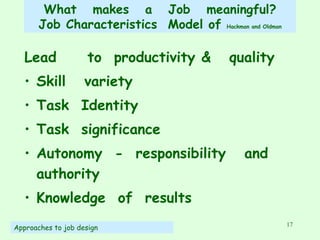
What  makes  a  Job  meaningful? Job Characteristics  Model of  Hackman and Oldman Lead  to  productivity &  quality Skill  variety Task  Identity Task  significance Autonomy  -  responsibility  and  authority Knowledge  of  results Approaches to job design
Approaches  to  job  design Job  rotation Job  enlargement Job enrichment  Empowerment Self  managing  teams AUTONOMOUS WORK GROUPS
Autonomous  Work  Groups  -  Self  Managing  Teams planning  work  /  Scheduling  work decide who  will  do  what controlling  scrap obtaining  supplies  complete  an  agreed  amount  of work often  -  responsibility  for  product  quality
SMTs Sundaram Fastners Split manufacturing  system  into  smaller  modules -  Zones of Autonomous  Production - AIM Enhancing  worker  skills Increasing  flexibility Telco -  automation has reduced all low end jobs.  Workers are now largely operate as self directed  teams and need less supervision
AUTONOMOUS  WORK  GROUPS at  DR  REDDY’S-  Human  Capital – Jan 2003 Experiment at one Formulations  Unit  Team  of  56  young  people (PUC) Structure Handholding  group  Executives – SMT  members Housekeeping  Personnel Responsibility  of  SMT – Maintenance, HR, Safety, Continuous /  process improvement  Was result  of  BPR Other  companies  using SMT
 
Other  Companies  that  use  SMT  Human  Capital – Jan 2003 EID  Parry Godrej Dupont Godrej (Mercury) Pepsi Barriers  to  implementing SMTs
Barriers  to  implementing  Autonomous  Work  Groups Training  Supervisor  resistance incompatible  systems  -  lack  of  planning lack  of  management  support  lack  of  union  support end
Intrinsic  Motivation feeling  of  having  accomplished  something worthwhile Satisfaction  from  doing  a  job  well Rewards  like More  responsibility Training  for  better  job  etc… Appreciation
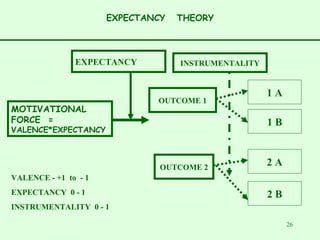
EXPECTANCY  THEORY MOTIVATIONAL FORCE  = VALENCE*EXPECTANCY OUTCOME 1 OUTCOME 2 2 B 2 A 1 B 1 A INSTRUMENTALITY EXPECTANCY VALENCE - +1  to  - 1 EXPECTANCY  0 - 1 INSTRUMENTALITY  0 - 1
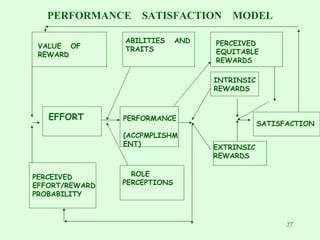
PERFORMANCE  SATISFACTION  MODEL INTRINSIC REWARDS VALUE  OF  REWARD EFFORT PERCEIVED  EFFORT/REWARD  PROBABILITY ROLE  PERCEPTIONS PERFORMANCE (ACCPMPLISHMENT) ABILITIES  AND TRAITS PERCEIVED EQUITABLE REWARDS EXTRINSIC REWARDS SATISFACTION
What Job Enrichment Means  freedom  to  Plan,   Implement  and  evaluate  work Direct  feedback client  relationships new  learning scheduling  own  work unique  experience control  over  resources direct  communication  authority personal  accountability
EMPOWERMENT Recognising  and  unleashing  power  of  individual  Knowledge  and  Internal  motivation Empowerment  requires authority  to  resolve  work  related  problems...
EMPOWERMENT  REQUIRES … commitment – part  of  a  larger  process Role  clarity - so you know what to delegate Suitable communications and co-ordinating  systems Huge  amounts of  training Some  issues  in  empowerment
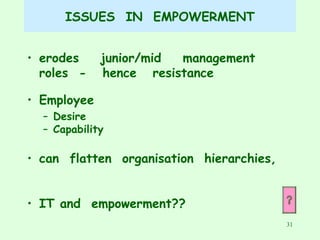
ISSUES  IN  EMPOWERMENT erodes  junior/mid  management  roles  -  hence  resistance Employee Desire Capability can  flatten  organisation  hierarchies,  IT and  empowerment??
 
 
From Dirxions Jan 2008 YES Bank says "Yes" to Red Box Rewards YES Bank has engaged Red Box Rewards to manage rewards to be given to its employees for exceptional sales performance. The program aims to recognize and reward consistently good performance among its sales staff and increase overall productivity. Reward items range from cars to motor-bikes and white goods such as air conditioners and DVD players.

Motivation

  • 1.
    Motivating Employees( Theory not covered here, but needed for exam) Strategies Incentive Schemes Job Enrichment - Empowerment
  • 2.
    MOTIVATION Revisiting motivation…Why bother ??? Attraction Development Contribution retention employee engagement...
  • 3.
    Employee Engagement“… emotional connection - an employee feels for organization that influences him or her to exert greater discretionary effort to work". Some Key drivers… easier for small companies...
  • 4.
    Some Key Drivers of EE common to many studies Trust and integrity – do managers communicate and 'walk the talk'. Nature of the job – mentally stimulating day-to-day? Line of sight between employee and company performance Career Growth opportunities Pride in company – Association with Co a source of Self Esteem Coworkers/team members Employee development Relationship with one's manager Consequences of EE – one study – highly engaged employees outperform disengaged by 2—28 % - one study Older emp – rewards and recognition
  • 5.
    MOTIVATION MUSINGSRole of unsatisfied needs Reward that satisfies (need) may be Intrinsic or Extrinsic Individuals are motivated differently Perceived Inequity can de-motivate Different forms of inequity
  • 6.
    Motivation MusingsImportance of creating valencies Importance of expectancies Importance of - ability - self efficacy Importance of role, task clarity Different Techniques - importance of money
  • 7.
    DOES MONEY MOTIVATE? Amount should be significant Motivating if rooted in performance The problem with money… indicates performance indicates appreciation
  • 8.
    The Problem with Money… Can create conflicts between employees between employees and organisation Between attainment of different goals Types of money incentives
  • 9.
    MONEY INCENTIVES MAY BE Individual or group White collar or blue collar Linked to output, Quality or any parameter that reflects a desired outcome
  • 10.
    INCENTIVES FOR OPERATIONS EMPLOYEES Straight piecework Proportionate Increasing rate Decreasing rate Guaranteed piecework Standard Hour Plans - incentive on time saved Problems with incentives no details required for exam
  • 11.
    PROBLEMS WITH INCENTIVES Erosion of standards / wrong standards allowances short ‘termism’ conflict with other goals variability in earnings conflicts  lack of team work require frequent review When not linked to the individual’s performance??? Other types of incentives
  • 12.
    OTHER KINDS OF INCENTIVES PERFORMANCE RELATED PAY SALES INCENTIVES EXECUTIVE BONUSES PROFIT SHARING GAIN SHARING SHARE AWARDS REFERAL / RETENTION BONUSES SKILL INCENTIVES QUALITY INCENTIVES Other motivational strategies
  • 13.
    SOME MOTIVATION STRATEGIES Incentives - cash/kind Status and benefits Leadership Security Congenial organisation climate Participation / Voice
  • 14.
    SOME MOTIVATION STRATEGIES Appreciation Enabling growth Training - Development stretch goals Flexibility Missions that motivate Job Design and Empowerment …
  • 15.
    JOB DESIGNThe specification of Contents Methods Relationships of jobs McJob??? What does job design include…
  • 16.
    JOB DESIGNTasks may be Wide or narrow Simple or complex Individual or group Methods Responsibilities Authority - how much freedom? Interactions - Relationships Feedback How to design a job to make it meaningful
  • 17.
    What makes a Job meaningful? Job Characteristics Model of Hackman and Oldman Lead to productivity & quality Skill variety Task Identity Task significance Autonomy - responsibility and authority Knowledge of results Approaches to job design
  • 18.
    Approaches to job design Job rotation Job enlargement Job enrichment Empowerment Self managing teams AUTONOMOUS WORK GROUPS
  • 19.
    Autonomous Work Groups - Self Managing Teams planning work / Scheduling work decide who will do what controlling scrap obtaining supplies complete an agreed amount of work often - responsibility for product quality
  • 20.
    SMTs Sundaram FastnersSplit manufacturing system into smaller modules - Zones of Autonomous Production - AIM Enhancing worker skills Increasing flexibility Telco - automation has reduced all low end jobs. Workers are now largely operate as self directed teams and need less supervision
  • 21.
    AUTONOMOUS WORK GROUPS at DR REDDY’S- Human Capital – Jan 2003 Experiment at one Formulations Unit Team of 56 young people (PUC) Structure Handholding group Executives – SMT members Housekeeping Personnel Responsibility of SMT – Maintenance, HR, Safety, Continuous / process improvement Was result of BPR Other companies using SMT
  • 22.
  • 23.
    Other Companies that use SMT Human Capital – Jan 2003 EID Parry Godrej Dupont Godrej (Mercury) Pepsi Barriers to implementing SMTs
  • 24.
    Barriers to implementing Autonomous Work Groups Training Supervisor resistance incompatible systems - lack of planning lack of management support lack of union support end
  • 25.
    Intrinsic Motivationfeeling of having accomplished something worthwhile Satisfaction from doing a job well Rewards like More responsibility Training for better job etc… Appreciation
  • 26.
    EXPECTANCY THEORYMOTIVATIONAL FORCE = VALENCE*EXPECTANCY OUTCOME 1 OUTCOME 2 2 B 2 A 1 B 1 A INSTRUMENTALITY EXPECTANCY VALENCE - +1 to - 1 EXPECTANCY 0 - 1 INSTRUMENTALITY 0 - 1
  • 27.
    PERFORMANCE SATISFACTION MODEL INTRINSIC REWARDS VALUE OF REWARD EFFORT PERCEIVED EFFORT/REWARD PROBABILITY ROLE PERCEPTIONS PERFORMANCE (ACCPMPLISHMENT) ABILITIES AND TRAITS PERCEIVED EQUITABLE REWARDS EXTRINSIC REWARDS SATISFACTION
  • 28.
    What Job EnrichmentMeans freedom to Plan, Implement and evaluate work Direct feedback client relationships new learning scheduling own work unique experience control over resources direct communication authority personal accountability
  • 29.
    EMPOWERMENT Recognising and unleashing power of individual Knowledge and Internal motivation Empowerment requires authority to resolve work related problems...
  • 30.
    EMPOWERMENT REQUIRES… commitment – part of a larger process Role clarity - so you know what to delegate Suitable communications and co-ordinating systems Huge amounts of training Some issues in empowerment
  • 31.
    ISSUES IN EMPOWERMENT erodes junior/mid management roles - hence resistance Employee Desire Capability can flatten organisation hierarchies, IT and empowerment??
  • 32.
  • 33.
  • 34.
    From Dirxions Jan2008 YES Bank says "Yes" to Red Box Rewards YES Bank has engaged Red Box Rewards to manage rewards to be given to its employees for exceptional sales performance. The program aims to recognize and reward consistently good performance among its sales staff and increase overall productivity. Reward items range from cars to motor-bikes and white goods such as air conditioners and DVD players.

Editor's Notes

  • #2 DNA 29/9/06 Sony India has lost a lot of its product managers. The alleged reason (apart from a buoyant job market) isa strong hierarchical culture exacerbated by the influx of Japanese maangers who have been placed in a new top management level. Thus the existing product heads, earlier reporting to the jap head of marketing now reports to a Jap manager who is part of this new level. It has blocked the growth of prospects of middle managers. From BT – 2006/07- Infy again a best place to work in While hr execs such as Maitra may have been able to meet with every employee a decade or more ago (when the workforce numbered just around 1,000), technology now helps them prepare individual career paths for Infoscions. "That's something that stands out for me about Infosys ," says Rai. "Employees can choose at what pace they want to run their career. I have chosen not to run at break-neck speed, but the company is okay with that." – she leaves for home at 6 pm- 32 year old Project Manager