3-1
Chapter 13Chapter 13
Capital BudgetingCapital Budgeting
TechniquesTechniques
Instructor: Ajab Khan Burki
3-2
Capital BudgetingCapital Budgeting
TechniquesTechniques
Project Evaluation and Selection
Potential Difficulties
Capital Rationing
Project Monitoring
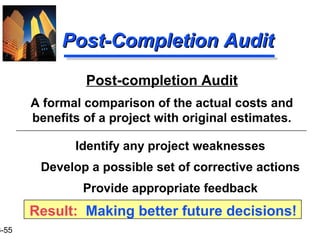
Post-Completion Audit
3-3
Project Evaluation:Project Evaluation:
Alternative MethodsAlternative Methods
Payback Period (PBP)
Internal Rate of Return (IRR)
Net Present Value (NPV)
Profitability Index (PI)
3-4
Proposed Project DataProposed Project Data
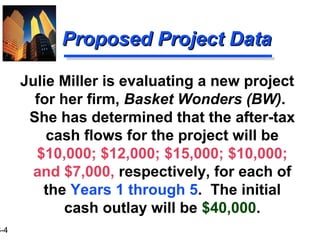
Julie Miller is evaluating a new project
for her firm, Basket Wonders (BW).
She has determined that the after-tax
cash flows for the project will be
$10,000; $12,000; $15,000; $10,000;
and $7,000, respectively, for each of
the Years 1 through 5. The initial
cash outlay will be $40,000.
3-5
Independent ProjectIndependent Project
IndependentIndependent -- A project whose
acceptance (or rejection) does not
prevent the acceptance of other
projects under consideration.
For this project, assume that it is
independent of any other potential
projects that Basket Wonders may
undertake.
3-6
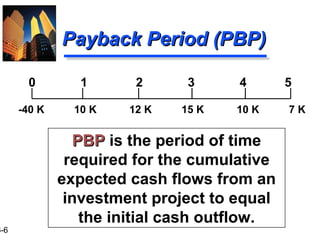
Payback Period (PBP)Payback Period (PBP)
PBPPBP is the period of time
required for the cumulative
expected cash flows from an
investment project to equal
the initial cash outflow.
PBPPBP is the period of time
required for the cumulative
expected cash flows from an
investment project to equal
the initial cash outflow.
0 1 2 3 4 5
-40 K 10 K 12 K 15 K 10 K 7 K
3-7
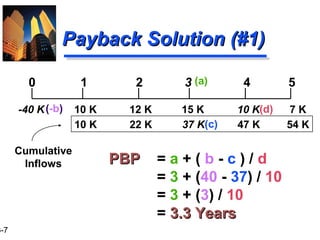
(c)10 K 22 K 37 K 47 K 54 K
Payback Solution (#1)Payback Solution (#1)
PBPPBP = a + ( b - c ) / d
= 3 + (40 - 37) / 10
= 3 + (3) / 10
= 3.3 Years3.3 Years
0 1 2 3 4 5
-40 K 10 K 12 K 15 K 10 K 7 K
Cumulative
Inflows
(a)
(-b) (d)
3-8
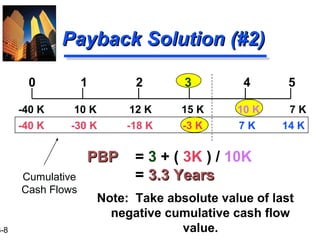
Payback Solution (#2)Payback Solution (#2)
PBPPBP = 3 + ( 3K ) / 10K
= 3.3 Years3.3 Years
Note: Take absolute value of last
negative cumulative cash flow
value.
Cumulative
Cash Flows
-40 K 10 K 12 K 15 K 10 K 7 K
0 1 2 3 4 5
-40 K -30 K -18 K -3 K 7 K 14 K
3-9
PBP Acceptance CriterionPBP Acceptance Criterion
Yes! The firm will receive back the
initial cash outlay in less than 3.5
years. [3.3 Years < 3.5 Year Max.]
The management of Basket Wonders
has set a maximum PBP of 3.5
years for projects of this type.
Should this project be accepted?
3-10
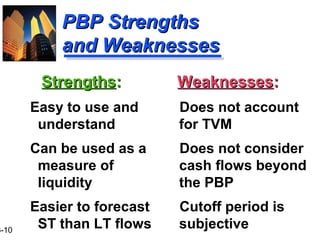
PBP StrengthsPBP Strengths
and Weaknessesand Weaknesses
StrengthsStrengths::
Easy to use and
understand
Can be used as a
measure of
liquidity
Easier to forecast
ST than LT flows
WeaknessesWeaknesses::
Does not account
for TVM
Does not consider
cash flows beyond
the PBP
Cutoff period is
subjective
3-11
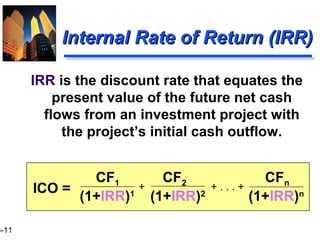
Internal Rate of Return (IRR)Internal Rate of Return (IRR)
IRR is the discount rate that equates the
present value of the future net cash
flows from an investment project with
the project’s initial cash outflow.
CF1 CF2 CFn
(1+IRR)1
(1+IRR)2
(1+IRR)n
+ . . . ++ICO =
3-12
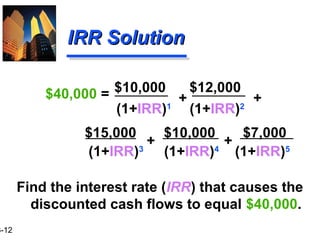
$15,000 $10,000 $7,000
IRR SolutionIRR Solution
$10,000 $12,000
(1+IRR)1
(1+IRR)2
Find the interest rate (IRR) that causes the
discounted cash flows to equal $40,000.
+ +
++$40,000 =
(1+IRR)3
(1+IRR)4
(1+IRR)5
3-13
IRR Solution (Try 10%)IRR Solution (Try 10%)
$40,000$40,000 = $10,000(PVIF10%,1) + $12,000(PVIF10%,2) +
$15,000(PVIF10%,3) + $10,000(PVIF10%,4) + $
7,000(PVIF10%,5)
$40,000$40,000 = $10,000(.909) + $12,000(.826) +
$15,000(.751) + $10,000(.683) +
$ 7,000(.621)
$40,000$40,000 = $9,090 + $9,912 + $11,265 +
$6,830 + $4,347
= $41,444$41,444 [[Rate is too low!!Rate is too low!!]]
3-14
IRR Solution (Try 15%)IRR Solution (Try 15%)
$40,000$40,000 = $10,000(PVIF15%,1) + $12,000(PVIF15%,2) +
$15,000(PVIF15%,3) + $10,000(PVIF15%,4) + $
7,000(PVIF15%,5)
$40,000$40,000 = $10,000(.870) + $12,000(.756) +
$15,000(.658) + $10,000(.572) +
$ 7,000(.497)
$40,000$40,000 = $8,700 + $9,072 + $9,870 +
$5,720 + $3,479
= $36,841$36,841 [[Rate is too high!!Rate is too high!!]]
3-15
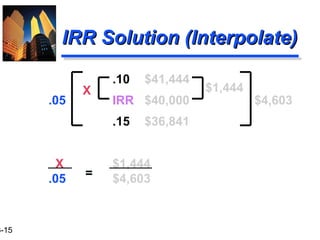
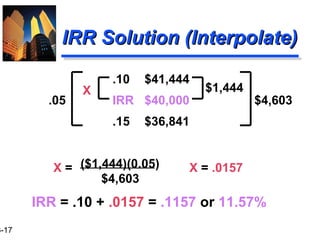
.10 $41,444
.05 IRR $40,000 $4,603
.15 $36,841
X $1,444
.05 $4,603
IRR Solution (Interpolate)IRR Solution (Interpolate)
$1,444X
=
3-16
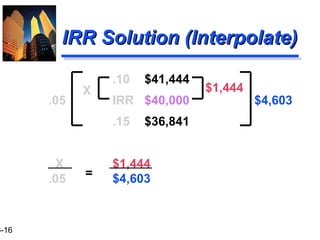
.10 $41,444
.05 IRR $40,000 $4,603
.15 $36,841
X $1,444
.05 $4,603
IRR Solution (Interpolate)IRR Solution (Interpolate)
$1,444X
=
3-17
.10 $41,444
.05 IRR $40,000 $4,603
.15 $36,841
($1,444)(0.05)
$4,603
IRR Solution (Interpolate)IRR Solution (Interpolate)
$1,444X
X = X = .0157
IRR = .10 + .0157 = .1157 or 11.57%
3-18
IRR Acceptance CriterionIRR Acceptance Criterion
No! The firm will receive 11.57% for
each dollar invested in this project at
a cost of 13%. [ IRR < Hurdle Rate ]
The management of Basket Wonders
has determined that the hurdle rate
is 13% for projects of this type.
Should this project be accepted?
3-19
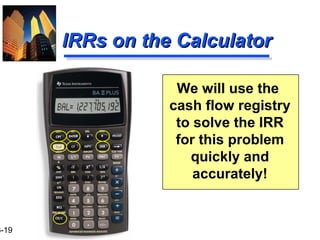
IRRs on the CalculatorIRRs on the Calculator
We will use the
cash flow registry
to solve the IRR
for this problem
quickly and
accurately!
3-20
Actual IRR Solution UsingActual IRR Solution Using
Your Financial CalculatorYour Financial Calculator
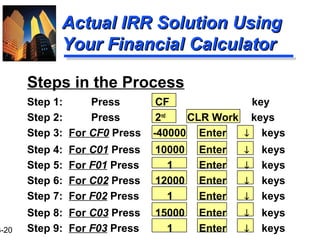
Steps in the Process
Step 1: Press CF key
Step 2: Press 2nd
CLR Work keys
Step 3: For CF0 Press -40000 Enter ↓ keys
Step 4: For C01 Press 10000 Enter ↓ keys
Step 5: For F01 Press 1 Enter ↓ keys
Step 6: For C02 Press 12000 Enter ↓ keys
Step 7: For F02 Press 1 Enter ↓ keys
Step 8: For C03 Press 15000 Enter ↓ keys
Step 9: For F03 Press 1 Enter ↓ keys
3-21
Actual IRR Solution UsingActual IRR Solution Using
Your Financial CalculatorYour Financial Calculator
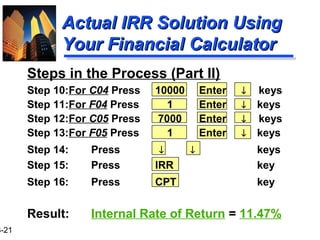
Steps in the Process (Part II)
Step 10:For C04 Press 10000 Enter ↓ keys
Step 11:For F04 Press 1 Enter ↓ keys
Step 12:For C05 Press 7000 Enter ↓ keys
Step 13:For F05 Press 1 Enter ↓ keys
Step 14: Press ↓ ↓ keys
Step 15: Press IRR key
Step 16: Press CPT key
Result: Internal Rate of Return = 11.47%
3-22
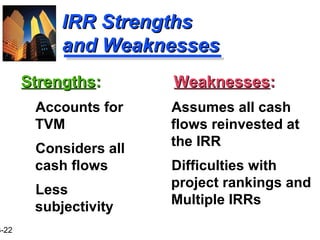
IRR StrengthsIRR Strengths
and Weaknessesand Weaknesses
StrengthsStrengths::
Accounts for
TVM
Considers all
cash flows
Less
subjectivity
WeaknessesWeaknesses::
Assumes all cash
flows reinvested at
the IRR
Difficulties with
project rankings and
Multiple IRRs
3-23
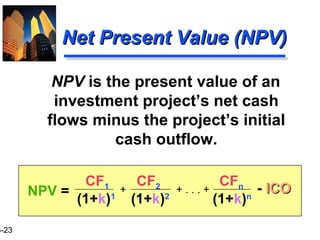
Net Present Value (NPV)Net Present Value (NPV)
NPV is the present value of an
investment project’s net cash
flows minus the project’s initial
cash outflow.
CF1 CF2 CFn
(1+k)1
(1+k)2
(1+k)n
+ . . . ++ - ICOICONPV =
3-24
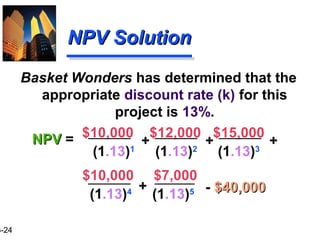
Basket Wonders has determined that the
appropriate discount rate (k) for this
project is 13%.
$10,000 $7,000
NPV SolutionNPV Solution
$10,000 $12,000 $15,000
(1.13)1
(1.13)2
(1.13)3
+ +
+ - $40,000$40,000(1.13)4
(1.13)5
NPVNPV = +
3-25
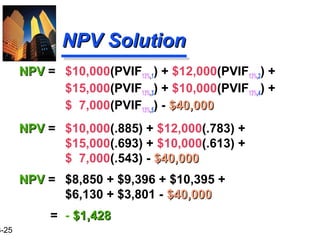
NPV SolutionNPV Solution
NPVNPV = $10,000(PVIF13%,1) + $12,000(PVIF13%,2) +
$15,000(PVIF13%,3) + $10,000(PVIF13%,4) +
$ 7,000(PVIF13%,5) - $40,000$40,000
NPVNPV = $10,000(.885) + $12,000(.783) +
$15,000(.693) + $10,000(.613) +
$ 7,000(.543) - $40,000$40,000
NPVNPV = $8,850 + $9,396 + $10,395 +
$6,130 + $3,801 - $40,000$40,000
= - $1,428$1,428
3-26
NPV Acceptance CriterionNPV Acceptance Criterion
No! The NPV is negative. This means
that the project is reducing shareholder
wealth. [RejectReject as NPVNPV < 00 ]
The management of Basket Wonders
has determined that the required
rate is 13% for projects of this type.
Should this project be accepted?
3-27
NPV on the CalculatorNPV on the Calculator
We will use the cash
flow registry to solve
the NPV for this
problem quickly and
accurately!
Hint: If you have not
cleared the cash flows
from your calculator, then
you may skip to Step 15.
3-28
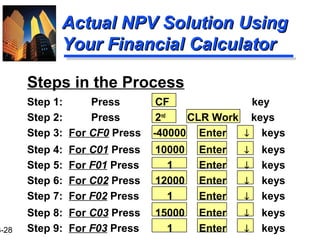
Actual NPV Solution UsingActual NPV Solution Using
Your Financial CalculatorYour Financial Calculator
Steps in the Process
Step 1: Press CF key
Step 2: Press 2nd
CLR Work keys
Step 3: For CF0 Press -40000 Enter ↓ keys
Step 4: For C01 Press 10000 Enter ↓ keys
Step 5: For F01 Press 1 Enter ↓ keys
Step 6: For C02 Press 12000 Enter ↓ keys
Step 7: For F02 Press 1 Enter ↓ keys
Step 8: For C03 Press 15000 Enter ↓ keys
Step 9: For F03 Press 1 Enter ↓ keys
3-29
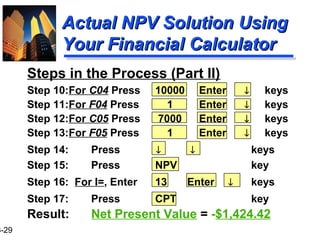
Steps in the Process (Part II)
Step 10:For C04 Press 10000 Enter ↓ keys
Step 11:For F04 Press 1 Enter ↓ keys
Step 12:For C05 Press 7000 Enter ↓ keys
Step 13:For F05 Press 1 Enter ↓ keys
Step 14: Press ↓ ↓ keys
Step 15: Press NPV key
Step 16: For I=, Enter 13 Enter ↓ keys
Step 17: Press CPT key
Result: Net Present Value = -$1,424.42
Actual NPV Solution UsingActual NPV Solution Using
Your Financial CalculatorYour Financial Calculator
3-30
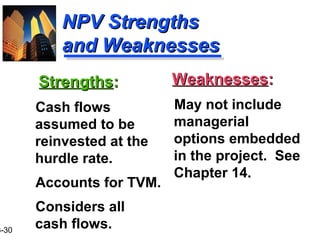
NPV StrengthsNPV Strengths
and Weaknessesand Weaknesses
StrengthsStrengths::
Cash flows
assumed to be
reinvested at the
hurdle rate.
Accounts for TVM.
Considers all
cash flows.
WeaknessesWeaknesses::
May not include
managerial
options embedded
in the project. See
Chapter 14.
3-31
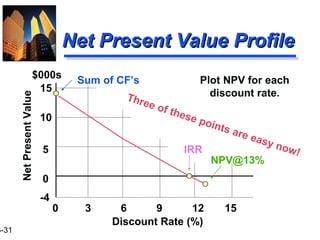
Net Present Value ProfileNet Present Value Profile
Discount Rate (%)
0 3 6 9 12 15
IRR
NPV@13%
Sum of CF’s Plot NPV for each
discount rate.Three of these points are easy now!
NetPresentValue
$000s
15
10
5
0
-4
3-32
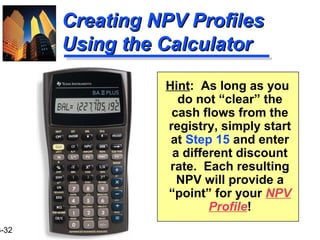
Creating NPV ProfilesCreating NPV Profiles
Using the CalculatorUsing the Calculator
Hint: As long as you
do not “clear” the
cash flows from the
registry, simply start
at Step 15 and enter
a different discount
rate. Each resulting
NPV will provide a
“point” for your NPV
Profile!
3-33
Profitability Index (PI)Profitability Index (PI)
PI is the ratio of the present value of
a project’s future net cash flows to
the project’s initial cash outflow.
CF1 CF2 CFn
(1+k)1
(1+k)2
(1+k)n
+ . . . ++ ICOICOPI =
PI = 1 + [ NPVNPV / ICOICO ]
<< OR >>
3-34
PI Acceptance CriterionPI Acceptance Criterion
No! The PIPI is less than 1.00. This
means that the project is not profitable.
[RejectReject as PIPI < 1.001.00 ]
PIPI = $38,572 / $40,000
= .9643 (Method #1, 13-33)
Should this project be accepted?
3-35
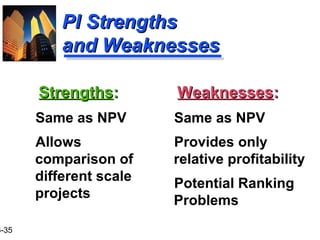
PI StrengthsPI Strengths
and Weaknessesand Weaknesses
StrengthsStrengths::
Same as NPV
Allows
comparison of
different scale
projects
WeaknessesWeaknesses::
Same as NPV
Provides only
relative profitability
Potential Ranking
Problems
3-36
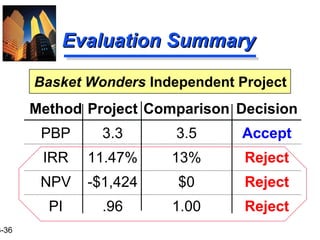
Evaluation SummaryEvaluation Summary
Method Project Comparison Decision
PBP 3.3 3.5 Accept
IRR 11.47% 13% Reject
NPV -$1,424 $0 Reject
PI .96 1.00 Reject
Basket Wonders Independent Project
3-37
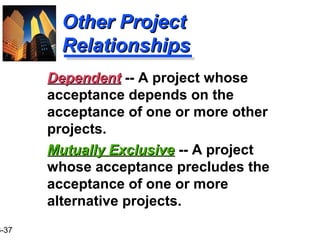
Other ProjectOther Project
RelationshipsRelationships
Mutually ExclusiveMutually Exclusive -- A project
whose acceptance precludes the
acceptance of one or more
alternative projects.
DependentDependent -- A project whose
acceptance depends on the
acceptance of one or more other
projects.
3-38
Potential ProblemsPotential Problems
Under Mutual ExclusivityUnder Mutual Exclusivity
A. Scale of InvestmentA. Scale of Investment
B. Cash-flow PatternB. Cash-flow Pattern
C. Project LifeC. Project Life
Ranking of project proposals may
create contradictory results.
3-39
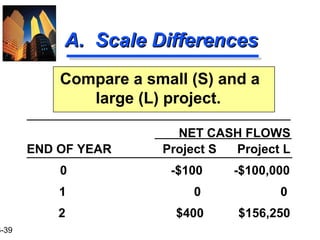
A. Scale DifferencesA. Scale Differences
Compare a small (S) and a
large (L) project.
NET CASH FLOWS
Project S Project LEND OF YEAR
0 -$100 -$100,000
1 0 0
2 $400 $156,250
3-40
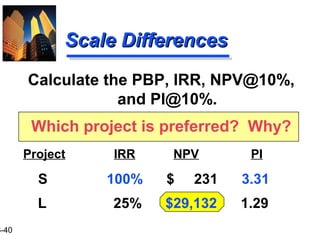
Scale DifferencesScale Differences
Calculate the PBP, IRR, NPV@10%,
and PI@10%.
Which project is preferred? Why?
Project IRR NPV PI
S 100% $ 231 3.31
L 25% $29,132 1.29
3-41
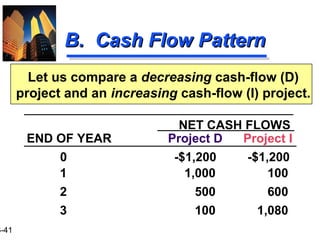
B. Cash Flow PatternB. Cash Flow Pattern
Let us compare a decreasing cash-flow (D)
project and an increasing cash-flow (I) project.
NET CASH FLOWS
Project D Project IEND OF YEAR
0 -$1,200 -$1,200
1 1,000 100
2 500 600
3 100 1,080
3-42
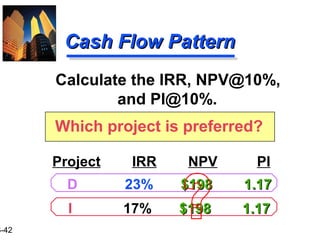
D 23% $198 1.17$198 1.17
I 17% $198 1.17$198 1.17
Cash Flow PatternCash Flow Pattern
Calculate the IRR, NPV@10%,
and PI@10%.
Which project is preferred?
Project IRR NPV PI
3-43
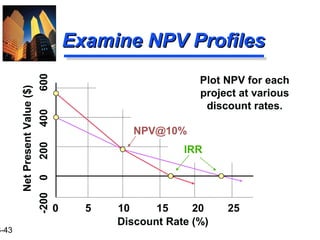
Examine NPV ProfilesExamine NPV Profiles
Discount Rate (%)
0 5 10 15 20 25
-2000200400600
IRR
NPV@10%
Plot NPV for each
project at various
discount rates.
NetPresentValue($)
3-44
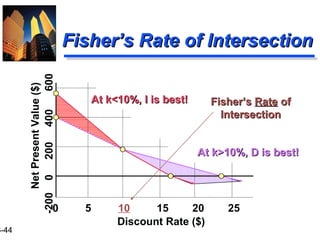
Fisher’s Rate of IntersectionFisher’s Rate of Intersection
Discount Rate ($)
0 5 10 15 20 25
-2000200400600
NetPresentValue($)
At k<10%, I is best!At k<10%, I is best! Fisher’sFisher’s RateRate ofof
IntersectionIntersection
At k>10%, D is best!At k>10%, D is best!
3-45
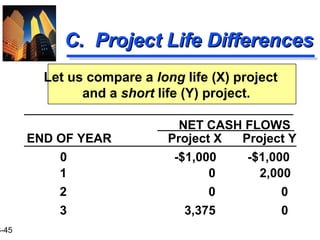
C. Project Life DifferencesC. Project Life Differences
Let us compare a long life (X) project
and a short life (Y) project.
NET CASH FLOWS
Project X Project YEND OF YEAR
0 -$1,000 -$1,000
1 0 2,000
2 0 0
3 3,375 0
3-46
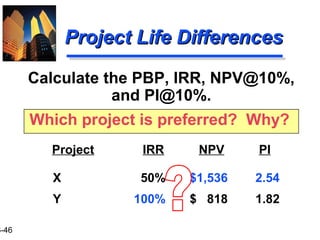
X 50% $1,536 2.54
Y 100% $ 818 1.82
Project Life DifferencesProject Life Differences
Calculate the PBP, IRR, NPV@10%,
and PI@10%.
Which project is preferred? Why?
Project IRR NPV PI
3-47
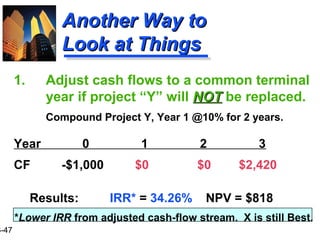
Another Way toAnother Way to
Look at ThingsLook at Things
1. Adjust cash flows to a common terminal
year if project “Y” will NOTNOT be replaced.
Compound Project Y, Year 1 @10% for 2 years.
Year 0 1 2 3
CF -$1,000 $0 $0 $2,420
Results: IRR* = 34.26% NPV = $818
*Lower IRR from adjusted cash-flow stream. X is still Best.
3-48
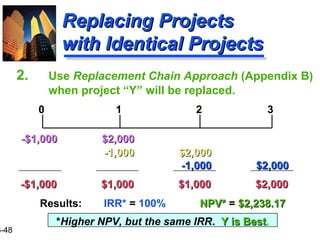
Replacing ProjectsReplacing Projects
with Identical Projectswith Identical Projects
2. Use Replacement Chain Approach (Appendix B)
when project “Y” will be replaced.
0 1 2 3
-$1,000 $2,000-$1,000 $2,000
-1,000 $2,000-1,000 $2,000
-1,000 $2,000-1,000 $2,000
-$1,000 $1,000 $1,000 $2,000-$1,000 $1,000 $1,000 $2,000
Results: IRR* = 100% NPV*NPV* = $2,238.17$2,238.17
*Higher NPV, but the same IRR. Y is BestY is Best.
3-49
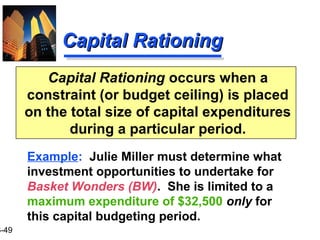
Capital RationingCapital Rationing
Capital Rationing occurs when a
constraint (or budget ceiling) is placed
on the total size of capital expenditures
during a particular period.
Example: Julie Miller must determine what
investment opportunities to undertake for
Basket Wonders (BW). She is limited to a
maximum expenditure of $32,500 only for
this capital budgeting period.
3-50
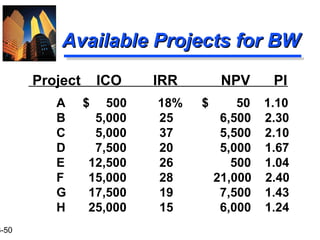
Available Projects for BWAvailable Projects for BW
Project ICO IRR NPV PI
A $ 500 18% $ 50 1.10
B 5,000 25 6,500 2.30
C 5,000 37 5,500 2.10
D 7,500 20 5,000 1.67
E 12,500 26 500 1.04
F 15,000 28 21,000 2.40
G 17,500 19 7,500 1.43
H 25,000 15 6,000 1.24
3-51
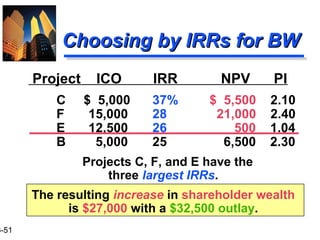
Choosing by IRRs for BWChoosing by IRRs for BW
Project ICO IRR NPV PI
C $ 5,000 37% $ 5,500 2.10
F 15,000 28 21,000 2.40
E 12,500 26 500 1.04
B 5,000 25 6,500 2.30
Projects C, F, and E have the
three largest IRRs.
The resulting increase in shareholder wealth
is $27,000 with a $32,500 outlay.
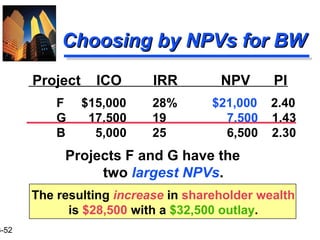
3-52
Choosing by NPVs for BWChoosing by NPVs for BW
Project ICO IRR NPV PI
F $15,000 28% $21,000 2.40
G 17,500 19 7,500 1.43
B 5,000 25 6,500 2.30
Projects F and G have the
two largest NPVs.
The resulting increase in shareholder wealth
is $28,500 with a $32,500 outlay.
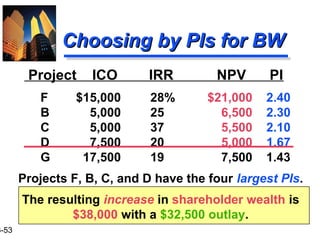
3-53
Choosing by PIs for BWChoosing by PIs for BW
Project ICO IRR NPV PI
F $15,000 28% $21,000 2.40
B 5,000 25 6,500 2.30
C 5,000 37 5,500 2.10
D 7,500 20 5,000 1.67
G 17,500 19 7,500 1.43
Projects F, B, C, and D have the four largest PIs.
The resulting increase in shareholder wealth is
$38,000 with a $32,500 outlay.
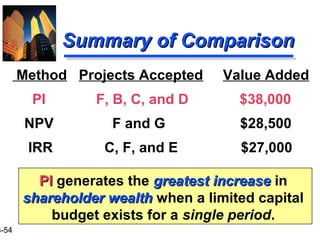
3-54
Summary of ComparisonSummary of Comparison
Method Projects Accepted Value Added
PI F, B, C, and D $38,000
NPV F and G $28,500
IRR C, F, and E $27,000
PIPI generates the greatestgreatest increaseincrease in
shareholder wealthshareholder wealth when a limited capital
budget exists for a single period.
3-55
Post-Completion AuditPost-Completion Audit
Post-completion Audit
A formal comparison of the actual costs and
benefits of a project with original estimates.
Identify any project weaknesses
Develop a possible set of corrective actions
Provide appropriate feedback
Result: Making better future decisions!
3-56
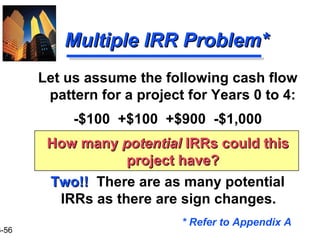
Multiple IRR Problem*Multiple IRR Problem*
Two!!Two!! There are as many potential
IRRs as there are sign changes.
Let us assume the following cash flow
pattern for a project for Years 0 to 4:
-$100 +$100 +$900 -$1,000
How manyHow many potentialpotential IRRs could thisIRRs could this
project have?project have?
* Refer to Appendix A
3-57
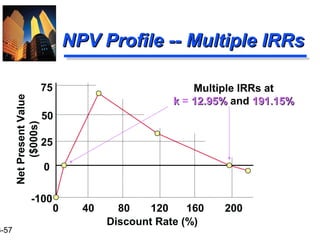
NPV Profile -- Multiple IRRsNPV Profile -- Multiple IRRs
Discount Rate (%)
0 40 80 120 160 200
NetPresentValue
($000s)
Multiple IRRs at
kk = 12.95%12.95% and 191.15%191.15%
75
50
25
0
-100
3-58
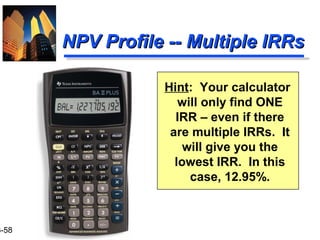
NPV Profile -- Multiple IRRsNPV Profile -- Multiple IRRs
Hint: Your calculator
will only find ONE
IRR – even if there
are multiple IRRs. It
will give you the
lowest IRR. In this
case, 12.95%.

Financial Management Slides Ch 13

  • 1.
    3-1 Chapter 13Chapter 13 CapitalBudgetingCapital Budgeting TechniquesTechniques Instructor: Ajab Khan Burki
  • 2.
    3-2 Capital BudgetingCapital Budgeting TechniquesTechniques ProjectEvaluation and Selection Potential Difficulties Capital Rationing Project Monitoring Post-Completion Audit
  • 3.
    3-3 Project Evaluation:Project Evaluation: AlternativeMethodsAlternative Methods Payback Period (PBP) Internal Rate of Return (IRR) Net Present Value (NPV) Profitability Index (PI)
  • 4.
    3-4 Proposed Project DataProposedProject Data Julie Miller is evaluating a new project for her firm, Basket Wonders (BW). She has determined that the after-tax cash flows for the project will be $10,000; $12,000; $15,000; $10,000; and $7,000, respectively, for each of the Years 1 through 5. The initial cash outlay will be $40,000.
  • 5.
    3-5 Independent ProjectIndependent Project IndependentIndependent-- A project whose acceptance (or rejection) does not prevent the acceptance of other projects under consideration. For this project, assume that it is independent of any other potential projects that Basket Wonders may undertake.
  • 6.
    3-6 Payback Period (PBP)PaybackPeriod (PBP) PBPPBP is the period of time required for the cumulative expected cash flows from an investment project to equal the initial cash outflow. PBPPBP is the period of time required for the cumulative expected cash flows from an investment project to equal the initial cash outflow. 0 1 2 3 4 5 -40 K 10 K 12 K 15 K 10 K 7 K
  • 7.
    3-7 (c)10 K 22K 37 K 47 K 54 K Payback Solution (#1)Payback Solution (#1) PBPPBP = a + ( b - c ) / d = 3 + (40 - 37) / 10 = 3 + (3) / 10 = 3.3 Years3.3 Years 0 1 2 3 4 5 -40 K 10 K 12 K 15 K 10 K 7 K Cumulative Inflows (a) (-b) (d)
  • 8.
    3-8 Payback Solution (#2)PaybackSolution (#2) PBPPBP = 3 + ( 3K ) / 10K = 3.3 Years3.3 Years Note: Take absolute value of last negative cumulative cash flow value. Cumulative Cash Flows -40 K 10 K 12 K 15 K 10 K 7 K 0 1 2 3 4 5 -40 K -30 K -18 K -3 K 7 K 14 K
  • 9.
    3-9 PBP Acceptance CriterionPBPAcceptance Criterion Yes! The firm will receive back the initial cash outlay in less than 3.5 years. [3.3 Years < 3.5 Year Max.] The management of Basket Wonders has set a maximum PBP of 3.5 years for projects of this type. Should this project be accepted?
  • 10.
    3-10 PBP StrengthsPBP Strengths andWeaknessesand Weaknesses StrengthsStrengths:: Easy to use and understand Can be used as a measure of liquidity Easier to forecast ST than LT flows WeaknessesWeaknesses:: Does not account for TVM Does not consider cash flows beyond the PBP Cutoff period is subjective
  • 11.
    3-11 Internal Rate ofReturn (IRR)Internal Rate of Return (IRR) IRR is the discount rate that equates the present value of the future net cash flows from an investment project with the project’s initial cash outflow. CF1 CF2 CFn (1+IRR)1 (1+IRR)2 (1+IRR)n + . . . ++ICO =
  • 12.
    3-12 $15,000 $10,000 $7,000 IRRSolutionIRR Solution $10,000 $12,000 (1+IRR)1 (1+IRR)2 Find the interest rate (IRR) that causes the discounted cash flows to equal $40,000. + + ++$40,000 = (1+IRR)3 (1+IRR)4 (1+IRR)5
  • 13.
    3-13 IRR Solution (Try10%)IRR Solution (Try 10%) $40,000$40,000 = $10,000(PVIF10%,1) + $12,000(PVIF10%,2) + $15,000(PVIF10%,3) + $10,000(PVIF10%,4) + $ 7,000(PVIF10%,5) $40,000$40,000 = $10,000(.909) + $12,000(.826) + $15,000(.751) + $10,000(.683) + $ 7,000(.621) $40,000$40,000 = $9,090 + $9,912 + $11,265 + $6,830 + $4,347 = $41,444$41,444 [[Rate is too low!!Rate is too low!!]]
  • 14.
    3-14 IRR Solution (Try15%)IRR Solution (Try 15%) $40,000$40,000 = $10,000(PVIF15%,1) + $12,000(PVIF15%,2) + $15,000(PVIF15%,3) + $10,000(PVIF15%,4) + $ 7,000(PVIF15%,5) $40,000$40,000 = $10,000(.870) + $12,000(.756) + $15,000(.658) + $10,000(.572) + $ 7,000(.497) $40,000$40,000 = $8,700 + $9,072 + $9,870 + $5,720 + $3,479 = $36,841$36,841 [[Rate is too high!!Rate is too high!!]]
  • 15.
    3-15 .10 $41,444 .05 IRR$40,000 $4,603 .15 $36,841 X $1,444 .05 $4,603 IRR Solution (Interpolate)IRR Solution (Interpolate) $1,444X =
  • 16.
    3-16 .10 $41,444 .05 IRR$40,000 $4,603 .15 $36,841 X $1,444 .05 $4,603 IRR Solution (Interpolate)IRR Solution (Interpolate) $1,444X =
  • 17.
    3-17 .10 $41,444 .05 IRR$40,000 $4,603 .15 $36,841 ($1,444)(0.05) $4,603 IRR Solution (Interpolate)IRR Solution (Interpolate) $1,444X X = X = .0157 IRR = .10 + .0157 = .1157 or 11.57%
  • 18.
    3-18 IRR Acceptance CriterionIRRAcceptance Criterion No! The firm will receive 11.57% for each dollar invested in this project at a cost of 13%. [ IRR < Hurdle Rate ] The management of Basket Wonders has determined that the hurdle rate is 13% for projects of this type. Should this project be accepted?
  • 19.
    3-19 IRRs on theCalculatorIRRs on the Calculator We will use the cash flow registry to solve the IRR for this problem quickly and accurately!
  • 20.
    3-20 Actual IRR SolutionUsingActual IRR Solution Using Your Financial CalculatorYour Financial Calculator Steps in the Process Step 1: Press CF key Step 2: Press 2nd CLR Work keys Step 3: For CF0 Press -40000 Enter ↓ keys Step 4: For C01 Press 10000 Enter ↓ keys Step 5: For F01 Press 1 Enter ↓ keys Step 6: For C02 Press 12000 Enter ↓ keys Step 7: For F02 Press 1 Enter ↓ keys Step 8: For C03 Press 15000 Enter ↓ keys Step 9: For F03 Press 1 Enter ↓ keys
  • 21.
    3-21 Actual IRR SolutionUsingActual IRR Solution Using Your Financial CalculatorYour Financial Calculator Steps in the Process (Part II) Step 10:For C04 Press 10000 Enter ↓ keys Step 11:For F04 Press 1 Enter ↓ keys Step 12:For C05 Press 7000 Enter ↓ keys Step 13:For F05 Press 1 Enter ↓ keys Step 14: Press ↓ ↓ keys Step 15: Press IRR key Step 16: Press CPT key Result: Internal Rate of Return = 11.47%
  • 22.
    3-22 IRR StrengthsIRR Strengths andWeaknessesand Weaknesses StrengthsStrengths:: Accounts for TVM Considers all cash flows Less subjectivity WeaknessesWeaknesses:: Assumes all cash flows reinvested at the IRR Difficulties with project rankings and Multiple IRRs
  • 23.
    3-23 Net Present Value(NPV)Net Present Value (NPV) NPV is the present value of an investment project’s net cash flows minus the project’s initial cash outflow. CF1 CF2 CFn (1+k)1 (1+k)2 (1+k)n + . . . ++ - ICOICONPV =
  • 24.
    3-24 Basket Wonders hasdetermined that the appropriate discount rate (k) for this project is 13%. $10,000 $7,000 NPV SolutionNPV Solution $10,000 $12,000 $15,000 (1.13)1 (1.13)2 (1.13)3 + + + - $40,000$40,000(1.13)4 (1.13)5 NPVNPV = +
  • 25.
    3-25 NPV SolutionNPV Solution NPVNPV= $10,000(PVIF13%,1) + $12,000(PVIF13%,2) + $15,000(PVIF13%,3) + $10,000(PVIF13%,4) + $ 7,000(PVIF13%,5) - $40,000$40,000 NPVNPV = $10,000(.885) + $12,000(.783) + $15,000(.693) + $10,000(.613) + $ 7,000(.543) - $40,000$40,000 NPVNPV = $8,850 + $9,396 + $10,395 + $6,130 + $3,801 - $40,000$40,000 = - $1,428$1,428
  • 26.
    3-26 NPV Acceptance CriterionNPVAcceptance Criterion No! The NPV is negative. This means that the project is reducing shareholder wealth. [RejectReject as NPVNPV < 00 ] The management of Basket Wonders has determined that the required rate is 13% for projects of this type. Should this project be accepted?
  • 27.
    3-27 NPV on theCalculatorNPV on the Calculator We will use the cash flow registry to solve the NPV for this problem quickly and accurately! Hint: If you have not cleared the cash flows from your calculator, then you may skip to Step 15.
  • 28.
    3-28 Actual NPV SolutionUsingActual NPV Solution Using Your Financial CalculatorYour Financial Calculator Steps in the Process Step 1: Press CF key Step 2: Press 2nd CLR Work keys Step 3: For CF0 Press -40000 Enter ↓ keys Step 4: For C01 Press 10000 Enter ↓ keys Step 5: For F01 Press 1 Enter ↓ keys Step 6: For C02 Press 12000 Enter ↓ keys Step 7: For F02 Press 1 Enter ↓ keys Step 8: For C03 Press 15000 Enter ↓ keys Step 9: For F03 Press 1 Enter ↓ keys
  • 29.
    3-29 Steps in theProcess (Part II) Step 10:For C04 Press 10000 Enter ↓ keys Step 11:For F04 Press 1 Enter ↓ keys Step 12:For C05 Press 7000 Enter ↓ keys Step 13:For F05 Press 1 Enter ↓ keys Step 14: Press ↓ ↓ keys Step 15: Press NPV key Step 16: For I=, Enter 13 Enter ↓ keys Step 17: Press CPT key Result: Net Present Value = -$1,424.42 Actual NPV Solution UsingActual NPV Solution Using Your Financial CalculatorYour Financial Calculator
  • 30.
    3-30 NPV StrengthsNPV Strengths andWeaknessesand Weaknesses StrengthsStrengths:: Cash flows assumed to be reinvested at the hurdle rate. Accounts for TVM. Considers all cash flows. WeaknessesWeaknesses:: May not include managerial options embedded in the project. See Chapter 14.
  • 31.
    3-31 Net Present ValueProfileNet Present Value Profile Discount Rate (%) 0 3 6 9 12 15 IRR NPV@13% Sum of CF’s Plot NPV for each discount rate.Three of these points are easy now! NetPresentValue $000s 15 10 5 0 -4
  • 32.
    3-32 Creating NPV ProfilesCreatingNPV Profiles Using the CalculatorUsing the Calculator Hint: As long as you do not “clear” the cash flows from the registry, simply start at Step 15 and enter a different discount rate. Each resulting NPV will provide a “point” for your NPV Profile!
  • 33.
    3-33 Profitability Index (PI)ProfitabilityIndex (PI) PI is the ratio of the present value of a project’s future net cash flows to the project’s initial cash outflow. CF1 CF2 CFn (1+k)1 (1+k)2 (1+k)n + . . . ++ ICOICOPI = PI = 1 + [ NPVNPV / ICOICO ] << OR >>
  • 34.
    3-34 PI Acceptance CriterionPIAcceptance Criterion No! The PIPI is less than 1.00. This means that the project is not profitable. [RejectReject as PIPI < 1.001.00 ] PIPI = $38,572 / $40,000 = .9643 (Method #1, 13-33) Should this project be accepted?
  • 35.
    3-35 PI StrengthsPI Strengths andWeaknessesand Weaknesses StrengthsStrengths:: Same as NPV Allows comparison of different scale projects WeaknessesWeaknesses:: Same as NPV Provides only relative profitability Potential Ranking Problems
  • 36.
    3-36 Evaluation SummaryEvaluation Summary MethodProject Comparison Decision PBP 3.3 3.5 Accept IRR 11.47% 13% Reject NPV -$1,424 $0 Reject PI .96 1.00 Reject Basket Wonders Independent Project
  • 37.
    3-37 Other ProjectOther Project RelationshipsRelationships MutuallyExclusiveMutually Exclusive -- A project whose acceptance precludes the acceptance of one or more alternative projects. DependentDependent -- A project whose acceptance depends on the acceptance of one or more other projects.
  • 38.
    3-38 Potential ProblemsPotential Problems UnderMutual ExclusivityUnder Mutual Exclusivity A. Scale of InvestmentA. Scale of Investment B. Cash-flow PatternB. Cash-flow Pattern C. Project LifeC. Project Life Ranking of project proposals may create contradictory results.
  • 39.
    3-39 A. Scale DifferencesA.Scale Differences Compare a small (S) and a large (L) project. NET CASH FLOWS Project S Project LEND OF YEAR 0 -$100 -$100,000 1 0 0 2 $400 $156,250
  • 40.
    3-40 Scale DifferencesScale Differences Calculatethe PBP, IRR, NPV@10%, and PI@10%. Which project is preferred? Why? Project IRR NPV PI S 100% $ 231 3.31 L 25% $29,132 1.29
  • 41.
    3-41 B. Cash FlowPatternB. Cash Flow Pattern Let us compare a decreasing cash-flow (D) project and an increasing cash-flow (I) project. NET CASH FLOWS Project D Project IEND OF YEAR 0 -$1,200 -$1,200 1 1,000 100 2 500 600 3 100 1,080
  • 42.
    3-42 D 23% $1981.17$198 1.17 I 17% $198 1.17$198 1.17 Cash Flow PatternCash Flow Pattern Calculate the IRR, NPV@10%, and PI@10%. Which project is preferred? Project IRR NPV PI
  • 43.
    3-43 Examine NPV ProfilesExamineNPV Profiles Discount Rate (%) 0 5 10 15 20 25 -2000200400600 IRR NPV@10% Plot NPV for each project at various discount rates. NetPresentValue($)
  • 44.
    3-44 Fisher’s Rate ofIntersectionFisher’s Rate of Intersection Discount Rate ($) 0 5 10 15 20 25 -2000200400600 NetPresentValue($) At k<10%, I is best!At k<10%, I is best! Fisher’sFisher’s RateRate ofof IntersectionIntersection At k>10%, D is best!At k>10%, D is best!
  • 45.
    3-45 C. Project LifeDifferencesC. Project Life Differences Let us compare a long life (X) project and a short life (Y) project. NET CASH FLOWS Project X Project YEND OF YEAR 0 -$1,000 -$1,000 1 0 2,000 2 0 0 3 3,375 0
  • 46.
    3-46 X 50% $1,5362.54 Y 100% $ 818 1.82 Project Life DifferencesProject Life Differences Calculate the PBP, IRR, NPV@10%, and PI@10%. Which project is preferred? Why? Project IRR NPV PI
  • 47.
    3-47 Another Way toAnotherWay to Look at ThingsLook at Things 1. Adjust cash flows to a common terminal year if project “Y” will NOTNOT be replaced. Compound Project Y, Year 1 @10% for 2 years. Year 0 1 2 3 CF -$1,000 $0 $0 $2,420 Results: IRR* = 34.26% NPV = $818 *Lower IRR from adjusted cash-flow stream. X is still Best.
  • 48.
    3-48 Replacing ProjectsReplacing Projects withIdentical Projectswith Identical Projects 2. Use Replacement Chain Approach (Appendix B) when project “Y” will be replaced. 0 1 2 3 -$1,000 $2,000-$1,000 $2,000 -1,000 $2,000-1,000 $2,000 -1,000 $2,000-1,000 $2,000 -$1,000 $1,000 $1,000 $2,000-$1,000 $1,000 $1,000 $2,000 Results: IRR* = 100% NPV*NPV* = $2,238.17$2,238.17 *Higher NPV, but the same IRR. Y is BestY is Best.
  • 49.
    3-49 Capital RationingCapital Rationing CapitalRationing occurs when a constraint (or budget ceiling) is placed on the total size of capital expenditures during a particular period. Example: Julie Miller must determine what investment opportunities to undertake for Basket Wonders (BW). She is limited to a maximum expenditure of $32,500 only for this capital budgeting period.
  • 50.
    3-50 Available Projects forBWAvailable Projects for BW Project ICO IRR NPV PI A $ 500 18% $ 50 1.10 B 5,000 25 6,500 2.30 C 5,000 37 5,500 2.10 D 7,500 20 5,000 1.67 E 12,500 26 500 1.04 F 15,000 28 21,000 2.40 G 17,500 19 7,500 1.43 H 25,000 15 6,000 1.24
  • 51.
    3-51 Choosing by IRRsfor BWChoosing by IRRs for BW Project ICO IRR NPV PI C $ 5,000 37% $ 5,500 2.10 F 15,000 28 21,000 2.40 E 12,500 26 500 1.04 B 5,000 25 6,500 2.30 Projects C, F, and E have the three largest IRRs. The resulting increase in shareholder wealth is $27,000 with a $32,500 outlay.
  • 52.
    3-52 Choosing by NPVsfor BWChoosing by NPVs for BW Project ICO IRR NPV PI F $15,000 28% $21,000 2.40 G 17,500 19 7,500 1.43 B 5,000 25 6,500 2.30 Projects F and G have the two largest NPVs. The resulting increase in shareholder wealth is $28,500 with a $32,500 outlay.
  • 53.
    3-53 Choosing by PIsfor BWChoosing by PIs for BW Project ICO IRR NPV PI F $15,000 28% $21,000 2.40 B 5,000 25 6,500 2.30 C 5,000 37 5,500 2.10 D 7,500 20 5,000 1.67 G 17,500 19 7,500 1.43 Projects F, B, C, and D have the four largest PIs. The resulting increase in shareholder wealth is $38,000 with a $32,500 outlay.
  • 54.
    3-54 Summary of ComparisonSummaryof Comparison Method Projects Accepted Value Added PI F, B, C, and D $38,000 NPV F and G $28,500 IRR C, F, and E $27,000 PIPI generates the greatestgreatest increaseincrease in shareholder wealthshareholder wealth when a limited capital budget exists for a single period.
  • 55.
    3-55 Post-Completion AuditPost-Completion Audit Post-completionAudit A formal comparison of the actual costs and benefits of a project with original estimates. Identify any project weaknesses Develop a possible set of corrective actions Provide appropriate feedback Result: Making better future decisions!
  • 56.
    3-56 Multiple IRR Problem*MultipleIRR Problem* Two!!Two!! There are as many potential IRRs as there are sign changes. Let us assume the following cash flow pattern for a project for Years 0 to 4: -$100 +$100 +$900 -$1,000 How manyHow many potentialpotential IRRs could thisIRRs could this project have?project have? * Refer to Appendix A
  • 57.
    3-57 NPV Profile --Multiple IRRsNPV Profile -- Multiple IRRs Discount Rate (%) 0 40 80 120 160 200 NetPresentValue ($000s) Multiple IRRs at kk = 12.95%12.95% and 191.15%191.15% 75 50 25 0 -100
  • 58.
    3-58 NPV Profile --Multiple IRRsNPV Profile -- Multiple IRRs Hint: Your calculator will only find ONE IRR – even if there are multiple IRRs. It will give you the lowest IRR. In this case, 12.95%.