McGraw-Hill/Irwin © 2008 The McGraw-Hill Companies, Inc. All rights reserved.
2
Individual Behavior, Values,
and Personality
Chapter 2
MN201
Lecturer:
LONG BUNTENG
Week II
McShane/Von Glinow OB4e © 2008 The McGraw-Hill Companies, Inc. All rights reserved.
Slide 2-2
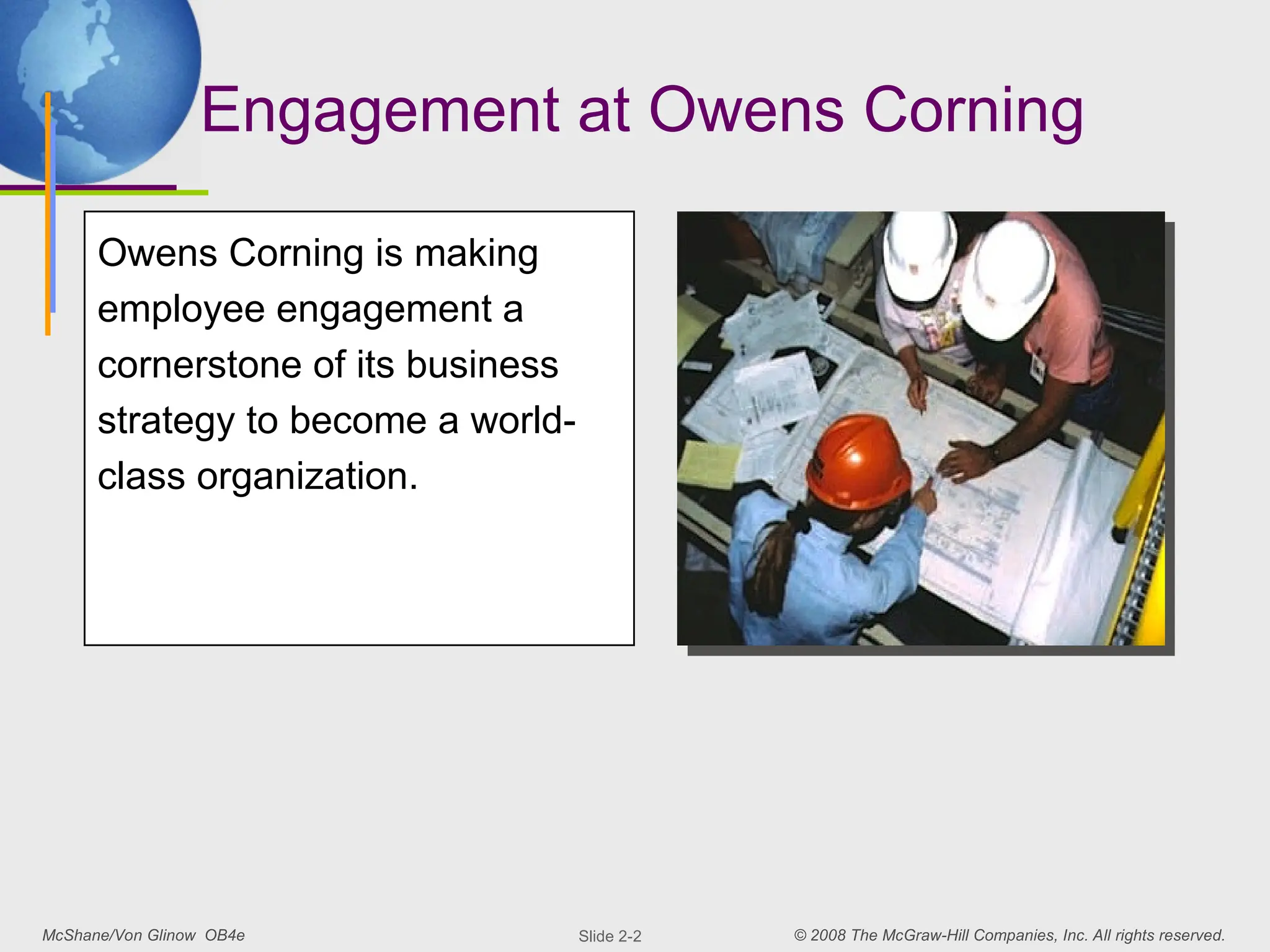
Engagement at Owens Corning
Owens Corning is making
employee engagement a
cornerstone of its business
strategy to become a world-
class organization.
Reprinted with permission of Owens Corning. All rights reserved
McShane/Von Glinow OB4e © 2008 The McGraw-Hill Companies, Inc. All rights reserved.
Slide 2-3
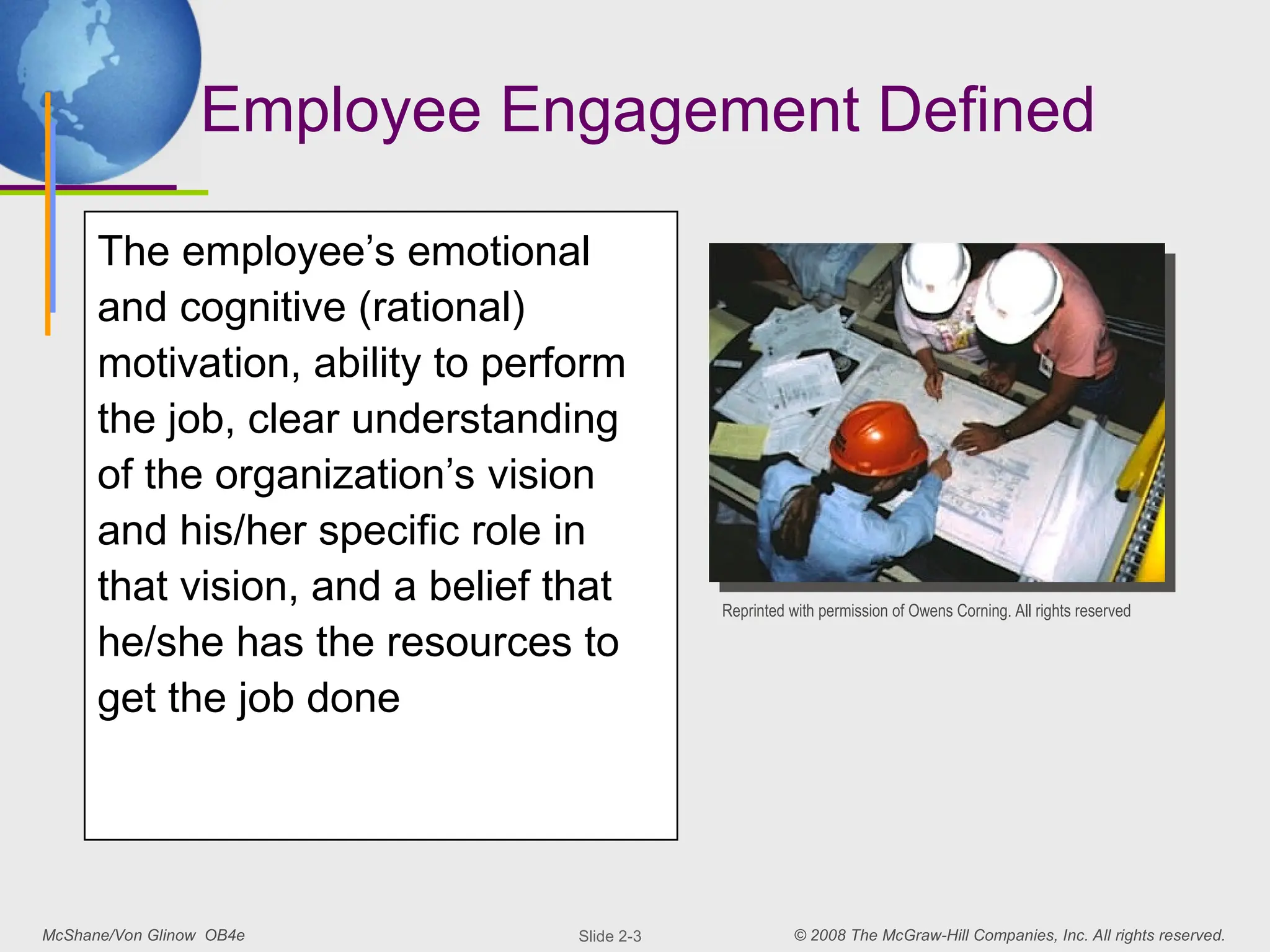
Employee Engagement Defined
The employee’s emotional
and cognitive (rational)
motivation, ability to perform
the job, clear understanding
of the organization’s vision
and his/her specific role in
that vision, and a belief that
he/she has the resources to
get the job done
Reprinted with permission of Owens Corning. All rights reserved
McShane/Von Glinow OB4e © 2008 The McGraw-Hill Companies, Inc. All rights reserved.
Slide 2-4
Individual
Individual
Behavior
Behavior
and Results
and Results
Role
Role
Perceptions
Perceptions
Situational
Situational
Factors
Factors
Motivation
Motivation
Ability
Ability
Values
Values
Personality
Personality
Perceptions
Perceptions
Emotions
Emotions
Attitudes
Attitudes
Stress
Stress
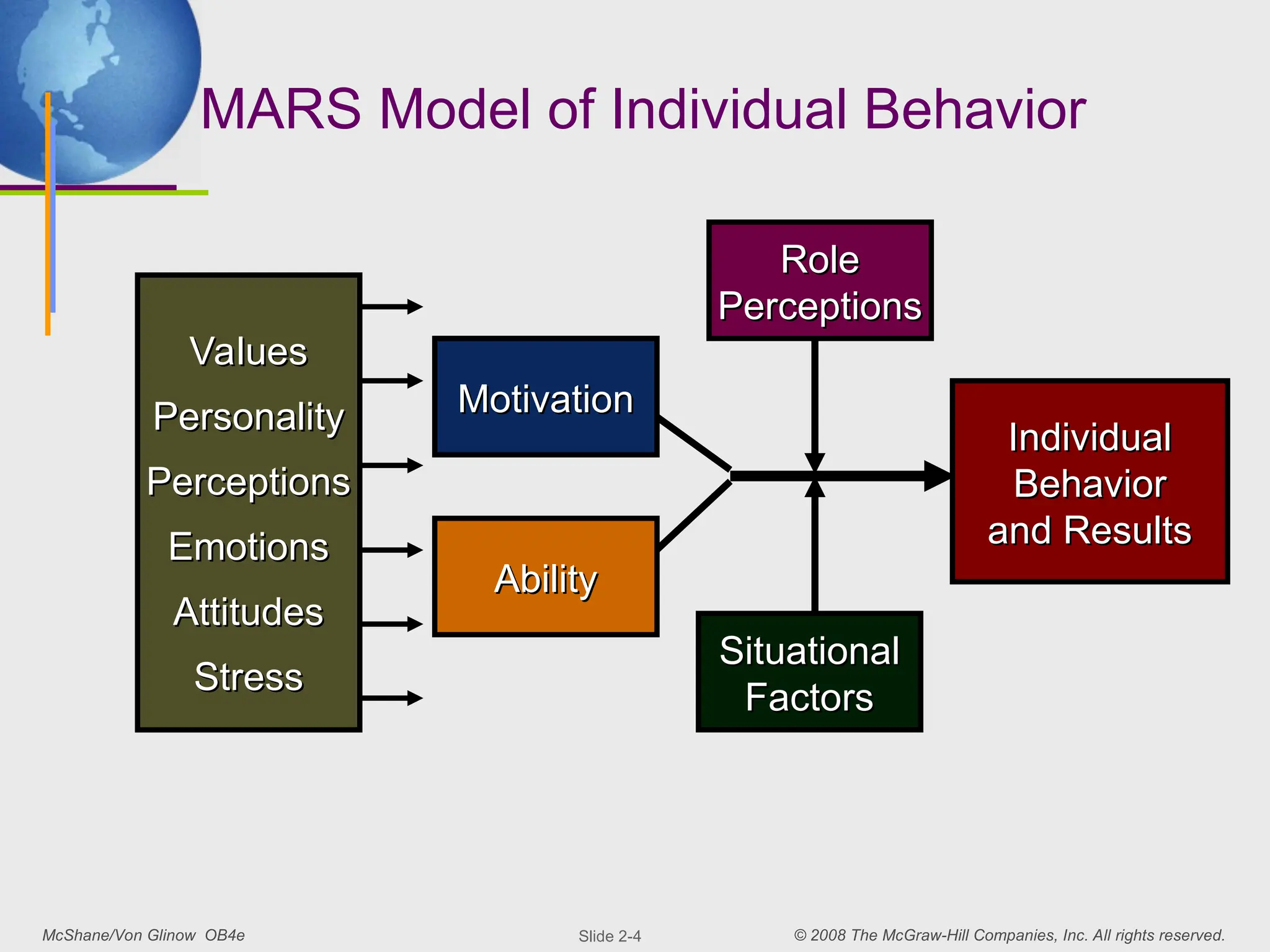
MARS Model of Individual Behavior
McShane/Von Glinow OB4e © 2008 The McGraw-Hill Companies, Inc. All rights reserved.
Slide 2-5
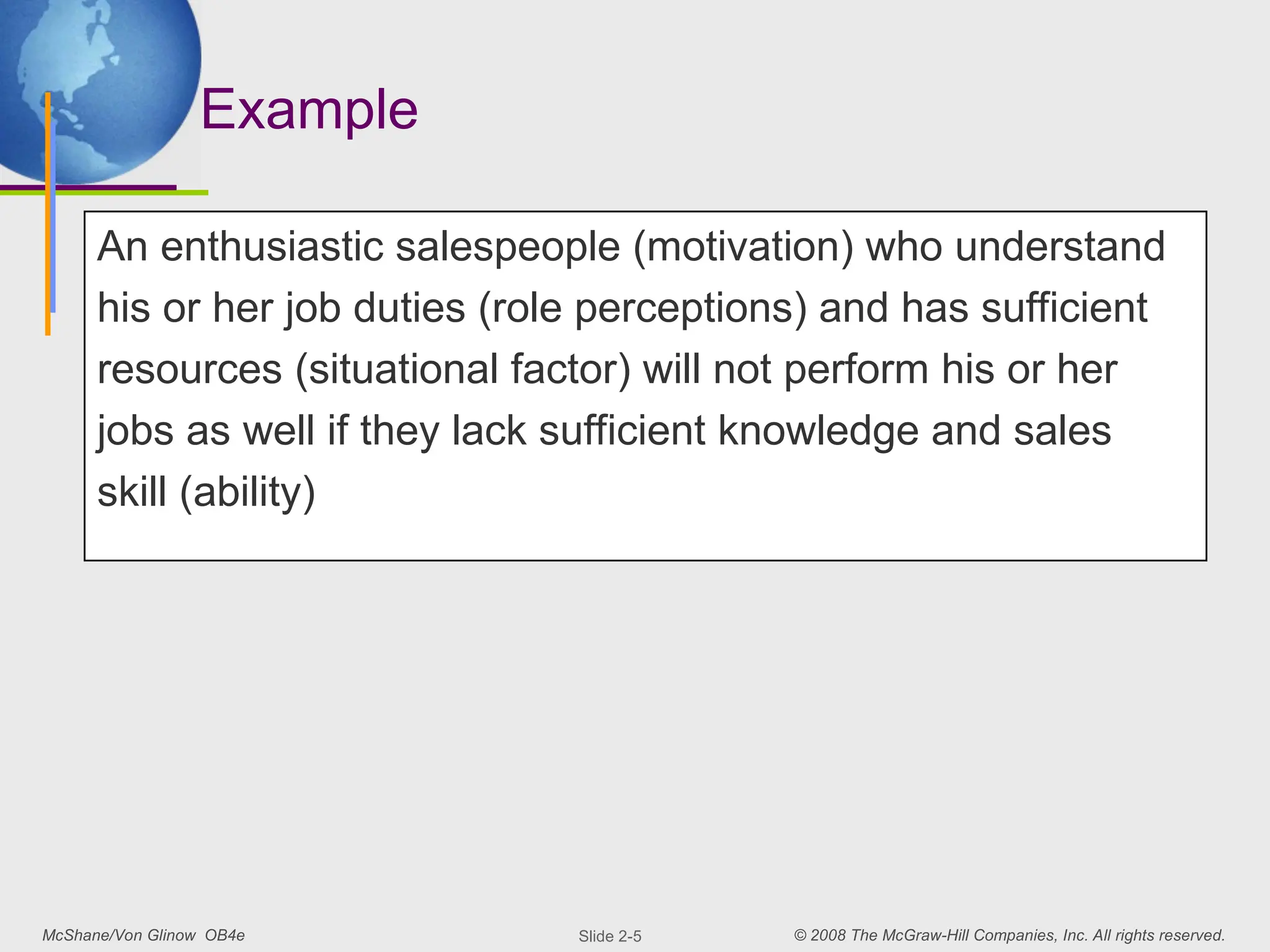
Example
An enthusiastic salespeople (motivation) who understand
his or her job duties (role perceptions) and has sufficient
resources (situational factor) will not perform his or her
jobs as well if they lack sufficient knowledge and sales
skill (ability)
McShane/Von Glinow OB4e © 2008 The McGraw-Hill Companies, Inc. All rights reserved.
Slide 2-6
M
M
A
A
R
R
S
S
BAR
BAR
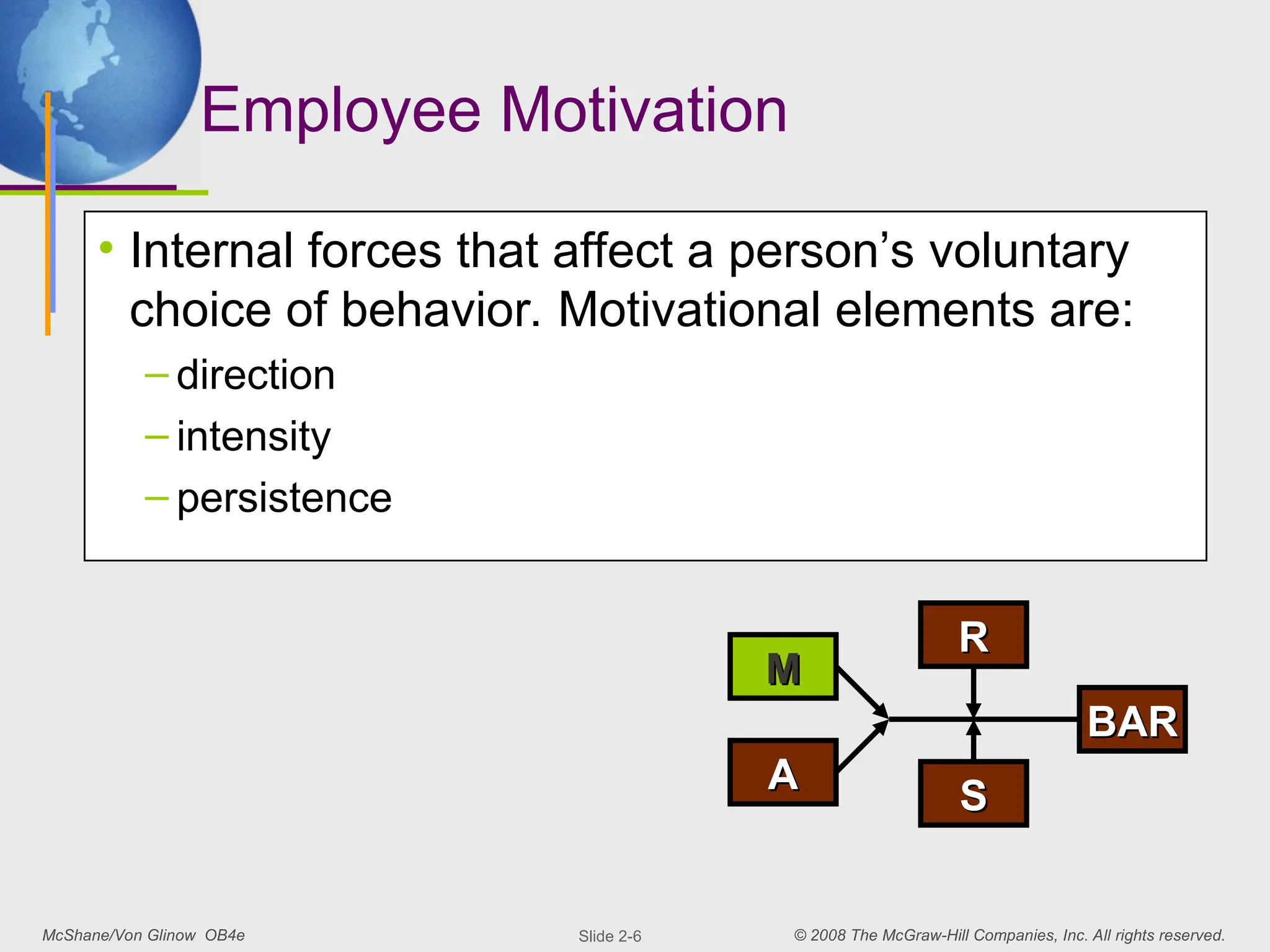
Employee Motivation
• Internal forces that affect a person’s voluntary
choice of behavior. Motivational elements are:
– direction
– intensity
– persistence
McShane/Von Glinow OB4e © 2008 The McGraw-Hill Companies, Inc. All rights reserved.
Slide 2-7
M
M
A
A
R
R
S
S
BAR
BAR
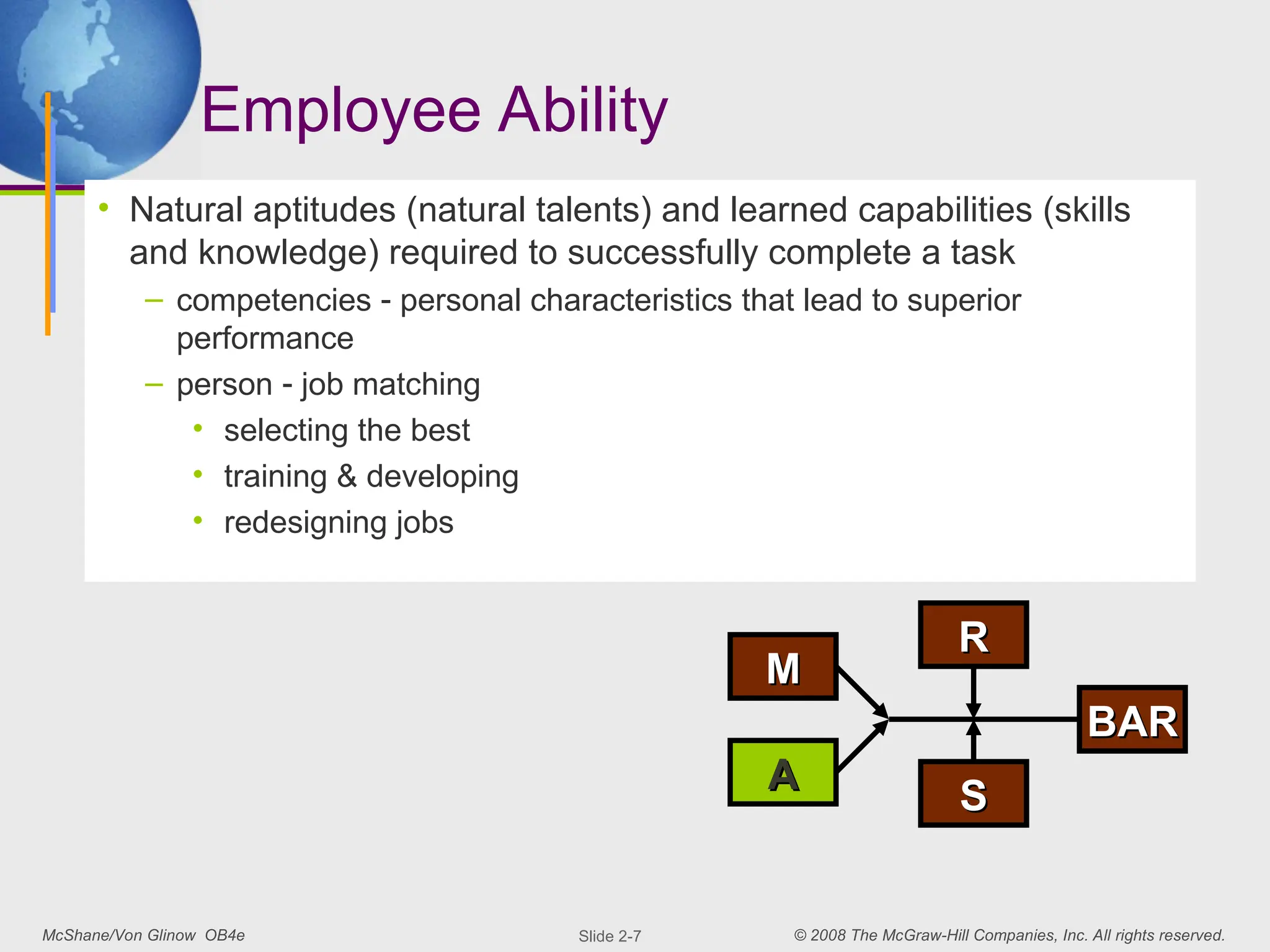
Employee Ability
• Natural aptitudes (natural talents) and learned capabilities (skills
and knowledge) required to successfully complete a task
– competencies  personal characteristics that lead to superior
performance
– person  job matching
• selecting the best
• training & developing
• redesigning jobs
McShane/Von Glinow OB4e © 2008 The McGraw-Hill Companies, Inc. All rights reserved.
Slide 2-8
M
M
A
A
R
R
S
S
BAR
BAR
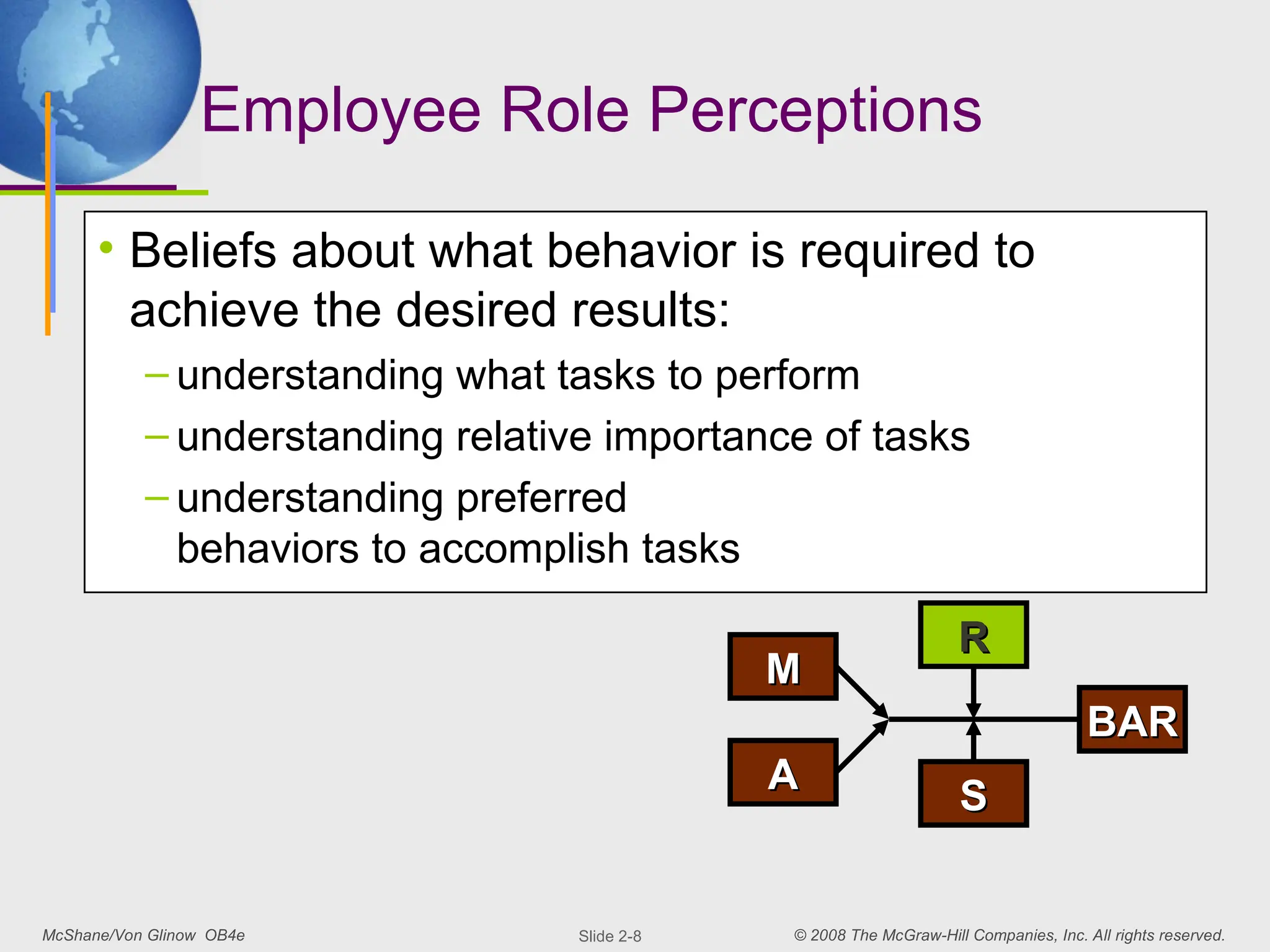
Employee Role Perceptions
• Beliefs about what behavior is required to
achieve the desired results:
– understanding what tasks to perform
– understanding relative importance of tasks
– understanding preferred
behaviors to accomplish tasks
McShane/Von Glinow OB4e © 2008 The McGraw-Hill Companies, Inc. All rights reserved.
Slide 2-9
M
M
A
A
R
R
S
S
BAR
BAR
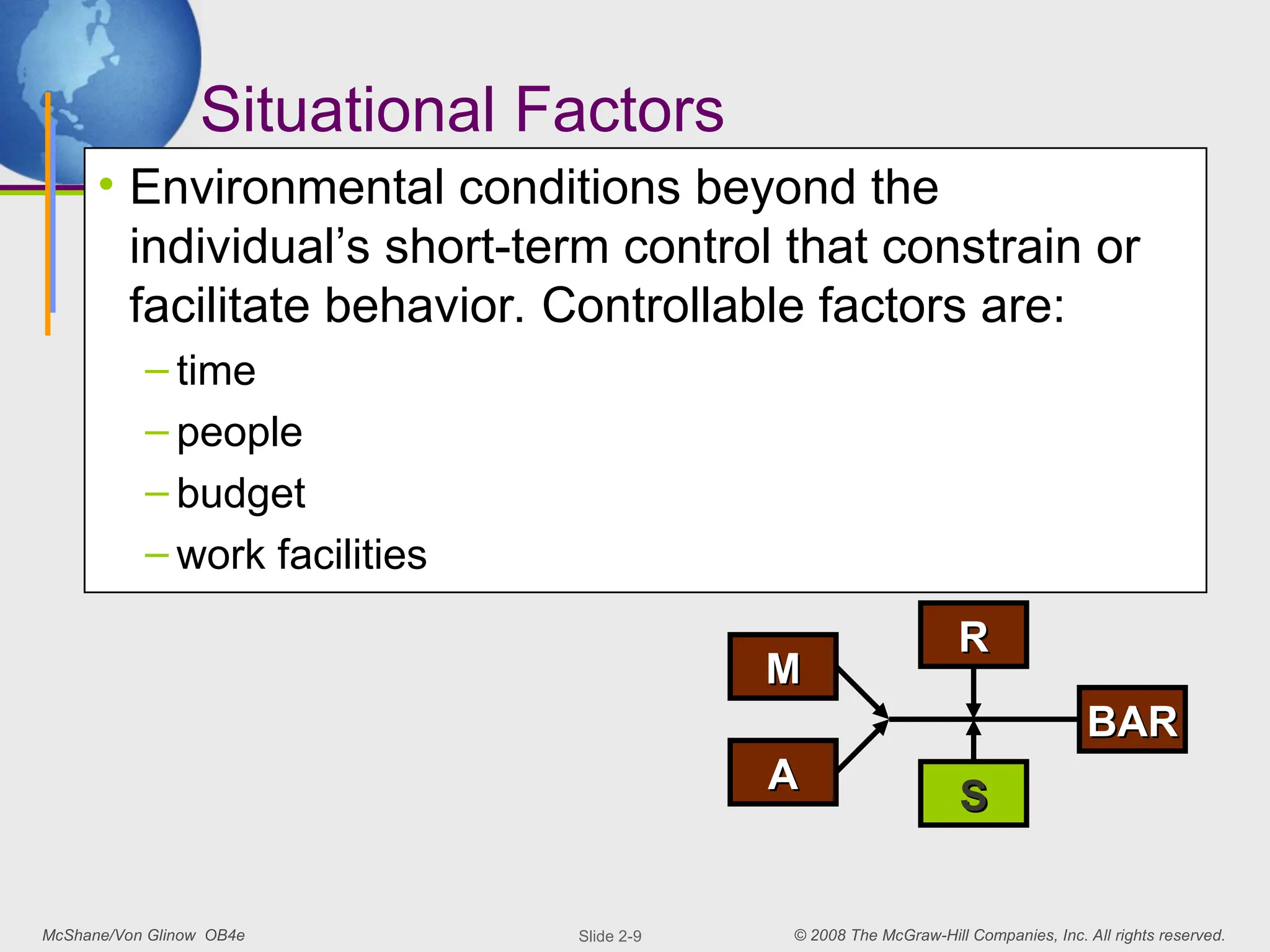
Situational Factors
• Environmental conditions beyond the
individual’s short-term control that constrain or
facilitate behavior. Controllable factors are:
– time
– people
– budget
– work facilities
McShane/Von Glinow OB4e © 2008 The McGraw-Hill Companies, Inc. All rights reserved.
Slide 2-10
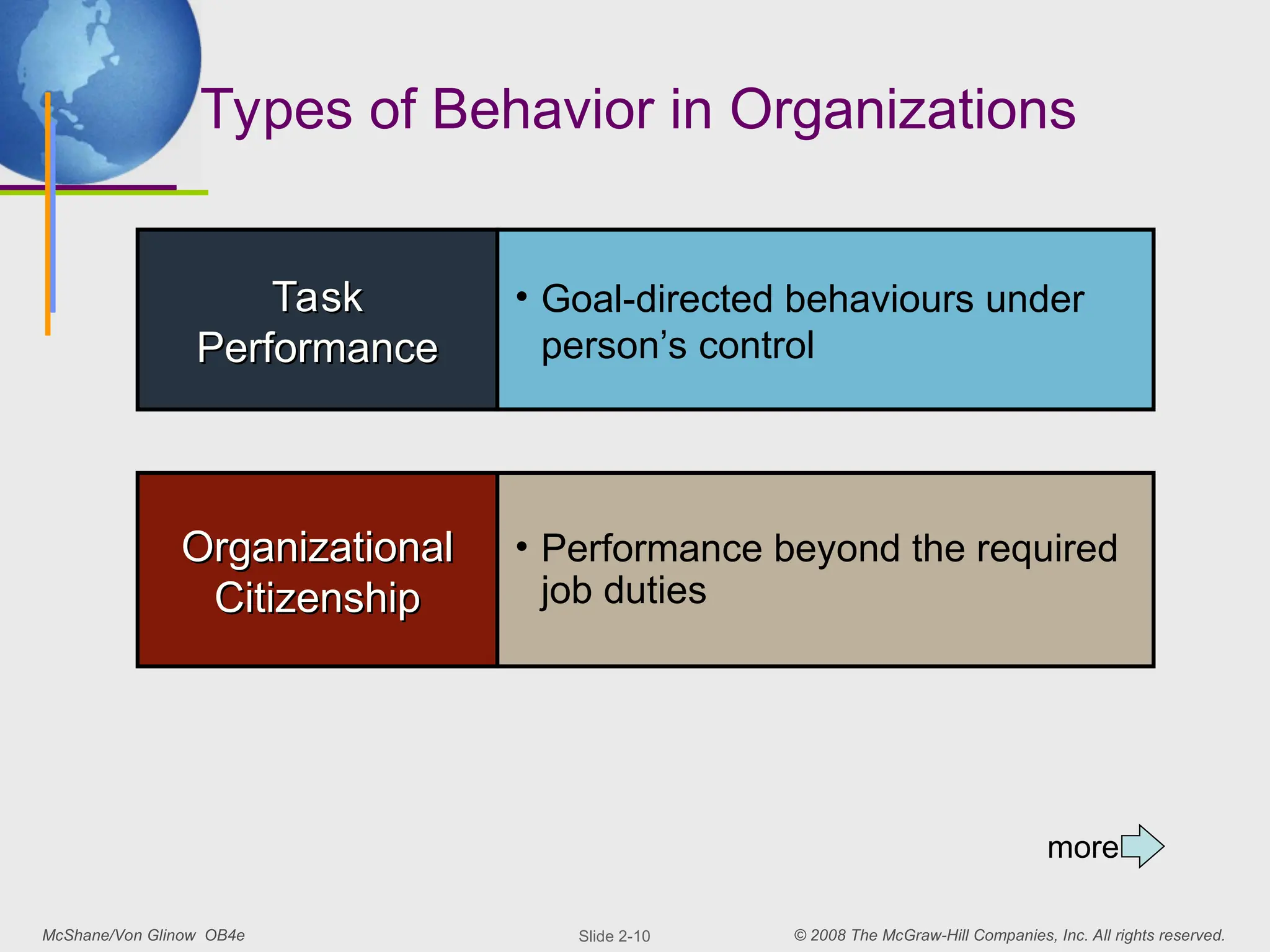
Organizational
Organizational
Citizenship
Citizenship
• Performance beyond the required
job duties
Task
Task
Performance
Performance
• Goal-directed behaviours under
person’s control
more
Types of Behavior in Organizations
McShane/Von Glinow OB4e © 2008 The McGraw-Hill Companies, Inc. All rights reserved.
Slide 2-11
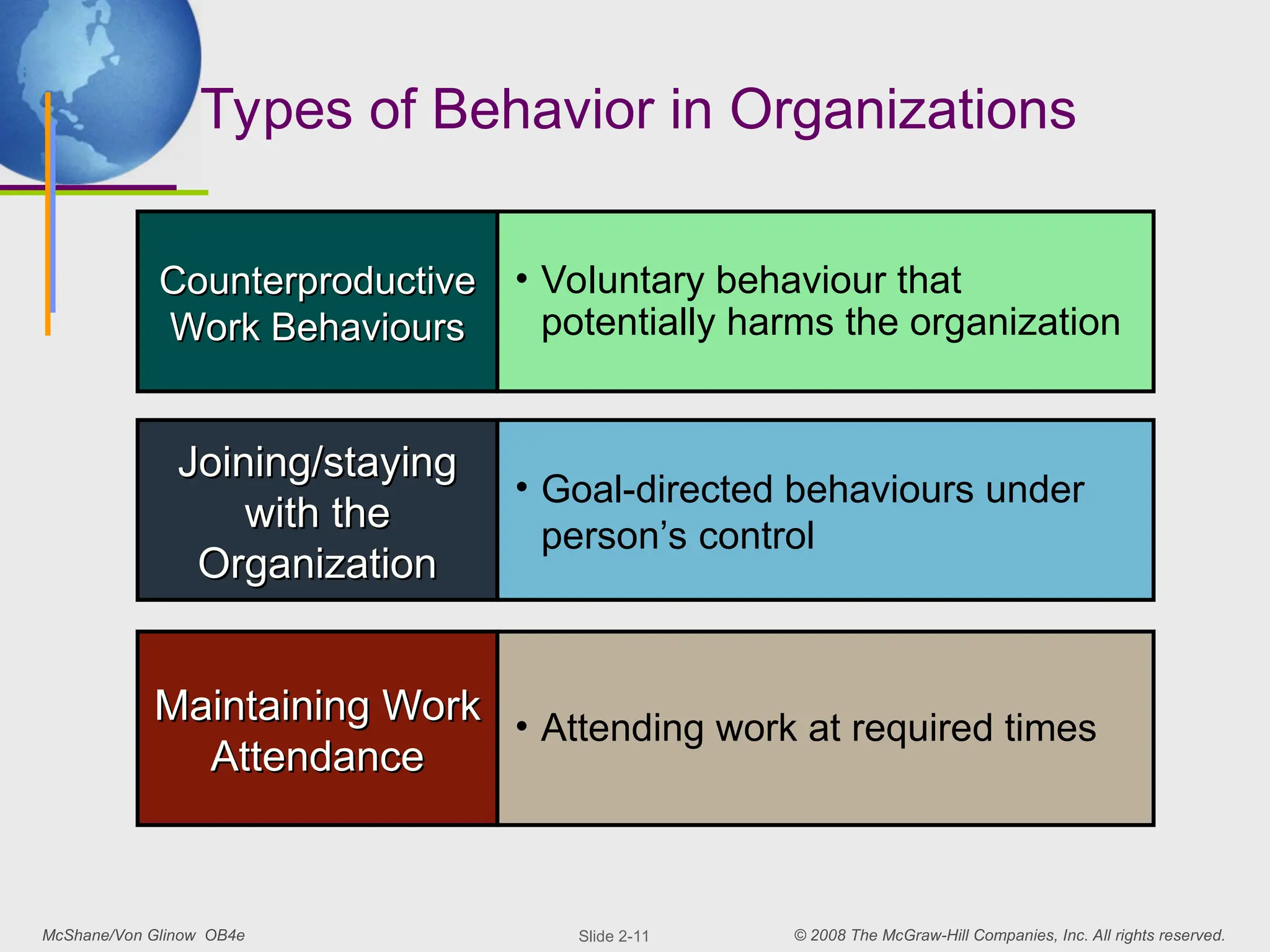
Maintaining Work
Maintaining Work
Attendance
Attendance
• Attending work at required times
Joining/staying
Joining/staying
with the
with the
Organization
Organization
• Goal-directed behaviours under
person’s control
Types of Behavior in Organizations
Counterproductive
Counterproductive
Work Behaviours
Work Behaviours
• Voluntary behaviour that
potentially harms the organization
McShane/Von Glinow OB4e © 2008 The McGraw-Hill Companies, Inc. All rights reserved.
Slide 2-12
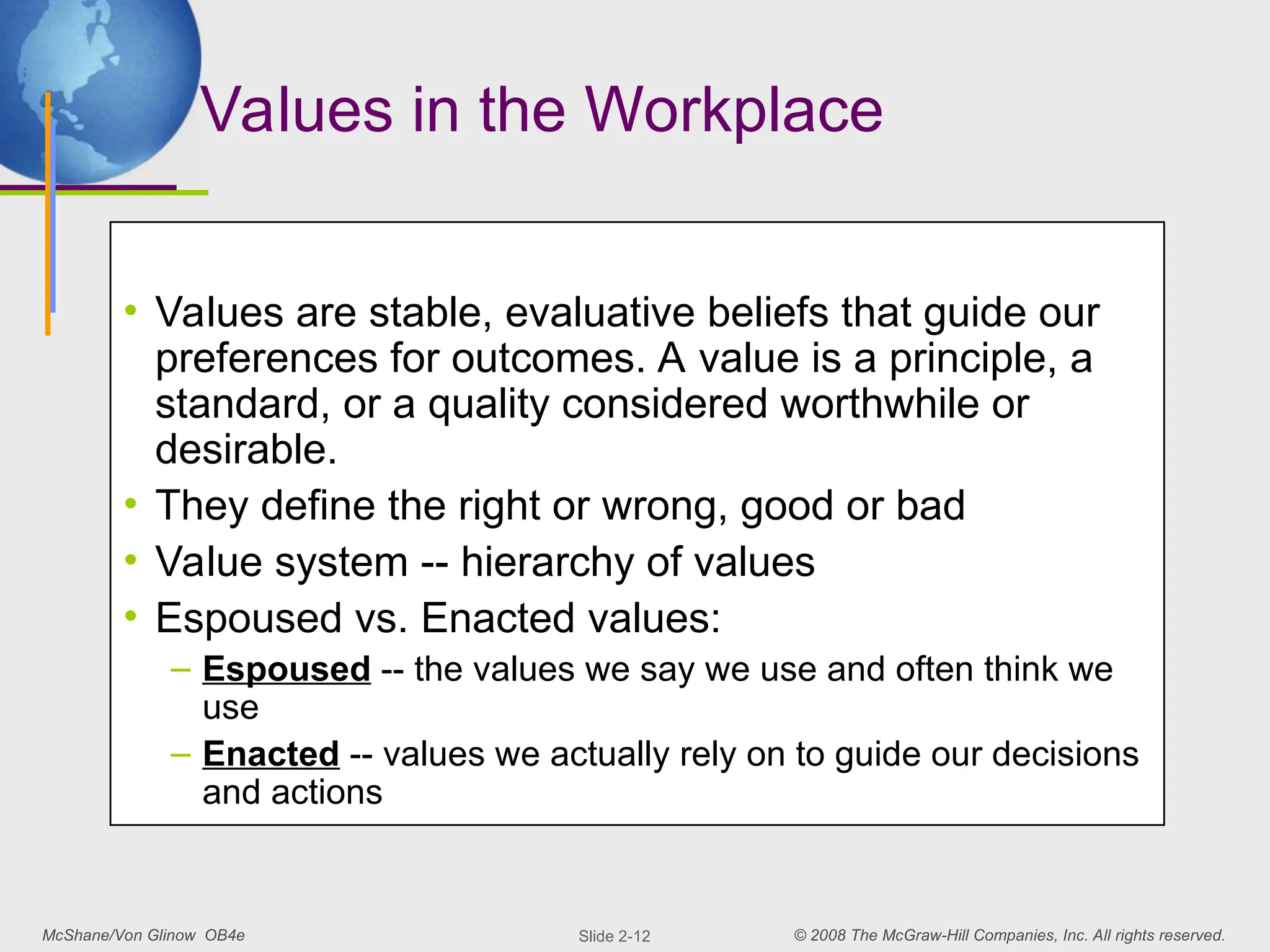
Values in the Workplace
• Values are stable, evaluative beliefs that guide our
preferences for outcomes. A value is a principle, a
standard, or a quality considered worthwhile or
desirable.
• They define the right or wrong, good or bad
• Value system -- hierarchy of values
• Espoused vs. Enacted values:
– Espoused -- the values we say we use and often think we
use
– Enacted -- values we actually rely on to guide our decisions
and actions
McShane/Von Glinow OB4e © 2008 The McGraw-Hill Companies, Inc. All rights reserved.
Slide 2-13
Three Categories of Values
• Personal values define who an individual is. They serve
as guides in handling situations and interacting with
others.
• Organizational values are the standards that guide an
individual's behavior in a professional context. They
define how an individual accomplishes work, interacts in
professional situations, and how he makes decisions
relative to his job/career.
• Cultural values are standards that guide how a person
relates meaningfully to others in different social
situations.
McShane/Von Glinow OB4e © 2008 The McGraw-Hill Companies, Inc. All rights reserved.
Slide 2-14
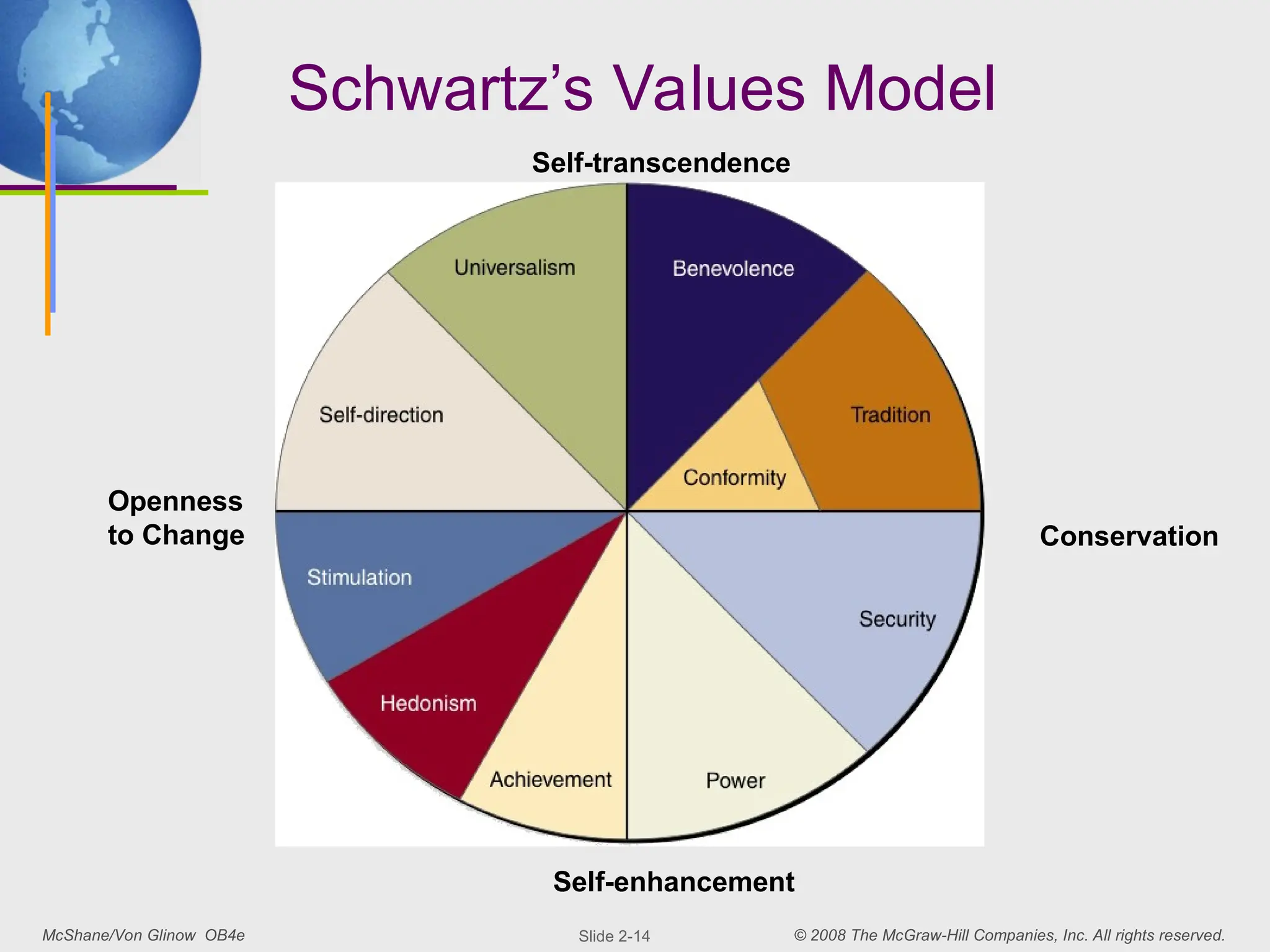
Schwartz’s Values Model
Conservation
Self-enhancement
Self-transcendence
Openness
to Change
McShane/Von Glinow OB4e © 2008 The McGraw-Hill Companies, Inc. All rights reserved.
Slide 2-15
Values and Behavior
• Habitual behavior tends to be consistent with our
values, but our everyday conscious decisions and
actions apply our values much less consistently.
• Decisions and behaviors linked to values when:43
1. Mindful and conscious of our values
2. Have logical reasons to apply values in that situation
3. Situation does not interfere
McShane/Von Glinow OB4e © 2008 The McGraw-Hill Companies, Inc. All rights reserved.
Slide 2-16
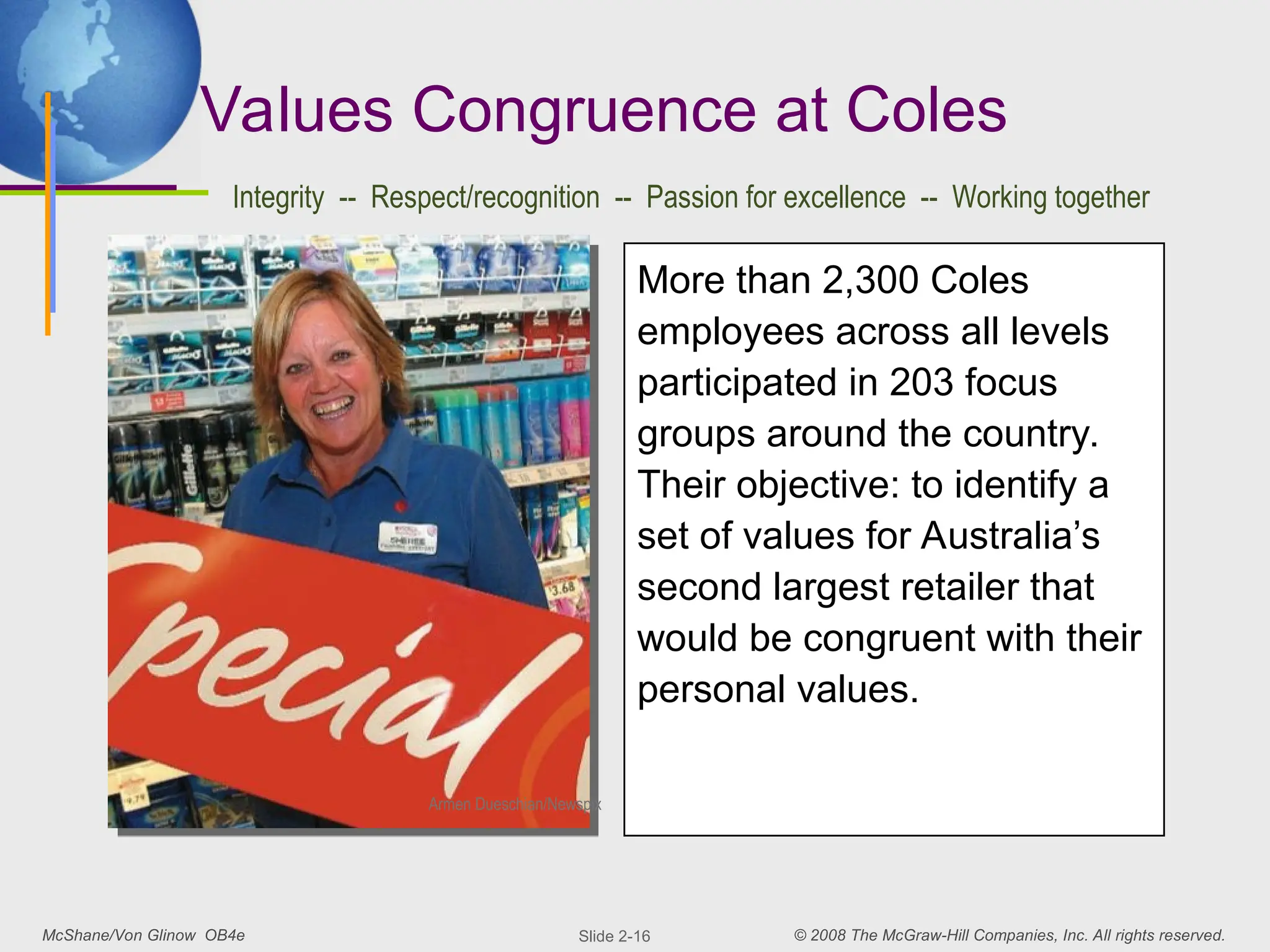
Values Congruence at Coles
More than 2,300 Coles
employees across all levels
participated in 203 focus
groups around the country.
Their objective: to identify a
set of values for Australia’s
second largest retailer that
would be congruent with their
personal values.
Armen Dueschian/Newspix
Integrity -- Respect/recognition -- Passion for excellence -- Working together
McShane/Von Glinow OB4e © 2008 The McGraw-Hill Companies, Inc. All rights reserved.
Slide 2-17
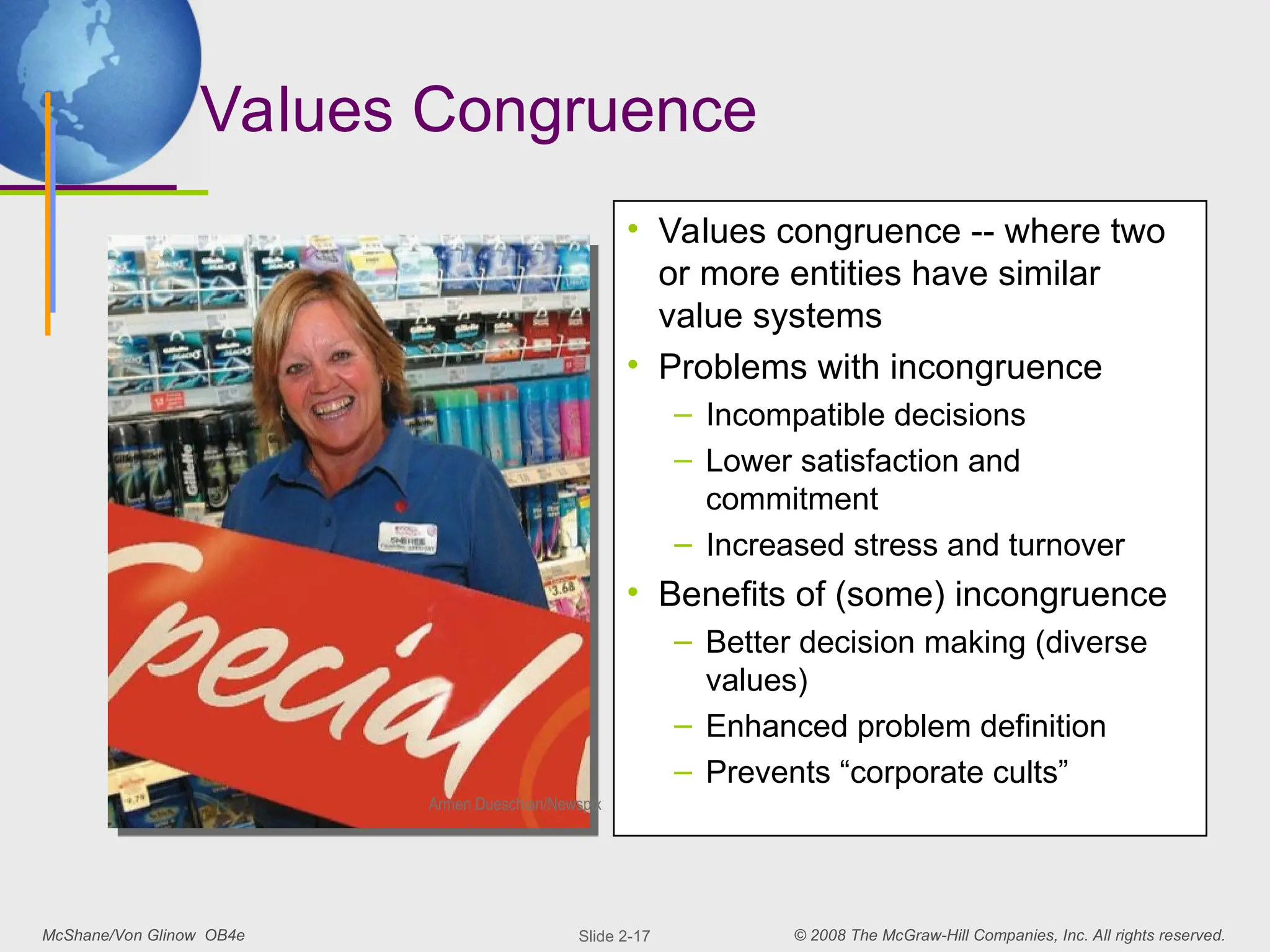
Values Congruence
• Values congruence -- where two
or more entities have similar
value systems
• Problems with incongruence
– Incompatible decisions
– Lower satisfaction and
commitment
– Increased stress and turnover
• Benefits of (some) incongruence
– Better decision making (diverse
values)
– Enhanced problem definition
– Prevents “corporate cults”
Armen Dueschian/Newspix
McShane/Von Glinow OB4e © 2008 The McGraw-Hill Companies, Inc. All rights reserved.
Slide 2-18
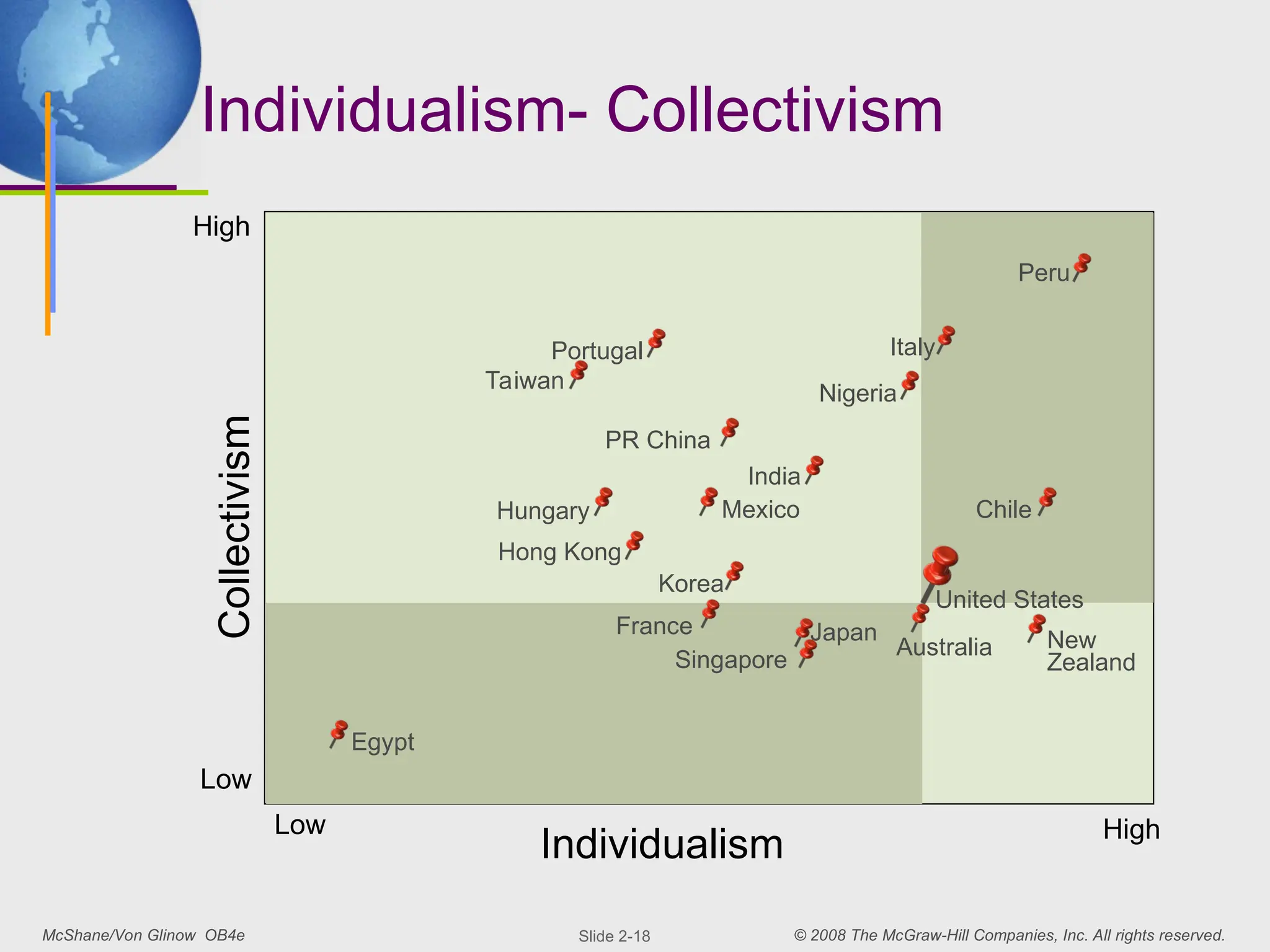
Individualism- Collectivism
Peru
Chile
Italy
Nigeria
India
United States
Japan
Egypt
Korea
France
PR China
Portugal
Mexico
Hong Kong
Taiwan
Collectivism
High
Low
Individualism High
Low
Australia
Hungary
New
Zealand
Singapore
McShane/Von Glinow OB4e © 2008 The McGraw-Hill Companies, Inc. All rights reserved.
Slide 2-19
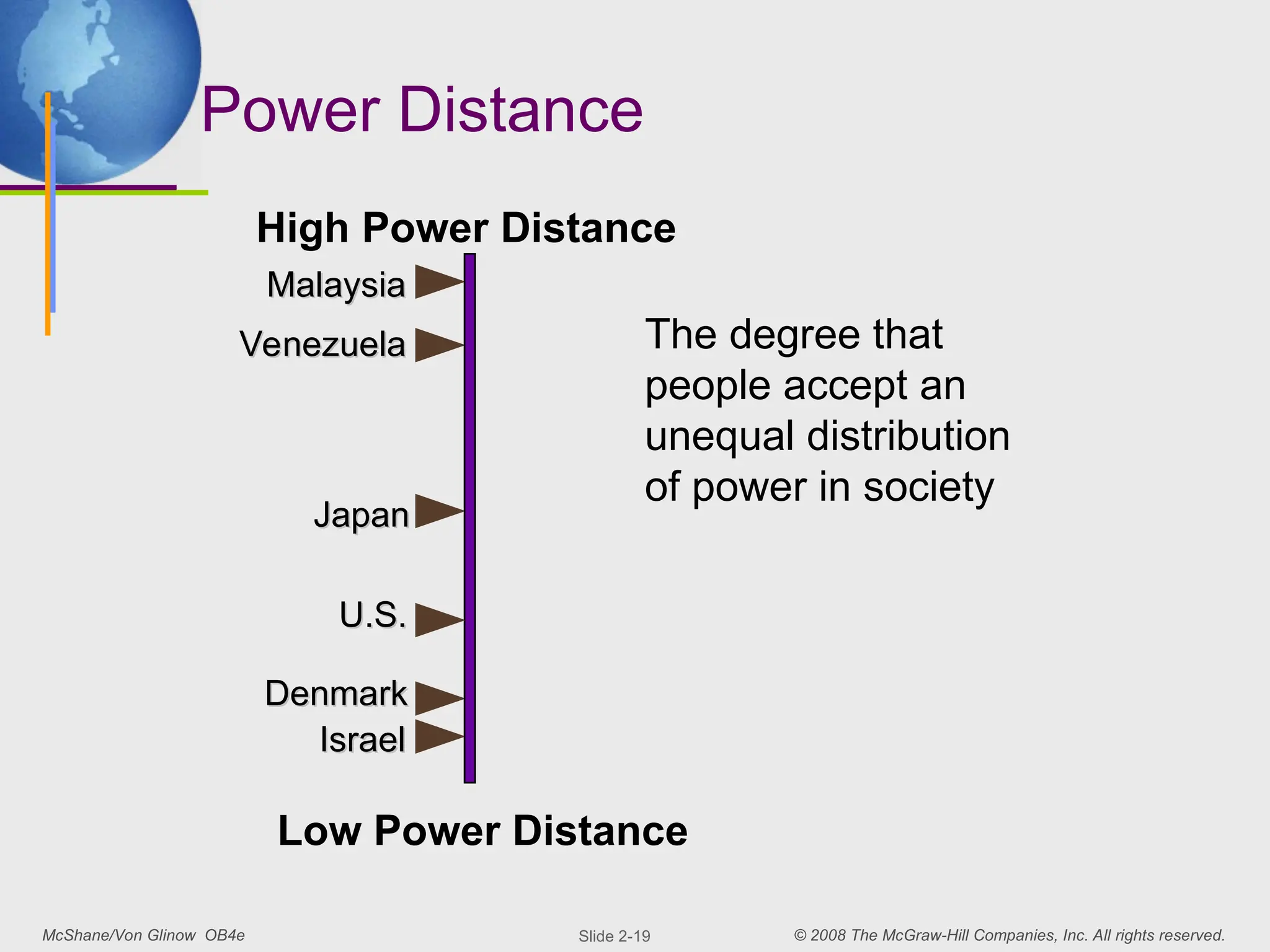
Power Distance
The degree that
people accept an
unequal distribution
of power in society
Japan
Japan
Israel
Israel
Denmark
Denmark
Venezuela
Venezuela
High Power Distance
Malaysia
Malaysia
Low Power Distance
U.S.
U.S.
McShane/Von Glinow OB4e © 2008 The McGraw-Hill Companies, Inc. All rights reserved.
Slide 2-20
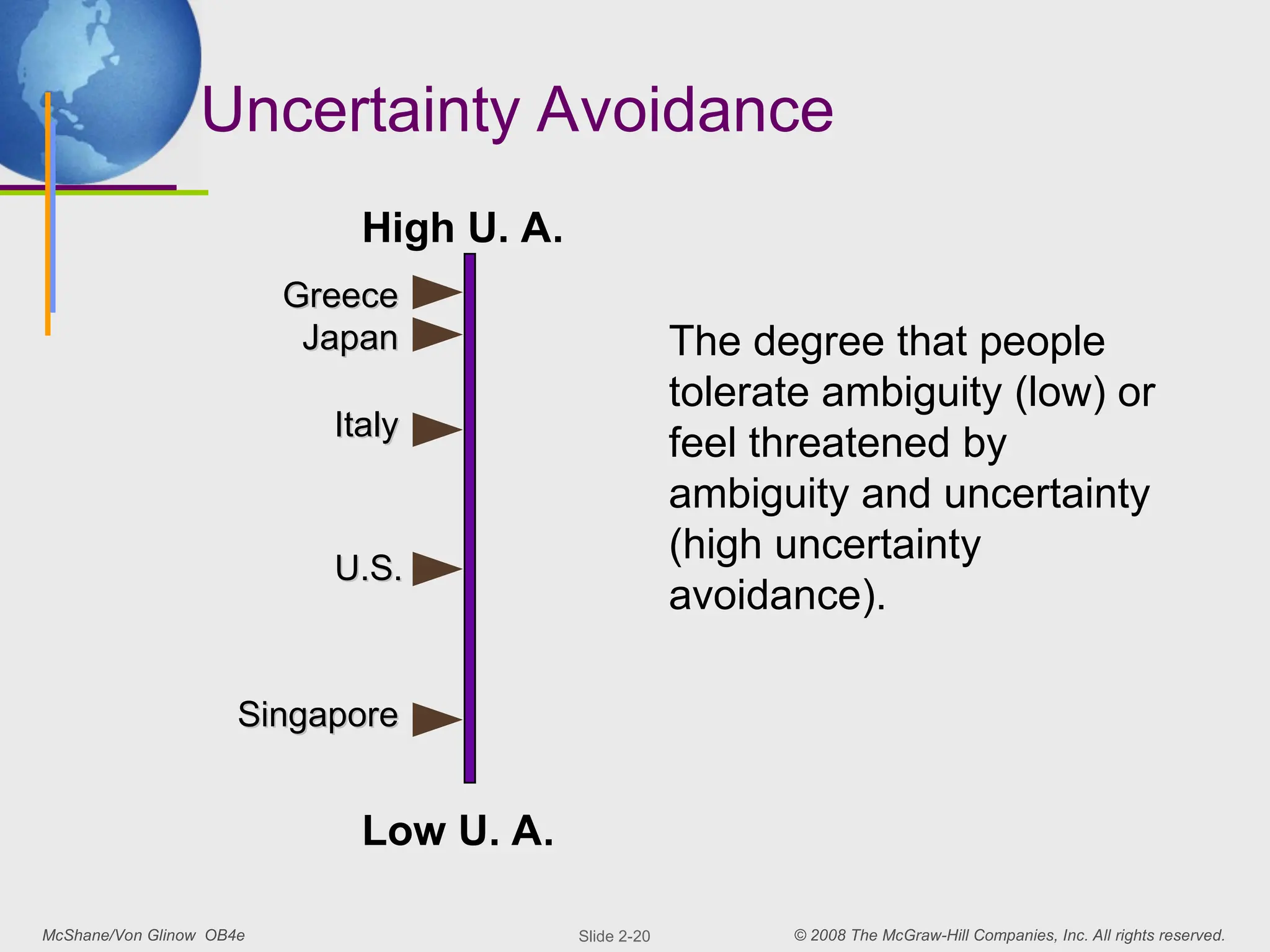
Uncertainty Avoidance
High U. A.
Low U. A.
Japan
Japan
Greece
Greece
U.S.
U.S.
The degree that people
tolerate ambiguity (low) or
feel threatened by
ambiguity and uncertainty
(high uncertainty
avoidance).
Italy
Italy
Singapore
Singapore
McShane/Von Glinow OB4e © 2008 The McGraw-Hill Companies, Inc. All rights reserved.
Slide 2-21
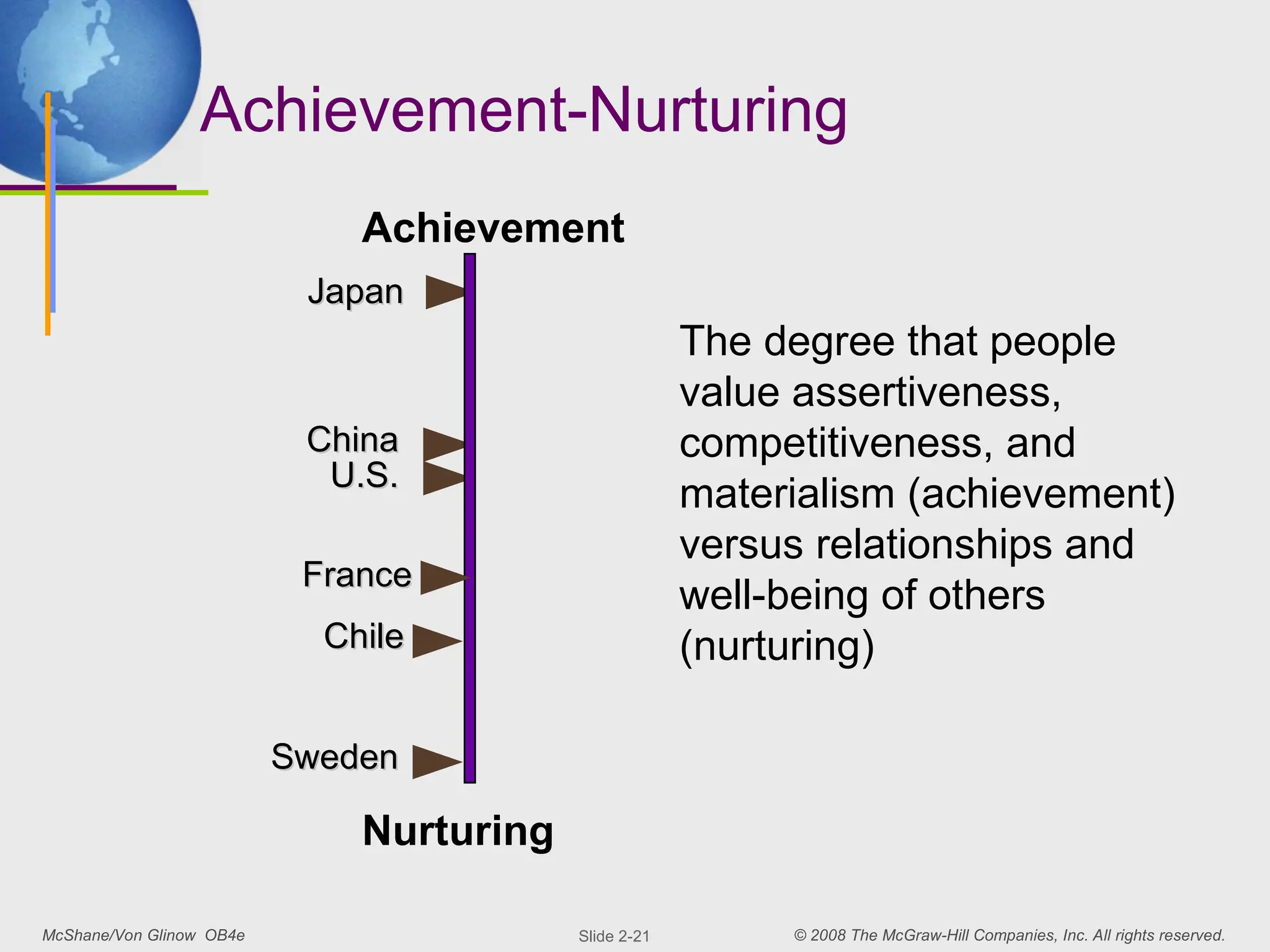
Achievement-Nurturing
Achievement
Nurturing
Japan
Japan
U.S.
U.S.
Sweden
Sweden
The degree that people
value assertiveness,
competitiveness, and
materialism (achievement)
versus relationships and
well-being of others
(nurturing)
China
China
Chile
Chile
France
France
McShane/Von Glinow OB4e © 2008 The McGraw-Hill Companies, Inc. All rights reserved.
Slide 2-22
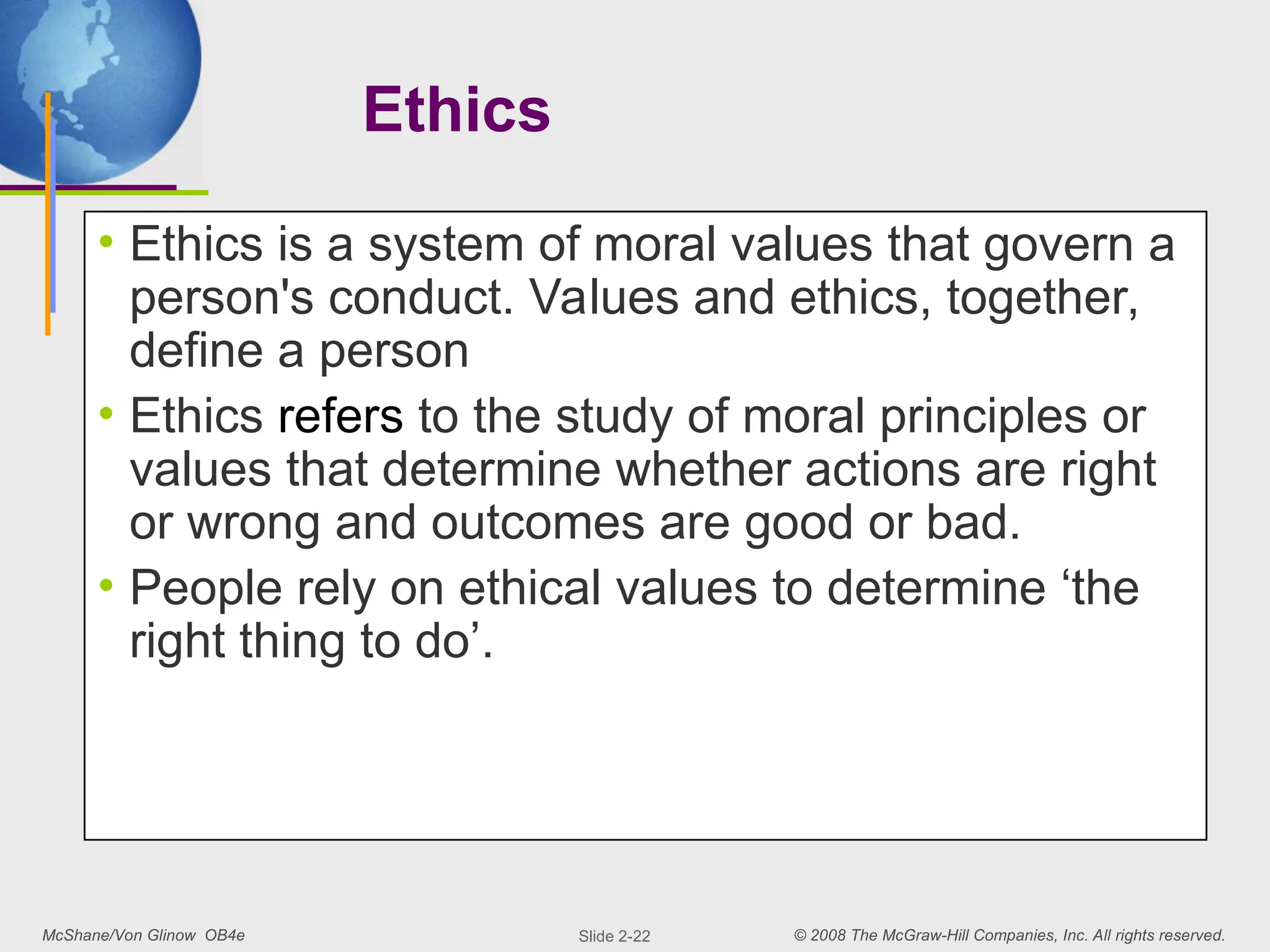
Ethics
• Ethics is a system of moral values that govern a
person's conduct. Values and ethics, together,
define a person
• Ethics refers to the study of moral principles or
values that determine whether actions are right
or wrong and outcomes are good or bad.
• People rely on ethical values to determine ‘the
right thing to do’.
McShane/Von Glinow OB4e © 2008 The McGraw-Hill Companies, Inc. All rights reserved.
Slide 2-23
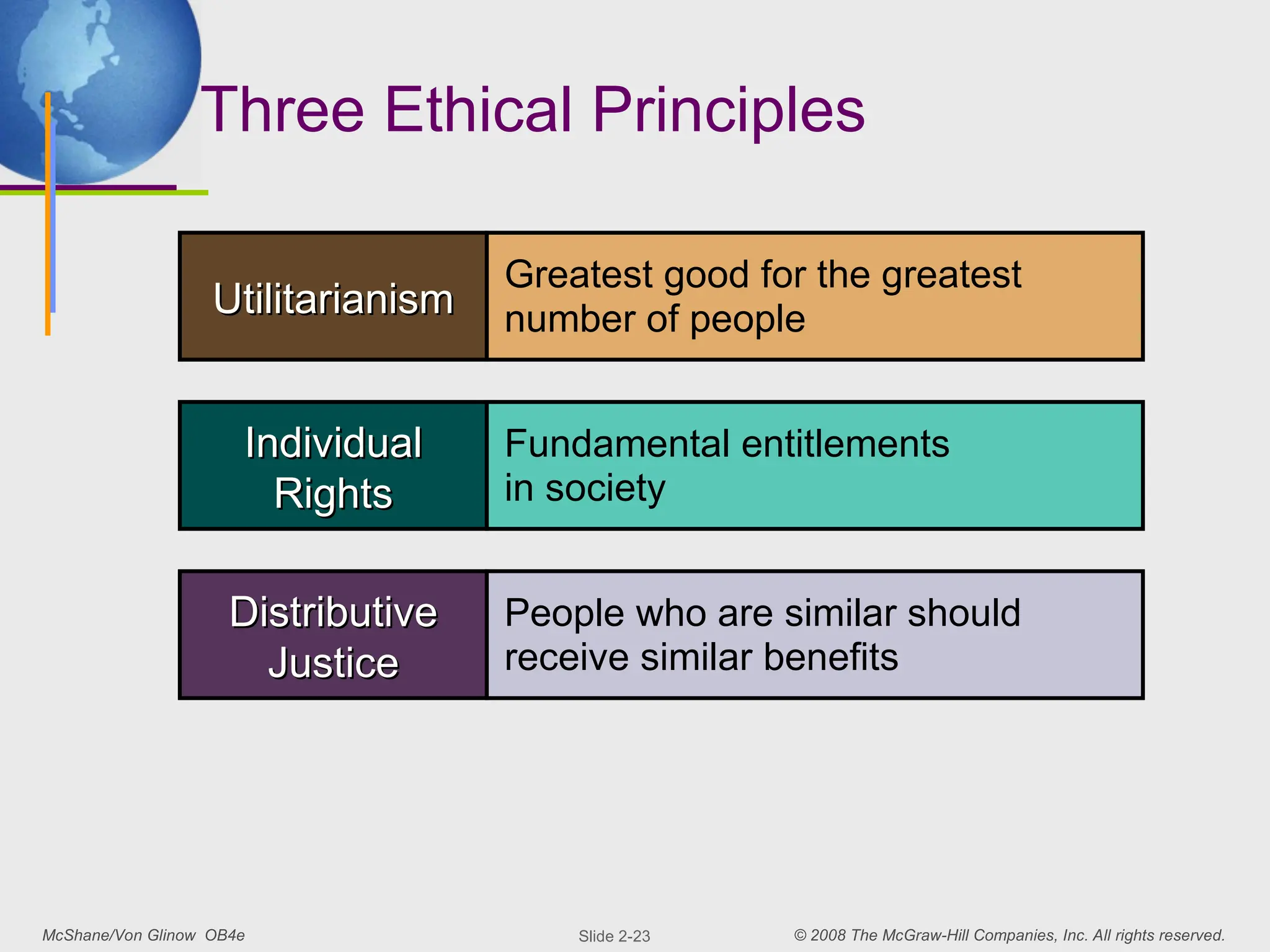
Utilitarianism
Utilitarianism
Individual
Individual
Rights
Rights
Greatest good for the greatest
number of people
Fundamental entitlements
in society
Distributive
Distributive
Justice
Justice
People who are similar should
receive similar benefits
Three Ethical Principles
McShane/Von Glinow OB4e © 2008 The McGraw-Hill Companies, Inc. All rights reserved.
Slide 2-24
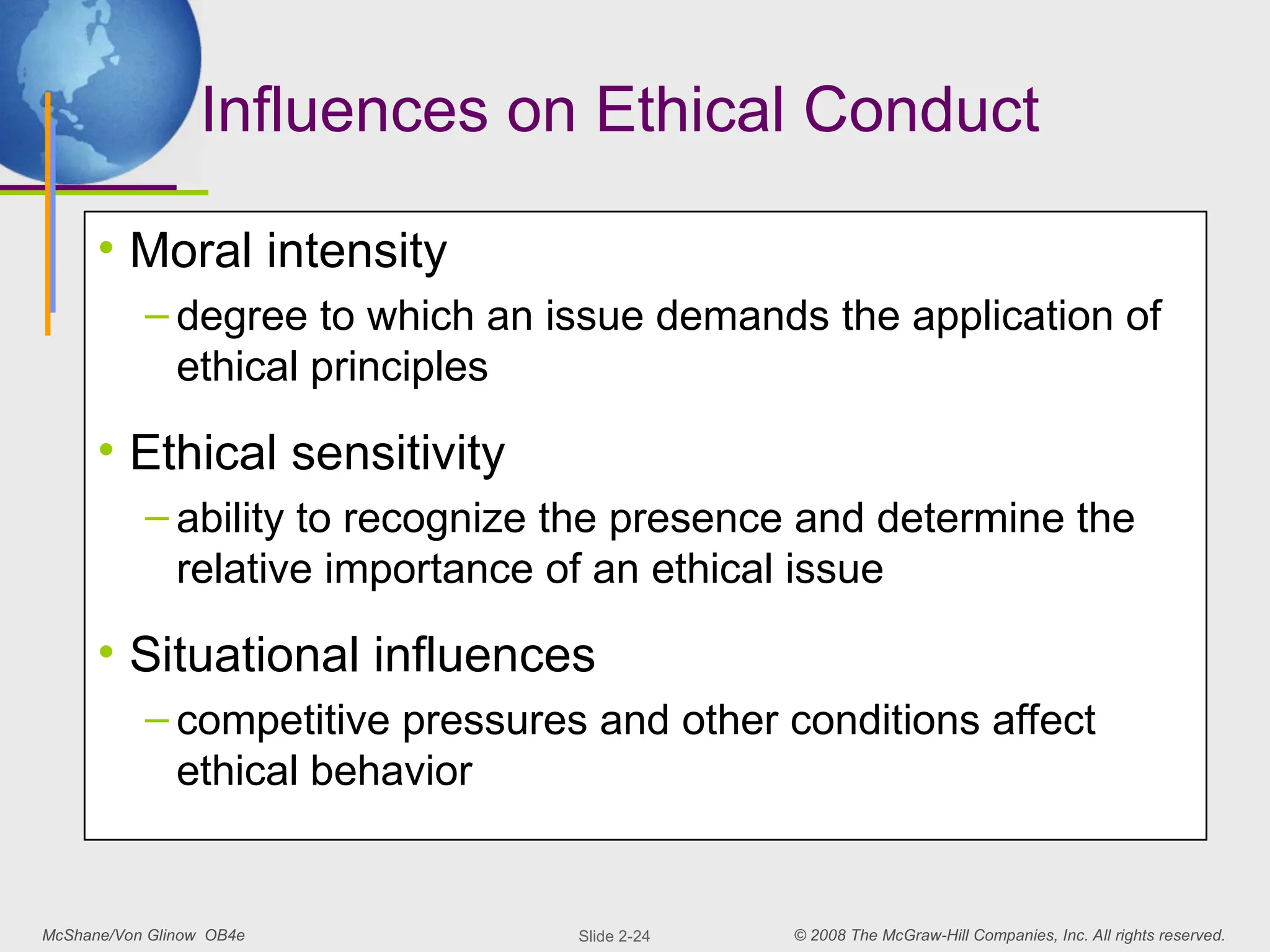
Influences on Ethical Conduct
• Moral intensity
– degree to which an issue demands the application of
ethical principles
• Ethical sensitivity
– ability to recognize the presence and determine the
relative importance of an ethical issue
• Situational influences
– competitive pressures and other conditions affect
ethical behavior
McShane/Von Glinow OB4e © 2008 The McGraw-Hill Companies, Inc. All rights reserved.
Slide 2-25
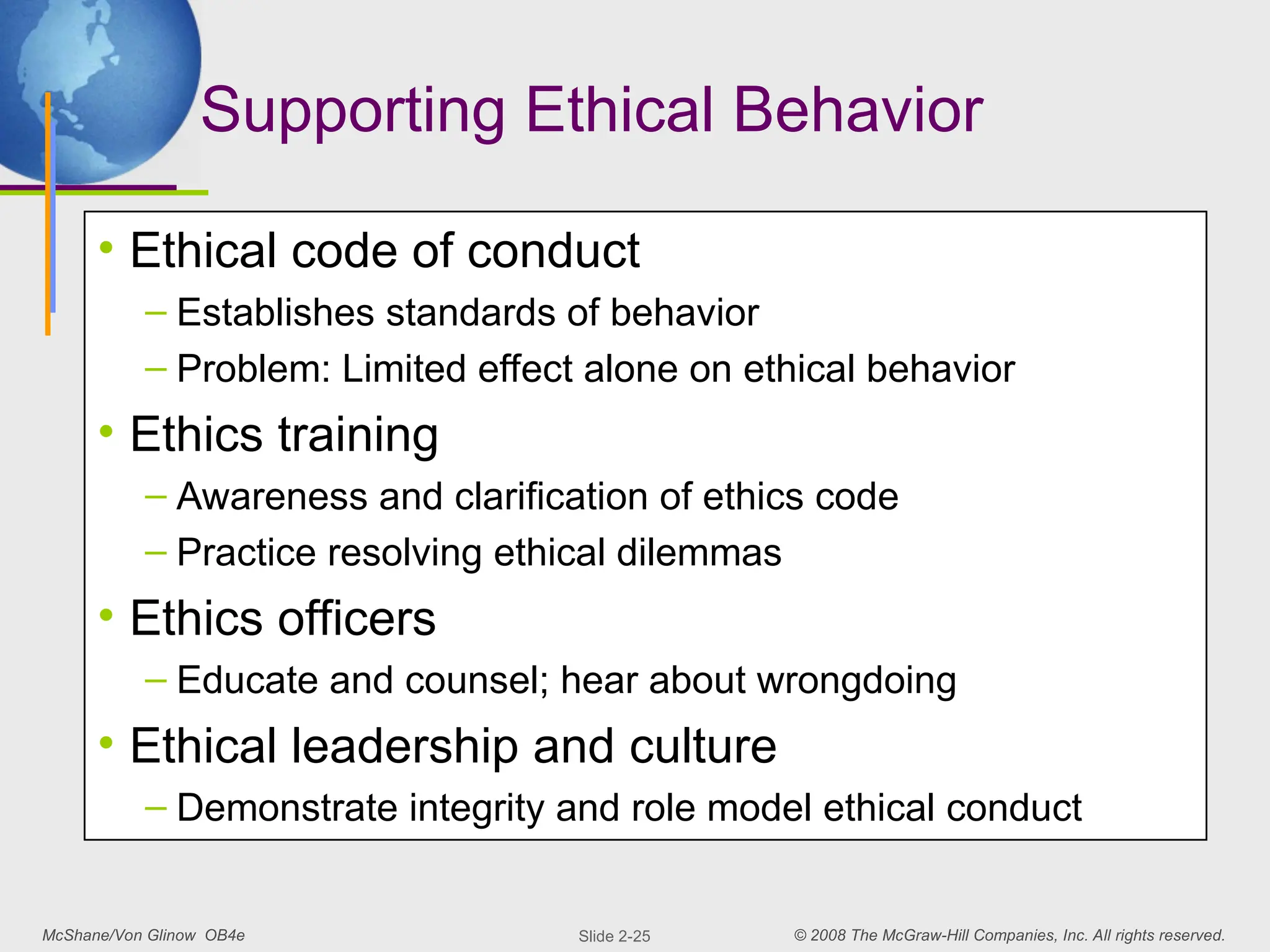
Supporting Ethical Behavior
• Ethical code of conduct
– Establishes standards of behavior
– Problem: Limited effect alone on ethical behavior
• Ethics training
– Awareness and clarification of ethics code
– Practice resolving ethical dilemmas
• Ethics officers
– Educate and counsel; hear about wrongdoing
• Ethical leadership and culture
– Demonstrate integrity and role model ethical conduct
McShane/Von Glinow OB4e © 2008 The McGraw-Hill Companies, Inc. All rights reserved.
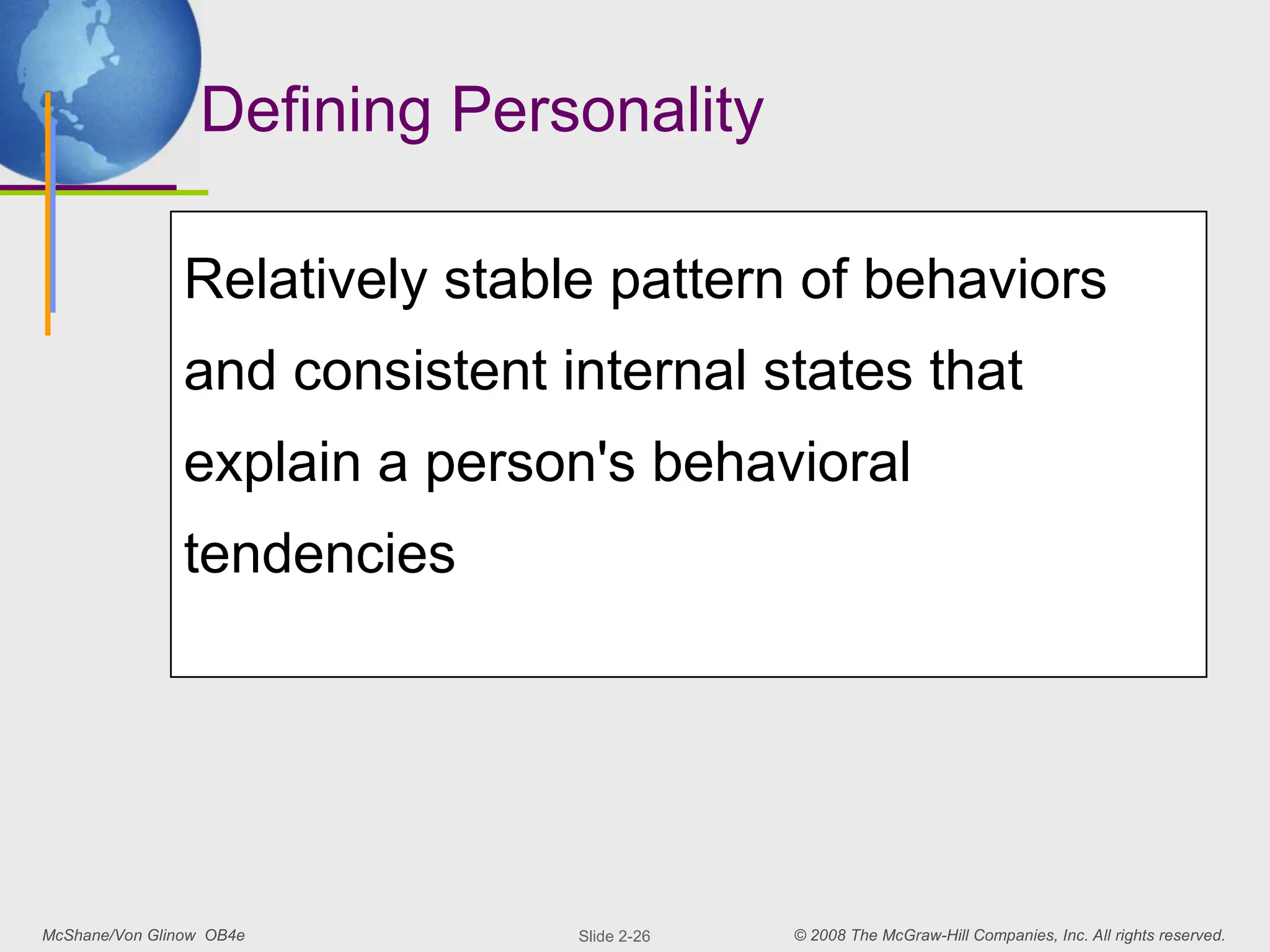
Slide 2-26
Defining Personality
Relatively stable pattern of behaviors
and consistent internal states that
explain a person's behavioral
tendencies
McShane/Von Glinow OB4e © 2008 The McGraw-Hill Companies, Inc. All rights reserved.
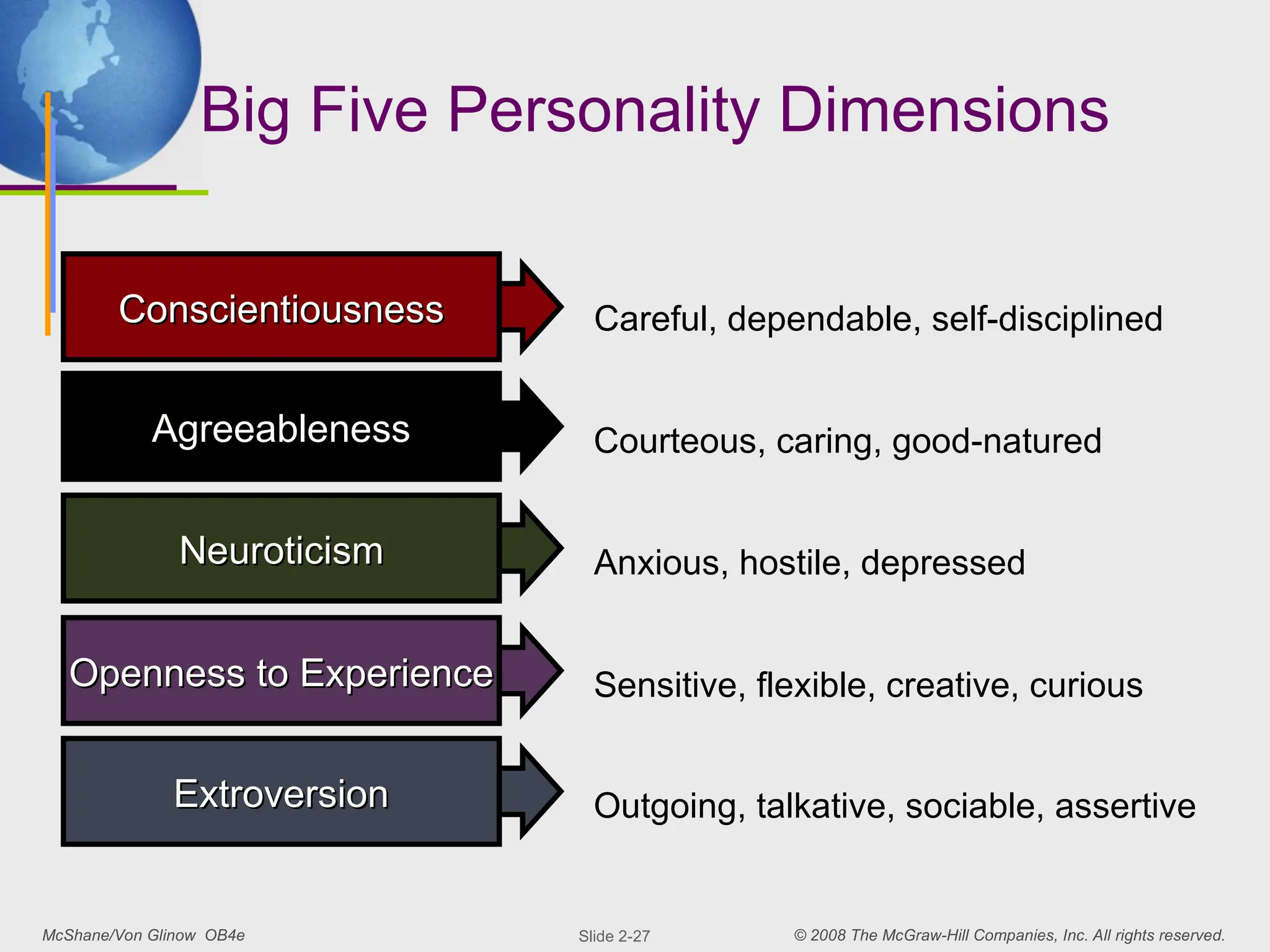
Slide 2-27
Big Five Personality Dimensions
Outgoing, talkative, sociable, assertive
Sensitive, flexible, creative, curious
Careful, dependable, self-disciplined
Courteous, caring, good-natured
Anxious, hostile, depressed
Extroversion
Extroversion
Openness to Experience
Conscientiousness
Conscientiousness
Agreeableness
Neuroticism
Neuroticism
McShane/Von Glinow OB4e © 2008 The McGraw-Hill Companies, Inc. All rights reserved.
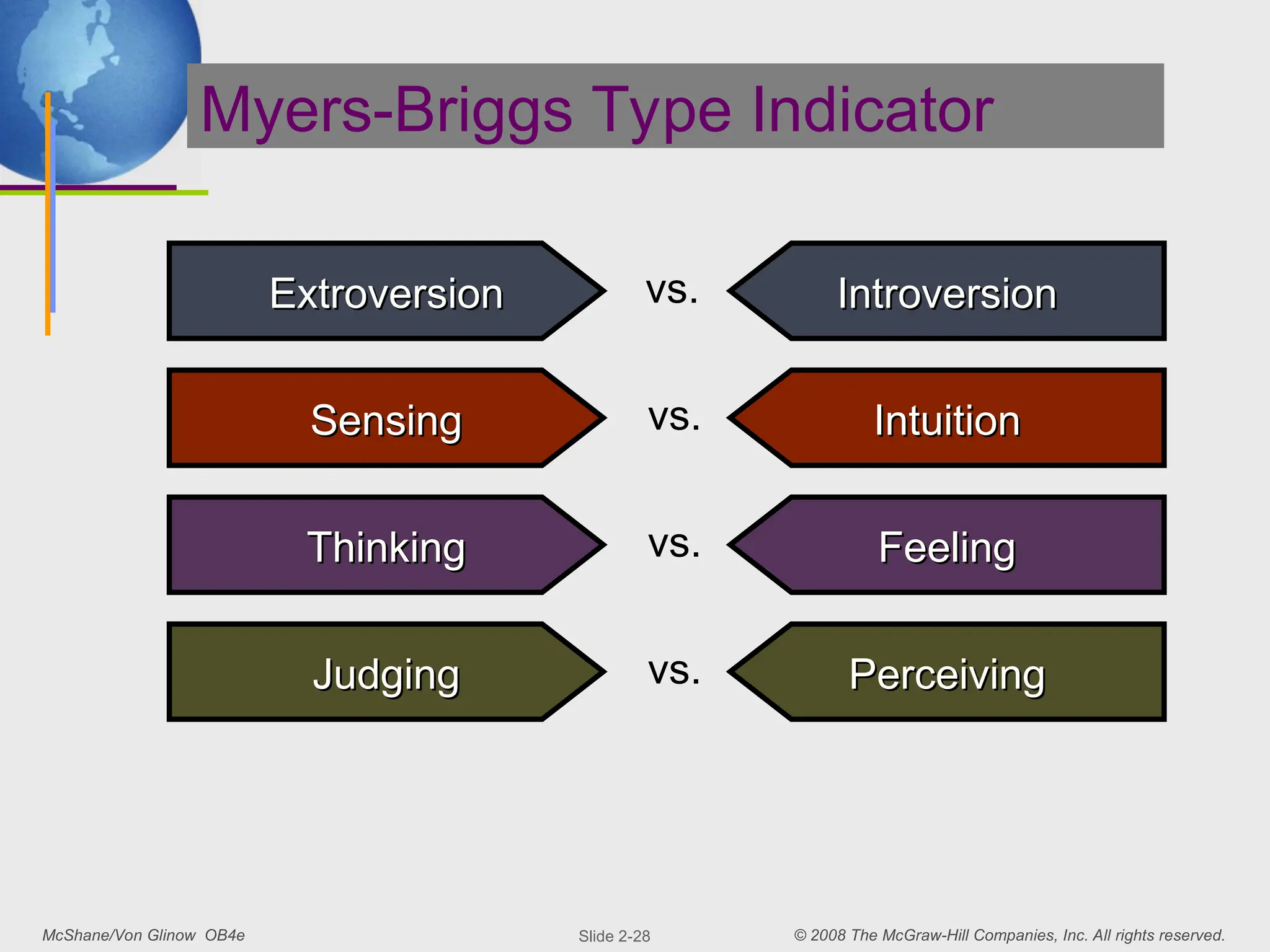
Slide 2-28
Myers-Briggs Type Indicator
Extroversion
Extroversion Introversion
Introversion
vs.
Sensing
Sensing Intuition
Intuition
vs.
Thinking
Thinking Feeling
Feeling
vs.
Judging
Judging Perceiving
Perceiving
vs.
McShane/Von Glinow OB4e © 2008 The McGraw-Hill Companies, Inc. All rights reserved.
Slide 2-29
Locus of Control and Self-Monitoring
• Locus of control
– Internal beliefs in ones effort and ability
– External beliefs events are mainly due to external
causes
• Self-monitoring personality
– Sensitivity to situational cues, and ability to adapt your
behavior to that situation
McShane/Von Glinow OB4e © 2008 The McGraw-Hill Companies, Inc. All rights reserved.
Slide 2-30
Holland’s Occupational Choice Theory
• Career success depends on fit between the person and
work environment
• Holland identifies six “themes”
– Represent work environment and personality
traits/interests
• A person aligned mainly with one theme is highly
differentiated
• A person has high consistency when preferences relate
to adjacent themes

Individual Behavior, Values, and Personality.ppt

  • 1.
    McGraw-Hill/Irwin © 2008The McGraw-Hill Companies, Inc. All rights reserved. 2 Individual Behavior, Values, and Personality Chapter 2 MN201 Lecturer: LONG BUNTENG Week II
  • 2.
    McShane/Von Glinow OB4e© 2008 The McGraw-Hill Companies, Inc. All rights reserved. Slide 2-2 Engagement at Owens Corning Owens Corning is making employee engagement a cornerstone of its business strategy to become a world- class organization. Reprinted with permission of Owens Corning. All rights reserved
  • 3.
    McShane/Von Glinow OB4e© 2008 The McGraw-Hill Companies, Inc. All rights reserved. Slide 2-3 Employee Engagement Defined The employee’s emotional and cognitive (rational) motivation, ability to perform the job, clear understanding of the organization’s vision and his/her specific role in that vision, and a belief that he/she has the resources to get the job done Reprinted with permission of Owens Corning. All rights reserved
  • 4.
    McShane/Von Glinow OB4e© 2008 The McGraw-Hill Companies, Inc. All rights reserved. Slide 2-4 Individual Individual Behavior Behavior and Results and Results Role Role Perceptions Perceptions Situational Situational Factors Factors Motivation Motivation Ability Ability Values Values Personality Personality Perceptions Perceptions Emotions Emotions Attitudes Attitudes Stress Stress MARS Model of Individual Behavior
  • 5.
    McShane/Von Glinow OB4e© 2008 The McGraw-Hill Companies, Inc. All rights reserved. Slide 2-5 Example An enthusiastic salespeople (motivation) who understand his or her job duties (role perceptions) and has sufficient resources (situational factor) will not perform his or her jobs as well if they lack sufficient knowledge and sales skill (ability)
  • 6.
    McShane/Von Glinow OB4e© 2008 The McGraw-Hill Companies, Inc. All rights reserved. Slide 2-6 M M A A R R S S BAR BAR Employee Motivation • Internal forces that affect a person’s voluntary choice of behavior. Motivational elements are: – direction – intensity – persistence
  • 7.
    McShane/Von Glinow OB4e© 2008 The McGraw-Hill Companies, Inc. All rights reserved. Slide 2-7 M M A A R R S S BAR BAR Employee Ability • Natural aptitudes (natural talents) and learned capabilities (skills and knowledge) required to successfully complete a task – competencies  personal characteristics that lead to superior performance – person  job matching • selecting the best • training & developing • redesigning jobs
  • 8.
    McShane/Von Glinow OB4e© 2008 The McGraw-Hill Companies, Inc. All rights reserved. Slide 2-8 M M A A R R S S BAR BAR Employee Role Perceptions • Beliefs about what behavior is required to achieve the desired results: – understanding what tasks to perform – understanding relative importance of tasks – understanding preferred behaviors to accomplish tasks
  • 9.
    McShane/Von Glinow OB4e© 2008 The McGraw-Hill Companies, Inc. All rights reserved. Slide 2-9 M M A A R R S S BAR BAR Situational Factors • Environmental conditions beyond the individual’s short-term control that constrain or facilitate behavior. Controllable factors are: – time – people – budget – work facilities
  • 10.
    McShane/Von Glinow OB4e© 2008 The McGraw-Hill Companies, Inc. All rights reserved. Slide 2-10 Organizational Organizational Citizenship Citizenship • Performance beyond the required job duties Task Task Performance Performance • Goal-directed behaviours under person’s control more Types of Behavior in Organizations
  • 11.
    McShane/Von Glinow OB4e© 2008 The McGraw-Hill Companies, Inc. All rights reserved. Slide 2-11 Maintaining Work Maintaining Work Attendance Attendance • Attending work at required times Joining/staying Joining/staying with the with the Organization Organization • Goal-directed behaviours under person’s control Types of Behavior in Organizations Counterproductive Counterproductive Work Behaviours Work Behaviours • Voluntary behaviour that potentially harms the organization
  • 12.
    McShane/Von Glinow OB4e© 2008 The McGraw-Hill Companies, Inc. All rights reserved. Slide 2-12 Values in the Workplace • Values are stable, evaluative beliefs that guide our preferences for outcomes. A value is a principle, a standard, or a quality considered worthwhile or desirable. • They define the right or wrong, good or bad • Value system -- hierarchy of values • Espoused vs. Enacted values: – Espoused -- the values we say we use and often think we use – Enacted -- values we actually rely on to guide our decisions and actions
  • 13.
    McShane/Von Glinow OB4e© 2008 The McGraw-Hill Companies, Inc. All rights reserved. Slide 2-13 Three Categories of Values • Personal values define who an individual is. They serve as guides in handling situations and interacting with others. • Organizational values are the standards that guide an individual's behavior in a professional context. They define how an individual accomplishes work, interacts in professional situations, and how he makes decisions relative to his job/career. • Cultural values are standards that guide how a person relates meaningfully to others in different social situations.
  • 14.
    McShane/Von Glinow OB4e© 2008 The McGraw-Hill Companies, Inc. All rights reserved. Slide 2-14 Schwartz’s Values Model Conservation Self-enhancement Self-transcendence Openness to Change
  • 15.
    McShane/Von Glinow OB4e© 2008 The McGraw-Hill Companies, Inc. All rights reserved. Slide 2-15 Values and Behavior • Habitual behavior tends to be consistent with our values, but our everyday conscious decisions and actions apply our values much less consistently. • Decisions and behaviors linked to values when:43 1. Mindful and conscious of our values 2. Have logical reasons to apply values in that situation 3. Situation does not interfere
  • 16.
    McShane/Von Glinow OB4e© 2008 The McGraw-Hill Companies, Inc. All rights reserved. Slide 2-16 Values Congruence at Coles More than 2,300 Coles employees across all levels participated in 203 focus groups around the country. Their objective: to identify a set of values for Australia’s second largest retailer that would be congruent with their personal values. Armen Dueschian/Newspix Integrity -- Respect/recognition -- Passion for excellence -- Working together
  • 17.
    McShane/Von Glinow OB4e© 2008 The McGraw-Hill Companies, Inc. All rights reserved. Slide 2-17 Values Congruence • Values congruence -- where two or more entities have similar value systems • Problems with incongruence – Incompatible decisions – Lower satisfaction and commitment – Increased stress and turnover • Benefits of (some) incongruence – Better decision making (diverse values) – Enhanced problem definition – Prevents “corporate cults” Armen Dueschian/Newspix
  • 18.
    McShane/Von Glinow OB4e© 2008 The McGraw-Hill Companies, Inc. All rights reserved. Slide 2-18 Individualism- Collectivism Peru Chile Italy Nigeria India United States Japan Egypt Korea France PR China Portugal Mexico Hong Kong Taiwan Collectivism High Low Individualism High Low Australia Hungary New Zealand Singapore
  • 19.
    McShane/Von Glinow OB4e© 2008 The McGraw-Hill Companies, Inc. All rights reserved. Slide 2-19 Power Distance The degree that people accept an unequal distribution of power in society Japan Japan Israel Israel Denmark Denmark Venezuela Venezuela High Power Distance Malaysia Malaysia Low Power Distance U.S. U.S.
  • 20.
    McShane/Von Glinow OB4e© 2008 The McGraw-Hill Companies, Inc. All rights reserved. Slide 2-20 Uncertainty Avoidance High U. A. Low U. A. Japan Japan Greece Greece U.S. U.S. The degree that people tolerate ambiguity (low) or feel threatened by ambiguity and uncertainty (high uncertainty avoidance). Italy Italy Singapore Singapore
  • 21.
    McShane/Von Glinow OB4e© 2008 The McGraw-Hill Companies, Inc. All rights reserved. Slide 2-21 Achievement-Nurturing Achievement Nurturing Japan Japan U.S. U.S. Sweden Sweden The degree that people value assertiveness, competitiveness, and materialism (achievement) versus relationships and well-being of others (nurturing) China China Chile Chile France France
  • 22.
    McShane/Von Glinow OB4e© 2008 The McGraw-Hill Companies, Inc. All rights reserved. Slide 2-22 Ethics • Ethics is a system of moral values that govern a person's conduct. Values and ethics, together, define a person • Ethics refers to the study of moral principles or values that determine whether actions are right or wrong and outcomes are good or bad. • People rely on ethical values to determine ‘the right thing to do’.
  • 23.
    McShane/Von Glinow OB4e© 2008 The McGraw-Hill Companies, Inc. All rights reserved. Slide 2-23 Utilitarianism Utilitarianism Individual Individual Rights Rights Greatest good for the greatest number of people Fundamental entitlements in society Distributive Distributive Justice Justice People who are similar should receive similar benefits Three Ethical Principles
  • 24.
    McShane/Von Glinow OB4e© 2008 The McGraw-Hill Companies, Inc. All rights reserved. Slide 2-24 Influences on Ethical Conduct • Moral intensity – degree to which an issue demands the application of ethical principles • Ethical sensitivity – ability to recognize the presence and determine the relative importance of an ethical issue • Situational influences – competitive pressures and other conditions affect ethical behavior
  • 25.
    McShane/Von Glinow OB4e© 2008 The McGraw-Hill Companies, Inc. All rights reserved. Slide 2-25 Supporting Ethical Behavior • Ethical code of conduct – Establishes standards of behavior – Problem: Limited effect alone on ethical behavior • Ethics training – Awareness and clarification of ethics code – Practice resolving ethical dilemmas • Ethics officers – Educate and counsel; hear about wrongdoing • Ethical leadership and culture – Demonstrate integrity and role model ethical conduct
  • 26.
    McShane/Von Glinow OB4e© 2008 The McGraw-Hill Companies, Inc. All rights reserved. Slide 2-26 Defining Personality Relatively stable pattern of behaviors and consistent internal states that explain a person's behavioral tendencies
  • 27.
    McShane/Von Glinow OB4e© 2008 The McGraw-Hill Companies, Inc. All rights reserved. Slide 2-27 Big Five Personality Dimensions Outgoing, talkative, sociable, assertive Sensitive, flexible, creative, curious Careful, dependable, self-disciplined Courteous, caring, good-natured Anxious, hostile, depressed Extroversion Extroversion Openness to Experience Openness to Experience Conscientiousness Conscientiousness Agreeableness Neuroticism Neuroticism
  • 28.
    McShane/Von Glinow OB4e© 2008 The McGraw-Hill Companies, Inc. All rights reserved. Slide 2-28 Myers-Briggs Type Indicator Extroversion Extroversion Introversion Introversion vs. Sensing Sensing Intuition Intuition vs. Thinking Thinking Feeling Feeling vs. Judging Judging Perceiving Perceiving vs.
  • 29.
    McShane/Von Glinow OB4e© 2008 The McGraw-Hill Companies, Inc. All rights reserved. Slide 2-29 Locus of Control and Self-Monitoring • Locus of control – Internal beliefs in ones effort and ability – External beliefs events are mainly due to external causes • Self-monitoring personality – Sensitivity to situational cues, and ability to adapt your behavior to that situation
  • 30.
    McShane/Von Glinow OB4e© 2008 The McGraw-Hill Companies, Inc. All rights reserved. Slide 2-30 Holland’s Occupational Choice Theory • Career success depends on fit between the person and work environment • Holland identifies six “themes” – Represent work environment and personality traits/interests • A person aligned mainly with one theme is highly differentiated • A person has high consistency when preferences relate to adjacent themes