Copyright © 2015 McGraw-Hill Education. All rights reserved. No reproduction or distribution without the prior written consent of McGraw-Hill Education.
Motivation
Chapter Nine
9-2
The Nature of Motivation
Motivation
 The psychological forces that determine the
direction of a person’s behavior in an
organization, a person’s level of effort, and a
person’s level of
persistence
9-3
The Nature of Motivation
Direction
 possible behaviors the individual could engage in
Effort
 how hard the individual will work
Persistence
 whether the individual will keep trying or give up
9-4
The Nature of Motivation
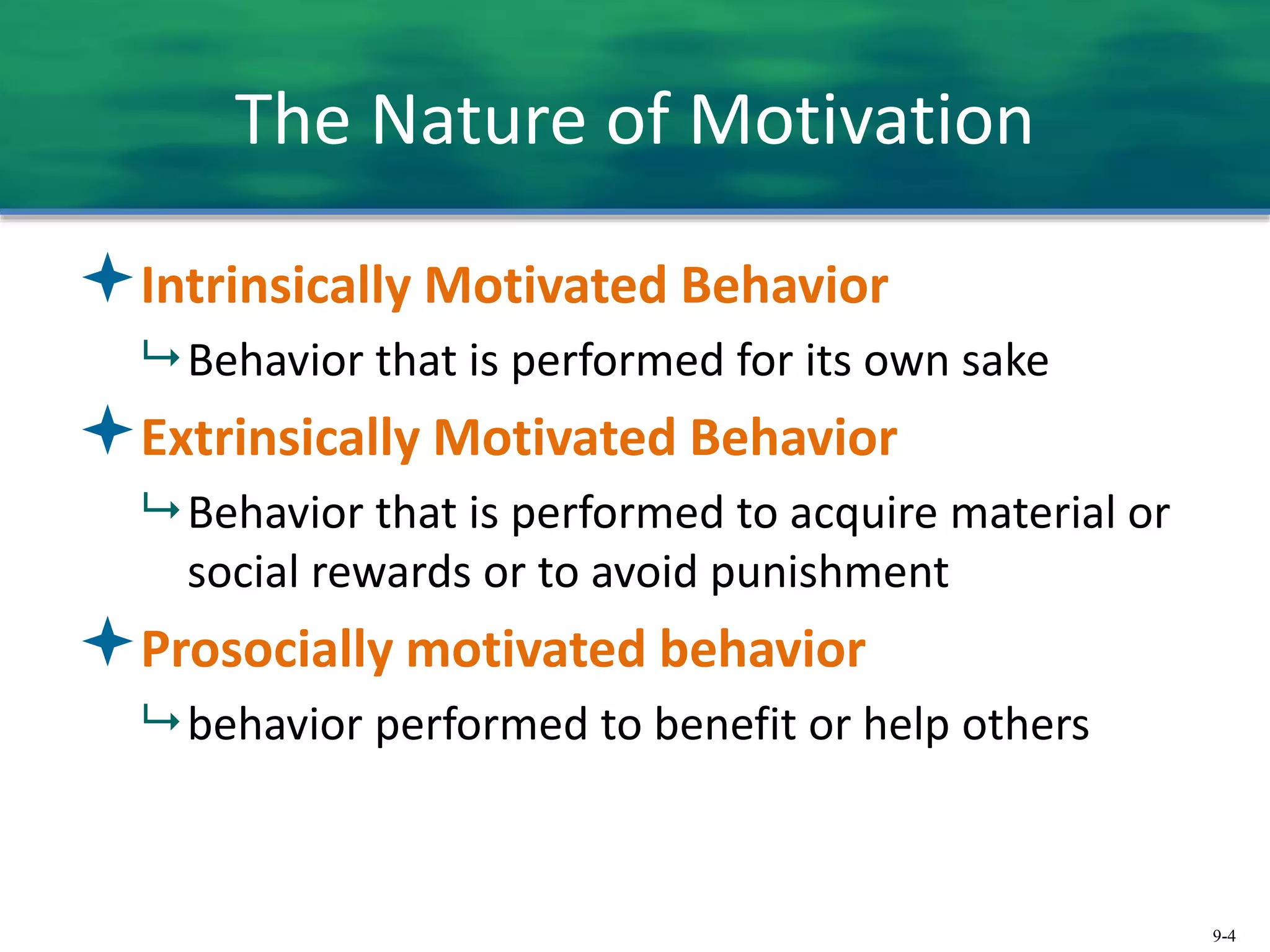
Intrinsically Motivated Behavior
 Behavior that is performed for its own sake
Extrinsically Motivated Behavior
 Behavior that is performed to acquire material or
social rewards or to avoid punishment
Prosocially motivated behavior
 behavior performed to benefit or help others
9-5
The Nature of Motivation
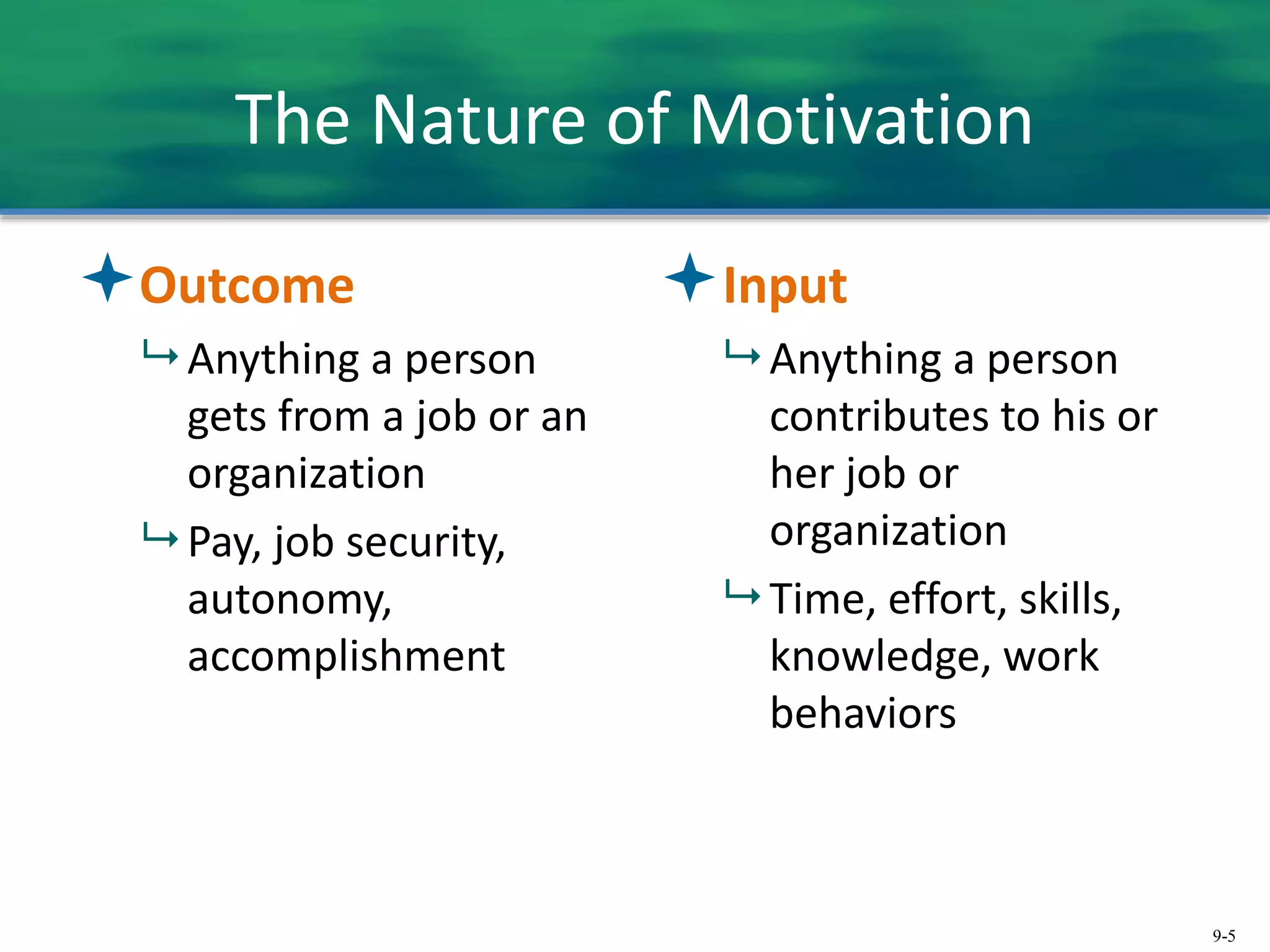
Outcome
 Anything a person
gets from a job or an
organization
 Pay, job security,
autonomy,
accomplishment
Input
 Anything a person
contributes to his or
her job or
organization
 Time, effort, skills,
knowledge, work
behaviors
9-6
The Motivation Equation
Figure 9.1
9-7
Expectancy Theory
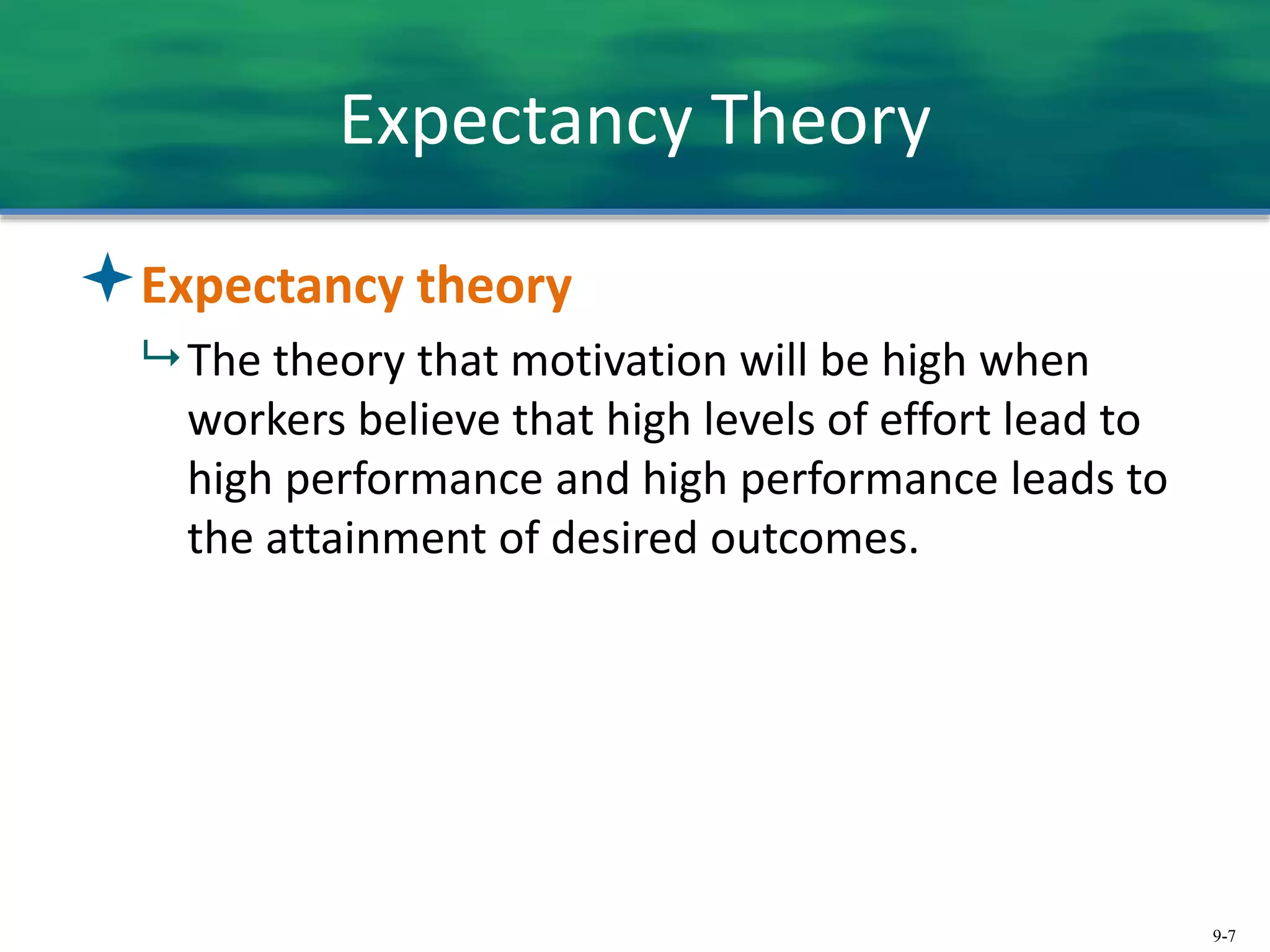
Expectancy theory
 The theory that motivation will be high when
workers believe that high levels of effort lead to
high performance and high performance leads to
the attainment of desired outcomes.
9-8
Question?
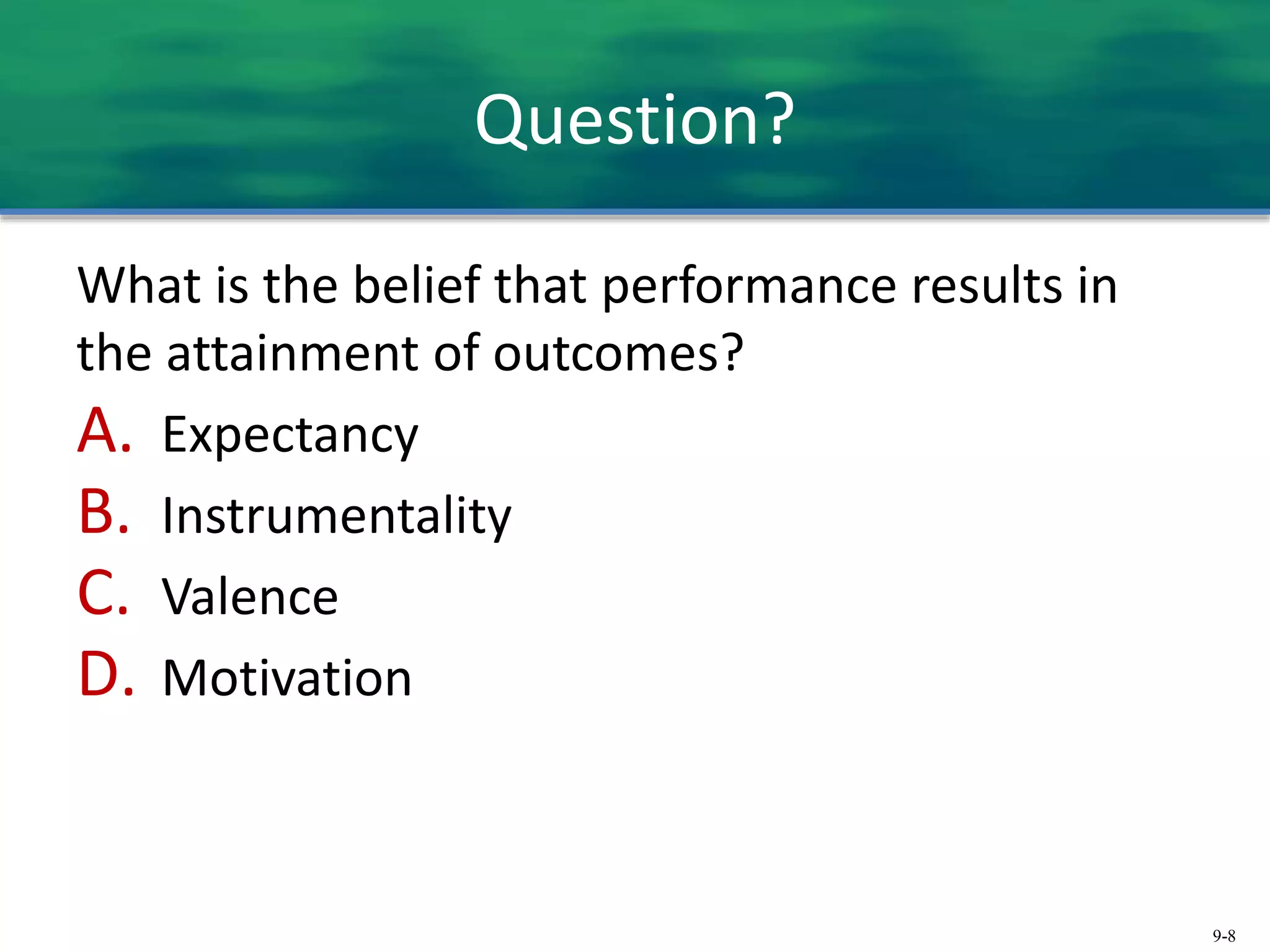
What is the belief that performance results in
the attainment of outcomes?
A. Expectancy
B. Instrumentality
C. Valence
D. Motivation
9-9
Expectancy Theory
Expectancy
 the belief that effort (input) will result in a certain
level of performance
Instrumentality
 the belief that performance results in the attainment
of outcomes
Valence
 how desirable each of the available outcomes from
the job is to a person
9-10
Expectancy, Instrumentality,
and Valence
Figure 9.2
9-11
Expectancy Theory
Figure 9.3
9-12
Need Theories
Need Theories
 Theories of motivation that focus on what needs
people are trying to satisfy at work and what
outcomes will satisfy those needs
 Basis premise is that people are motivated to
obtain outcomes at work to satisfy their needs
9-13
Maslow’s Hierarchy of Needs
9-14
Herzberg’s Motivation-Hygiene Theory
Herzberg’s Motivation-Hygiene Theory
 A need theory that distinguishes between
motivator needs (related to the nature of the
work itself) and hygiene needs (related to the
physical and psychological context in which the
work is performed) and proposes that motivator
needs must be met for motivation and job
satisfaction to be high.
9-15
Herzberg’s Motivation-Hygiene Theory
Motivator needs relate to the nature of the
work itself and how challenging it is
Hygiene needs are related to the physical and
psychological context in which the work is
performed
9-16
McClelland’s Needs for Achievement,
Affiliation, and Power
Need for
Achievement
 A strong desire to
perform challenging
tasks well and meet
personal standards
for excellence
9-17
McClelland’s Needs for Achievement,
Affiliation, and Power
Need for Affiliation
 Extent to which an individual is concerned about
establishing and maintaining good interpersonal
relations, being liked, and having the people
around him get along with each other
Need for Power
 Extent to which an individual desires to control or
influence others
9-18
Equity Theory
Equity Theory
 A theory of motivation that focuses on people’s
perceptions of the fairness of their work
outcomes relative to their work inputs.
9-19
Equity Theory
Equity
 Justice, impartiality, and fairness to which all
organizational members are entitled
Inequity
 Lack of fairness
9-20
Equity Theory
Table 9.2
9-21
Equity Theory
Underpayment
inequity
 exists when a person
perceives that his
own outcome–input
ratio is less than the
ratio of a referent.
Overpayment
inequity
 exists when a person
perceives that his
own outcome–input
ratio is greater than
the ratio of a
referent.
9-22
Goal Setting Theory
Goal Setting Theory
 Focuses on identifying the types of goals that are
effective in producing high levels of motivation
and performance and explaining why goals have
these effects
9-23
Learning Theories
Learning Theories
 Theories that focus on increasing employee
motivation and performance by linking the
outcomes that employees receive to the
performance of desired behaviors and the
attainment of goals
9-24
Question?
What is a relatively permanent change in
person’s knowledge or behavior that
results from practice or experience?
A. Observation
B. Learning
C. Anecdotal
D. Empirical
9-25
Learning Theories
Learning
 A relatively
permanent change
in person’s
knowledge or
behavior that results
from
practice or
experience
9-26
Operant Conditioning Theory
Operant Conditioning
 People learn to perform behaviors that lead to
desired consequences and learn not to perform
behaviors that lead to undesired consequences.
9-27
Operant Conditioning Theory
Positive
Reinforcement
 Giving people
outcomes they
desire when they
perform
organizationally
functional behaviors
Negative
Reinforcement
 Eliminating
undesired outcomes
when people
perform
organizationally
functional behaviors
9-28
Operant Conditioning Theory
Extinction
 Curtailing the
performance of a
dysfunctional
behavior by
eliminating whatever
is reinforcing them
Punishment
 Administering an
undesired or
negative
consequence when
dysfunctional
behavior occurs
9-29
Discussion Question
Which of the following motivates employees
best?
A. Positive Reinforcement
B. Negative Reinforcement
C. Extinction
D. Punishment
9-30
Social Learning Theory
Social Learning Theory
 A theory that takes into account how learning and
motivation are influenced by people’s
thoughts and beliefs and their observations of
other people’s behavior
9-31
Social Learning Theory
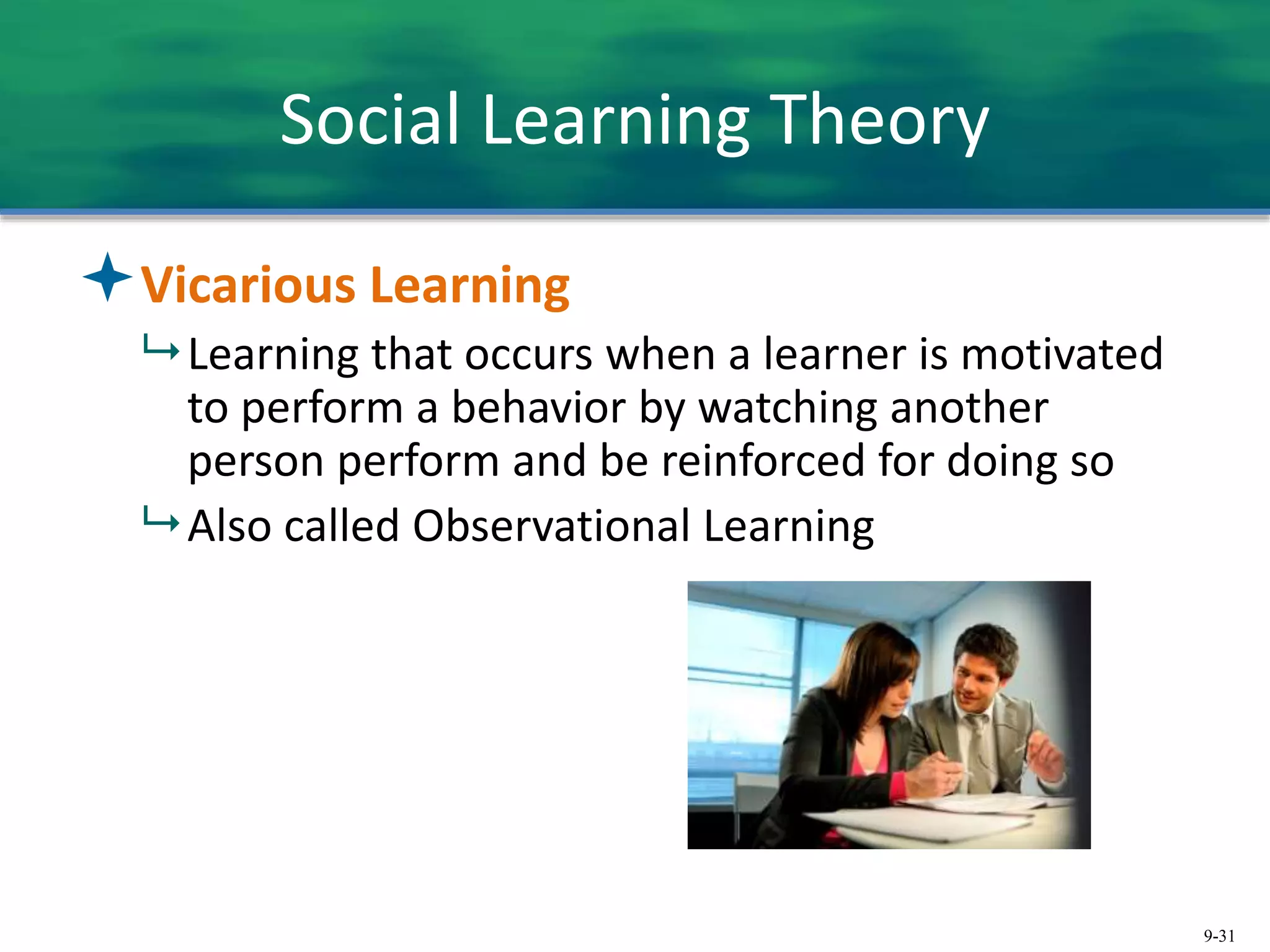
Vicarious Learning
 Learning that occurs when a learner is motivated
to perform a behavior by watching another
person perform and be reinforced for doing so
 Also called Observational Learning
9-32
Social Learning Theory
Self-Reinforcement
 Any desired or attractive outcome or award that a
person can give himself or herself for good
performance
Self-efficacy
 A person’s belief about his or her ability to
perform a behavior successfully
9-33
Pay and Motivation
Pay as a Motivator
 Expectancy: Instrumentality, the association
between performance and outcomes, must be
high for motivation to be high.
 Need Theory: pay is used to satisfy many needs.
 Equity Theory: pay is given in relation to inputs
9-34
Pay and Motivation
Pay as a Motivator
 Goal Setting Theory: pay is linked to attainment of
goals.
 Learning Theory: outcomes (pay), is distributed
upon performance of functional behaviors.
9-35
Merit Pay and Performance
Merit Pay Plan
 A compensation plan
that bases pay on
performance
9-36
Salary Increase or Bonus?
Employee Stock Option
 A financial instrument that entitles the bearer to
buy shares of an organization’s stock at a certain
price during a certain period of time or under
certain conditions.
9-37
Examples of Merit Pay Plans
Piece-rate Pay
 Employee’s pay is
based on the
number of units that
the employee
produces
Commission Pay
 Employee’s pay is
based on a
percentage of sales
that the employee
makes
9-38
Examples of Merit Pay Plans
Scanlon plan
 focuses on reduced
expenses or cutting
costs
Profit sharing
 employees receive a
share of an
organization’s profits
9-39
SAS
9-40
Video: SAS
What impact does the multitude of benefits
available at SAS have on employee
motivation?
What are the advantages of the SAS model?

MG371 ch9

  • 1.
    Copyright © 2015McGraw-Hill Education. All rights reserved. No reproduction or distribution without the prior written consent of McGraw-Hill Education. Motivation Chapter Nine
  • 2.
    9-2 The Nature ofMotivation Motivation  The psychological forces that determine the direction of a person’s behavior in an organization, a person’s level of effort, and a person’s level of persistence
  • 3.
    9-3 The Nature ofMotivation Direction  possible behaviors the individual could engage in Effort  how hard the individual will work Persistence  whether the individual will keep trying or give up
  • 4.
    9-4 The Nature ofMotivation Intrinsically Motivated Behavior  Behavior that is performed for its own sake Extrinsically Motivated Behavior  Behavior that is performed to acquire material or social rewards or to avoid punishment Prosocially motivated behavior  behavior performed to benefit or help others
  • 5.
    9-5 The Nature ofMotivation Outcome  Anything a person gets from a job or an organization  Pay, job security, autonomy, accomplishment Input  Anything a person contributes to his or her job or organization  Time, effort, skills, knowledge, work behaviors
  • 6.
  • 7.
    9-7 Expectancy Theory Expectancy theory The theory that motivation will be high when workers believe that high levels of effort lead to high performance and high performance leads to the attainment of desired outcomes.
  • 8.
    9-8 Question? What is thebelief that performance results in the attainment of outcomes? A. Expectancy B. Instrumentality C. Valence D. Motivation
  • 9.
    9-9 Expectancy Theory Expectancy  thebelief that effort (input) will result in a certain level of performance Instrumentality  the belief that performance results in the attainment of outcomes Valence  how desirable each of the available outcomes from the job is to a person
  • 10.
  • 11.
  • 12.
    9-12 Need Theories Need Theories Theories of motivation that focus on what needs people are trying to satisfy at work and what outcomes will satisfy those needs  Basis premise is that people are motivated to obtain outcomes at work to satisfy their needs
  • 13.
  • 14.
    9-14 Herzberg’s Motivation-Hygiene Theory Herzberg’sMotivation-Hygiene Theory  A need theory that distinguishes between motivator needs (related to the nature of the work itself) and hygiene needs (related to the physical and psychological context in which the work is performed) and proposes that motivator needs must be met for motivation and job satisfaction to be high.
  • 15.
    9-15 Herzberg’s Motivation-Hygiene Theory Motivatorneeds relate to the nature of the work itself and how challenging it is Hygiene needs are related to the physical and psychological context in which the work is performed
  • 16.
    9-16 McClelland’s Needs forAchievement, Affiliation, and Power Need for Achievement  A strong desire to perform challenging tasks well and meet personal standards for excellence
  • 17.
    9-17 McClelland’s Needs forAchievement, Affiliation, and Power Need for Affiliation  Extent to which an individual is concerned about establishing and maintaining good interpersonal relations, being liked, and having the people around him get along with each other Need for Power  Extent to which an individual desires to control or influence others
  • 18.
    9-18 Equity Theory Equity Theory A theory of motivation that focuses on people’s perceptions of the fairness of their work outcomes relative to their work inputs.
  • 19.
    9-19 Equity Theory Equity  Justice,impartiality, and fairness to which all organizational members are entitled Inequity  Lack of fairness
  • 20.
  • 21.
    9-21 Equity Theory Underpayment inequity  existswhen a person perceives that his own outcome–input ratio is less than the ratio of a referent. Overpayment inequity  exists when a person perceives that his own outcome–input ratio is greater than the ratio of a referent.
  • 22.
    9-22 Goal Setting Theory GoalSetting Theory  Focuses on identifying the types of goals that are effective in producing high levels of motivation and performance and explaining why goals have these effects
  • 23.
    9-23 Learning Theories Learning Theories Theories that focus on increasing employee motivation and performance by linking the outcomes that employees receive to the performance of desired behaviors and the attainment of goals
  • 24.
    9-24 Question? What is arelatively permanent change in person’s knowledge or behavior that results from practice or experience? A. Observation B. Learning C. Anecdotal D. Empirical
  • 25.
    9-25 Learning Theories Learning  Arelatively permanent change in person’s knowledge or behavior that results from practice or experience
  • 26.
    9-26 Operant Conditioning Theory OperantConditioning  People learn to perform behaviors that lead to desired consequences and learn not to perform behaviors that lead to undesired consequences.
  • 27.
    9-27 Operant Conditioning Theory Positive Reinforcement Giving people outcomes they desire when they perform organizationally functional behaviors Negative Reinforcement  Eliminating undesired outcomes when people perform organizationally functional behaviors
  • 28.
    9-28 Operant Conditioning Theory Extinction Curtailing the performance of a dysfunctional behavior by eliminating whatever is reinforcing them Punishment  Administering an undesired or negative consequence when dysfunctional behavior occurs
  • 29.
    9-29 Discussion Question Which ofthe following motivates employees best? A. Positive Reinforcement B. Negative Reinforcement C. Extinction D. Punishment
  • 30.
    9-30 Social Learning Theory SocialLearning Theory  A theory that takes into account how learning and motivation are influenced by people’s thoughts and beliefs and their observations of other people’s behavior
  • 31.
    9-31 Social Learning Theory VicariousLearning  Learning that occurs when a learner is motivated to perform a behavior by watching another person perform and be reinforced for doing so  Also called Observational Learning
  • 32.
    9-32 Social Learning Theory Self-Reinforcement Any desired or attractive outcome or award that a person can give himself or herself for good performance Self-efficacy  A person’s belief about his or her ability to perform a behavior successfully
  • 33.
    9-33 Pay and Motivation Payas a Motivator  Expectancy: Instrumentality, the association between performance and outcomes, must be high for motivation to be high.  Need Theory: pay is used to satisfy many needs.  Equity Theory: pay is given in relation to inputs
  • 34.
    9-34 Pay and Motivation Payas a Motivator  Goal Setting Theory: pay is linked to attainment of goals.  Learning Theory: outcomes (pay), is distributed upon performance of functional behaviors.
  • 35.
    9-35 Merit Pay andPerformance Merit Pay Plan  A compensation plan that bases pay on performance
  • 36.
    9-36 Salary Increase orBonus? Employee Stock Option  A financial instrument that entitles the bearer to buy shares of an organization’s stock at a certain price during a certain period of time or under certain conditions.
  • 37.
    9-37 Examples of MeritPay Plans Piece-rate Pay  Employee’s pay is based on the number of units that the employee produces Commission Pay  Employee’s pay is based on a percentage of sales that the employee makes
  • 38.
    9-38 Examples of MeritPay Plans Scanlon plan  focuses on reduced expenses or cutting costs Profit sharing  employees receive a share of an organization’s profits
  • 39.
  • 40.
    9-40 Video: SAS What impactdoes the multitude of benefits available at SAS have on employee motivation? What are the advantages of the SAS model?