BY
OMOLE ADETOUN (ACIPM) *
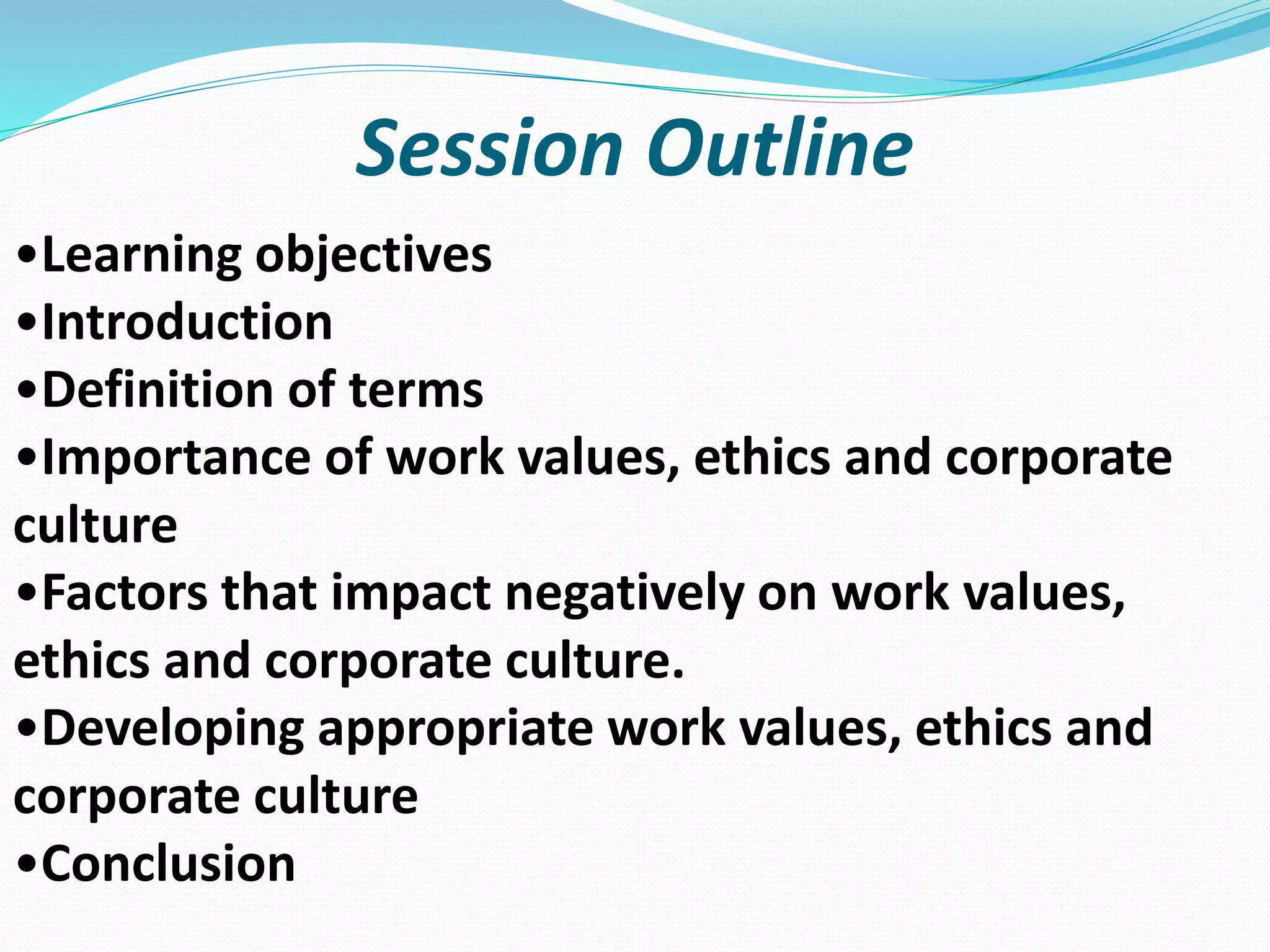
Session Outline
•Learning objectives
•Introduction
•Definition of terms
•Importance of work values, ethics and corporate
culture
•Factors that impact negatively on work values,
ethics and corporate culture.
•Developing appropriate work values, ethics and
corporate culture
•Conclusion
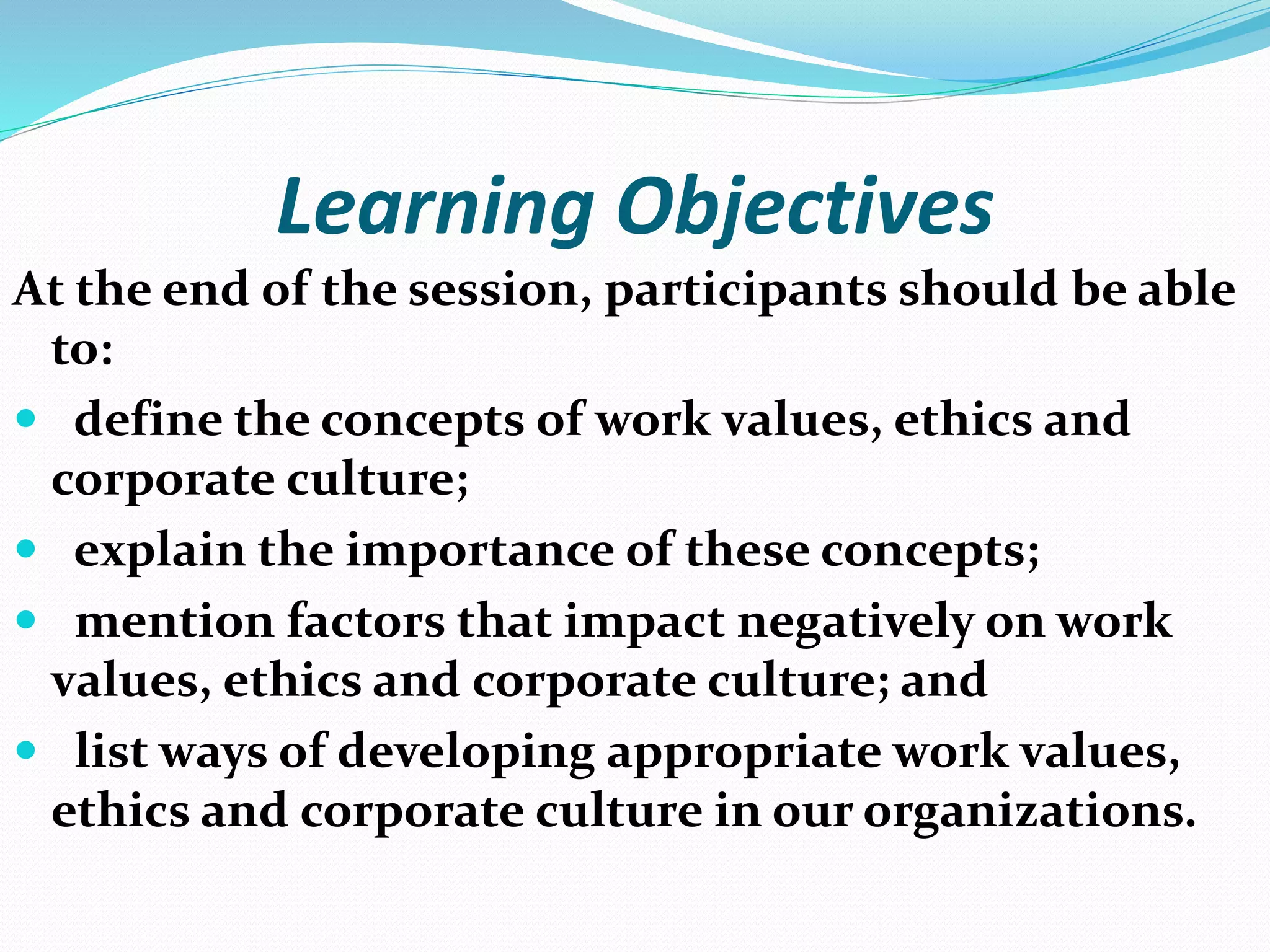
Learning Objectives
At the end of the session, participants should be able
to:
 define the concepts of work values, ethics and
corporate culture;
 explain the importance of these concepts;
 mention factors that impact negatively on work
values, ethics and corporate culture; and
 list ways of developing appropriate work values,
ethics and corporate culture in our organizations.
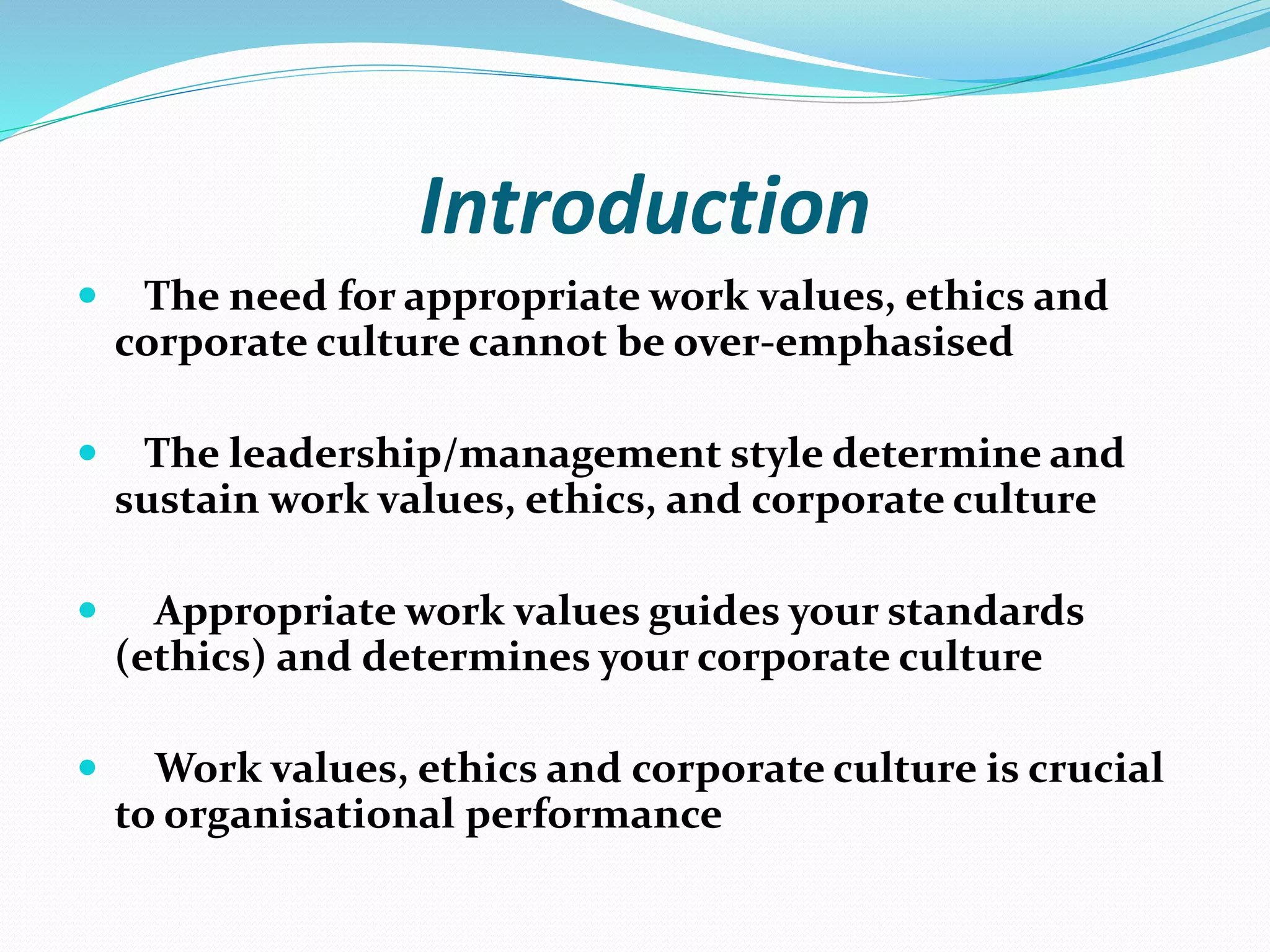
Introduction
 The need for appropriate work values, ethics and
corporate culture cannot be over-emphasised
 The leadership/management style determine and
sustain work values, ethics, and corporate culture
 Appropriate work values guides your standards
(ethics) and determines your corporate culture
 Work values, ethics and corporate culture is crucial
to organisational performance
Definition of Terms:
Synonyms of the word, ‘Appropriate’:
 suitable,
 befitting,
 proper,
 well-timed,
 practical,
 workable,
 good ,
 applicable…
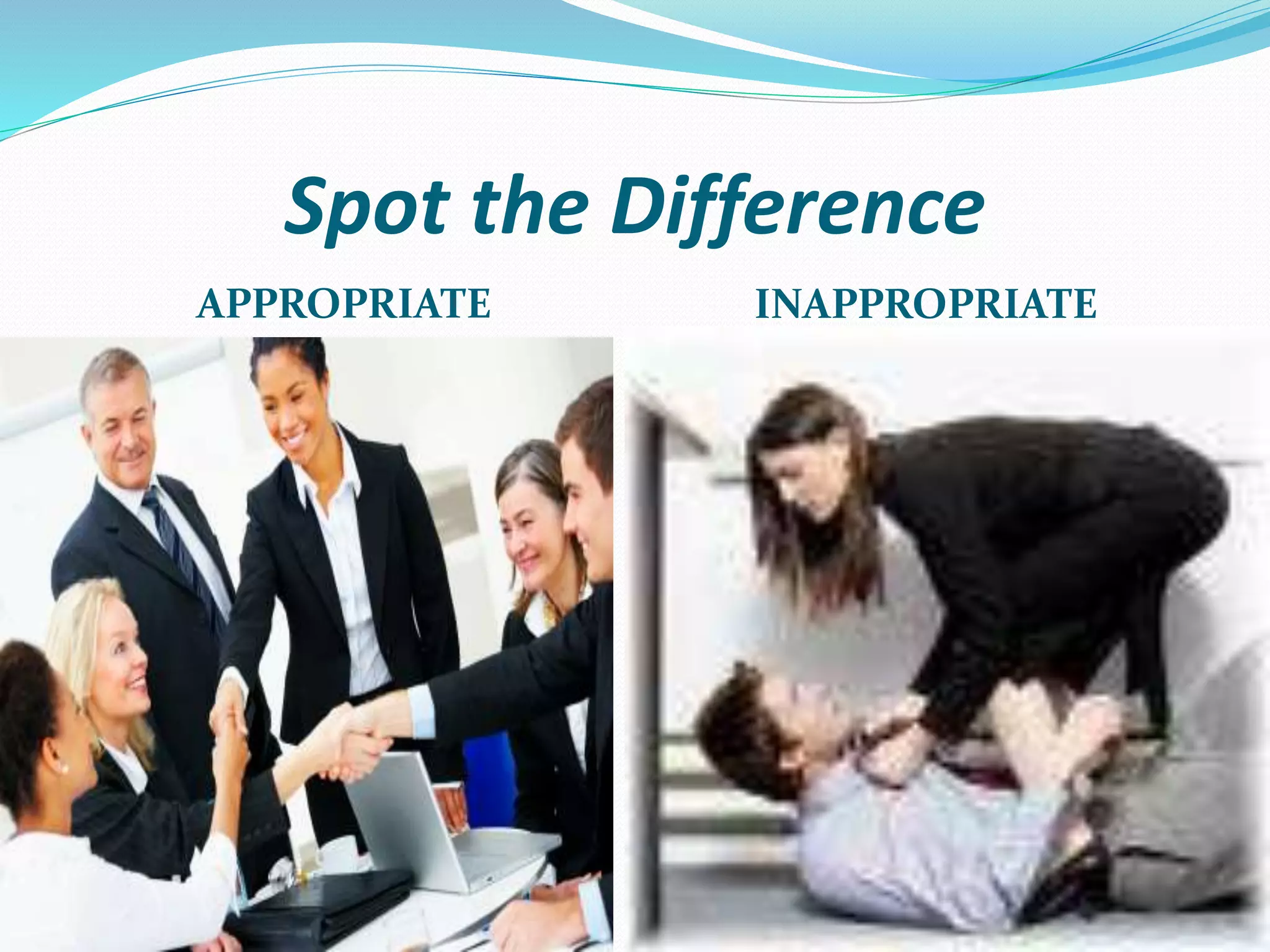
Spot the Difference
APPROPRIATE INAPPROPRIATE
WORK VALUES
 the worth, importance or
usefulness of something to
somebody
 are beliefs and practices you
consider important
 are passed down from
generation to generation
 govern what people do, how
they do them , why they do them
and their efforts
 can aid or impede individual
and organisational growth
 become our way of life
(culture) overtime
Personal work values
 Integrity
 Loyalty to your team / boss / organisation / profession
 Diligence
 Maximising profits and minimising losses for your
company (simply by doing your tasks / job perfectly)
 Working as a team with your colleagues for the progress
of the company regardless of your differences
 Excellent customer service
Common organisational values include:
 integrity
 service excellence / professionalism
 operational efficiency/competence
 cost - consciousness
 customer satisfaction
 technology know-how
 timeliness
Organisational values
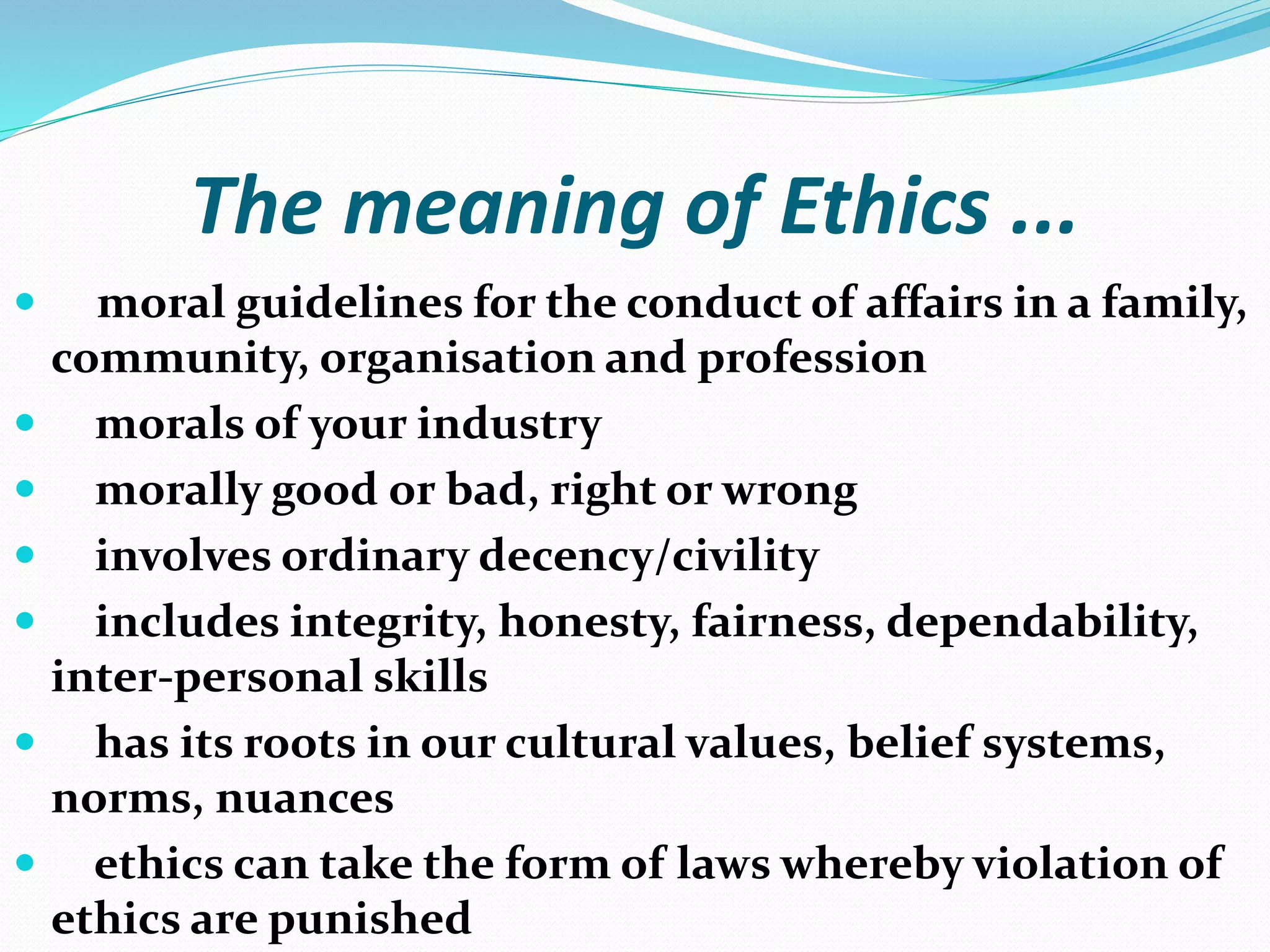
Work Ethics (Formal Dress code)
APPROPRIATE INAPPROPRIATE
The meaning of Ethics ...
 moral guidelines for the conduct of affairs in a family,
community, organisation and profession
 morals of your industry
 morally good or bad, right or wrong
 involves ordinary decency/civility
 includes integrity, honesty, fairness, dependability,
inter-personal skills
 has its roots in our cultural values, belief systems,
norms, nuances
 ethics can take the form of laws whereby violation of
ethics are punished
Importance of Work Ethics
 Required for predictable behaviour,
 good communication for building relationships
 ensures good conduct in the society
 absence of ethics leads to disorderliness, chaos and
anarchy
 many professional bodies provide members with a
code of conduct and ethics
 violation of ethics attracts strong sanctions and
discipline
Inappropriate Work Ethics
Appropriate Work Ethics
 Allegiance to authority
 Office etiquette
 Team spirit
 Confidentiality and tact
 Proper dress sense
 Excellent interpersonal relationship
 Emotional maturity/control . . . . . .
WORK ETHICS ....
 everything starts and ends with
leadership – ‘trickle down’ effect
 leaders (managers, supervisors,
coaches etc) set the standards for
their staff/subordinates/team
 your attitude as a superior rubs
off on your staff and they, in turn,
act the same way towards each other
and towards customers as well.
 management need to act in
consonance with employee
expectation to foster commonality of
purpose
 the boss determines the speed of
the team!
CORPORATE CULTURE
“How we do things around here”
...... Our shared beliefs, attitudes,
norms, behaviours, practices, dressing,
language (spoken and unspoken) systems,
processes etc.
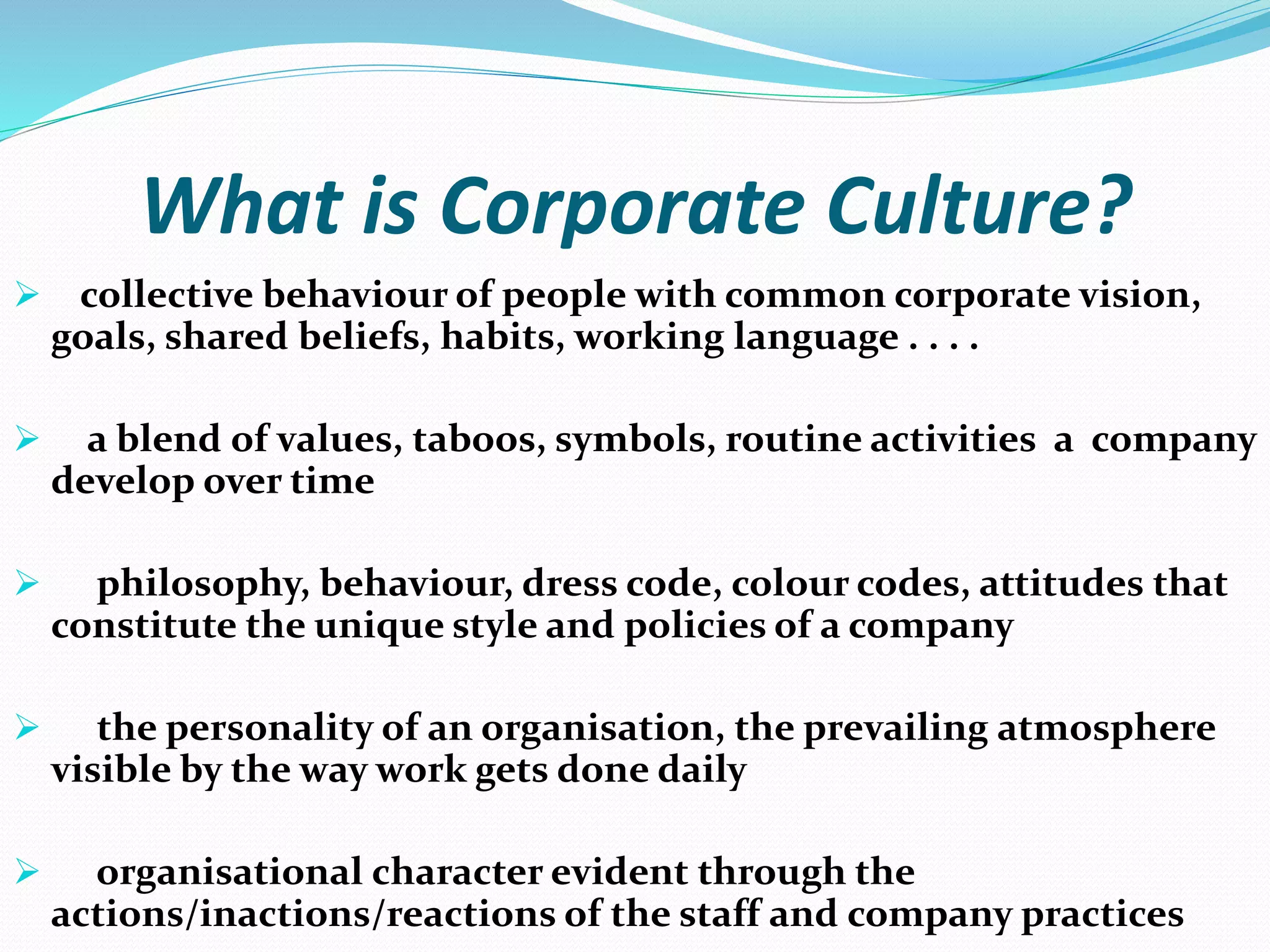
What is Corporate Culture?
 collective behaviour of people with common corporate vision,
goals, shared beliefs, habits, working language . . . .
 a blend of values, taboos, symbols, routine activities a company
develop over time
 philosophy, behaviour, dress code, colour codes, attitudes that
constitute the unique style and policies of a company
 the personality of an organisation, the prevailing atmosphere
visible by the way work gets done daily
 organisational character evident through the
actions/inactions/reactions of the staff and company practices
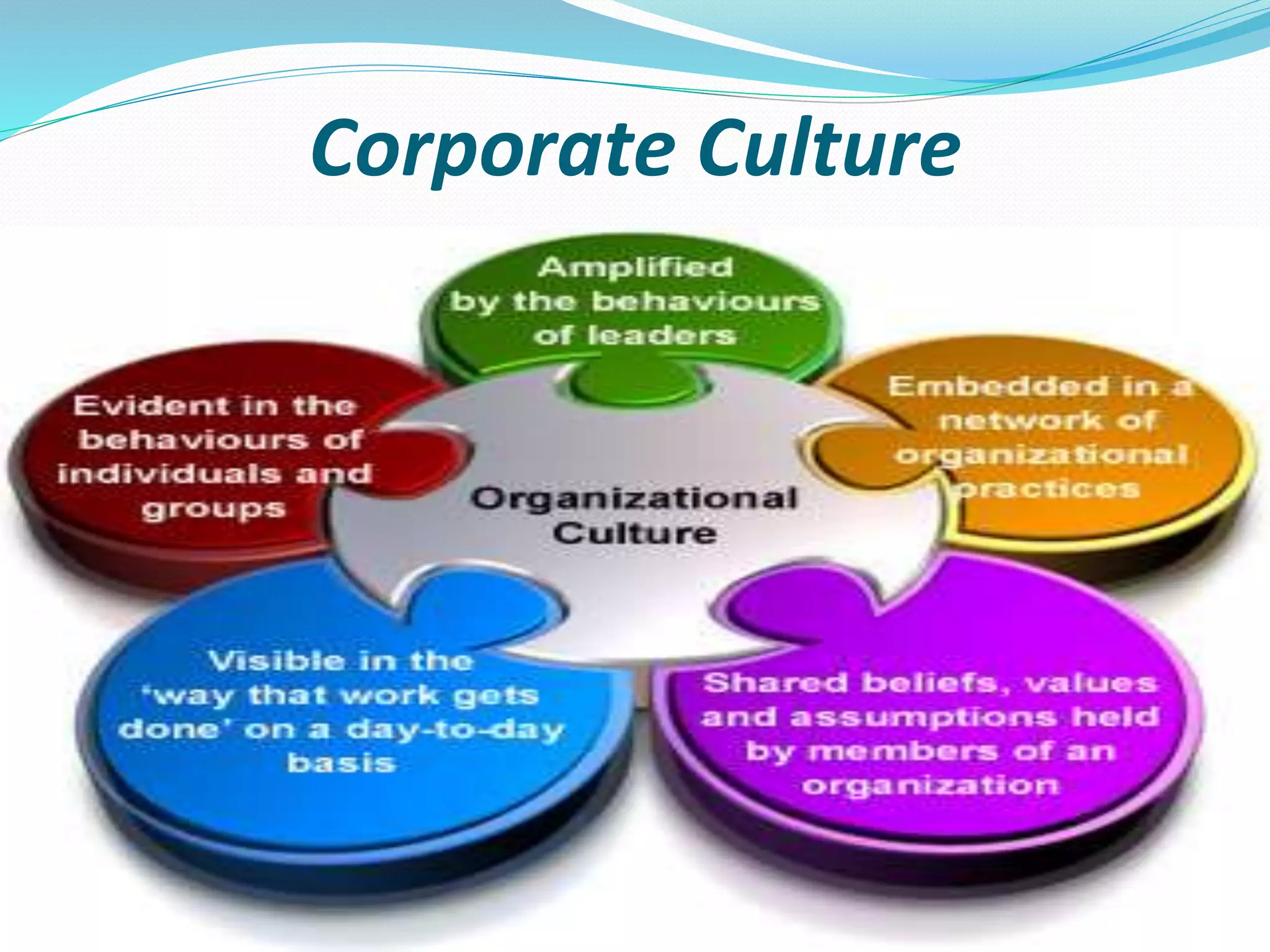
Corporate Culture
Benefits of Corporate Culture
 provides an efficient working environment
 essential to create mutually respectable relationships
 helps day-to-day simple and important action
 guides peoples’ behaviour within an organisation
 assists you in decision making whenever the need arises
 gives you an edge in solving problems bordering on ethics, values,
corporate culture and diversity
 helps to shape and prepare employees for future responsibilities /
challenges
Class Activity
Let’s break into
groups . . .
 Critically
analyse the case
study and
highlight salient
points.
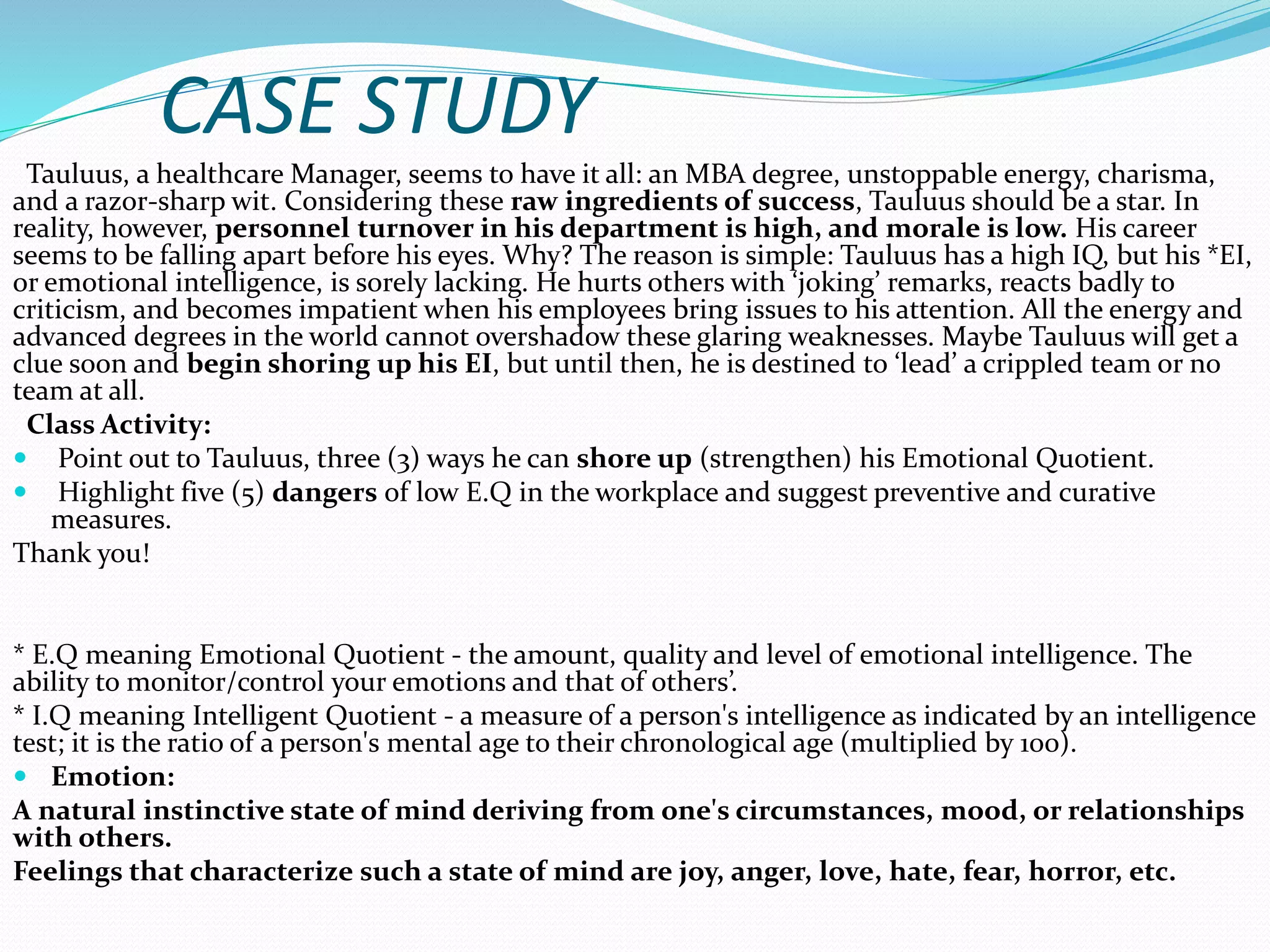
CASE STUDY
Tauluus, a healthcare Manager, seems to have it all: an MBA degree, unstoppable energy, charisma,
and a razor-sharp wit. Considering these raw ingredients of success, Tauluus should be a star. In
reality, however, personnel turnover in his department is high, and morale is low. His career
seems to be falling apart before his eyes. Why? The reason is simple: Tauluus has a high IQ, but his *EI,
or emotional intelligence, is sorely lacking. He hurts others with ‘joking’ remarks, reacts badly to
criticism, and becomes impatient when his employees bring issues to his attention. All the energy and
advanced degrees in the world cannot overshadow these glaring weaknesses. Maybe Tauluus will get a
clue soon and begin shoring up his EI, but until then, he is destined to ‘lead’ a crippled team or no
team at all.
Class Activity:
 Point out to Tauluus, three (3) ways he can shore up (strengthen) his Emotional Quotient.
 Highlight five (5) dangers of low E.Q in the workplace and suggest preventive and curative
measures.
Thank you!
* E.Q meaning Emotional Quotient - the amount, quality and level of emotional intelligence. The
ability to monitor/control your emotions and that of others’.
* I.Q meaning Intelligent Quotient - a measure of a person's intelligence as indicated by an intelligence
test; it is the ratio of a person's mental age to their chronological age (multiplied by 100).
 Emotion:
A natural instinctive state of mind deriving from one's circumstances, mood, or relationships
with others.
Feelings that characterize such a state of mind are joy, anger, love, hate, fear, horror, etc.
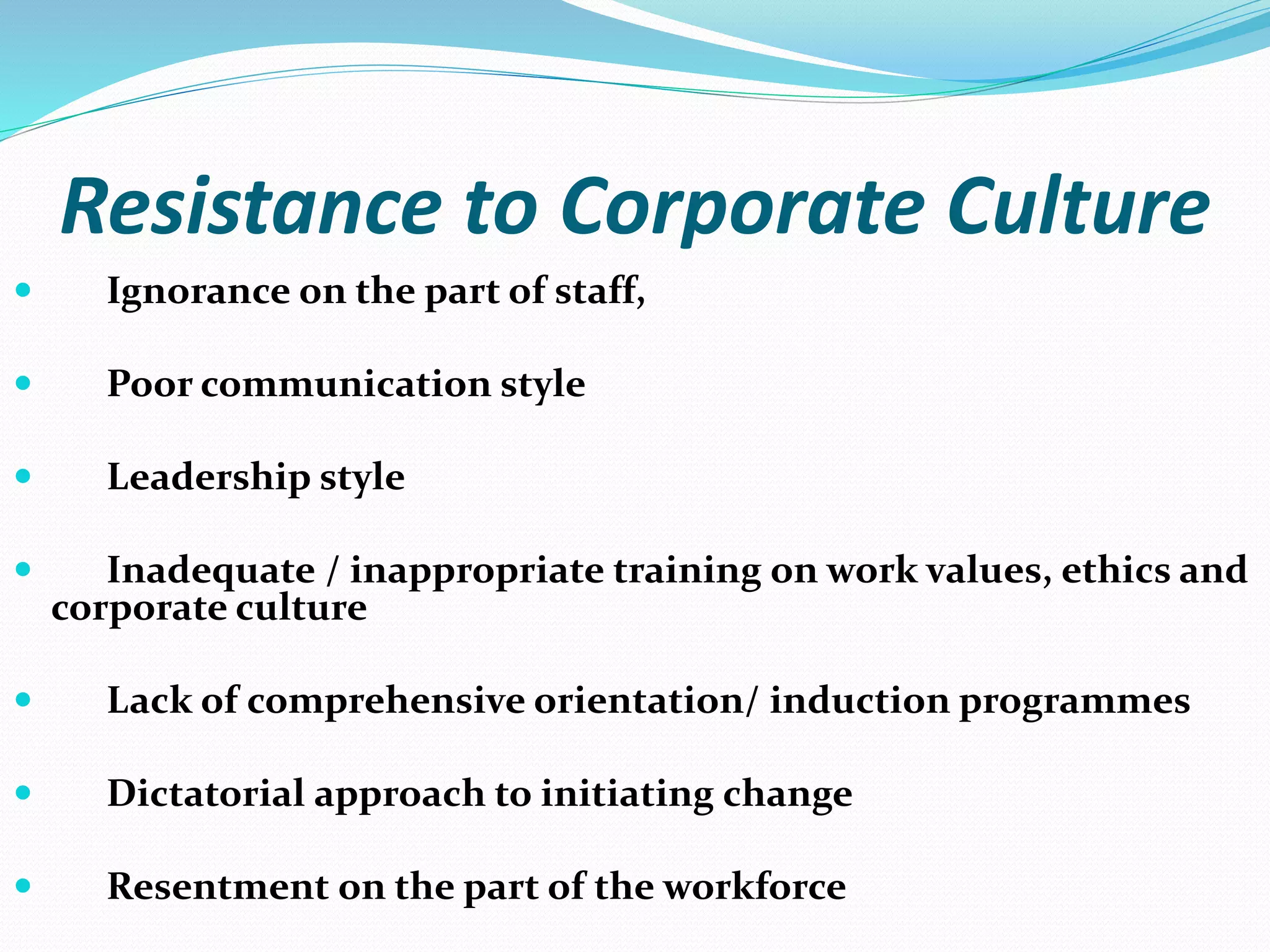
Resistance to Corporate Culture
 Ignorance on the part of staff,
 Poor communication style
 Leadership style
 Inadequate / inappropriate training on work values, ethics and
corporate culture
 Lack of comprehensive orientation/ induction programmes
 Dictatorial approach to initiating change
 Resentment on the part of the workforce
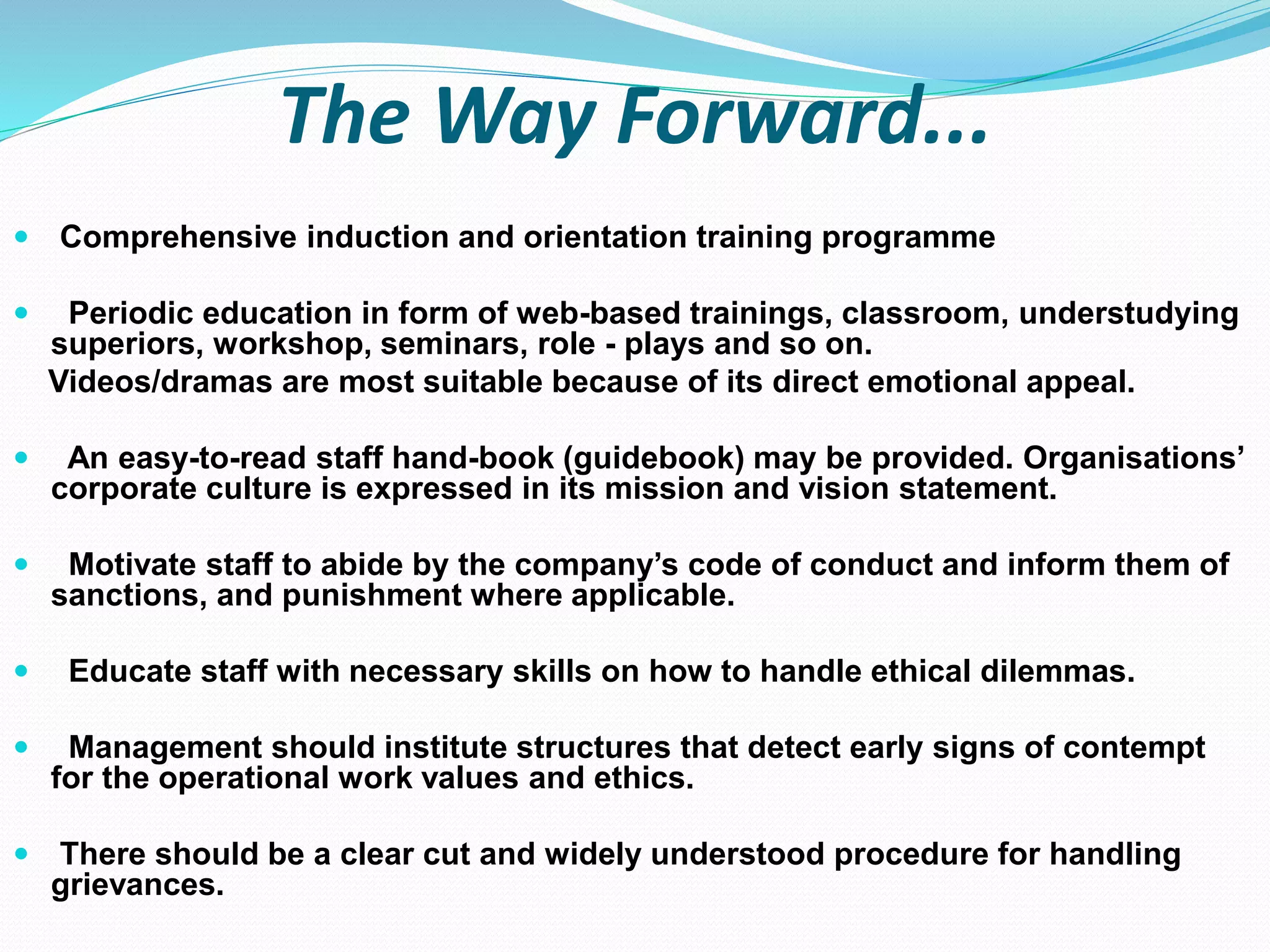
The Way Forward...
 Comprehensive induction and orientation training programme
 Periodic education in form of web-based trainings, classroom, understudying
superiors, workshop, seminars, role - plays and so on.
Videos/dramas are most suitable because of its direct emotional appeal.
 An easy-to-read staff hand-book (guidebook) may be provided. Organisations’
corporate culture is expressed in its mission and vision statement.
 Motivate staff to abide by the company’s code of conduct and inform them of
sanctions, and punishment where applicable.
 Educate staff with necessary skills on how to handle ethical dilemmas.
 Management should institute structures that detect early signs of contempt
for the operational work values and ethics.
 There should be a clear cut and widely understood procedure for handling
grievances.
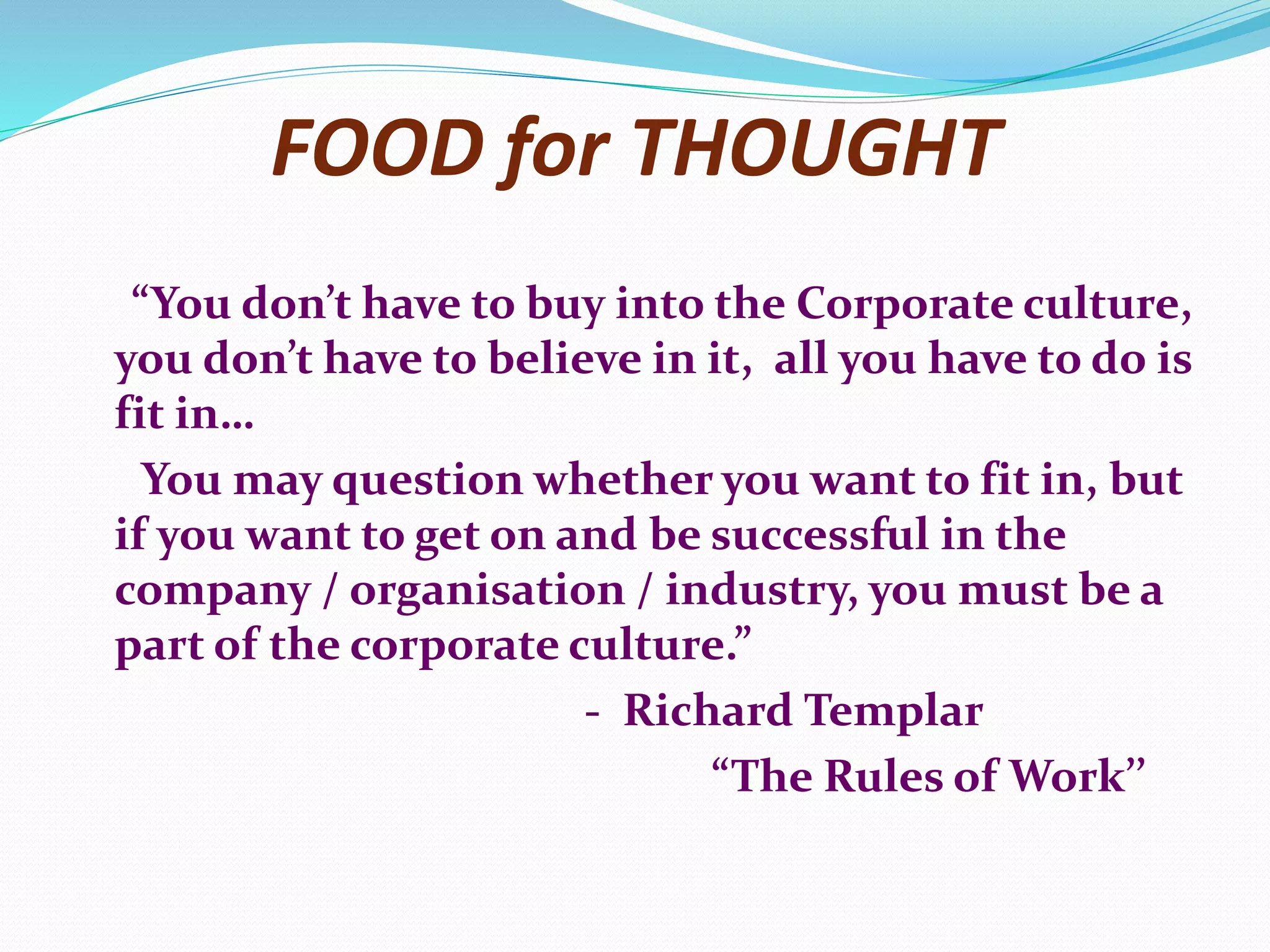
FOOD for THOUGHT
“You don’t have to buy into the Corporate culture,
you don’t have to believe in it, all you have to do is
fit in…
You may question whether you want to fit in, but
if you want to get on and be successful in the
company / organisation / industry, you must be a
part of the corporate culture.”
- Richard Templar
“The Rules of Work’’
Any Question, Please?
Conclusion
 Work values, ethics and corporate culture defines
your organisation, - says more than words (branding)
 Leadership / management style determine and
sustain work values, ethics and corporate culture
 Work values, ethics and corporate culture can
make or mar organisational performance.
 Personal values and ethics of staff must align with
the organisational values, ethics and corporate
culture.
References
For Further Study:
 Armstrong, Michael (2000). A Handbook of Human
Resource Management Practice Kogan Page, Penton
Ville, London
 Fajana, Sola (2002). An Introduction to Human
Resource Management Labofin, Akoka Lagos
 Heller, R. (1998). Communicate Clearly. Dorling
Kindersley Limited, London.
 Templar, R. (2003). The Rules of Work. Pearson
Education Limited. Edinburgh Gate.
The End
Thank you for participating,

Developing appropriate work values, ethics and corporate

  • 1.
  • 2.
    Session Outline •Learning objectives •Introduction •Definitionof terms •Importance of work values, ethics and corporate culture •Factors that impact negatively on work values, ethics and corporate culture. •Developing appropriate work values, ethics and corporate culture •Conclusion
  • 3.
    Learning Objectives At theend of the session, participants should be able to:  define the concepts of work values, ethics and corporate culture;  explain the importance of these concepts;  mention factors that impact negatively on work values, ethics and corporate culture; and  list ways of developing appropriate work values, ethics and corporate culture in our organizations.
  • 4.
    Introduction  The needfor appropriate work values, ethics and corporate culture cannot be over-emphasised  The leadership/management style determine and sustain work values, ethics, and corporate culture  Appropriate work values guides your standards (ethics) and determines your corporate culture  Work values, ethics and corporate culture is crucial to organisational performance
  • 5.
    Definition of Terms: Synonymsof the word, ‘Appropriate’:  suitable,  befitting,  proper,  well-timed,  practical,  workable,  good ,  applicable…
  • 6.
  • 7.
    WORK VALUES  theworth, importance or usefulness of something to somebody  are beliefs and practices you consider important  are passed down from generation to generation  govern what people do, how they do them , why they do them and their efforts  can aid or impede individual and organisational growth  become our way of life (culture) overtime
  • 8.
    Personal work values Integrity  Loyalty to your team / boss / organisation / profession  Diligence  Maximising profits and minimising losses for your company (simply by doing your tasks / job perfectly)  Working as a team with your colleagues for the progress of the company regardless of your differences  Excellent customer service
  • 9.
    Common organisational valuesinclude:  integrity  service excellence / professionalism  operational efficiency/competence  cost - consciousness  customer satisfaction  technology know-how  timeliness Organisational values
  • 10.
    Work Ethics (FormalDress code) APPROPRIATE INAPPROPRIATE
  • 11.
    The meaning ofEthics ...  moral guidelines for the conduct of affairs in a family, community, organisation and profession  morals of your industry  morally good or bad, right or wrong  involves ordinary decency/civility  includes integrity, honesty, fairness, dependability, inter-personal skills  has its roots in our cultural values, belief systems, norms, nuances  ethics can take the form of laws whereby violation of ethics are punished
  • 12.
    Importance of WorkEthics  Required for predictable behaviour,  good communication for building relationships  ensures good conduct in the society  absence of ethics leads to disorderliness, chaos and anarchy  many professional bodies provide members with a code of conduct and ethics  violation of ethics attracts strong sanctions and discipline
  • 13.
  • 14.
    Appropriate Work Ethics Allegiance to authority  Office etiquette  Team spirit  Confidentiality and tact  Proper dress sense  Excellent interpersonal relationship  Emotional maturity/control . . . . . .
  • 15.
    WORK ETHICS .... everything starts and ends with leadership – ‘trickle down’ effect  leaders (managers, supervisors, coaches etc) set the standards for their staff/subordinates/team  your attitude as a superior rubs off on your staff and they, in turn, act the same way towards each other and towards customers as well.  management need to act in consonance with employee expectation to foster commonality of purpose  the boss determines the speed of the team!
  • 16.
    CORPORATE CULTURE “How wedo things around here” ...... Our shared beliefs, attitudes, norms, behaviours, practices, dressing, language (spoken and unspoken) systems, processes etc.
  • 17.
    What is CorporateCulture?  collective behaviour of people with common corporate vision, goals, shared beliefs, habits, working language . . . .  a blend of values, taboos, symbols, routine activities a company develop over time  philosophy, behaviour, dress code, colour codes, attitudes that constitute the unique style and policies of a company  the personality of an organisation, the prevailing atmosphere visible by the way work gets done daily  organisational character evident through the actions/inactions/reactions of the staff and company practices
  • 18.
  • 19.
    Benefits of CorporateCulture  provides an efficient working environment  essential to create mutually respectable relationships  helps day-to-day simple and important action  guides peoples’ behaviour within an organisation  assists you in decision making whenever the need arises  gives you an edge in solving problems bordering on ethics, values, corporate culture and diversity  helps to shape and prepare employees for future responsibilities / challenges
  • 20.
    Class Activity Let’s breakinto groups . . .  Critically analyse the case study and highlight salient points.
  • 21.
    CASE STUDY Tauluus, ahealthcare Manager, seems to have it all: an MBA degree, unstoppable energy, charisma, and a razor-sharp wit. Considering these raw ingredients of success, Tauluus should be a star. In reality, however, personnel turnover in his department is high, and morale is low. His career seems to be falling apart before his eyes. Why? The reason is simple: Tauluus has a high IQ, but his *EI, or emotional intelligence, is sorely lacking. He hurts others with ‘joking’ remarks, reacts badly to criticism, and becomes impatient when his employees bring issues to his attention. All the energy and advanced degrees in the world cannot overshadow these glaring weaknesses. Maybe Tauluus will get a clue soon and begin shoring up his EI, but until then, he is destined to ‘lead’ a crippled team or no team at all. Class Activity:  Point out to Tauluus, three (3) ways he can shore up (strengthen) his Emotional Quotient.  Highlight five (5) dangers of low E.Q in the workplace and suggest preventive and curative measures. Thank you! * E.Q meaning Emotional Quotient - the amount, quality and level of emotional intelligence. The ability to monitor/control your emotions and that of others’. * I.Q meaning Intelligent Quotient - a measure of a person's intelligence as indicated by an intelligence test; it is the ratio of a person's mental age to their chronological age (multiplied by 100).  Emotion: A natural instinctive state of mind deriving from one's circumstances, mood, or relationships with others. Feelings that characterize such a state of mind are joy, anger, love, hate, fear, horror, etc.
  • 22.
    Resistance to CorporateCulture  Ignorance on the part of staff,  Poor communication style  Leadership style  Inadequate / inappropriate training on work values, ethics and corporate culture  Lack of comprehensive orientation/ induction programmes  Dictatorial approach to initiating change  Resentment on the part of the workforce
  • 23.
    The Way Forward... Comprehensive induction and orientation training programme  Periodic education in form of web-based trainings, classroom, understudying superiors, workshop, seminars, role - plays and so on. Videos/dramas are most suitable because of its direct emotional appeal.  An easy-to-read staff hand-book (guidebook) may be provided. Organisations’ corporate culture is expressed in its mission and vision statement.  Motivate staff to abide by the company’s code of conduct and inform them of sanctions, and punishment where applicable.  Educate staff with necessary skills on how to handle ethical dilemmas.  Management should institute structures that detect early signs of contempt for the operational work values and ethics.  There should be a clear cut and widely understood procedure for handling grievances.
  • 24.
    FOOD for THOUGHT “Youdon’t have to buy into the Corporate culture, you don’t have to believe in it, all you have to do is fit in… You may question whether you want to fit in, but if you want to get on and be successful in the company / organisation / industry, you must be a part of the corporate culture.” - Richard Templar “The Rules of Work’’
  • 25.
  • 26.
    Conclusion  Work values,ethics and corporate culture defines your organisation, - says more than words (branding)  Leadership / management style determine and sustain work values, ethics and corporate culture  Work values, ethics and corporate culture can make or mar organisational performance.  Personal values and ethics of staff must align with the organisational values, ethics and corporate culture.
  • 27.
    References For Further Study: Armstrong, Michael (2000). A Handbook of Human Resource Management Practice Kogan Page, Penton Ville, London  Fajana, Sola (2002). An Introduction to Human Resource Management Labofin, Akoka Lagos  Heller, R. (1998). Communicate Clearly. Dorling Kindersley Limited, London.  Templar, R. (2003). The Rules of Work. Pearson Education Limited. Edinburgh Gate.
  • 28.
    The End Thank youfor participating,