Attitudes, Values, and
        Ethics
Attitudes and Emotions
   Attitudes have three components:
    cognitive, affective, and behavioral.

    • The cognitive component refers to the knowledge or intellectual
      beliefs an individual might have about an object.

    • The feeling or affective component refers to the emotion
      connected with that object.

    • The behavioral component refers to how a person acts. All
      three components are interrelated.

   People search for consistency among the components of an
    attitude.
Cognitive dissonance is the situation in
which the pieces of knowledge, information,
attitudes, or beliefs held by an individual
are contradictory.

  People search for ways to reduce internal conflicts when they
  experience a clash between the information they receive and
  their actions or attitudes.
Emotions

   An emotion is a feeling such as
    anger, fear, joy, or surprise that
    underlies behavior

   Emotions have three components:
    internal     arousal,      expressive
    behavior, and a cognitive appraisal.
Emotions
Managing Emotion

   To manage emotion well, managers
   should create a friendly emotional
   climate by setting a positive example,
   including serving as a model of healthy
   emotional expression. Managers might
   also include a positive attitude as one
   factor in selecting individuals and teams
Emotional Labor
   We regulate feelings and expressions
    to meet organizational goals.
   Surface acting is faked expressions.
    
   Deep acting is controlling feelings.
   Emotional dissonance is mismatch
    between felt and expressed
    emotions emotional exhaustion 
Attitudes and Job Satisfaction
   Attitudes   are   linked  to   job
    satisfaction,   the    amount    of
    pleasure or contentment associated
    with a job.

   Workers     will   have    high   job
    satisfaction when they have positive
    attitudes toward such job factors as
    the work itself, recognition, and the
    opportunity for advancement.
Job Satisfaction
   One-half of (U.S.) workers have high
    job satisfaction.
   Benefits, pay, job security rank high.
   Fun on the job leads to satisfaction.
   High job satisfaction correlates with
    organizational performance.
   High organizational performance can
    lead to high job satisfaction.
Consequences of Job Satisfaction
    Among the consequences of high job satisfaction
    are:

   High productivity when the work involves people
    contact
   Loyalty to the company (important because of
    employee retention)
   A stronger tendency to achieve customer loyalty
   Low absenteeism and turnover
   Less job stress and burnout
   Better safety performance
   Better life satisfaction
Organizational Citizenship Behavior
   A broader consequence of job
    satisfaction is that it contributes to
    organizational citizenship
    behavior, or the willingness to work
    for the good of the organization even
    without the promise of a specific
    reward
Organizational Citizenship Behavior
                  (OCB)

   Goes above and beyond call of duty.
   Satisfied workers may show OCB.
   Workers with service orientation and
    empathy may engage in OCB.
   High OCB leads to low turnover, and
    sometimes work/family conflict.
OCB
   Five     key          components     of
    organizational     citizenship behavior
    are:
    •   conscientiousness
    •   altruism
    •   civic virtue
    •   courtesy
    •   sportsmanship.

   The  good     organizational  citizen
    engages in extrarole behavior
VALUES
   A value refers to the importance a
    person attaches to something that
    serves as a guide to action.
Values
   Baby boomers more conservative and
    respectful of authority
   Generation X and Generation Y more
    team-oriented and tech savvy
   Many values are learned through modeling
    and listening
   Employee-employer value fit leads to high
    performance
   Poor employee-employer value fit can lead
    to person-role conflict.
ETHICS
   Ethics is the moral choices a person
    makes, and what he or she should
    do. Ethics can also be regarded as
    the vehicle that converts values into
    action.
Ethical Decision Making Criteria

 A standard way of understanding ethical decision-
 making is to understand the philosophical basis
 for making these decisions.

 Focus on consequences.
 According to this criterion, if nobody gets hurt,
 the decision is ethical. Focusing on consequences
 is often referred to as utilitarian.
Ethical Decision Making
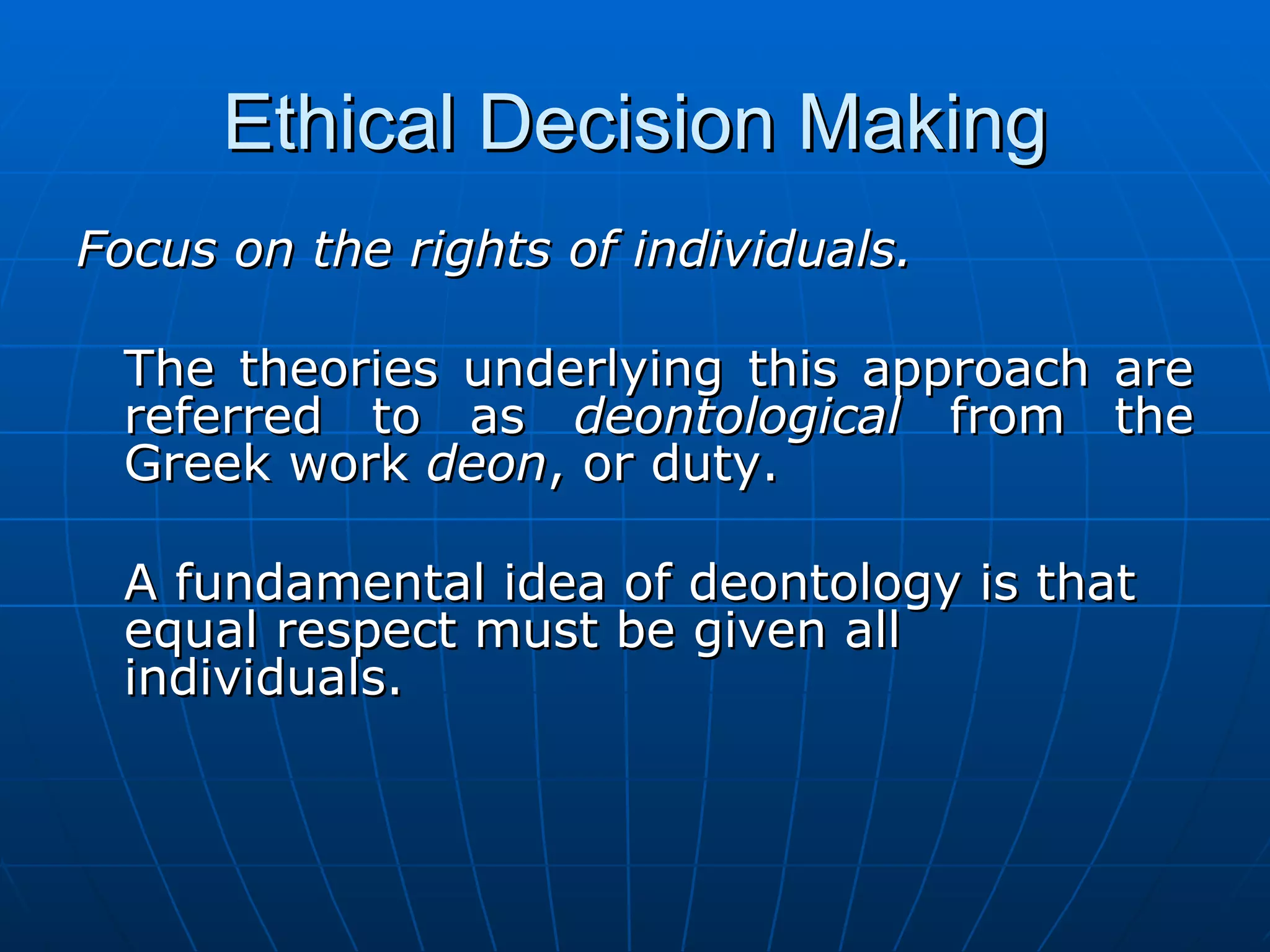
Focus on the rights of individuals.

 The theories underlying this approach are
 referred to as deontological from the
 Greek work deon, or duty.

 A fundamental idea of deontology is that
 equal respect must be given all
 individuals.
Ethical Decision Making
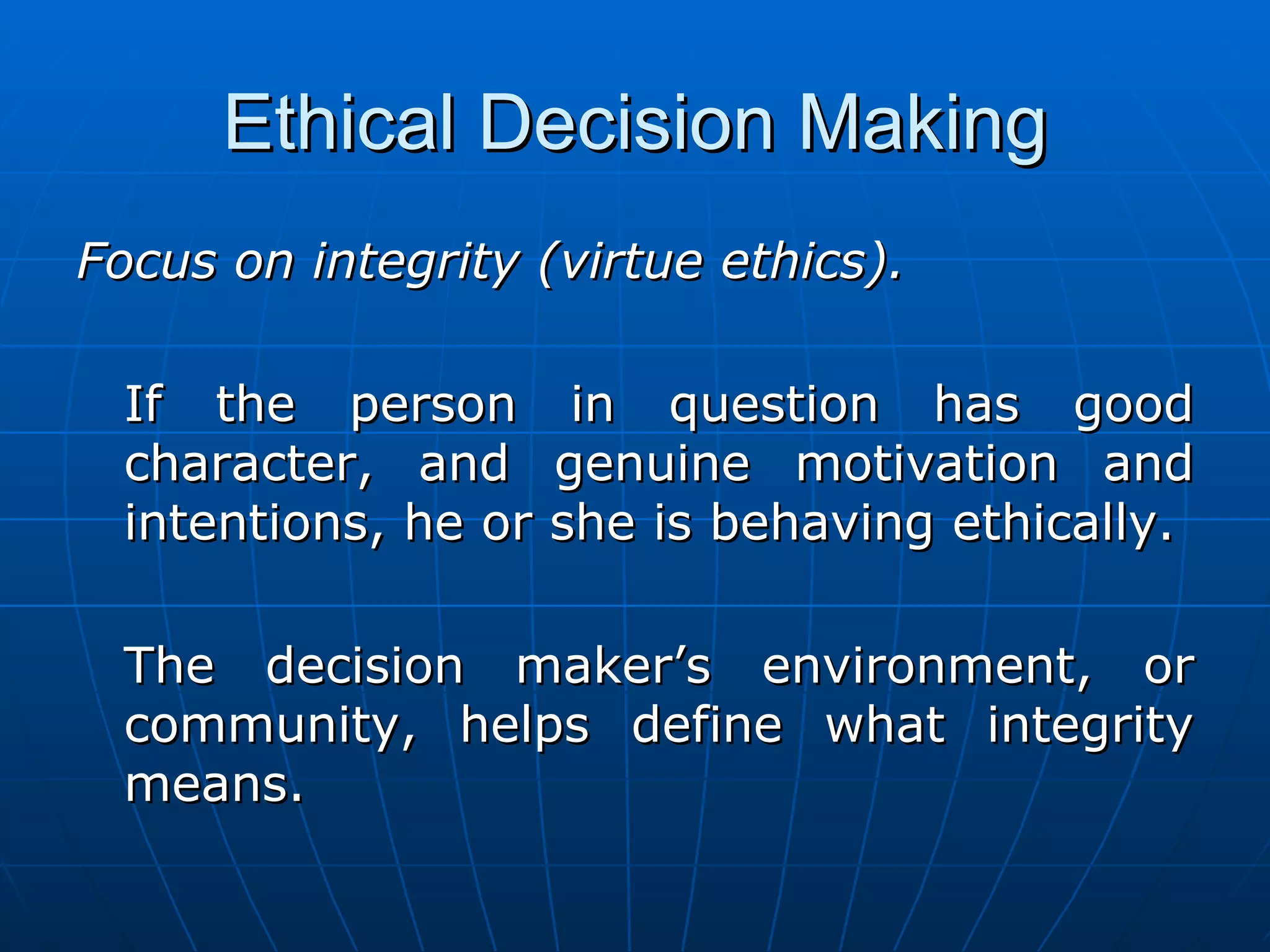
Focus on integrity (virtue ethics).

  If the person in question has good
  character, and genuine motivation and
  intentions, he or she is behaving ethically.

  The decision maker’s environment, or
  community, helps define what integrity
  means.
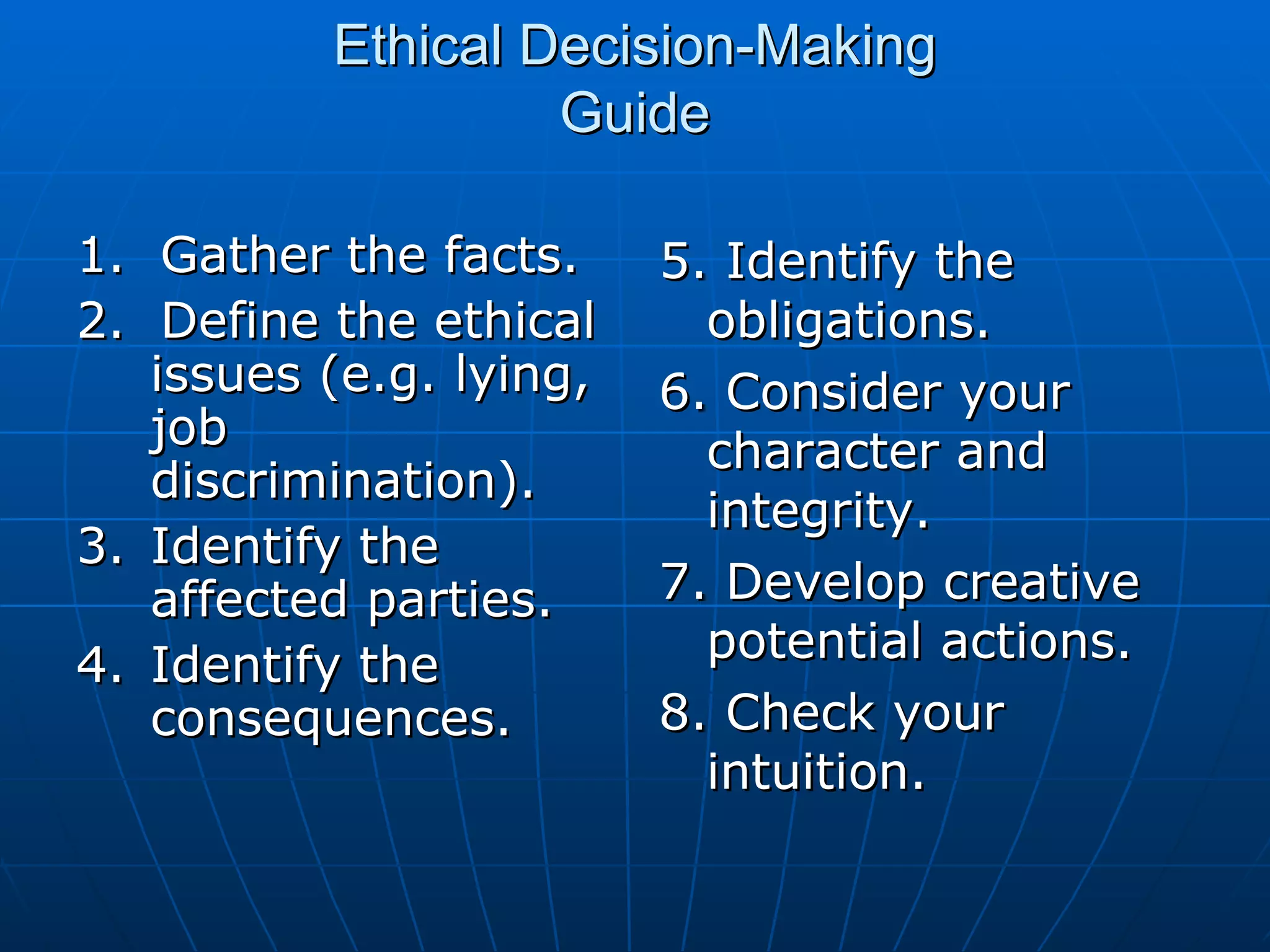
Ethical Decision-Making
                   Guide

1. Gather the facts.     5. Identify the
2. Define the ethical      obligations.
   issues (e.g. lying,   6. Consider your
   job                     character and
   discrimination).
                           integrity.
3. Identify the
   affected parties.     7. Develop creative
4. Identify the            potential actions.
   consequences.         8. Check your
                           intuition.
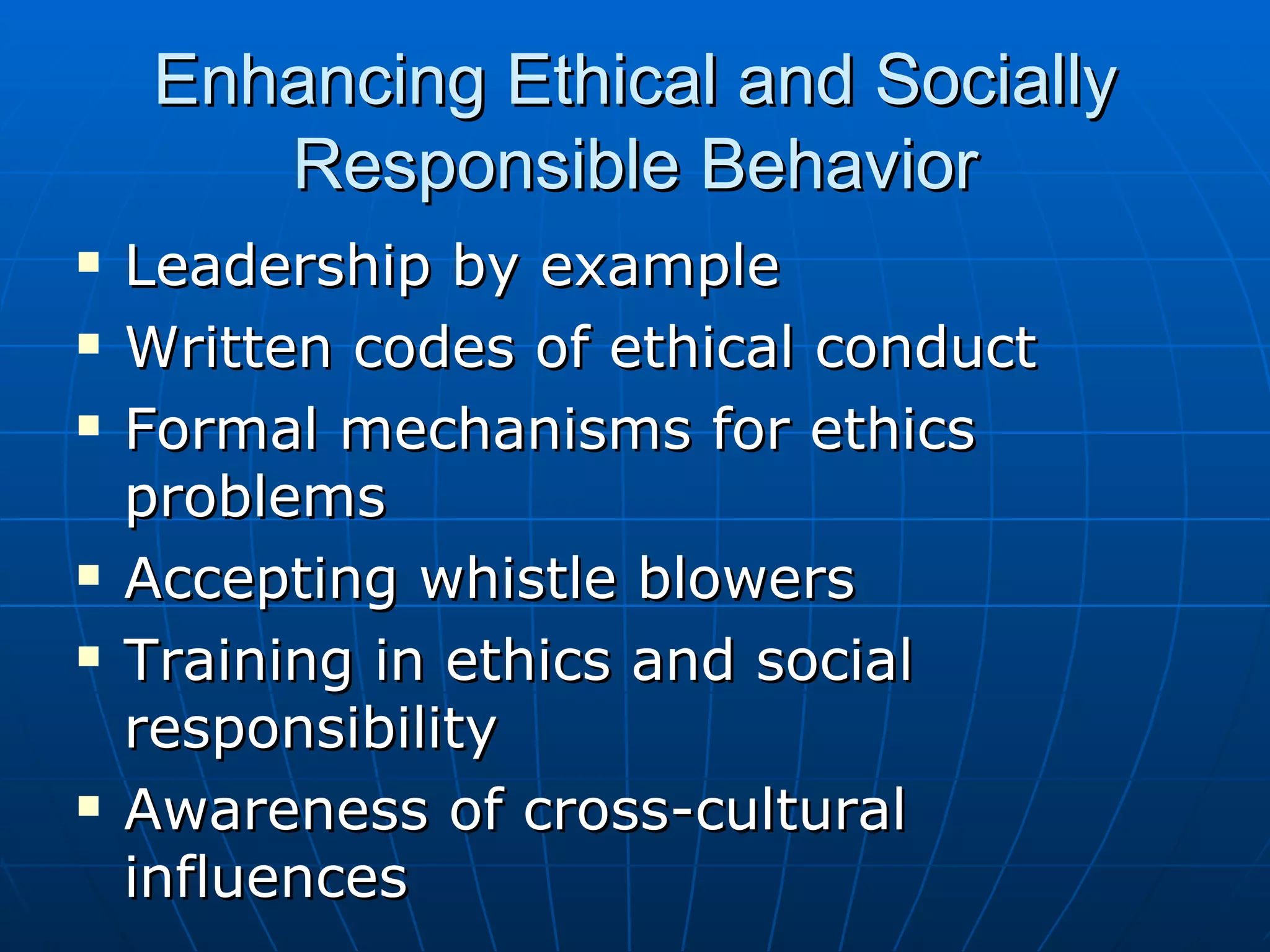
Enhancing Ethical and Socially
        Responsible Behavior
   Leadership by example
   Written codes of ethical conduct
   Formal mechanisms for ethics
    problems
   Accepting whistle blowers
   Training in ethics and social
    responsibility
   Awareness of cross-cultural
    influences

Oblecture4

  • 1.
  • 2.
    Attitudes and Emotions  Attitudes have three components: cognitive, affective, and behavioral. • The cognitive component refers to the knowledge or intellectual beliefs an individual might have about an object. • The feeling or affective component refers to the emotion connected with that object. • The behavioral component refers to how a person acts. All three components are interrelated.  People search for consistency among the components of an attitude.
  • 3.
    Cognitive dissonance isthe situation in which the pieces of knowledge, information, attitudes, or beliefs held by an individual are contradictory. People search for ways to reduce internal conflicts when they experience a clash between the information they receive and their actions or attitudes.
  • 4.
    Emotions  An emotion is a feeling such as anger, fear, joy, or surprise that underlies behavior  Emotions have three components: internal arousal, expressive behavior, and a cognitive appraisal.
  • 5.
    Emotions Managing Emotion To manage emotion well, managers should create a friendly emotional climate by setting a positive example, including serving as a model of healthy emotional expression. Managers might also include a positive attitude as one factor in selecting individuals and teams
  • 6.
    Emotional Labor  We regulate feelings and expressions to meet organizational goals.  Surface acting is faked expressions.   Deep acting is controlling feelings.  Emotional dissonance is mismatch between felt and expressed emotions emotional exhaustion 
  • 7.
    Attitudes and JobSatisfaction  Attitudes are linked to job satisfaction, the amount of pleasure or contentment associated with a job.  Workers will have high job satisfaction when they have positive attitudes toward such job factors as the work itself, recognition, and the opportunity for advancement.
  • 8.
    Job Satisfaction  One-half of (U.S.) workers have high job satisfaction.  Benefits, pay, job security rank high.  Fun on the job leads to satisfaction.  High job satisfaction correlates with organizational performance.  High organizational performance can lead to high job satisfaction.
  • 9.
    Consequences of JobSatisfaction Among the consequences of high job satisfaction are:  High productivity when the work involves people contact  Loyalty to the company (important because of employee retention)  A stronger tendency to achieve customer loyalty  Low absenteeism and turnover  Less job stress and burnout  Better safety performance  Better life satisfaction
  • 10.
    Organizational Citizenship Behavior  A broader consequence of job satisfaction is that it contributes to organizational citizenship behavior, or the willingness to work for the good of the organization even without the promise of a specific reward
  • 11.
    Organizational Citizenship Behavior (OCB)  Goes above and beyond call of duty.  Satisfied workers may show OCB.  Workers with service orientation and empathy may engage in OCB.  High OCB leads to low turnover, and sometimes work/family conflict.
  • 12.
    OCB  Five key components of organizational citizenship behavior are: • conscientiousness • altruism • civic virtue • courtesy • sportsmanship.  The good organizational citizen engages in extrarole behavior
  • 13.
    VALUES  A value refers to the importance a person attaches to something that serves as a guide to action.
  • 14.
    Values  Baby boomers more conservative and respectful of authority  Generation X and Generation Y more team-oriented and tech savvy  Many values are learned through modeling and listening  Employee-employer value fit leads to high performance  Poor employee-employer value fit can lead to person-role conflict.
  • 15.
    ETHICS  Ethics is the moral choices a person makes, and what he or she should do. Ethics can also be regarded as the vehicle that converts values into action.
  • 16.
    Ethical Decision MakingCriteria A standard way of understanding ethical decision- making is to understand the philosophical basis for making these decisions. Focus on consequences. According to this criterion, if nobody gets hurt, the decision is ethical. Focusing on consequences is often referred to as utilitarian.
  • 17.
    Ethical Decision Making Focuson the rights of individuals. The theories underlying this approach are referred to as deontological from the Greek work deon, or duty. A fundamental idea of deontology is that equal respect must be given all individuals.
  • 18.
    Ethical Decision Making Focuson integrity (virtue ethics). If the person in question has good character, and genuine motivation and intentions, he or she is behaving ethically. The decision maker’s environment, or community, helps define what integrity means.
  • 19.
    Ethical Decision-Making Guide 1. Gather the facts. 5. Identify the 2. Define the ethical obligations. issues (e.g. lying, 6. Consider your job character and discrimination). integrity. 3. Identify the affected parties. 7. Develop creative 4. Identify the potential actions. consequences. 8. Check your intuition.
  • 20.
    Enhancing Ethical andSocially Responsible Behavior  Leadership by example  Written codes of ethical conduct  Formal mechanisms for ethics problems  Accepting whistle blowers  Training in ethics and social responsibility  Awareness of cross-cultural influences