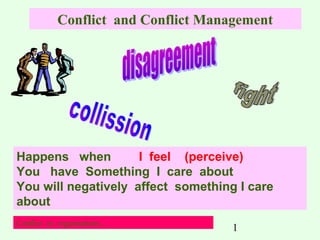
Conflict and Conflict Management

Happens when
I feel (perceive)
You have Something I care about
You will negatively affect something I care
about
Conflict in organisations…

1
Conflict in Organisations
•

Inevitable

•

Has many causes

•

Is not always bad

•

Therefore must be ‘managed’

•

May be ‘perceived’ or ‘felt’

Potential conflict in organisations

2
Potential Conflicts in Organisations
• Regional affiliations
• Erosion of status
• Differences in personal views
• Basis for grant of pay increase – allocation of pay
increase budget
• Autonomy to a position / level / individual
• Diversification plans
• Own manufacture or outsourcing
• HQ versus Branch Office
• Product Pricing
• …
Levels of conflict…

3
Conflict may be…
1. Intrapersonal – frustration, goal conflict, cognitive dissonance,
role conflict etc

2. Interpersonal
3. Intergroup
4. Organisational - structural
Sources of Interpersonal Conflict…

4
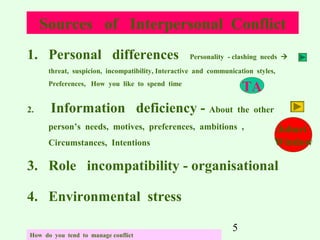
Sources of Interpersonal Conflict
1. Personal differences

Personality - clashing needs 

threat, suspicion, incompatibility, Interactive and communication styles,

TA

Preferences, How you like to spend time

2.

Information deficiency - About

the other

person’s needs, motives, preferences, ambitions ,
Circumstances, Intentions

Johari
Window

3. Role incompatibility - organisational
4. Environmental stress
How do you tend to manage conflict

5
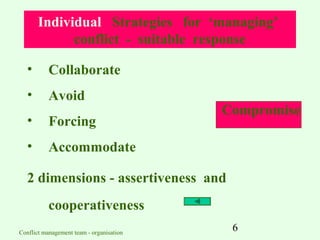
Individual Strategies for ‘managing’
conflict - suitable response
•

Collaborate

•

Avoid

•

Forcing

•

Accommodate

Compromise

2 dimensions - assertiveness and
cooperativeness
Conflict management team - organisation

6
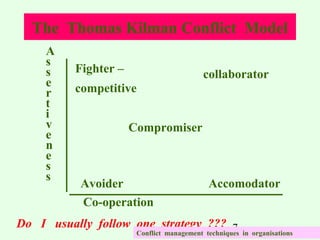
The Thomas Kilman Conflict Model
A
s
s
e
r
t
i
v
e
n
e
s
s

Fighter –

collaborator

competitive
Compromiser

Avoider
Co-operation

Accomodator

Do I usually follow one strategy ??? 7
Conflict management techniques in organisations
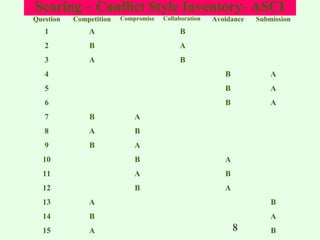
Scoring – Conflict Style Inventory- ASCI
Compromise

Collaboration

Question

Competition

Avoidance

Submission

1

A

B

2

B

A

3

A

B

4

B

A

5

B

A

6

B

A

7

B

A

8

A

B

9

B

A

10

B

A

11

A

B

12

B

A

13

A

B

14

B

A

15

A

8

B
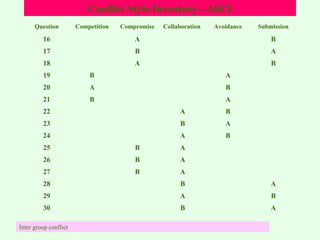
Conflict Style Inventory - ASCI
Question

Competition

Compromise

Collaboration

Avoidance

Submission

16

A

B

17

B

A

18

A

B

19

B

A

20

A

B

21

B

A

22

A

B

23

B

A

24

A

B

25

B

A

26

B

A

27

B

A

28

B

A

29

A

B

30

B

A

Inter group conflict

9
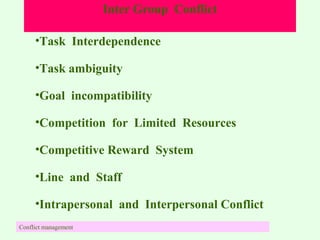
Inter Group Conflict
•Task Interdependence
•Task ambiguity
•Goal incompatibility
•Competition for Limited Resources
•Competitive Reward System
•Line and Staff
•Intrapersonal and Interpersonal Conflict
Conflict management

10
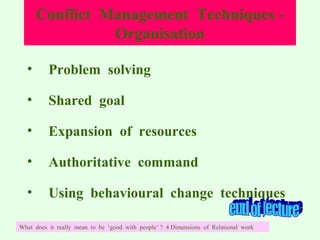
Conflict Management Techniques Organisation
•

Problem solving

•

Shared goal

•

Expansion of resources

•

Authoritative command

•

Using behavioural change techniques
11

What does it really mean to be ‘good with people’ ? 4 Dimensions of Relational work
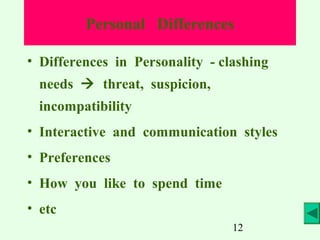
Personal Differences
• Differences in Personality - clashing
needs  threat, suspicion,
incompatibility
• Interactive and communication styles
• Preferences
• How you like to spend time
• etc
12
New view of conflict
• Is inevitable
• Has many different causes
• May aid or hinder organisational
performance
• Task of management - manage
conflict
• Best performance requires moderate
13
Positive aspects of conflict
• Energising - focuses members on
existence of problems
• Promotes change
• Stimulates interest and creativity
• Can be fun

14
Is conflict always bad?
Differentiate between • Personalised conflict
• Issue based conflict
Between
• Task conflict – content and goals of work
• Relationship conflict
• Process conflict – how work is done
15
‘perceived’ and ‘felt’ conflict
Perceived - Awareness by one or more
parties that there is a situation where
conflict may arise
Felt - emotional involvement in a
conflict creating stress, anxiety,
tenseness, frustration, hostility
16
‘Two dimensions of conflict handling
intentions
• Co-operativeness - how much you
want to satisfy the other party’s
concerns
• Assertiveness - how much you want to
satisfy your own concerns
17
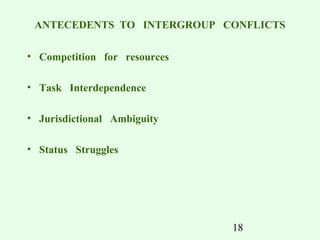
ANTECEDENTS TO INTERGROUP CONFLICTS
• Competition for resources
• Task Interdependence
• Jurisdictional Ambiguity
• Status Struggles

18
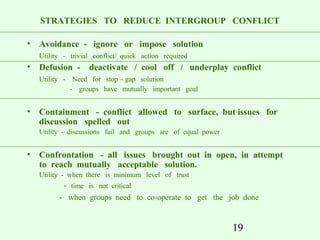
STRATEGIES TO REDUCE INTERGROUP CONFLICT
• Avoidance - ignore or impose solution
Utility - trivial conflict/ quick action required

• Defusion -

deactivate / cool off / underplay conflict

Utility - Need for stop – gap solution
- groups have mutually important goal

• Containment - conflict allowed to surface, but issues for
discussion spelled out
Utility - discussions fail and groups are of equal power

• Confrontation - all issues brought out in open, in attempt
to reach mutually acceptable solution.
Utility - when there is minimum level of trust

-

time is not critical

- when groups need to co-operate to get the job done

19
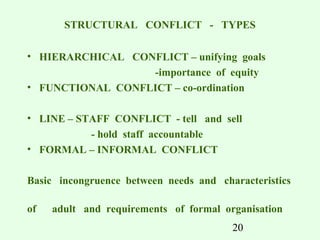
STRUCTURAL CONFLICT - TYPES
• HIERARCHICAL CONFLICT – unifying goals
-importance of equity
• FUNCTIONAL CONFLICT – co-ordination
• LINE – STAFF CONFLICT - tell and sell
- hold staff accountable
• FORMAL – INFORMAL CONFLICT
Basic incongruence between needs and characteristics
of

adult and requirements of formal organisation
20

Organisationalconflict

  • 1.
    Conflict and ConflictManagement Happens when I feel (perceive) You have Something I care about You will negatively affect something I care about Conflict in organisations… 1
  • 2.
    Conflict in Organisations • Inevitable • Hasmany causes • Is not always bad • Therefore must be ‘managed’ • May be ‘perceived’ or ‘felt’ Potential conflict in organisations 2
  • 3.
    Potential Conflicts inOrganisations • Regional affiliations • Erosion of status • Differences in personal views • Basis for grant of pay increase – allocation of pay increase budget • Autonomy to a position / level / individual • Diversification plans • Own manufacture or outsourcing • HQ versus Branch Office • Product Pricing • … Levels of conflict… 3
  • 4.
    Conflict may be… 1.Intrapersonal – frustration, goal conflict, cognitive dissonance, role conflict etc 2. Interpersonal 3. Intergroup 4. Organisational - structural Sources of Interpersonal Conflict… 4
  • 5.
    Sources of InterpersonalConflict 1. Personal differences Personality - clashing needs  threat, suspicion, incompatibility, Interactive and communication styles, TA Preferences, How you like to spend time 2. Information deficiency - About the other person’s needs, motives, preferences, ambitions , Circumstances, Intentions Johari Window 3. Role incompatibility - organisational 4. Environmental stress How do you tend to manage conflict 5
  • 6.
    Individual Strategies for‘managing’ conflict - suitable response • Collaborate • Avoid • Forcing • Accommodate Compromise 2 dimensions - assertiveness and cooperativeness Conflict management team - organisation 6
  • 7.
    The Thomas KilmanConflict Model A s s e r t i v e n e s s Fighter – collaborator competitive Compromiser Avoider Co-operation Accomodator Do I usually follow one strategy ??? 7 Conflict management techniques in organisations
  • 8.
    Scoring – ConflictStyle Inventory- ASCI Compromise Collaboration Question Competition Avoidance Submission 1 A B 2 B A 3 A B 4 B A 5 B A 6 B A 7 B A 8 A B 9 B A 10 B A 11 A B 12 B A 13 A B 14 B A 15 A 8 B
  • 9.
    Conflict Style Inventory- ASCI Question Competition Compromise Collaboration Avoidance Submission 16 A B 17 B A 18 A B 19 B A 20 A B 21 B A 22 A B 23 B A 24 A B 25 B A 26 B A 27 B A 28 B A 29 A B 30 B A Inter group conflict 9
  • 10.
    Inter Group Conflict •TaskInterdependence •Task ambiguity •Goal incompatibility •Competition for Limited Resources •Competitive Reward System •Line and Staff •Intrapersonal and Interpersonal Conflict Conflict management 10
  • 11.
    Conflict Management TechniquesOrganisation • Problem solving • Shared goal • Expansion of resources • Authoritative command • Using behavioural change techniques 11 What does it really mean to be ‘good with people’ ? 4 Dimensions of Relational work
  • 12.
    Personal Differences • Differencesin Personality - clashing needs  threat, suspicion, incompatibility • Interactive and communication styles • Preferences • How you like to spend time • etc 12
  • 13.
    New view ofconflict • Is inevitable • Has many different causes • May aid or hinder organisational performance • Task of management - manage conflict • Best performance requires moderate 13
  • 14.
    Positive aspects ofconflict • Energising - focuses members on existence of problems • Promotes change • Stimulates interest and creativity • Can be fun 14
  • 15.
    Is conflict alwaysbad? Differentiate between • Personalised conflict • Issue based conflict Between • Task conflict – content and goals of work • Relationship conflict • Process conflict – how work is done 15
  • 16.
    ‘perceived’ and ‘felt’conflict Perceived - Awareness by one or more parties that there is a situation where conflict may arise Felt - emotional involvement in a conflict creating stress, anxiety, tenseness, frustration, hostility 16
  • 17.
    ‘Two dimensions ofconflict handling intentions • Co-operativeness - how much you want to satisfy the other party’s concerns • Assertiveness - how much you want to satisfy your own concerns 17
  • 18.
    ANTECEDENTS TO INTERGROUPCONFLICTS • Competition for resources • Task Interdependence • Jurisdictional Ambiguity • Status Struggles 18
  • 19.
    STRATEGIES TO REDUCEINTERGROUP CONFLICT • Avoidance - ignore or impose solution Utility - trivial conflict/ quick action required • Defusion - deactivate / cool off / underplay conflict Utility - Need for stop – gap solution - groups have mutually important goal • Containment - conflict allowed to surface, but issues for discussion spelled out Utility - discussions fail and groups are of equal power • Confrontation - all issues brought out in open, in attempt to reach mutually acceptable solution. Utility - when there is minimum level of trust - time is not critical - when groups need to co-operate to get the job done 19
  • 20.
    STRUCTURAL CONFLICT -TYPES • HIERARCHICAL CONFLICT – unifying goals -importance of equity • FUNCTIONAL CONFLICT – co-ordination • LINE – STAFF CONFLICT - tell and sell - hold staff accountable • FORMAL – INFORMAL CONFLICT Basic incongruence between needs and characteristics of adult and requirements of formal organisation 20

Editor's Notes

  • #2 Inadvertant bloopers Viren (a colleague) smsd me askin me for a another person’s telephone no. I messaged it. After a few minutes I received the following message from viren. “NOT IN SERVICE NO THANKS ANYWAY”