Assignment
                         On

   CONFLICT MANAGEMENT
Course Instructor                  Speaker
Dr. Kalyan Ghadei                Pradeep Kumar
(Assistant Professor )          Research Scholar
                                  I.D. No. PX-11034
                              Email-Pradeep.prasar@gmail.com

    DEPARTMENT OF EXTENSION EDUCATION
    INSTITUTE OF AGRICULTURAL SCIENCES
          BANARAS HINDU UNIVERSITY
               VARANASI-221005
Contents
Introduction
Views of conflict
Characteristics of conflict
Source of conflict
Functional & dysfunctional conflict
Levels & types of conflict
Ways to manage conflict
Tips for managing conflict
Conclusion
References
Introduction:
Students bring different ideas, goals, values,
beliefs and needs to their teams and these
differences are a primary strength of teams.
These same differences inevitably lead to
conflict, even if the level of conflict is low.
Since conflict is inevitable, one of the ways in
which faculty members can help students
improve their abilities to function on
multidisciplinary teams is to work with them
to develop their understanding of conflict and
their capabilities to manage and resolve
conflict.
CONFLICT
an expressed struggle between at least two
interdependent parties who perceive incompatible
goals, scarce resources, and interference from the
other party in achieving their goals
                          Or
a process that begins when one party perceives
that another party has negatively affected or about
to affect something that the first party cares about
Characteristics of
         conflict
 Interpersonal conflict requires at least two
people. (Conflict within one’s self, or interpersonal
conflict, generally is studied by psychologists.
Communication students and scholars are
interested in communication between people. )

Conflict inherently involves some sense of
struggle or incompatibility or perceived difference
among values, goals, or desires.
Action, whether overt or covert, is key to
interpersonal conflict. Until action or expression
occurs, conflict is latent, lurking below the surface.

Power or attempts to influence inevitably occur
within conflicts. If the parties really don’t care
about the outcome, the discussion probably
doesn’t rise to the level where we call it a conflict.
When people argue without caring about what
happens next or without a sense of involvement
and struggle, it probably is just a disagreement
VIEWS OF CONFLICT
Traditional view:
    The belief that all conflicts are harmful and
must be avoided
Human relations view:
      That belief that conflict is a natural and
inevitable outcome in any group
Integrationist view:
    The belief that conflict is not only a positive
force    in group but that it is absolutely
necessary for a group to perform effectively
Sources of Conflict

Conflicts may    originate from a
number of          different sources,
including:
   oDifferences in information, beliefs,
   values, interests, or desires.
   oA scarcity of some resource.
   oRivalries in which one person or
   group competes with another.
Functional conflict: works toward the
goals of an organization or group

Dysfunctional conflict: blocks an
organization or group from reaching its
goals
Functional conflict
Constructive
Increase information & ideas
Encourages innovative thinking
Unshackles different points of
view
Reduce stagnation
Dysfunctional conflict

Tension, anxiety, stress
Drives out low conflict tolerant
people
Reduce trust
Poor decision because of withheld or
  distorted
Reduce information
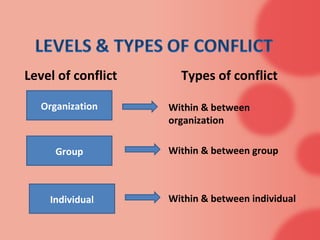
Level of conflict     Types of conflict

   Organization     Within & between
                    organization

      Group         Within & between group


    Individual      Within & between individual
Group Conflict
Intragroup conflict:
• conflict among members of a group
• early stages of group development
• ways of doing tasks or reaching
group’s goals

Intergroup conflict:
• between two or more groups
Individual Conflict
Interpersonal conflict:
  • between two or more people a differences in views
  about what should be done
  • differences in orientation to work and time in
  different parts of an organization


Intrapersonal conflict:
  • occurs within an individual
  • threat to a person’s values
  • feeding of unfair treatment
  • multiple and contradictory sources of socialization
Conflict Management

is defined as “the opportunity to
improve situations and strengthen
relationships”
5 ways to manage conflict
•Avoidance
•Competition (A)
•Accommodation (B)
•Compromise (C)
•Collaboration (D)
Conflict Continuum
I win, you lose (competition—A)

I lose or give in (accommodate—B)

We both get something (compromise—C)

We both “win”(collaborate—D)
Competition

Plus
 •The winner is clear
 •Winners usually experience gains

Minus
 •Establishes the battleground for the
 next conflict
 •May cause worthy competitors to
 withdraw or leave the organization
Accommodation


Plus
 •Curtails conflict situation
 •Enhances ego of the other

Minus
 •Sometimes establishes a
 precedence
 •Does not fully engage participants
Compromise

Plus
 •Shows good will
 •Establishes friendship

Minus
 •No one gets what they want
 •May feel like a dead end
Collaboration

Plus
 •Everyone “wins”
 •Creates good feelings

Minus
 •Hard to achieve since no one knows
 how
 •Often confusing since players can
 “win” something they didn’t know they
 wanted
Tips for Managing Conflict
1. Avoids feelings or perceptions that imply the
  other person is wrong or needs to change.
2. Communicates a desire to work together to
  explore a problem or seek a solution.
3. Exhibits behavior that is spontaneous and
  destruction-free.
4. Identifies with another team member’s
  problems, shares feelings, and accepts the
  team member’s reaction.
5. Treats other team members with respect and
  trust.
6. Investigates issues rather than taking sides
  on them.
Conclusion
Individuals should understand their
own personal triggers to better deal
with   conflict situations  in   the
workplace.

Group members should think about
other group members early on to
identify privately those individuals and
behaviors that may push their buttons.
References:
Lakra, Kerobin and Meena, Dinesh chand (2009 and 2010; respectively)
Assignment on conflict management, submitted to Department of
Extension Education, I. Ag. Sci., B.H.U.,Varanasi

Rahim, M.A. (2002) Toward a theory of managing organizational conflict. The
International journal of conflict management,13,206-235.

http://foundationcoalition.org/publications/brochures/conflict.pdf

http://www.referenceforbusiness.com/management/Comp-De/Conflict-
Management-and-Negotiation.html

http://www.scribd.com/doc/25304585/Functional-and-Dysfunctional-Conflicts
http://www.mindtools.com/pages/article/newLDR_81.htm
Conflict management ppt

Conflict management ppt

  • 1.
    Assignment On CONFLICT MANAGEMENT Course Instructor Speaker Dr. Kalyan Ghadei Pradeep Kumar (Assistant Professor ) Research Scholar I.D. No. PX-11034 Email-Pradeep.prasar@gmail.com DEPARTMENT OF EXTENSION EDUCATION INSTITUTE OF AGRICULTURAL SCIENCES BANARAS HINDU UNIVERSITY VARANASI-221005
  • 2.
    Contents Introduction Views of conflict Characteristicsof conflict Source of conflict Functional & dysfunctional conflict Levels & types of conflict Ways to manage conflict Tips for managing conflict Conclusion References
  • 3.
    Introduction: Students bring differentideas, goals, values, beliefs and needs to their teams and these differences are a primary strength of teams. These same differences inevitably lead to conflict, even if the level of conflict is low. Since conflict is inevitable, one of the ways in which faculty members can help students improve their abilities to function on multidisciplinary teams is to work with them to develop their understanding of conflict and their capabilities to manage and resolve conflict.
  • 4.
    CONFLICT an expressed strugglebetween at least two interdependent parties who perceive incompatible goals, scarce resources, and interference from the other party in achieving their goals Or a process that begins when one party perceives that another party has negatively affected or about to affect something that the first party cares about
  • 5.
    Characteristics of conflict  Interpersonal conflict requires at least two people. (Conflict within one’s self, or interpersonal conflict, generally is studied by psychologists. Communication students and scholars are interested in communication between people. ) Conflict inherently involves some sense of struggle or incompatibility or perceived difference among values, goals, or desires.
  • 6.
    Action, whether overtor covert, is key to interpersonal conflict. Until action or expression occurs, conflict is latent, lurking below the surface. Power or attempts to influence inevitably occur within conflicts. If the parties really don’t care about the outcome, the discussion probably doesn’t rise to the level where we call it a conflict. When people argue without caring about what happens next or without a sense of involvement and struggle, it probably is just a disagreement
  • 7.
    VIEWS OF CONFLICT Traditionalview: The belief that all conflicts are harmful and must be avoided Human relations view: That belief that conflict is a natural and inevitable outcome in any group Integrationist view: The belief that conflict is not only a positive force in group but that it is absolutely necessary for a group to perform effectively
  • 8.
    Sources of Conflict Conflictsmay originate from a number of different sources, including: oDifferences in information, beliefs, values, interests, or desires. oA scarcity of some resource. oRivalries in which one person or group competes with another.
  • 9.
    Functional conflict: workstoward the goals of an organization or group Dysfunctional conflict: blocks an organization or group from reaching its goals
  • 10.
    Functional conflict Constructive Increase information& ideas Encourages innovative thinking Unshackles different points of view Reduce stagnation
  • 11.
    Dysfunctional conflict Tension, anxiety,stress Drives out low conflict tolerant people Reduce trust Poor decision because of withheld or distorted Reduce information
  • 12.
    Level of conflict Types of conflict Organization Within & between organization Group Within & between group Individual Within & between individual
  • 13.
    Group Conflict Intragroup conflict: •conflict among members of a group • early stages of group development • ways of doing tasks or reaching group’s goals Intergroup conflict: • between two or more groups
  • 14.
    Individual Conflict Interpersonal conflict: • between two or more people a differences in views about what should be done • differences in orientation to work and time in different parts of an organization Intrapersonal conflict: • occurs within an individual • threat to a person’s values • feeding of unfair treatment • multiple and contradictory sources of socialization
  • 15.
    Conflict Management is definedas “the opportunity to improve situations and strengthen relationships”
  • 16.
    5 ways tomanage conflict •Avoidance •Competition (A) •Accommodation (B) •Compromise (C) •Collaboration (D)
  • 17.
    Conflict Continuum I win,you lose (competition—A) I lose or give in (accommodate—B) We both get something (compromise—C) We both “win”(collaborate—D)
  • 18.
    Competition Plus •The winneris clear •Winners usually experience gains Minus •Establishes the battleground for the next conflict •May cause worthy competitors to withdraw or leave the organization
  • 19.
    Accommodation Plus •Curtails conflictsituation •Enhances ego of the other Minus •Sometimes establishes a precedence •Does not fully engage participants
  • 20.
    Compromise Plus •Shows goodwill •Establishes friendship Minus •No one gets what they want •May feel like a dead end
  • 21.
    Collaboration Plus •Everyone “wins” •Creates good feelings Minus •Hard to achieve since no one knows how •Often confusing since players can “win” something they didn’t know they wanted
  • 22.
    Tips for ManagingConflict 1. Avoids feelings or perceptions that imply the other person is wrong or needs to change. 2. Communicates a desire to work together to explore a problem or seek a solution. 3. Exhibits behavior that is spontaneous and destruction-free. 4. Identifies with another team member’s problems, shares feelings, and accepts the team member’s reaction. 5. Treats other team members with respect and trust. 6. Investigates issues rather than taking sides on them.
  • 23.
    Conclusion Individuals should understandtheir own personal triggers to better deal with conflict situations in the workplace. Group members should think about other group members early on to identify privately those individuals and behaviors that may push their buttons.
  • 24.
    References: Lakra, Kerobin andMeena, Dinesh chand (2009 and 2010; respectively) Assignment on conflict management, submitted to Department of Extension Education, I. Ag. Sci., B.H.U.,Varanasi Rahim, M.A. (2002) Toward a theory of managing organizational conflict. The International journal of conflict management,13,206-235. http://foundationcoalition.org/publications/brochures/conflict.pdf http://www.referenceforbusiness.com/management/Comp-De/Conflict- Management-and-Negotiation.html http://www.scribd.com/doc/25304585/Functional-and-Dysfunctional-Conflicts http://www.mindtools.com/pages/article/newLDR_81.htm

Editor's Notes