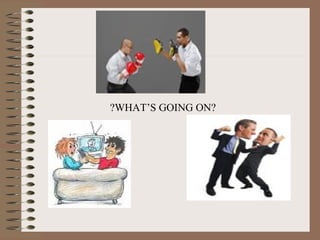
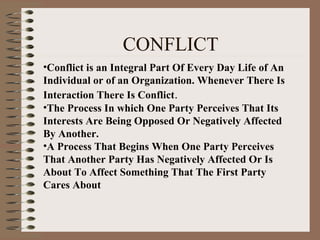
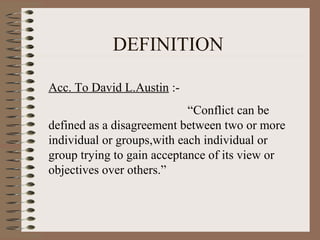
?WHAT’S GOING ON?
CONFLICT
CONFLICT
•Conflict is an Integral Part Of Every Day Life of An
Individual or of an Organization. Whenever There Is
Interaction There Is Conflict.
•The Process In which One Party Perceives That Its
Interests Are Being Opposed Or Negatively Affected
By Another.
•A Process That Begins When One Party Perceives
That Another Party Has Negatively Affected Or Is
About To Affect Something That The First Party
Cares About
DEFINITION
Acc. To David L.Austin :-
“Conflict can be
defined as a disagreement between two or more
individual or groups,with each individual or
group trying to gain acceptance of its view or
objectives over others.”
FEATURES OF CONFLICT
1. Individuals are not able to choose the
alternatives
2. Conflicting perceptions,values and goals
3. Dynamic process
4. Conflict must be perceived by the parties
VIEWS OF CONFLICT
• TRADITIONAL VIEW:
The Belief That All Conflict Is Harmful
And Must Be Avoided.
• HUMAN RELATIONS VIEW:
The Belief That Conflict Is A Natural
And Inevitable Outcome In Any Group.
• INTERACTIONIST VIEW:
The Belief That Conflict Is Not Only A
Positive Force In A Group But That It Is
Absolutely Necessary For A Group To
Perform Effectively.
FUNCTIONAL &
DYSFUNCTIONAL CONFLICT
•Functional conflict support the goals of the
group and improve its performance.
• Dysfunctional conflicts hinder group
performance and does not support the goals of the
group.
FUNCTIONAL ASPECTS
• Analytical thinking
• Group cohesiveness
• Healthy Competition
• Challenge
• Identification of weaknesses
• High quality decisions
• Awareness
• Enjoyment
DYSFUNCTIONAL ASPECTS
• Personal Vs Organizational goals
• High employee turnover
• Climate of distrust
• Dissatisfaction
• Tensions
• Low Productivity
LEVEL OF CONFLICT
There should be an optimum level of
conflict in the organizations that is very
useful for the development of creativity,
high problem solving behaviors and
productivity.
LEVELS OF CONFLICTS
There are four levels of conflicts:-
• Individual level conflict
• Interpersonal conflict
• Group level conflict
• Organization level conflict
INDIVIDUAL LEVEL
CONFLICT
Individual conflicts arises within an
individual whenever his motives are
blocked or he is confronted with
competing roles and goals and he is
unable to take decisions.
CAUSES OF INDIVIDUAL
LEVEL OF CONFLICTS
• Unacceptability
• Incomparability
• Uncertainty
1. Frustration
a. Aggression
b. Withdrawal
c. Fixation
d. Compromise
2. Goal conflict
a. Approach – Approach Conflict
b. Approach – Avoidance Conflict
c. Avoidance-Avoidance Conflict
3. Role Conflict:-
Types of Role Conflict:-
a. Intrasender Role Conflict
b. Intersender Role Conflict
c. Self Role Conflict
d. Inter Role Conflict
c. Avoidance-Avoidance Conflict
INTERPERSONAL CONFLICT
Interpersonal Conflict involves conflict
between two or more individuals and is the
most common and most recognized conflicts.
SOURCES OF INTERPERSONAL
CONFLICTS
• Personal Differences
• Information Deficiency
• Role incompatibility
• Environment stress
GROUP LEVEL CONFLICT
A group consists of two or more persons who
are in interaction with each other, have a well
defined structure of role and status relations
and have a system of values and norms of
behavior for smooth working of the group.
There are two types of group level conflict:-
1. Intra Group Conflict
2. Inter Group Conflict
CAUSES OF INTRA GROUP
CONFLICT
• When the group faces a new problem
• When new values are imported from the
social environment into the group
• When a person’s extra group role comes
into conflict with his intra group role.
CAUSES OF INTER GROUP
CONFLICTS
• Absence of joint decision making
• Difference in goals
• Difference in perception
• Difference in goals as well as
perceptions
ORGANIZATION LEVEL
CONFLICT
The organization level conflict can be between
the buyer & seller organization, between union &
organizations employing the members, between
govt. agencies that regulate certain organizations
& the organizations that are affected by them.
TYPES OF CONFLICT:
• TASK CONFLICT – CONFLICT OVER
CONTENT AND GOALS OF THE WORK.
• RELATIONALSHIP CONFLICT –
CONFLICT BASED ON INTERPERSONAL
RELATIONSHIPS.
• PROCESS CONFLICT – CONFLICT
OVER HOW WORK GETS DONE.
SOURCES OF CONFLICT
• COMMUNICATION PROBLEMS
• INCOMPATIBLE GOALS
• DIFFERENT VALUES & BELIEFS
• AMBIGUOUS RULES
• SCARCE RESOURCES
• TASK INTERDEPENDENCE
CONFLICT MANAGEMENT
Conflict is destructive in nature and it
should be resolved as soon as possible after
it has developed, but all efforts should be
made to prevent it from developing.There
are two measures or approaches for
managing the organizational conflict:-
1. Preventive Measures
2. Curative Measures
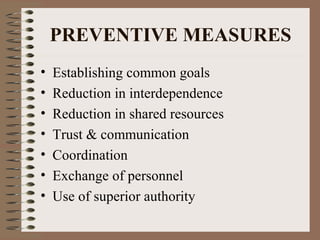
PREVENTIVE MEASURES
• Establishing common goals
• Reduction in interdependence
• Reduction in shared resources
• Trust & communication
• Coordination
• Exchange of personnel
• Use of superior authority
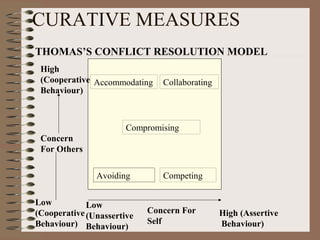
CURATIVE MEASURES
THOMAS’S CONFLICT RESOLUTION MODEL
Accommodating Collaborating
Avoiding Competing
Compromising
High
(Cooperative
Behaviour)
Low
(Cooperative
Behaviour)
Concern
For Others
Low
(Unassertive
Behaviour)
High (Assertive
Behaviour)
Concern For
Self
Conflict final

Conflict final

  • 1.
  • 2.
  • 3.
    CONFLICT •Conflict is anIntegral Part Of Every Day Life of An Individual or of an Organization. Whenever There Is Interaction There Is Conflict. •The Process In which One Party Perceives That Its Interests Are Being Opposed Or Negatively Affected By Another. •A Process That Begins When One Party Perceives That Another Party Has Negatively Affected Or Is About To Affect Something That The First Party Cares About
  • 4.
    DEFINITION Acc. To DavidL.Austin :- “Conflict can be defined as a disagreement between two or more individual or groups,with each individual or group trying to gain acceptance of its view or objectives over others.”
  • 5.
    FEATURES OF CONFLICT 1.Individuals are not able to choose the alternatives 2. Conflicting perceptions,values and goals 3. Dynamic process 4. Conflict must be perceived by the parties
  • 6.
    VIEWS OF CONFLICT •TRADITIONAL VIEW: The Belief That All Conflict Is Harmful And Must Be Avoided. • HUMAN RELATIONS VIEW: The Belief That Conflict Is A Natural And Inevitable Outcome In Any Group. • INTERACTIONIST VIEW: The Belief That Conflict Is Not Only A Positive Force In A Group But That It Is Absolutely Necessary For A Group To Perform Effectively.
  • 7.
    FUNCTIONAL & DYSFUNCTIONAL CONFLICT •Functionalconflict support the goals of the group and improve its performance. • Dysfunctional conflicts hinder group performance and does not support the goals of the group.
  • 8.
    FUNCTIONAL ASPECTS • Analyticalthinking • Group cohesiveness • Healthy Competition • Challenge • Identification of weaknesses • High quality decisions • Awareness • Enjoyment
  • 9.
    DYSFUNCTIONAL ASPECTS • PersonalVs Organizational goals • High employee turnover • Climate of distrust • Dissatisfaction • Tensions • Low Productivity
  • 10.
    LEVEL OF CONFLICT Thereshould be an optimum level of conflict in the organizations that is very useful for the development of creativity, high problem solving behaviors and productivity.
  • 11.
    LEVELS OF CONFLICTS Thereare four levels of conflicts:- • Individual level conflict • Interpersonal conflict • Group level conflict • Organization level conflict
  • 13.
    INDIVIDUAL LEVEL CONFLICT Individual conflictsarises within an individual whenever his motives are blocked or he is confronted with competing roles and goals and he is unable to take decisions.
  • 14.
    CAUSES OF INDIVIDUAL LEVELOF CONFLICTS • Unacceptability • Incomparability • Uncertainty 1. Frustration a. Aggression b. Withdrawal c. Fixation d. Compromise 2. Goal conflict a. Approach – Approach Conflict b. Approach – Avoidance Conflict c. Avoidance-Avoidance Conflict
  • 15.
    3. Role Conflict:- Typesof Role Conflict:- a. Intrasender Role Conflict b. Intersender Role Conflict c. Self Role Conflict d. Inter Role Conflict c. Avoidance-Avoidance Conflict
  • 17.
    INTERPERSONAL CONFLICT Interpersonal Conflictinvolves conflict between two or more individuals and is the most common and most recognized conflicts.
  • 18.
    SOURCES OF INTERPERSONAL CONFLICTS •Personal Differences • Information Deficiency • Role incompatibility • Environment stress
  • 19.
    GROUP LEVEL CONFLICT Agroup consists of two or more persons who are in interaction with each other, have a well defined structure of role and status relations and have a system of values and norms of behavior for smooth working of the group. There are two types of group level conflict:- 1. Intra Group Conflict 2. Inter Group Conflict
  • 20.
    CAUSES OF INTRAGROUP CONFLICT • When the group faces a new problem • When new values are imported from the social environment into the group • When a person’s extra group role comes into conflict with his intra group role.
  • 21.
    CAUSES OF INTERGROUP CONFLICTS • Absence of joint decision making • Difference in goals • Difference in perception • Difference in goals as well as perceptions
  • 22.
    ORGANIZATION LEVEL CONFLICT The organizationlevel conflict can be between the buyer & seller organization, between union & organizations employing the members, between govt. agencies that regulate certain organizations & the organizations that are affected by them.
  • 23.
    TYPES OF CONFLICT: •TASK CONFLICT – CONFLICT OVER CONTENT AND GOALS OF THE WORK. • RELATIONALSHIP CONFLICT – CONFLICT BASED ON INTERPERSONAL RELATIONSHIPS. • PROCESS CONFLICT – CONFLICT OVER HOW WORK GETS DONE.
  • 24.
    SOURCES OF CONFLICT •COMMUNICATION PROBLEMS • INCOMPATIBLE GOALS • DIFFERENT VALUES & BELIEFS • AMBIGUOUS RULES • SCARCE RESOURCES • TASK INTERDEPENDENCE
  • 25.
    CONFLICT MANAGEMENT Conflict isdestructive in nature and it should be resolved as soon as possible after it has developed, but all efforts should be made to prevent it from developing.There are two measures or approaches for managing the organizational conflict:- 1. Preventive Measures 2. Curative Measures
  • 26.
    PREVENTIVE MEASURES • Establishingcommon goals • Reduction in interdependence • Reduction in shared resources • Trust & communication • Coordination • Exchange of personnel • Use of superior authority
  • 27.
    CURATIVE MEASURES THOMAS’S CONFLICTRESOLUTION MODEL Accommodating Collaborating Avoiding Competing Compromising High (Cooperative Behaviour) Low (Cooperative Behaviour) Concern For Others Low (Unassertive Behaviour) High (Assertive Behaviour) Concern For Self