 Conflict refers to collision or disagreement.
 In organisational context, conflict refers to a
process in which one party perceives that
another party has taken or will take actions that
are incompatible with one’s own interests.
 Conflict may be within an individual when there
is incompatibility between his or her goals; may
be within two individuals, when one does not
see eye-to-eye with another, and in the process
tries to block or frustrate the attempts of
another; or between two groups in an
organisation.
 Conflict may be cognitive or affective.
 Cognitive conflict refers to difference in
perspectives or judgments about issues.
 Affective conflict is emotional and directed
at other people. It is likely to be destructive
because it can lead to anger, bitterness, etc.
 Conflict in cognitive form can air legitimate
differences of opinion and develop better
ideas and solutions to problems.
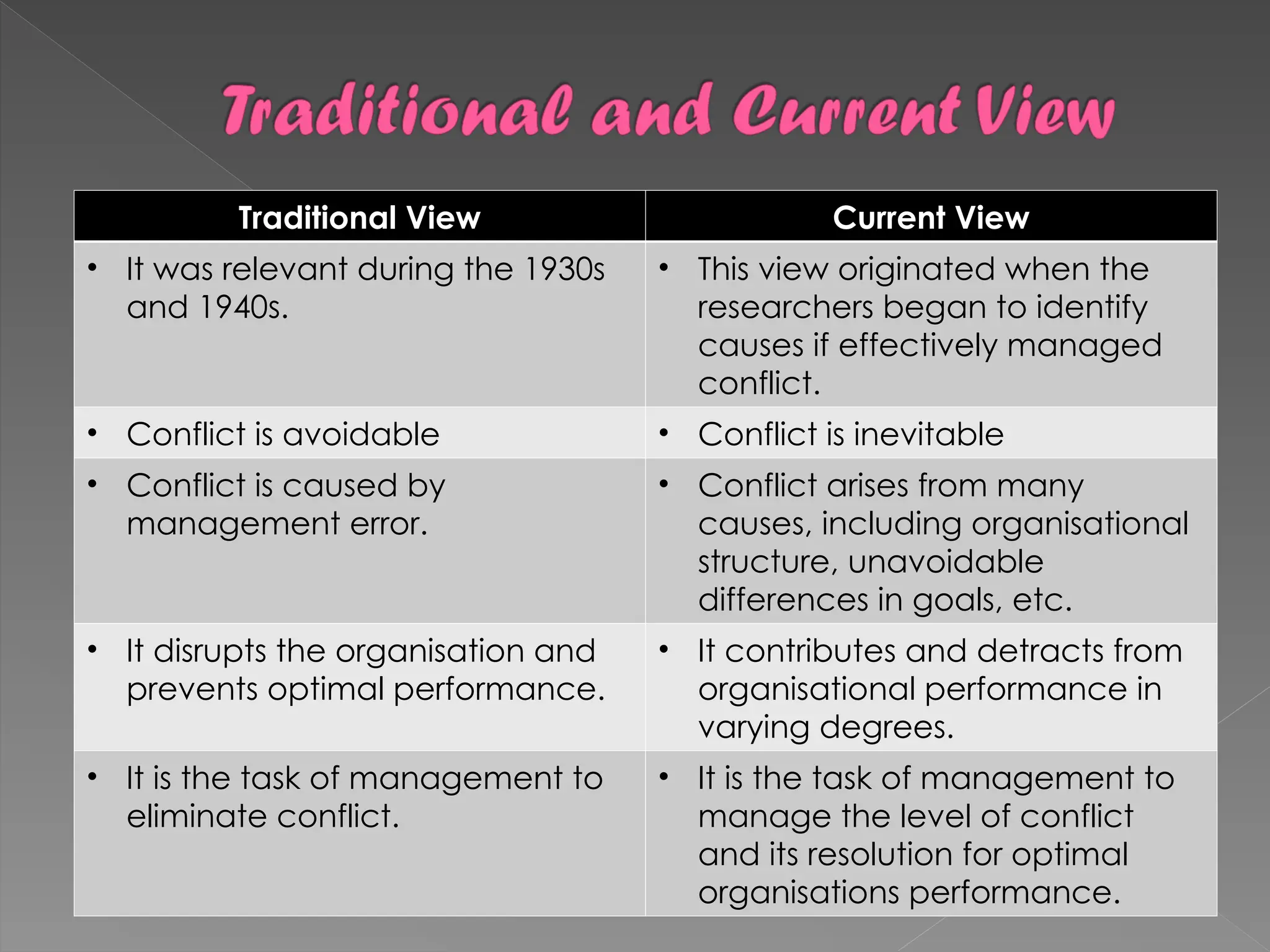
Traditional View Current View
• It was relevant during the 1930s
and 1940s.
• This view originated when the
researchers began to identify
causes if effectively managed
conflict.
• Conflict is avoidable • Conflict is inevitable
• Conflict is caused by
management error.
• Conflict arises from many
causes, including organisational
structure, unavoidable
differences in goals, etc.
• It disrupts the organisation and
prevents optimal performance.
• It contributes and detracts from
organisational performance in
varying degrees.
• It is the task of management to
eliminate conflict.
• It is the task of management to
manage the level of conflict
and its resolution for optimal
organisations performance.
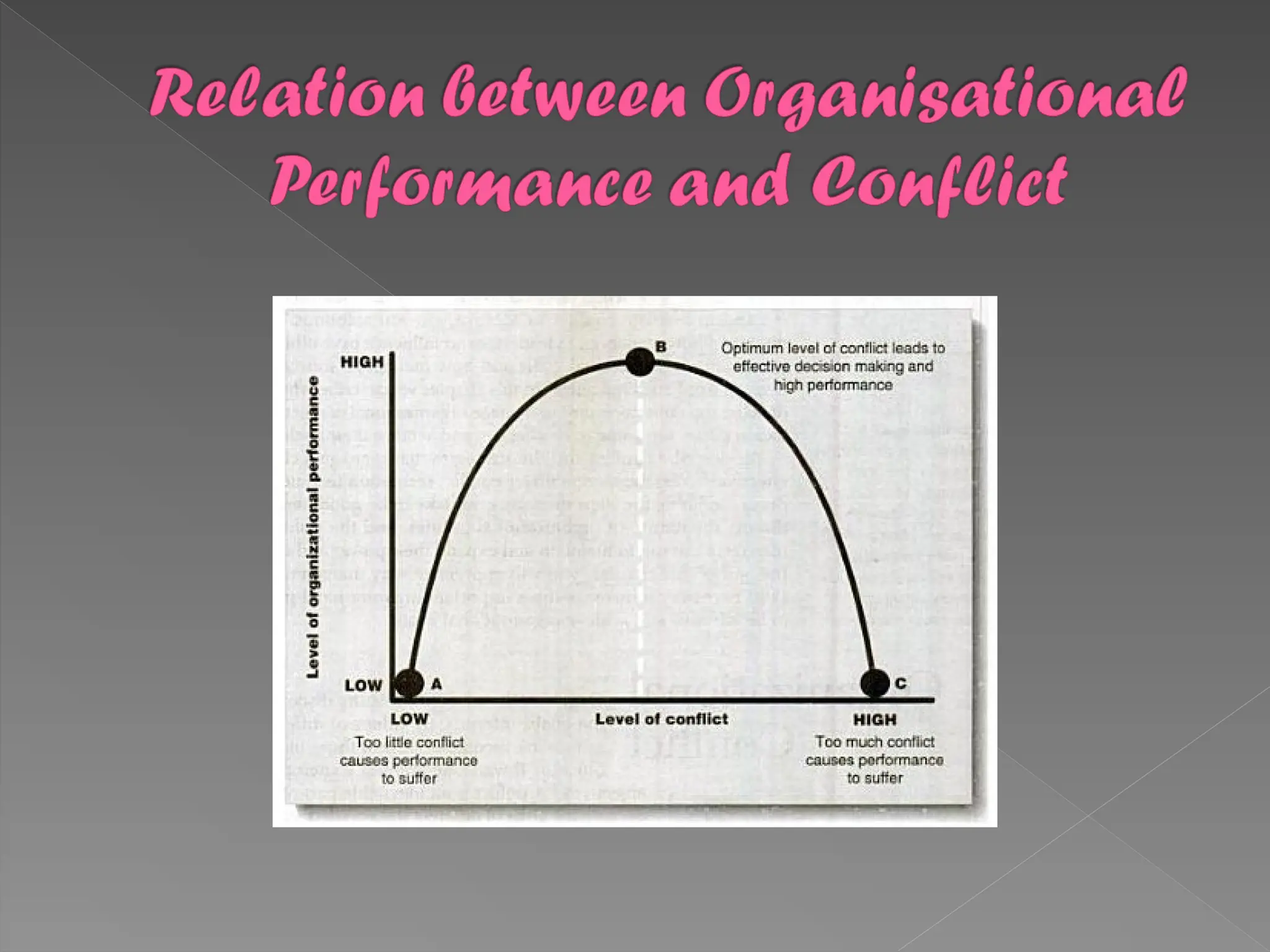
 Functional Conflict refers to
confrontation between two idea, goals
and parties that improve employees and
the organisation’s performance.
 Dysfunctional Conflict is the negative
side of conflict. Symptoms are
personality clashes, unresolved anger,
inefficiency, resource wastage, etc.
 It increases awareness of what problems
exist, who is involved and how to solve
the problem.
 It motivates organisational members to
consider problems.
 It promotes change. Persons are more
aware of injustices, inefficiencies and
frustrations.
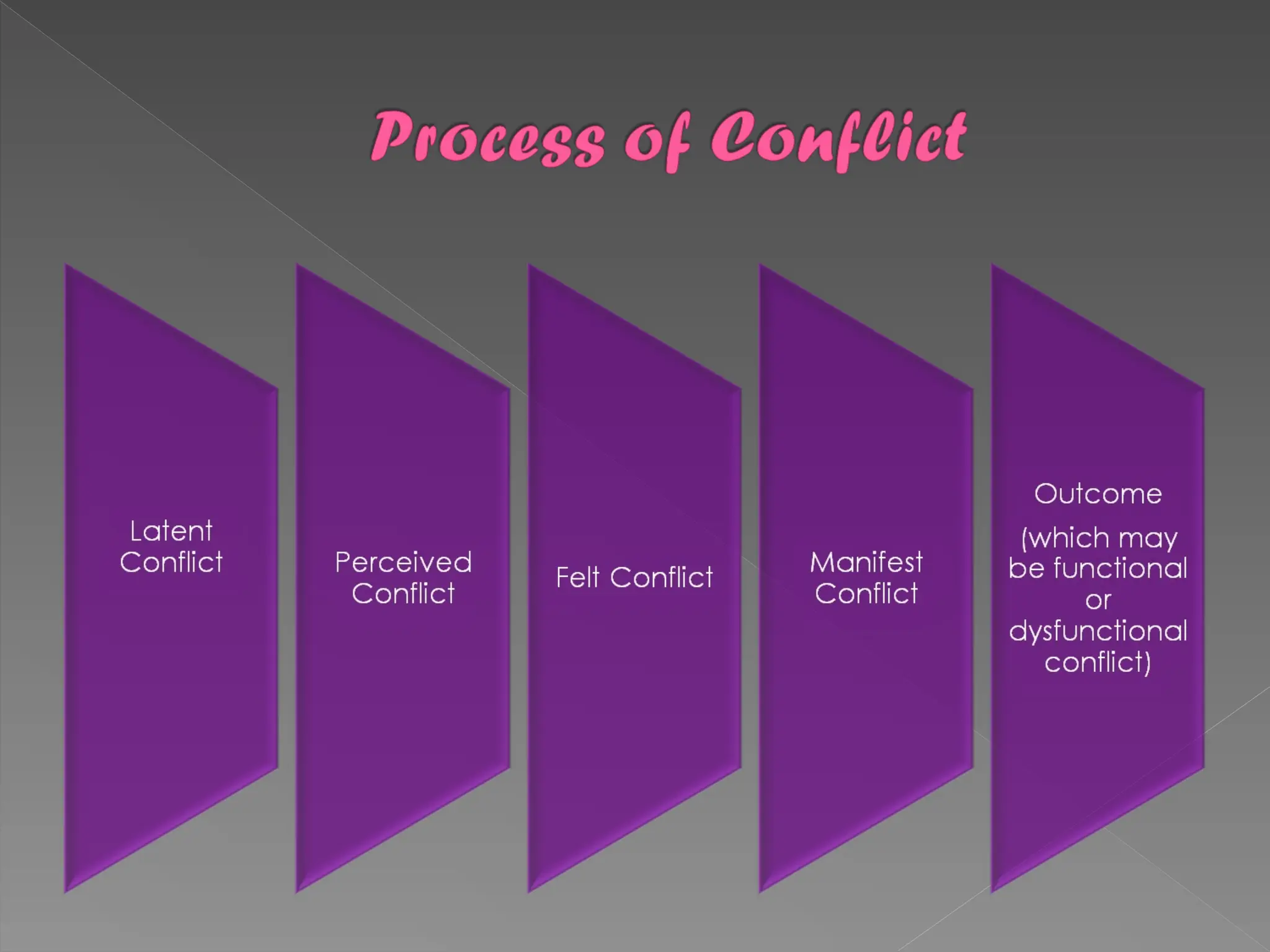
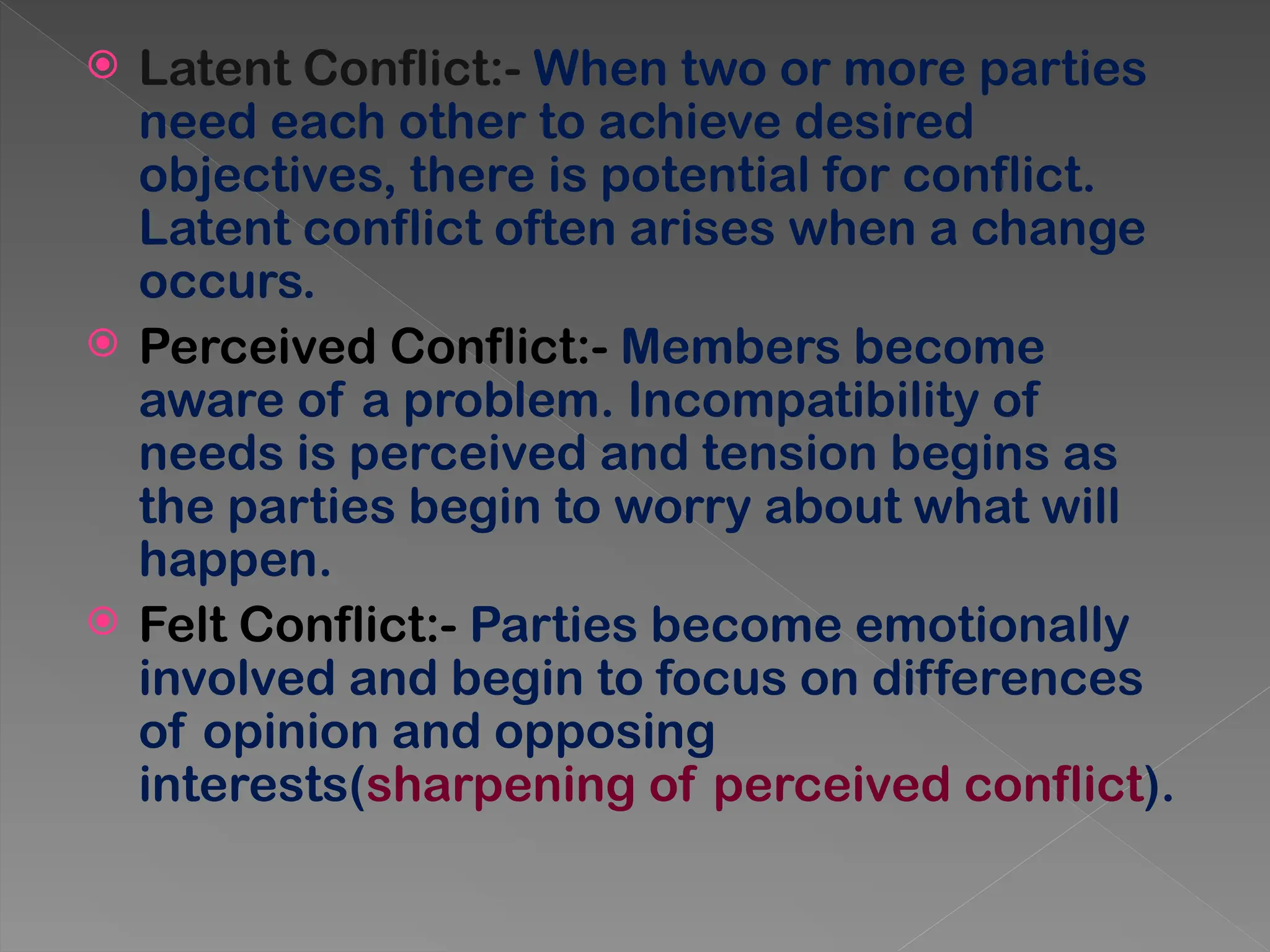
 Latent Conflict:- When two or more parties
need each other to achieve desired
objectives, there is potential for conflict.
Latent conflict often arises when a change
occurs.
 Perceived Conflict:- Members become
aware of a problem. Incompatibility of
needs is perceived and tension begins as
the parties begin to worry about what will
happen.
 Felt Conflict:- Parties become emotionally
involved and begin to focus on differences
of opinion and opposing
interests(sharpening of perceived conflict).
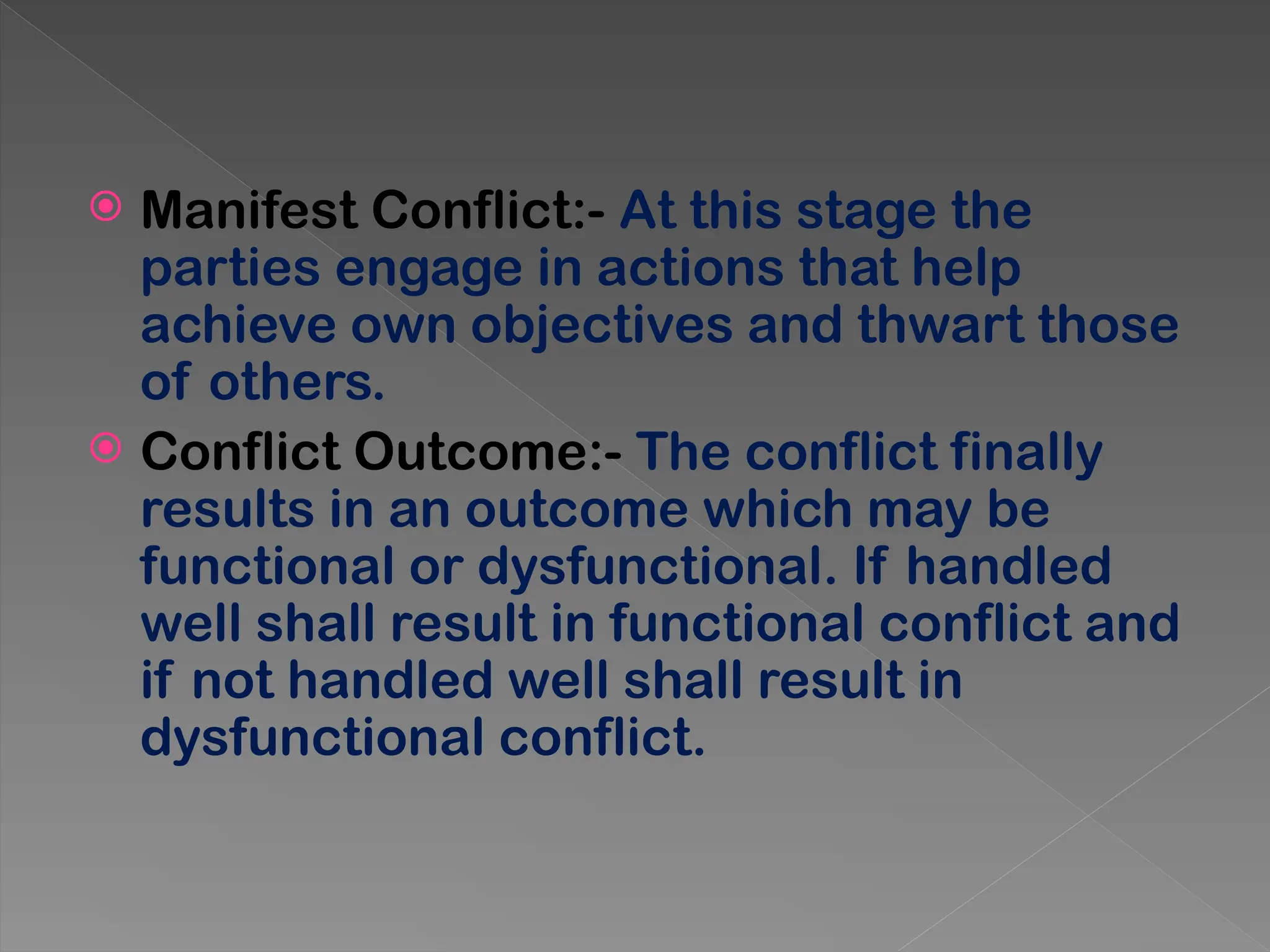
 Manifest Conflict:- At this stage the
parties engage in actions that help
achieve own objectives and thwart those
of others.
 Conflict Outcome:- The conflict finally
results in an outcome which may be
functional or dysfunctional. If handled
well shall result in functional conflict and
if not handled well shall result in
dysfunctional conflict.
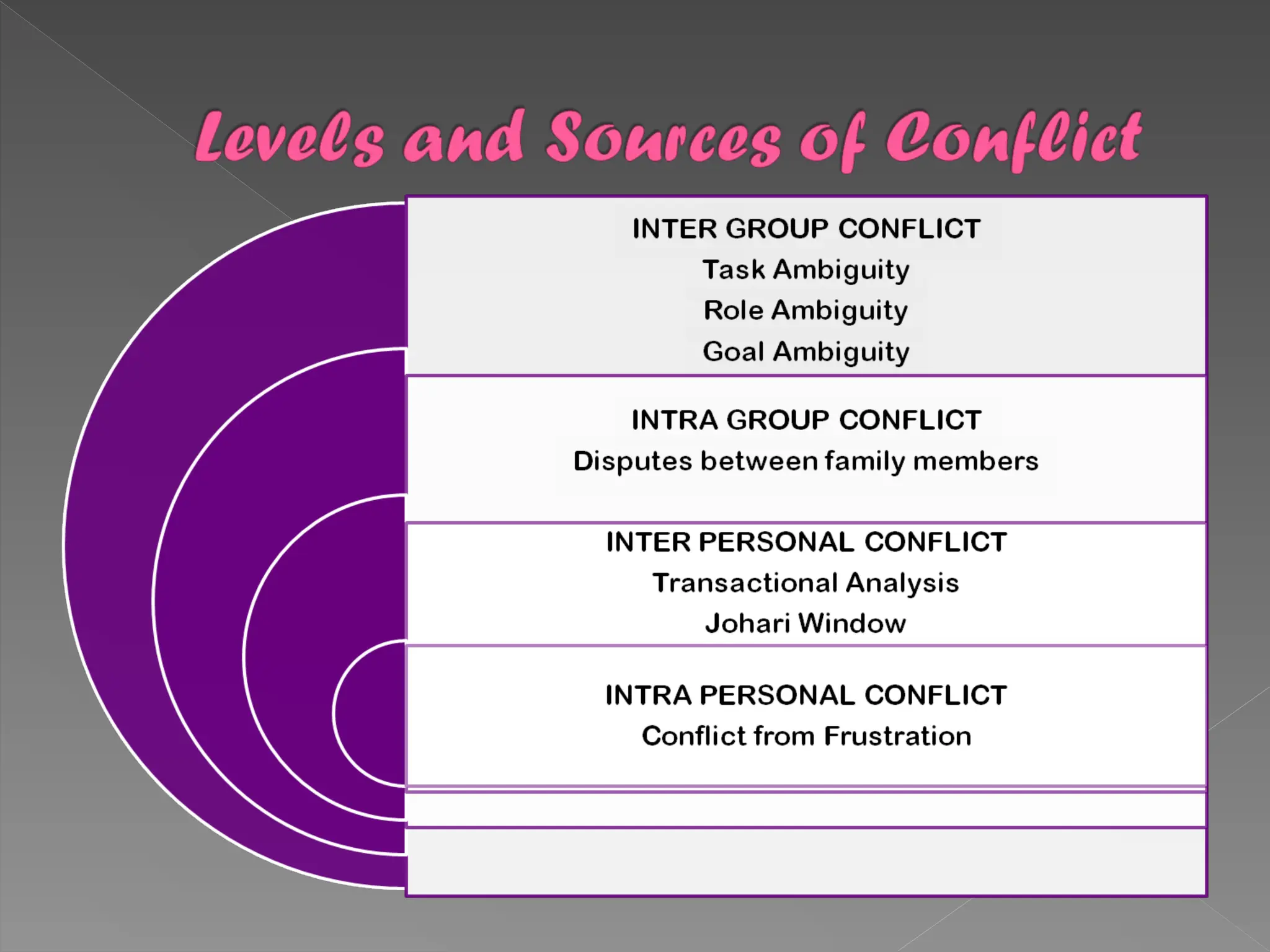
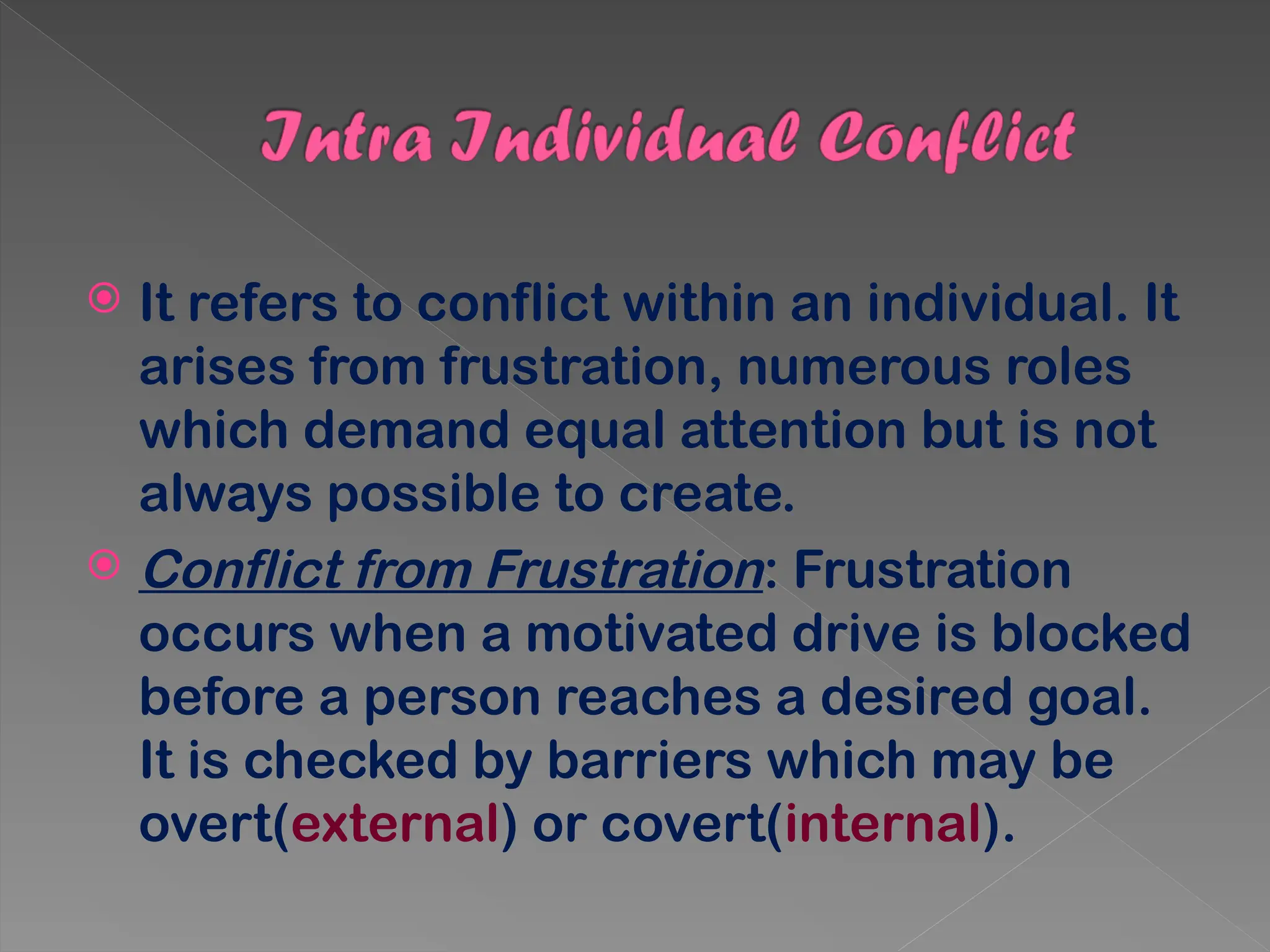
 It refers to conflict within an individual. It
arises from frustration, numerous roles
which demand equal attention but is not
always possible to create.
 Conflict from Frustration: Frustration
occurs when a motivated drive is blocked
before a person reaches a desired goal.
It is checked by barriers which may be
overt(external) or covert(internal).
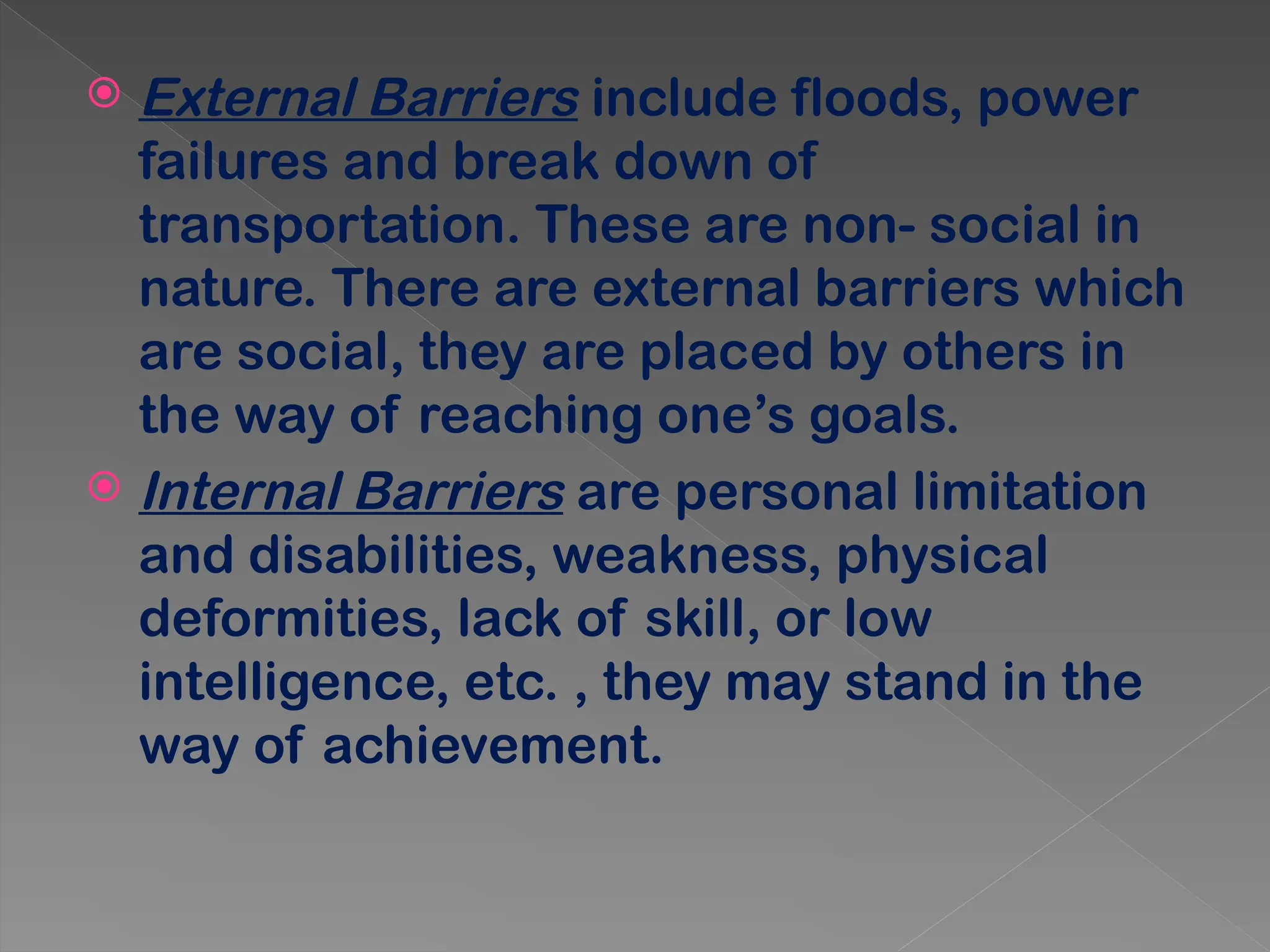
 External Barriers include floods, power
failures and break down of
transportation. These are non- social in
nature. There are external barriers which
are social, they are placed by others in
the way of reaching one’s goals.
 Internal Barriers are personal limitation
and disabilities, weakness, physical
deformities, lack of skill, or low
intelligence, etc. , they may stand in the
way of achievement.
 Goal Conflict is more complex than
conflict from frustration. It occurs when
the attainment of one goal excludes the
possibility of attaining another. The
major forms of conflict may be
distinguished as:-
Approach-Approach Conflict
Avoidance-Avoidance Conflict
Approach-Avoidance Conflict
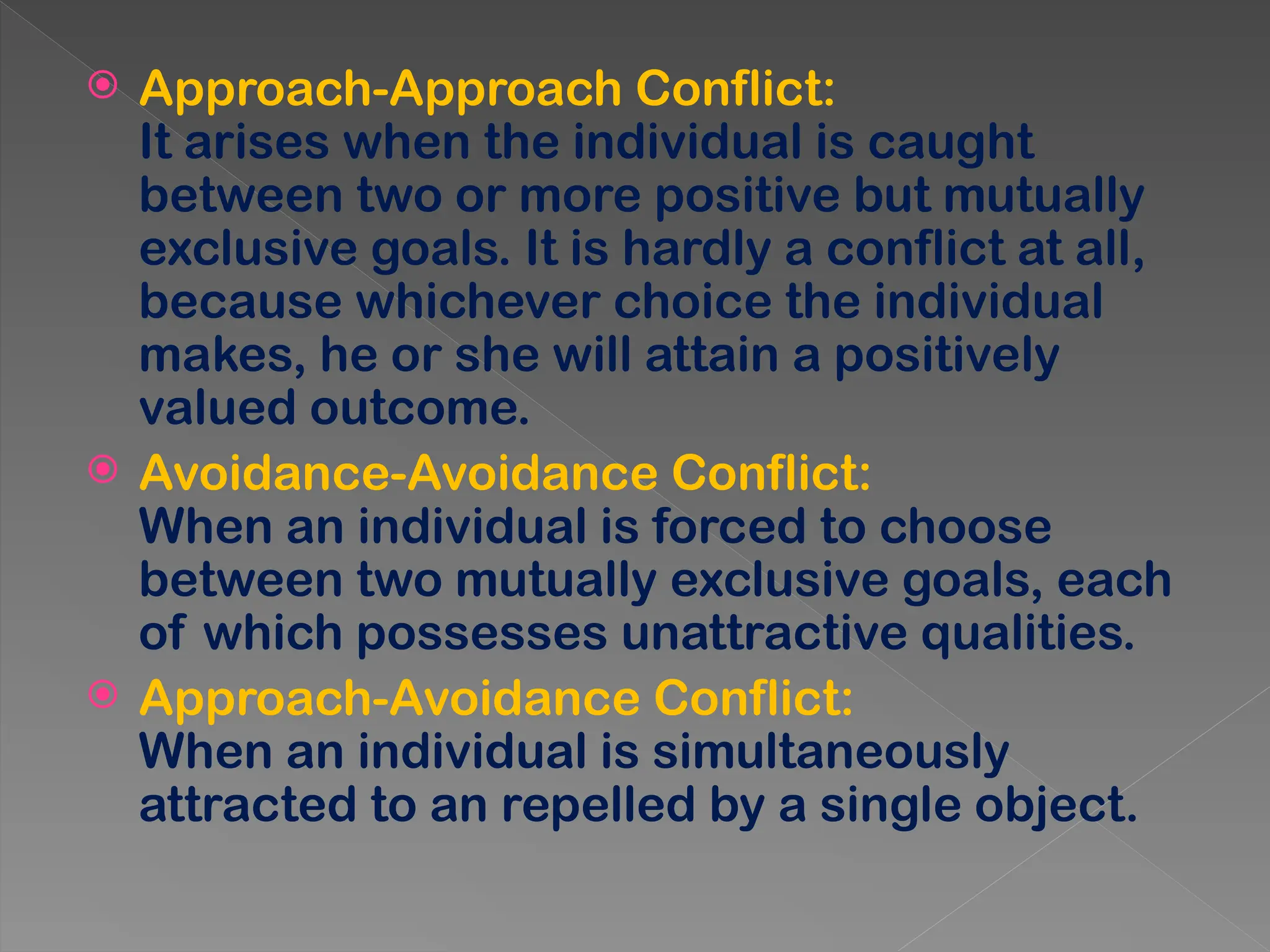
 Approach-Approach Conflict:
It arises when the individual is caught
between two or more positive but mutually
exclusive goals. It is hardly a conflict at all,
because whichever choice the individual
makes, he or she will attain a positively
valued outcome.
 Avoidance-Avoidance Conflict:
When an individual is forced to choose
between two mutually exclusive goals, each
of which possesses unattractive qualities.
 Approach-Avoidance Conflict:
When an individual is simultaneously
attracted to an repelled by a single object.
 Inter individual conflict occurs between
two individuals in an organisation. It
arises mainly because of difference in
perception, personalities and role
ambiguities.
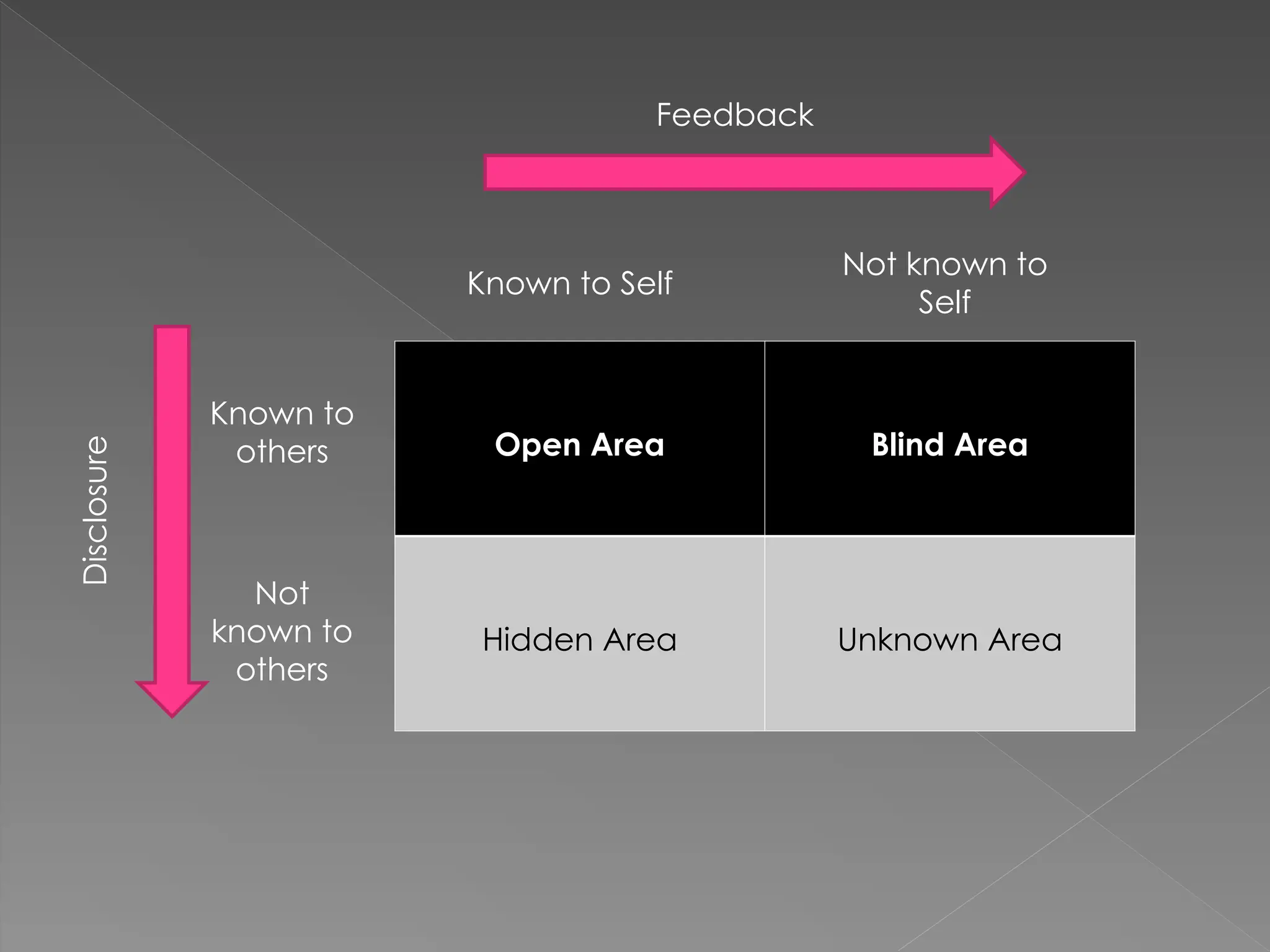
 Transactional Analysis and Johari
Window explain the phenomenon of
inter-personal conflict.
 When two people interact with each
others, there results a social transaction.
Analysis of this social transaction is
called Transactional Analysis(TA). TA
was introduced by Eric Berne and
popularised by Thomas Harris in the
1960s.
 Ego States: Basic to TA is assumption
that a person has three ego states, viz.,
parent, adult and child.
 The Parent Ego state represents the part
of a person’s personality that is
authoritative, dogmatic, overprotective,
controlling, nurturing, critical and
righteous.
 The Adult Ego represents the mature,
rational and objective part of a person’s
personality. These characteristics are
acquired as one matures into
adolescence and adulthood.
 The Child Ego state represents the
childish, dependent, and immature part
of a person’s personality.
 Developed by Joseph Luft and Harry
Ingham, this model is highly useful in
analysing the causes for inter-personal
conflict. The model is based on two
assumptions:
 i) Degree to which the person knows
about himself or herself.
 ii) Degree to which the person is known
to others.
Open Area Blind Area
Hidden Area Unknown Area
Feedback
Known to Self
Known to
others
Not known to
Self
Not
known to
others
Disclosure
 Intra Group Conflict:- It refers to dispute
among some or all of a group’s members,
which often affect the group’s performance.
Family run business can be especially prove
to severe intra-group and other type of
conflicts.
 Inter Group Conflict:- It is also organisation
conflict, refers to the conflict between
groups, departments, or sections in an
organisation. Conflict between groups is
frequent and highly visible.
 For Intrapersonal Conflict:- It can be
resolved by developing compatibility
between his or her personal and
organisational goals.
According to the Hindu philosophy, an
individual consists of three gunas or
psychogenic substances. These are Satwa,
Rajas and Tamas.
Satwa refers to purity, calmness, goodness,
etc.
Rajas refers to passion, impatience,
jealousy, etc.
Tamas refers to anger, pride, confusion, etc.
 For Interpersonal Conflict:- The
additional approaches to solve the
conflict are: the lose-lose, win-lose and
win-win strategies. These can be
resolved by changing behavioural inputs.
Lose-Lose is the approach in which both
the parties stand to lose. It is less
effective.
Win-Lose is where one party to conflict
tries to marshal all the resources to win,
and the other party loses.
Win-Win is the strategy where a conflict
resolution is probably the most desirable
from the human and organisation view.
 For Intra Group Conflict:- It can be resolved
if the members recognise and respect roles
of family members. All the members need to
realise that united they stand divided they
fall.
 For Inter Group Conflict:- Problem solving is
considered to be the most effective
approach. Changing organisational
structure is another approach for resolving
conflict. Appealing to superordinate goals,
i.e., a common goal of both parties and
combined efforts can also solve conflict.
When the issue is trivial avoidance is the
most useful strategy.
 Cooperativeness- It is the desire to satisfy other person’s
concern.
 Assertiveness- It is the desire to satisfy one’s own
concern.
 Avoidance- It is the desire to withdraw from conflict.
 Accommodation- It is the willingness to sacrifice the goals
so that the other part can achieve the goals.
 Compromise- A situation in which part to conflict is willing
to give up something.
 Competition- A desire to satisfy one’s own interest.
 Collaboration- A situation in which the parties to conflict
each desire to satisfy the concern of all parties.
 Since the score of collaboration is highest, it is the most
effective to manage conflict.
Conflict Management is a tool to reducee

Conflict Management is a tool to reducee

  • 2.
     Conflict refersto collision or disagreement.  In organisational context, conflict refers to a process in which one party perceives that another party has taken or will take actions that are incompatible with one’s own interests.  Conflict may be within an individual when there is incompatibility between his or her goals; may be within two individuals, when one does not see eye-to-eye with another, and in the process tries to block or frustrate the attempts of another; or between two groups in an organisation.
  • 3.
     Conflict maybe cognitive or affective.  Cognitive conflict refers to difference in perspectives or judgments about issues.  Affective conflict is emotional and directed at other people. It is likely to be destructive because it can lead to anger, bitterness, etc.  Conflict in cognitive form can air legitimate differences of opinion and develop better ideas and solutions to problems.
  • 4.
    Traditional View CurrentView • It was relevant during the 1930s and 1940s. • This view originated when the researchers began to identify causes if effectively managed conflict. • Conflict is avoidable • Conflict is inevitable • Conflict is caused by management error. • Conflict arises from many causes, including organisational structure, unavoidable differences in goals, etc. • It disrupts the organisation and prevents optimal performance. • It contributes and detracts from organisational performance in varying degrees. • It is the task of management to eliminate conflict. • It is the task of management to manage the level of conflict and its resolution for optimal organisations performance.
  • 5.
     Functional Conflictrefers to confrontation between two idea, goals and parties that improve employees and the organisation’s performance.  Dysfunctional Conflict is the negative side of conflict. Symptoms are personality clashes, unresolved anger, inefficiency, resource wastage, etc.
  • 6.
     It increasesawareness of what problems exist, who is involved and how to solve the problem.  It motivates organisational members to consider problems.  It promotes change. Persons are more aware of injustices, inefficiencies and frustrations.
  • 9.
     Latent Conflict:-When two or more parties need each other to achieve desired objectives, there is potential for conflict. Latent conflict often arises when a change occurs.  Perceived Conflict:- Members become aware of a problem. Incompatibility of needs is perceived and tension begins as the parties begin to worry about what will happen.  Felt Conflict:- Parties become emotionally involved and begin to focus on differences of opinion and opposing interests(sharpening of perceived conflict).
  • 10.
     Manifest Conflict:-At this stage the parties engage in actions that help achieve own objectives and thwart those of others.  Conflict Outcome:- The conflict finally results in an outcome which may be functional or dysfunctional. If handled well shall result in functional conflict and if not handled well shall result in dysfunctional conflict.
  • 12.
     It refersto conflict within an individual. It arises from frustration, numerous roles which demand equal attention but is not always possible to create.  Conflict from Frustration: Frustration occurs when a motivated drive is blocked before a person reaches a desired goal. It is checked by barriers which may be overt(external) or covert(internal).
  • 13.
     External Barriersinclude floods, power failures and break down of transportation. These are non- social in nature. There are external barriers which are social, they are placed by others in the way of reaching one’s goals.  Internal Barriers are personal limitation and disabilities, weakness, physical deformities, lack of skill, or low intelligence, etc. , they may stand in the way of achievement.
  • 14.
     Goal Conflictis more complex than conflict from frustration. It occurs when the attainment of one goal excludes the possibility of attaining another. The major forms of conflict may be distinguished as:- Approach-Approach Conflict Avoidance-Avoidance Conflict Approach-Avoidance Conflict
  • 15.
     Approach-Approach Conflict: Itarises when the individual is caught between two or more positive but mutually exclusive goals. It is hardly a conflict at all, because whichever choice the individual makes, he or she will attain a positively valued outcome.  Avoidance-Avoidance Conflict: When an individual is forced to choose between two mutually exclusive goals, each of which possesses unattractive qualities.  Approach-Avoidance Conflict: When an individual is simultaneously attracted to an repelled by a single object.
  • 16.
     Inter individualconflict occurs between two individuals in an organisation. It arises mainly because of difference in perception, personalities and role ambiguities.  Transactional Analysis and Johari Window explain the phenomenon of inter-personal conflict.
  • 17.
     When twopeople interact with each others, there results a social transaction. Analysis of this social transaction is called Transactional Analysis(TA). TA was introduced by Eric Berne and popularised by Thomas Harris in the 1960s.  Ego States: Basic to TA is assumption that a person has three ego states, viz., parent, adult and child.
  • 18.
     The ParentEgo state represents the part of a person’s personality that is authoritative, dogmatic, overprotective, controlling, nurturing, critical and righteous.  The Adult Ego represents the mature, rational and objective part of a person’s personality. These characteristics are acquired as one matures into adolescence and adulthood.  The Child Ego state represents the childish, dependent, and immature part of a person’s personality.
  • 19.
     Developed byJoseph Luft and Harry Ingham, this model is highly useful in analysing the causes for inter-personal conflict. The model is based on two assumptions:  i) Degree to which the person knows about himself or herself.  ii) Degree to which the person is known to others.
  • 20.
    Open Area BlindArea Hidden Area Unknown Area Feedback Known to Self Known to others Not known to Self Not known to others Disclosure
  • 21.
     Intra GroupConflict:- It refers to dispute among some or all of a group’s members, which often affect the group’s performance. Family run business can be especially prove to severe intra-group and other type of conflicts.  Inter Group Conflict:- It is also organisation conflict, refers to the conflict between groups, departments, or sections in an organisation. Conflict between groups is frequent and highly visible.
  • 22.
     For IntrapersonalConflict:- It can be resolved by developing compatibility between his or her personal and organisational goals. According to the Hindu philosophy, an individual consists of three gunas or psychogenic substances. These are Satwa, Rajas and Tamas. Satwa refers to purity, calmness, goodness, etc. Rajas refers to passion, impatience, jealousy, etc. Tamas refers to anger, pride, confusion, etc.
  • 23.
     For InterpersonalConflict:- The additional approaches to solve the conflict are: the lose-lose, win-lose and win-win strategies. These can be resolved by changing behavioural inputs. Lose-Lose is the approach in which both the parties stand to lose. It is less effective. Win-Lose is where one party to conflict tries to marshal all the resources to win, and the other party loses. Win-Win is the strategy where a conflict resolution is probably the most desirable from the human and organisation view.
  • 24.
     For IntraGroup Conflict:- It can be resolved if the members recognise and respect roles of family members. All the members need to realise that united they stand divided they fall.  For Inter Group Conflict:- Problem solving is considered to be the most effective approach. Changing organisational structure is another approach for resolving conflict. Appealing to superordinate goals, i.e., a common goal of both parties and combined efforts can also solve conflict. When the issue is trivial avoidance is the most useful strategy.
  • 26.
     Cooperativeness- Itis the desire to satisfy other person’s concern.  Assertiveness- It is the desire to satisfy one’s own concern.  Avoidance- It is the desire to withdraw from conflict.  Accommodation- It is the willingness to sacrifice the goals so that the other part can achieve the goals.  Compromise- A situation in which part to conflict is willing to give up something.  Competition- A desire to satisfy one’s own interest.  Collaboration- A situation in which the parties to conflict each desire to satisfy the concern of all parties.  Since the score of collaboration is highest, it is the most effective to manage conflict.