 A disagreement between people that may be
the result of different:
◦ Ideas
◦ Perspectives
◦ Priorities
◦ Preferences
◦ Beliefs
◦ Values
◦ Goals
◦ Organization structures
 Conflict is a problem when:
◦ It hampers productivity & increases tension
◦ Lowers morale
◦ Causes more & continued conflicts
◦ Causes inappropriate behavior
◦ Increases absenteeism
 Conflict is constructive when:
◦ Opens up issues of importance resulting in issue
clarification
◦ Helps build cohesiveness as people learn more about
each other
◦ Causes reassessment by allowing for examination of
procedures or actions
◦ Increases individual involvement
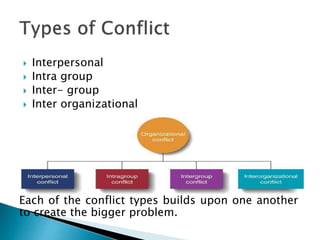
 Interpersonal
 Intra group
 Inter- group
 Inter organizational
Each of the conflict types builds upon one another
to create the bigger problem.
Conflict Resolution Styles
 Forcing conflict style: person attempts to resolve
conflict by using aggressive behavior
 Avoiding: person attempts to passively ignore the
conflict rather than solve it
 Accommodating: person attempts to resolve the
conflict by passively giving in to the other party
 Compromising: person attempts to resolve the
conflict through assertive give & take concessions
 Collaborating: person attempts to jointly resolve
the conflict with the best solution agreeable to all
parties
 Lose – lose conflict
 Management by avoidance or accommodation
 Win – lose conflict
◦ Management by competition & compromise
 Win – Win conflict
◦ Management by collaboration
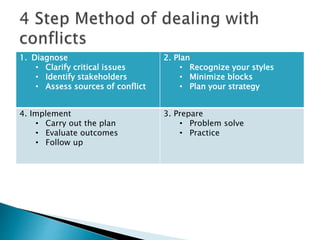
1. Diagnose
• Clarify critical issues
• Identify stakeholders
• Assess sources of conflict
2. Plan
• Recognize your styles
• Minimize blocks
• Plan your strategy
4. Implement
• Carry out the plan
• Evaluate outcomes
• Follow up
3. Prepare
• Problem solve
• Practice
 Have a positive attitude
 Not letting small problems escalate, deal with
them as they arise
 Have an open ear to others perspective on conflict
solution
 Focus on solving problems, not changing people
 If you can’t resolve the problem, turn to someone
who can help
 Give constructive critic/feedback
 Conflict Between people is a Fact of Life.
 Conflicts occur at all levels of interaction.
 Thus, conflict is a critical event in the course of a
relationship.
 Whether a relationship is healthy or unhealthy
depends not so much on the number of conflicts
between participants but on how the conflicts are
resolved.
Conflict management

Conflict management

  • 2.
     A disagreementbetween people that may be the result of different: ◦ Ideas ◦ Perspectives ◦ Priorities ◦ Preferences ◦ Beliefs ◦ Values ◦ Goals ◦ Organization structures
  • 4.
     Conflict isa problem when: ◦ It hampers productivity & increases tension ◦ Lowers morale ◦ Causes more & continued conflicts ◦ Causes inappropriate behavior ◦ Increases absenteeism  Conflict is constructive when: ◦ Opens up issues of importance resulting in issue clarification ◦ Helps build cohesiveness as people learn more about each other ◦ Causes reassessment by allowing for examination of procedures or actions ◦ Increases individual involvement
  • 5.
     Interpersonal  Intragroup  Inter- group  Inter organizational Each of the conflict types builds upon one another to create the bigger problem.
  • 6.
    Conflict Resolution Styles Forcing conflict style: person attempts to resolve conflict by using aggressive behavior  Avoiding: person attempts to passively ignore the conflict rather than solve it  Accommodating: person attempts to resolve the conflict by passively giving in to the other party  Compromising: person attempts to resolve the conflict through assertive give & take concessions  Collaborating: person attempts to jointly resolve the conflict with the best solution agreeable to all parties
  • 7.
     Lose –lose conflict  Management by avoidance or accommodation  Win – lose conflict ◦ Management by competition & compromise  Win – Win conflict ◦ Management by collaboration
  • 8.
    1. Diagnose • Clarifycritical issues • Identify stakeholders • Assess sources of conflict 2. Plan • Recognize your styles • Minimize blocks • Plan your strategy 4. Implement • Carry out the plan • Evaluate outcomes • Follow up 3. Prepare • Problem solve • Practice
  • 9.
     Have apositive attitude  Not letting small problems escalate, deal with them as they arise  Have an open ear to others perspective on conflict solution  Focus on solving problems, not changing people  If you can’t resolve the problem, turn to someone who can help  Give constructive critic/feedback
  • 10.
     Conflict Betweenpeople is a Fact of Life.  Conflicts occur at all levels of interaction.  Thus, conflict is a critical event in the course of a relationship.  Whether a relationship is healthy or unhealthy depends not so much on the number of conflicts between participants but on how the conflicts are resolved.