Burke-Litwin change model
Approaches to Managing Organizational Change
Prepared By
Kindly restrict the use of slides for personal purpose.
Please seek permission to reproduce the same in public forms and presentations.
Manu Melwin Joy
Assistant Professor
Ilahia School of Management Studies
Kerala, India.
Phone – 9744551114
Mail – manu_melwinjoy@yahoo.com
Burke-Litwin change model
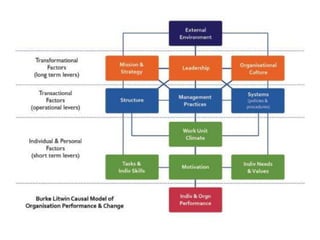
• The Burke-Litwin change
model revolves around
defining and establishing a
cause-and-effect relationship
between 12 organizational
dimensions that are key to
organizational change.
• Let’s take a look at how this
change model can make the
process easier.
Burke-Litwin change model
• External Environment: The key
external factors that have an
impact on the organization must
be identified and their direct and
indirect impact on the
organization should be clearly
established.
• Mission and Strategy: the vision,
mission and the strategy of the
organization, as defined by the
top management should be
examined in terms of the
employees’ point-of-view about
them.
Burke-Litwin change model
• Leadership: A study of the
leadership structure of the
organization should be carried
out, which clearly identifies the
chief role models in the
organization.
• Organizational Culture: An
organizational culture study
should seek information on the
explicit as well as the implied
rules, regulations, customs,
principles and values that
influence the organizational
behavior.
Burke-Litwin change model
• Structure: The study of
structure should not be
confined to hierarchical
structure; rather it should be a
function based structure
focusing on the responsibiliity ,
authority, communication,
decision making and control
structure that exists between
the people of the organization.
• Systems: Systems includes all
types of policies and procedures
with regards to both the people
and the operations of the
organization.
Burke-Litwin change model
• Management Practices: This
would entail a study of how well
the mangers conform to the
organization’s strategy when
dealing with employees and the
resources.
• Work Unit Climate: It is a
collective study of how the
employees think, feel and what
do they expect. The kind of
relationships the employees
share with their team members
and members of other teams is
also an important aspect of
work unit climate.
Burke-Litwin change model
• Tasks and Skills: This involves
understanding what a specific job
position demands and the kind of
skills and knowledge that an
employee must have in order to fulfill
the task responsibilities of that job
position. It’s important to see how
well jobs and employees have been
matched.
• Individual Values and Needs: This
dimension seeks to explore the
employee’s opinion about their work
so as to identify the quality factors
that will result in job enrichment and
better job satisfaction.
Burke-Litwin change model
• Motivation Level: Identifying the
motivation level of the employees
will make it easier to determine
how willingly they would put in
their efforts to achieve
organizational goals. This would
also involve identifying
motivational triggers.
• Individual and Overall
Performance: This dimension takes
into account the level of
performance, on individual and
organizational levels, in key areas
like productivity, quality, efficiency,
budget and customer satisfaction
etc.
Porras & Robertson Model
• Porras & Robertson outline four types of
organizational change based on the category
of change (planned or unplanned) and its
order (first or second).
Porras & Robertson Model
• Planned change originates with a
decision made by the organization
itself with the deliberate purpose of
improving its functioning.
• It is also common to engage an
outside resource to help in the
processes of making these
improvements.
• Planned change is typically initiated
to respond to new external
demands imposed upon the
organization.
• Planned change will often affect
many unforeseen segments of the
organization.
Porras & Robertson Model
• Unplanned change is change
that originates outside of the
organizational system and to
which the organization must
respond.
• This adaptive response is often
focused on the alteration of
relatively clearly defined and
narrow segments of the
organization.
• It is spontaneous, evolutionary,
fortuitous, or accidental.
Porras & Robertson Model
• First-order change, linear and
continuous in nature, involves
alterations in system
characteristics without any
shift in either fundamental
assumptions about key
organizational cause-and-
effect relationships or in the
basic paradigm used by the
system to guide its
functioning.
Porras & Robertson Model
• Second-order change is a
multi-dimensional, multi-
level, qualitative,
discontinuous, radical
organizational change
involving a paradigmatic
shift.
Burke litwin change model -  Organizational Change and Development - Manu Melwin Joy

Burke litwin change model - Organizational Change and Development - Manu Melwin Joy

  • 1.
    Burke-Litwin change model Approachesto Managing Organizational Change
  • 2.
    Prepared By Kindly restrictthe use of slides for personal purpose. Please seek permission to reproduce the same in public forms and presentations. Manu Melwin Joy Assistant Professor Ilahia School of Management Studies Kerala, India. Phone – 9744551114 Mail – manu_melwinjoy@yahoo.com
  • 3.
    Burke-Litwin change model •The Burke-Litwin change model revolves around defining and establishing a cause-and-effect relationship between 12 organizational dimensions that are key to organizational change. • Let’s take a look at how this change model can make the process easier.
  • 5.
    Burke-Litwin change model •External Environment: The key external factors that have an impact on the organization must be identified and their direct and indirect impact on the organization should be clearly established. • Mission and Strategy: the vision, mission and the strategy of the organization, as defined by the top management should be examined in terms of the employees’ point-of-view about them.
  • 6.
    Burke-Litwin change model •Leadership: A study of the leadership structure of the organization should be carried out, which clearly identifies the chief role models in the organization. • Organizational Culture: An organizational culture study should seek information on the explicit as well as the implied rules, regulations, customs, principles and values that influence the organizational behavior.
  • 7.
    Burke-Litwin change model •Structure: The study of structure should not be confined to hierarchical structure; rather it should be a function based structure focusing on the responsibiliity , authority, communication, decision making and control structure that exists between the people of the organization. • Systems: Systems includes all types of policies and procedures with regards to both the people and the operations of the organization.
  • 8.
    Burke-Litwin change model •Management Practices: This would entail a study of how well the mangers conform to the organization’s strategy when dealing with employees and the resources. • Work Unit Climate: It is a collective study of how the employees think, feel and what do they expect. The kind of relationships the employees share with their team members and members of other teams is also an important aspect of work unit climate.
  • 9.
    Burke-Litwin change model •Tasks and Skills: This involves understanding what a specific job position demands and the kind of skills and knowledge that an employee must have in order to fulfill the task responsibilities of that job position. It’s important to see how well jobs and employees have been matched. • Individual Values and Needs: This dimension seeks to explore the employee’s opinion about their work so as to identify the quality factors that will result in job enrichment and better job satisfaction.
  • 10.
    Burke-Litwin change model •Motivation Level: Identifying the motivation level of the employees will make it easier to determine how willingly they would put in their efforts to achieve organizational goals. This would also involve identifying motivational triggers. • Individual and Overall Performance: This dimension takes into account the level of performance, on individual and organizational levels, in key areas like productivity, quality, efficiency, budget and customer satisfaction etc.
  • 11.
    Porras & RobertsonModel • Porras & Robertson outline four types of organizational change based on the category of change (planned or unplanned) and its order (first or second).
  • 12.
    Porras & RobertsonModel • Planned change originates with a decision made by the organization itself with the deliberate purpose of improving its functioning. • It is also common to engage an outside resource to help in the processes of making these improvements. • Planned change is typically initiated to respond to new external demands imposed upon the organization. • Planned change will often affect many unforeseen segments of the organization.
  • 13.
    Porras & RobertsonModel • Unplanned change is change that originates outside of the organizational system and to which the organization must respond. • This adaptive response is often focused on the alteration of relatively clearly defined and narrow segments of the organization. • It is spontaneous, evolutionary, fortuitous, or accidental.
  • 14.
    Porras & RobertsonModel • First-order change, linear and continuous in nature, involves alterations in system characteristics without any shift in either fundamental assumptions about key organizational cause-and- effect relationships or in the basic paradigm used by the system to guide its functioning.
  • 15.
    Porras & RobertsonModel • Second-order change is a multi-dimensional, multi- level, qualitative, discontinuous, radical organizational change involving a paradigmatic shift.