ORGANISATIONALTHEORY, DESIGN
AND DEVELOPMENT
UNIT - IV
MBA - VCEW
SYLLABUS
UNIT IV - ORGANISATIONAL CHANGE
Meaning – Forces for Change - Resistance to Change –
Types and forms of change – Evolutionary and
Revolutionary change – Change process - Organisation
Development – HR functions and Strategic Change
Management - Implications for practicing Managers
MEANING OF CHANGE
Change means, to alter, to make different, to make or to pass from
one state to another, to exchange. in their writings. It is described as a
relatively enduring alteration of the present state of an organization
or its components and their differentiated and integrated functions in
totally and partially, in order to obtain greater viability in the context
of the present and anticipated future environment. organizational
change means significant alternation in any one or more of the tasks
,techniques , structure and people of the organization.
FORCES FOR CHANGE
• Improving Cost Effectiveness and enhancing quality through
better operations, Projects execution, improved systems and
procedures, continuous improvement etc.
• New Product Development, Technology Up gradation
• Greater Customer Orientation, Providing higher value, new
services, tapping new markets.
• Expansion and development of the business.
• Skill Development, managing talent, generating commitment,
changing mind-sets.
• Restructuring – Modifying structure, culture, process, and styles,
creating capacity for adaption and innovation.
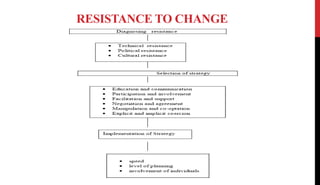
RESISTANCE TO CHANGE
Changes meet with varying degrees of resistance. It is necessary to understand
what factors create resistance and how they can effectively deal with. Few
organizational change efforts tend to be complete failures, but few tend to be
entirely successful either. Most effort encounter problems; they often take
longer than expected or desired, they sometimes take toll on people’s morale,
and they often cost a great deal in terms of managerial times and emotional
upheaval . Some organizations do not try to initiate needed changes because the
managers involved are afraid that they are simply incapable of successfully
implement them.
RESISTANCE TO CHANGE
TYPES AND FORMS OF CHANGE
• Structural change
• Cyclical changes
• Unplanned change
• Planned change
STRUCTURAL CHANGE
It is a considerable quantitative rise or decline, which results is
change in essential quality. It is a non reversible; and so requires
permanent adjustment. Essential quality changes took place for
example in the speed of communication , which increased slightly as
messages went from human runners to those transmitted by
messengers on horse back but the telegraph ,telephone ,radio,
television, cable network, internet and world wide web brought in a
dramatic alternation .
CYCLICAL CHANGES
These are changes in certain measure or condition from level or state
to which it likely to return later. Over a time period cyclical changes
fallow the pattern in their fluctuation, returning regularly to prior
state. They require only temporary adjustment. Perhaps fashion
industry is a good example. It has seen thin ties to broad ties to thin
ties several times. Since cyclical changes have a shorter duration, it is
inappropriate to make permanent or irreversible decisions as a
response to cyclical changes.
UNPLANNED CHANGE
Situations and conditions that are imposed on the organization, are often
unforeseen. Responsiveness to unplanned changed require tremendous
flexibility and adaptability on the part of organization.
PLANNED CHANGE
It can be defined as conscious deliberate and usually collaborative effort to
improve operations of system. It involves some kind of organized effort and
deliberate decisions to alter the organization. Planned change therefore
involves inventing a future and creating conditions and resources for
realizing for future.
CHARACTERISTIC OF CHANGE
• Rate of Change
• Direction of Change
• Diffusion of change
RATE OF CHANGE
Change does not occur at the same rate for all things or set of
conditions. With the development of microprocessors and personal
computers, the rate of change of many industries such as banking
and telecommunications has gone up dramatically.
DIRECTION OF CHANGE
This term is used to define the way present conditions will alter
future events. Would people favour large departmental stores are
smaller neighbourhood shops, what would be preferred options for
investing the savings and what choice of courses / specializations
would students opt for? Such questions raise issue of direction of
change .the need to predict the course of change accurately is as
vital as forecasting how rapidly it will grow.
DIFFUSION OF CHANGE
The term diffusion means to spread out. Diffusion of change
frequently called ‘dynamo effect’ for example a change in
procurement procedure in a company may result in changes in
several departments such as accounting, receiving, inspection, and
material control . It is virtually impossible to change any part of
any organization without affecting to some degree some or all of
the other parts.
EVOLUTIONARYAND REVOLUTIONARY
CHANGE
EVOLUTIONARY CHANGE
• Change that is gradual , incremental and specifically focused.
• A constant attempt to improve , adapt and adjust strategy and
structure incrementally.
• Three instruments that are used in evolutionary change are :-
Socio-technical systems, TQM and empowered flexible groups .
REVOLUTIONARY CHANGE
• Change that is sudden , drastic and organization wide.
• Bold attempt to quickly find new ways to be effective.
• It results in a radical shift in ways of doing things, new goals
and a new structure.
CHANGE PROCESS
What is Change Process?
It is the process which changes the state or which results in
change. Change process as Unfreezing, Changing and Refreezing.
Change process is used mainly as problem solving and problem
finding.
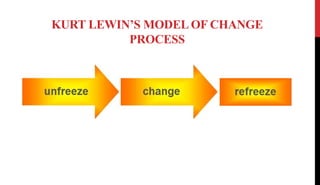
KURT LEWIN’S MODEL OF CHANGE
PROCESS
UNFREEZE
Change efforts to overcome the pressures of resistance to change. Driving
forces for change need to be greater than restraining forces working for
status quo.
Following steps need to be taken in unfreeze:
• Determine what needs to be done
• Ensure there is strong support from upper management
• Create the need for change
• Understand & Manage doubts & concerns
CHANGE
Moving to new state the following steps need to be taken:
• Communicate often
• Dispel rumours
• Empower action
• Involve people in the process
REFREEZE
Stabilizing the change; making new change permanent.
Following steps need to be taken:
• Anchor the changes into culture
• Develop ways to sustain the change
• Provide support & training
• Celebrate success
ORGANIZATIONAL DEVELOPMENT
The knowledge base of Organizational Development is extensive
and is constantly growing. Here we describe what we believe are
the most important underpinnings for the field. We will examine
the following concepts they are:
• Models and theories of planned change
• Systems theory
• Participation and empowerment
• Teams and team work
• Parallel learning structures
• A normative-re-educative strategy of changing
• Applied behavioural science
• Action research
Thank You

OTDD Chapter 4

  • 1.
  • 2.
    SYLLABUS UNIT IV -ORGANISATIONAL CHANGE Meaning – Forces for Change - Resistance to Change – Types and forms of change – Evolutionary and Revolutionary change – Change process - Organisation Development – HR functions and Strategic Change Management - Implications for practicing Managers
  • 3.
    MEANING OF CHANGE Changemeans, to alter, to make different, to make or to pass from one state to another, to exchange. in their writings. It is described as a relatively enduring alteration of the present state of an organization or its components and their differentiated and integrated functions in totally and partially, in order to obtain greater viability in the context of the present and anticipated future environment. organizational change means significant alternation in any one or more of the tasks ,techniques , structure and people of the organization.
  • 4.
    FORCES FOR CHANGE •Improving Cost Effectiveness and enhancing quality through better operations, Projects execution, improved systems and procedures, continuous improvement etc. • New Product Development, Technology Up gradation • Greater Customer Orientation, Providing higher value, new services, tapping new markets. • Expansion and development of the business.
  • 5.
    • Skill Development,managing talent, generating commitment, changing mind-sets. • Restructuring – Modifying structure, culture, process, and styles, creating capacity for adaption and innovation.
  • 6.
    RESISTANCE TO CHANGE Changesmeet with varying degrees of resistance. It is necessary to understand what factors create resistance and how they can effectively deal with. Few organizational change efforts tend to be complete failures, but few tend to be entirely successful either. Most effort encounter problems; they often take longer than expected or desired, they sometimes take toll on people’s morale, and they often cost a great deal in terms of managerial times and emotional upheaval . Some organizations do not try to initiate needed changes because the managers involved are afraid that they are simply incapable of successfully implement them.
  • 7.
  • 8.
    TYPES AND FORMSOF CHANGE • Structural change • Cyclical changes • Unplanned change • Planned change
  • 9.
    STRUCTURAL CHANGE It isa considerable quantitative rise or decline, which results is change in essential quality. It is a non reversible; and so requires permanent adjustment. Essential quality changes took place for example in the speed of communication , which increased slightly as messages went from human runners to those transmitted by messengers on horse back but the telegraph ,telephone ,radio, television, cable network, internet and world wide web brought in a dramatic alternation .
  • 10.
    CYCLICAL CHANGES These arechanges in certain measure or condition from level or state to which it likely to return later. Over a time period cyclical changes fallow the pattern in their fluctuation, returning regularly to prior state. They require only temporary adjustment. Perhaps fashion industry is a good example. It has seen thin ties to broad ties to thin ties several times. Since cyclical changes have a shorter duration, it is inappropriate to make permanent or irreversible decisions as a response to cyclical changes.
  • 11.
    UNPLANNED CHANGE Situations andconditions that are imposed on the organization, are often unforeseen. Responsiveness to unplanned changed require tremendous flexibility and adaptability on the part of organization. PLANNED CHANGE It can be defined as conscious deliberate and usually collaborative effort to improve operations of system. It involves some kind of organized effort and deliberate decisions to alter the organization. Planned change therefore involves inventing a future and creating conditions and resources for realizing for future.
  • 12.
    CHARACTERISTIC OF CHANGE •Rate of Change • Direction of Change • Diffusion of change
  • 13.
    RATE OF CHANGE Changedoes not occur at the same rate for all things or set of conditions. With the development of microprocessors and personal computers, the rate of change of many industries such as banking and telecommunications has gone up dramatically.
  • 14.
    DIRECTION OF CHANGE Thisterm is used to define the way present conditions will alter future events. Would people favour large departmental stores are smaller neighbourhood shops, what would be preferred options for investing the savings and what choice of courses / specializations would students opt for? Such questions raise issue of direction of change .the need to predict the course of change accurately is as vital as forecasting how rapidly it will grow.
  • 15.
    DIFFUSION OF CHANGE Theterm diffusion means to spread out. Diffusion of change frequently called ‘dynamo effect’ for example a change in procurement procedure in a company may result in changes in several departments such as accounting, receiving, inspection, and material control . It is virtually impossible to change any part of any organization without affecting to some degree some or all of the other parts.
  • 16.
    EVOLUTIONARYAND REVOLUTIONARY CHANGE EVOLUTIONARY CHANGE •Change that is gradual , incremental and specifically focused. • A constant attempt to improve , adapt and adjust strategy and structure incrementally. • Three instruments that are used in evolutionary change are :- Socio-technical systems, TQM and empowered flexible groups .
  • 17.
    REVOLUTIONARY CHANGE • Changethat is sudden , drastic and organization wide. • Bold attempt to quickly find new ways to be effective. • It results in a radical shift in ways of doing things, new goals and a new structure.
  • 18.
    CHANGE PROCESS What isChange Process? It is the process which changes the state or which results in change. Change process as Unfreezing, Changing and Refreezing. Change process is used mainly as problem solving and problem finding.
  • 19.
    KURT LEWIN’S MODELOF CHANGE PROCESS
  • 20.
    UNFREEZE Change efforts toovercome the pressures of resistance to change. Driving forces for change need to be greater than restraining forces working for status quo. Following steps need to be taken in unfreeze: • Determine what needs to be done • Ensure there is strong support from upper management • Create the need for change • Understand & Manage doubts & concerns
  • 21.
    CHANGE Moving to newstate the following steps need to be taken: • Communicate often • Dispel rumours • Empower action • Involve people in the process
  • 22.
    REFREEZE Stabilizing the change;making new change permanent. Following steps need to be taken: • Anchor the changes into culture • Develop ways to sustain the change • Provide support & training • Celebrate success
  • 23.
    ORGANIZATIONAL DEVELOPMENT The knowledgebase of Organizational Development is extensive and is constantly growing. Here we describe what we believe are the most important underpinnings for the field. We will examine the following concepts they are:
  • 24.
    • Models andtheories of planned change • Systems theory • Participation and empowerment • Teams and team work • Parallel learning structures • A normative-re-educative strategy of changing • Applied behavioural science • Action research
  • 25.