Organizational Learning
Instructor: Ms. Chhavi Jatana
Presented by: Nupur Jha (17) || Prachi Singla (18)
09-11-2021 1
HRM | Organizational Learning
Organizational Learning
• Organizational learning is concerned with
the development of new knowledge or
insights that have the potential to
influence behavior.
• Marsick (1994): Organizational learning is
a process of: ‘Coordinated systems
change, with mechanisms built in for
individuals and groups to access, build
and use organizational memory, structure
and culture to develop long-term
organizational capacity.
09-11-2021 2
HRM | Organizational Learning
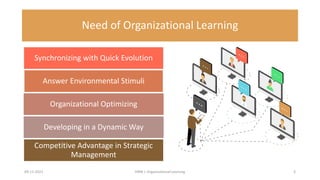
Need of Organizational Learning
Synchronizing with Quick Evolution
Answer Environmental Stimuli
Organizational Optimizing
Developing in a Dynamic Way
Competitive Advantage in Strategic
Management
09-11-2021 3
HRM | Organizational Learning
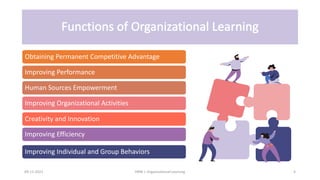
Obtaining Permanent Competitive Advantage
Improving Performance
Human Sources Empowerment
Creativity and Innovation
Improving Individual and Group Behaviors
Improving Efficiency
Improving Organizational Activities
09-11-2021 4
HRM | Organizational Learning
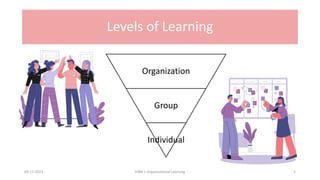
Levels of Learning
Organization
Group
Individual
09-11-2021 5
HRM | Organizational Learning
Individual Learning
Behaviourism
• Behaviorists assume that the
behavior is a function of its
consequences i.e. positive
reinforcement is likely to result in
the desired behavioral outcome.
• Much competence-based training
is based on this approach.
Competence approaches are useful
for repetitive tasks but can be rigid
and mechanical and lack higher
order learning
Cognitive Theory
• Learning is a change in states of
knowledge rather than a change in
the probability of response
(behaviorists).
• This information processing
perspective laid an emphasis on
problem solving.
09-11-2021 6
HRM | Organizational Learning
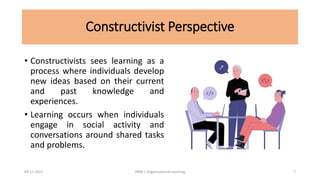
Constructivist Perspective
• Constructivists sees learning as a
process where individuals develop
new ideas based on their current
and past knowledge and
experiences.
• Learning occurs when individuals
engage in social activity and
conversations around shared tasks
and problems.
09-11-2021 7
HRM | Organizational Learning
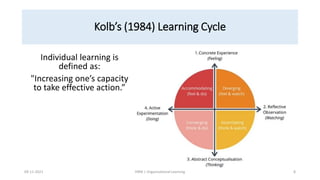
Kolb’s (1984) Learning Cycle
Individual learning is
defined as:
"Increasing one’s capacity
to take effective action.”
09-11-2021 8
HRM | Organizational Learning
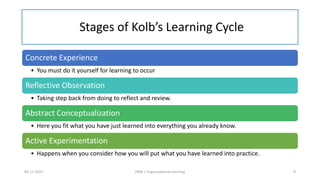
Stages of Kolb’s Learning Cycle
Concrete Experience
• You must do it yourself for learning to occur
Reflective Observation
• Taking step back from doing to reflect and review.
Abstract Conceptualization
• Here you fit what you have just learned into everything you already know.
Active Experimentation
• Happens when you consider how you will put what you have learned into practice.
09-11-2021 HRM | Organizational Learning 9
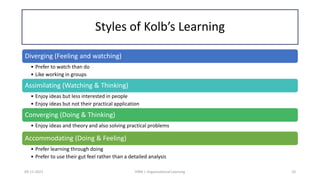
Styles of Kolb’s Learning
09-11-2021 HRM | Organizational Learning 10
Diverging (Feeling and watching)
• Prefer to watch than do
• Like working in groups
Assimilating (Watching & Thinking)
• Enjoy ideas but less interested in people
• Enjoy ideas but not their practical application
Converging (Doing & Thinking)
• Enjoy ideas and theory and also solving practical problems
Accommodating (Doing & Feeling)
• Prefer learning through doing
• Prefer to use their gut feel rather than a detailed analysis
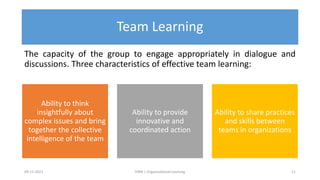
Team Learning
The capacity of the group to engage appropriately in dialogue and
discussions. Three characteristics of effective team learning:
Ability to think
insightfully about
complex issues and bring
together the collective
intelligence of the team
Ability to provide
innovative and
coordinated action
Ability to share practices
and skills between
teams in organizations
09-11-2021 11
HRM | Organizational Learning
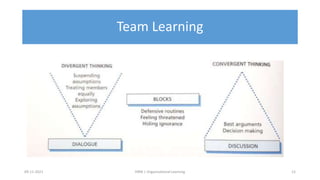
Team Learning
09-11-2021 12
HRM | Organizational Learning
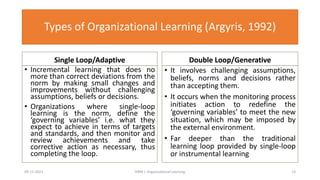
Types of Organizational Learning (Argyris, 1992)
Single Loop/Adaptive
• Incremental learning that does no
more than correct deviations from the
norm by making small changes and
improvements without challenging
assumptions, beliefs or decisions.
• Organizations where single-loop
learning is the norm, define the
‘governing variables’ i.e. what they
expect to achieve in terms of targets
and standards, and then monitor and
review achievements and take
corrective action as necessary, thus
completing the loop.
Double Loop/Generative
• It involves challenging assumptions,
beliefs, norms and decisions rather
than accepting them.
• It occurs when the monitoring process
initiates action to redefine the
‘governing variables’ to meet the new
situation, which may be imposed by
the external environment.
• Far deeper than the traditional
learning loop provided by single-loop
or instrumental learning
09-11-2021 13
HRM | Organizational Learning
Single Loop/Adaptive Double Loop/Generative
Single Loop & Double Loop
Learning
Easterby-Smith and Araujo (1999) Single-
loop learning could be ‘where an
organization tries out new methods and
tactics and attempts to get rapid
feedback on their consequences in order
to be able to make continuous
adjustments and adaptations’. In
contrast, double-loop learning is
associated ‘with radical change, which
might involve a major change in strategic
direction, possibly linked to replacement
of senior personnel, and wholesale
revision of systems’.
09-11-2021 14
HRM | Organizational Learning
Other Types of Organizational Learning
Dawes (2003)
• Hereditary learning: it points at a
science, which has been created by
organization founders.
• Experiential learning: it considers a
science, which is obtained through
experience, which can be obtained on
purpose or by chance.
• Vicarious learning: It points at the
second hand experience, which has
been done by the people out of an
organization.
Marquardt (2002)
• Adaptive learning: A person, group or
organization learn through experience
and evaluation (their previous
performance).
• Forward-looking learning:
Organization learns through
prospective futures.
• Practical learning: working on real
issues, focusing on the obtained
science and real performance of
solutions
09-11-2021 15
HRM | Organizational Learning
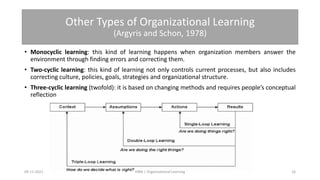
Other Types of Organizational Learning
(Argyris and Schon, 1978)
• Monocyclic learning: this kind of learning happens when organization members answer the
environment through finding errors and correcting them.
• Two-cyclic learning: this kind of learning not only controls current processes, but also includes
correcting culture, policies, goals, strategies and organizational structure.
• Three-cyclic learning (twofold): it is based on changing methods and requires people’s conceptual
reflection
09-11-2021 16
HRM | Organizational Learning
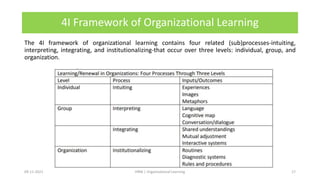
4I Framework of Organizational Learning
The 4I framework of organizational learning contains four related (sub)processes-intuiting,
interpreting, integrating, and institutionalizing-that occur over three levels: individual, group, and
organization.
09-11-2021 17
HRM | Organizational Learning
4I Framework of Organizational Learning
09-11-2021 18
HRM | Organizational Learning
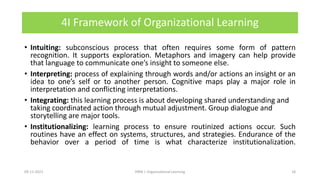
• Intuiting: subconscious process that often requires some form of pattern
recognition. It supports exploration. Metaphors and imagery can help provide
that language to communicate one’s insight to someone else.
• Interpreting: process of explaining through words and/or actions an insight or an
idea to one’s self or to another person. Cognitive maps play a major role in
interpretation and conflicting interpretations.
• Integrating: this learning process is about developing shared understanding and
taking coordinated action through mutual adjustment. Group dialogue and
storytelling are major tools.
• Institutionalizing: learning process to ensure routinized actions occur. Such
routines have an effect on systems, structures, and strategies. Endurance of the
behavior over a period of time is what characterize institutionalization.
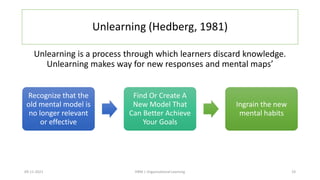
Unlearning (Hedberg, 1981)
Unlearning is a process through which learners discard knowledge.
Unlearning makes way for new responses and mental maps’
09-11-2021 19
HRM | Organizational Learning
Recognize that the
old mental model is
no longer relevant
or effective
Find Or Create A
New Model That
Can Better Achieve
Your Goals
Ingrain the new
mental habits
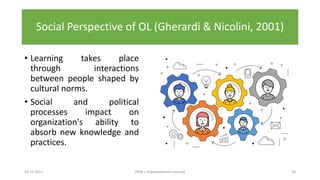
Social Perspective of OL (Gherardi & Nicolini, 2001)
• Learning takes place
through interactions
between people shaped by
cultural norms.
• Social and political
processes impact on
organization's ability to
absorb new knowledge and
practices.
09-11-2021 20
HRM | Organizational Learning
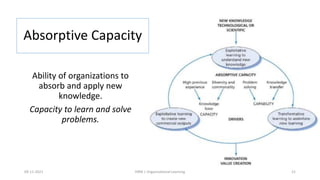
Ability of organizations to
absorb and apply new
knowledge.
Capacity to learn and solve
problems.
09-11-2021 21
HRM | Organizational Learning
Absorptive Capacity
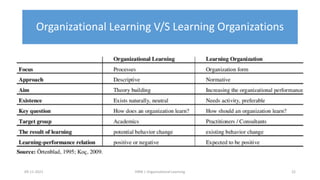
Organizational Learning V/S Learning Organizations
09-11-2021 22
HRM | Organizational Learning
Toyota: The Five Whys
The company looks at every problem as an opportunity to identify root causes and develop
countermeasures. They use a method called “the five whys.”
It goes like this:
• There is a puddle of oil on the floor —-> Clean up the puddle.
• WHY is there a puddle of oil on the floor? Because the machine is leaking oil. Fix the
machine.
• WHY is the machine leaking oil? Because the gasket has deteriorated. ——> Replace the
gasket.
• WHY has the gasket deteriorated? Because we bought inferior gaskets. —–> Order
different gaskets next time and so on.
• Do you see how the organization as a whole has learned from this experience? Individual
managers might have been the people to ask those “WHYs,” but they transferred the
knowledge to their organization by changing policies and procedures based on what they
learned.
09-11-2021 HRM | Organizational Learning 23
Thank You
09-11-2021 24
HRM | Organizational Learning

Organizational Learning

  • 1.
    Organizational Learning Instructor: Ms.Chhavi Jatana Presented by: Nupur Jha (17) || Prachi Singla (18) 09-11-2021 1 HRM | Organizational Learning
  • 2.
    Organizational Learning • Organizationallearning is concerned with the development of new knowledge or insights that have the potential to influence behavior. • Marsick (1994): Organizational learning is a process of: ‘Coordinated systems change, with mechanisms built in for individuals and groups to access, build and use organizational memory, structure and culture to develop long-term organizational capacity. 09-11-2021 2 HRM | Organizational Learning
  • 3.
    Need of OrganizationalLearning Synchronizing with Quick Evolution Answer Environmental Stimuli Organizational Optimizing Developing in a Dynamic Way Competitive Advantage in Strategic Management 09-11-2021 3 HRM | Organizational Learning
  • 4.
    Obtaining Permanent CompetitiveAdvantage Improving Performance Human Sources Empowerment Creativity and Innovation Improving Individual and Group Behaviors Improving Efficiency Improving Organizational Activities 09-11-2021 4 HRM | Organizational Learning
  • 5.
  • 6.
    Individual Learning Behaviourism • Behavioristsassume that the behavior is a function of its consequences i.e. positive reinforcement is likely to result in the desired behavioral outcome. • Much competence-based training is based on this approach. Competence approaches are useful for repetitive tasks but can be rigid and mechanical and lack higher order learning Cognitive Theory • Learning is a change in states of knowledge rather than a change in the probability of response (behaviorists). • This information processing perspective laid an emphasis on problem solving. 09-11-2021 6 HRM | Organizational Learning
  • 7.
    Constructivist Perspective • Constructivistssees learning as a process where individuals develop new ideas based on their current and past knowledge and experiences. • Learning occurs when individuals engage in social activity and conversations around shared tasks and problems. 09-11-2021 7 HRM | Organizational Learning
  • 8.
    Kolb’s (1984) LearningCycle Individual learning is defined as: "Increasing one’s capacity to take effective action.” 09-11-2021 8 HRM | Organizational Learning
  • 9.
    Stages of Kolb’sLearning Cycle Concrete Experience • You must do it yourself for learning to occur Reflective Observation • Taking step back from doing to reflect and review. Abstract Conceptualization • Here you fit what you have just learned into everything you already know. Active Experimentation • Happens when you consider how you will put what you have learned into practice. 09-11-2021 HRM | Organizational Learning 9
  • 10.
    Styles of Kolb’sLearning 09-11-2021 HRM | Organizational Learning 10 Diverging (Feeling and watching) • Prefer to watch than do • Like working in groups Assimilating (Watching & Thinking) • Enjoy ideas but less interested in people • Enjoy ideas but not their practical application Converging (Doing & Thinking) • Enjoy ideas and theory and also solving practical problems Accommodating (Doing & Feeling) • Prefer learning through doing • Prefer to use their gut feel rather than a detailed analysis
  • 11.
    Team Learning The capacityof the group to engage appropriately in dialogue and discussions. Three characteristics of effective team learning: Ability to think insightfully about complex issues and bring together the collective intelligence of the team Ability to provide innovative and coordinated action Ability to share practices and skills between teams in organizations 09-11-2021 11 HRM | Organizational Learning
  • 12.
    Team Learning 09-11-2021 12 HRM| Organizational Learning
  • 13.
    Types of OrganizationalLearning (Argyris, 1992) Single Loop/Adaptive • Incremental learning that does no more than correct deviations from the norm by making small changes and improvements without challenging assumptions, beliefs or decisions. • Organizations where single-loop learning is the norm, define the ‘governing variables’ i.e. what they expect to achieve in terms of targets and standards, and then monitor and review achievements and take corrective action as necessary, thus completing the loop. Double Loop/Generative • It involves challenging assumptions, beliefs, norms and decisions rather than accepting them. • It occurs when the monitoring process initiates action to redefine the ‘governing variables’ to meet the new situation, which may be imposed by the external environment. • Far deeper than the traditional learning loop provided by single-loop or instrumental learning 09-11-2021 13 HRM | Organizational Learning Single Loop/Adaptive Double Loop/Generative
  • 14.
    Single Loop &Double Loop Learning Easterby-Smith and Araujo (1999) Single- loop learning could be ‘where an organization tries out new methods and tactics and attempts to get rapid feedback on their consequences in order to be able to make continuous adjustments and adaptations’. In contrast, double-loop learning is associated ‘with radical change, which might involve a major change in strategic direction, possibly linked to replacement of senior personnel, and wholesale revision of systems’. 09-11-2021 14 HRM | Organizational Learning
  • 15.
    Other Types ofOrganizational Learning Dawes (2003) • Hereditary learning: it points at a science, which has been created by organization founders. • Experiential learning: it considers a science, which is obtained through experience, which can be obtained on purpose or by chance. • Vicarious learning: It points at the second hand experience, which has been done by the people out of an organization. Marquardt (2002) • Adaptive learning: A person, group or organization learn through experience and evaluation (their previous performance). • Forward-looking learning: Organization learns through prospective futures. • Practical learning: working on real issues, focusing on the obtained science and real performance of solutions 09-11-2021 15 HRM | Organizational Learning
  • 16.
    Other Types ofOrganizational Learning (Argyris and Schon, 1978) • Monocyclic learning: this kind of learning happens when organization members answer the environment through finding errors and correcting them. • Two-cyclic learning: this kind of learning not only controls current processes, but also includes correcting culture, policies, goals, strategies and organizational structure. • Three-cyclic learning (twofold): it is based on changing methods and requires people’s conceptual reflection 09-11-2021 16 HRM | Organizational Learning
  • 17.
    4I Framework ofOrganizational Learning The 4I framework of organizational learning contains four related (sub)processes-intuiting, interpreting, integrating, and institutionalizing-that occur over three levels: individual, group, and organization. 09-11-2021 17 HRM | Organizational Learning
  • 18.
    4I Framework ofOrganizational Learning 09-11-2021 18 HRM | Organizational Learning • Intuiting: subconscious process that often requires some form of pattern recognition. It supports exploration. Metaphors and imagery can help provide that language to communicate one’s insight to someone else. • Interpreting: process of explaining through words and/or actions an insight or an idea to one’s self or to another person. Cognitive maps play a major role in interpretation and conflicting interpretations. • Integrating: this learning process is about developing shared understanding and taking coordinated action through mutual adjustment. Group dialogue and storytelling are major tools. • Institutionalizing: learning process to ensure routinized actions occur. Such routines have an effect on systems, structures, and strategies. Endurance of the behavior over a period of time is what characterize institutionalization.
  • 19.
    Unlearning (Hedberg, 1981) Unlearningis a process through which learners discard knowledge. Unlearning makes way for new responses and mental maps’ 09-11-2021 19 HRM | Organizational Learning Recognize that the old mental model is no longer relevant or effective Find Or Create A New Model That Can Better Achieve Your Goals Ingrain the new mental habits
  • 20.
    Social Perspective ofOL (Gherardi & Nicolini, 2001) • Learning takes place through interactions between people shaped by cultural norms. • Social and political processes impact on organization's ability to absorb new knowledge and practices. 09-11-2021 20 HRM | Organizational Learning
  • 21.
    Ability of organizationsto absorb and apply new knowledge. Capacity to learn and solve problems. 09-11-2021 21 HRM | Organizational Learning Absorptive Capacity
  • 22.
    Organizational Learning V/SLearning Organizations 09-11-2021 22 HRM | Organizational Learning
  • 23.
    Toyota: The FiveWhys The company looks at every problem as an opportunity to identify root causes and develop countermeasures. They use a method called “the five whys.” It goes like this: • There is a puddle of oil on the floor —-> Clean up the puddle. • WHY is there a puddle of oil on the floor? Because the machine is leaking oil. Fix the machine. • WHY is the machine leaking oil? Because the gasket has deteriorated. ——> Replace the gasket. • WHY has the gasket deteriorated? Because we bought inferior gaskets. —–> Order different gaskets next time and so on. • Do you see how the organization as a whole has learned from this experience? Individual managers might have been the people to ask those “WHYs,” but they transferred the knowledge to their organization by changing policies and procedures based on what they learned. 09-11-2021 HRM | Organizational Learning 23
  • 24.
    Thank You 09-11-2021 24 HRM| Organizational Learning

Editor's Notes

  • #9 It ignores the learner’s motivation to learn.
  • #13 Defensive routines Can block effective team learning Usually its individuals who don’t want to confront their own thinking to save themselves from threat or embarrassment.