© 2014 Pearson Education, Inc.
Lecture Presentation
Chapter 20
Organic Chemistry
Sherril Soman
Grand Valley State University
© 2014 Pearson Education, Inc.
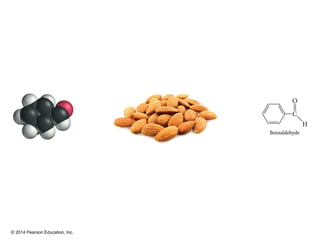
• Our sense of smell helps us identify food, people,
and other organisms, and alerts us to dangers such
as polluted air or spoiled food.
• Odorants must be volatile.
• However, many volatile substances have no
scent at all.
• Most common smells are caused by
organic molecules.
• The study of compounds containing carbon
combined with one or more of the elements
hydrogen, nitrogen, oxygen, and sulfur, including
their properties and their reactions, is known as
organic chemistry.
Fragrances and Odors
© 2014 Pearson Education, Inc.
What Is Organic Chemistry?
• Organic chemistry is a branch of chemistry
that focuses on compounds that contain
carbon.
– Except CO, CO2, carbonates, and carbides
• Even though organic compounds only contain
a few elements, the unique ways carbon
atoms can attach together to form molecules
leads to millions of different organic
compounds.
© 2014 Pearson Education, Inc.
• Life as we know it is because of organic
chemistry.
• Organic molecules can be very large and
complex.
• It is this complexity of large organic molecules
that allows the complex functions of the cells
to occur.
The Chemistry of Life
© 2014 Pearson Education, Inc.
• Organic compounds are easily decomposed
into simpler substances by heating, but
inorganic substances are not.
• Inorganic compounds were readily
synthesized in the lab, but synthesis of
organic compounds in the lab is hard.
Differences Between Organic and Inorganic
Compounds
© 2014 Pearson Education, Inc.
• Organic compounds tend to be molecular.
• They are mainly composed of just six
nonmetallic elements.
– C, H, O, N, S, and P
• Compounds are found in all three states.
– Solids, liquids, and gases
– Solids tend to have low melting points
• Solubility in water varies depending on which
of the other elements are attached to C and
how many there are.
– CH3OH is miscible with water; C10H21OH is
insoluble.
What’s Special About Organic Compounds?
© 2014 Pearson Education, Inc.
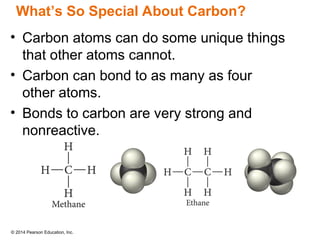
• Carbon atoms can do some unique things
that other atoms cannot.
• Carbon can bond to as many as four
other atoms.
• Bonds to carbon are very strong and
nonreactive.
What’s So Special About Carbon?
© 2014 Pearson Education, Inc.
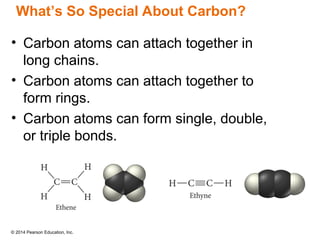
• Carbon atoms can attach together in
long chains.
• Carbon atoms can attach together to
form rings.
• Carbon atoms can form single, double,
or triple bonds.
What’s So Special About Carbon?
© 2014 Pearson Education, Inc.
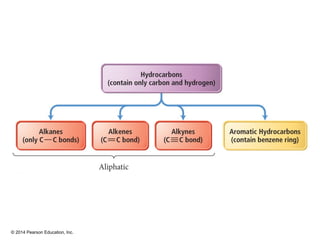
• Hydrocarbons contain only C and H.
– Aliphatic or aromatic
• Insoluble in water
– No polar bonds to attract water molecules
• Aliphatic hydrocarbons
– Saturated or unsaturated aliphatics
• Saturated = alkanes; unsaturated = alkenes or
alkynes
– May be chains or rings
– Chains may be straight or branched.
• Aromatic hydrocarbons
Hydrocarbons
© 2014 Pearson Education, Inc.
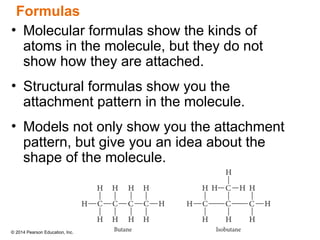
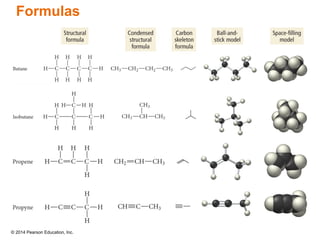
• Molecular formulas show the kinds of
atoms in the molecule, but they do not
show how they are attached.
• Structural formulas show you the
attachment pattern in the molecule.
• Models not only show you the attachment
pattern, but give you an idea about the
shape of the molecule.
Formulas
© 2014 Pearson Education, Inc.
• Attached atoms listed in order
– Central atom with attached atoms
• Follow normal bonding patterns
– Use to determine position of multiple bonds
• () used to indicate more than one identical
group attached to same previous central atom
– Unless () group is listed first, in which case
attached to next central atom
Condensed Structural Formulas
© 2014 Pearson Education, Inc.
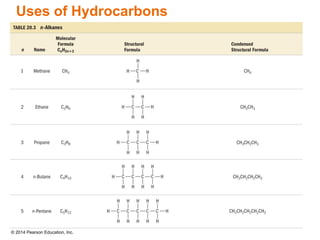
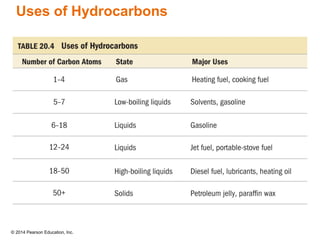
Uses of Hydrocarbons
© 2014 Pearson Education, Inc.
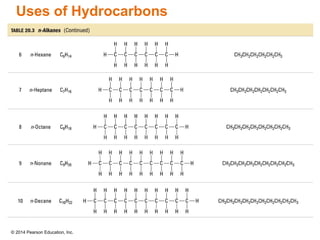
Uses of Hydrocarbons
© 2014 Pearson Education, Inc.
Uses of Hydrocarbons
© 2014 Pearson Education, Inc.
Physical Properties of Aliphatic
Hydrocarbons
• Boiling points and melting points increase
as the size of the molecule increases.
– Nonpolar molecules
– Main attractive forces are dispersion forces
• Less dense than water
• Insoluble in water
© 2014 Pearson Education, Inc.
Saturated Hydrocarbons
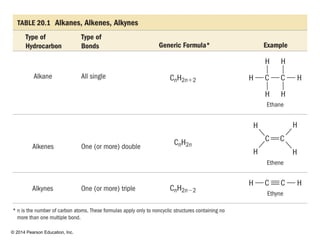
• A saturated hydrocarbon has all C─C
single bonds.
– It is saturated with hydrogens.
• Saturated aliphatic hydrocarbons are called
alkanes.
• Chain alkanes have the general
formula CnH2n+2.
• Ring alkanes have all C─C single bonds, but
have fewer hydrogens than a chain with the
same number of carbons.
© 2014 Pearson Education, Inc.
• Unsaturated hydrocarbons have one or more
C═C double bonds or C≡C triple bonds.
• Unsaturated aliphatic hydrocarbons that
contain C═C are called alkenes.
– The general formula of a monounsaturated chain alkene
is CnH2n.
– Remove two more H for each additional double bond.
• Unsaturated aliphatic hydrocarbons that
contain C≡C are called alkynes.
– The general formula of an alkyne with one triple bond
is CnH2n−2.
– Remove four more H for each additional triple bond.
Unsaturated Hydrocarbons
© 2014 Pearson Education, Inc.
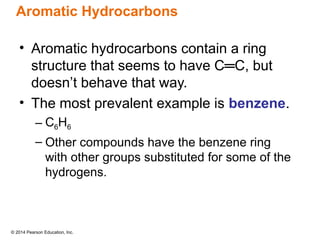
Aromatic Hydrocarbons
• Aromatic hydrocarbons contain a ring
structure that seems to have C═C, but
doesn’t behave that way.
• The most prevalent example is benzene.
– C6H6
– Other compounds have the benzene ring
with other groups substituted for some of the
hydrogens.
© 2014 Pearson Education, Inc.
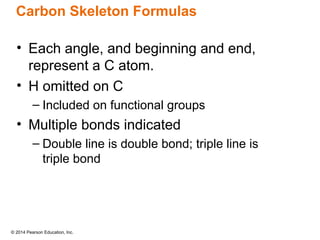
• Each angle, and beginning and end,
represent a C atom.
• H omitted on C
– Included on functional groups
• Multiple bonds indicated
– Double line is double bond; triple line is
triple bond
Carbon Skeleton Formulas
© 2014 Pearson Education, Inc.
Formulas
© 2014 Pearson Education, Inc.
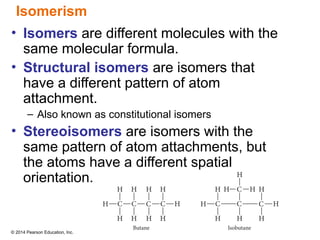
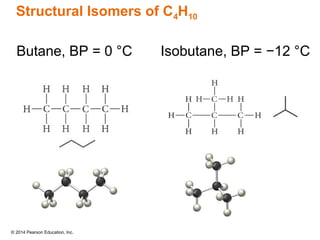
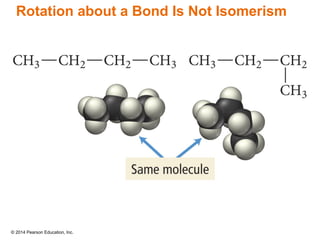
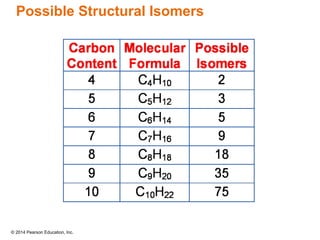
• Isomers are different molecules with the
same molecular formula.
• Structural isomers are isomers that
have a different pattern of atom
attachment.
– Also known as constitutional isomers
• Stereoisomers are isomers with the
same pattern of atom attachments, but
the atoms have a different spatial
orientation.
Isomerism
© 2014 Pearson Education, Inc.
Butane, BP = 0 °C Isobutane, BP = −12 °C
Structural Isomers of C4H10
© 2014 Pearson Education, Inc.
Rotation about a Bond Is Not Isomerism
© 2014 Pearson Education, Inc.
Possible Structural Isomers
© 2014 Pearson Education, Inc.
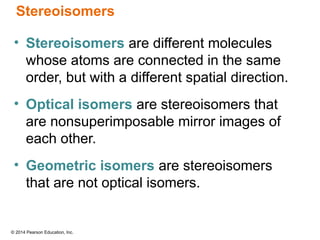
Stereoisomers
• Stereoisomers are different molecules
whose atoms are connected in the same
order, but with a different spatial direction.
• Optical isomers are stereoisomers that
are nonsuperimposable mirror images of
each other.
• Geometric isomers are stereoisomers
that are not optical isomers.
© 2014 Pearson Education, Inc.
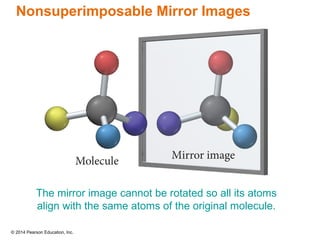
Nonsuperimposable Mirror Images
The mirror image cannot be rotated so all its atoms
align with the same atoms of the original molecule.
© 2014 Pearson Education, Inc.
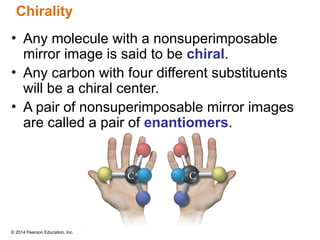
• Any molecule with a nonsuperimposable
mirror image is said to be chiral.
• Any carbon with four different substituents
will be a chiral center.
• A pair of nonsuperimposable mirror images
are called a pair of enantiomers.
Chirality
© 2014 Pearson Education, Inc.
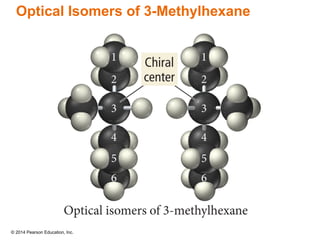
Optical Isomers of 3-Methylhexane
© 2014 Pearson Education, Inc.
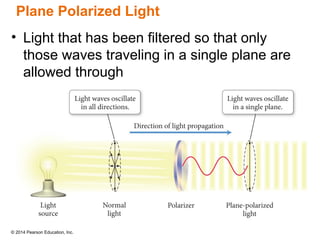
• Light that has been filtered so that only
those waves traveling in a single plane are
allowed through
Plane Polarized Light
© 2014 Pearson Education, Inc.
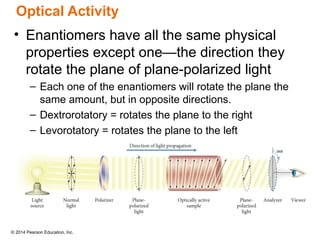
• Enantiomers have all the same physical
properties except one—the direction they
rotate the plane of plane-polarized light
– Each one of the enantiomers will rotate the plane the
same amount, but in opposite directions.
– Dextrorotatory = rotates the plane to the right
– Levorotatory = rotates the plane to the left
Optical Activity
© 2014 Pearson Education, Inc.
Mixtures of Enantiomers
• An equimolar mixture of a pair of
enantiomers is called a racemic mixture.
• Because half the molecules are rotating the
plane to the left and the other half are
rotating it to the right, the rotations cancel,
and the racemic mixture does not rotate
the plane.
• If the mixture is nonracemic, the amount of
rotation can be used to determine the
percentages of each enantiomer in the
mixture.
© 2014 Pearson Education, Inc.
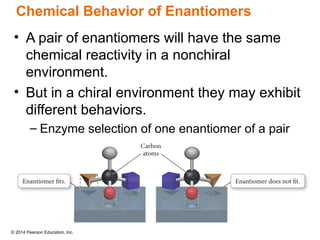
Chemical Behavior of Enantiomers
• A pair of enantiomers will have the same
chemical reactivity in a nonchiral
environment.
• But in a chiral environment they may exhibit
different behaviors.
– Enzyme selection of one enantiomer of a pair
© 2014 Pearson Education, Inc.
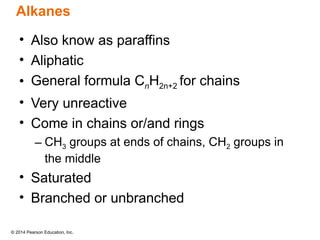
• Also know as paraffins
• Aliphatic
• General formula CnH2n+2 for chains
• Very unreactive
• Come in chains or/and rings
– CH3 groups at ends of chains, CH2 groups in
the middle
• Saturated
• Branched or unbranched
Alkanes
© 2014 Pearson Education, Inc.
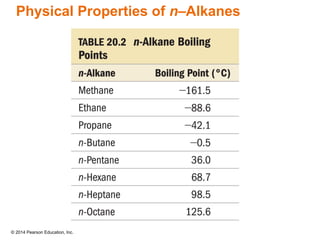
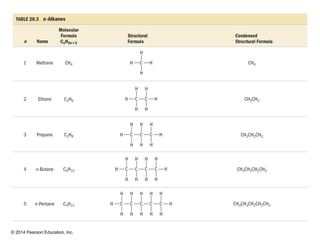
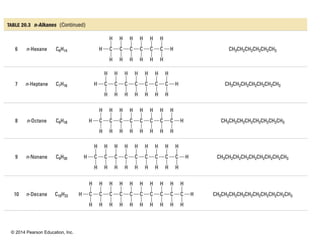
Physical Properties of n–Alkanes
© 2014 Pearson Education, Inc.
• Each name consists of three parts
– Prefix
• Indicates position, number, and type of branches
• Indicates position, number, and type of each
functional group
– Parent
• Indicates the length of the longest carbon chain or ring
– Suffix
• Indicates the type of hydrocarbon
o -ane, -ene, -yne
• Certain functional groups
Naming
© 2014 Pearson Education, Inc.
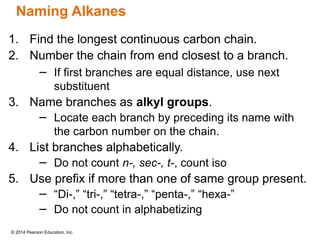
1. Find the longest continuous carbon chain.
2. Number the chain from end closest to a branch.
− If first branches are equal distance, use next
substituent
3. Name branches as alkyl groups.
− Locate each branch by preceding its name with
the carbon number on the chain.
4. List branches alphabetically.
− Do not count n-, sec-, t-, count iso
5. Use prefix if more than one of same group present.
− “Di-,” “tri-,” “tetra-,” “penta-,” “hexa-”
− Do not count in alphabetizing
Naming Alkanes
© 2014 Pearson Education, Inc.
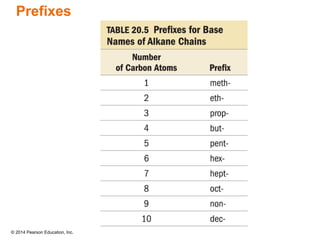
Prefixes
© 2014 Pearson Education, Inc.
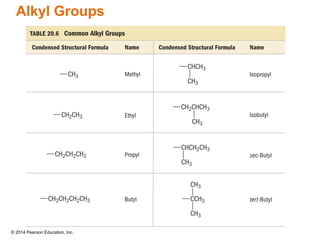
Alkyl Groups
© 2014 Pearson Education, Inc.
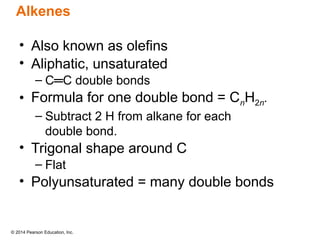
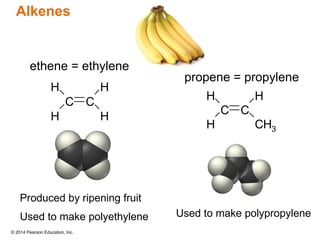
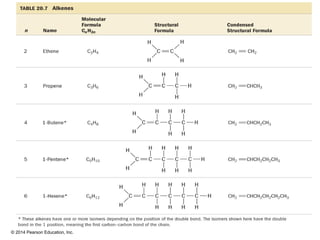
• Also known as olefins
• Aliphatic, unsaturated
– C═C double bonds
• Formula for one double bond = CnH2n.
– Subtract 2 H from alkane for each
double bond.
• Trigonal shape around C
– Flat
• Polyunsaturated = many double bonds
Alkenes
© 2014 Pearson Education, Inc.
Alkenes
ethene = ethylene
propene = propylene
Produced by ripening fruit
C C
H
H H
H
C C
H
H CH3
H
Used to make polyethylene Used to make polypropylene
© 2014 Pearson Education, Inc.
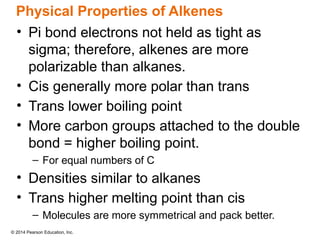
• Pi bond electrons not held as tight as
sigma; therefore, alkenes are more
polarizable than alkanes.
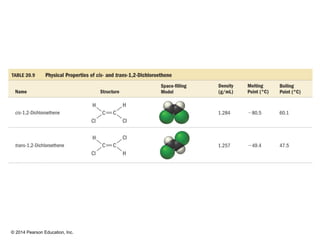
• Cis generally more polar than trans
• Trans lower boiling point
• More carbon groups attached to the double
bond = higher boiling point.
– For equal numbers of C
• Densities similar to alkanes
• Trans higher melting point than cis
– Molecules are more symmetrical and pack better.
Physical Properties of Alkenes
© 2014 Pearson Education, Inc.
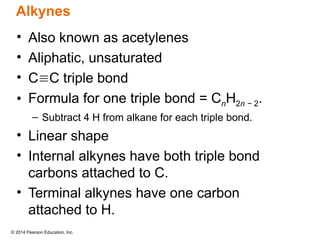
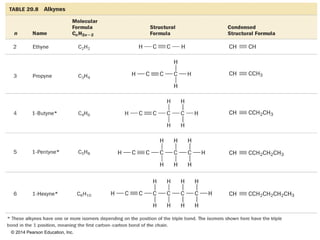
• Also known as acetylenes
• Aliphatic, unsaturated
• CC triple bond
• Formula for one triple bond = CnH2n − 2.
– Subtract 4 H from alkane for each triple bond.
• Linear shape
• Internal alkynes have both triple bond
carbons attached to C.
• Terminal alkynes have one carbon
attached to H.
Alkynes
© 2014 Pearson Education, Inc.
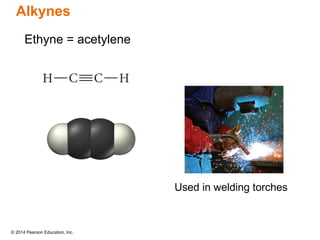
Alkynes
Used in welding torches
Ethyne = acetylene
© 2014 Pearson Education, Inc.
Physical Properties of Alkynes
• Higher boiling points than similar sized
alkenes
– Similar size = same number of carbons
– More pi bond = more polarization = higher boiling point
• Slightly higher densities than similar alkenes
• There are no alkyne cis or trans isomers.
• Internal alkynes have higher boiling points
than terminal alkynes.
– With the same number of C
© 2014 Pearson Education, Inc.
• Change suffix on main name from -ane to
-ene for base name of alkene, or to -yne
for the base name of the alkyne.
• Number chain from end closest to
multiple bond.
• Number in front of main name indicates
first carbon of multiple bond.
Naming Alkenes and Alkynes
© 2014 Pearson Education, Inc.
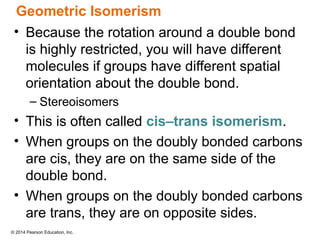
Geometric Isomerism
• Because the rotation around a double bond
is highly restricted, you will have different
molecules if groups have different spatial
orientation about the double bond.
– Stereoisomers
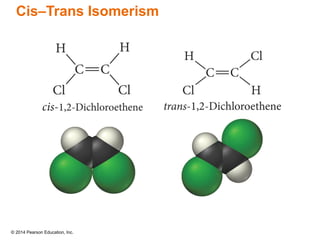
• This is often called cis–trans isomerism.
• When groups on the doubly bonded carbons
are cis, they are on the same side of the
double bond.
• When groups on the doubly bonded carbons
are trans, they are on opposite sides.
© 2014 Pearson Education, Inc.
Cis–Trans Isomerism
© 2014 Pearson Education, Inc.
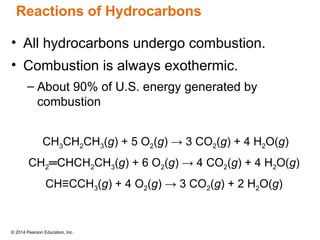
Reactions of Hydrocarbons
• All hydrocarbons undergo combustion.
• Combustion is always exothermic.
– About 90% of U.S. energy generated by
combustion
CH3CH2CH3(g) + 5 O2(g) → 3 CO2(g) + 4 H2O(g)
CH2═CHCH2CH3(g) + 6 O2(g) → 4 CO2(g) + 4 H2O(g)
CH≡CCH3(g) + 4 O2(g) → 3 CO2(g) + 2 H2O(g)
© 2014 Pearson Education, Inc.
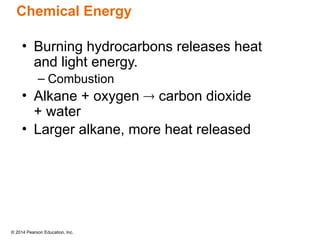
Chemical Energy
• Burning hydrocarbons releases heat
and light energy.
– Combustion
• Alkane + oxygen  carbon dioxide
+ water
• Larger alkane, more heat released
© 2014 Pearson Education, Inc.
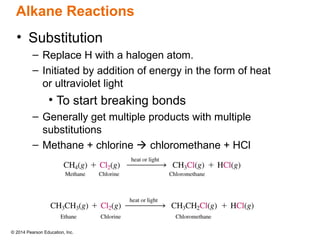
• Substitution
– Replace H with a halogen atom.
– Initiated by addition of energy in the form of heat
or ultraviolet light
• To start breaking bonds
– Generally get multiple products with multiple
substitutions
– Methane + chlorine  chloromethane + HCl
Alkane Reactions
© 2014 Pearson Education, Inc.
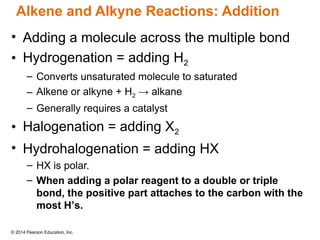
Alkene and Alkyne Reactions: Addition
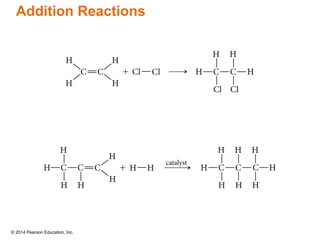
• Adding a molecule across the multiple bond
• Hydrogenation = adding H2
– Converts unsaturated molecule to saturated
– Alkene or alkyne + H2 → alkane
– Generally requires a catalyst
• Halogenation = adding X2
• Hydrohalogenation = adding HX
– HX is polar.
– When adding a polar reagent to a double or triple
bond, the positive part attaches to the carbon with the
most H’s.
© 2014 Pearson Education, Inc.
Addition Reactions
© 2014 Pearson Education, Inc.
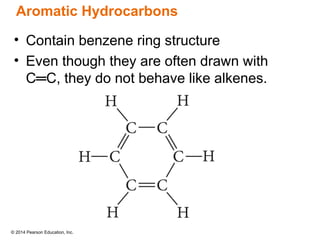
Aromatic Hydrocarbons
• Contain benzene ring structure
• Even though they are often drawn with
C═C, they do not behave like alkenes.
© 2014 Pearson Education, Inc.
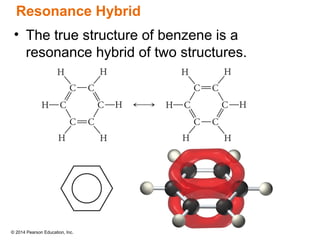
Resonance Hybrid
• The true structure of benzene is a
resonance hybrid of two structures.
© 2014 Pearson Education, Inc.
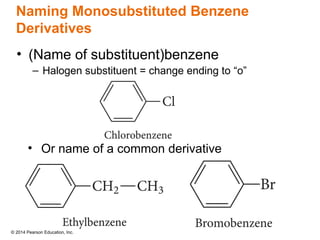
• (Name of substituent)benzene
– Halogen substituent = change ending to “o”
• Or name of a common derivative
Naming Monosubstituted Benzene
Derivatives
© 2014 Pearson Education, Inc.
Naming Benzene as a Substituent
• When the benzene ring is not the base
name, it is called a phenyl group.
© 2014 Pearson Education, Inc.
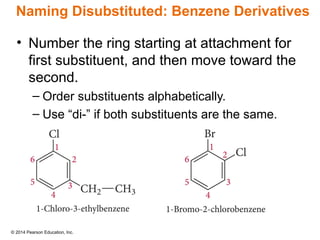
• Number the ring starting at attachment for
first substituent, and then move toward the
second.
– Order substituents alphabetically.
– Use “di-” if both substituents are the same.
Naming Disubstituted: Benzene Derivatives
© 2014 Pearson Education, Inc.
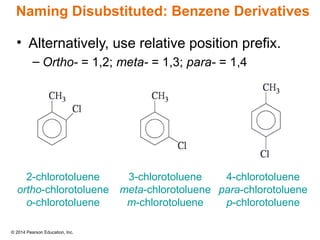
• Alternatively, use relative position prefix.
– Ortho- = 1,2; meta- = 1,3; para- = 1,4
2-chlorotoluene
ortho-chlorotoluene
o-chlorotoluene
3-chlorotoluene
meta-chlorotoluene
m-chlorotoluene
4-chlorotoluene
para-chlorotoluene
p-chlorotoluene
Naming Disubstituted: Benzene Derivatives
© 2014 Pearson Education, Inc.
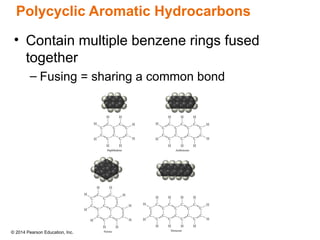
• Contain multiple benzene rings fused
together
– Fusing = sharing a common bond
Polycyclic Aromatic Hydrocarbons
© 2014 Pearson Education, Inc.
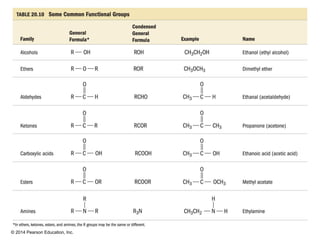
• Other organic compounds are hydrocarbons
in which functional groups have been
substituted for hydrogens.
• A functional group is a group of atoms that
shows a characteristic influence on the
properties of the molecule.
– Generally, the reactions that a compound will
perform are determined by what functional
groups it has.
– Because the kind of hydrocarbon chain is
irrelevant to the reactions, it may be indicated by
the general symbol.
Functional Groups
© 2014 Pearson Education, Inc.
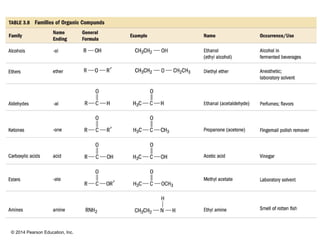
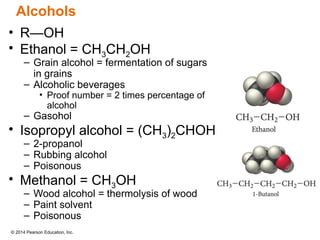
• R—OH
• Ethanol = CH3CH2OH
– Grain alcohol = fermentation of sugars
in grains
– Alcoholic beverages
• Proof number = 2 times percentage of
alcohol
– Gasohol
• Isopropyl alcohol = (CH3)2CHOH
– 2-propanol
– Rubbing alcohol
– Poisonous
• Methanol = CH3OH
– Wood alcohol = thermolysis of wood
– Paint solvent
– Poisonous
Alcohols
© 2014 Pearson Education, Inc.
• Main chain contains OH.
• Number main chain from end closest to OH.
• Give base name -ol ending and place
number of C on chain where OH attached
in front.
• Name as hydroxy group if higher
precedence group present.
Naming Alcohols
© 2014 Pearson Education, Inc.
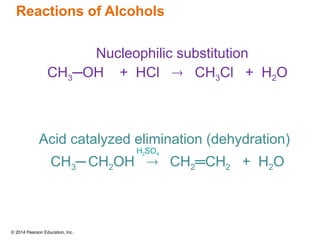
Nucleophilic substitution
CH3─OH + HCl  CH3Cl + H2O
Acid catalyzed elimination (dehydration)
CH3─ CH2OH  CH2═CH2 + H2O
H2SO4
Reactions of Alcohols
© 2014 Pearson Education, Inc.
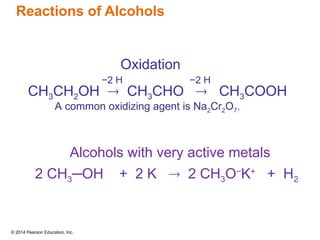
Reactions of Alcohols
Oxidation
CH3CH2OH  CH3CHO  CH3COOH
−2 H −2 H
A common oxidizing agent is Na2Cr2O7.
Alcohols with very active metals
2 CH3─OH + 2 K  2 CH3O−
K+
+ H2
© 2014 Pearson Education, Inc.
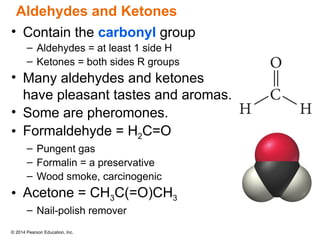
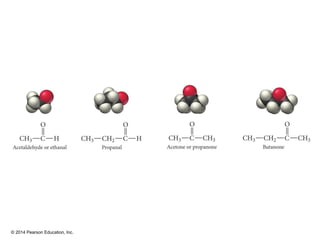
• Contain the carbonyl group
– Aldehydes = at least 1 side H
– Ketones = both sides R groups
• Many aldehydes and ketones
have pleasant tastes and aromas.
• Some are pheromones.
• Formaldehyde = H2C=O
– Pungent gas
– Formalin = a preservative
– Wood smoke, carcinogenic
• Acetone = CH3C(=O)CH3
– Nail-polish remover
Aldehydes and Ketones
© 2014 Pearson Education, Inc.
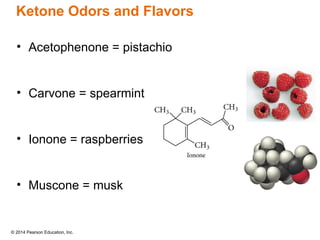
• Acetophenone = pistachio
• Carvone = spearmint
• Ionone = raspberries
• Muscone = musk
Ketone Odors and Flavors
© 2014 Pearson Education, Inc.
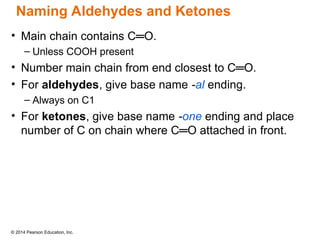
• Main chain contains C═O.
– Unless COOH present
• Number main chain from end closest to C═O.
• For aldehydes, give base name -al ending.
– Always on C1
• For ketones, give base name -one ending and place
number of C on chain where C═O attached in front.
Naming Aldehydes and Ketones
© 2014 Pearson Education, Inc.
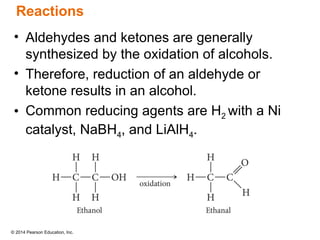
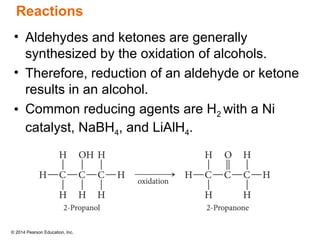
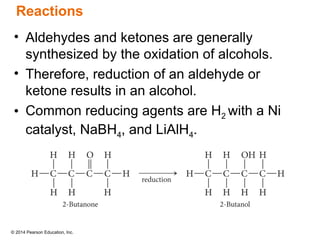
• Aldehydes and ketones are generally
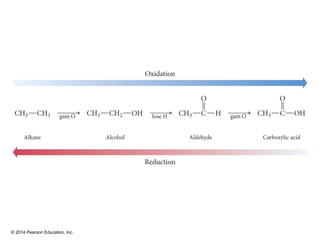
synthesized by the oxidation of alcohols.
• Therefore, reduction of an aldehyde or
ketone results in an alcohol.
• Common reducing agents are H2 with a Ni
catalyst, NaBH4, and LiAlH4.
Reactions
© 2014 Pearson Education, Inc.
• Aldehydes and ketones are generally
synthesized by the oxidation of alcohols.
• Therefore, reduction of an aldehyde or ketone
results in an alcohol.
• Common reducing agents are H2 with a Ni
catalyst, NaBH4, and LiAlH4.
Reactions
© 2014 Pearson Education, Inc.
• Aldehydes and ketones are generally
synthesized by the oxidation of alcohols.
• Therefore, reduction of an aldehyde or
ketone results in an alcohol.
• Common reducing agents are H2 with a Ni
catalyst, NaBH4, and LiAlH4.
Reactions
© 2014 Pearson Education, Inc.
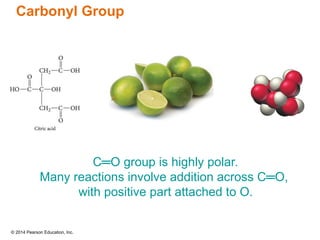
Carbonyl Group
C═O group is highly polar.
Many reactions involve addition across C═O,
with positive part attached to O.
© 2014 Pearson Education, Inc.
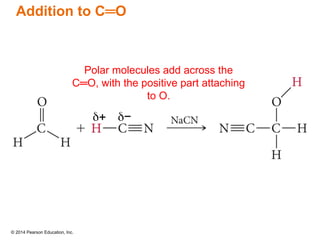
Addition to C═O
Polar molecules add across the
C═O, with the positive part attaching
to O.
 −
© 2014 Pearson Education, Inc.
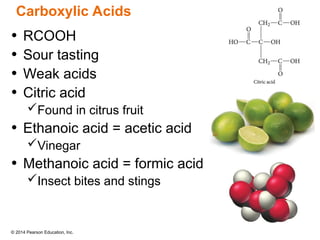
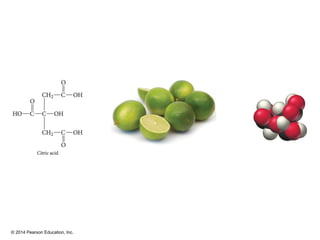
• RCOOH
• Sour tasting
• Weak acids
• Citric acid
Found in citrus fruit
• Ethanoic acid = acetic acid
Vinegar
• Methanoic acid = formic acid
Insect bites and stings
Carboxylic Acids
© 2014 Pearson Education, Inc.
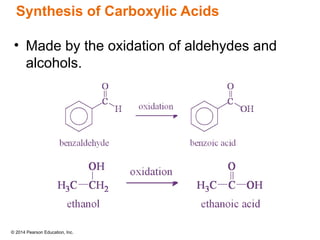
Synthesis of Carboxylic Acids
• Made by the oxidation of aldehydes and
alcohols.
© 2014 Pearson Education, Inc.
• Carboxylic acid group always on end of
main chain
– Has highest naming precedence of functional
groups
• C of group always C1
– Position not indicated in name
• Change ending to -oic acid
Naming Carboxylic Acids
© 2014 Pearson Education, Inc.
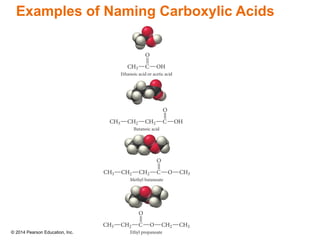
Examples of Naming Carboxylic Acids
© 2014 Pearson Education, Inc.
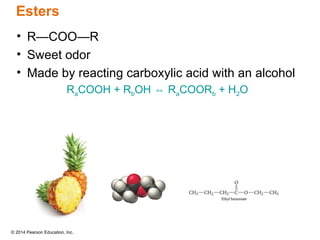
• R—COO—R
• Sweet odor
• Made by reacting carboxylic acid with an alcohol
RaCOOH + RbOH R
⇔ aCOORb + H2O
Esters
© 2014 Pearson Education, Inc.
• Carboxylic acid group always on end of
main chain
– Unless carboxylic acid group present
• C of ester group on C1
– Position not indicated in name
• Begin name with alkyl group attached to O.
• Name main chain with -oate ending.
Naming Esters
© 2014 Pearson Education, Inc.
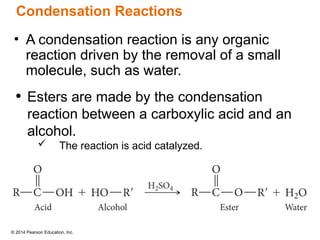
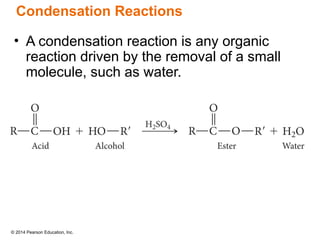
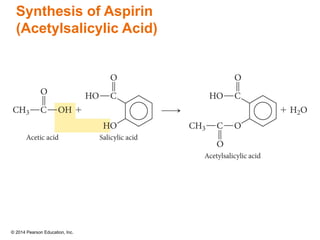
• A condensation reaction is any organic
reaction driven by the removal of a small
molecule, such as water.
• Esters are made by the condensation
reaction between a carboxylic acid and an
alcohol.
 The reaction is acid catalyzed.
Condensation Reactions
© 2014 Pearson Education, Inc.
• A condensation reaction is any organic
reaction driven by the removal of a small
molecule, such as water.
Condensation Reactions
© 2014 Pearson Education, Inc.
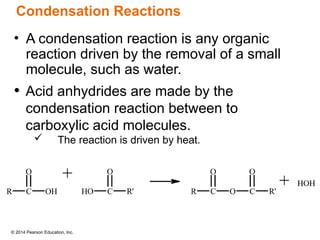
• Acid anhydrides are made by the
condensation reaction between to
carboxylic acid molecules.
 The reaction is driven by heat.
• A condensation reaction is any organic
reaction driven by the removal of a small
molecule, such as water.
Condensation Reactions
© 2014 Pearson Education, Inc.
Synthesis of Aspirin
(Acetylsalicylic Acid)
© 2014 Pearson Education, Inc.
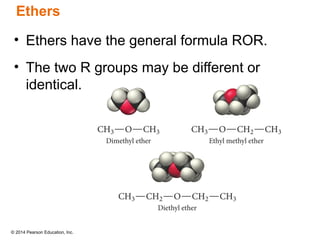
Ethers
• Ethers have the general formula ROR.
• The two R groups may be different or
identical.
© 2014 Pearson Education, Inc.
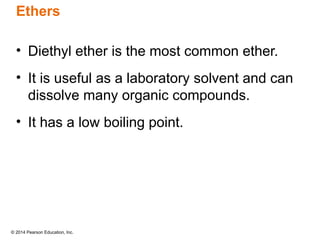
Ethers
• Diethyl ether is the most common ether.
• It is useful as a laboratory solvent and can
dissolve many organic compounds.
• It has a low boiling point.
© 2014 Pearson Education, Inc.
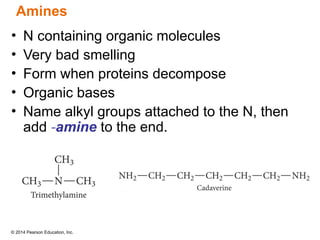
• N containing organic molecules
• Very bad smelling
• Form when proteins decompose
• Organic bases
• Name alkyl groups attached to the N, then
add -amine to the end.
Amines
© 2014 Pearson Education, Inc.
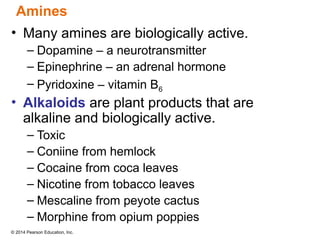
• Many amines are biologically active.
– Dopamine – a neurotransmitter
– Epinephrine – an adrenal hormone
– Pyridoxine – vitamin B6
• Alkaloids are plant products that are
alkaline and biologically active.
– Toxic
– Coniine from hemlock
– Cocaine from coca leaves
– Nicotine from tobacco leaves
– Mescaline from peyote cactus
– Morphine from opium poppies
Amines
© 2014 Pearson Education, Inc.
Amine Reactions
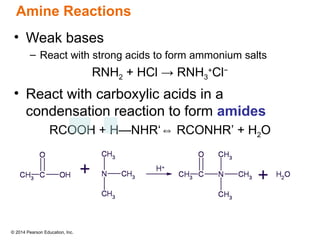
• Weak bases
– React with strong acids to form ammonium salts
RNH2 + HCl → RNH3
+
Cl−
• React with carboxylic acids in a
condensation reaction to form amides
RCOOH + H—NHR‘ RCONHR
⇔ ’ + H2O
© 2014 Pearson Education, Inc.
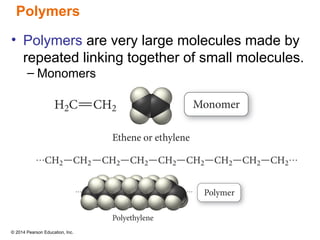
• Polymers are very large molecules made by
repeated linking together of small molecules.
– Monomers
Polymers
© 2014 Pearson Education, Inc.
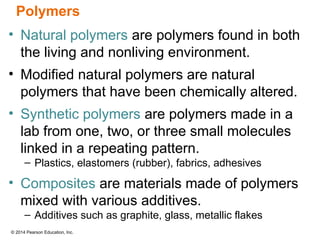
• Natural polymers are polymers found in both
the living and nonliving environment.
• Modified natural polymers are natural
polymers that have been chemically altered.
• Synthetic polymers are polymers made in a
lab from one, two, or three small molecules
linked in a repeating pattern.
– Plastics, elastomers (rubber), fabrics, adhesives
• Composites are materials made of polymers
mixed with various additives.
– Additives such as graphite, glass, metallic flakes
Polymers
© 2014 Pearson Education, Inc.
• Polysaccharides – polymers made of repeating small
sugar molecule units
– Cellulose (cotton)
– Starch
• Proteins – polymers made of repeating amino acid units
• Nucleic acids (DNA) – polymers made of repeating
nucleotide units
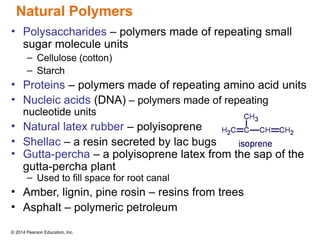
• Natural latex rubber – polyisoprene
• Shellac – a resin secreted by lac bugs
• Gutta-percha – a polyisoprene latex from the sap of the
gutta-percha plant
– Used to fill space for root canal
• Amber, lignin, pine rosin – resins from trees
• Asphalt – polymeric petroleum
Natural Polymers
© 2014 Pearson Education, Inc.
• Cellulose acetate – an ester of cellulose and acetic acid
– Rayon
– Film
• Vulcanized rubber – latex rubber hardened by cross-
linking with sulfur
• Nitrocellulose – an ester of cellulose with nitric acid
– Gun cotton
– Celluloid
• Ping-Pong™ balls
• Casein – a polymer of the protein casein made by
treating cow’s milk with acid
– Buttons, moldings, adhesives
Modified Natural Polymers
© 2014 Pearson Education, Inc.
Polymerization
• Polymerization is the process of linking the
monomer units together.
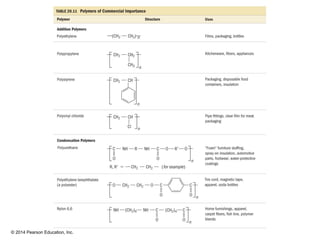
• There are two processes by which
polymerization may proceed—addition
polymerization and condensation
polymerization.
• Monomer units may link head to tail, or head
to head, or tail to tail during polymerization.
– Head to tail most common
– Regular pattern gives stronger attractions between
chains than random arrangements
© 2014 Pearson Education, Inc.
• Monomers add to the growing chain in
such a manner that all the atoms in the
original monomer wind up in the chain.
– No other side products formed; no atoms
eliminated
• First monomer must “open” to start
reaction.
– Done with heat, or the addition of an initiator
• The process is a chain reaction.
– Each added unit ready to add another
Addition Polymerization
© 2014 Pearson Education, Inc.
Condensation Polymerization
• Monomer units are joined by removing
small molecules from the combining units.
– Polyesters, polyamides lose water
• No initiator is needed.
• The process is a chain reaction.
• Each monomer has two reactive ends, so
the chain can grow in two directions.
© 2014 Pearson Education, Inc.
• Transparent or translucent
• Chemical resistance
• Thermal and electrical insulators
• Low density
• Varying strengths
– Kevlar
• Mold or extrude
• Elasticity
– Regain original shape if quick stress applied
• Foamed
• Tend to soften when heated, rather than
quickly melt
Characteristics of Plastics

20_Lecture....................................ppt

  • 1.
    © 2014 PearsonEducation, Inc. Lecture Presentation Chapter 20 Organic Chemistry Sherril Soman Grand Valley State University
  • 2.
    © 2014 PearsonEducation, Inc. • Our sense of smell helps us identify food, people, and other organisms, and alerts us to dangers such as polluted air or spoiled food. • Odorants must be volatile. • However, many volatile substances have no scent at all. • Most common smells are caused by organic molecules. • The study of compounds containing carbon combined with one or more of the elements hydrogen, nitrogen, oxygen, and sulfur, including their properties and their reactions, is known as organic chemistry. Fragrances and Odors
  • 3.
    © 2014 PearsonEducation, Inc.
  • 4.
    © 2014 PearsonEducation, Inc. What Is Organic Chemistry? • Organic chemistry is a branch of chemistry that focuses on compounds that contain carbon. – Except CO, CO2, carbonates, and carbides • Even though organic compounds only contain a few elements, the unique ways carbon atoms can attach together to form molecules leads to millions of different organic compounds.
  • 5.
    © 2014 PearsonEducation, Inc. • Life as we know it is because of organic chemistry. • Organic molecules can be very large and complex. • It is this complexity of large organic molecules that allows the complex functions of the cells to occur. The Chemistry of Life
  • 6.
    © 2014 PearsonEducation, Inc. • Organic compounds are easily decomposed into simpler substances by heating, but inorganic substances are not. • Inorganic compounds were readily synthesized in the lab, but synthesis of organic compounds in the lab is hard. Differences Between Organic and Inorganic Compounds
  • 7.
    © 2014 PearsonEducation, Inc. • Organic compounds tend to be molecular. • They are mainly composed of just six nonmetallic elements. – C, H, O, N, S, and P • Compounds are found in all three states. – Solids, liquids, and gases – Solids tend to have low melting points • Solubility in water varies depending on which of the other elements are attached to C and how many there are. – CH3OH is miscible with water; C10H21OH is insoluble. What’s Special About Organic Compounds?
  • 8.
    © 2014 PearsonEducation, Inc. • Carbon atoms can do some unique things that other atoms cannot. • Carbon can bond to as many as four other atoms. • Bonds to carbon are very strong and nonreactive. What’s So Special About Carbon?
  • 9.
    © 2014 PearsonEducation, Inc. • Carbon atoms can attach together in long chains. • Carbon atoms can attach together to form rings. • Carbon atoms can form single, double, or triple bonds. What’s So Special About Carbon?
  • 10.
    © 2014 PearsonEducation, Inc. • Hydrocarbons contain only C and H. – Aliphatic or aromatic • Insoluble in water – No polar bonds to attract water molecules • Aliphatic hydrocarbons – Saturated or unsaturated aliphatics • Saturated = alkanes; unsaturated = alkenes or alkynes – May be chains or rings – Chains may be straight or branched. • Aromatic hydrocarbons Hydrocarbons
  • 11.
    © 2014 PearsonEducation, Inc.
  • 12.
    © 2014 PearsonEducation, Inc.
  • 13.
    © 2014 PearsonEducation, Inc. • Molecular formulas show the kinds of atoms in the molecule, but they do not show how they are attached. • Structural formulas show you the attachment pattern in the molecule. • Models not only show you the attachment pattern, but give you an idea about the shape of the molecule. Formulas
  • 14.
    © 2014 PearsonEducation, Inc. • Attached atoms listed in order – Central atom with attached atoms • Follow normal bonding patterns – Use to determine position of multiple bonds • () used to indicate more than one identical group attached to same previous central atom – Unless () group is listed first, in which case attached to next central atom Condensed Structural Formulas
  • 15.
    © 2014 PearsonEducation, Inc. Uses of Hydrocarbons
  • 16.
    © 2014 PearsonEducation, Inc. Uses of Hydrocarbons
  • 17.
    © 2014 PearsonEducation, Inc. Uses of Hydrocarbons
  • 18.
    © 2014 PearsonEducation, Inc. Physical Properties of Aliphatic Hydrocarbons • Boiling points and melting points increase as the size of the molecule increases. – Nonpolar molecules – Main attractive forces are dispersion forces • Less dense than water • Insoluble in water
  • 19.
    © 2014 PearsonEducation, Inc. Saturated Hydrocarbons • A saturated hydrocarbon has all C─C single bonds. – It is saturated with hydrogens. • Saturated aliphatic hydrocarbons are called alkanes. • Chain alkanes have the general formula CnH2n+2. • Ring alkanes have all C─C single bonds, but have fewer hydrogens than a chain with the same number of carbons.
  • 20.
    © 2014 PearsonEducation, Inc. • Unsaturated hydrocarbons have one or more C═C double bonds or C≡C triple bonds. • Unsaturated aliphatic hydrocarbons that contain C═C are called alkenes. – The general formula of a monounsaturated chain alkene is CnH2n. – Remove two more H for each additional double bond. • Unsaturated aliphatic hydrocarbons that contain C≡C are called alkynes. – The general formula of an alkyne with one triple bond is CnH2n−2. – Remove four more H for each additional triple bond. Unsaturated Hydrocarbons
  • 21.
    © 2014 PearsonEducation, Inc. Aromatic Hydrocarbons • Aromatic hydrocarbons contain a ring structure that seems to have C═C, but doesn’t behave that way. • The most prevalent example is benzene. – C6H6 – Other compounds have the benzene ring with other groups substituted for some of the hydrogens.
  • 22.
    © 2014 PearsonEducation, Inc. • Each angle, and beginning and end, represent a C atom. • H omitted on C – Included on functional groups • Multiple bonds indicated – Double line is double bond; triple line is triple bond Carbon Skeleton Formulas
  • 23.
    © 2014 PearsonEducation, Inc. Formulas
  • 24.
    © 2014 PearsonEducation, Inc. • Isomers are different molecules with the same molecular formula. • Structural isomers are isomers that have a different pattern of atom attachment. – Also known as constitutional isomers • Stereoisomers are isomers with the same pattern of atom attachments, but the atoms have a different spatial orientation. Isomerism
  • 25.
    © 2014 PearsonEducation, Inc. Butane, BP = 0 °C Isobutane, BP = −12 °C Structural Isomers of C4H10
  • 26.
    © 2014 PearsonEducation, Inc. Rotation about a Bond Is Not Isomerism
  • 27.
    © 2014 PearsonEducation, Inc. Possible Structural Isomers
  • 28.
    © 2014 PearsonEducation, Inc. Stereoisomers • Stereoisomers are different molecules whose atoms are connected in the same order, but with a different spatial direction. • Optical isomers are stereoisomers that are nonsuperimposable mirror images of each other. • Geometric isomers are stereoisomers that are not optical isomers.
  • 29.
    © 2014 PearsonEducation, Inc. Nonsuperimposable Mirror Images The mirror image cannot be rotated so all its atoms align with the same atoms of the original molecule.
  • 30.
    © 2014 PearsonEducation, Inc. • Any molecule with a nonsuperimposable mirror image is said to be chiral. • Any carbon with four different substituents will be a chiral center. • A pair of nonsuperimposable mirror images are called a pair of enantiomers. Chirality
  • 31.
    © 2014 PearsonEducation, Inc. Optical Isomers of 3-Methylhexane
  • 32.
    © 2014 PearsonEducation, Inc. • Light that has been filtered so that only those waves traveling in a single plane are allowed through Plane Polarized Light
  • 33.
    © 2014 PearsonEducation, Inc. • Enantiomers have all the same physical properties except one—the direction they rotate the plane of plane-polarized light – Each one of the enantiomers will rotate the plane the same amount, but in opposite directions. – Dextrorotatory = rotates the plane to the right – Levorotatory = rotates the plane to the left Optical Activity
  • 34.
    © 2014 PearsonEducation, Inc. Mixtures of Enantiomers • An equimolar mixture of a pair of enantiomers is called a racemic mixture. • Because half the molecules are rotating the plane to the left and the other half are rotating it to the right, the rotations cancel, and the racemic mixture does not rotate the plane. • If the mixture is nonracemic, the amount of rotation can be used to determine the percentages of each enantiomer in the mixture.
  • 35.
    © 2014 PearsonEducation, Inc. Chemical Behavior of Enantiomers • A pair of enantiomers will have the same chemical reactivity in a nonchiral environment. • But in a chiral environment they may exhibit different behaviors. – Enzyme selection of one enantiomer of a pair
  • 36.
    © 2014 PearsonEducation, Inc. • Also know as paraffins • Aliphatic • General formula CnH2n+2 for chains • Very unreactive • Come in chains or/and rings – CH3 groups at ends of chains, CH2 groups in the middle • Saturated • Branched or unbranched Alkanes
  • 37.
    © 2014 PearsonEducation, Inc.
  • 38.
    © 2014 PearsonEducation, Inc.
  • 39.
    © 2014 PearsonEducation, Inc. Physical Properties of n–Alkanes
  • 40.
    © 2014 PearsonEducation, Inc. • Each name consists of three parts – Prefix • Indicates position, number, and type of branches • Indicates position, number, and type of each functional group – Parent • Indicates the length of the longest carbon chain or ring – Suffix • Indicates the type of hydrocarbon o -ane, -ene, -yne • Certain functional groups Naming
  • 41.
    © 2014 PearsonEducation, Inc. 1. Find the longest continuous carbon chain. 2. Number the chain from end closest to a branch. − If first branches are equal distance, use next substituent 3. Name branches as alkyl groups. − Locate each branch by preceding its name with the carbon number on the chain. 4. List branches alphabetically. − Do not count n-, sec-, t-, count iso 5. Use prefix if more than one of same group present. − “Di-,” “tri-,” “tetra-,” “penta-,” “hexa-” − Do not count in alphabetizing Naming Alkanes
  • 42.
    © 2014 PearsonEducation, Inc. Prefixes
  • 43.
    © 2014 PearsonEducation, Inc. Alkyl Groups
  • 44.
    © 2014 PearsonEducation, Inc. • Also known as olefins • Aliphatic, unsaturated – C═C double bonds • Formula for one double bond = CnH2n. – Subtract 2 H from alkane for each double bond. • Trigonal shape around C – Flat • Polyunsaturated = many double bonds Alkenes
  • 45.
    © 2014 PearsonEducation, Inc. Alkenes ethene = ethylene propene = propylene Produced by ripening fruit C C H H H H C C H H CH3 H Used to make polyethylene Used to make polypropylene
  • 46.
    © 2014 PearsonEducation, Inc.
  • 47.
    © 2014 PearsonEducation, Inc. • Pi bond electrons not held as tight as sigma; therefore, alkenes are more polarizable than alkanes. • Cis generally more polar than trans • Trans lower boiling point • More carbon groups attached to the double bond = higher boiling point. – For equal numbers of C • Densities similar to alkanes • Trans higher melting point than cis – Molecules are more symmetrical and pack better. Physical Properties of Alkenes
  • 48.
    © 2014 PearsonEducation, Inc. • Also known as acetylenes • Aliphatic, unsaturated • CC triple bond • Formula for one triple bond = CnH2n − 2. – Subtract 4 H from alkane for each triple bond. • Linear shape • Internal alkynes have both triple bond carbons attached to C. • Terminal alkynes have one carbon attached to H. Alkynes
  • 49.
    © 2014 PearsonEducation, Inc.
  • 50.
    © 2014 PearsonEducation, Inc. Alkynes Used in welding torches Ethyne = acetylene
  • 51.
    © 2014 PearsonEducation, Inc. Physical Properties of Alkynes • Higher boiling points than similar sized alkenes – Similar size = same number of carbons – More pi bond = more polarization = higher boiling point • Slightly higher densities than similar alkenes • There are no alkyne cis or trans isomers. • Internal alkynes have higher boiling points than terminal alkynes. – With the same number of C
  • 52.
    © 2014 PearsonEducation, Inc. • Change suffix on main name from -ane to -ene for base name of alkene, or to -yne for the base name of the alkyne. • Number chain from end closest to multiple bond. • Number in front of main name indicates first carbon of multiple bond. Naming Alkenes and Alkynes
  • 53.
    © 2014 PearsonEducation, Inc. Geometric Isomerism • Because the rotation around a double bond is highly restricted, you will have different molecules if groups have different spatial orientation about the double bond. – Stereoisomers • This is often called cis–trans isomerism. • When groups on the doubly bonded carbons are cis, they are on the same side of the double bond. • When groups on the doubly bonded carbons are trans, they are on opposite sides.
  • 54.
    © 2014 PearsonEducation, Inc. Cis–Trans Isomerism
  • 55.
    © 2014 PearsonEducation, Inc.
  • 56.
    © 2014 PearsonEducation, Inc. Reactions of Hydrocarbons • All hydrocarbons undergo combustion. • Combustion is always exothermic. – About 90% of U.S. energy generated by combustion CH3CH2CH3(g) + 5 O2(g) → 3 CO2(g) + 4 H2O(g) CH2═CHCH2CH3(g) + 6 O2(g) → 4 CO2(g) + 4 H2O(g) CH≡CCH3(g) + 4 O2(g) → 3 CO2(g) + 2 H2O(g)
  • 57.
    © 2014 PearsonEducation, Inc. Chemical Energy • Burning hydrocarbons releases heat and light energy. – Combustion • Alkane + oxygen  carbon dioxide + water • Larger alkane, more heat released
  • 58.
    © 2014 PearsonEducation, Inc. • Substitution – Replace H with a halogen atom. – Initiated by addition of energy in the form of heat or ultraviolet light • To start breaking bonds – Generally get multiple products with multiple substitutions – Methane + chlorine  chloromethane + HCl Alkane Reactions
  • 59.
    © 2014 PearsonEducation, Inc. Alkene and Alkyne Reactions: Addition • Adding a molecule across the multiple bond • Hydrogenation = adding H2 – Converts unsaturated molecule to saturated – Alkene or alkyne + H2 → alkane – Generally requires a catalyst • Halogenation = adding X2 • Hydrohalogenation = adding HX – HX is polar. – When adding a polar reagent to a double or triple bond, the positive part attaches to the carbon with the most H’s.
  • 60.
    © 2014 PearsonEducation, Inc. Addition Reactions
  • 61.
    © 2014 PearsonEducation, Inc. Aromatic Hydrocarbons • Contain benzene ring structure • Even though they are often drawn with C═C, they do not behave like alkenes.
  • 62.
    © 2014 PearsonEducation, Inc. Resonance Hybrid • The true structure of benzene is a resonance hybrid of two structures.
  • 63.
    © 2014 PearsonEducation, Inc. • (Name of substituent)benzene – Halogen substituent = change ending to “o” • Or name of a common derivative Naming Monosubstituted Benzene Derivatives
  • 64.
    © 2014 PearsonEducation, Inc. Naming Benzene as a Substituent • When the benzene ring is not the base name, it is called a phenyl group.
  • 65.
    © 2014 PearsonEducation, Inc. • Number the ring starting at attachment for first substituent, and then move toward the second. – Order substituents alphabetically. – Use “di-” if both substituents are the same. Naming Disubstituted: Benzene Derivatives
  • 66.
    © 2014 PearsonEducation, Inc. • Alternatively, use relative position prefix. – Ortho- = 1,2; meta- = 1,3; para- = 1,4 2-chlorotoluene ortho-chlorotoluene o-chlorotoluene 3-chlorotoluene meta-chlorotoluene m-chlorotoluene 4-chlorotoluene para-chlorotoluene p-chlorotoluene Naming Disubstituted: Benzene Derivatives
  • 67.
    © 2014 PearsonEducation, Inc. • Contain multiple benzene rings fused together – Fusing = sharing a common bond Polycyclic Aromatic Hydrocarbons
  • 68.
    © 2014 PearsonEducation, Inc. • Other organic compounds are hydrocarbons in which functional groups have been substituted for hydrogens. • A functional group is a group of atoms that shows a characteristic influence on the properties of the molecule. – Generally, the reactions that a compound will perform are determined by what functional groups it has. – Because the kind of hydrocarbon chain is irrelevant to the reactions, it may be indicated by the general symbol. Functional Groups
  • 69.
    © 2014 PearsonEducation, Inc.
  • 70.
    © 2014 PearsonEducation, Inc. • R—OH • Ethanol = CH3CH2OH – Grain alcohol = fermentation of sugars in grains – Alcoholic beverages • Proof number = 2 times percentage of alcohol – Gasohol • Isopropyl alcohol = (CH3)2CHOH – 2-propanol – Rubbing alcohol – Poisonous • Methanol = CH3OH – Wood alcohol = thermolysis of wood – Paint solvent – Poisonous Alcohols
  • 71.
    © 2014 PearsonEducation, Inc. • Main chain contains OH. • Number main chain from end closest to OH. • Give base name -ol ending and place number of C on chain where OH attached in front. • Name as hydroxy group if higher precedence group present. Naming Alcohols
  • 72.
    © 2014 PearsonEducation, Inc. Nucleophilic substitution CH3─OH + HCl  CH3Cl + H2O Acid catalyzed elimination (dehydration) CH3─ CH2OH  CH2═CH2 + H2O H2SO4 Reactions of Alcohols
  • 73.
    © 2014 PearsonEducation, Inc. Reactions of Alcohols Oxidation CH3CH2OH  CH3CHO  CH3COOH −2 H −2 H A common oxidizing agent is Na2Cr2O7. Alcohols with very active metals 2 CH3─OH + 2 K  2 CH3O− K+ + H2
  • 74.
    © 2014 PearsonEducation, Inc.
  • 75.
    © 2014 PearsonEducation, Inc. • Contain the carbonyl group – Aldehydes = at least 1 side H – Ketones = both sides R groups • Many aldehydes and ketones have pleasant tastes and aromas. • Some are pheromones. • Formaldehyde = H2C=O – Pungent gas – Formalin = a preservative – Wood smoke, carcinogenic • Acetone = CH3C(=O)CH3 – Nail-polish remover Aldehydes and Ketones
  • 76.
    © 2014 PearsonEducation, Inc.
  • 77.
    © 2014 PearsonEducation, Inc.
  • 78.
    © 2014 PearsonEducation, Inc. • Acetophenone = pistachio • Carvone = spearmint • Ionone = raspberries • Muscone = musk Ketone Odors and Flavors
  • 79.
    © 2014 PearsonEducation, Inc. • Main chain contains C═O. – Unless COOH present • Number main chain from end closest to C═O. • For aldehydes, give base name -al ending. – Always on C1 • For ketones, give base name -one ending and place number of C on chain where C═O attached in front. Naming Aldehydes and Ketones
  • 80.
    © 2014 PearsonEducation, Inc. • Aldehydes and ketones are generally synthesized by the oxidation of alcohols. • Therefore, reduction of an aldehyde or ketone results in an alcohol. • Common reducing agents are H2 with a Ni catalyst, NaBH4, and LiAlH4. Reactions
  • 81.
    © 2014 PearsonEducation, Inc. • Aldehydes and ketones are generally synthesized by the oxidation of alcohols. • Therefore, reduction of an aldehyde or ketone results in an alcohol. • Common reducing agents are H2 with a Ni catalyst, NaBH4, and LiAlH4. Reactions
  • 82.
    © 2014 PearsonEducation, Inc. • Aldehydes and ketones are generally synthesized by the oxidation of alcohols. • Therefore, reduction of an aldehyde or ketone results in an alcohol. • Common reducing agents are H2 with a Ni catalyst, NaBH4, and LiAlH4. Reactions
  • 83.
    © 2014 PearsonEducation, Inc. Carbonyl Group C═O group is highly polar. Many reactions involve addition across C═O, with positive part attached to O.
  • 84.
    © 2014 PearsonEducation, Inc. Addition to C═O Polar molecules add across the C═O, with the positive part attaching to O.  −
  • 85.
    © 2014 PearsonEducation, Inc. • RCOOH • Sour tasting • Weak acids • Citric acid Found in citrus fruit • Ethanoic acid = acetic acid Vinegar • Methanoic acid = formic acid Insect bites and stings Carboxylic Acids
  • 86.
    © 2014 PearsonEducation, Inc. Synthesis of Carboxylic Acids • Made by the oxidation of aldehydes and alcohols.
  • 87.
    © 2014 PearsonEducation, Inc. • Carboxylic acid group always on end of main chain – Has highest naming precedence of functional groups • C of group always C1 – Position not indicated in name • Change ending to -oic acid Naming Carboxylic Acids
  • 88.
    © 2014 PearsonEducation, Inc. Examples of Naming Carboxylic Acids
  • 89.
    © 2014 PearsonEducation, Inc.
  • 90.
    © 2014 PearsonEducation, Inc. • R—COO—R • Sweet odor • Made by reacting carboxylic acid with an alcohol RaCOOH + RbOH R ⇔ aCOORb + H2O Esters
  • 91.
    © 2014 PearsonEducation, Inc. • Carboxylic acid group always on end of main chain – Unless carboxylic acid group present • C of ester group on C1 – Position not indicated in name • Begin name with alkyl group attached to O. • Name main chain with -oate ending. Naming Esters
  • 92.
    © 2014 PearsonEducation, Inc. • A condensation reaction is any organic reaction driven by the removal of a small molecule, such as water. • Esters are made by the condensation reaction between a carboxylic acid and an alcohol.  The reaction is acid catalyzed. Condensation Reactions
  • 93.
    © 2014 PearsonEducation, Inc. • A condensation reaction is any organic reaction driven by the removal of a small molecule, such as water. Condensation Reactions
  • 94.
    © 2014 PearsonEducation, Inc. • Acid anhydrides are made by the condensation reaction between to carboxylic acid molecules.  The reaction is driven by heat. • A condensation reaction is any organic reaction driven by the removal of a small molecule, such as water. Condensation Reactions
  • 95.
    © 2014 PearsonEducation, Inc. Synthesis of Aspirin (Acetylsalicylic Acid)
  • 96.
    © 2014 PearsonEducation, Inc. Ethers • Ethers have the general formula ROR. • The two R groups may be different or identical.
  • 97.
    © 2014 PearsonEducation, Inc. Ethers • Diethyl ether is the most common ether. • It is useful as a laboratory solvent and can dissolve many organic compounds. • It has a low boiling point.
  • 98.
    © 2014 PearsonEducation, Inc. • N containing organic molecules • Very bad smelling • Form when proteins decompose • Organic bases • Name alkyl groups attached to the N, then add -amine to the end. Amines
  • 99.
    © 2014 PearsonEducation, Inc. • Many amines are biologically active. – Dopamine – a neurotransmitter – Epinephrine – an adrenal hormone – Pyridoxine – vitamin B6 • Alkaloids are plant products that are alkaline and biologically active. – Toxic – Coniine from hemlock – Cocaine from coca leaves – Nicotine from tobacco leaves – Mescaline from peyote cactus – Morphine from opium poppies Amines
  • 100.
    © 2014 PearsonEducation, Inc. Amine Reactions • Weak bases – React with strong acids to form ammonium salts RNH2 + HCl → RNH3 + Cl− • React with carboxylic acids in a condensation reaction to form amides RCOOH + H—NHR‘ RCONHR ⇔ ’ + H2O
  • 101.
    © 2014 PearsonEducation, Inc. • Polymers are very large molecules made by repeated linking together of small molecules. – Monomers Polymers
  • 102.
    © 2014 PearsonEducation, Inc. • Natural polymers are polymers found in both the living and nonliving environment. • Modified natural polymers are natural polymers that have been chemically altered. • Synthetic polymers are polymers made in a lab from one, two, or three small molecules linked in a repeating pattern. – Plastics, elastomers (rubber), fabrics, adhesives • Composites are materials made of polymers mixed with various additives. – Additives such as graphite, glass, metallic flakes Polymers
  • 103.
    © 2014 PearsonEducation, Inc. • Polysaccharides – polymers made of repeating small sugar molecule units – Cellulose (cotton) – Starch • Proteins – polymers made of repeating amino acid units • Nucleic acids (DNA) – polymers made of repeating nucleotide units • Natural latex rubber – polyisoprene • Shellac – a resin secreted by lac bugs • Gutta-percha – a polyisoprene latex from the sap of the gutta-percha plant – Used to fill space for root canal • Amber, lignin, pine rosin – resins from trees • Asphalt – polymeric petroleum Natural Polymers
  • 104.
    © 2014 PearsonEducation, Inc.
  • 105.
    © 2014 PearsonEducation, Inc. • Cellulose acetate – an ester of cellulose and acetic acid – Rayon – Film • Vulcanized rubber – latex rubber hardened by cross- linking with sulfur • Nitrocellulose – an ester of cellulose with nitric acid – Gun cotton – Celluloid • Ping-Pong™ balls • Casein – a polymer of the protein casein made by treating cow’s milk with acid – Buttons, moldings, adhesives Modified Natural Polymers
  • 106.
    © 2014 PearsonEducation, Inc. Polymerization • Polymerization is the process of linking the monomer units together. • There are two processes by which polymerization may proceed—addition polymerization and condensation polymerization. • Monomer units may link head to tail, or head to head, or tail to tail during polymerization. – Head to tail most common – Regular pattern gives stronger attractions between chains than random arrangements
  • 107.
    © 2014 PearsonEducation, Inc.
  • 108.
    © 2014 PearsonEducation, Inc. • Monomers add to the growing chain in such a manner that all the atoms in the original monomer wind up in the chain. – No other side products formed; no atoms eliminated • First monomer must “open” to start reaction. – Done with heat, or the addition of an initiator • The process is a chain reaction. – Each added unit ready to add another Addition Polymerization
  • 109.
    © 2014 PearsonEducation, Inc. Condensation Polymerization • Monomer units are joined by removing small molecules from the combining units. – Polyesters, polyamides lose water • No initiator is needed. • The process is a chain reaction. • Each monomer has two reactive ends, so the chain can grow in two directions.
  • 110.
    © 2014 PearsonEducation, Inc. • Transparent or translucent • Chemical resistance • Thermal and electrical insulators • Low density • Varying strengths – Kevlar • Mold or extrude • Elasticity – Regain original shape if quick stress applied • Foamed • Tend to soften when heated, rather than quickly melt Characteristics of Plastics