Lewis Dot Structures and
Molecular Geometries
Dr. Walker
What will you know? What will
you do?
• (3c) ·Lewis dot diagrams are used to represent valence electrons in an element.
Structural formulas show the arrangements of atoms and bonds in a molecule and
are represented by Lewis dot structures.
• Draw Lewis dot diagrams to represent valence electrons in elements and draw
Lewis dot structures to show covalent bonding.
• Use valence shell electron pair repulsion (VSEPR) model to draw and name
molecular shapes (bent, linear, trigonal planar, tetrahedral, and trigonal
pyramidal).
• Polar bonds form between elements with very different electronegativities. Non-
polar bonds form between elements with similar electronegativities.
• Polar molecules result when electrons are distributed unequally.
• Recognize polar molecules and non-polar molecules.
• (6a) · Draw Lewis dot structures, identify geometries, and describe polarities of the
following molecules: CH4, C2H6, C2H4, C2H2, CH3CH2OH, CH2O, C6H6, CH3COOH.
Lewis Dot Structures
• Created by Gilbert Lewis in 1916
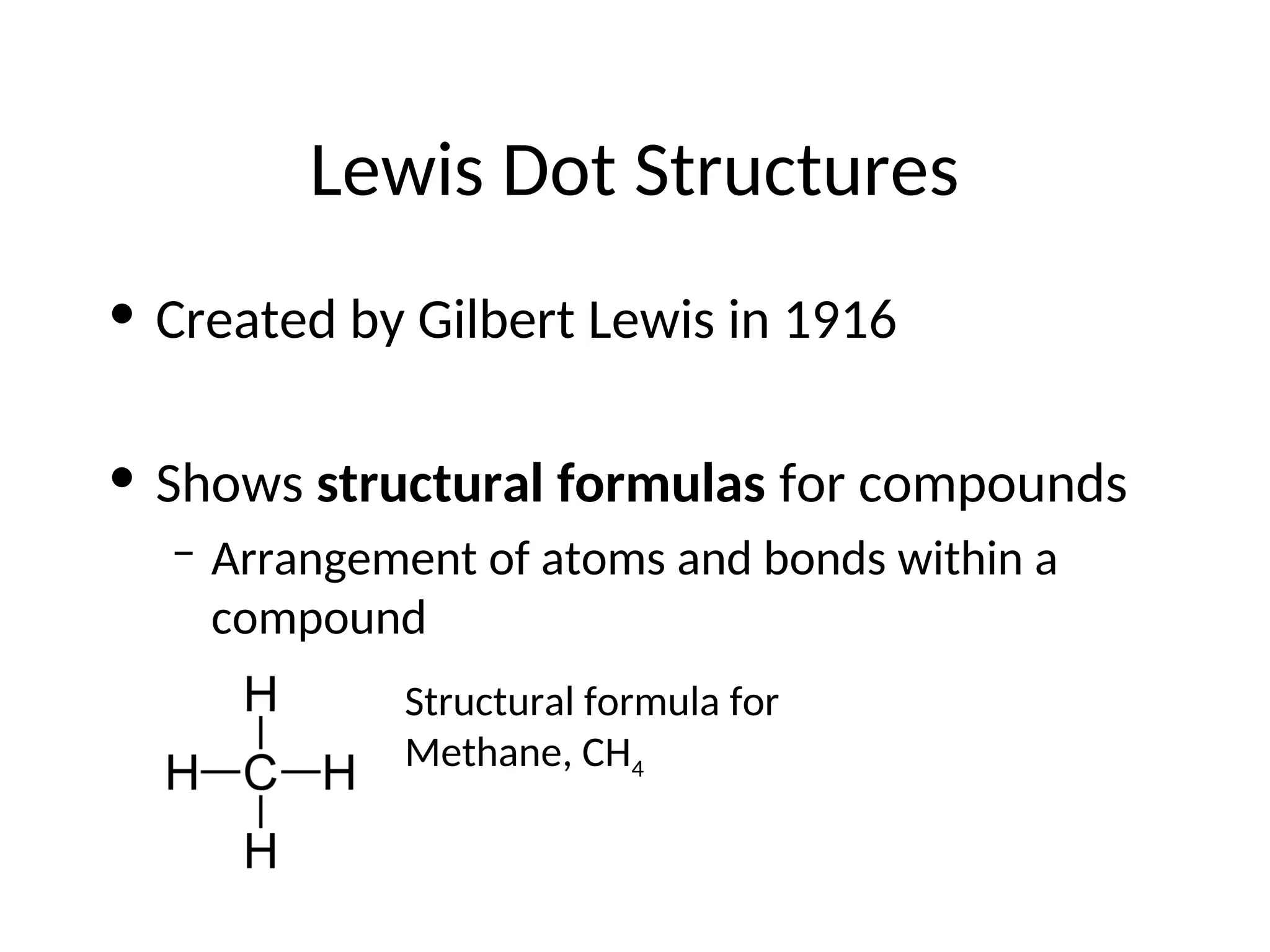
• Shows structural formulas for compounds
– Arrangement of atoms and bonds within a
compound
Structural formula for
Methane, CH4
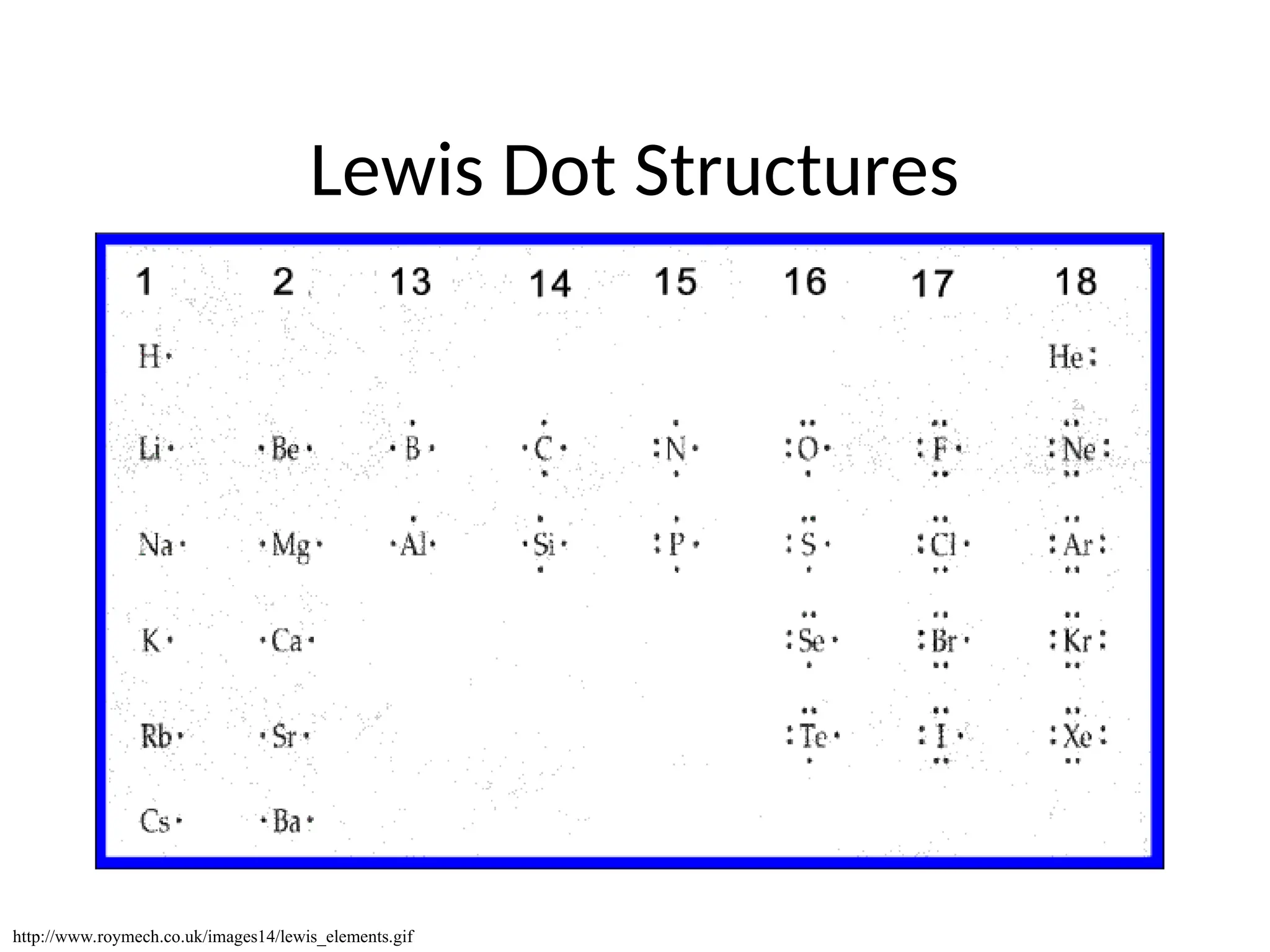
Lewis Dot Structures
• Uses valence electrons
• One dot = one valence electron
• One dash = a covalent bond = two electrons
Lewis Dot Structures
http://www.roymech.co.uk/images14/lewis_elements.gif
Practice
• How many dots will the following elements
contain?
– Fluorine
– Boron
– Carbon
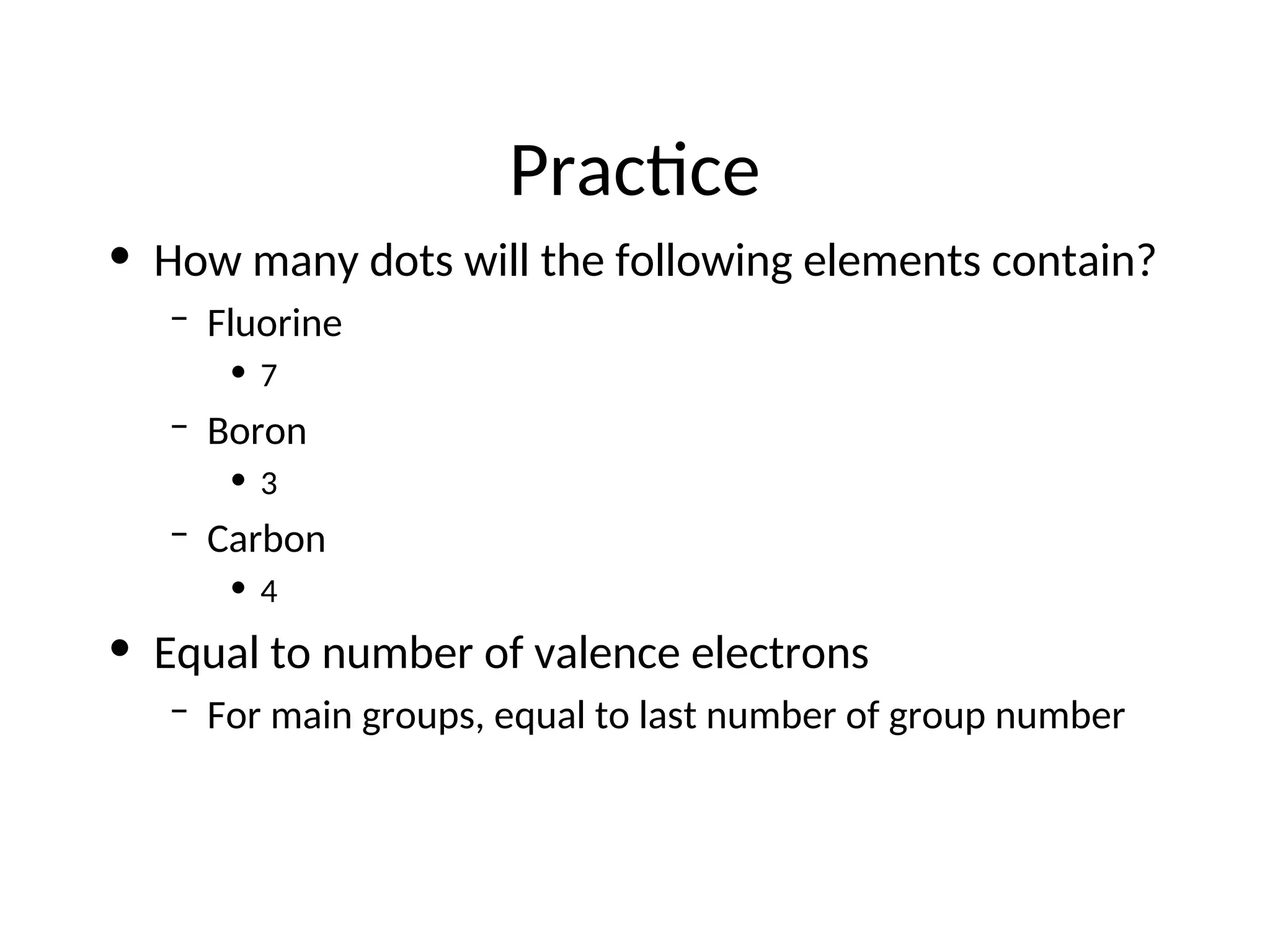
Practice
• How many dots will the following elements contain?
– Fluorine
• 7
– Boron
• 3
– Carbon
• 4
• Equal to number of valence electrons
– For main groups, equal to last number of group number
Lewis Structures
• Lewis structures show how valence electrons
are arranged among atoms in a molecule.
• Lewis structures reflect the idea that stability
of a compound relates to the octet rule
• Shared electrons pairs are covalent bonds and
can be represented by two dots (:) or by a
single line ( - )
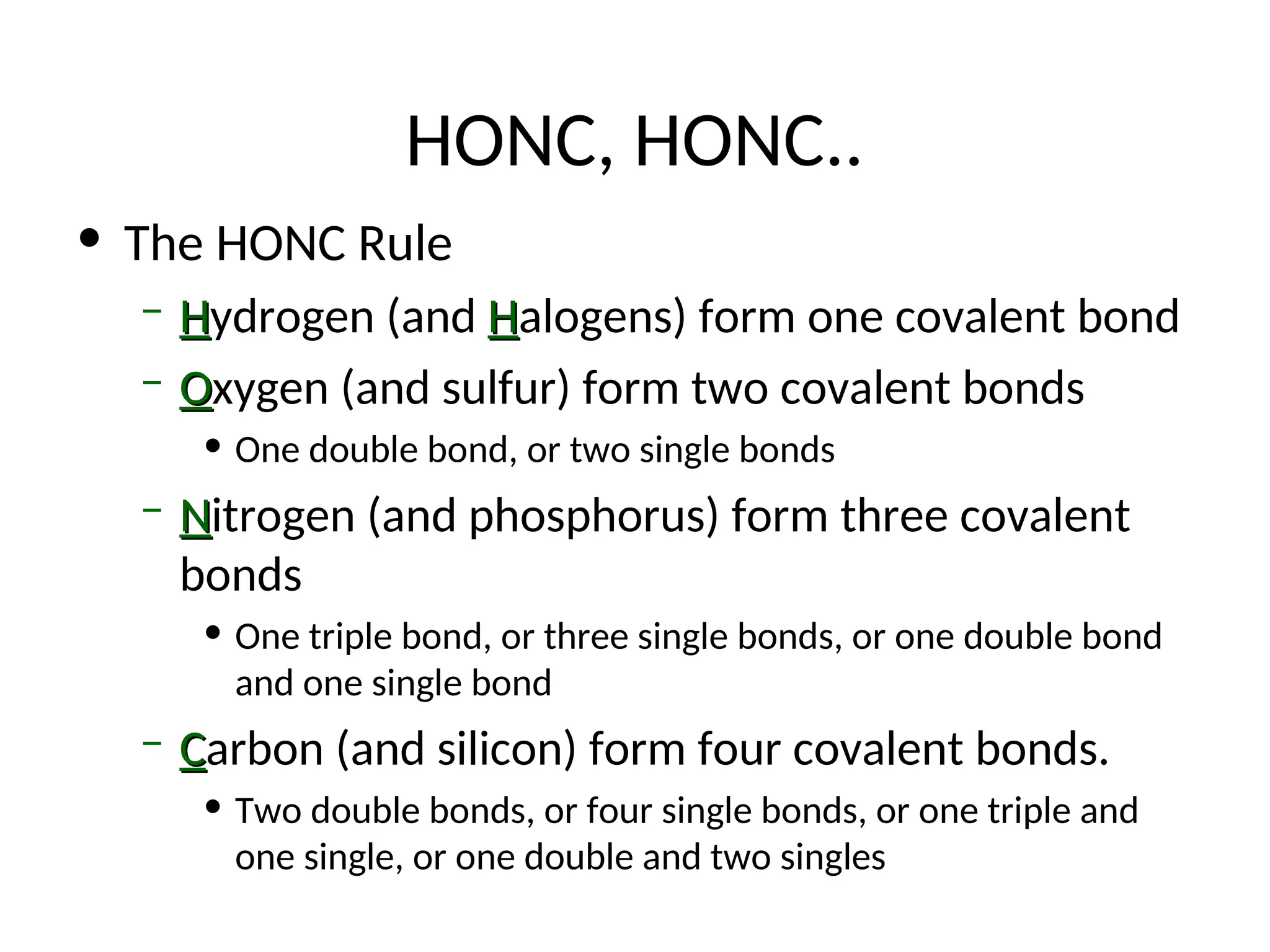
HONC, HONC..
• The HONC Rule
– H
Hydrogen (and H
Halogens) form one covalent bond
– O
Oxygen (and sulfur) form two covalent bonds
• One double bond, or two single bonds
– N
Nitrogen (and phosphorus) form three covalent
bonds
• One triple bond, or three single bonds, or one double bond
and one single bond
– C
Carbon (and silicon) form four covalent bonds.
• Two double bonds, or four single bonds, or one triple and
one single, or one double and two singles
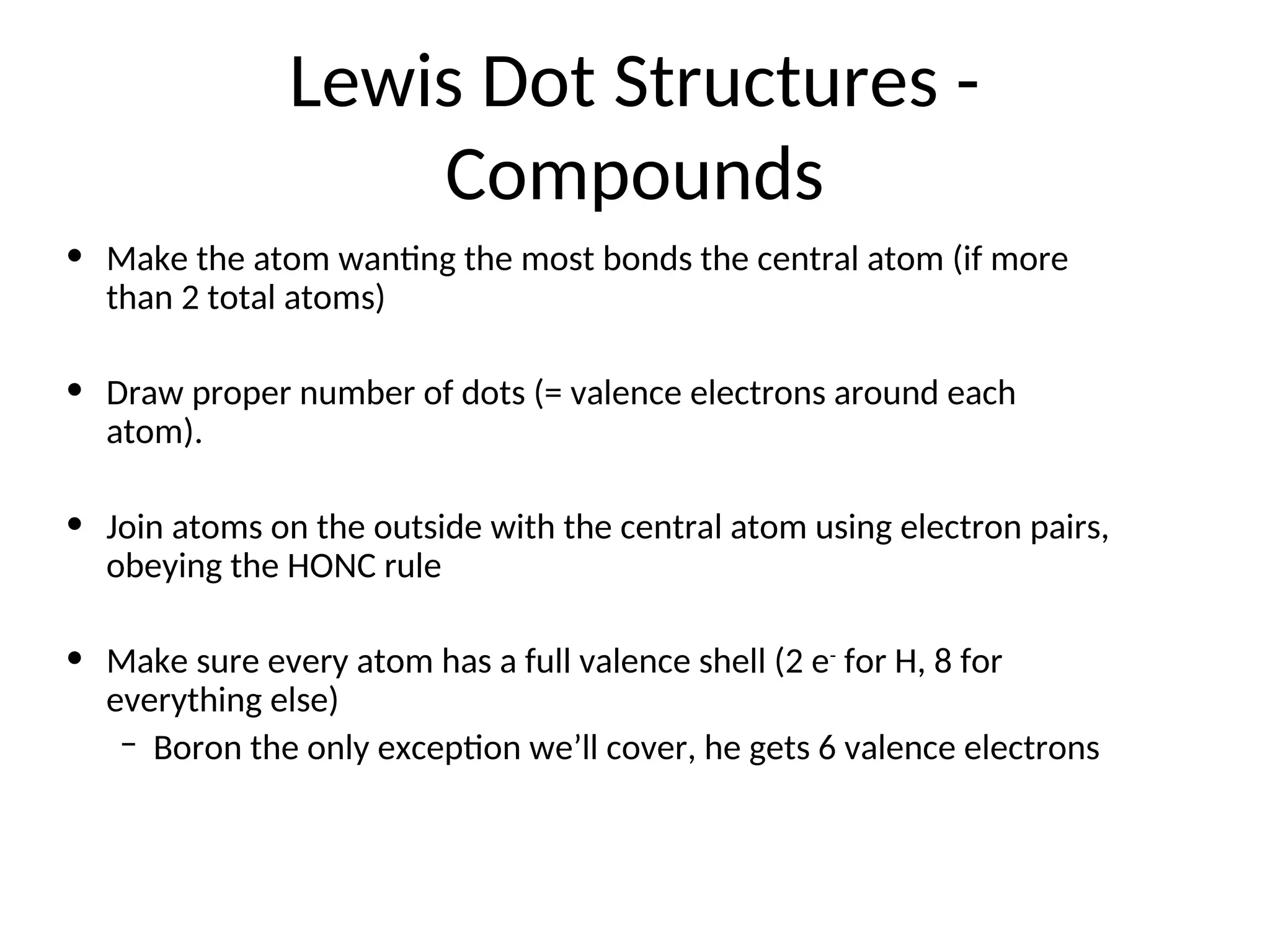
Lewis Dot Structures -
Compounds
• Make the atom wanting the most bonds the central atom (if more
than 2 total atoms)
• Draw proper number of dots (= valence electrons around each
atom).
• Join atoms on the outside with the central atom using electron pairs,
obeying the HONC rule
• Make sure every atom has a full valence shell (2 e-
for H, 8 for
everything else)
– Boron the only exception we’ll cover, he gets 6 valence electrons
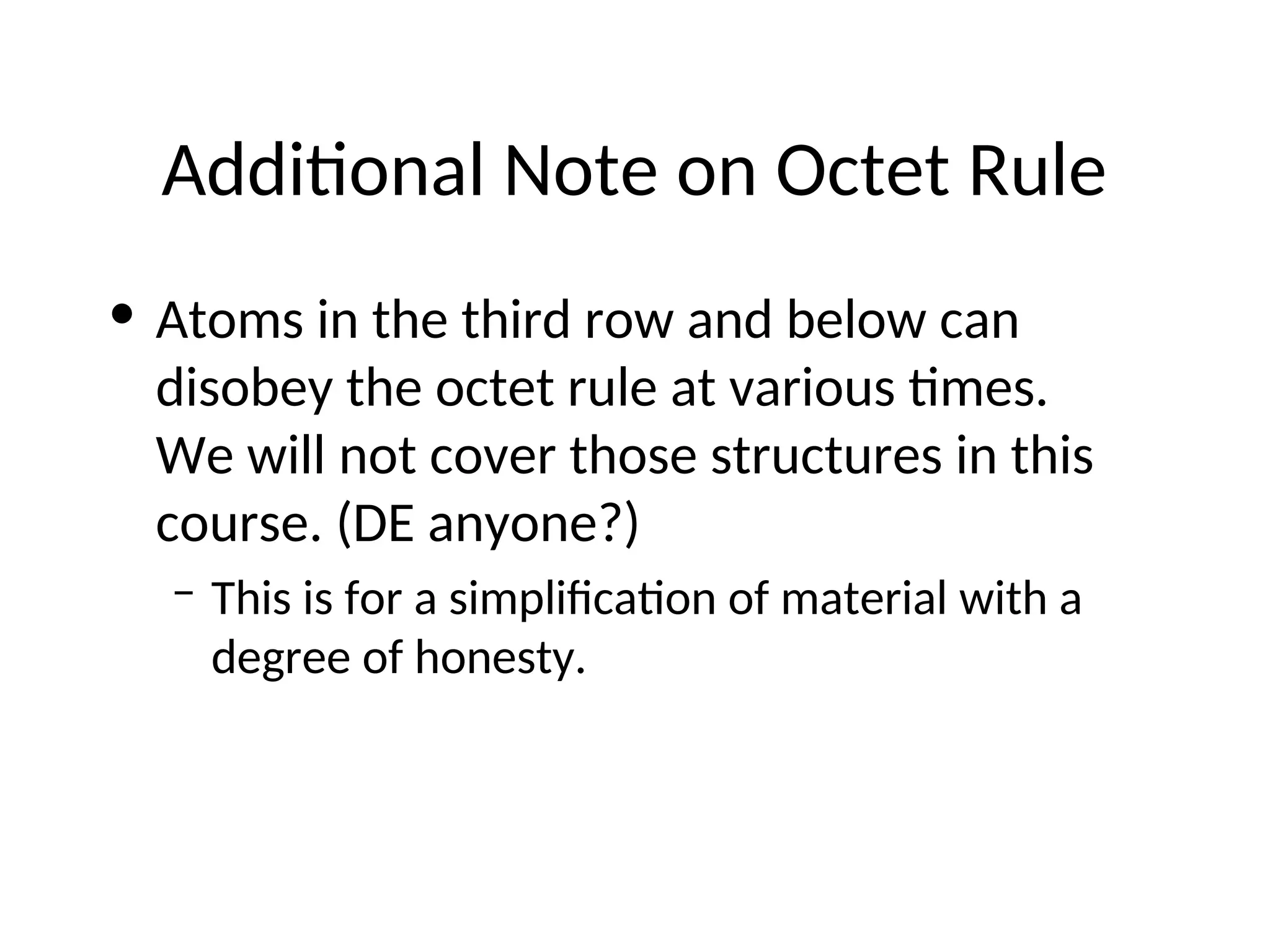
Additional Note on Octet Rule
• Atoms in the third row and below can
disobey the octet rule at various times.
We will not cover those structures in this
course. (DE anyone?)
– This is for a simplification of material with a
degree of honesty.
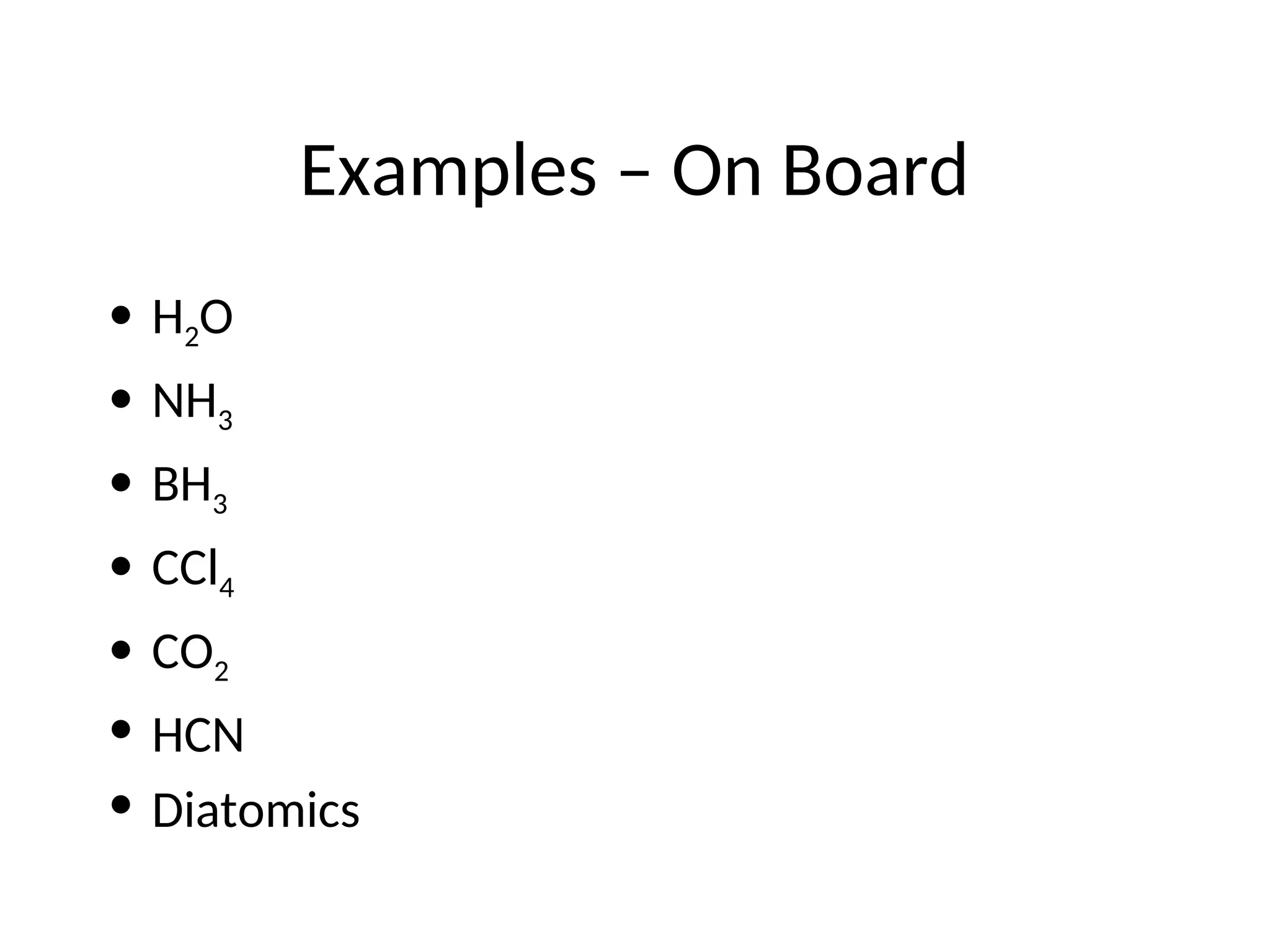
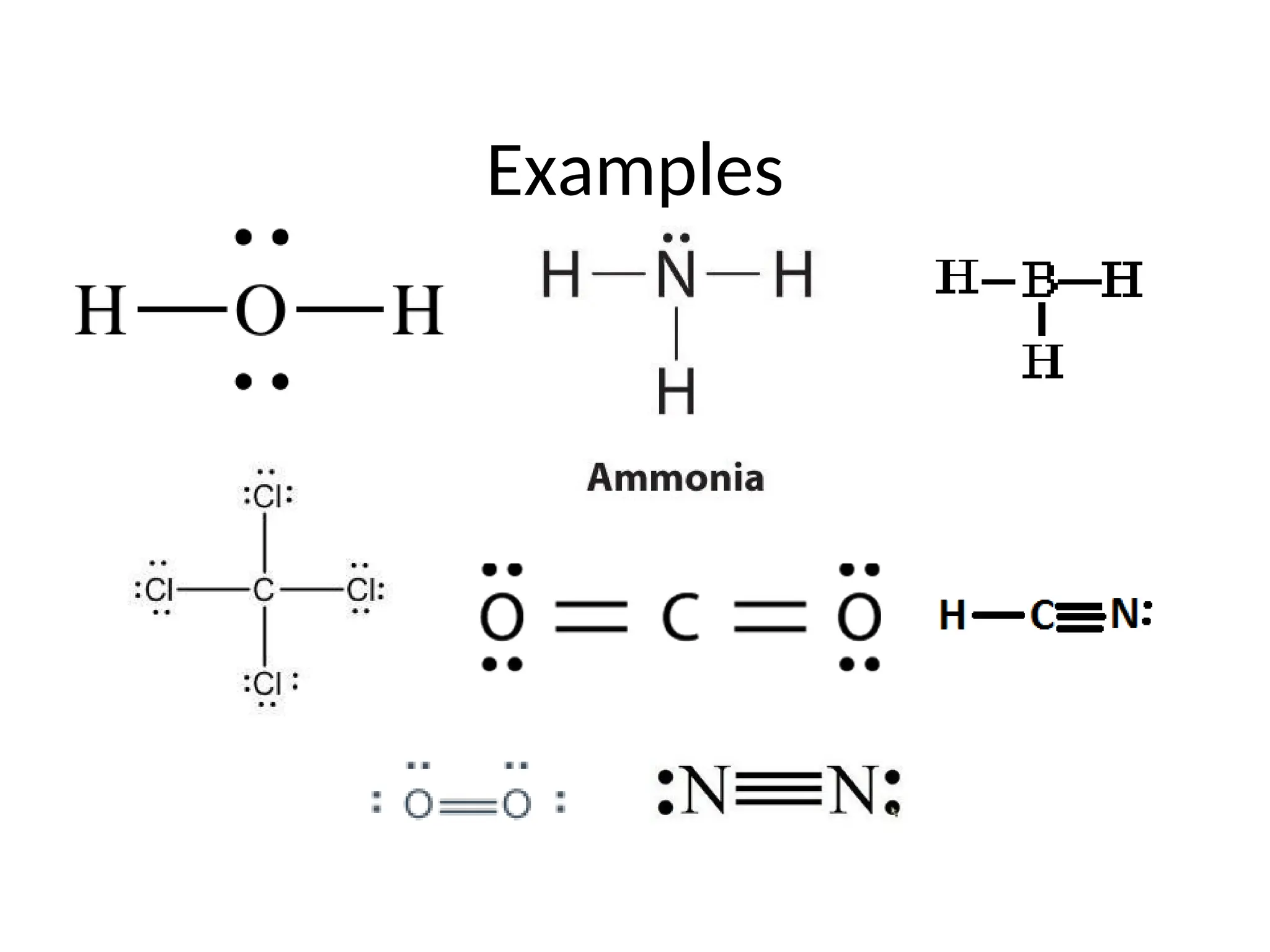
Examples – On Board
• H2O
• NH3
• BH3
• CCl4
• CO2
• HCN
• Diatomics
Examples
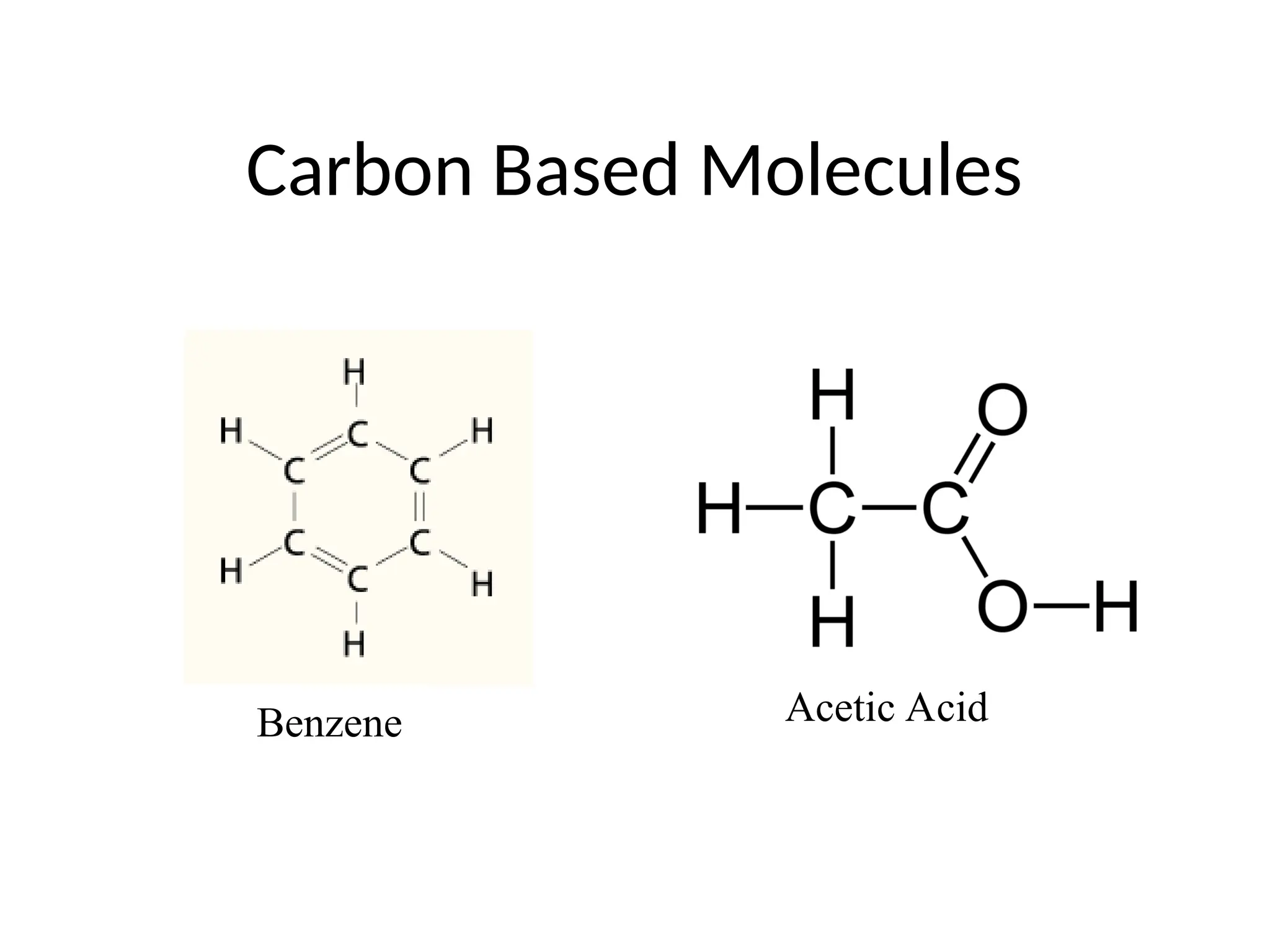
Carbon Based Molecules
• With multiple carbon compounds, connect
carbons together
• Arrange other elements around carbon, fill
octets
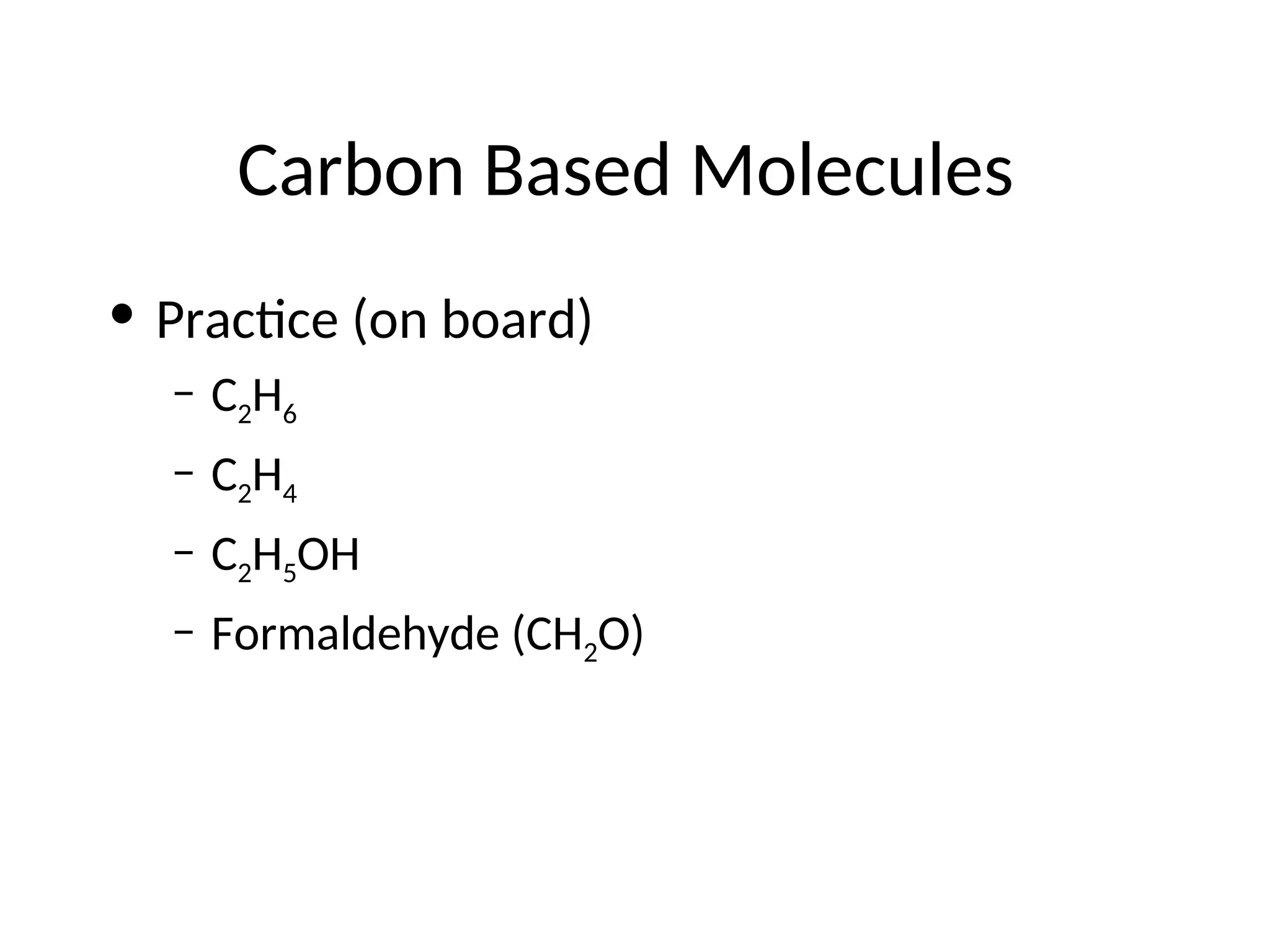
Carbon Based Molecules
• Practice (on board)
– C2H6
– C2H4
– C2H5OH
– Formaldehyde (CH2O)
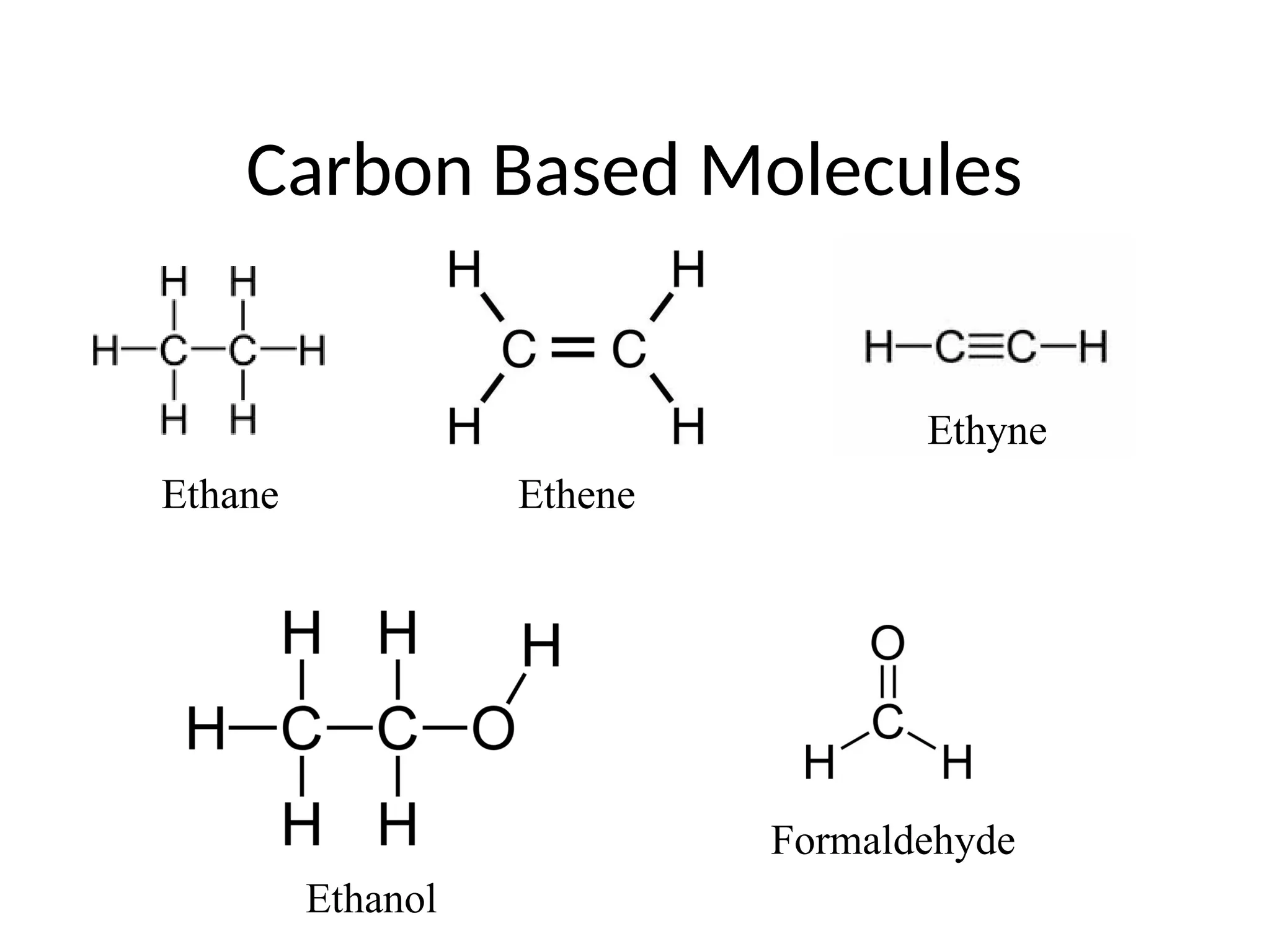
Carbon Based Molecules
Ethane Ethene
Ethyne
Formaldehyde
Ethanol
Carbon Based Molecules
Benzene Acetic Acid
Molecular Geometry
• Based on Valence Shell Electron Pair
Repulsion (VSEPR) theory
• Electron pairs around a central atom
arrange themselves so they can be as far
apart as possible from each other.
Molecular Geometry
• You will be responsible for five molecular shapes
• Compounds take a three-dimensional shape
based on:
– Number of atoms attached
– Number of unbonded electrons present
• These are general rules for binary compounds
– There are always exceptions!!! (including
organics)
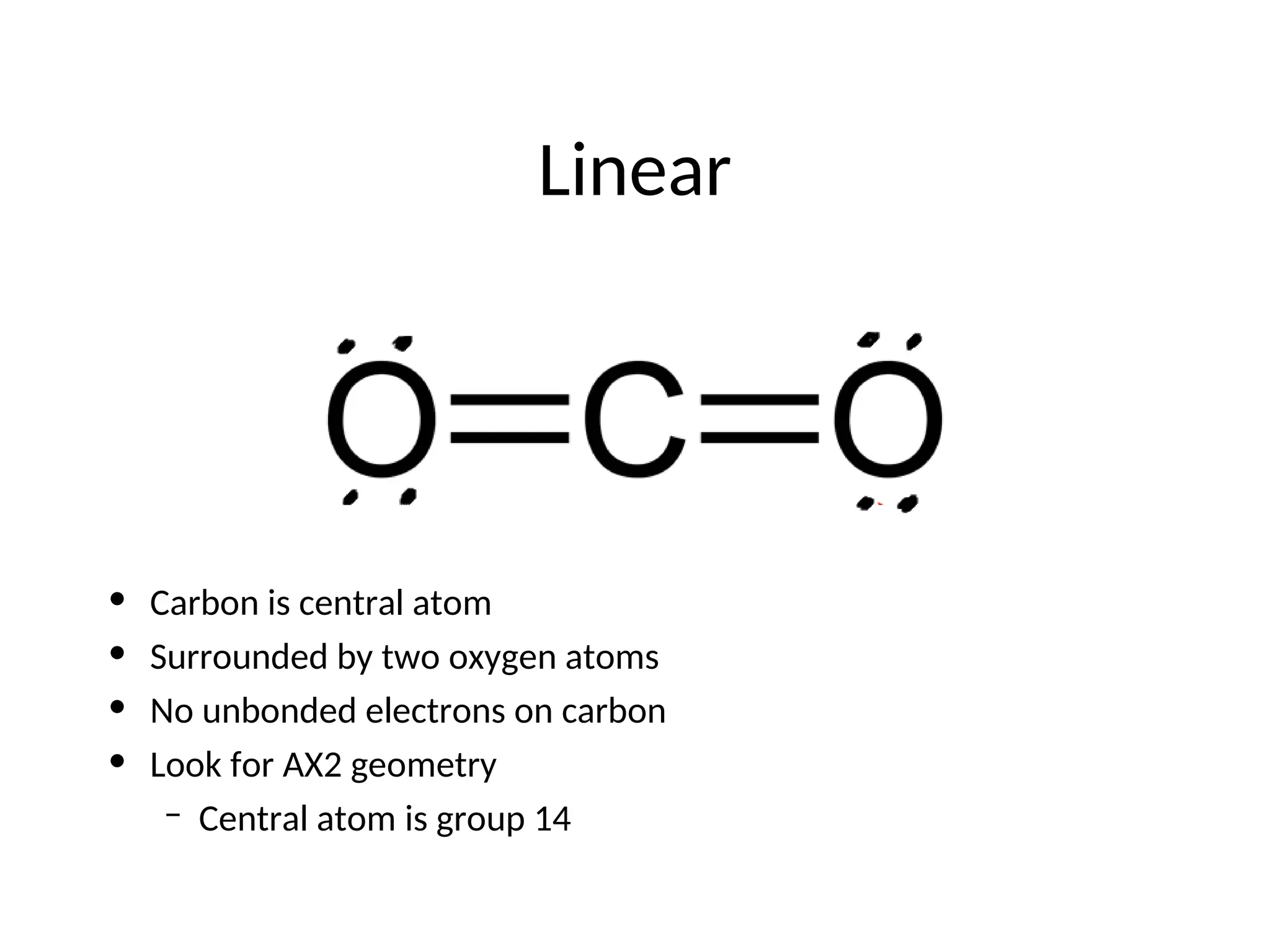
Linear
• Carbon is central atom
• Surrounded by two oxygen atoms
• No unbonded electrons on carbon
• Look for AX2 geometry
– Central atom is group 14
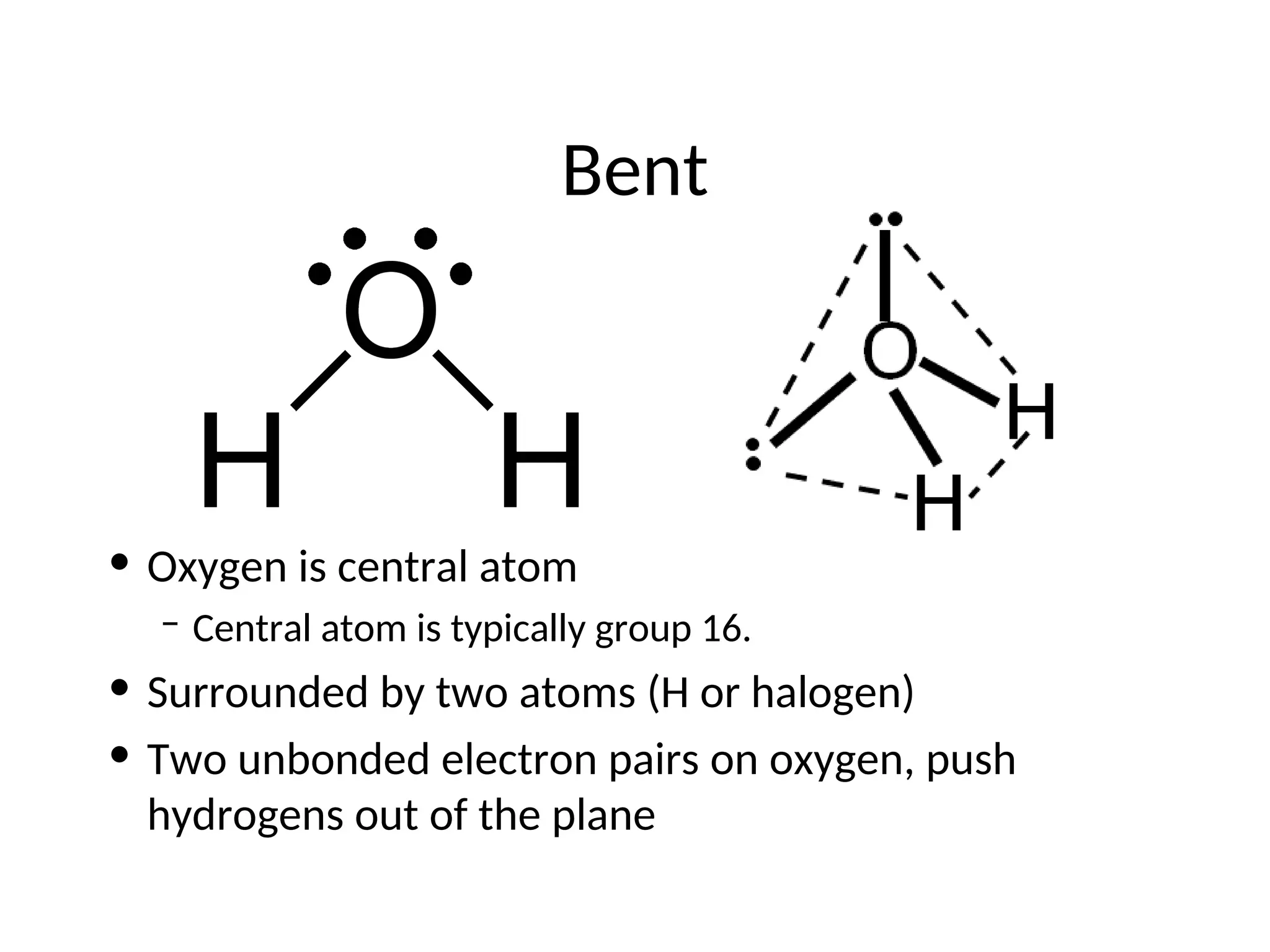
Bent
• Oxygen is central atom
– Central atom is typically group 16.
• Surrounded by two atoms (H or halogen)
• Two unbonded electron pairs on oxygen, push
hydrogens out of the plane
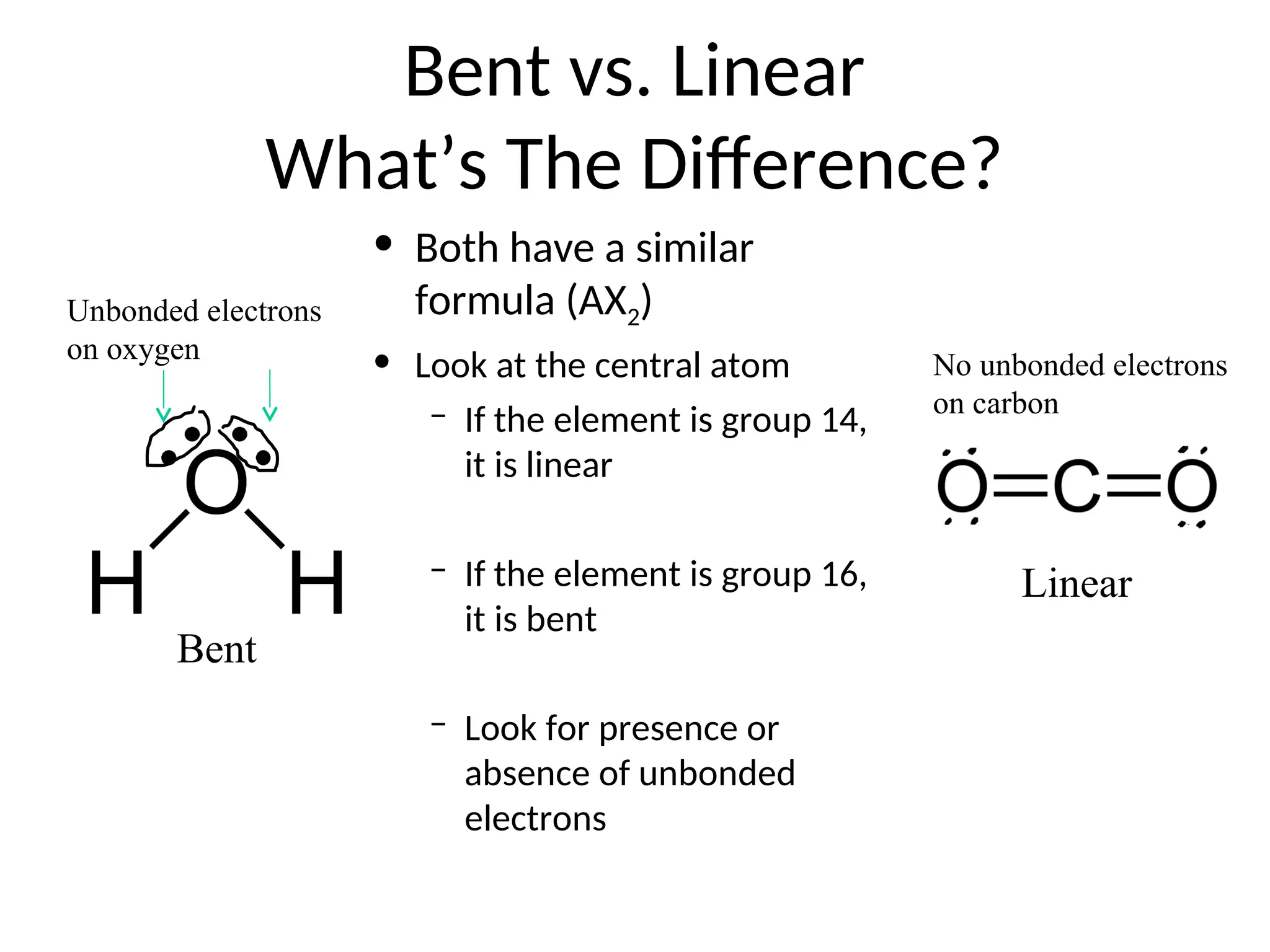
Bent vs. Linear
What’s The Difference?
• Both have a similar
formula (AX2)
• Look at the central atom
– If the element is group 14,
it is linear
– If the element is group 16,
it is bent
– Look for presence or
absence of unbonded
electrons
Bent
Linear
Unbonded electrons
on oxygen
No unbonded electrons
on carbon
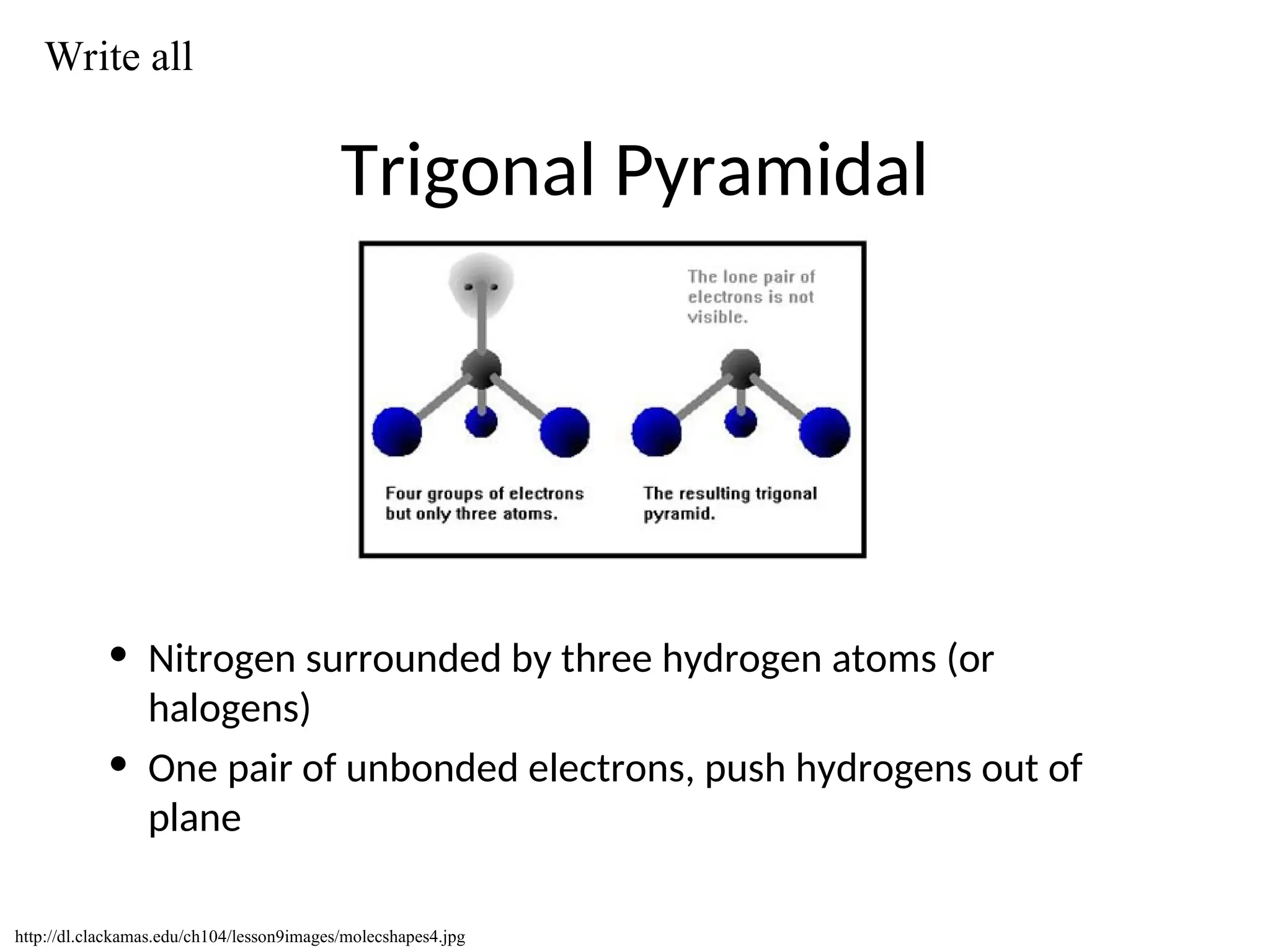
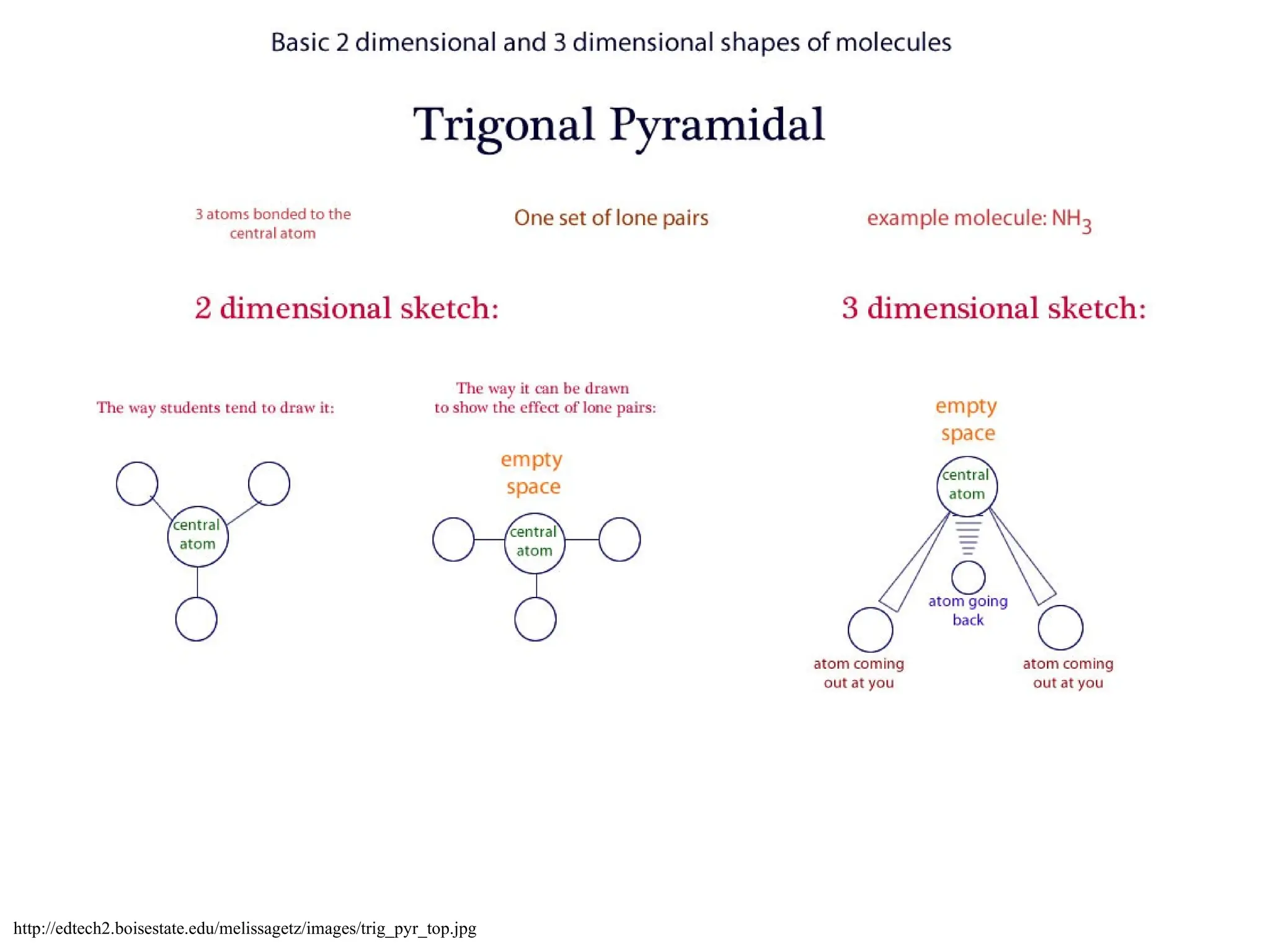
Trigonal Pyramidal
• Nitrogen surrounded by three hydrogen atoms (or
halogens)
• One pair of unbonded electrons, push hydrogens out of
plane
http://dl.clackamas.edu/ch104/lesson9images/molecshapes4.jpg
Write all
http://edtech2.boisestate.edu/melissagetz/images/trig_pyr_top.jpg
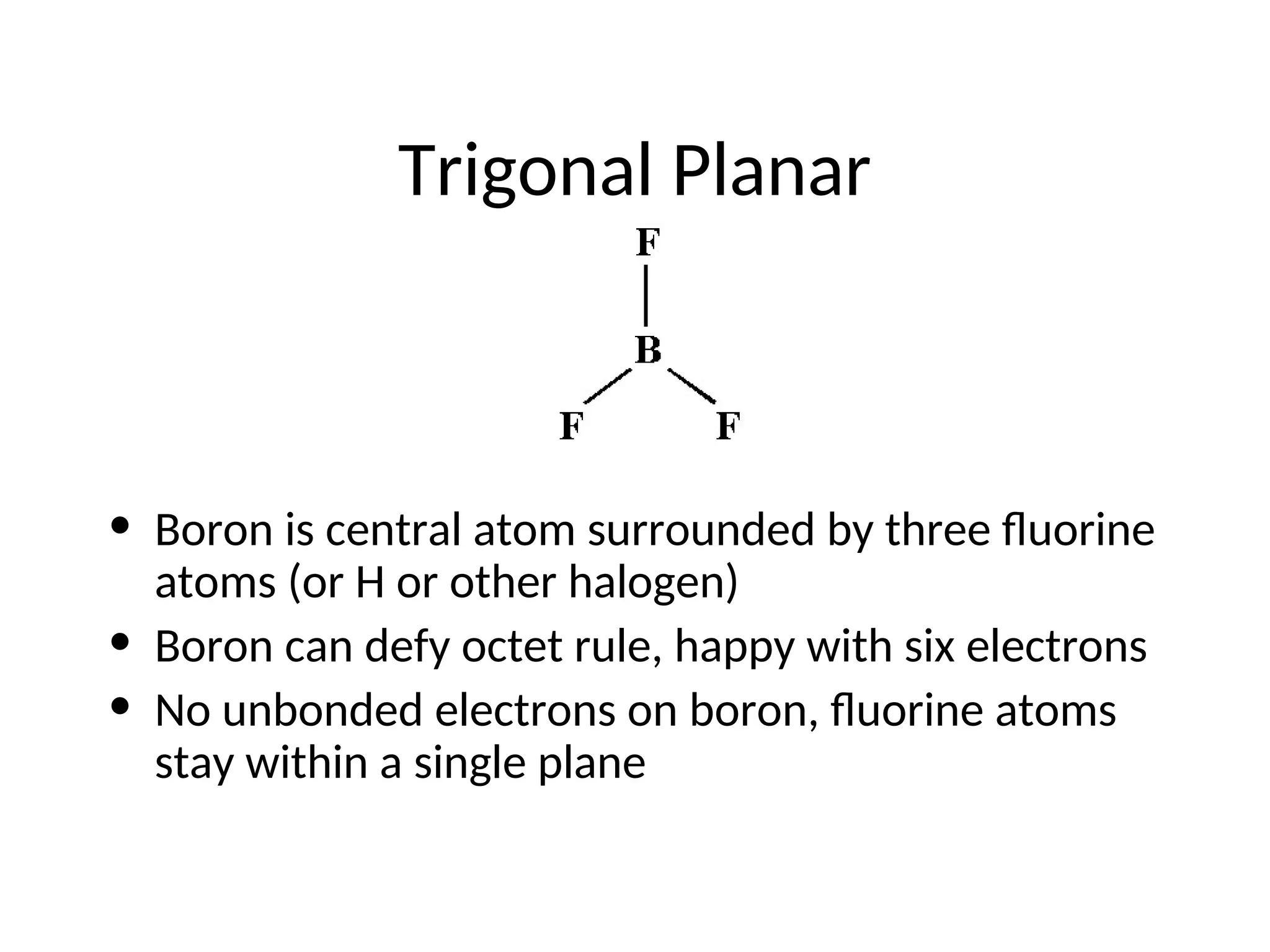
Trigonal Planar
• Boron is central atom surrounded by three fluorine
atoms (or H or other halogen)
• Boron can defy octet rule, happy with six electrons
• No unbonded electrons on boron, fluorine atoms
stay within a single plane
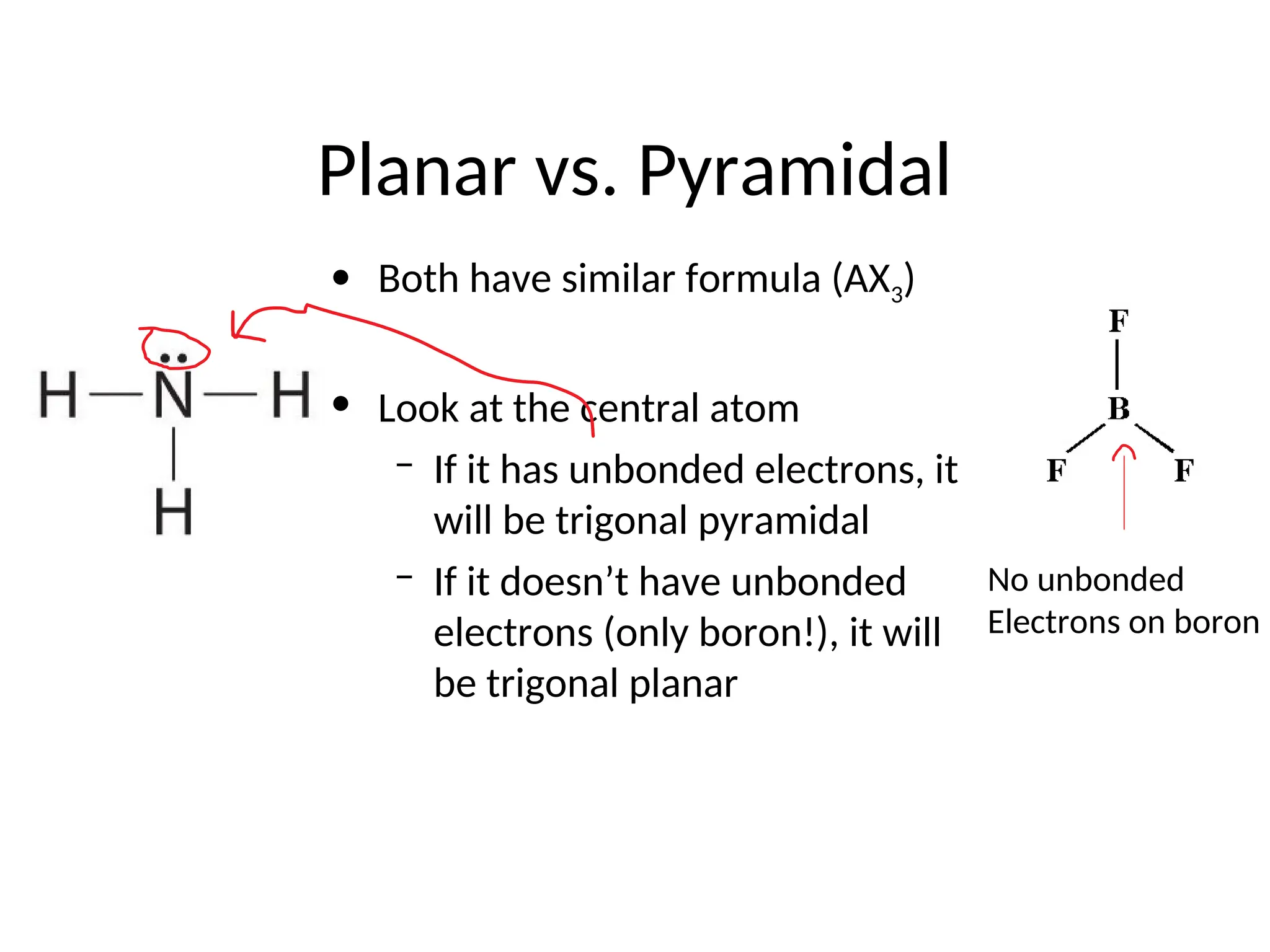
Planar vs. Pyramidal
• Both have similar formula (AX3)
• Look at the central atom
– If it has unbonded electrons, it
will be trigonal pyramidal
– If it doesn’t have unbonded
electrons (only boron!), it will
be trigonal planar
No unbonded
Electrons on boron
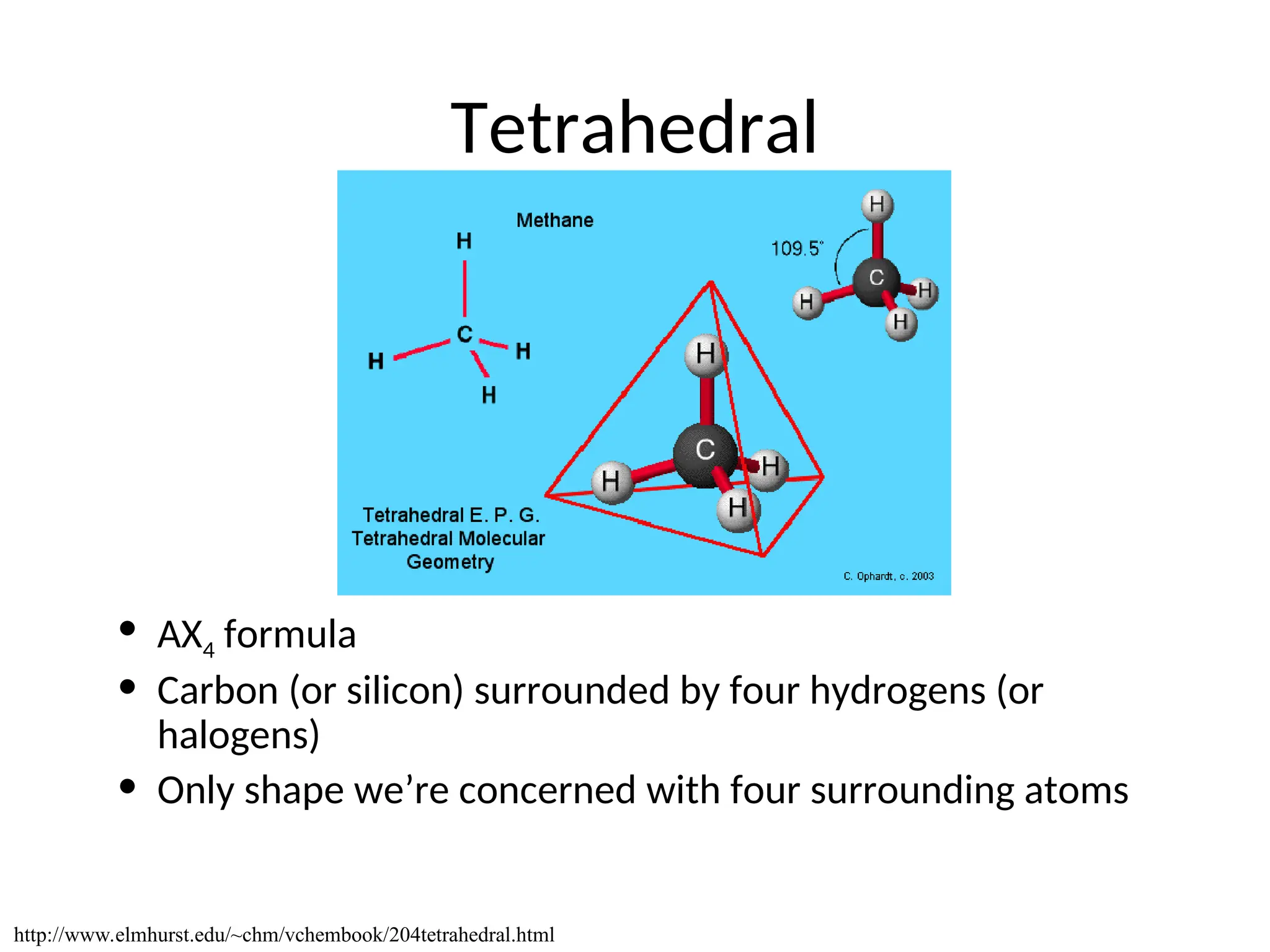
Tetrahedral
• AX4 formula
• Carbon (or silicon) surrounded by four hydrogens (or
halogens)
• Only shape we’re concerned with four surrounding atoms
http://www.elmhurst.edu/~chm/vchembook/204tetrahedral.html
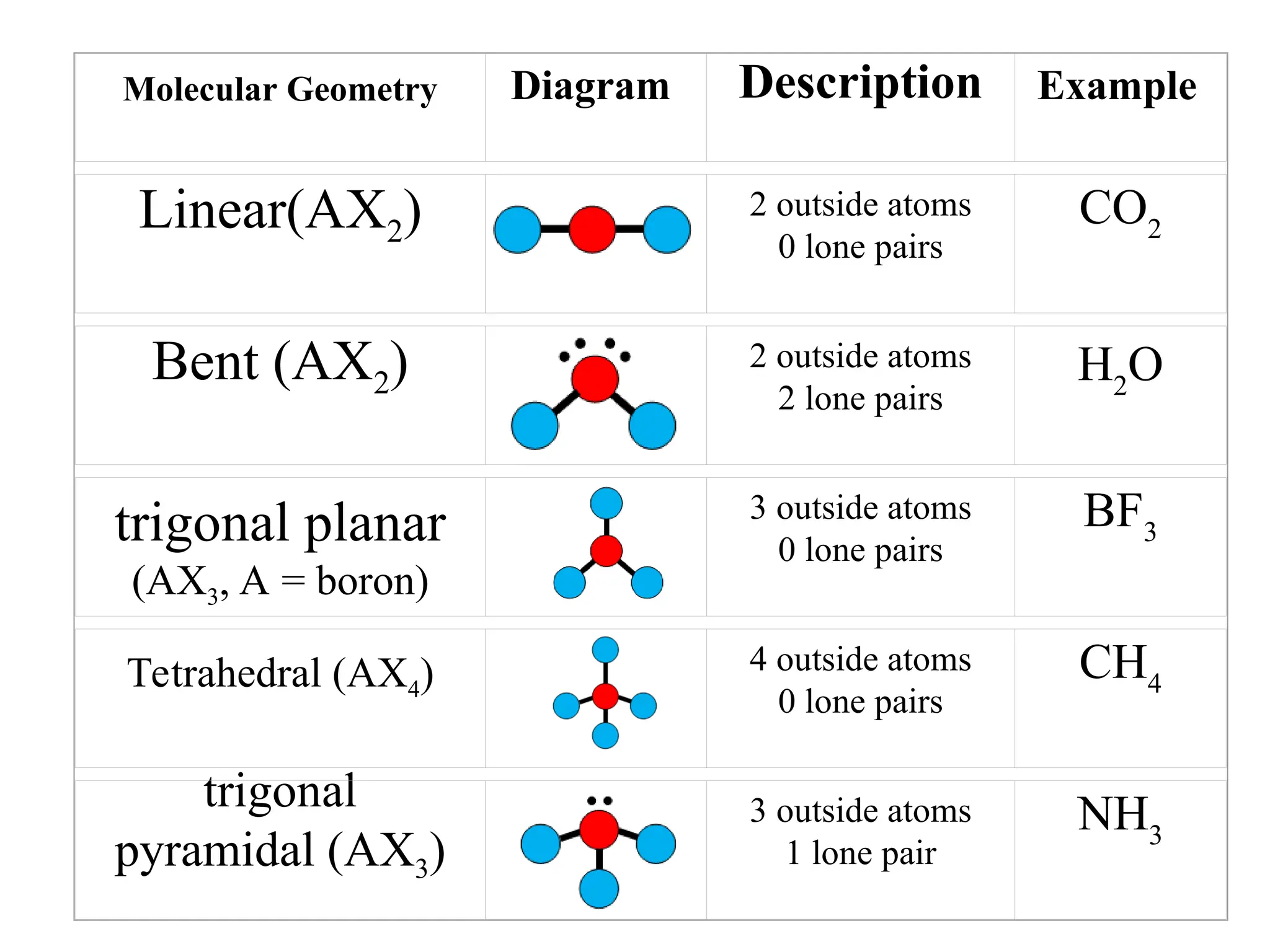
Molecular Geometry Diagram Description Example
Linear(AX2) 2 outside atoms
0 lone pairs
CO2
Bent (AX2) 2 outside atoms
2 lone pairs
H2
O
trigonal planar
(AX3, A = boron)
3 outside atoms
0 lone pairs
BF3
Tetrahedral (AX4) 4 outside atoms
0 lone pairs
CH4
trigonal
pyramidal (AX3)
3 outside atoms
1 lone pair
NH3
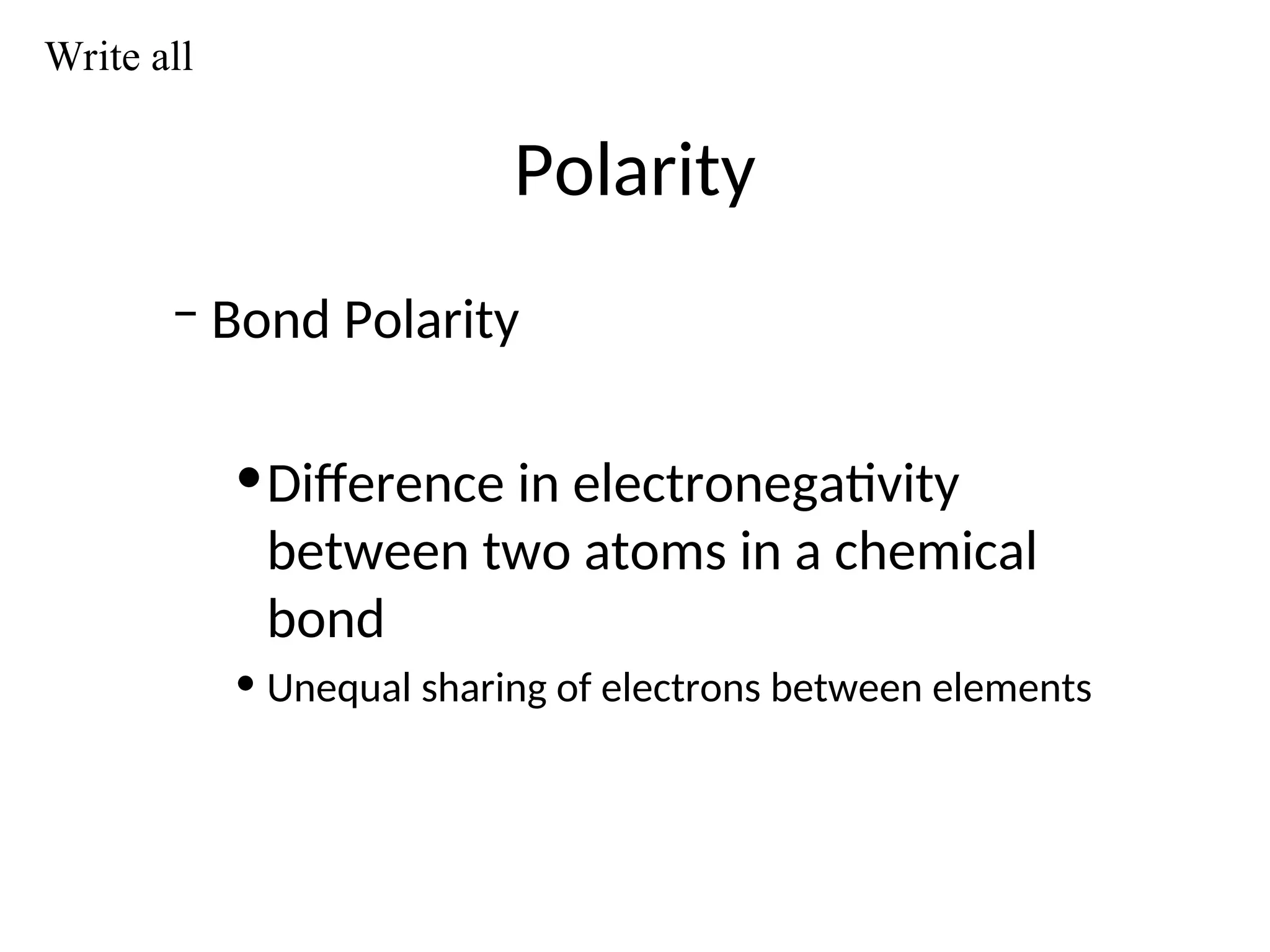
Polarity
– Bond Polarity
•Difference in electronegativity
between two atoms in a chemical
bond
• Unequal sharing of electrons between elements
Write all
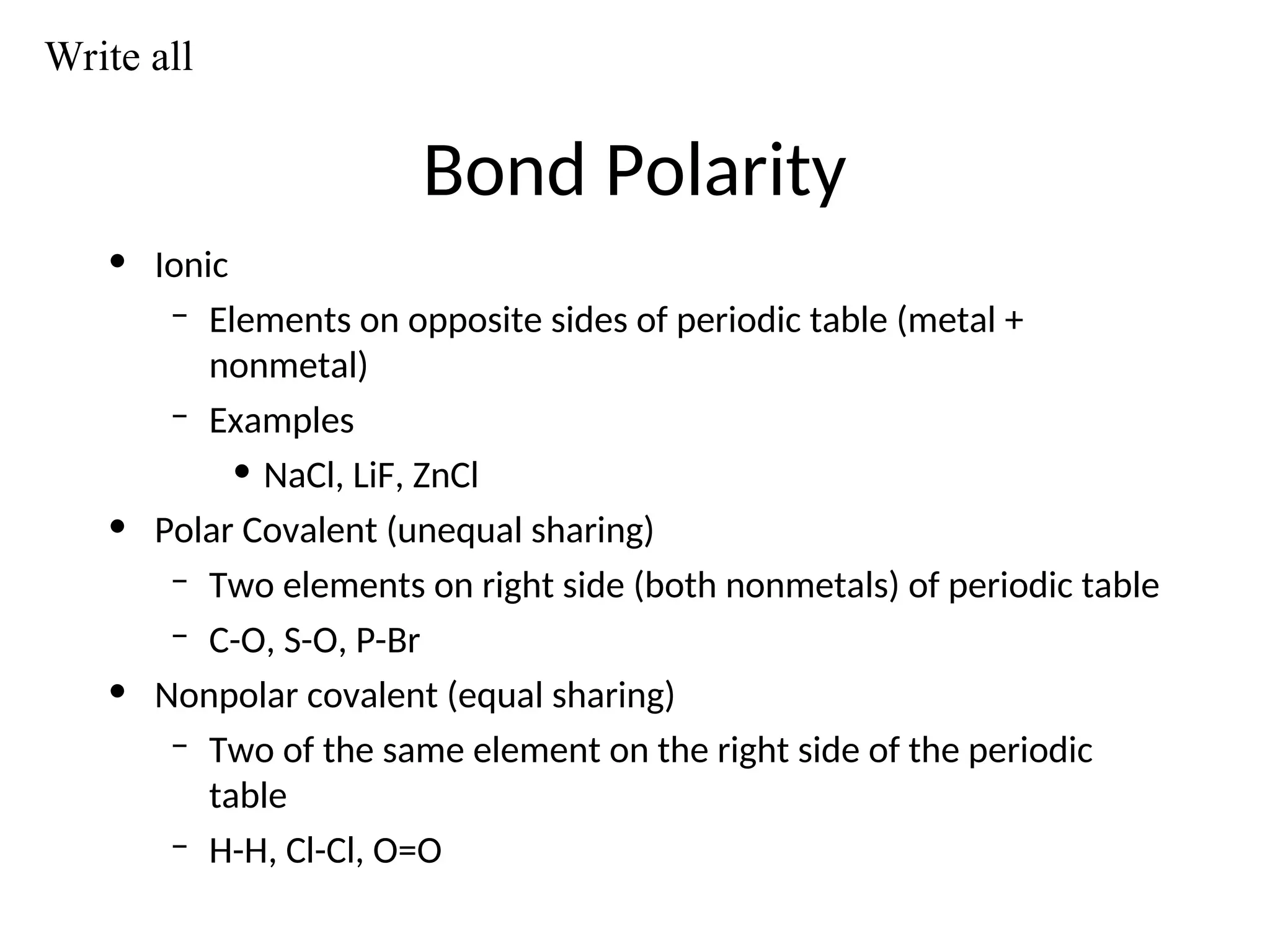
Bond Polarity
• Ionic
– Elements on opposite sides of periodic table (metal +
nonmetal)
– Examples
• NaCl, LiF, ZnCl
• Polar Covalent (unequal sharing)
– Two elements on right side (both nonmetals) of periodic table
– C-O, S-O, P-Br
• Nonpolar covalent (equal sharing)
– Two of the same element on the right side of the periodic
table
– H-H, Cl-Cl, O=O
Write all
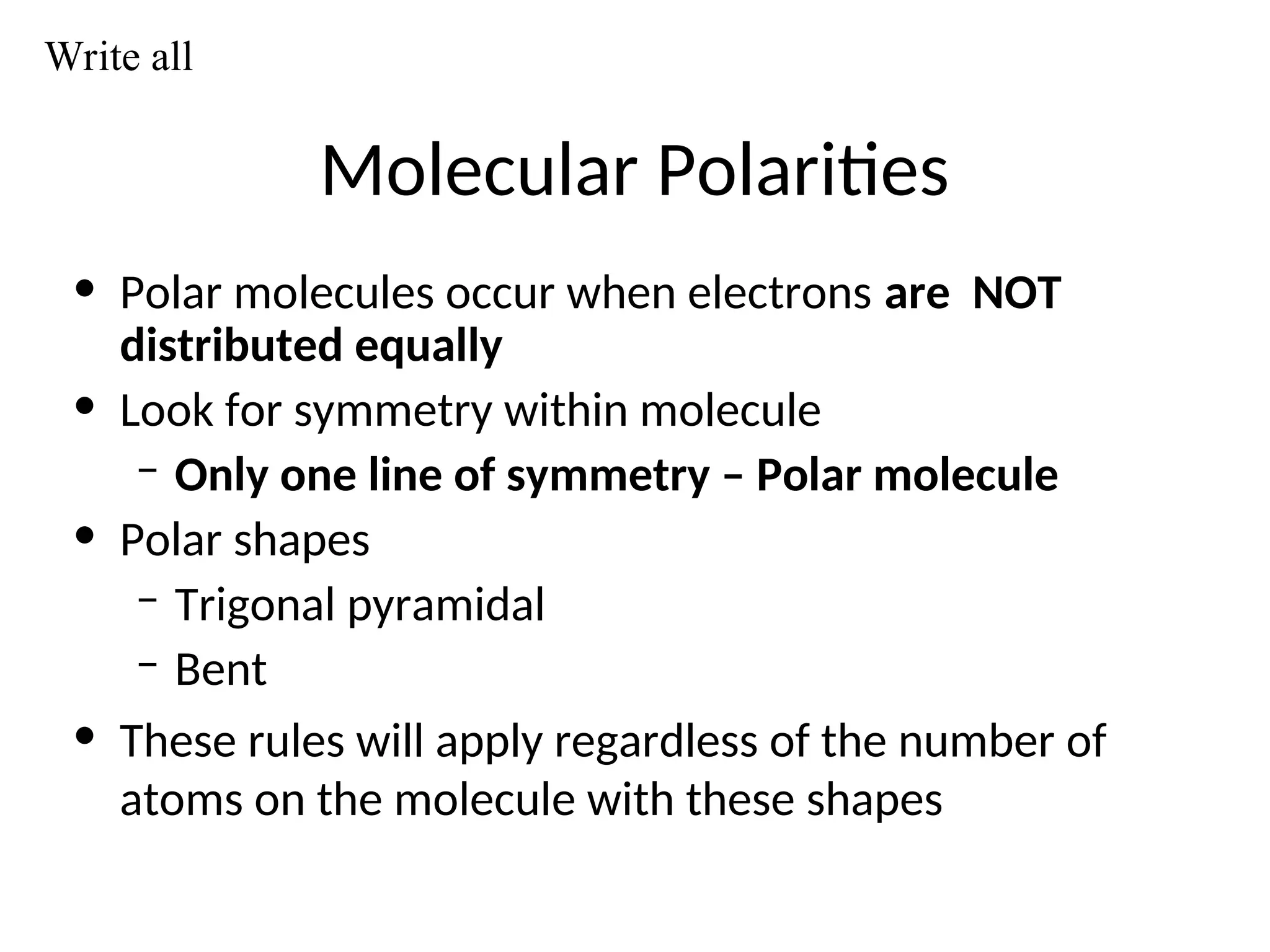
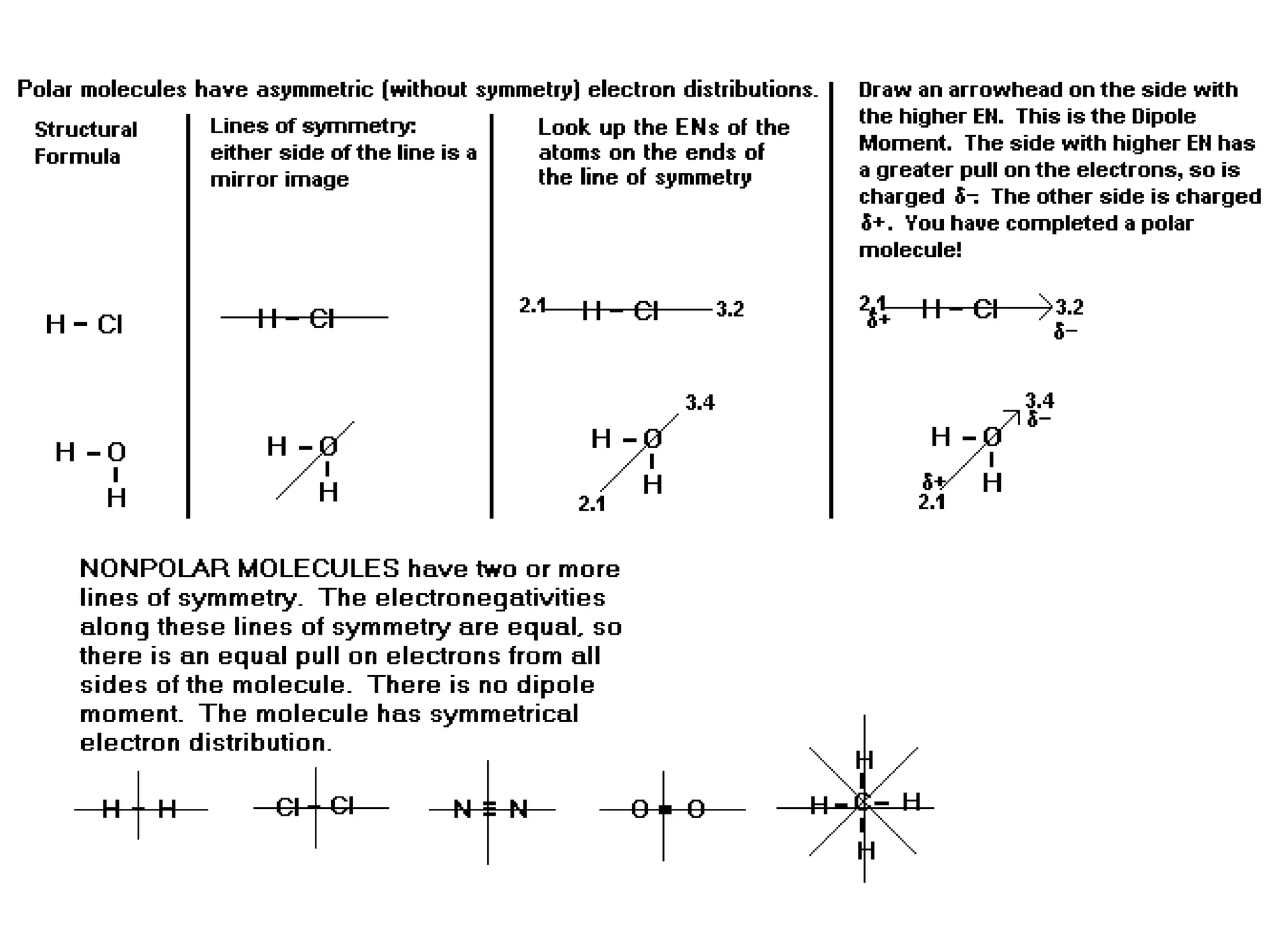
Molecular Polarities
• Polar molecules occur when electrons are NOT
distributed equally
• Look for symmetry within molecule
– Only one line of symmetry – Polar molecule
• Polar shapes
– Trigonal pyramidal
– Bent
• These rules will apply regardless of the number of
atoms on the molecule with these shapes
Write all
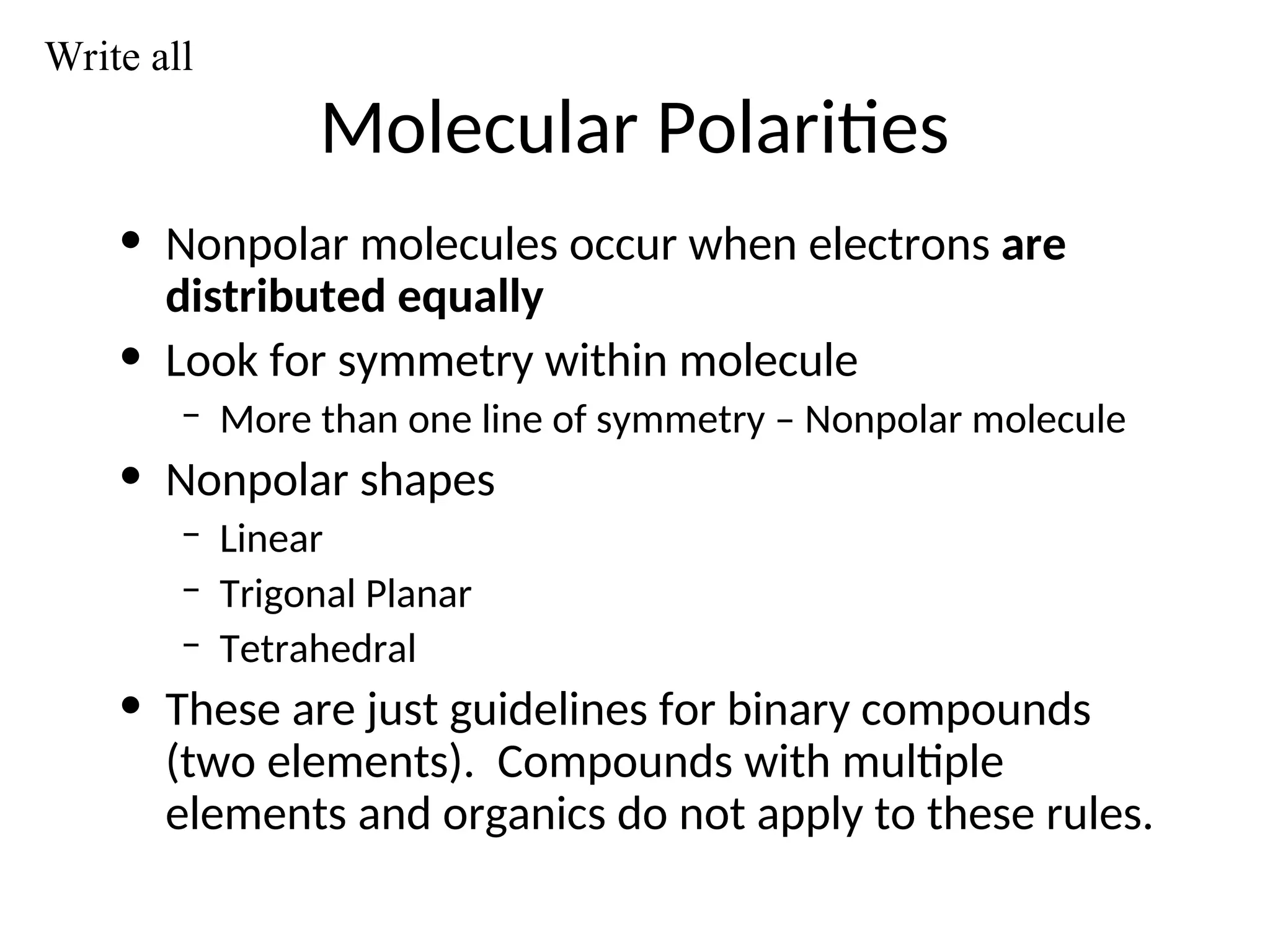
Molecular Polarities
• Nonpolar molecules occur when electrons are
distributed equally
• Look for symmetry within molecule
– More than one line of symmetry – Nonpolar molecule
• Nonpolar shapes
– Linear
– Trigonal Planar
– Tetrahedral
• These are just guidelines for binary compounds
(two elements). Compounds with multiple
elements and organics do not apply to these rules.
Write all
Skills to Master
• Drawing Lewis dot structures from a given
molecular formula
• Assigning a shape based on a molecular
formula (or Lewis dot structure)
• Determine whether a bond is polar or nonpolar
• Determine whether a molecule is polar or
nonpolar based on formula (or Lewis dot
structure)
Terms To Know
• Lewis Dot Structure
• Structural formula
• Linear
• Bent
• Trigonal pyramidal
• Trigonal planar
• Tetrahedral
• Polarity
• Electronegativity (review)
• Polar
• Polar covalent
• Nonpolar
• Nonpolar covalent

Lewis_Dot_Structures_and_VSEPR_Fall_2016.ppt

  • 1.
    Lewis Dot Structuresand Molecular Geometries Dr. Walker
  • 2.
    What will youknow? What will you do? • (3c) ·Lewis dot diagrams are used to represent valence electrons in an element. Structural formulas show the arrangements of atoms and bonds in a molecule and are represented by Lewis dot structures. • Draw Lewis dot diagrams to represent valence electrons in elements and draw Lewis dot structures to show covalent bonding. • Use valence shell electron pair repulsion (VSEPR) model to draw and name molecular shapes (bent, linear, trigonal planar, tetrahedral, and trigonal pyramidal). • Polar bonds form between elements with very different electronegativities. Non- polar bonds form between elements with similar electronegativities. • Polar molecules result when electrons are distributed unequally. • Recognize polar molecules and non-polar molecules. • (6a) · Draw Lewis dot structures, identify geometries, and describe polarities of the following molecules: CH4, C2H6, C2H4, C2H2, CH3CH2OH, CH2O, C6H6, CH3COOH.
  • 3.
    Lewis Dot Structures •Created by Gilbert Lewis in 1916 • Shows structural formulas for compounds – Arrangement of atoms and bonds within a compound Structural formula for Methane, CH4
  • 4.
    Lewis Dot Structures •Uses valence electrons • One dot = one valence electron • One dash = a covalent bond = two electrons
  • 5.
  • 6.
    Practice • How manydots will the following elements contain? – Fluorine – Boron – Carbon
  • 7.
    Practice • How manydots will the following elements contain? – Fluorine • 7 – Boron • 3 – Carbon • 4 • Equal to number of valence electrons – For main groups, equal to last number of group number
  • 8.
    Lewis Structures • Lewisstructures show how valence electrons are arranged among atoms in a molecule. • Lewis structures reflect the idea that stability of a compound relates to the octet rule • Shared electrons pairs are covalent bonds and can be represented by two dots (:) or by a single line ( - )
  • 9.
    HONC, HONC.. • TheHONC Rule – H Hydrogen (and H Halogens) form one covalent bond – O Oxygen (and sulfur) form two covalent bonds • One double bond, or two single bonds – N Nitrogen (and phosphorus) form three covalent bonds • One triple bond, or three single bonds, or one double bond and one single bond – C Carbon (and silicon) form four covalent bonds. • Two double bonds, or four single bonds, or one triple and one single, or one double and two singles
  • 10.
    Lewis Dot Structures- Compounds • Make the atom wanting the most bonds the central atom (if more than 2 total atoms) • Draw proper number of dots (= valence electrons around each atom). • Join atoms on the outside with the central atom using electron pairs, obeying the HONC rule • Make sure every atom has a full valence shell (2 e- for H, 8 for everything else) – Boron the only exception we’ll cover, he gets 6 valence electrons
  • 11.
    Additional Note onOctet Rule • Atoms in the third row and below can disobey the octet rule at various times. We will not cover those structures in this course. (DE anyone?) – This is for a simplification of material with a degree of honesty.
  • 12.
    Examples – OnBoard • H2O • NH3 • BH3 • CCl4 • CO2 • HCN • Diatomics
  • 13.
  • 14.
    Carbon Based Molecules •With multiple carbon compounds, connect carbons together • Arrange other elements around carbon, fill octets
  • 15.
    Carbon Based Molecules •Practice (on board) – C2H6 – C2H4 – C2H5OH – Formaldehyde (CH2O)
  • 16.
    Carbon Based Molecules EthaneEthene Ethyne Formaldehyde Ethanol
  • 17.
  • 18.
    Molecular Geometry • Basedon Valence Shell Electron Pair Repulsion (VSEPR) theory • Electron pairs around a central atom arrange themselves so they can be as far apart as possible from each other.
  • 19.
    Molecular Geometry • Youwill be responsible for five molecular shapes • Compounds take a three-dimensional shape based on: – Number of atoms attached – Number of unbonded electrons present • These are general rules for binary compounds – There are always exceptions!!! (including organics)
  • 20.
    Linear • Carbon iscentral atom • Surrounded by two oxygen atoms • No unbonded electrons on carbon • Look for AX2 geometry – Central atom is group 14
  • 21.
    Bent • Oxygen iscentral atom – Central atom is typically group 16. • Surrounded by two atoms (H or halogen) • Two unbonded electron pairs on oxygen, push hydrogens out of the plane
  • 22.
    Bent vs. Linear What’sThe Difference? • Both have a similar formula (AX2) • Look at the central atom – If the element is group 14, it is linear – If the element is group 16, it is bent – Look for presence or absence of unbonded electrons Bent Linear Unbonded electrons on oxygen No unbonded electrons on carbon
  • 23.
    Trigonal Pyramidal • Nitrogensurrounded by three hydrogen atoms (or halogens) • One pair of unbonded electrons, push hydrogens out of plane http://dl.clackamas.edu/ch104/lesson9images/molecshapes4.jpg Write all
  • 24.
  • 25.
    Trigonal Planar • Boronis central atom surrounded by three fluorine atoms (or H or other halogen) • Boron can defy octet rule, happy with six electrons • No unbonded electrons on boron, fluorine atoms stay within a single plane
  • 26.
    Planar vs. Pyramidal •Both have similar formula (AX3) • Look at the central atom – If it has unbonded electrons, it will be trigonal pyramidal – If it doesn’t have unbonded electrons (only boron!), it will be trigonal planar No unbonded Electrons on boron
  • 27.
    Tetrahedral • AX4 formula •Carbon (or silicon) surrounded by four hydrogens (or halogens) • Only shape we’re concerned with four surrounding atoms http://www.elmhurst.edu/~chm/vchembook/204tetrahedral.html
  • 28.
    Molecular Geometry DiagramDescription Example Linear(AX2) 2 outside atoms 0 lone pairs CO2 Bent (AX2) 2 outside atoms 2 lone pairs H2 O trigonal planar (AX3, A = boron) 3 outside atoms 0 lone pairs BF3 Tetrahedral (AX4) 4 outside atoms 0 lone pairs CH4 trigonal pyramidal (AX3) 3 outside atoms 1 lone pair NH3
  • 29.
    Polarity – Bond Polarity •Differencein electronegativity between two atoms in a chemical bond • Unequal sharing of electrons between elements Write all
  • 30.
    Bond Polarity • Ionic –Elements on opposite sides of periodic table (metal + nonmetal) – Examples • NaCl, LiF, ZnCl • Polar Covalent (unequal sharing) – Two elements on right side (both nonmetals) of periodic table – C-O, S-O, P-Br • Nonpolar covalent (equal sharing) – Two of the same element on the right side of the periodic table – H-H, Cl-Cl, O=O Write all
  • 31.
    Molecular Polarities • Polarmolecules occur when electrons are NOT distributed equally • Look for symmetry within molecule – Only one line of symmetry – Polar molecule • Polar shapes – Trigonal pyramidal – Bent • These rules will apply regardless of the number of atoms on the molecule with these shapes Write all
  • 32.
    Molecular Polarities • Nonpolarmolecules occur when electrons are distributed equally • Look for symmetry within molecule – More than one line of symmetry – Nonpolar molecule • Nonpolar shapes – Linear – Trigonal Planar – Tetrahedral • These are just guidelines for binary compounds (two elements). Compounds with multiple elements and organics do not apply to these rules. Write all
  • 34.
    Skills to Master •Drawing Lewis dot structures from a given molecular formula • Assigning a shape based on a molecular formula (or Lewis dot structure) • Determine whether a bond is polar or nonpolar • Determine whether a molecule is polar or nonpolar based on formula (or Lewis dot structure)
  • 35.
    Terms To Know •Lewis Dot Structure • Structural formula • Linear • Bent • Trigonal pyramidal • Trigonal planar • Tetrahedral • Polarity • Electronegativity (review) • Polar • Polar covalent • Nonpolar • Nonpolar covalent