ENDOPHTHALMITIS versus TASS
Mohamed ELShafie
MD, HMD
Vitreoretinal Consultant
Debate Debate Debate
b
C
c
TASS
0
1
0
2
0
3
0
3
Acute, severe,
intraocular inflammation of the
anterior segment after
intraocular
Surgery
Sterile
postoperative inflammatory reaction
by non infectious substance enters
anterior segment.
5 COVID19 IN CHILDREN
Typically starts within
24 hours after surgery.
IOL Contamination: onset of
over a month
Onset
1
4
5
3
2
Good response to topical steroid
drops
Lack of bacterial or fungal growth
from cultures of intraocular taps
Pain or absence of pain
Marked decrease in vision
Photophobia
Acute severe inflammatory reaction
of AC within 12 - 48 hours postop
Corneal edema limbus to limbus
Dilated or irregular pupil
Increased IOP
Hypopyon
Clinical
picture
0
1
0
2
Aetiology
Contaminated BSS, Intraocular irrigating
solutions, Viscoelastic agents.
Intraocular medications (antibiotics in
irrigation solutions or intracameral antibiotics)
0
3
0
4
Glove powder touching tips of instruments,
IOL’s
Reuse of single use devices
Breakdown in standard sterilization practices
Topical ointments
0
5
01
Mild / early cases
Frequent 4-8 x per day steroid
1% prednisolone acetate or
0.1% dexamethasone
02
Moderate cases
take 3-6 weeks
to clear up
03
Severe cases (dense
fibrin and hypopyon)
oral prednisolone
Treatment
considerations
Surgery: if inflammation persists
AC washout
Vitrectomy
IOL removal
04
Massive
X
presentation
to
DesignBall
team
10
b
C
c
Endophthalmitis
• A Purulent inflammation of the intraocular fluids (vitreous and aqueous) due to infection
• Progressive vitritis is the hallmark of any form of endophthalmitis
Types:
• Acute or Chronic
• Develop very rapidly or slowly
• Persist for long periods of time
Exogenous Endogenous
Occurs from “outside’ the eye
• Postoperative (phaco- trab – IV)
• Traumatic
• Extension of Corneal ulcer
Originates from sources in the body
• Immunocompromised
• Hematogenous spread
Acute Postoperative Endophthalmitis
• Infectious endophthalmitis shortly after ocular surgery (3-5 days)
Symptoms Signs
• 94.3% reported blurred vision
• 82.1% red eye
• 74% pain:
25% of patients did not have pain.
• 34.5% swollen lid
• Epiphora
• Photophobia
• 85% hypopyon:
15% of patients may not have a hypopyon.
• 79% hazy media (Poor fundus visualization)
• Vitreous inflammation
• 26% light perception (LP) vision only
70% were gram positive, coagulase-negative staphylococci
(Staphyloccus epidermidis= exotoxins + biofilm)
Preoperative
• Bacteria from patient’s own periocular flora.
• Introduced during procedure or early post-op period.
• Blepharitis
• +ve regurge = NLDO
• DM , Immunosuppression
• TED (exophthalmos)
Prevention: Intraoperative
• Good selection of cases (ECCE and SICS will never die)
• Personnel
• Eye should be prepped with 5% povidone-iodine.
• Lashes may be draped.
• Strict removal of viscoelastic
• Contaminated sol. or implants
• Long operation time
• Upon PCR avoid fishing and excessive manipulations
• Wound leak or dehiscence- especially a leaking SICS wound
• Suture abscess
• Vitreous incarceration in the wound
• Eroding scleral sutures used to fixate IOLs
Prevention:
Postoperative
Newer 4th generation fluoroquinolones (moxifloxacin) penetrate
blood ocular barrier efficiently
Patient education
DD
Ultrasound Evaluation
if significant vitritis or media opacity prevents
adequate view of fundus
Dispersed vitreous opacities with vitritis
Chorioretinal thickening
Assess for : retinal or choroidal detachment, retained
lens material
Retinal or choroidal detachment are poor prognostic
factors
INTERVENTION
Suspect: Denial
• Doubt between post-operative inflammation
and endophthalmitis with severe haze in the
ocular media or vitreous opacities clinically
• Possibility of an infection should be given
priority given the potentially rapid and
devastating consequences of delayed
treatment.
• Results :
1. No role of systemic AB
2. Acuity at presentation is important prognostic factor for vitrectomy
No role of immediate PPV for HM or better VA
Immediate PPV for PL only
3. Vitreous is the best source for culture
Re-consider EVS
Although intravitreal vancomycin remains a standard
choice for gram-positive organisms, intravitreal
ceftazidime is now favored over amikacin, the drug
used in the EVS, due to safety concerns about
amikacin's retinal toxicity
The availability of moxifloxacin with excellent intraocular
penetration has led some to treat systemically in spite of
the EVS findings
A subgroup analysis in the EVS identified a trend
suggesting that diabetic patients might benefit from
vitrectomy regardless of their presenting visual acuity
EVS: Intravitreal
• You have to inject within 1 hour
( staph epidermides is doubled every 25 minutes)
• Proper dosage and aseptic technique are critical:
Inadequate doses can cause treatment failure
Excess dose can cause toxic effects on the retina
Mixing has potential for poor technique
Only 1 from 8 needed re injection
Intravitreal corticosteroids
IV (dexamethasone) is controversial
Modulate the host inflammatory response to the infection and
minimize ocular damage from this response.
Avoid when fungal infection is suspected.
Re-inject 36-48 hours
• A minority of patients will require further treatment.
• In many cases, eyes look somewhat worse 1 day after treatment before improving subsequently.
• It requires > 24 hours to observe an improvement in clinical appearance after initial treatment.
• Often, 36 hours after treatment, culture are available.
• Decision to reinject antibiotics should not be taken lightly, since repeat injection may increase risk
of retinal toxicity
• 100% retinal toxicity rates with 3 IVI doses of 1mg vanco combined with 400 μg amikacin or 200
μg gentamicin.
Vision Pain
AC
reaction
RR :
vitreous
haze
PPV
24-48 not improving after IVI
Cornea
Vitrectomy is done when the vitreous is gone
Proportional to vision
EVS: PPV
• Break equal end of the game
• PVD
• Periphery
• SO is bacteriostatic
Conclusions: Silicone oil reduces the risk of postoperative retinal detachment,
especially in case of undetected retinal breaks, produces compartmentalization of
the eye, may lead to early visual recovery, allows laser photocoagulation, prevents
severe postoperative hypotony and has antimicrobic activity due to an inhibitory
effect for several species of pathogens.
You have a case or cases of infection….now what?
Data Collection
Important: gather
data one at a time
1. Patients 2. Surgical Day(s)
3. Surgeons 4. Operating Room
5. Staff (scrub,
circulator)
6. Instrument sets
–sterilizer(s)
7. Instrument
cleaning products
(have they
changed? new?)
8. Sterile
processing staff
9. Interview staff.
Explain the process
for cleaning
instruments
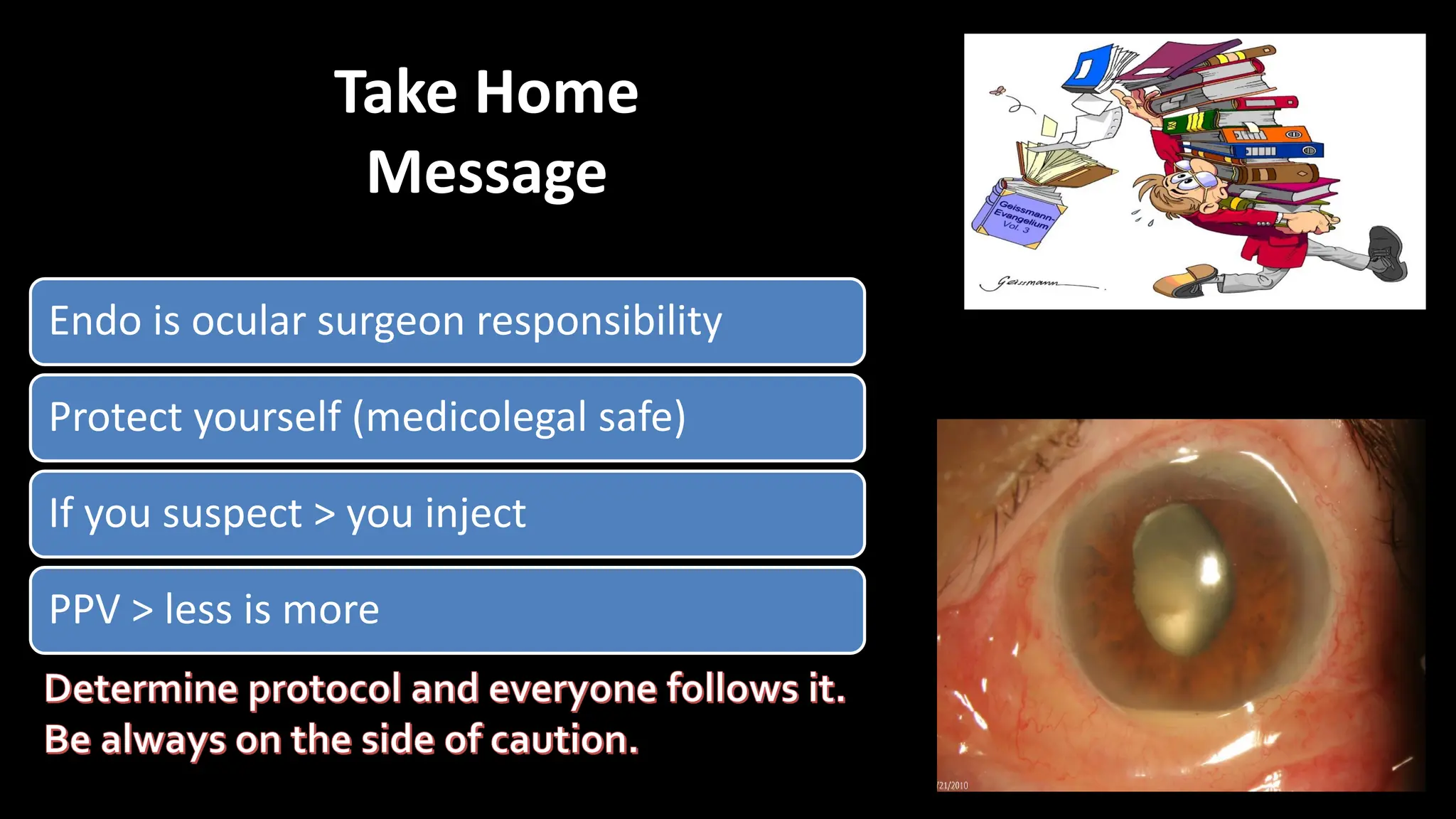
Take Home
Message
Endo is ocular surgeon responsibility
Protect yourself (medicolegal safe)
If you suspect > you inject
PPV > less is more
Determine protocol and everyone follows it.
Be always on the side of caution.

best practice in TASS versus endophthalmitis

  • 1.
    ENDOPHTHALMITIS versus TASS MohamedELShafie MD, HMD Vitreoretinal Consultant
  • 2.
  • 3.
  • 4.
    0 1 0 2 0 3 0 3 Acute, severe, intraocular inflammationof the anterior segment after intraocular Surgery Sterile postoperative inflammatory reaction by non infectious substance enters anterior segment.
  • 5.
    5 COVID19 INCHILDREN Typically starts within 24 hours after surgery. IOL Contamination: onset of over a month Onset
  • 6.
    1 4 5 3 2 Good response totopical steroid drops Lack of bacterial or fungal growth from cultures of intraocular taps Pain or absence of pain Marked decrease in vision Photophobia Acute severe inflammatory reaction of AC within 12 - 48 hours postop Corneal edema limbus to limbus Dilated or irregular pupil Increased IOP Hypopyon Clinical picture
  • 7.
    0 1 0 2 Aetiology Contaminated BSS, Intraocularirrigating solutions, Viscoelastic agents. Intraocular medications (antibiotics in irrigation solutions or intracameral antibiotics) 0 3 0 4 Glove powder touching tips of instruments, IOL’s Reuse of single use devices Breakdown in standard sterilization practices Topical ointments 0 5
  • 8.
    01 Mild / earlycases Frequent 4-8 x per day steroid 1% prednisolone acetate or 0.1% dexamethasone 02 Moderate cases take 3-6 weeks to clear up 03 Severe cases (dense fibrin and hypopyon) oral prednisolone Treatment considerations Surgery: if inflammation persists AC washout Vitrectomy IOL removal 04
  • 10.
  • 11.
    • A Purulentinflammation of the intraocular fluids (vitreous and aqueous) due to infection • Progressive vitritis is the hallmark of any form of endophthalmitis Types: • Acute or Chronic • Develop very rapidly or slowly • Persist for long periods of time Exogenous Endogenous Occurs from “outside’ the eye • Postoperative (phaco- trab – IV) • Traumatic • Extension of Corneal ulcer Originates from sources in the body • Immunocompromised • Hematogenous spread
  • 12.
    Acute Postoperative Endophthalmitis •Infectious endophthalmitis shortly after ocular surgery (3-5 days) Symptoms Signs • 94.3% reported blurred vision • 82.1% red eye • 74% pain: 25% of patients did not have pain. • 34.5% swollen lid • Epiphora • Photophobia • 85% hypopyon: 15% of patients may not have a hypopyon. • 79% hazy media (Poor fundus visualization) • Vitreous inflammation • 26% light perception (LP) vision only
  • 13.
    70% were grampositive, coagulase-negative staphylococci (Staphyloccus epidermidis= exotoxins + biofilm)
  • 14.
    Preoperative • Bacteria frompatient’s own periocular flora. • Introduced during procedure or early post-op period. • Blepharitis • +ve regurge = NLDO • DM , Immunosuppression • TED (exophthalmos)
  • 15.
    Prevention: Intraoperative • Goodselection of cases (ECCE and SICS will never die) • Personnel • Eye should be prepped with 5% povidone-iodine. • Lashes may be draped. • Strict removal of viscoelastic • Contaminated sol. or implants • Long operation time
  • 16.
    • Upon PCRavoid fishing and excessive manipulations • Wound leak or dehiscence- especially a leaking SICS wound • Suture abscess • Vitreous incarceration in the wound • Eroding scleral sutures used to fixate IOLs
  • 17.
    Prevention: Postoperative Newer 4th generationfluoroquinolones (moxifloxacin) penetrate blood ocular barrier efficiently Patient education DD
  • 23.
    Ultrasound Evaluation if significantvitritis or media opacity prevents adequate view of fundus Dispersed vitreous opacities with vitritis Chorioretinal thickening Assess for : retinal or choroidal detachment, retained lens material Retinal or choroidal detachment are poor prognostic factors
  • 24.
  • 25.
    Suspect: Denial • Doubtbetween post-operative inflammation and endophthalmitis with severe haze in the ocular media or vitreous opacities clinically • Possibility of an infection should be given priority given the potentially rapid and devastating consequences of delayed treatment.
  • 27.
    • Results : 1.No role of systemic AB 2. Acuity at presentation is important prognostic factor for vitrectomy No role of immediate PPV for HM or better VA Immediate PPV for PL only 3. Vitreous is the best source for culture
  • 28.
    Re-consider EVS Although intravitrealvancomycin remains a standard choice for gram-positive organisms, intravitreal ceftazidime is now favored over amikacin, the drug used in the EVS, due to safety concerns about amikacin's retinal toxicity The availability of moxifloxacin with excellent intraocular penetration has led some to treat systemically in spite of the EVS findings A subgroup analysis in the EVS identified a trend suggesting that diabetic patients might benefit from vitrectomy regardless of their presenting visual acuity
  • 29.
    EVS: Intravitreal • Youhave to inject within 1 hour ( staph epidermides is doubled every 25 minutes) • Proper dosage and aseptic technique are critical: Inadequate doses can cause treatment failure Excess dose can cause toxic effects on the retina Mixing has potential for poor technique Only 1 from 8 needed re injection
  • 30.
    Intravitreal corticosteroids IV (dexamethasone)is controversial Modulate the host inflammatory response to the infection and minimize ocular damage from this response. Avoid when fungal infection is suspected.
  • 31.
    Re-inject 36-48 hours •A minority of patients will require further treatment. • In many cases, eyes look somewhat worse 1 day after treatment before improving subsequently. • It requires > 24 hours to observe an improvement in clinical appearance after initial treatment. • Often, 36 hours after treatment, culture are available. • Decision to reinject antibiotics should not be taken lightly, since repeat injection may increase risk of retinal toxicity • 100% retinal toxicity rates with 3 IVI doses of 1mg vanco combined with 400 μg amikacin or 200 μg gentamicin. Vision Pain AC reaction RR : vitreous haze
  • 32.
    PPV 24-48 not improvingafter IVI Cornea Vitrectomy is done when the vitreous is gone Proportional to vision
  • 33.
    EVS: PPV • Breakequal end of the game • PVD • Periphery • SO is bacteriostatic Conclusions: Silicone oil reduces the risk of postoperative retinal detachment, especially in case of undetected retinal breaks, produces compartmentalization of the eye, may lead to early visual recovery, allows laser photocoagulation, prevents severe postoperative hypotony and has antimicrobic activity due to an inhibitory effect for several species of pathogens.
  • 35.
    You have acase or cases of infection….now what? Data Collection Important: gather data one at a time 1. Patients 2. Surgical Day(s) 3. Surgeons 4. Operating Room 5. Staff (scrub, circulator) 6. Instrument sets –sterilizer(s) 7. Instrument cleaning products (have they changed? new?) 8. Sterile processing staff 9. Interview staff. Explain the process for cleaning instruments
  • 36.
    Take Home Message Endo isocular surgeon responsibility Protect yourself (medicolegal safe) If you suspect > you inject PPV > less is more Determine protocol and everyone follows it. Be always on the side of caution.