THIRD NERVE PALSY
Prepared by:
Anis Suzanna binti Mohamad
Optometrist
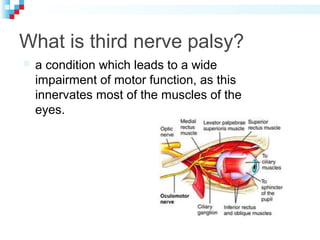
What is third nerve palsy?
 a condition which leads to a wide
impairment of motor function, as this
innervates most of the muscles of the
eyes.
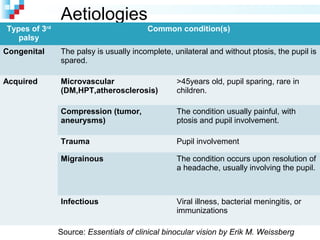
Aetiologies
Types of 3rd
palsy
Common condition(s)
Congenital The palsy is usually incomplete, unilateral and without ptosis, the pupil is
spared.
Acquired Microvascular
(DM,HPT,atherosclerosis)
>45years old, pupil sparing, rare in
children.
Compression (tumor,
aneurysms)
The condition usually painful, with
ptosis and pupil involvement.
Trauma Pupil involvement
Migrainous The condition occurs upon resolution of
a headache, usually involving the pupil.
Infectious Viral illness, bacterial meningitis, or
immunizations
Source: Essentials of clinical binocular vision by Erik M. Weissberg
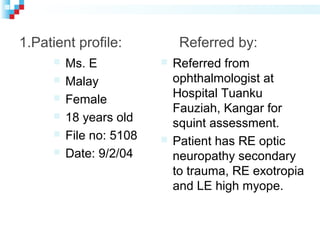
1.Patient profile: Referred by:
 Ms. E
 Malay
 Female
 18 years old
 File no: 5108
 Date: 9/2/04
 Referred from
ophthalmologist at
Hospital Tuanku
Fauziah, Kangar for
squint assessment.
 Patient has RE optic
neuropathy secondary
to trauma, RE exotropia
and LE high myope.
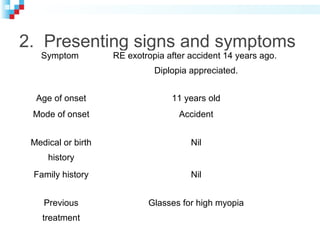
2. Presenting signs and symptoms
Symptom RE exotropia after accident 14 years ago.
Diplopia appreciated.
Age of onset 11 years old
Mode of onset Accident
Medical or birth
history
Nil
Family history Nil
Previous
treatment
Glasses for high myopia
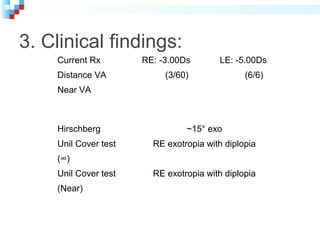
3. Clinical findings:
Current Rx
Distance VA
Near VA
RE: -3.00Ds LE: -5.00Ds
(3/60) (6/6)
Hirschberg
Unil Cover test
(∞)
Unil Cover test
(Near)
~15° exo
RE exotropia with diplopia
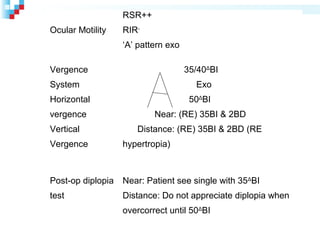
Ocular Motility
RSR++
RIR-
‘A’ pattern exo
Vergence
System
Horizontal
vergence
Vertical
Vergence
35/40Δ
BI
Exo
50Δ
BI
Near: (RE) 35BI & 2BD
Distance: (RE) 35BI & 2BD (RE
hypertropia)
Post-op diplopia
test
Near: Patient see single with 35Δ
BI
Distance: Do not appreciate diplopia when
overcorrect until 50Δ
BI
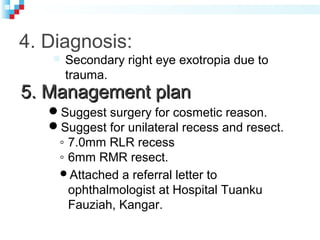
4. Diagnosis:
 Secondary right eye exotropia due to
trauma.
5. Management plan5. Management plan
Suggest surgery for cosmetic reason.
Suggest for unilateral recess and resect.
◦ 7.0mm RLR recess
◦ 6mm RMR resect.
Attached a referral letter to
ophthalmologist at Hospital Tuanku
Fauziah, Kangar.
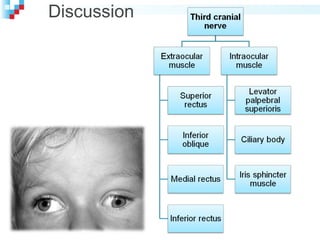
Discussion
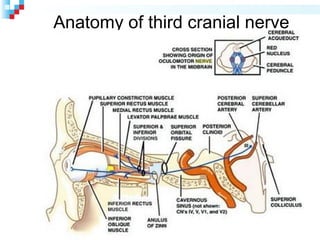
Anatomy of third cranial nerve
Anatomic Basis of Neurologic Diagnosis by Cary D. Alberstone
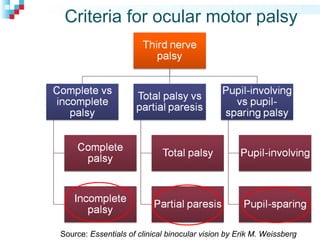
Criteria for ocular motor palsy
Source: Essentials of clinical binocular vision by Erik M. Weissberg
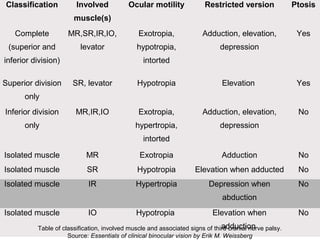
Classification Involved
muscle(s)
Ocular motility Restricted version Ptosis
Complete
(superior and
inferior division)
MR,SR,IR,IO,
levator
Exotropia,
hypotropia,
intorted
Adduction, elevation,
depression
Yes
Superior division
only
SR, levator Hypotropia Elevation Yes
Inferior division
only
MR,IR,IO Exotropia,
hypertropia,
intorted
Adduction, elevation,
depression
No
Isolated muscle MR Exotropia Adduction No
Isolated muscle SR Hypotropia Elevation when adducted No
Isolated muscle IR Hypertropia Depression when
abduction
No
Isolated muscle IO Hypotropia Elevation when
adduction
No
Table of classification, involved muscle and associated signs of third cranial nerve palsy.
Source: Essentials of clinical binocular vision by Erik M. Weissberg
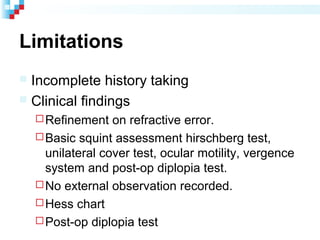
Limitations
 Incomplete history taking
 Clinical findings
Refinement on refractive error.
Basic squint assessment hirschberg test,
unilateral cover test, ocular motility, vergence
system and post-op diplopia test.
No external observation recorded.
Hess chart
Post-op diplopia test
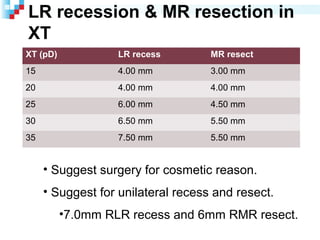
LR recession & MR resection in
XT
XT (pD) LR recess MR resect
15 4.00 mm 3.00 mm
20 4.00 mm 4.00 mm
25 6.00 mm 4.50 mm
30 6.50 mm 5.50 mm
35 7.50 mm 5.50 mm
• Suggest surgery for cosmetic reason.
• Suggest for unilateral recess and resect.
•7.0mm RLR recess and 6mm RMR resect.
References:
I. Millodot, M. 2000. Dictionary of Optometry and
Visual Science. Oxford: Butterworth-Heinemann
Ltd.
II. Erik M. 2004. Essentials of clinical binocular vision.
Elsevier: Butterworth-Heinemann Ltd.
III. Alec M. Ansons. 2001. Diagnosis and management
of ocular motility disorders.Blackwell Science Ltd.
IV. Bruce Evans, David Pickwell. 2004. Pickwell’s
binocular vision anomalies: investigation and
treatment. Elsevier: Butterworth-Heinemann Ltd.
V. Burian & von Noorden. 2000. Burian von-Noorden’s
Binocular Vision and ocular motility: theory and
management of strabismus. Elsevier: Butterworth-
Heinemann Ltd.
VI. Cary D. Alberstone. 2000. Anatomic Basis of
Case presentation: Third nerve palsy

Case presentation: Third nerve palsy

  • 1.
    THIRD NERVE PALSY Preparedby: Anis Suzanna binti Mohamad Optometrist
  • 2.
    What is thirdnerve palsy?  a condition which leads to a wide impairment of motor function, as this innervates most of the muscles of the eyes.
  • 3.
    Aetiologies Types of 3rd palsy Commoncondition(s) Congenital The palsy is usually incomplete, unilateral and without ptosis, the pupil is spared. Acquired Microvascular (DM,HPT,atherosclerosis) >45years old, pupil sparing, rare in children. Compression (tumor, aneurysms) The condition usually painful, with ptosis and pupil involvement. Trauma Pupil involvement Migrainous The condition occurs upon resolution of a headache, usually involving the pupil. Infectious Viral illness, bacterial meningitis, or immunizations Source: Essentials of clinical binocular vision by Erik M. Weissberg
  • 4.
    1.Patient profile: Referredby:  Ms. E  Malay  Female  18 years old  File no: 5108  Date: 9/2/04  Referred from ophthalmologist at Hospital Tuanku Fauziah, Kangar for squint assessment.  Patient has RE optic neuropathy secondary to trauma, RE exotropia and LE high myope.
  • 5.
    2. Presenting signsand symptoms Symptom RE exotropia after accident 14 years ago. Diplopia appreciated. Age of onset 11 years old Mode of onset Accident Medical or birth history Nil Family history Nil Previous treatment Glasses for high myopia
  • 6.
    3. Clinical findings: CurrentRx Distance VA Near VA RE: -3.00Ds LE: -5.00Ds (3/60) (6/6) Hirschberg Unil Cover test (∞) Unil Cover test (Near) ~15° exo RE exotropia with diplopia RE exotropia with diplopia
  • 7.
    Ocular Motility RSR++ RIR- ‘A’ patternexo Vergence System Horizontal vergence Vertical Vergence 35/40Δ BI Exo 50Δ BI Near: (RE) 35BI & 2BD Distance: (RE) 35BI & 2BD (RE hypertropia) Post-op diplopia test Near: Patient see single with 35Δ BI Distance: Do not appreciate diplopia when overcorrect until 50Δ BI
  • 8.
    4. Diagnosis:  Secondaryright eye exotropia due to trauma. 5. Management plan5. Management plan Suggest surgery for cosmetic reason. Suggest for unilateral recess and resect. ◦ 7.0mm RLR recess ◦ 6mm RMR resect. Attached a referral letter to ophthalmologist at Hospital Tuanku Fauziah, Kangar.
  • 9.
  • 10.
    Anatomy of thirdcranial nerve
  • 11.
    Anatomic Basis ofNeurologic Diagnosis by Cary D. Alberstone
  • 13.
    Criteria for ocularmotor palsy Source: Essentials of clinical binocular vision by Erik M. Weissberg
  • 14.
    Classification Involved muscle(s) Ocular motilityRestricted version Ptosis Complete (superior and inferior division) MR,SR,IR,IO, levator Exotropia, hypotropia, intorted Adduction, elevation, depression Yes Superior division only SR, levator Hypotropia Elevation Yes Inferior division only MR,IR,IO Exotropia, hypertropia, intorted Adduction, elevation, depression No Isolated muscle MR Exotropia Adduction No Isolated muscle SR Hypotropia Elevation when adducted No Isolated muscle IR Hypertropia Depression when abduction No Isolated muscle IO Hypotropia Elevation when adduction No Table of classification, involved muscle and associated signs of third cranial nerve palsy. Source: Essentials of clinical binocular vision by Erik M. Weissberg
  • 15.
    Limitations  Incomplete historytaking  Clinical findings Refinement on refractive error. Basic squint assessment hirschberg test, unilateral cover test, ocular motility, vergence system and post-op diplopia test. No external observation recorded. Hess chart Post-op diplopia test
  • 16.
    LR recession &MR resection in XT XT (pD) LR recess MR resect 15 4.00 mm 3.00 mm 20 4.00 mm 4.00 mm 25 6.00 mm 4.50 mm 30 6.50 mm 5.50 mm 35 7.50 mm 5.50 mm • Suggest surgery for cosmetic reason. • Suggest for unilateral recess and resect. •7.0mm RLR recess and 6mm RMR resect.
  • 17.
    References: I. Millodot, M.2000. Dictionary of Optometry and Visual Science. Oxford: Butterworth-Heinemann Ltd. II. Erik M. 2004. Essentials of clinical binocular vision. Elsevier: Butterworth-Heinemann Ltd. III. Alec M. Ansons. 2001. Diagnosis and management of ocular motility disorders.Blackwell Science Ltd. IV. Bruce Evans, David Pickwell. 2004. Pickwell’s binocular vision anomalies: investigation and treatment. Elsevier: Butterworth-Heinemann Ltd. V. Burian & von Noorden. 2000. Burian von-Noorden’s Binocular Vision and ocular motility: theory and management of strabismus. Elsevier: Butterworth- Heinemann Ltd. VI. Cary D. Alberstone. 2000. Anatomic Basis of

Editor's Notes

  • #3 Innervates:- MR,LEVATOR, SR,CILIARY MUSCLES, SPHINCTER OF PUPIL, IR,IO
  • #5 The superior rectus and inferior oblique muscles are responsible for upward vertical movements. The superior rectus acts in all fields of gaze and the inferior oblique on medial gaze. The inferior rectus and superior oblique muscles are responsible for downward vertical movement. The inferior rectus acts in all fields of gaze, and the superior oblique on medial gaze. The lateral rectus is responsible for abduction. The medial rectus is responsible for adduction. The superior oblique is responsible for intorsion. The inferior oblique is responsible for extorsion.
  • #10 The origin of third cranial nerve nuclear is in midline of the superior colliculus in midbrain. Third nerve is innervating two types of muscle of the eye which are extraocular muscles and also intraocular muscles. Third nerve which originates from Edinger-Westphal nuclear consists of parasympathetic neurons that functioning to constrict the iris sphincter muscle. For the bilateral innervations of levator palpebral superioris muscle of the eyelid, it is originate from subnuclei of this nucleus. Third nerve fibers run in the nucleus in cerebral aqueduct to red nucleus and reach cerebral peduncle. From here, third nerves run through subarchnoid space between superior cerebellar artery and posterior cerebellar artery. After that, third nerve will enter lateral wall of the cavernous sinus and then divided them into two division which are superior division and inferior division. For the superior division, it includes innervations of superior rectus and levator palpebrae superioris muscles. For the inferior division, it includes innervations of inferior rectus, inferior oblique, medial rectus and also parasympathetic fibres which contribute to the pupillary constriction and also accommodation of the crystalline lens.
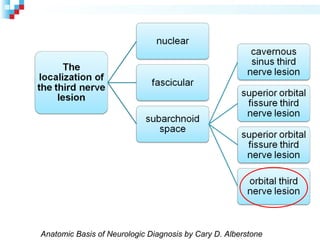
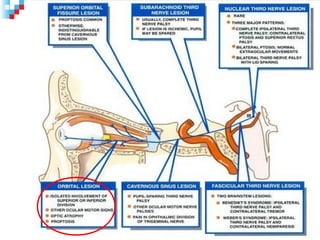
  • #13 the localization of the third nerve lesion can be based on the region of the third nerve pathway. Three major region of possible third nerve lesion are on nuclear, fascicular and also subarchnoid space. The subarchnoid lesion includes cavernous sinus third nerve lesion, superior orbital fissure third nerve lesion and also orbital third nerve lesion. For this case, patient has orbital third nerve lesion due to trauma that she had before.
  • #14 ocular motor palsy can be classified based on (1) complete or incomplete palsy. Complete palsy is a condition involves both superior division and inferior division of the nerve. Incomplete division is a condition involves superior division, inferior division or an isolated muscle. Ocular motor palsy also can be classified based on (2) total palsy or partial paresis. Total palsy is full restriction of extraocular muscle in present. Whereas partial paresis is restriction of extraocular is limited. Ocular motor palsy also futher classified using (3) pupil involvement either pupil involving or pupil sparing. Pupil involving can be detected when pupil is dilated and associated with accommodation insufficiency. For pupil sparing, pupil is not dilated and accommodative function is normal.
  • #15 For this case, the sign and symptoms and also clinical finding are quite confusing to classify this case ether inferior division of third nerve palsy or isolated inferior rectus palsy. However, this case is quite similar and prone to the diagnosis of isolated inferior rectus. It is due to the ocular posture that patient have such as hypertropic, possibly slightly exotropic and the A pattern has be seen. Examiner did not mention about decompensatory of head posture hence no record for head tilt of and face turn for this patient. This table below shown that patient had classified into isolated inferior rectus palsy according to the involve muscle, ocular motility, restricted version and also presence of ptosis.