Mohamed Ahmed ELShafie
Lecturer of ophthalmology
Harvard Medical School Almuni
Director of Training Unit
01069201269
Trying to see all retina
⚫How much
retina is there
⚫How do we
measure
⚫Factors that
Influence what
we see
⚫How do we
overcome Cornea
⚫How do we
overcome Pupil
⚫How do we
overcome
spherical shape
of Retina
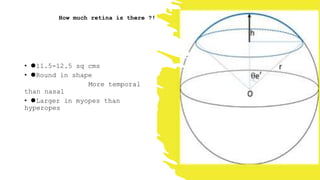
• ⚫11.5-12.5 sq cms
• ⚫Round in shape
More temporal
than nasal
• ⚫Larger in myopes than
hyperopes
How much retina is there ?!
PURPOSE OF
FUNDOSCOPIC
EXAM
⚫Examine the vitreous
⚫Examine the optic nerve
⚫Examine the macula
⚫Examine the vasculature
⚫Examine the peripheral retina
⚫Examine the choroid
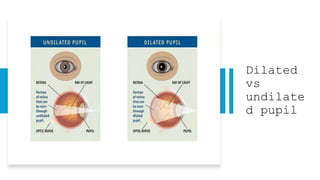
Dilated
vs
undilate
d pupil
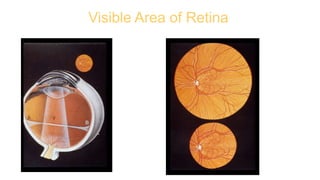
Visible Area of Retina
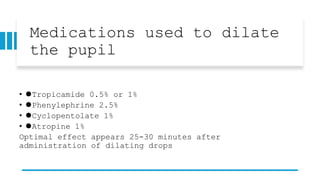
Medications used to dilate
the pupil
• ⚫Tropicamide 0.5% or 1%
• ⚫Phenylephrine 2.5%
• ⚫Cyclopentolate 1%
• ⚫Atropine 1%
Optimal effect appears 25-30 minutes after
administration of dilating drops
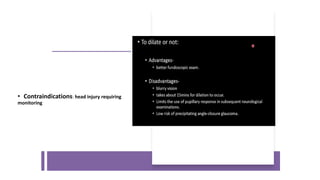
• Contraindications: head injury requiring
monitoring
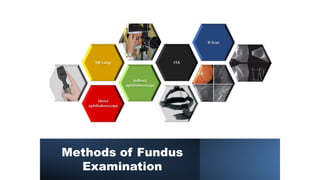
Methods of Fundus
Examination
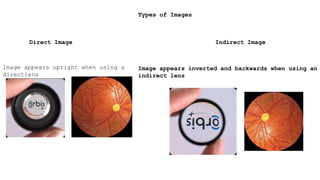
Types of Images
Direct Image
Image appears upright when using a
directlens
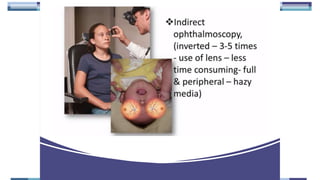
Indirect Image
Image appears inverted and backwards when using an
indirect lens
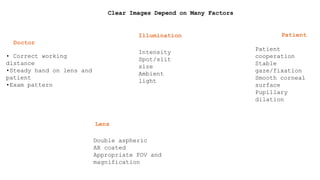
Clear Images Depend on Many Factors
Doctor
• Correct working
distance
•Steady hand on lens and
patient
•Exam pattern
Illumination
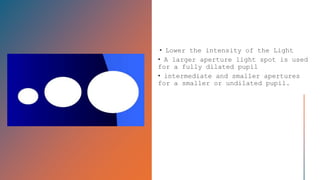
Intensity
Spot/slit
size
Ambient
light
Lens
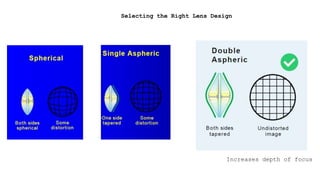
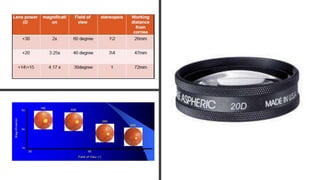
Double aspheric
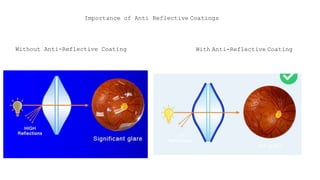
AR coated
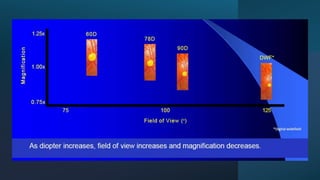
Appropriate FOV and
magnification
Patient
Patient
cooperation
Stable
gaze/fixation
Smooth corneal
surface
Pupillary
dilation
Selecting the Right Lens Design
Increases depth of focus
Importance of Anti Reflective Coatings
Without Anti-Reflective Coating With Anti-Reflective Coating
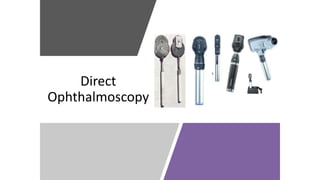
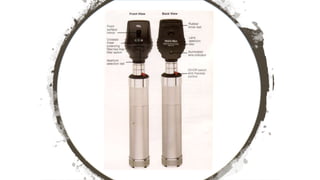
Direct
Ophthalmoscopy
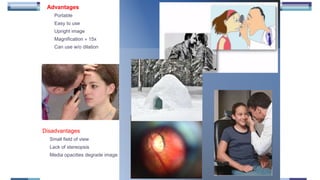
Advantages
Portable
Easy to use
Upright image
Magnification  15x
Can use w/o dilation
Disadvantages
Small field of view
Lack of stereopsis
Media opacities degrade image
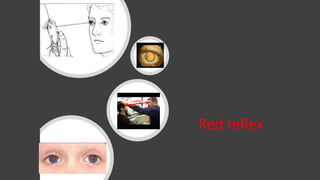
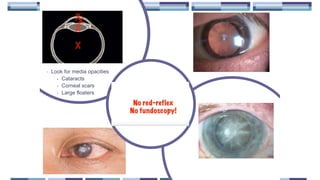
Red reflex
• Look for media opacities
• Cataracts
• Corneal scars
• Large floaters
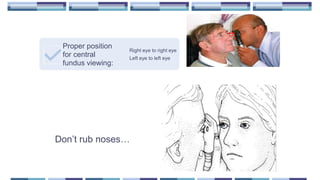
Don’t rub noses…
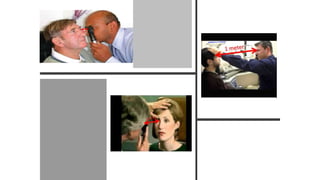
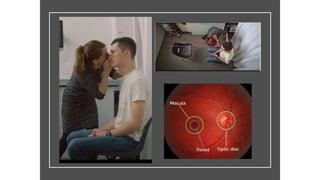
Proper position
for central
fundus viewing:
Right eye to right eye
Left eye to left eye
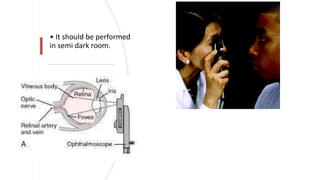
• It should be performed
in semi dark room.
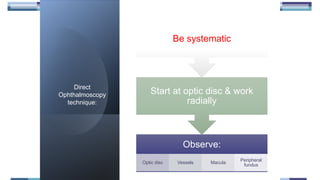
Direct
Ophthalmoscopy
technique:
Observe:
Optic disc Vessels Macula
Peripheral
fundus
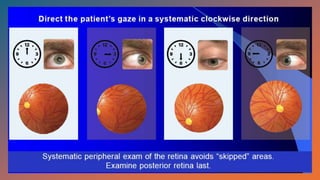
Start at optic disc & work
radially
Be systematic
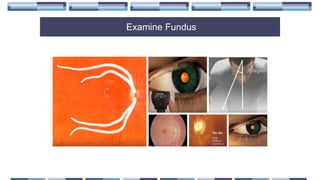
Examine Fundus
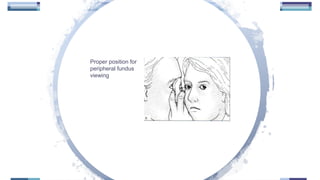
Proper position for
peripheral fundus
viewing
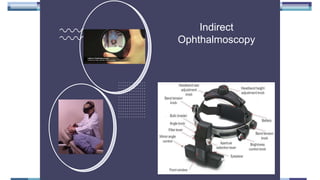
Indirect
Ophthalmoscopy
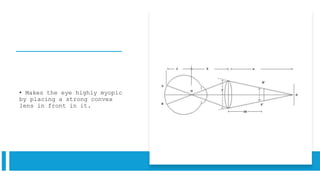
• Makes the eye highly myopic
by placing a strong convex
lens in front in it.
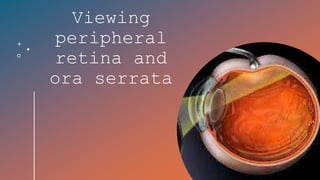
Viewing
peripheral
retina and
ora serrata
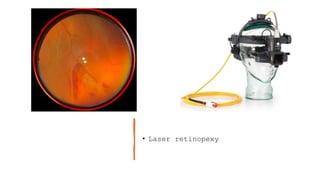
• Laser retinopexy
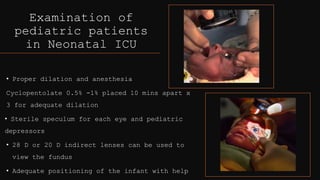
Examination of
pediatric patients
in Neonatal ICU
• Proper dilation and anesthesia
Cyclopentolate 0.5% -1% placed 10 mins apart x
3 for adequate dilation
• Sterile speculum for each eye and pediatric
depressors
• 28 D or 20 D indirect lenses can be used to
view the fundus
• Adequate positioning of the infant with help
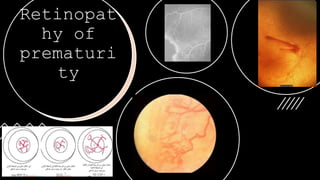
Retinopat
hy of
prematuri
ty
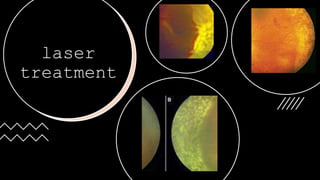
laser
treatment
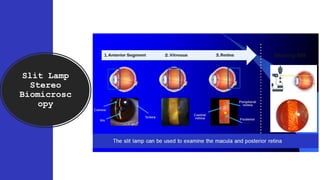
Slit Lamp
Stereo
Biomicrosc
opy
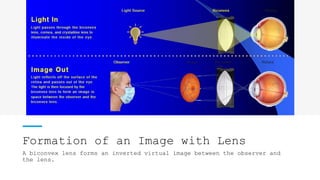
Formation of an Image with Lens
A biconvex lens forms an inverted virtual image between the observer and
the lens.
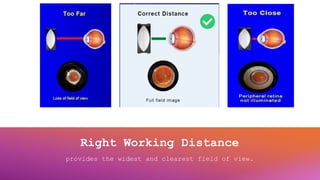
Right Working Distance
provides the widest and clearest field of view.
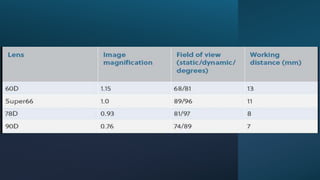
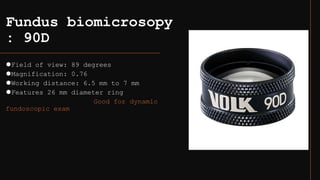
Fundus biomicrosopy
: 90D
⚫Field of view: 89 degrees
⚫Magnification: 0.76
⚫Working distance: 6.5 mm to 7 mm
⚫Features 26 mm diameter ring
Good for dynamic
fundoscopic exam
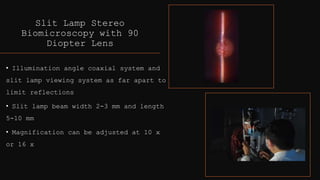
Slit Lamp Stereo
Biomicroscopy with 90
Diopter Lens
• Illumination angle coaxial system and
slit lamp viewing system as far apart to
limit reflections
• Slit lamp beam width 2-3 mm and length
5-10 mm
• Magnification can be adjusted at 10 x
or 16 x
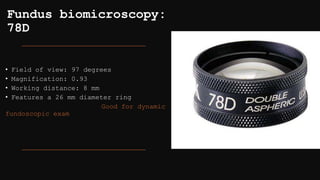
Fundus biomicroscopy:
78D
• Field of view: 97 degrees
• Magnification: 0.93
• Working distance: 8 mm
• Features a 26 mm diameter ring
Good for dynamic
fundoscopic exam
Fundus
contact
Biomicrosc
opy
⚫ Wider angle of visualization
⚫Coupling agent
⚫Stabilization of view during laser
procedures
⚫Dilated pupil
⚫3D relationship between vitreous
and Retina
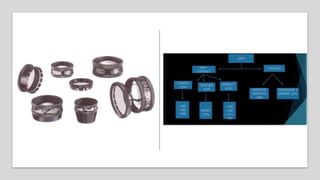
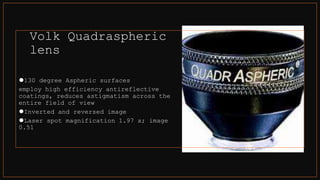
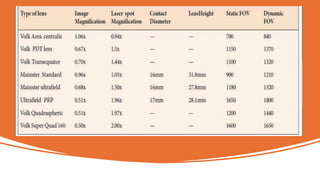
Volk Quadraspheric
lens
⚫130 degree Aspheric surfaces
employ high efficiency antireflective
coatings, reduces astigmatism across the
entire field of view
⚫Inverted and reversed image
⚫Laser spot magnification 1.97 x; image
0.51
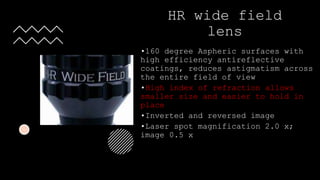
HR wide field
lens
•160 degree Aspheric surfaces with
high efficiency antireflective
coatings, reduces astigmatism across
the entire field of view
•High index of refraction allows
smaller size and easier to hold in
place
•Inverted and reversed image
•Laser spot magnification 2.0 x;
image 0.5 x
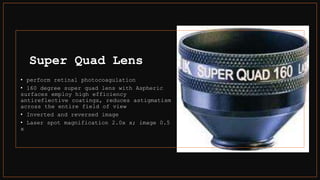
Super Quad Lens
• perform retinal photocoagulation
• 160 degree super quad lens with Aspheric
surfaces employ high efficiency
antireflective coatings, reduces astigmatism
across the entire field of view
• Inverted and reversed image
• Laser spot magnification 2.0x x; image 0.5
x
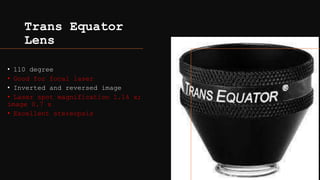
Trans Equator
Lens
• 110 degree
• Good for focal laser
• Inverted and reversed image
• Laser spot magnification 1.14 x;
image 0.7 x
• Excellent stereopsis
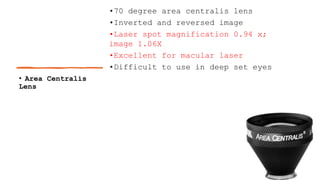
• Area Centralis
Lens
•70 degree area centralis lens
•Inverted and reversed image
•Laser spot magnification 0.94 x;
image 1.06X
•Excellent for macular laser
•Difficult to use in deep set eyes
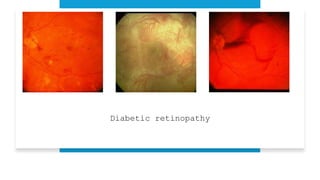
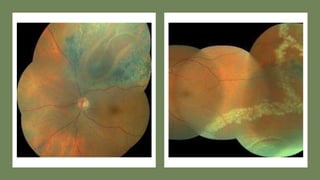
Diabetic retinopathy
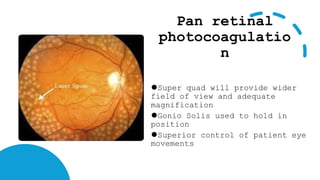
Pan retinal
photocoagulatio
n
⚫Super quad will provide wider
field of view and adequate
magnification
⚫Gonio Solis used to hold in
position
⚫Superior control of patient eye
movements
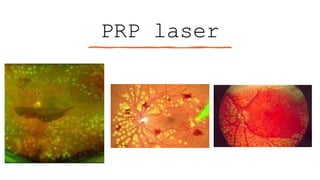
PRP laser
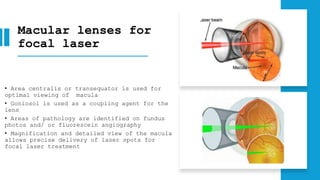
Macular lenses for
focal laser
• Area centralis or transequator is used for
optimal viewing of macula
• Goniosol is used as a coupling agent for the
lens
• Areas of pathology are identified on fundus
photos and/ or fluorescein angiography
• Magnification and detailed view of the macula
allows precise delivery of laser spots for
focal laser treatment
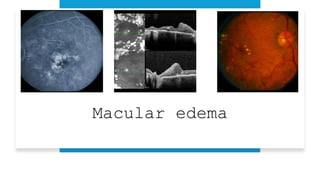
Macular edema
mastering visualization of posterior segment

mastering visualization of posterior segment