Secondary Articulation,
Lenition and Linking
Megat Syaathibiy Bin Megat Mohamed Amin
Ahmad Asjad Bin Mohd Zulkefli
Abdul Aziz Bin Ahmad
Secondary Articulation
Velarization
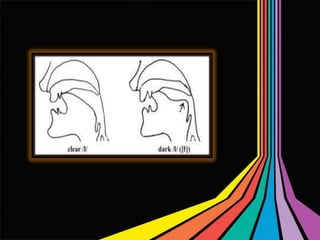
• A secondary articulation of
consonants by which the back of the
tongue is raised toward the velum
during the articulation of the
consonant.
• A common example of a velarized
consonant is the velarized alveolar
lateral approximant (or dark L).
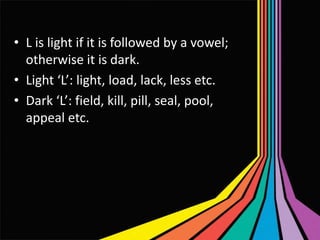
• L is light if it is followed by a vowel;
otherwise it is dark.
• Light ‘L’: light, load, lack, less etc.
• Dark ‘L’: field, kill, pill, seal, pool,
appeal etc.
Aspiration
• Strong puff of air upon release of a
voiceless stop.
• [p], [t], [k]
• Voiceless stops can be aspirated
ONLY in syllable initial position.
Examples:
• Pin /pʰɪn/
• People /pʰipəl/
• Tick /tʰɪk/
• Table /tʰebəl/
• Cat /kʰæt/
• Kick /kʰɪk/
Lenition
Consonant Lenition
• Diminution or decrease in :– The degree of constriction of a
consonant.
– The voicing of a voiced consonant.
– The length of time of the constriction.
Lenition (cont.)
• Example: American English – tap or
flap - / t / and / d / are realized as / ɾ
/ - (voiced alveolar tap or flap)
– Similar to a short / d /
– Saves articulatory time
Examples of Lenition
matter

[mætǝr]

[mæɾǝr]

better

[bætǝr]

[bæɾǝr]

rider

[rɑɪdǝr]

[rɑɪɾǝr]

betting

[bԑt
ɪŋ]

[bԑ
ɾɪŋ]

caddy

[kædi]

[kæɾi]

bedding

[bԑdŋ]
ɪ

[bԑ
ɾɪŋ]

setting

[sԑt
ɪŋ]

[sԑ
ɾɪŋ]

teddy

[tԑdi
]

[tԑ
ɾi]
Lenition (cont.)
• Another common type of
lenition:–Reduction of oral stops or
plosives to glottal stops
• Put it right – [pʊʔ ɪʔ ɹaɪʔ],
• that- [ðəʔ]
Lenition (cont.)
• The most extreme form of
lenition is:– Complete elision of segments
• the sixth month [ðəsɪks mʌnθ]
• Elision of consonants – cup of tea –
[kʌpəti]
Linking
Linking
• In real connected speech,
we sometimes link word
together.
• The sound changes when
words are linked together
Rules of Linking
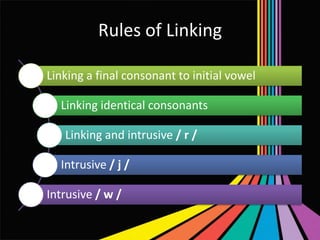
Linking a final consonant to initial vowel

Linking identical consonants
Linking and intrusive / r /
Intrusive / j /
Intrusive / w /
Rules of Linking
1. Linking a final consonant to initial
vowel.
– drink a cup of tea [driŋkǝ kʌpəti:]
– put it on [pʊtɪtɒn]

2. Linking identical consonants
–
–
–
–

bad dog [bæddɒg]
stop pushing [stɒppʊʃɪŋ]
big girl [biggɜ:l]
good deal [gʊddi:l]
Rules of Linking (cont.)
3. Linking / r / and intrusive / r /
– four eggs [fɔ:regz]
– your eyes [jɔ:raiz]
– for ever [fɔ:revə]
– media events [mi:dɪərɪvents]
– Australia and Africa [ɒstreɪlǝrǝnæftikǝ]
– Formula A [fɔ:rmjələr ei]
– The media are to blame.
Rules of Linking (cont.)
4. Intrusive / j / - when a word ending
with / i:, ɪ; aɪ; eɪ; ɔɪ /, followed by a
word beginning with a vowel
– the other [ðijʌðǝ]
– my aunt [maɪjɑ:nt]
– see us [si:j ǝs]
– I agree.
– They are here.
Rules of Linking (cont.)
5. Intrusive / w / - when a word ending
in / u:, ʊ; aʊ; əʊ /, followed by a
word beginning with a vowel
–
–
–
–

go in [gǝʊ wɪn]
two others [tu:wʌδǝz]
I want to eat
Please do it.
References
Aspects of Connected Speech. (2011). Retrieved
November 30, 2013 from
http://www.slideshare.net/vanyendao/chapte
r-8-aspect-of-connected-speech
Aspects of connected speech: Linking. (2012).
Retrieved November 30, 2013 from
http://linkingphonetics.wordpress.com/
Carr, P. (2002) English Phonetics and Phonology:
An introduction. Blackwell Publishers: Oxford.
Roach, P. (2000) English Phonetics and
Phonology: A practical course. Cambridge
University Press: Cambridge.
Q1. The following are examples of dark / l /, except
a) Seal
b) Pool
c) Load
d) Field
Q2. L is light if it is followed by a vowel, otherwise
it is dark.

TRUE / FALSE
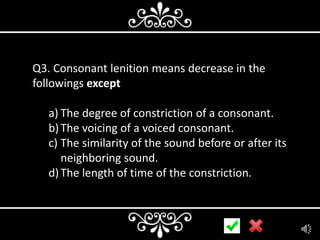
Q3. Consonant lenition means decrease in the
followings except

a) The degree of constriction of a consonant.
b) The voicing of a voiced consonant.
c) The similarity of the sound before or after its
neighboring sound.
d) The length of time of the constriction.
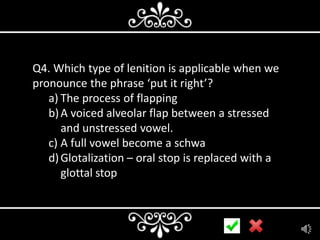
Q4. Which type of lenition is applicable when we
pronounce the phrase ‘put it right’?
a) The process of flapping
b) A voiced alveolar flap between a stressed
and unstressed vowel.
c) A full vowel become a schwa
d) Glotalization – oral stop is replaced with a
glottal stop
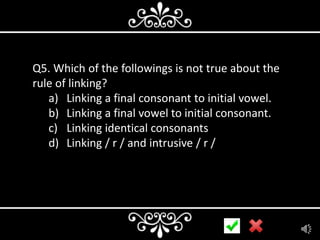
Q5. Which of the followings is not true about the
rule of linking?
a) Linking a final consonant to initial vowel.
b) Linking a final vowel to initial consonant.
c) Linking identical consonants
d) Linking / r / and intrusive / r /
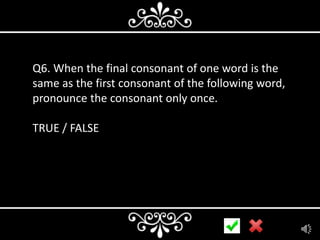
Q6. When the final consonant of one word is the
same as the first consonant of the following word,
pronounce the consonant only once.
TRUE / FALSE
Q7. For a smoother transition between the sound and to
ensure complete pronunciation of both the vowels, we
insert:i. A short / j / sound after a front vowel
ii. A short / w/ sound after a front vowel
iii. A short / w / sound after a back vowel
iv. A short / j / sound after a back vowel
a) i & ii
b) i & iii
c) ii & iv
d) ii and iv
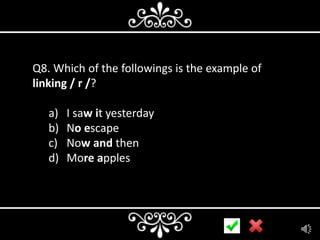
Q8. Which of the followings is the example of
linking / r /?

a)
b)
c)
d)

I saw it yesterday
No escape
Now and then
More apples
THE END

Aspect of Connected Speech - Secondary Articulation, Lenition and Linking

  • 1.
    Secondary Articulation, Lenition andLinking Megat Syaathibiy Bin Megat Mohamed Amin Ahmad Asjad Bin Mohd Zulkefli Abdul Aziz Bin Ahmad
  • 2.
  • 3.
    Velarization • A secondaryarticulation of consonants by which the back of the tongue is raised toward the velum during the articulation of the consonant. • A common example of a velarized consonant is the velarized alveolar lateral approximant (or dark L).
  • 5.
    • L islight if it is followed by a vowel; otherwise it is dark. • Light ‘L’: light, load, lack, less etc. • Dark ‘L’: field, kill, pill, seal, pool, appeal etc.
  • 6.
    Aspiration • Strong puffof air upon release of a voiceless stop. • [p], [t], [k] • Voiceless stops can be aspirated ONLY in syllable initial position.
  • 7.
    Examples: • Pin /pʰɪn/ •People /pʰipəl/ • Tick /tʰɪk/ • Table /tʰebəl/ • Cat /kʰæt/ • Kick /kʰɪk/
  • 8.
  • 9.
    Consonant Lenition • Diminutionor decrease in :– The degree of constriction of a consonant. – The voicing of a voiced consonant. – The length of time of the constriction.
  • 10.
    Lenition (cont.) • Example:American English – tap or flap - / t / and / d / are realized as / ɾ / - (voiced alveolar tap or flap) – Similar to a short / d / – Saves articulatory time
  • 11.
  • 12.
    Lenition (cont.) • Anothercommon type of lenition:–Reduction of oral stops or plosives to glottal stops • Put it right – [pʊʔ ɪʔ ɹaɪʔ], • that- [ðəʔ]
  • 13.
    Lenition (cont.) • Themost extreme form of lenition is:– Complete elision of segments • the sixth month [ðəsɪks mʌnθ] • Elision of consonants – cup of tea – [kʌpəti]
  • 14.
  • 15.
    Linking • In realconnected speech, we sometimes link word together. • The sound changes when words are linked together
  • 16.
    Rules of Linking Linkinga final consonant to initial vowel Linking identical consonants Linking and intrusive / r / Intrusive / j / Intrusive / w /
  • 17.
    Rules of Linking 1.Linking a final consonant to initial vowel. – drink a cup of tea [driŋkǝ kʌpəti:] – put it on [pʊtɪtɒn] 2. Linking identical consonants – – – – bad dog [bæddɒg] stop pushing [stɒppʊʃɪŋ] big girl [biggɜ:l] good deal [gʊddi:l]
  • 18.
    Rules of Linking(cont.) 3. Linking / r / and intrusive / r / – four eggs [fɔ:regz] – your eyes [jɔ:raiz] – for ever [fɔ:revə] – media events [mi:dɪərɪvents] – Australia and Africa [ɒstreɪlǝrǝnæftikǝ] – Formula A [fɔ:rmjələr ei] – The media are to blame.
  • 19.
    Rules of Linking(cont.) 4. Intrusive / j / - when a word ending with / i:, ɪ; aɪ; eɪ; ɔɪ /, followed by a word beginning with a vowel – the other [ðijʌðǝ] – my aunt [maɪjɑ:nt] – see us [si:j ǝs] – I agree. – They are here.
  • 20.
    Rules of Linking(cont.) 5. Intrusive / w / - when a word ending in / u:, ʊ; aʊ; əʊ /, followed by a word beginning with a vowel – – – – go in [gǝʊ wɪn] two others [tu:wʌδǝz] I want to eat Please do it.
  • 21.
    References Aspects of ConnectedSpeech. (2011). Retrieved November 30, 2013 from http://www.slideshare.net/vanyendao/chapte r-8-aspect-of-connected-speech Aspects of connected speech: Linking. (2012). Retrieved November 30, 2013 from http://linkingphonetics.wordpress.com/ Carr, P. (2002) English Phonetics and Phonology: An introduction. Blackwell Publishers: Oxford. Roach, P. (2000) English Phonetics and Phonology: A practical course. Cambridge University Press: Cambridge.
  • 23.
    Q1. The followingare examples of dark / l /, except a) Seal b) Pool c) Load d) Field
  • 24.
    Q2. L islight if it is followed by a vowel, otherwise it is dark. TRUE / FALSE
  • 25.
    Q3. Consonant lenitionmeans decrease in the followings except a) The degree of constriction of a consonant. b) The voicing of a voiced consonant. c) The similarity of the sound before or after its neighboring sound. d) The length of time of the constriction.
  • 26.
    Q4. Which typeof lenition is applicable when we pronounce the phrase ‘put it right’? a) The process of flapping b) A voiced alveolar flap between a stressed and unstressed vowel. c) A full vowel become a schwa d) Glotalization – oral stop is replaced with a glottal stop
  • 27.
    Q5. Which ofthe followings is not true about the rule of linking? a) Linking a final consonant to initial vowel. b) Linking a final vowel to initial consonant. c) Linking identical consonants d) Linking / r / and intrusive / r /
  • 28.
    Q6. When thefinal consonant of one word is the same as the first consonant of the following word, pronounce the consonant only once. TRUE / FALSE
  • 29.
    Q7. For asmoother transition between the sound and to ensure complete pronunciation of both the vowels, we insert:i. A short / j / sound after a front vowel ii. A short / w/ sound after a front vowel iii. A short / w / sound after a back vowel iv. A short / j / sound after a back vowel a) i & ii b) i & iii c) ii & iv d) ii and iv
  • 30.
    Q8. Which ofthe followings is the example of linking / r /? a) b) c) d) I saw it yesterday No escape Now and then More apples
  • 31.