What is minimal pairs?
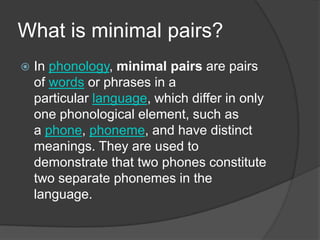
   In phonology, minimal pairs are pairs
    of words or phrases in a
    particular language, which differ in only
    one phonological element, such as
    a phone, phoneme, and have distinct
    meanings. They are used to
    demonstrate that two phones constitute
    two separate phonemes in the
    language.
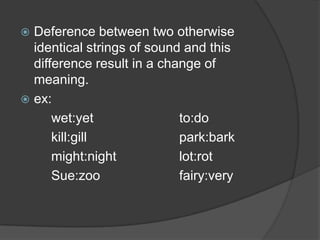
 Deference between two otherwise
  identical strings of sound and this
  difference result in a change of
  meaning.
 ex:
      wet:yet               to:do
      kill:gill             park:bark
      might:night           lot:rot
      Sue:zoo               fairy:very
Phoneme in minimal pairs
 If we substitute one segment for another
  and this result in a change in meaning
  the two segments belong to two
  difference phonemes
 Thus (k) and (m) are realization of two
  difference phonemes (k) and (m)
  because substituting one for the other
  as first element of the string (aet) gives
  two difference words . (cat) and (mat)
 Example:
 pig:big (p is opposed to b)
- /p/ is opposed to /t/ as in (pea:tea)
- /p/ is opposed to /j/ as in (peep:jeep)
- /p/ is opposed to /d/ as in (Pig:dig)
- peep:cheap
- Peat:feet
- Port:thought
- pea:we
- rip:ring
Minimal set
   A set of distinct words in a language
    which differ in only one or a limited
    number of phonological elements. If
    there are two words in the set, it is a
    minimal pair. A minimal set is used to
    demonstrate that the phonological
    element under consideration is
    phonemic—that is, that it has contrastive
    function in determining meaning.

Minimal pairs and minimal sets in Phonology

  • 2.
    What is minimalpairs?  In phonology, minimal pairs are pairs of words or phrases in a particular language, which differ in only one phonological element, such as a phone, phoneme, and have distinct meanings. They are used to demonstrate that two phones constitute two separate phonemes in the language.
  • 3.
     Deference betweentwo otherwise identical strings of sound and this difference result in a change of meaning.  ex: wet:yet to:do kill:gill park:bark might:night lot:rot Sue:zoo fairy:very
  • 5.
    Phoneme in minimalpairs  If we substitute one segment for another and this result in a change in meaning the two segments belong to two difference phonemes  Thus (k) and (m) are realization of two difference phonemes (k) and (m) because substituting one for the other as first element of the string (aet) gives two difference words . (cat) and (mat)
  • 6.
     Example:  pig:big(p is opposed to b) - /p/ is opposed to /t/ as in (pea:tea) - /p/ is opposed to /j/ as in (peep:jeep) - /p/ is opposed to /d/ as in (Pig:dig) - peep:cheap - Peat:feet - Port:thought - pea:we - rip:ring
  • 7.
    Minimal set  A set of distinct words in a language which differ in only one or a limited number of phonological elements. If there are two words in the set, it is a minimal pair. A minimal set is used to demonstrate that the phonological element under consideration is phonemic—that is, that it has contrastive function in determining meaning.