ASPECTS OF CONNECTED SPEECH RHYTHM UCSG Phonology Members :  Karen Meza   Erika Vega   B26 Professor: Lc.  Sara Rivadeneira
RHYTHM In sequences of short strings of connected speech, some words are emphasized more than other words. The reasons for this are what we might call natural sentence stress or rhythm. Rhythm is the timing patterns among syllables.          There are basically two types of sentence rhythm in languages: "stress-timed rhythm"  "syllables-timed rhythm."
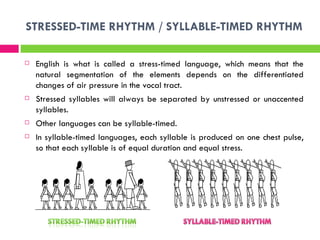
STRESSED-TIME RHYTHM / SYLLABLE-TIMED RHYTHM English is what is called a stress-timed language, which means that the natural segmentation of the elements depends on the differentiated changes of air pressure in the vocal tract. Stressed syllables will always be separated by unstressed or unaccented syllables. Other languages can be syllable-timed. In syllable-timed languages, each syllable is produced on one chest pulse, so that each syllable is of equal duration and equal stress.
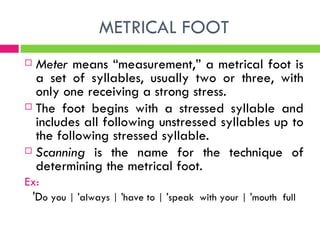
METRICAL FOOT Meter  means “measurement,” a metrical foot is a set of syllables, usually two or three, with only one receiving a strong stress.  The foot begins with a stressed syllable and includes all following unstressed syllables up to the following stressed syllable. Scanning  is the name for the technique of determining the metrical foot. Ex: 'D o you | 'always | 'have to | 'speak  with your | 'mouth  full
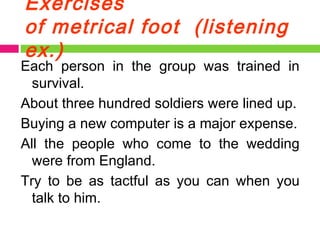
Exercises of metrical foot  (listening ex.) Each person in the group was trained in survival. About three hundred soldiers were lined up. Buying a new computer is a major expense. All the people who come to the wedding were from England.  Try to be as tactful as you can when you talk to him.
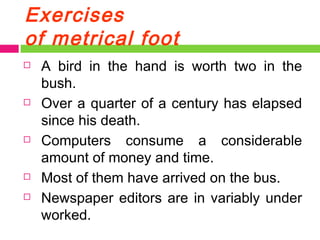
Exercises of metrical foot A bird in the hand is worth two in the bush. Over a quarter of a century has elapsed since his death. Computers consume a considerable amount of money and time. Most of them have arrived on the bus. Newspaper editors are in variably under worked.
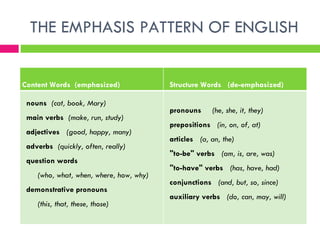
THE EMPHASIS PATTERN OF ENGLISH Content Words  (emphasized)    Structure Words   (de-emphasized)    nouns   (cat, book, Mary)        main verbs   (make, run, study)       adjectives    (good, happy, many)      adverbs    (quickly, often, really)       question words           (who, what, when, where, how, why)     demonstrative pronouns            (this, that, these, those)                                                      pronouns      (he, she, it, they)      prepositions    (in, on, of, at)      articles    (a, an, the)      "to-be" verbs    (am, is, are, was)      "to-have" verbs    (has, have, had)      conjunctions    (and, but, so, since)       auxiliary verbs    (do, can, may, will)     
Metrical Phonology Definition.-  Metrical phonology is a phonological theory concerned with organizing segments into groups of relative prominence. Segments are organized into  syllables , syllables into metrical feet, feet into phonological words, and words into larger units. This organization is represented formally by metrical trees and grids.
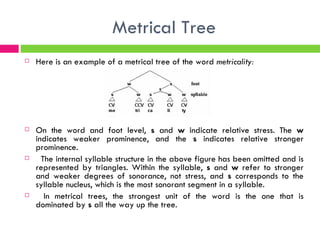
Metrical Tree Here is an example of a metrical tree of the word  metricality: On the word and foot level,  s  and  w  indicate relative stress. The  w  indicates weaker prominence, and the  s  indicates relative stronger prominence.    The internal syllable structure in the above figure has been omitted and is represented by triangles. Within the syllable,  s  and  w  refer to stronger and weaker degrees of sonorance, not stress, and  s  corresponds to the syllable nucleus, which is the most sonorant segment in a syllable.    In metrical trees, the strongest unit of the word is the one that is dominated by  s  all the way up the tree.
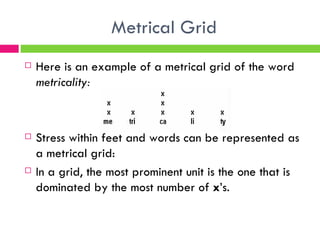
Metrical Grid Here is an example of a metrical grid of the word  metricality: Stress within feet and words can be represented as a metrical grid: In a grid, the most prominent unit is the one that is dominated by the most number of  x ’s.
Stress-shift Also called  iambic reversal . The tendency in some languages, including English, to avoid stress on adjacent syllables (called a  stress clash ) by moving one stress (usually the first) to another syllable.  The  word formation process  in which only the  audible   emphasis  of a  syllable  changes to create a new word.
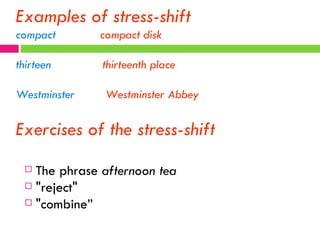
Examples of stress-shift compact  compact disk thirteen  thirteenth place Westminster  Westminster Abbey Exercises of the stress-shift The phrase  afternoon tea "reject"  "combine”

Aspects of connected speech

  • 1.
    ASPECTS OF CONNECTEDSPEECH RHYTHM UCSG Phonology Members : Karen Meza Erika Vega B26 Professor: Lc. Sara Rivadeneira
  • 2.
    RHYTHM In sequencesof short strings of connected speech, some words are emphasized more than other words. The reasons for this are what we might call natural sentence stress or rhythm. Rhythm is the timing patterns among syllables.         There are basically two types of sentence rhythm in languages: "stress-timed rhythm" "syllables-timed rhythm."
  • 3.
    STRESSED-TIME RHYTHM /SYLLABLE-TIMED RHYTHM English is what is called a stress-timed language, which means that the natural segmentation of the elements depends on the differentiated changes of air pressure in the vocal tract. Stressed syllables will always be separated by unstressed or unaccented syllables. Other languages can be syllable-timed. In syllable-timed languages, each syllable is produced on one chest pulse, so that each syllable is of equal duration and equal stress.
  • 4.
    METRICAL FOOT Meter means “measurement,” a metrical foot is a set of syllables, usually two or three, with only one receiving a strong stress. The foot begins with a stressed syllable and includes all following unstressed syllables up to the following stressed syllable. Scanning is the name for the technique of determining the metrical foot. Ex: 'D o you | 'always | 'have to | 'speak with your | 'mouth full
  • 5.
    Exercises of metricalfoot (listening ex.) Each person in the group was trained in survival. About three hundred soldiers were lined up. Buying a new computer is a major expense. All the people who come to the wedding were from England. Try to be as tactful as you can when you talk to him.
  • 6.
    Exercises of metricalfoot A bird in the hand is worth two in the bush. Over a quarter of a century has elapsed since his death. Computers consume a considerable amount of money and time. Most of them have arrived on the bus. Newspaper editors are in variably under worked.
  • 7.
    THE EMPHASIS PATTERNOF ENGLISH Content Words  (emphasized)   Structure Words   (de-emphasized)   nouns  (cat, book, Mary)        main verbs  (make, run, study)      adjectives   (good, happy, many)     adverbs   (quickly, often, really)     question words          (who, what, when, where, how, why)   demonstrative pronouns           (this, that, these, those)                                                    pronouns     (he, she, it, they)     prepositions   (in, on, of, at)     articles    (a, an, the)     "to-be" verbs    (am, is, are, was)     "to-have" verbs    (has, have, had)     conjunctions   (and, but, so, since)      auxiliary verbs   (do, can, may, will)    
  • 8.
    Metrical Phonology Definition.- Metrical phonology is a phonological theory concerned with organizing segments into groups of relative prominence. Segments are organized into syllables , syllables into metrical feet, feet into phonological words, and words into larger units. This organization is represented formally by metrical trees and grids.
  • 9.
    Metrical Tree Hereis an example of a metrical tree of the word metricality: On the word and foot level, s and w indicate relative stress. The w indicates weaker prominence, and the s indicates relative stronger prominence.   The internal syllable structure in the above figure has been omitted and is represented by triangles. Within the syllable, s and w refer to stronger and weaker degrees of sonorance, not stress, and s corresponds to the syllable nucleus, which is the most sonorant segment in a syllable.   In metrical trees, the strongest unit of the word is the one that is dominated by s all the way up the tree.
  • 10.
    Metrical Grid Hereis an example of a metrical grid of the word metricality: Stress within feet and words can be represented as a metrical grid: In a grid, the most prominent unit is the one that is dominated by the most number of x ’s.
  • 11.
    Stress-shift Also called iambic reversal . The tendency in some languages, including English, to avoid stress on adjacent syllables (called a stress clash ) by moving one stress (usually the first) to another syllable. The word formation process in which only the audible emphasis of a syllable changes to create a new word.
  • 12.
    Examples of stress-shiftcompact compact disk thirteen thirteenth place Westminster Westminster Abbey Exercises of the stress-shift The phrase afternoon tea "reject" "combine”