Can you list all of the English vowel sounds
(monophthongs and diphthongs) (with words that
contain those sounds)
LECTURE 3: VOWELS
1. Definition
2. Classification
3. Describing vowels
4. Identifying vowels
5. Diphthongs
DEFINITION
• Vowels are the sounds in the production of which none of the
articulators come very close together so the passage of air-stream
is relatively unobstructed and the air can get out freely.
• Vowels are the type of sounds that depend mainly on the
variations in the position of the tongue. They are normally
voiced.
• Vowels can be classified according to three variables:
• How high or low the tongue is
• How far front or back the tongue is
• Degree of lip rounding
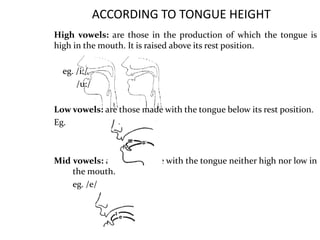
ACCORDING TO TONGUE HEIGHT
High vowels: are those in the production of which the tongue is
high in the mouth. It is raised above its rest position.
eg. /i:/
/u:/
Low vowels: are those made with the tongue below its rest position.
Eg.
Mid vowels: are those made with the tongue neither high nor low in
the mouth.
eg. /e/
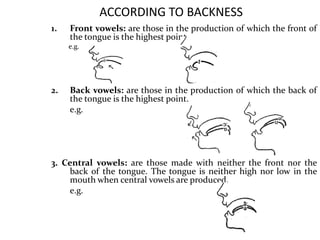
ACCORDING TO BACKNESS
1. Front vowels: are those in the production of which the front of
the tongue is the highest point.
e.g.
2. Back vowels: are those in the production of which the back of
the tongue is the highest point.
e.g.
3. Central vowels: are those made with neither the front nor the
back of the tongue. The tongue is neither high nor low in the
mouth when central vowels are produced.
e.g.
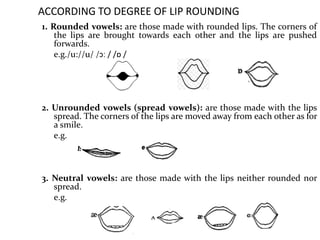
ACCORDING TO DEGREE OF LIP ROUNDING
1. Rounded vowels: are those made with rounded lips. The corners of
the lips are brought towards each other and the lips are pushed
forwards.
e.g./u://u/ /ɔː / /ɒ /
2. Unrounded vowels (spread vowels): are those made with the lips
spread. The corners of the lips are moved away from each other as for
a smile.
e.g.
3. Neutral vowels: are those made with the lips neither rounded nor
spread.
e.g.
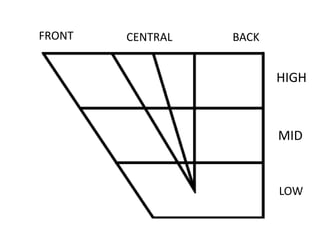
FRONT CENTRAL BACK
HIGH
MID
LOW
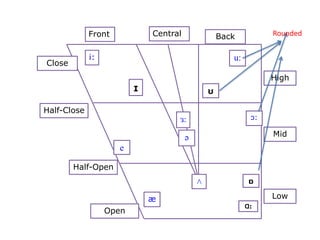
Front Central Back
Close
Half-Close
Half-Open
Open
i:
ɪ
ɜ:
ǝ
e
æ
Ɑ:
:c
ɒ
u:
ʊ
High
Mid
Low>
Rounded
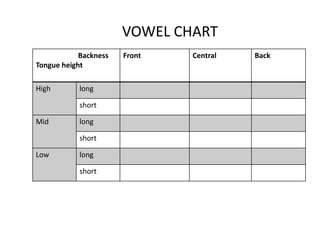
Backness
Tongue height
Front Central Back
High long
short
Mid long
short
Low long
short
VOWEL CHART
Backness
tongue height
Front Central Back
High long iː uː
short ɪ ʊ
Mid long ɜː ɔː
short e ə
Low long ɑː
short æ ʌ ɒ
VOWEL CHART
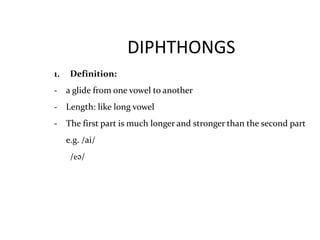
DIPHTHONGS
1. Definition:
- a glide from one vowel to another
- Length: like long vowel
- The first part is much longer and stronger than the second part
e.g. /ai/
/eә/
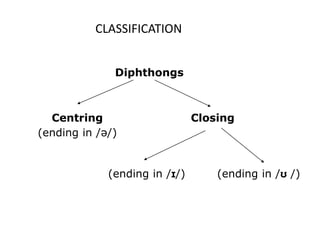
CLASSIFICATION
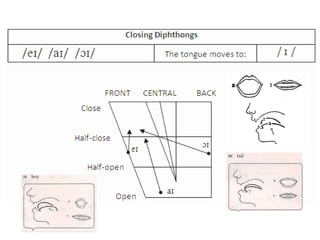
Diphthongs
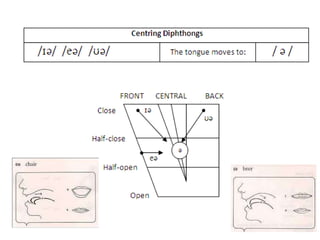
Centring
(ending in /ә/)
Closing
(ending in /ɪ/) (ending in /ʊ /)
DESCRIBING AND IDENTIFYING VOWELS
1. Describing: long/short, high/mid/low, front/central/back,
rounded/unrounded.
e.g./e/: short mid front unrounded vowel
2. Identifying
e.g. long mid central unrounded vowel: /з:/
• high front short vowel
• high back long vowel
• low back long vowel
• low back unrounded vowel
• mid back to front diphthong
• high back rounded short vowel
• low central vowel
• mid front vowel
• mid central vowel
Vowels

Vowels

  • 1.
    Can you listall of the English vowel sounds (monophthongs and diphthongs) (with words that contain those sounds)
  • 2.
    LECTURE 3: VOWELS 1.Definition 2. Classification 3. Describing vowels 4. Identifying vowels 5. Diphthongs
  • 3.
    DEFINITION • Vowels arethe sounds in the production of which none of the articulators come very close together so the passage of air-stream is relatively unobstructed and the air can get out freely. • Vowels are the type of sounds that depend mainly on the variations in the position of the tongue. They are normally voiced. • Vowels can be classified according to three variables: • How high or low the tongue is • How far front or back the tongue is • Degree of lip rounding
  • 4.
    ACCORDING TO TONGUEHEIGHT High vowels: are those in the production of which the tongue is high in the mouth. It is raised above its rest position. eg. /i:/ /u:/ Low vowels: are those made with the tongue below its rest position. Eg. Mid vowels: are those made with the tongue neither high nor low in the mouth. eg. /e/
  • 5.
    ACCORDING TO BACKNESS 1.Front vowels: are those in the production of which the front of the tongue is the highest point. e.g. 2. Back vowels: are those in the production of which the back of the tongue is the highest point. e.g. 3. Central vowels: are those made with neither the front nor the back of the tongue. The tongue is neither high nor low in the mouth when central vowels are produced. e.g.
  • 6.
    ACCORDING TO DEGREEOF LIP ROUNDING 1. Rounded vowels: are those made with rounded lips. The corners of the lips are brought towards each other and the lips are pushed forwards. e.g./u://u/ /ɔː / /ɒ / 2. Unrounded vowels (spread vowels): are those made with the lips spread. The corners of the lips are moved away from each other as for a smile. e.g. 3. Neutral vowels: are those made with the lips neither rounded nor spread. e.g.
  • 7.
  • 8.
  • 9.
    Backness Tongue height Front CentralBack High long short Mid long short Low long short VOWEL CHART
  • 10.
    Backness tongue height Front CentralBack High long iː uː short ɪ ʊ Mid long ɜː ɔː short e ə Low long ɑː short æ ʌ ɒ VOWEL CHART
  • 11.
    DIPHTHONGS 1. Definition: - aglide from one vowel to another - Length: like long vowel - The first part is much longer and stronger than the second part e.g. /ai/ /eә/
  • 12.
  • 16.
    DESCRIBING AND IDENTIFYINGVOWELS 1. Describing: long/short, high/mid/low, front/central/back, rounded/unrounded. e.g./e/: short mid front unrounded vowel 2. Identifying e.g. long mid central unrounded vowel: /з:/ • high front short vowel • high back long vowel • low back long vowel • low back unrounded vowel • mid back to front diphthong • high back rounded short vowel • low central vowel • mid front vowel • mid central vowel