











Aspects of Connected
Speech
Group members:
SANA
&
SIDRA
Aspects of Connected Speech
• Weak Forms
• Elision
• Assimilation
Assimilation
• A general term phonetics which refers to the
influence exercised by one sound segment
upon the articulation of another so that the
sound become more alike, or identical.
/t/ + /j/ = /tS/
…but use your head! /b@tSu:z j@ hed/
what you need…. /wotSuni:d/
the ball that you brought /th@bo:lth@tSu:bro:t/
last year…. /la:stSi@/
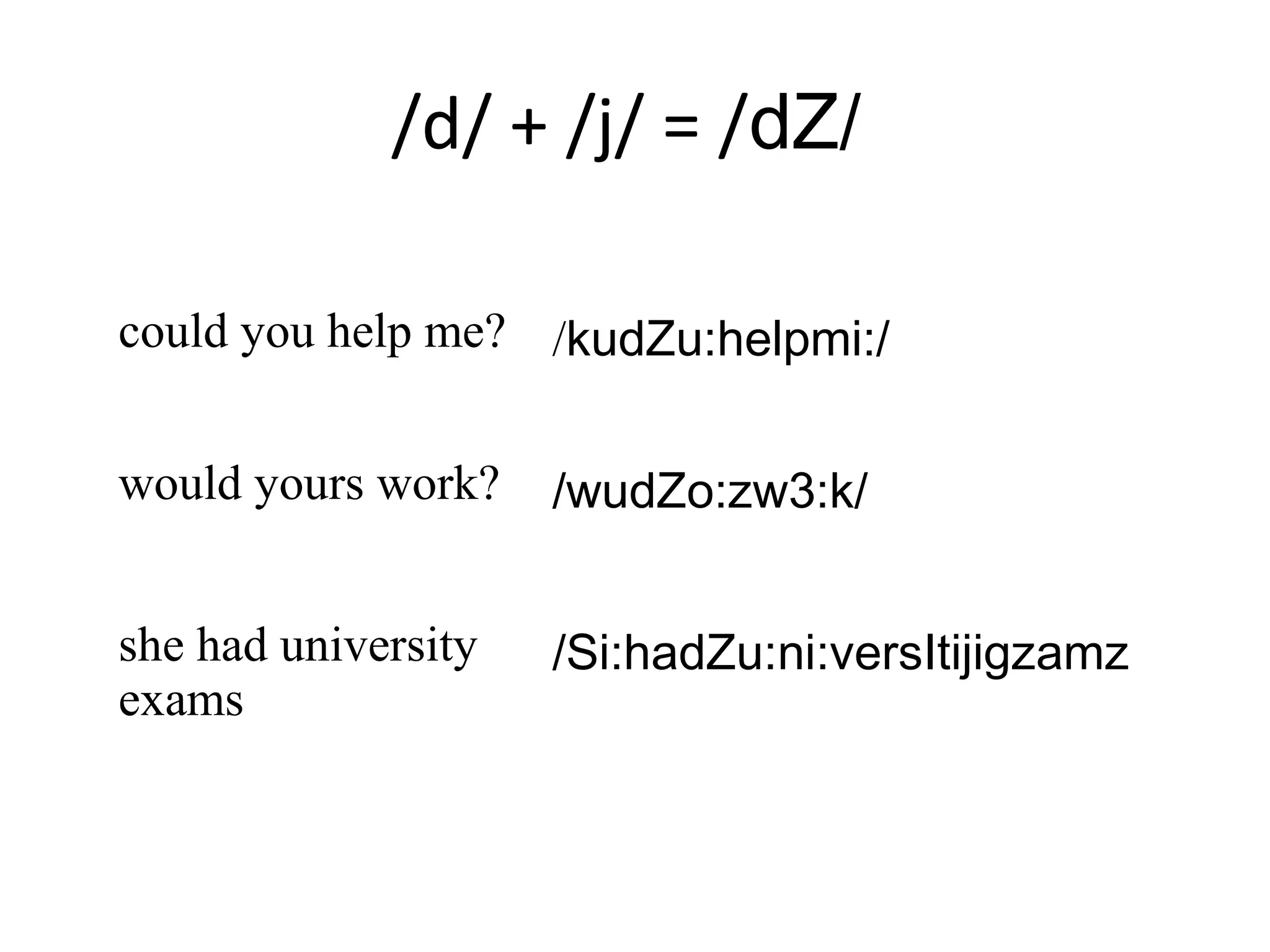
/d/ + /j/ = /dZ/
could you help me? /kudZu:helpmi:/
would yours work? /wudZo:zw3:k/
she had university
exams
/Si:hadZu:ni:versItijigzamz
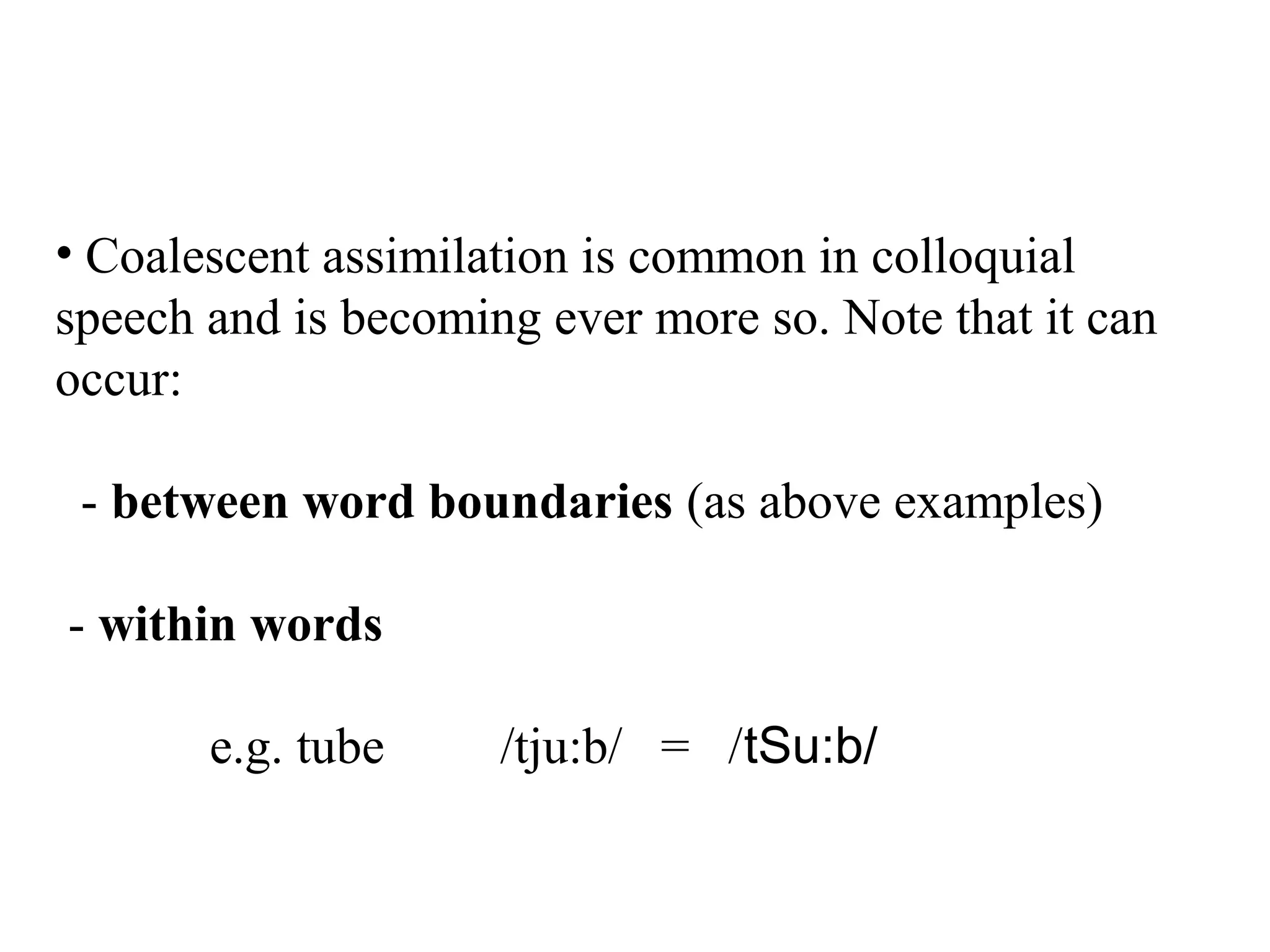
• Coalescent assimilation is common in colloquial
speech and is becoming ever more so. Note that it can
occur:
- between word boundaries (as above examples)
- within words
e.g. tube /tju:b/ = /tSu:b/
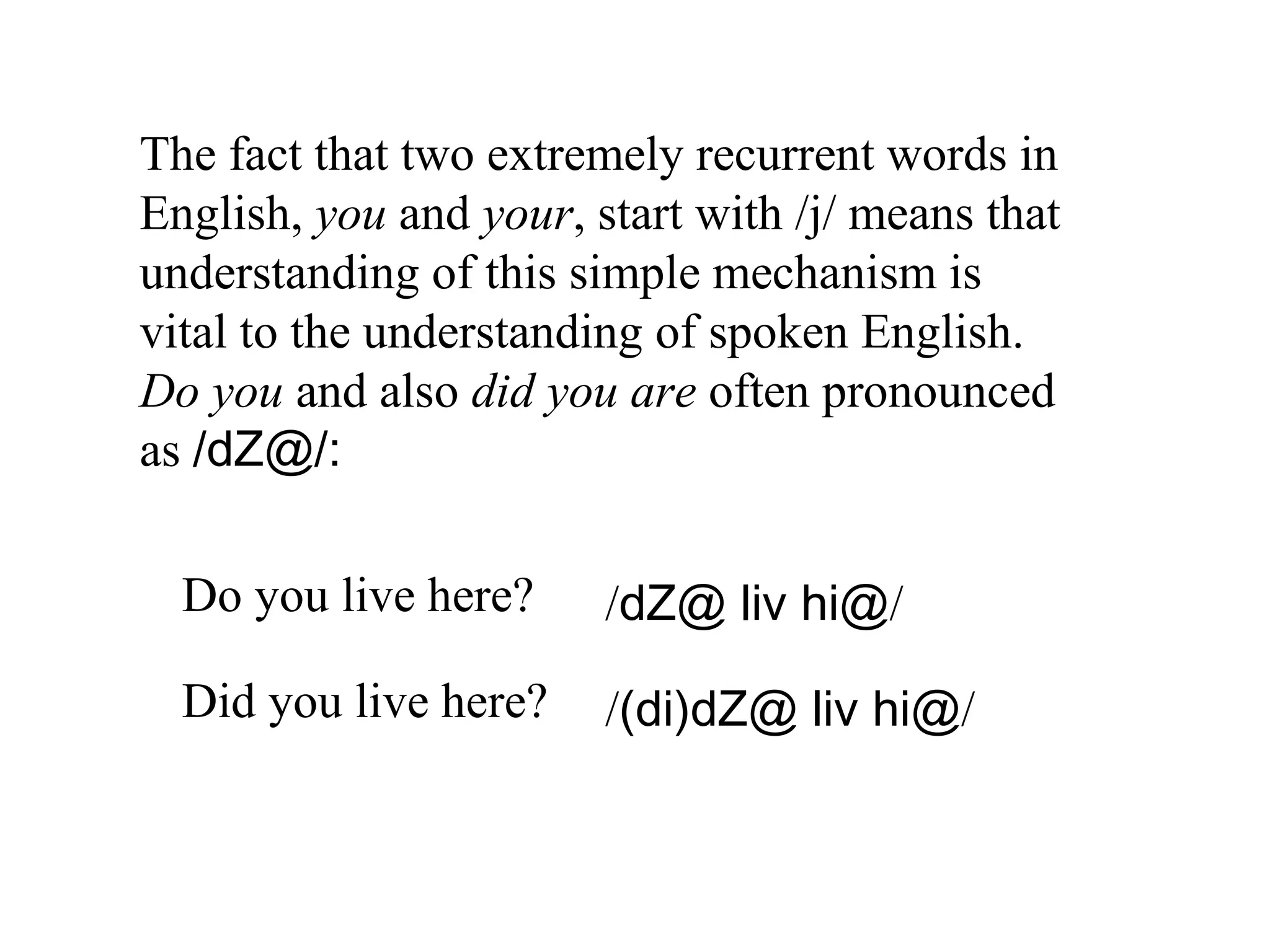
The fact that two extremely recurrent words in
English, you and your, start with /j/ means that
understanding of this simple mechanism is
vital to the understanding of spoken English.
Do you and also did you are often pronounced
as /dZ@/:
Do you live here? /dZ@ liv hi@/
Did you live here? /(di)dZ@ liv hi@/
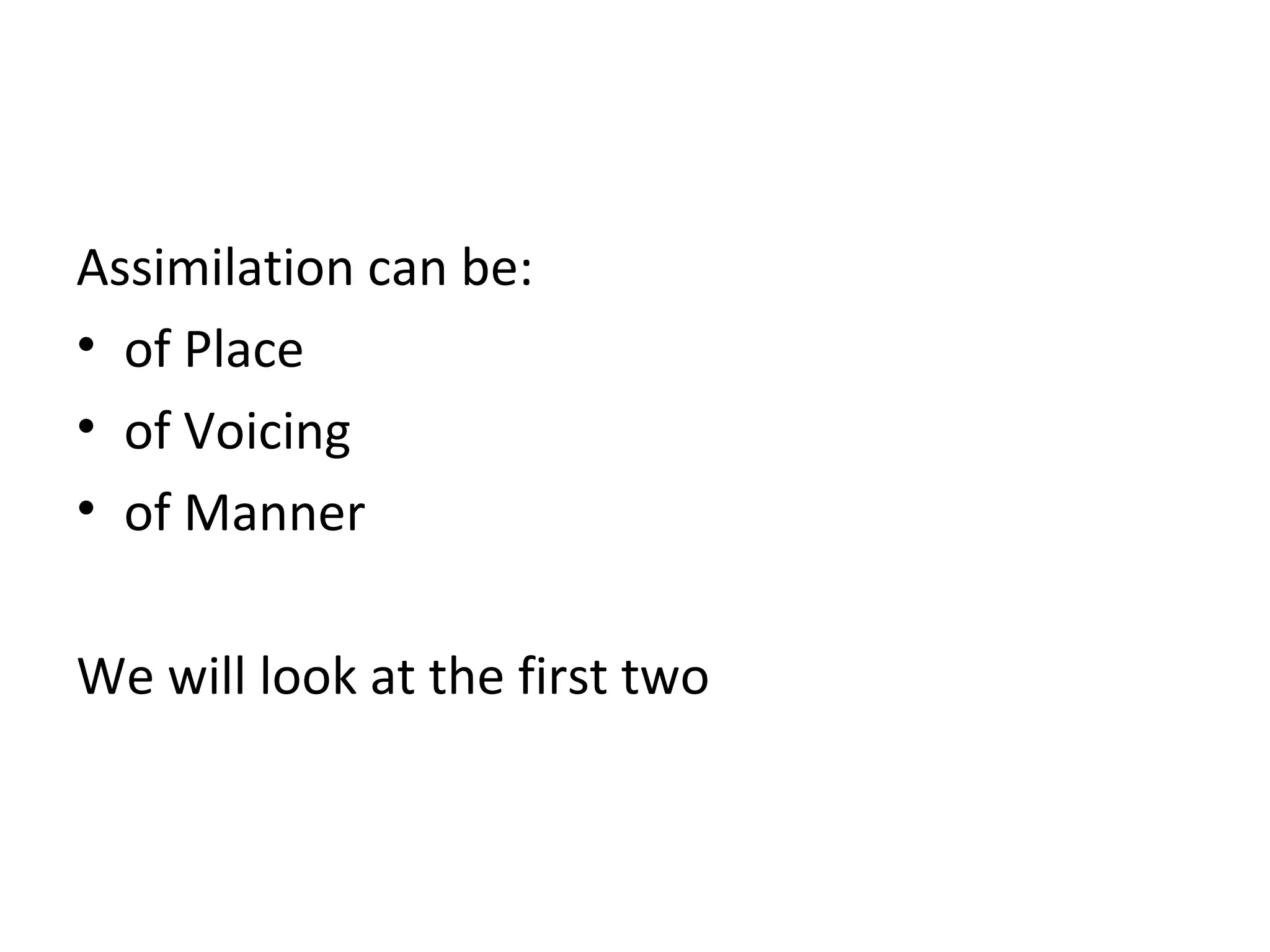
Assimilation can be:
• of Place
• of Voicing
• of Manner
We will look at the first two
Assimilation of Place
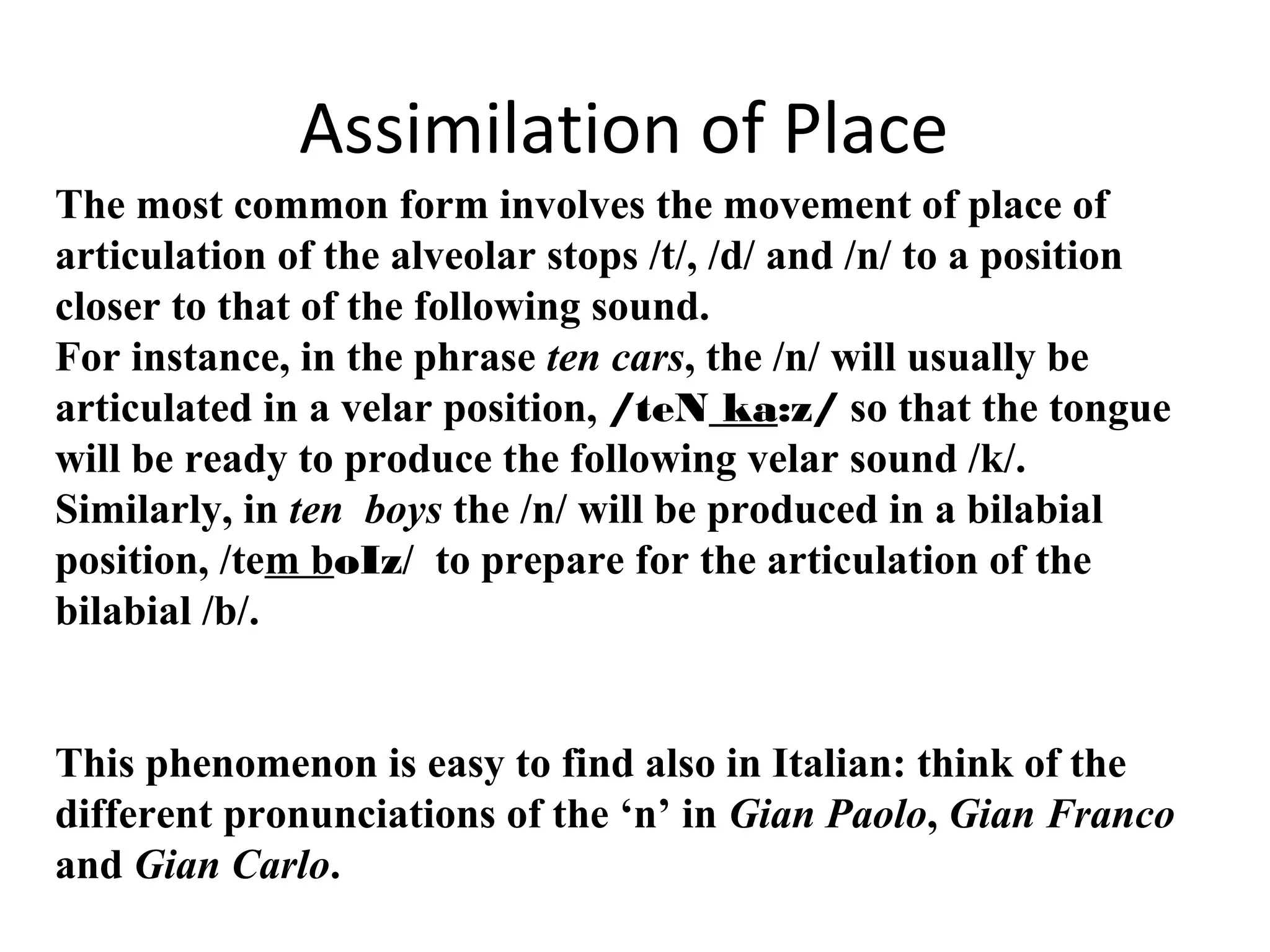
The most common form involves the movement of place of
articulation of the alveolar stops /t/, /d/ and /n/ to a position
closer to that of the following sound.
For instance, in the phrase ten cars, the /n/ will usually be
articulated in a velar position, /teN ka:z/ so that the tongue
will be ready to produce the following velar sound /k/.
Similarly, in ten boys the /n/ will be produced in a bilabial
position, /tem boIz/ to prepare for the articulation of the
bilabial /b/.
This phenomenon is easy to find also in Italian: think of the
different pronunciations of the ‘n’ in Gian Paolo, Gian Franco
and Gian Carlo.
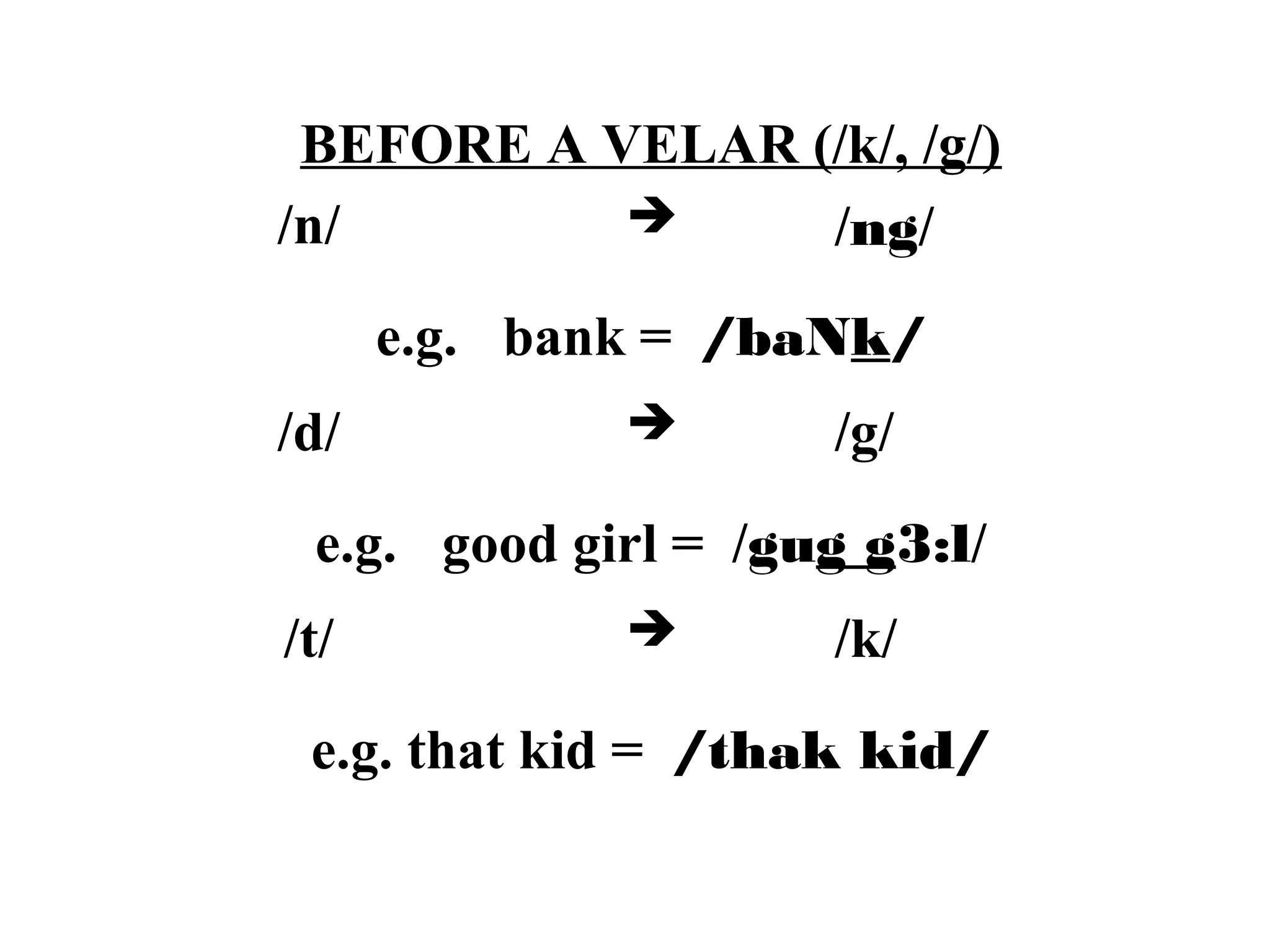
BEFORE A VELAR (/k/, /g/)
/n/  /ng/
e.g. bank = /baNk/
/d/  /g/
e.g. good girl = /gug g3:l/
/t/  /k/
e.g. that kid = /thak kid/
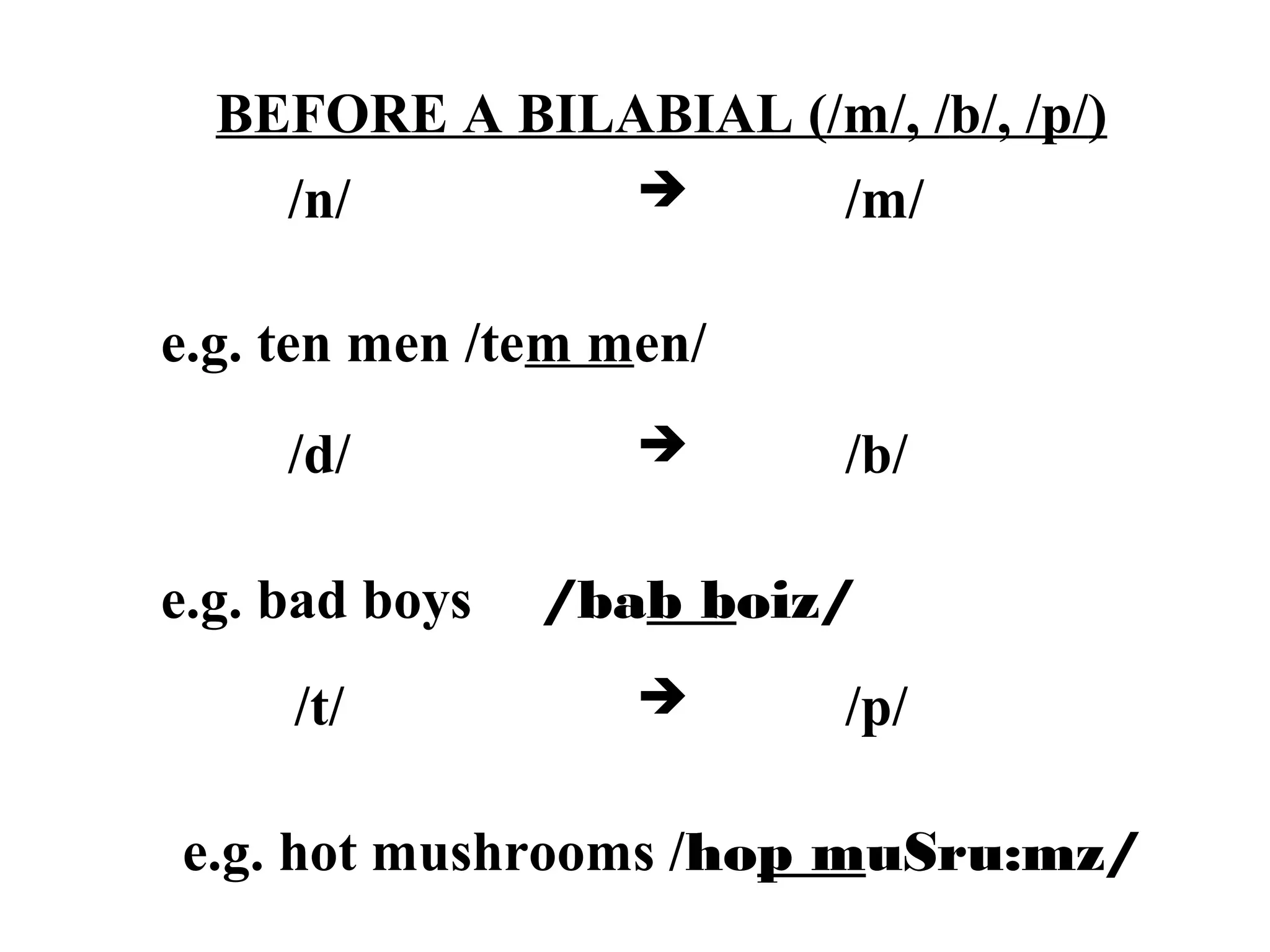
BEFORE A BILABIAL (/m/, /b/, /p/)
/n/  /m/
e.g. ten men /tem men/
/d/  /b/
e.g. bad boys /bab boiz/
/t/  /p/
e.g. hot mushrooms /hop muSru:mz/
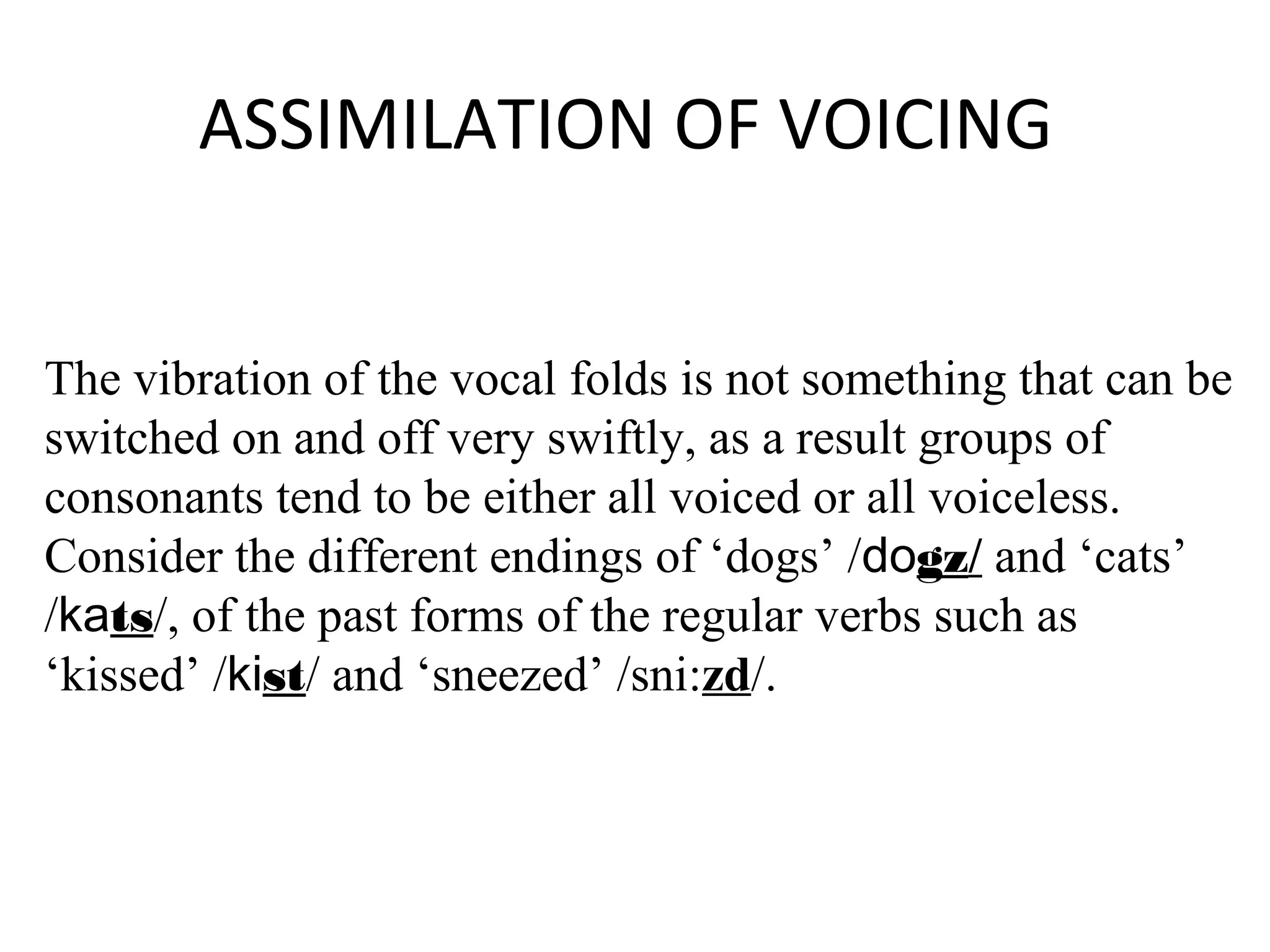
ASSIMILATION OF VOICING
The vibration of the vocal folds is not something that can be
switched on and off very swiftly, as a result groups of
consonants tend to be either all voiced or all voiceless.
Consider the different endings of ‘dogs’ /dogz/ and ‘cats’
/kats/, of the past forms of the regular verbs such as
‘kissed’ /kist/ and ‘sneezed’ /sni:zd/.
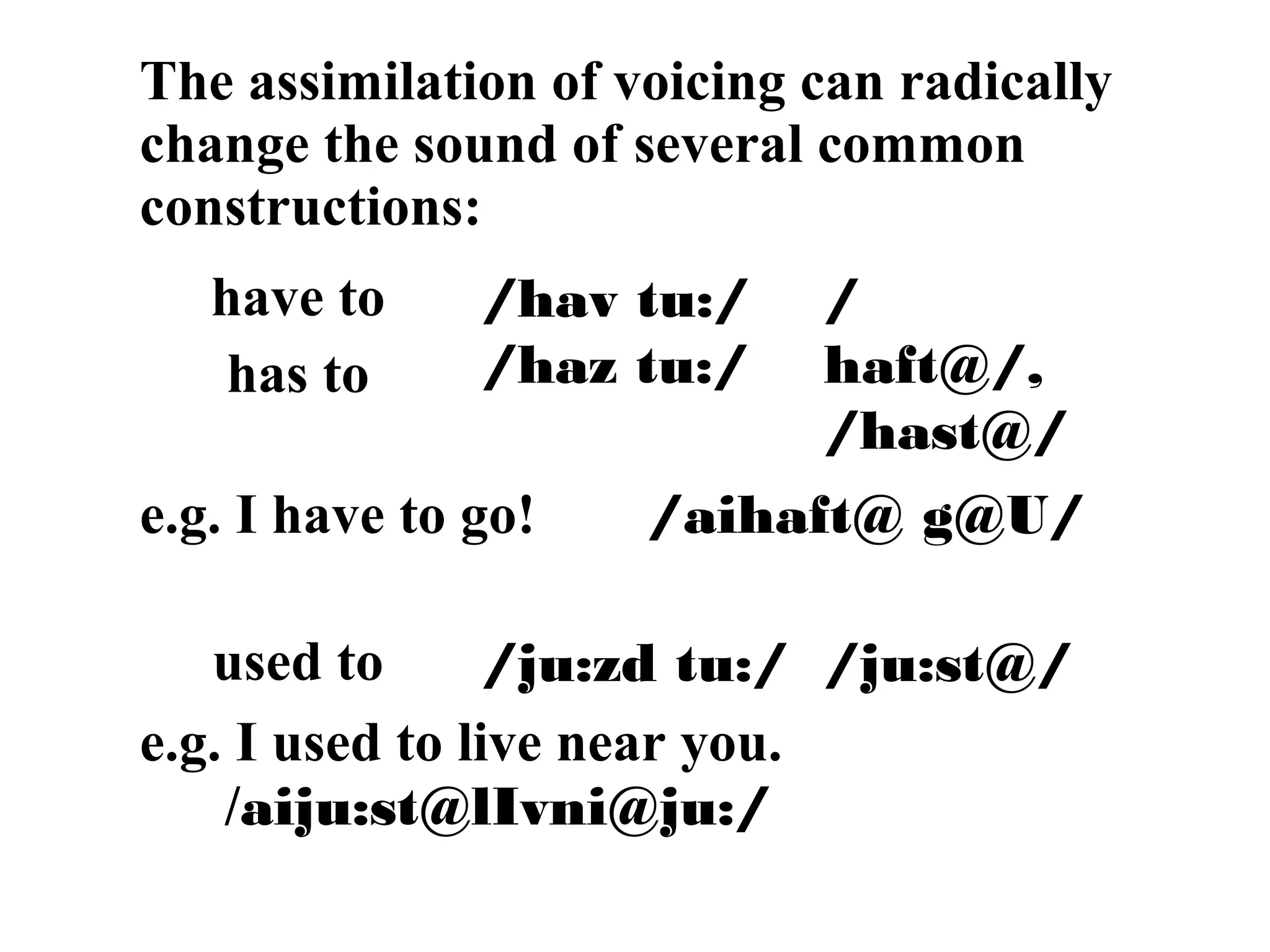
The assimilation of voicing can radically
change the sound of several common
constructions:
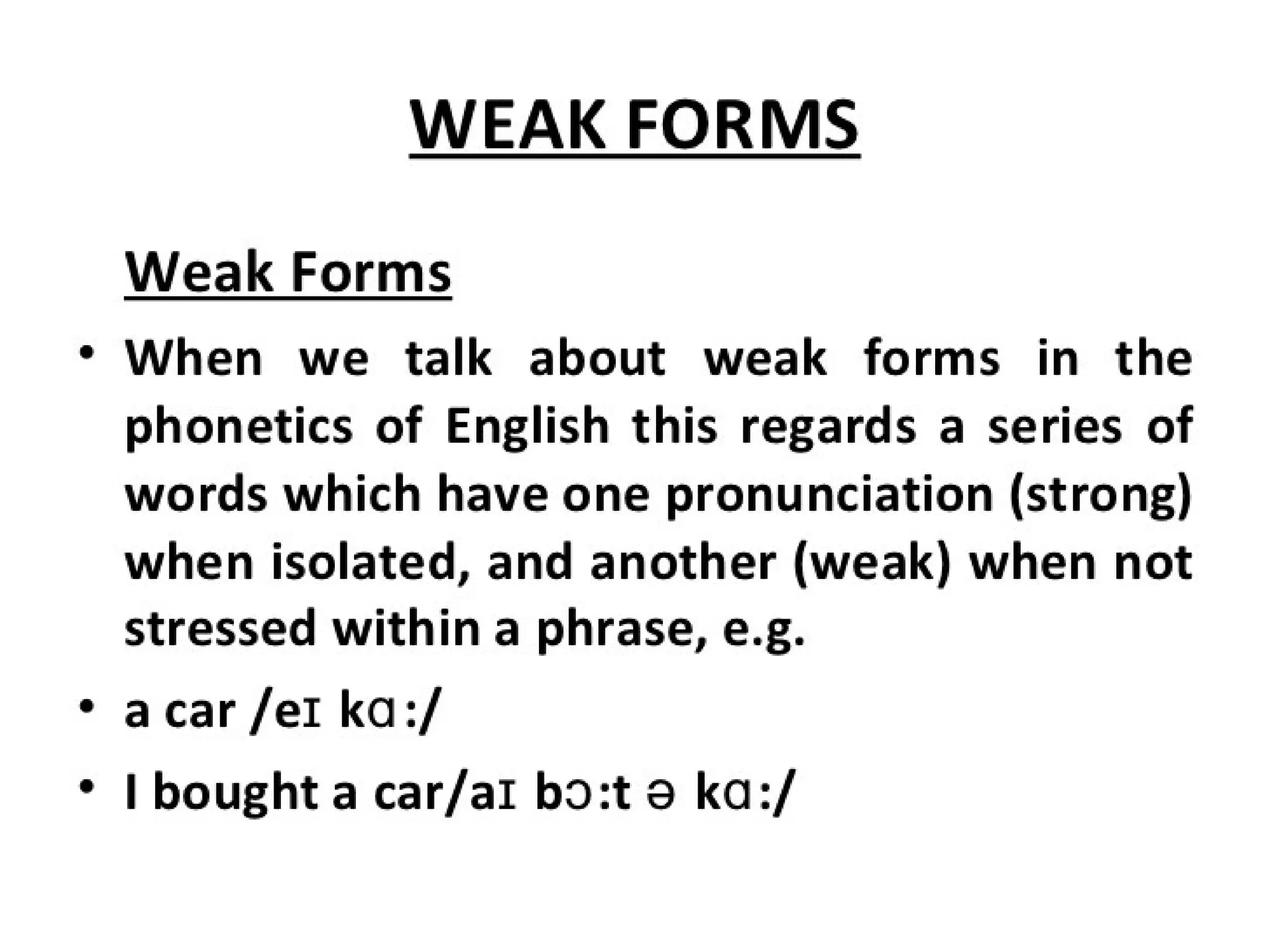
have to
has to
/hav tu:/
/haz tu:/
/
haft@/,
/hast@/
e.g. I have to go! /aihaft@ g@U/
used to /ju:zd tu:/ /ju:st@/
e.g. I used to live near you.
/aiju:st@lIvni@ju:/

aspects of connected speech

  • 1.
    Aspects of Connected Speech Groupmembers: SANA & SIDRA
  • 3.
    Aspects of ConnectedSpeech • Weak Forms • Elision • Assimilation
  • 25.
    Assimilation • A generalterm phonetics which refers to the influence exercised by one sound segment upon the articulation of another so that the sound become more alike, or identical.
  • 26.
    /t/ + /j/= /tS/ …but use your head! /b@tSu:z j@ hed/ what you need…. /wotSuni:d/ the ball that you brought /th@bo:lth@tSu:bro:t/ last year…. /la:stSi@/
  • 27.
    /d/ + /j/= /dZ/ could you help me? /kudZu:helpmi:/ would yours work? /wudZo:zw3:k/ she had university exams /Si:hadZu:ni:versItijigzamz
  • 28.
    • Coalescent assimilationis common in colloquial speech and is becoming ever more so. Note that it can occur: - between word boundaries (as above examples) - within words e.g. tube /tju:b/ = /tSu:b/
  • 29.
    The fact thattwo extremely recurrent words in English, you and your, start with /j/ means that understanding of this simple mechanism is vital to the understanding of spoken English. Do you and also did you are often pronounced as /dZ@/: Do you live here? /dZ@ liv hi@/ Did you live here? /(di)dZ@ liv hi@/
  • 30.
    Assimilation can be: •of Place • of Voicing • of Manner We will look at the first two
  • 31.
    Assimilation of Place Themost common form involves the movement of place of articulation of the alveolar stops /t/, /d/ and /n/ to a position closer to that of the following sound. For instance, in the phrase ten cars, the /n/ will usually be articulated in a velar position, /teN ka:z/ so that the tongue will be ready to produce the following velar sound /k/. Similarly, in ten boys the /n/ will be produced in a bilabial position, /tem boIz/ to prepare for the articulation of the bilabial /b/. This phenomenon is easy to find also in Italian: think of the different pronunciations of the ‘n’ in Gian Paolo, Gian Franco and Gian Carlo.
  • 32.
    BEFORE A VELAR(/k/, /g/) /n/  /ng/ e.g. bank = /baNk/ /d/  /g/ e.g. good girl = /gug g3:l/ /t/  /k/ e.g. that kid = /thak kid/
  • 33.
    BEFORE A BILABIAL(/m/, /b/, /p/) /n/  /m/ e.g. ten men /tem men/ /d/  /b/ e.g. bad boys /bab boiz/ /t/  /p/ e.g. hot mushrooms /hop muSru:mz/
  • 34.
    ASSIMILATION OF VOICING Thevibration of the vocal folds is not something that can be switched on and off very swiftly, as a result groups of consonants tend to be either all voiced or all voiceless. Consider the different endings of ‘dogs’ /dogz/ and ‘cats’ /kats/, of the past forms of the regular verbs such as ‘kissed’ /kist/ and ‘sneezed’ /sni:zd/.
  • 35.
    The assimilation ofvoicing can radically change the sound of several common constructions: have to has to /hav tu:/ /haz tu:/ / haft@/, /hast@/ e.g. I have to go! /aihaft@ g@U/ used to /ju:zd tu:/ /ju:st@/ e.g. I used to live near you. /aiju:st@lIvni@ju:/