Chapter 7/8 Fall 11
Phonemic Analysis
PHONOLOGY
(Lane 335)
What is Phonology?
It is a field of linguistics which studies the
distribution of sounds in a language as well
as the interaction between those different
sounds.
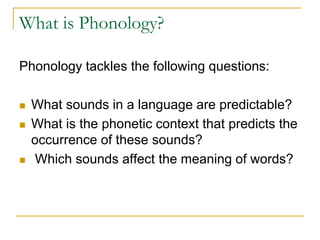
What is Phonology?
Phonology tackles the following questions:
 What sounds in a language are predictable?
 What is the phonetic context that predicts the
occurrence of these sounds?
 Which sounds affect the meaning of words?
Phonetics Vs Phonology
 Phonetics: studies how speech sounds are
produced, their physical properties & how
they are interpreted.
 Phonology: studies the organization of
speech sounds in a particular language.
Distinctive and Non-distinctive Sounds
 Distinctive (contrastive) Sounds: make a difference in
meaning; e.g. /p/ & /b/ in pin, bin.
 Non-distinctive (non-contrastive) Sounds:
Do NOT make a difference in meaning; e.g. [ph] in pin & spin.
Example:
/t/ in : top [thɒp]
stop [stɒp]
little [liɾ l]
kitten [kiʔn] (n is syllabic here)
hunter [hʌ nr]
Phoneme and Allophone
 A phoneme: a class of speech sounds that are identified
by a native speaker as the same sound; e.g. /t/;
unpredictable (given “in” in pin like the example above
we CANNOT predict which sound can come before it like
bin, tin, din, kin, gin, fin, thin, sin, shin, chin)
 A phoneme: a class of speech sounds that are identified
by a native speaker as the same sound; e.g. /t/;
phonemes are unpredictable
 A phoneme is an abstract representation & cannot be
pronounced (it is not a speech sound)
 A phone: the actual phonetic segment produced by a
speaker & has been classified as belonging to some
phoneme; e.g. [th]; predictable
 An allophone: a variant of a phoneme, e.g. /t/ = [ʔ], [ɾ]
Phoneme and Allophone
 The phonological system of a language has two levels:
1- the more concrete level which involves the physical
reality of phonetic segments, the allophones represented
by square brackets [ ] (greater number).
2- The abstract (underlying) level which involves phonemes
represented by / / slanted brackets (small inventory).
 /p/ has 3 allophones ([p], [ph], [p̚ ])
 Similar to natural sciences (H2O is realized as ice,
water, & water vapor); different realizations/forms of the
same thing.
Distribution of Speech Sounds
 The distribution of a phone = the set of phonetic
environments in which it occurs.
 Contrastive Sounds: if two sounds are separate
phonemes, they are contrastive
(interchanging the two, change the meaning of a word)
 Non-contrastive Sounds: if two phones are allophones of
the same phoneme, they are non-contrastive
(interchanging the phones, doesn’t change the meaning of
a word BUT it changes the pronunciation)
Minimal Pair : Commutative test
 A test to determine whether sounds are contrastive
or not.
 Defined as a pair of words with different meanings
which are pronounced exactly the same way except
for one sound that differs: pat, bat, fat, sat, mat
Thus /p, b, f, s, m/ are separate phonemes.
 In some languages, no minimal pairs, but we can
still establish phonemes
 Near Minimal Pair: (differ in more than one sound
but the environment of the sound is identical short i
and schwa in ‘mission’ & ‘vision’)
Kinds of Phonemic Distribution
 Overlapping Distribution: when the sets of phonetic environments
in which two sounds occur are partially or completely identical.
bait [bet] date [det]
lobe [lob] load [lod]
knobs [nabz] nods [nadz]
Two Kinds:
1- Contrastive distribution (give different meanings= belong to
different phonemes = appear in minimal pairs)
2- Free Variation (never cause a contrast in meaning = allophones
of the same phoneme = no minimal pairs)
mat mat maʔ can be released, unreleased or a glottal stop
either iðər aiðər – neither niðər, naiðər –
tomato təmætə, tometə - data dæta , deta
Kinds of Phonemic Distribution
 Complementary Distribution (mutually exclusive, non-
overlapping): when sounds DON’T occur in the same
phonetic environment
English
spat [spæt] pat [phæt]
spool [spul] pool [phul]
speak [spik] peek [phik]
 No minimal pairs for such sounds
 Phones in Complementary Distribution are allophones of
a single phoneme
 The appearance of one allophone or the other is
PREDICTABLE.
 In Thai and Korean [p] and [ph ] are separate phonemes
Phonological Rules
 Two levels of representation:
1- underlying (phonemic, mental)
2- surface (phonetic)
 Why do we need rules?
- to link the two levels
- to show when a particular allophone should
show up on the surface
Phonological Rules
PHONEMIC LEVEL
(underlying form)
PHONOLOGICAL RULES
PHONETIC LEVEL
(surface form)
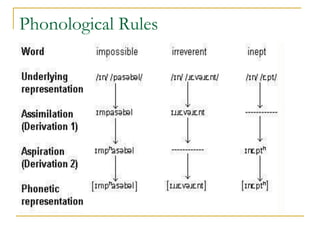
Phonological Rules
Definition
A phonological derivation is the set of stages used to
generate the phonetic representation of a word from its
underlying representation.
Discussion
Here is a diagram of the stages in a derivation.
Phonological rules influence each stage of a derivation:
Examples (English)
Here are some examples of the derivations of words
having the negative prefix /In/:
Phonological Rules
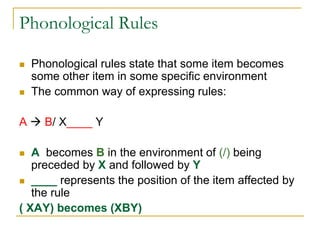
 Phonological rules state that some item becomes
some other item in some specific environment
 The common way of expressing rules:
A  B/ X____ Y
 A becomes B in the environment of (/) being
preceded by X and followed by Y
 ____ represents the position of the item affected by
the rule
( XAY) becomes (XBY)
Phonological Rules
 Example from English:
˷ ˷
 [fæn]: /æ/  /æ/ /____/n/
 A vowel is nasalized whenever it immediately
precedes a nasal stop
[+ syllabic]  [+nasal]/ __ [+nasal]
A +syllabic sound (= a vowel) becomes + nasal (= nasalized)
when it comes before a + nasal sound (= m, n, ŋ)
The above captures a generalization about all
vowels not only [æ] and all nasals not only [n].
Choosing the Underlying Form
 How do we decide on the representation at the
phonemic level?
 Phonemes and their allophones SHARE some
phonetic features
 The choice is “phonetically natural”
 Take the form which has the simplest form
Choosing the Underlying Form
 How do we decide on the representation at the
phonemic level?
 We can use an arbitrary number like 3 or Fred = harder to
read the rules
 Using /p/ tells us that the allophones associated with /p/ all
share some features like [voice, continuant, anterior,
coronal].
 /p/ is the simplest of the 3 phonetic forms with nothing
added to its ‘p-ness’ like being aspirated or being
unreleased: /pʰ/ and /p̚/
 Use the form with the widest distribution
7.13 p. 104
Form with the widest distribution:
Take the case of the devoicing of liquids and
glides following voiceless consonants
 kwit, flei, trap, pjur, swaip (all are devoiced)
 jɛs, wiʃ, bɔƗ, sk^ri, brik glas, fiƗθ, fiƗm
 If the [–voice] allophone were chosen to
represent then our rule(s) would specify
many environments thus the rule would be:
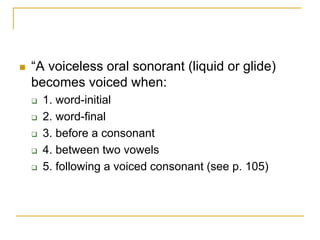
 “A voiceless oral sonorant (liquid or glide)
becomes voiced when:
 1. word-initial
 2. word-final
 3. before a consonant
 4. between two vowels
 5. following a voiced consonant (see p. 105)
 So using the voiced member of the pair i.e.
the allophone with the widest distribution is:
 Simpler
 Expresses a generalization that non-nasal
sonorants (liquids and glides) devoice following
voiceless segments
 Shows there is an assimilation process with
voicelessness spreading to the following
consonant.
Phonetic Naturalness
& Phonological Analysis
 Natural means “to be expected”, “frequently found
across languages”
 Does NOT mean “English-like”
 No words in English begin with onset clusters like
[ps], [pn], [pt].
 These clusters appear word initially in other
languages like German, Greek, & French.
Phonetic Naturalness
& Phonological Analysis (cont)
 What applies to one language is not necessarily true
of other languages.
 English /p/ has unaspirated p and aspirated p as
allophones
 Thai /p/ and /ph/ are two phonemes:
 paa ‘forest’
 ph aa ‘to split’
 English has /p/ and /b/
 Arabic has /b/ with two allophones [b] and [p]
Phonetic Similarity
 To choose the phonemic form, we have to consider
phonetic similarity.
 Example: [h] occurs syllable-initially [hæ m]
[ŋ ] occurs only syllable-finally [brɪ ŋ]
 Not allophones of the same phoneme
 They lack phonetic similarity
 [h]: non-nasal, obstruent, continuant
 [ŋ] nasal, sonorant, non-continuant
Pattern Congruity
 Phonologists consider the consequences of choosing
one phoneme over the other
 Pattern Congruity: the systematic organization of the set
of phonemes and their distribution.
 Choosing an allophone depends on the overall patterns
found in the phonological system (pattern congruity)
 For example:
In English: obstruent clusters have uniform voicing
Either all members of the cluster are [+ voice], or [- voice].
‘Mixed voice clusters’ DON’T occur phonemically
Pattern Congruity
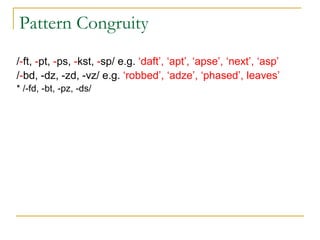
/-ft, -pt, -ps, -kst, -sp/ e.g. ‘daft’, ‘apt’, ‘apse’, ‘next’, ‘asp’
/-bd, -dz, -zd, -vz/ e.g. ‘robbed’, ‘adze’, ‘phased’, leaves’
* /-fd, -bt, -pz, -ds/
Process Naturalness
 In choosing the underlying form, the linking processes
should be considered
 pass [ph æs] pass you [ph æʃ ju]
 this [ðɪs] this year [ðɪʃjiə ]
 [s] appears in more environments so it makes sense to
choose it as the underlying form instead of vice versa
 Assimilation:
[s] alveolar [+coronal, +anterior] becomes
[ʃ] palato-alveolar [+coronal, - anterior] when followed by
[j] palatal [+ coronal, - anterior]
Phonology
 Phonology is concerned with the organization
of the system underlying the speech sounds
 The phonemic level represents native
speakers’ knowledge of the sound system of
their language
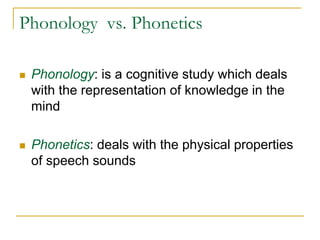
Phonology vs. Phonetics
 Phonology: is a cognitive study which deals
with the representation of knowledge in the
mind
 Phonetics: deals with the physical properties
of speech sounds
Chapter 7 Exercises
Exercise 1 page 110/130
Consider the distribution of [w] and [ʍ] in the following data.
Are the phones allophones of the same or different phonemes?
Why? If they are allophones of a single phoneme, give a rule to
account for the distribution.
a. ʍa’e why h. we way
b. ʍɪʧ which i. weð^r weather
c. ʍ^ɪt white j. wɔnt want
d. ʍeƗz whales k.wɪʧ witch
e. ʍɪp whip l. ʍ^ɪp wipe
f. əʍ^ɪl awhile m. weƗz Wales
g. ʍɛð^r whether n. əʍɔʃ awash
Chapter 7 Exercises
a. ʍa’e why h. we way
b. ʍɪʧ which i. weð^r weather
c. ʍ^ɪt white j. wɔnt want
d. ʍeƗz whales k. wɪʧ witch
e. ʍɪp whip l. ʍ^ɪp wipe
f. əʍ^ɪl awhile m. weƗz Wales
g. ʍɛð^r whether n. əʍɔʃ awash
Chapter 7 Exercises
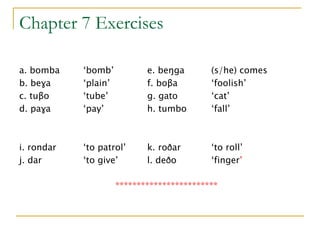
a. bomba ‘bomb’ e. beŋga (s/he) comes
b. beɣa ‘plain’ f. boβa ‘foolish’
c. tuβo ‘tube’ g. gato ‘cat’
d. paɣa ‘pay’ h. tumbo ‘fall’
i. rondar ‘to patrol’ k. roðar ‘to roll’
j. dar ‘to give’ l. deðo ‘finger’
************************
Phonology chapter 8

Phonology chapter 8

  • 1.
    Chapter 7/8 Fall11 Phonemic Analysis PHONOLOGY (Lane 335)
  • 2.
    What is Phonology? Itis a field of linguistics which studies the distribution of sounds in a language as well as the interaction between those different sounds.
  • 3.
    What is Phonology? Phonologytackles the following questions:  What sounds in a language are predictable?  What is the phonetic context that predicts the occurrence of these sounds?  Which sounds affect the meaning of words?
  • 4.
    Phonetics Vs Phonology Phonetics: studies how speech sounds are produced, their physical properties & how they are interpreted.  Phonology: studies the organization of speech sounds in a particular language.
  • 5.
    Distinctive and Non-distinctiveSounds  Distinctive (contrastive) Sounds: make a difference in meaning; e.g. /p/ & /b/ in pin, bin.  Non-distinctive (non-contrastive) Sounds: Do NOT make a difference in meaning; e.g. [ph] in pin & spin. Example: /t/ in : top [thɒp] stop [stɒp] little [liɾ l] kitten [kiʔn] (n is syllabic here) hunter [hʌ nr]
  • 6.
    Phoneme and Allophone A phoneme: a class of speech sounds that are identified by a native speaker as the same sound; e.g. /t/; unpredictable (given “in” in pin like the example above we CANNOT predict which sound can come before it like bin, tin, din, kin, gin, fin, thin, sin, shin, chin)  A phoneme: a class of speech sounds that are identified by a native speaker as the same sound; e.g. /t/; phonemes are unpredictable  A phoneme is an abstract representation & cannot be pronounced (it is not a speech sound)  A phone: the actual phonetic segment produced by a speaker & has been classified as belonging to some phoneme; e.g. [th]; predictable  An allophone: a variant of a phoneme, e.g. /t/ = [ʔ], [ɾ]
  • 7.
    Phoneme and Allophone The phonological system of a language has two levels: 1- the more concrete level which involves the physical reality of phonetic segments, the allophones represented by square brackets [ ] (greater number). 2- The abstract (underlying) level which involves phonemes represented by / / slanted brackets (small inventory).  /p/ has 3 allophones ([p], [ph], [p̚ ])  Similar to natural sciences (H2O is realized as ice, water, & water vapor); different realizations/forms of the same thing.
  • 8.
    Distribution of SpeechSounds  The distribution of a phone = the set of phonetic environments in which it occurs.  Contrastive Sounds: if two sounds are separate phonemes, they are contrastive (interchanging the two, change the meaning of a word)  Non-contrastive Sounds: if two phones are allophones of the same phoneme, they are non-contrastive (interchanging the phones, doesn’t change the meaning of a word BUT it changes the pronunciation)
  • 9.
    Minimal Pair :Commutative test  A test to determine whether sounds are contrastive or not.  Defined as a pair of words with different meanings which are pronounced exactly the same way except for one sound that differs: pat, bat, fat, sat, mat Thus /p, b, f, s, m/ are separate phonemes.  In some languages, no minimal pairs, but we can still establish phonemes  Near Minimal Pair: (differ in more than one sound but the environment of the sound is identical short i and schwa in ‘mission’ & ‘vision’)
  • 10.
    Kinds of PhonemicDistribution  Overlapping Distribution: when the sets of phonetic environments in which two sounds occur are partially or completely identical. bait [bet] date [det] lobe [lob] load [lod] knobs [nabz] nods [nadz] Two Kinds: 1- Contrastive distribution (give different meanings= belong to different phonemes = appear in minimal pairs) 2- Free Variation (never cause a contrast in meaning = allophones of the same phoneme = no minimal pairs) mat mat maʔ can be released, unreleased or a glottal stop either iðər aiðər – neither niðər, naiðər – tomato təmætə, tometə - data dæta , deta
  • 11.
    Kinds of PhonemicDistribution  Complementary Distribution (mutually exclusive, non- overlapping): when sounds DON’T occur in the same phonetic environment English spat [spæt] pat [phæt] spool [spul] pool [phul] speak [spik] peek [phik]  No minimal pairs for such sounds  Phones in Complementary Distribution are allophones of a single phoneme  The appearance of one allophone or the other is PREDICTABLE.  In Thai and Korean [p] and [ph ] are separate phonemes
  • 12.
    Phonological Rules  Twolevels of representation: 1- underlying (phonemic, mental) 2- surface (phonetic)  Why do we need rules? - to link the two levels - to show when a particular allophone should show up on the surface
  • 13.
    Phonological Rules PHONEMIC LEVEL (underlyingform) PHONOLOGICAL RULES PHONETIC LEVEL (surface form)
  • 14.
    Phonological Rules Definition A phonologicalderivation is the set of stages used to generate the phonetic representation of a word from its underlying representation. Discussion Here is a diagram of the stages in a derivation. Phonological rules influence each stage of a derivation: Examples (English) Here are some examples of the derivations of words having the negative prefix /In/:
  • 15.
    Phonological Rules  Phonologicalrules state that some item becomes some other item in some specific environment  The common way of expressing rules: A  B/ X____ Y  A becomes B in the environment of (/) being preceded by X and followed by Y  ____ represents the position of the item affected by the rule ( XAY) becomes (XBY)
  • 16.
    Phonological Rules  Examplefrom English: ˷ ˷  [fæn]: /æ/  /æ/ /____/n/  A vowel is nasalized whenever it immediately precedes a nasal stop [+ syllabic]  [+nasal]/ __ [+nasal] A +syllabic sound (= a vowel) becomes + nasal (= nasalized) when it comes before a + nasal sound (= m, n, ŋ) The above captures a generalization about all vowels not only [æ] and all nasals not only [n].
  • 17.
    Choosing the UnderlyingForm  How do we decide on the representation at the phonemic level?  Phonemes and their allophones SHARE some phonetic features  The choice is “phonetically natural”  Take the form which has the simplest form
  • 18.
    Choosing the UnderlyingForm  How do we decide on the representation at the phonemic level?  We can use an arbitrary number like 3 or Fred = harder to read the rules  Using /p/ tells us that the allophones associated with /p/ all share some features like [voice, continuant, anterior, coronal].  /p/ is the simplest of the 3 phonetic forms with nothing added to its ‘p-ness’ like being aspirated or being unreleased: /pʰ/ and /p̚/  Use the form with the widest distribution
  • 19.
    7.13 p. 104 Formwith the widest distribution: Take the case of the devoicing of liquids and glides following voiceless consonants  kwit, flei, trap, pjur, swaip (all are devoiced)  jɛs, wiʃ, bɔƗ, sk^ri, brik glas, fiƗθ, fiƗm  If the [–voice] allophone were chosen to represent then our rule(s) would specify many environments thus the rule would be:
  • 20.
     “A voicelessoral sonorant (liquid or glide) becomes voiced when:  1. word-initial  2. word-final  3. before a consonant  4. between two vowels  5. following a voiced consonant (see p. 105)
  • 21.
     So usingthe voiced member of the pair i.e. the allophone with the widest distribution is:  Simpler  Expresses a generalization that non-nasal sonorants (liquids and glides) devoice following voiceless segments  Shows there is an assimilation process with voicelessness spreading to the following consonant.
  • 22.
    Phonetic Naturalness & PhonologicalAnalysis  Natural means “to be expected”, “frequently found across languages”  Does NOT mean “English-like”  No words in English begin with onset clusters like [ps], [pn], [pt].  These clusters appear word initially in other languages like German, Greek, & French.
  • 23.
    Phonetic Naturalness & PhonologicalAnalysis (cont)  What applies to one language is not necessarily true of other languages.  English /p/ has unaspirated p and aspirated p as allophones  Thai /p/ and /ph/ are two phonemes:  paa ‘forest’  ph aa ‘to split’  English has /p/ and /b/  Arabic has /b/ with two allophones [b] and [p]
  • 24.
    Phonetic Similarity  Tochoose the phonemic form, we have to consider phonetic similarity.  Example: [h] occurs syllable-initially [hæ m] [ŋ ] occurs only syllable-finally [brɪ ŋ]  Not allophones of the same phoneme  They lack phonetic similarity  [h]: non-nasal, obstruent, continuant  [ŋ] nasal, sonorant, non-continuant
  • 25.
    Pattern Congruity  Phonologistsconsider the consequences of choosing one phoneme over the other  Pattern Congruity: the systematic organization of the set of phonemes and their distribution.  Choosing an allophone depends on the overall patterns found in the phonological system (pattern congruity)  For example: In English: obstruent clusters have uniform voicing Either all members of the cluster are [+ voice], or [- voice]. ‘Mixed voice clusters’ DON’T occur phonemically
  • 26.
    Pattern Congruity /-ft, -pt,-ps, -kst, -sp/ e.g. ‘daft’, ‘apt’, ‘apse’, ‘next’, ‘asp’ /-bd, -dz, -zd, -vz/ e.g. ‘robbed’, ‘adze’, ‘phased’, leaves’ * /-fd, -bt, -pz, -ds/
  • 27.
    Process Naturalness  Inchoosing the underlying form, the linking processes should be considered  pass [ph æs] pass you [ph æʃ ju]  this [ðɪs] this year [ðɪʃjiə ]  [s] appears in more environments so it makes sense to choose it as the underlying form instead of vice versa  Assimilation: [s] alveolar [+coronal, +anterior] becomes [ʃ] palato-alveolar [+coronal, - anterior] when followed by [j] palatal [+ coronal, - anterior]
  • 28.
    Phonology  Phonology isconcerned with the organization of the system underlying the speech sounds  The phonemic level represents native speakers’ knowledge of the sound system of their language
  • 29.
    Phonology vs. Phonetics Phonology: is a cognitive study which deals with the representation of knowledge in the mind  Phonetics: deals with the physical properties of speech sounds
  • 30.
    Chapter 7 Exercises Exercise1 page 110/130 Consider the distribution of [w] and [ʍ] in the following data. Are the phones allophones of the same or different phonemes? Why? If they are allophones of a single phoneme, give a rule to account for the distribution. a. ʍa’e why h. we way b. ʍɪʧ which i. weð^r weather c. ʍ^ɪt white j. wɔnt want d. ʍeƗz whales k.wɪʧ witch e. ʍɪp whip l. ʍ^ɪp wipe f. əʍ^ɪl awhile m. weƗz Wales g. ʍɛð^r whether n. əʍɔʃ awash
  • 31.
    Chapter 7 Exercises a.ʍa’e why h. we way b. ʍɪʧ which i. weð^r weather c. ʍ^ɪt white j. wɔnt want d. ʍeƗz whales k. wɪʧ witch e. ʍɪp whip l. ʍ^ɪp wipe f. əʍ^ɪl awhile m. weƗz Wales g. ʍɛð^r whether n. əʍɔʃ awash
  • 32.
    Chapter 7 Exercises a.bomba ‘bomb’ e. beŋga (s/he) comes b. beɣa ‘plain’ f. boβa ‘foolish’ c. tuβo ‘tube’ g. gato ‘cat’ d. paɣa ‘pay’ h. tumbo ‘fall’ i. rondar ‘to patrol’ k. roðar ‘to roll’ j. dar ‘to give’ l. deðo ‘finger’ ************************