Vowels
In this presentation, we’ll look at the
vowels, in particular, the vowels of
American English, and some of the
challenges they pose.
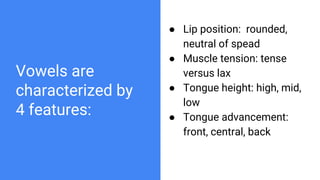
Vowels are
characterized by
4 features:
● Lip position: rounded,
neutral of spead
● Muscle tension: tense
versus lax
● Tongue height: high, mid,
low
● Tongue advancement:
front, central, back
In addition,
NAE has
several
dipthongs
which include a
glide
movement.
2 more
points about
vowels
All vowels are voiced.
All vowels are continuents -
during articulation of vowel
sounds, the airstream
escapes from the mouth in
an unobstructed manner.
More on vowel length
Sonorants include:
● All vowels
● Glides
● Liquids
● Nasals
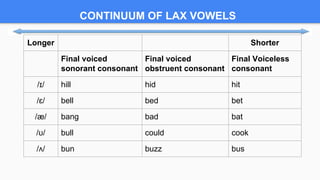
There is a continuum of vowel
lengthening related to whether
the vowel does or does not
occur before a sonorant -
consonants that can be syllabic.
(Non sonorants are called
obstruents.)
CONTINUUM OF LAX VOWELS
Longer Shorter
Final voiced
sonorant consonant
Final voiced
obstruent consonant
Final Voiceless
consonant
/ɪ/ hill hid hit
/ɛ/ bell bed bet
/æ/ bang bad bat
/ʊ/ bull could cook
/ʌ/ bun buzz bus
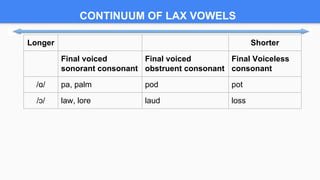
CONTINUUM OF LAX VOWELS
Longer Shorter
Final voiced
sonorant consonant
Final voiced
obstruent consonant
Final Voiceless
consonant
/ɑ/ pa, palm pod pot
/ɔ/ law, lore laud loss
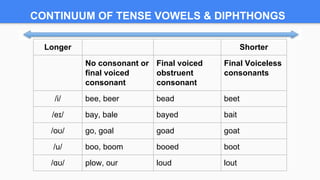
CONTINUUM OF TENSE VOWELS & DIPHTHONGS
Longer Shorter
No consonant or
final voiced
consonant
Final voiced
obstruent
consonant
Final Voiceless
consonants
/i/ bee, beer bead beet
/eɪ/ bay, bale bayed bait
/oʊ/ go, goal goad goat
/u/ boo, boom booed boot
/ɑʊ/ plow, our loud lout
CONTINUUM OF TENSE VOWELS & DIPHTHONGS (cont)
Longer Shorter
No consonant or
final voiced
consonant
Final voiced
obstruent
consonant
Final Voiceless
consonants
/ɑɪ/ buy, pyre bide bite
/ɔɪ/ boy, boil void voice
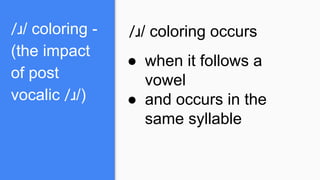
/ɹ/ coloring -
(the impact
of post
vocalic /ɹ/)
/ɹ/ coloring occurs
● when it follows a
vowel
● and occurs in the
same syllable
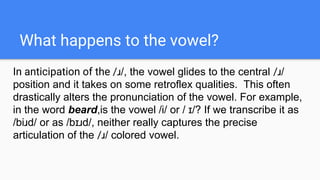
What happens to the vowel?
In anticipation of the /ɹ/, the vowel glides to the central /ɹ/
position and it takes on some retroflex qualities. This often
drastically alters the pronunciation of the vowel. For example,
in the word beard,is the vowel /i/ or / ɪ/? If we transcribe it as
/biɹd/ or as /bɪɹd/, neither really captures the precise
articulation of the /ɹ/ colored vowel.
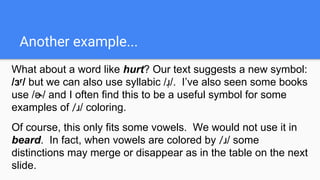
Another example...
What about a word like hurt? Our text suggests a new symbol:
/ɜʳ/ but we can also use syllabic /ɹ̩ /. I’ve also seen some books
use /ɚ/ and I often find this to be a useful symbol for some
examples of /ɹ/ coloring.
Of course, this only fits some vowels. We would not use it in
beard. In fact, when vowels are colored by /ɹ/ some
distinctions may merge or disappear as in the table on the next
slide.
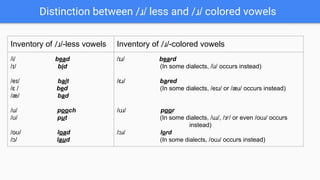
Distinction between /ɹ/ less and /ɹ/ colored vowels
Inventory of /ɹ/-less vowels Inventory of /ɹ/-colored vowels
/i/ bead
/ɪ/ bid
/eɪ/ bait
/ɛ / bed
/æ/ bad
/u/ pooch
/ʊ/ put
/oʊ/ load
/ɔ/ laud
/ɪɹ/ beard
(In some dialects, /iɹ/ occurs instead)
/ɛɹ/ bared
(In some dialects, /eɪɹ/ or /æɹ/ occurs instead)
/ʊɹ/ poor
(In some dialects, /uɹ/, /ɜʳ/ or even /oʊɹ/ occurs
instead)
/ɔɹ/ lord
(In some dialects, /oʊɹ/ occurs instead)
/l/ coloring
Post-vocalic /l/
also has an
impact on the
preceding
vowel although
not as much as
/ɹ/.
The effect of velarized (dark) [ɫ] is
most noticeable on front vowels
which are pulled back to create
more centralized versions than their
counterparts without /l/.
Vowel Centralized
(w/our postvocalic /l/)
Velarized
(colored by postvocalic /l/)
/i/
/ɪ/
/eɪ/
/ɛ/
/æ/
see, seed
Mick
may, maize
hep
tack
seal, sealed
milk
male, males
help
talc
Coloring of
vowels by
nasal
consonants
Nasals also impact the preceding
vowel causing the vowels to take on
a nasalized quality. Although our
text does not mention this, nasalized
vowels are often marked with a tilda
[ṽ].
Compare see vs. seen or seem
/si/ [sı̃m] [sı̃n]
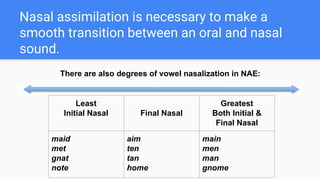
Nasal assimilation is necessary to make a
smooth transition between an oral and nasal
sound.
There are also degrees of vowel nasalization in NAE:
Least
Initial Nasal Final Nasal
Greatest
Both Initial &
Final Nasal
maid
met
gnat
note
aim
ten
tan
home
main
men
man
gnome
Reduced
Vowels
A typical characteristic of English is
the frequent occurrence of reduced
vowels in the speech stream. The
most common of these is the
mid-central schwa /ə/, especially if
we include reduced vowels with
postvocalic /ɹ/.
Reduced
Vowels
(cont)
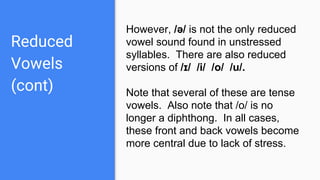
However, /ə/ is not the only reduced
vowel sound found in unstressed
syllables. There are also reduced
versions of /ɪ/ /i/ /o/ /u/.
Note that several of these are tense
vowels. Also note that /o/ is no
longer a diphthong. In all cases,
these front and back vowels become
more central due to lack of stress.
The Additional Unstressed Vowels of NAE
/ɪ/
● •
/i/
● •
/o/
● •
/o/
• ●
/u/
● •
music
reddish
sleeping
city
sassy
candy
meadow
narrow
shadow
hotel
motel
rosette
into
venue
menu
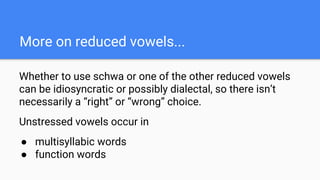
More on reduced vowels...
Whether to use schwa or one of the other reduced vowels
can be idiosyncratic or possibly dialectal, so there isn’t
necessarily a “right” or “wrong” choice.
Unstressed vowels occur in
● multisyllabic words
● function words
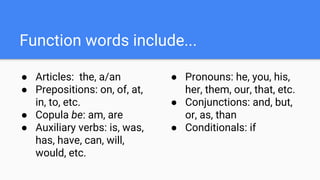
Function words include...
● Articles: the, a/an
● Prepositions: on, of, at,
in, to, etc.
● Copula be: am, are
● Auxiliary verbs: is, was,
has, have, can, will,
would, etc.
● Pronouns: he, you, his,
her, them, our, that, etc.
● Conjunctions: and, but,
or, as, than
● Conditionals: if
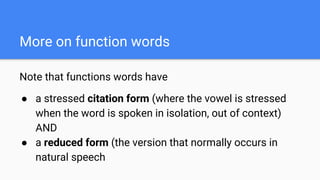
More on function words
Note that functions words have
● a stressed citation form (where the vowel is stressed
when the word is spoken in isolation, out of context)
AND
● a reduced form (the version that normally occurs in
natural speech

Vowels

  • 1.
  • 2.
    In this presentation,we’ll look at the vowels, in particular, the vowels of American English, and some of the challenges they pose.
  • 3.
    Vowels are characterized by 4features: ● Lip position: rounded, neutral of spead ● Muscle tension: tense versus lax ● Tongue height: high, mid, low ● Tongue advancement: front, central, back
  • 4.
  • 5.
    2 more points about vowels Allvowels are voiced. All vowels are continuents - during articulation of vowel sounds, the airstream escapes from the mouth in an unobstructed manner.
  • 6.
    More on vowellength Sonorants include: ● All vowels ● Glides ● Liquids ● Nasals There is a continuum of vowel lengthening related to whether the vowel does or does not occur before a sonorant - consonants that can be syllabic. (Non sonorants are called obstruents.)
  • 7.
    CONTINUUM OF LAXVOWELS Longer Shorter Final voiced sonorant consonant Final voiced obstruent consonant Final Voiceless consonant /ɪ/ hill hid hit /ɛ/ bell bed bet /æ/ bang bad bat /ʊ/ bull could cook /ʌ/ bun buzz bus
  • 8.
    CONTINUUM OF LAXVOWELS Longer Shorter Final voiced sonorant consonant Final voiced obstruent consonant Final Voiceless consonant /ɑ/ pa, palm pod pot /ɔ/ law, lore laud loss
  • 9.
    CONTINUUM OF TENSEVOWELS & DIPHTHONGS Longer Shorter No consonant or final voiced consonant Final voiced obstruent consonant Final Voiceless consonants /i/ bee, beer bead beet /eɪ/ bay, bale bayed bait /oʊ/ go, goal goad goat /u/ boo, boom booed boot /ɑʊ/ plow, our loud lout
  • 10.
    CONTINUUM OF TENSEVOWELS & DIPHTHONGS (cont) Longer Shorter No consonant or final voiced consonant Final voiced obstruent consonant Final Voiceless consonants /ɑɪ/ buy, pyre bide bite /ɔɪ/ boy, boil void voice
  • 11.
    /ɹ/ coloring - (theimpact of post vocalic /ɹ/) /ɹ/ coloring occurs ● when it follows a vowel ● and occurs in the same syllable
  • 12.
    What happens tothe vowel? In anticipation of the /ɹ/, the vowel glides to the central /ɹ/ position and it takes on some retroflex qualities. This often drastically alters the pronunciation of the vowel. For example, in the word beard,is the vowel /i/ or / ɪ/? If we transcribe it as /biɹd/ or as /bɪɹd/, neither really captures the precise articulation of the /ɹ/ colored vowel.
  • 13.
    Another example... What abouta word like hurt? Our text suggests a new symbol: /ɜʳ/ but we can also use syllabic /ɹ̩ /. I’ve also seen some books use /ɚ/ and I often find this to be a useful symbol for some examples of /ɹ/ coloring. Of course, this only fits some vowels. We would not use it in beard. In fact, when vowels are colored by /ɹ/ some distinctions may merge or disappear as in the table on the next slide.
  • 14.
    Distinction between /ɹ/less and /ɹ/ colored vowels Inventory of /ɹ/-less vowels Inventory of /ɹ/-colored vowels /i/ bead /ɪ/ bid /eɪ/ bait /ɛ / bed /æ/ bad /u/ pooch /ʊ/ put /oʊ/ load /ɔ/ laud /ɪɹ/ beard (In some dialects, /iɹ/ occurs instead) /ɛɹ/ bared (In some dialects, /eɪɹ/ or /æɹ/ occurs instead) /ʊɹ/ poor (In some dialects, /uɹ/, /ɜʳ/ or even /oʊɹ/ occurs instead) /ɔɹ/ lord (In some dialects, /oʊɹ/ occurs instead)
  • 15.
    /l/ coloring Post-vocalic /l/ alsohas an impact on the preceding vowel although not as much as /ɹ/. The effect of velarized (dark) [ɫ] is most noticeable on front vowels which are pulled back to create more centralized versions than their counterparts without /l/. Vowel Centralized (w/our postvocalic /l/) Velarized (colored by postvocalic /l/) /i/ /ɪ/ /eɪ/ /ɛ/ /æ/ see, seed Mick may, maize hep tack seal, sealed milk male, males help talc
  • 16.
    Coloring of vowels by nasal consonants Nasalsalso impact the preceding vowel causing the vowels to take on a nasalized quality. Although our text does not mention this, nasalized vowels are often marked with a tilda [ṽ]. Compare see vs. seen or seem /si/ [sı̃m] [sı̃n]
  • 17.
    Nasal assimilation isnecessary to make a smooth transition between an oral and nasal sound. There are also degrees of vowel nasalization in NAE: Least Initial Nasal Final Nasal Greatest Both Initial & Final Nasal maid met gnat note aim ten tan home main men man gnome
  • 18.
    Reduced Vowels A typical characteristicof English is the frequent occurrence of reduced vowels in the speech stream. The most common of these is the mid-central schwa /ə/, especially if we include reduced vowels with postvocalic /ɹ/.
  • 19.
    Reduced Vowels (cont) However, /ə/ isnot the only reduced vowel sound found in unstressed syllables. There are also reduced versions of /ɪ/ /i/ /o/ /u/. Note that several of these are tense vowels. Also note that /o/ is no longer a diphthong. In all cases, these front and back vowels become more central due to lack of stress.
  • 20.
    The Additional UnstressedVowels of NAE /ɪ/ ● • /i/ ● • /o/ ● • /o/ • ● /u/ ● • music reddish sleeping city sassy candy meadow narrow shadow hotel motel rosette into venue menu
  • 21.
    More on reducedvowels... Whether to use schwa or one of the other reduced vowels can be idiosyncratic or possibly dialectal, so there isn’t necessarily a “right” or “wrong” choice. Unstressed vowels occur in ● multisyllabic words ● function words
  • 22.
    Function words include... ●Articles: the, a/an ● Prepositions: on, of, at, in, to, etc. ● Copula be: am, are ● Auxiliary verbs: is, was, has, have, can, will, would, etc. ● Pronouns: he, you, his, her, them, our, that, etc. ● Conjunctions: and, but, or, as, than ● Conditionals: if
  • 23.
    More on functionwords Note that functions words have ● a stressed citation form (where the vowel is stressed when the word is spoken in isolation, out of context) AND ● a reduced form (the version that normally occurs in natural speech